Ab initio optical potentials and nucleon scattering on medium mass nuclei
A. Idini, C. Barbieri, P. Navr\'atil

TL;DR
This paper develops ab initio optical potentials using SCGF theory to accurately predict neutron scattering on medium mass nuclei, benchmarking against NCSMC calculations and highlighting the importance of target excitations.
Contribution
It introduces a novel ab initio method for deriving optical potentials for medium mass nuclei, incorporating target excitations for improved scattering predictions.
Findings
Satisfactory agreement with experimental scattering data at low energies
Benchmarking shows virtual excitations are essential for accurate high-energy predictions
Advances the derivation of optical potentials for complex many-body nuclear systems
Abstract
We derive ab initio optical potentials from self-consistent Green's function (SCGF) theory and compute the elastic scattering of neutrons off oxygen and calcium isotopes. The comparison with scattering data is satisfactory at low scattering energies. The method is benchmarked against no-core shell model with continuum (NCSMC) calculations, showing that virtual excitations of the target are crucial to predict proper fragmentation and absorption at higher energies. This is a significant step toward deriving optical potentials for medium mass nuclei and complex many-body systems in general.
Click any figure to enlarge with its caption.
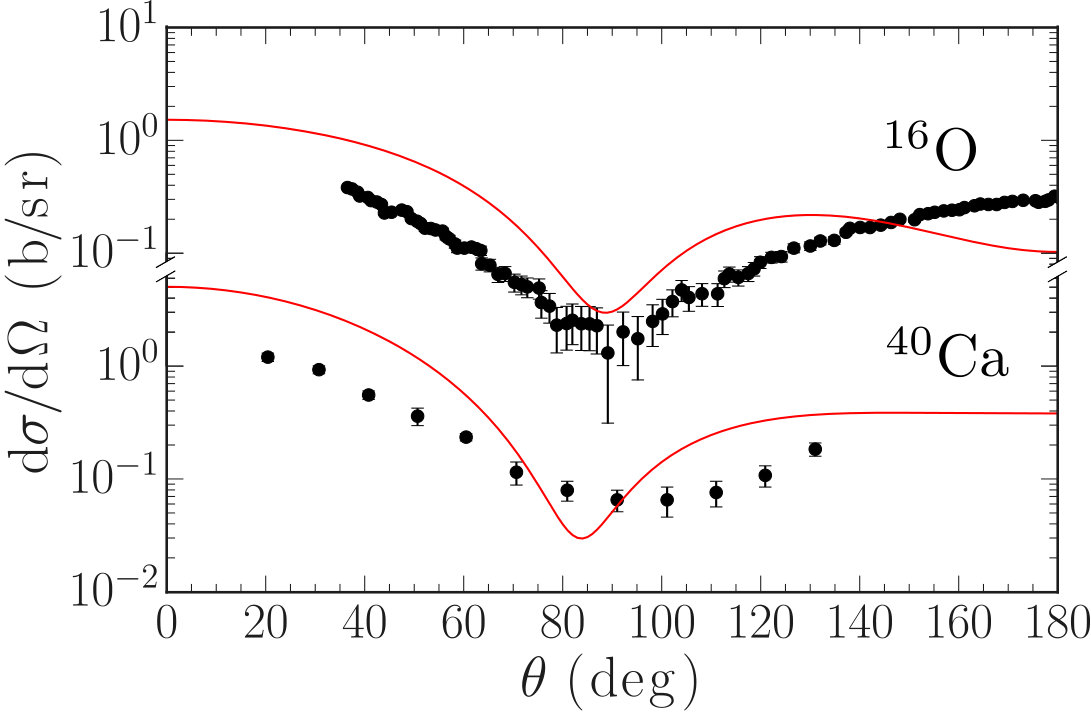 Figure 1
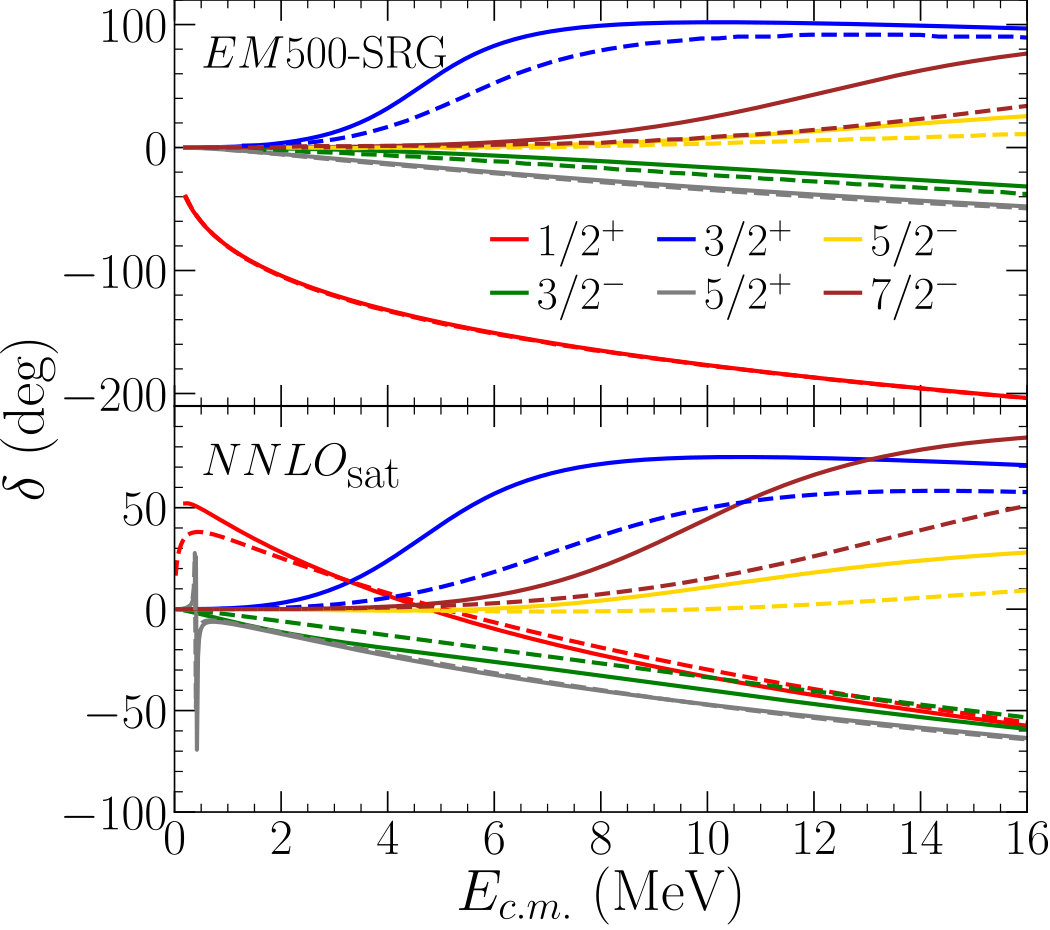 Figure 2
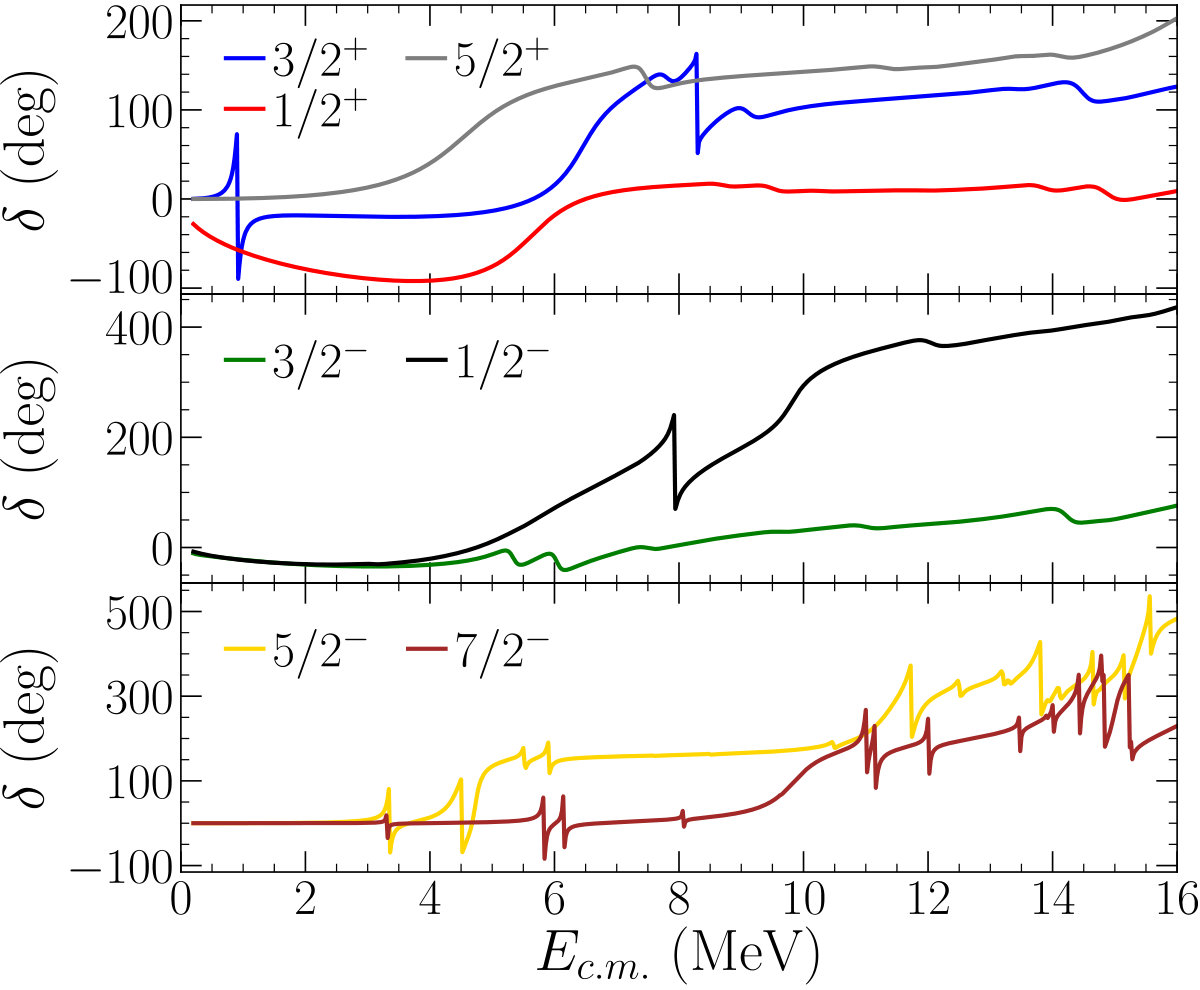 Figure 3
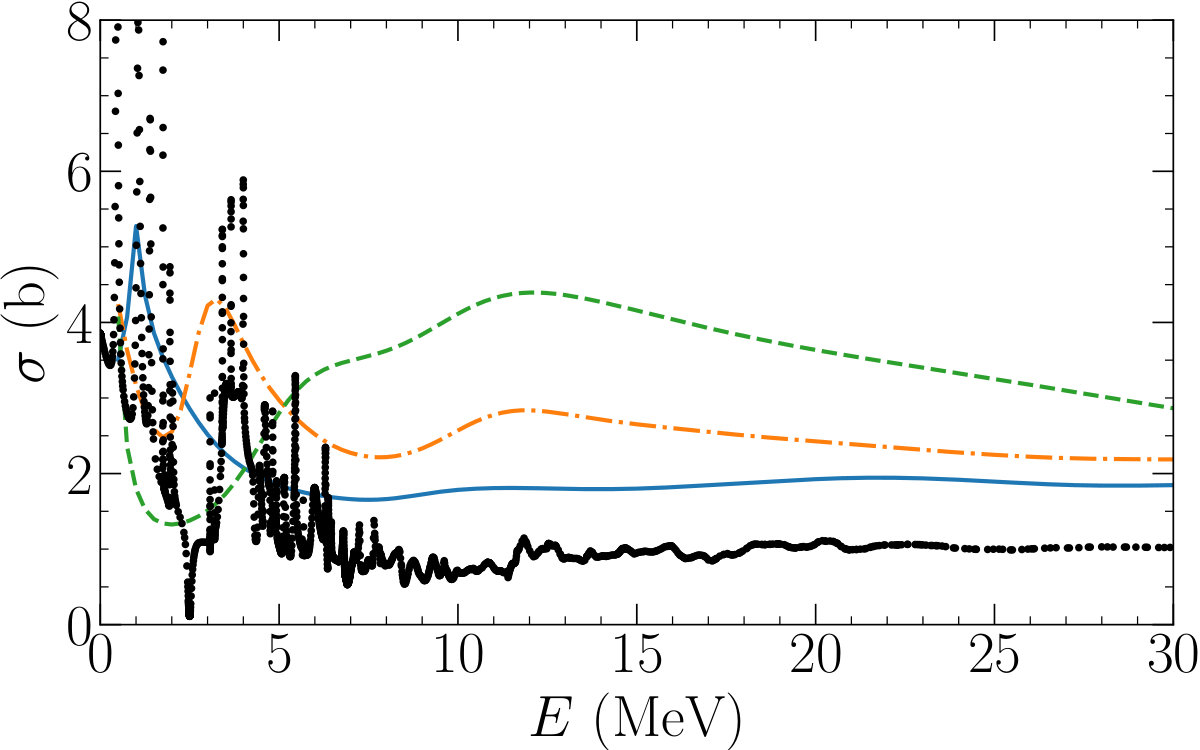 Figure 4
| (MeV) | |||||||||
|---|---|---|---|---|---|---|---|---|---|
| exp. | -4.14 | -3.27 | -1.09 | -0.30 | 0.41 | 0.94 | 3.23 | 3.02 | 3.54 |
| NNLO | -5.06 | -3.58 | -0.15 | -1.23 | -2.24 | 0.91 | 4.57 | 3.36 | 3.37 |
Peer Reviews
No public reviews on file for this paper yet. If you reviewed it on a platform where reviews are public (OpenReview, ICLR, NeurIPS, ICML), you can paste yours below so the community can read it here.
Videos
No videos yet. Explain this paper in a talk, walkthrough, or lecture? Add one.
Ab initio optical potentials and nucleon scattering on medium mass nuclei
A. Idini
Department of Physics, University of Surrey, Guildford, GU2 7XH, UK
Division of Mathematical Physics, Department of Physics, LTH, Lund University, Post Office Box 118, S-22100 Lund, Sweden
C. Barbieri
Department of Physics, University of Surrey, Guildford, GU2 7XH, UK
P. Navrátil
TRIUMF, 4004 Wesbrook Mall, Vancouver, British Columbia, V6T 2A3, Canada
Abstract
We derive ab initio optical potentials from self-consistent Green’s function (SCGF) theory and compute the elastic scattering of neutrons off oxygen and calcium isotopes. The comparison with scattering data is satisfactory at low scattering energies. The method is benchmarked against no-core shell model with continuum (NCSMC) calculations, showing that virtual excitations of the target are crucial to predict proper fragmentation and absorption at higher energies. This is a significant step toward deriving optical potentials for medium mass nuclei and complex many-body systems in general.
Introduction. Reactions are a fundamental aspect of nuclear physics since they are used experimentally to determine many properties of atomic nuclei. They are also a key component to significant scientific questions, such as the reaction networks that control nucleosynthesis. Unfortunately, first principles theoretical descriptions for scattering on medium-mass nuclei are still lacking. Even tough ground state properties and excited states can be calculated ab initio, the complexity of many-body dynamics forces us to model the reaction mechanisms in terms of phenomenological optical potentials. This lack of consistency among the structure and reaction theories has been a major issue for nuclear physics for decades.
Optical models are an effective way to decouple the scattering wave function of the projectile from the internal structure of the target. Thus, microscopic (non-phenomenological) formalisms have also been proposed to compute them Feshbach:58 ; Capuzzi:96 , although working implementations are still scarce. In this Letter, we discuss an ab initio calculation of optical potentials that starts from saturating nuclear forces and compares favourably with low-energy scattering data. In doing so, we also identify key ingredients needed to improve the predictability at higher energies. This represent a successful step toward gaining insight into the reaction dynamics and to perform reliable predictions of scattering with exotic nuclei.
Many-body Green’s function methods are particularly suited to pursue this goal for medium and heavy nuclei since their central quantity, the self-energy, is naturally linked to the Feshbach theory of optical potentials Feshbach:58 ; Cederbaum:2001 . While the particle part of the self-energy is equivalent to the original formulation of Feshbach, its hole part also describes the structure of the target Capuzzi:96 . Hence, it facilitates a consistent treatment of scattering and structure.
Some related (semi–)phenomenological attempts to exploit Green’s function methods include the nuclear field theory Mahaux:85 ; Idini:12 and its extension to nuclear transfer reactions Idini:15 ; Broglia:16 . Another incarnation of Green’s function related theories is the dispersive optical model Johnson:88 , which is a data driven formulation of global (local and non local) potentials constructed as the best possible parameterization of a microscopic self-energy Charity:06 ; Dickhoff:16 . The nuclear structure method was applied recently obtaining good reproduction of 40Ca scattering based on the Gogny D1S interaction Blanchon:15 . Other approaches, based on the nucleon-nucleon T-matrix and folding with the nuclear density have proven to be effective Vorabbi2016PRC ; Gennari2018PRC ; Burrows:2018ggt ; Whitehead:2018bfs .
Ab initio methods have been successful in direct calculations of scattering when only few nucleons are at play. Quantum Monte Carlo has been historically used for light nuclei Varga:02 ; Nollett:07 ; Lynn:16 . The no-core shell model with resonating group method (NCSM/RGM) or with continuum (NCSMC) have been successful in calculating scattering and transfer reactions for light targets Navratil:10 ; Baroni:13prl ; Raimondi:16 . Coupled cluster theory has also been employed with a Gamow basis for proton–40Ca Hagen:12 and combined with a Green’s function approach to compute phase shifts for 16O and Ca isotopes Rotureau:17 ; Rotureau:18 . On the other hand, the self-consistent Green’s function (SCGF) formalism Dickhoff:04 ; Soma:11 can calculate the microscopic optical potential directly even for heavier nuclei. This approach has been used to compute phase shifts Barbieri:05 and to investigate analytical properties of optical models Waldecker:11 . However, these early studies were limited to two-nucleon (NN) forces and a comparison to the experiment has been hindered by the lack of realistic Hamiltonians capable to reproduce the radius of the target.
Three-nucleon (3N) interactions have been recently formulated and implemented for SCGF theory in Carbone:13 ; Cipollone:15 ; Raimondi20183nf . Moreover, the introduction of saturating nuclear interactions Ekstrom:15 has allowed a good reproduction of radii and binding energies across the oxygen Lapoux:16 and calcium chains Garcia:16 . Hence, we are now in the position to meaningfully compare first principle approaches to scattering data in medium-mass nuclei. In the following, we present state of the art SCGF calculations to test current ab initio methods and compare our results to NCSM/RGM and NCSMC computations with NN and NN+3N interactions. We then use a saturating chiral Hamiltonian to study elastic scattering of neutrons from 16O and 40Ca.
Formalism. The Hamiltonian used to compute the self-energy is
[TABLE]
where is the center of mass kinetic energy for the -nucleon target plus the projectile and and are the NN and 3N interactions. is included as an equivalent effective two–body interaction, averaged on the correlated propagator as discussed in Refs. Cipollone:15 ; Rocco2018escatt . The SCGF calculation proceeds by solving the Dyson equation, , in an harmonic oscillator (HO) basis of + shells, where is the free particle propagator and the irreducible self-energy has the following general spectral representation:
[TABLE]
where and label the single particle quantum numbers of the HO basis, is the correlated and energy independent mean field, and sets the correct boundary conditions. We performed calculations with the third order algebraic diagrammatic construction [ADC(3)] method, where the matrices () couple single particle states to intermediate 2p1h (2h1p) configurations, () are interaction matrices among these configurations, and are their unperturbed energies Schirmer:83 ; Barbieri:17lnp . All intermediate 2p1h and 2h1p states (respectively labelled by indices and ) were included. For , this incorporates configurations up to MeV of excitation energy and partial waves of the projectile up to angular momentum for both parities.
The resulting dressed single particle propagator can be written in the Källén–Lehmann representation as
[TABLE]
The poles of the forward-in-time propagator, , indicate then the energy of the th exited state of the -nucleon system with respect to the ground state of the target . Hence, they are directly identified with the scattering energy. For each many-body state in the continuum, the corresponding overlaps are associated with the elastic scattering wave function through Feshbach theory Feshbach:58 ; Escher:02 .
Although the scattering waves are unbound, the self-energy associated with the optical potential is localized and it can be efficiently expanded on square integrable functions. Hence, we proceed by calculating Eq. (2) in HO basis but transform it to momentum space before solving the scattering problem. This will ensure that the proper asymptotic behaviours of both bound and scattering states are obtained. The optical potential for a given partial wave () is then expressed as
[TABLE]
which is non local and energy-dependent and where are the radial HO wavefunctions in momentum space. Through Eqs. (2) and (4), the SCGF approach provides a parametrized, separable and analytical form of the optical potential.
The parameter sets the time ordering boundary conditions, but it does not affect the solution of the many-body problem that comes from the diagonalization of the equation of motion Barbieri:05 ; Idini:12 ; Barbieri:17lnp . However, we retain it in Eq. (4) to introduce a small finite width for the 2p1h/2h1p configurations, which would otherwise be discretised in the present approach. We checked that this does not affect our conclusions below.
We use the intrinsic Hamiltonian of Eq. (1) and large enough HO spaces so that the intrinsic ground state decouples from the center of mass motion Hagen:09 . Even if decoupled, the latter is not fully suppressed and the self-energy (4) is still computed in laboratory frame. We correct for this by rescaling the scattering momentum appropriately, which naturally leads to the correct center of mass energy and reduced mass , with . The Dyson equation eventually reduces to the following one-body eigenvalue problem Dickhoff:04 ; Barbieri:17lnp :
[TABLE]
We diagonalize this Schrödinger–like equation in momentum space so that the kinetic energy is treated exactly and we account for the non locality and dependence of Eq. (4). The phase shifts are obtained as function of the projectile energy, for each partial wave, from where the differential cross section can be calculated. The bound states solutions of Eq. (5) yields overlap wave functions between and Dieperink:74 . Hence, they provide spectroscopic factors and asymptotic normalization coefficients that can be employed for the consistent computation of nucleon capture and knockout processes.
Results. We first compare to early NCSM/RGM results from Ref. Navratil:10 , where neutron scattering off 16O was computed with a NN-only interaction derived from the chiral N3LO force of Ref. Entem:03 (EM500) and evolved with free space similarity renormalization group (SRG) Bogner:07 to a cutoff = 2.66 fm*-1*. This soft interaction facilitates model space convergence and allows for a more meaningful benchmark. These early NCSM/RGM computations did not include virtual excitations of the target nucleus. For consistence, we performed our SCGF calculations with the same Hamiltonian but evaluated the phase shifts using only the static self-energy, . The comparison is shown by the upper panel of Fig. 1 and it is very satisfactory for the and partial waves. For this light nucleus, the discrepancy of about 1 MeV for the energy of the resonance is also consistent with the uncertainty in the transformation to the center of mass system done in Eq. (5). As we discuss below, doorway excitations of the target nucleus have a strong impact on the energies of single particle resonances. To account for this, we performed new NCSMC calculations that can also include low-lying excitations of 17O. Extrapolating from model spaces of = 6–10 we find quasiparticle energies of -3.4, -2.7, and 3.2 MeV for the bound states and the resonance, respectively. The corresponding results from SCGF, including the full self-energy, are , , and MeV. These should be expected to be more bound since SCGF introduces a larger number of 2p1h doorway configurations. At the same, time the excitation energies relative to the 17O ground state agree to within 200 keV, which is a satisfactory agreement given the different many-body truncations of the two approaches.
We performed an analogous comparison for the chiral NNLO NN+3N interaction of Ref. Ekstrom:15 . For NCSM techniques, 16O is more difficult to converge because the interaction is harder and the additional 3N matrix elements limit the applicability of importance-truncation Roth2007it . We performed our NCSM/RGM calculations at = 8 , and estimated an uncertainty of 1–2 MeV for the position of resonances. The SCGF still allows computations with and we find that phase shifts are well converged up to 15 MeV for this space. This puts in evidence the advantage of the latter approach to address ab initio scattering off medium mass isotopes. The NNLO benchmark is displayed by the lower panel of Fig. 1 and it is qualitatively similar to the case of the soft EM500-SRG interaction, with the and waves agreeing best. For both Hamiltonians, the largest discrepancies are for the and resonances, which are more affected by correlations in the continuum and the different many-body truncations of the two approaches. NNLO was explicitly constructed to reproduce correct nuclear saturation properties of medium mass nuclei, including binding energies and radii. The constraint on radii is crucial to predict elastic scattering observables that can be reasonably compared to the experiment, hence we will focus on this Hamiltonian in the following.
Virtual excitations of the target have the double effect of increasing the attraction of the real part of the optical potential (hence, lowering the single particle spectrum) and of generating a large number of narrow resonances. This is clearly seen in Figs. 2 that displays the phase shifts for neutron elastic scattering predicted by the whole self-energy of Eq. (2). Most of the virtual excitations responsible for this, especially at low energy, are accessed by coupling to hundreds of 2p1h configurations for 17O and appear as clear spikes or “smoothed” oscillations in the figure. The SCGF-ADC(3) approach has the advantage of including these states naturally, even to large energies, so it describes efficiently the relevant physics. Table 1 compares the energies of some representative bound and scattering states to the experiment. The single particle resonance is computed at MeV in the c.o.m. frame, very close the experimental value. The first and are both predicted as bound states, although experimentally they are found inverted with the in the continuum. We calculate a narrow width for a and a resonances, corresponding to excited states, close to the ones observed at 3.02 and 3.54 MeV Lister:66 . However, there are other very narrow -wave resonances, measured between 1.55-2.82 MeV, that our SCGF calculations do not resolve. In general, we find that NNLOsat predicts the location of dominant quasiparticle and holes states with an accuracy of 1 MeV for this nucleus.
Fig. 3 compares the low-energy differential cross sections originating from Eq. (5) to neutron scattering data for 16O at 3.286 MeV and 40Ca at 3.2 MeV. The minima are reproduced well for 16O (and close to the experiment for 40Ca), confirming the correct prediction of density distributions for NNLOsat Ekstrom:15 ; Garcia:16 ; Lecluse:17 . However, results are somewhat overestimated and hint at a general lack of absorption that is usually faced by attempts at computing the optical potentials from ab initio. This is likely related to missing doorway configurations (3p2h and beyond) that should be propagated in the denominators of Eq. (2) but are neglected by state of the art approaches. Note that there are more than 200 experimentally observed excitations already between the ground state and the neutron separation threshold in 41Ca Nesaraja:16 , while the SCGF-ADC(3) predicts only about 40 of them. This issue is likely to worsen at higher energies where configurations more complex than 2p1h become relevant. We investigated this problem by computing total +16O elastic cross sections, , with only , suppressing 50% of 2p1h/2h1p states (evenly across all energies), and by using the complete ADC(3) self-energy. Fig. 4 shows that presents oscillations up to about 5 MeV. These are in part reproduced by theory and are sensible to interferences among the projectile and the included 2p1h configurations. However, the link between absorption and the density of intermediate doorway configurations becomes clear at higher energies and it is confirmed by our calculations 111Note that the Lanczos algorithm used the solve for Eq. (2) does not affect these conclusions since it is specifically designed to preserve the strength distribution of response functions Waldecker:11 ; Soma:14 ..
To conclude, we have benchmarked optical potentials generated through SCGF theory to analogous full scale NCSMC simulations and to data for neutron elastic scattering at low energy. For both theory approaches, the correct asymptotic behaviour of the scattering wave are reproduced even if the target wave function and the optical potentials are expanded in a HO basis. The theory benchmark, with freezing of virtual excitation of the target, is very encouraging. The SCGF approach also has the capability of accounting for a large number of such intermediate excitations up to very large energies, and it achieves a promising description of complex resonance states from first principles. The use of a saturating chiral interaction allows us to make a meaningful comparison to the experiment, which was not possible in previous investigation of this approach. Overall, we found that the most important features of optical potentials at low energy are well reproduced, together with key observables related to elastic scattering.
The present study also puts in evidence how the lack of absorption normally observed in ab initio generated optical potentials is directly linked to the neglect of doorway configurations beyond 2p1h ones. Thus, addressing this challenge will be the next fundamental step toward predictive theories at medium scattering energies. It remains clear from the present results that obtaining reliable ab initio of optical potentials, directly from the self-energy, is becoming a goal within reach. The present findings open a path to establish consistent theories of structure and reactions for medium–mass nuclei.
Acknowledgments A.I. was supported by the Royal Society and Newton Fund through the Newton International Fellowship No. NF150402. This work was supported the United Kingdom Science and Technology Facilities Council (STFC) under Grants No. ST/P005314/1 and No. ST/L005816/1 and by the NSERC Grant No. SAPIN-2016-00033. TRIUMF receives federal funding via a contribution agreement with the National Research Council of Canada. Computations were performed using the DiRAC Data Intensive service at Leicester (funded by the UK BEIS via STFC capital grants ST/K000373/1 and ST/R002363/1 and STFC DiRAC Operations grant ST/R001014/1) and an INCITE Award on the Titan supercomputer of the Oak Ridge Leadership Computing Facility (OLCF) at ORNL.
The reference list from the paper itself. Each links out to its DOI / PubMed record.
- 1(1) Feshbach H 1958 Annals of Physics 5 357 – 390 ISSN 0003-4916 URL http://www.sciencedirect.com/science/article/pii/0003491658900071
- 2(2) Capuzzi F and Mahaux C 1996 Annals of Physics 245 147 – 208
- 3(3) Cederbaum L S 2001 Ann. Phys. 291 169 – 201
- 4(4) Mahaux C, Bortignon P F, Broglia R A and Dasso C H 1985 Phys. Rep. 120 1
- 5(5) Idini A, Barranco F and Vigezzi E 2012 Phys. Rev. C 85 014331 URL http://link.aps.org/doi/10.1103/Phys Rev C.85.014331
- 6(6) Idini A, Potel G, Barranco F, Vigezzi E and Broglia R A 2015 Phys. Rev. C 92 (3) 031304 URL http://link.aps.org/doi/10.1103/Phys Rev C.92.031304
- 7(7) Broglia R A, Bortignon P F, Barranco F, Vigezzi E, Idini A and Potel G 2016 Physica Scripta 91 063012 URL http://stacks.iop.org/1402-4896/91/i=6/a=063012
- 8(8) Johnson C H and Mahaux C 1988 Phys. Rev. C 38 2589