Maximum $k$-sum $\mathbf{n}$-free sets of the 2-dimensional integer lattice
Ilkyoo Choi, Ringi Kim, Boram Park

TL;DR
This paper determines the maximum density of sets in a 2D integer lattice that avoid certain sum configurations, extending sum-free set theory to higher dimensions and non-homogeneous cases.
Contribution
It introduces the first study of non-homogeneous sum-free sets in higher dimensions, specifically for 2D lattice points and arbitrary sums.
Findings
Established the maximum density of $k$-sum $ extbf{b}$-free sets in $[n]\times [n]$
Extended sum-free set theory to non-homogeneous, higher-dimensional contexts
Provided foundational results for future research in multi-dimensional additive combinatorics.
Abstract
For a positive integer , let denote . For a 2-dimensional integer lattice point and positive integers and , a \textit{-sum -free set} of is a subset of such that there are no elements in satisfying . For a 2-dimensional integer lattice point and positive integers and , we determine the maximum density of a {-sum -free set} of . This is the first investigation of the non-homogeneous sum-free set problem in higher dimensions.
Click any figure to enlarge with its caption.
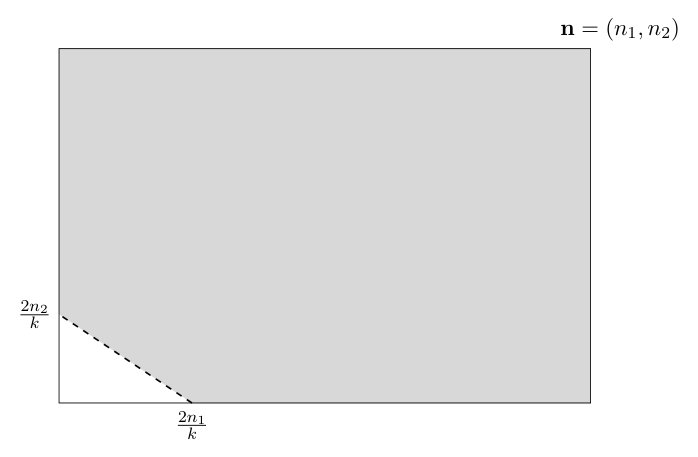 Figure 1
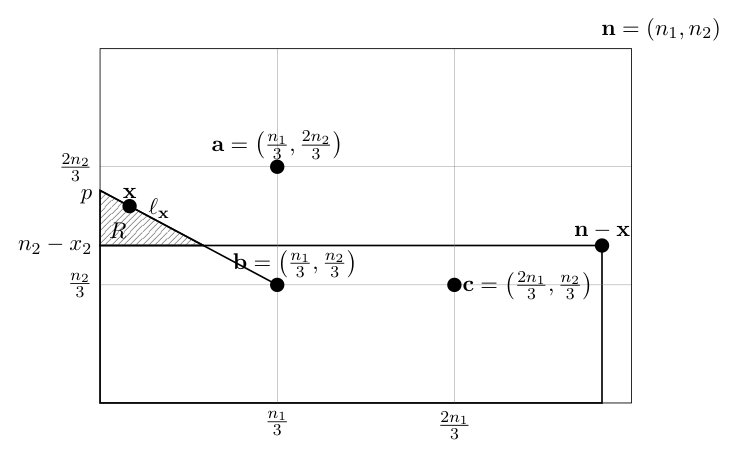 Figure 2
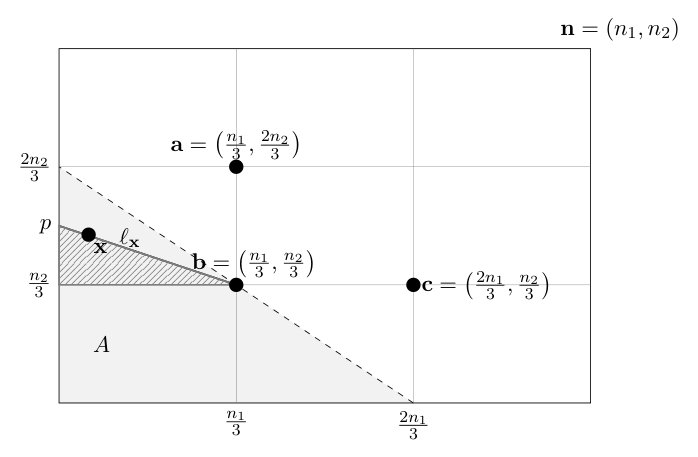 Figure 3
Peer Reviews
No public reviews on file for this paper yet. If you reviewed it on a platform where reviews are public (OpenReview, ICLR, NeurIPS, ICML), you can paste yours below so the community can read it here.
Videos
No videos yet. Explain this paper in a talk, walkthrough, or lecture? Add one.
Maximum -sum -free sets of the 2-dimensional integer lattice
Ilkyoo Choi
Ilkyoo Choi was supported by the National Research Foundation of Korea (NRF) grant funded by the Korea government (MSIP) (NRF-2018R1D1A1B07043049) and also by Hankuk University of Foreign Studies Research Fund. Department of Mathematics, Hankuk University of Foreign Studies, Yongin-si, Gyeonggi-do, Republic of Korea. E-mail: [email protected]
Ringi Kim Ringi Kim was supported by the National Research Foundation of Korea (NRF) grant funded by the Korea government (MSIP) (NRF-2018R1C1B6003786). Department of Mathematical Sciences, KAIST, Daejeon, Republic of Korea. E-mail: [email protected]
Boram Park Boram Park was supported by Basic Science Research Program through the National Research Foundation of Korea (NRF) funded by the Ministry of Science, ICT and Future Planning (NRF-2018R1C1B6003577). Department of Mathematics, Ajou University, Suwon-si, Gyeonggi-do, Republic of Korea. E-mail: [email protected]
Abstract
For a positive integer , let denote . For a 2-dimensional integer lattice point and positive integers and , a -sum -free set of is a subset of such that there are no elements in satisfying . For a 2-dimensional integer lattice point and positive integers and , we determine the maximum density of a -sum -free set of . This is the first investigation of the non-homogeneous sum-free set problem in higher dimensions.
1 Introduction
Let and denote the sets of positive integers and positive real numbers, respectively. For a positive integer , let . Throughout this paper, a bold letter such as , and stands for a single vector in for some integer . For a positive integer and a -dimensional integer lattice point , let denote the set and let .
For an abelian group (, ), a set is sum-free if there are no elements in satisfying . Sum-free sets were investigated by Schur [20] in 1917 as an attempt to prove Fermat’s Last Theorem. Ever since, sum-free sets received a significant amount of attention over the years, aiding the growth of the field of additive combinatorics. In particular, understanding sum-free subsets of the additive group on the positive integers has been considered an important topic in the area. Given a set , two natural questions arise: the maximum size of a sum-free subset of and the number of sum-free subsets of . It is easy to see that a sum-free subset of has size at most , which is tight as demonstrated by taking all integers of that are either odd or greater than . Conjectures by Cameron and Erdös [4, 5] concerning the number of sum-free subsets or maximal sum-free subsets of were settled in [1, 11, 21]. Other structural aspects of a sum-free subset of were also studied in [10, 6, 22].
There is a vast literature on generalizations and variations of sum-free subsets of . Among them, we emphasize the following two directions. The first is by Ruzsa [18, 19], who generalized the above classical problem to linear equations. For a positive integer and integers , let be a linear equation. An -solution-free set (or -free set for short) is a subset of such that no elements in satisfy the equation . The case when , which is also referred to as “ is homogeneous”, was actively studied due to its close ties to other subjects such as Sidon sets, progression-free sets, and Rado’s boundedness conjecture. See [12, 14, 13] for recent results on -free sets where is a homogeneous linear equation, and see [17, 9] for details regarding Rado’s boundedness conjecture. Also, the complexity of finding a maximum -free set is known to be NP-complete in almost all cases, see [16, 7] for recent results.
The second is a direction in [3], which generalizes the problem to finding a sum-free subset of the -dimensional integer lattice . To be precise, for a -dimensional integer lattice point , a sum-free set of is a subset of such that there are no elements in satisfying . Regarding the question of the maximum density of a sum-free subset of , Cameron [2] and Katz [15] provided some partial results, and Elsholtz and Rackham [8] resolved the 2-dimensional case as follows.
Theorem 1.1** ([8]).**
As goes to infinity, the density of a sum-free subset of is at most .
We initiate an investigation that lies at the intersection of the two aforementioned research directions. Namely, we consider the following problem: given a positive integer and a linear equation , find the maximum size of a subset of the integer lattice that does not contain a solution to . This is the first investigation of the non-homogeneous sum-free set problem in higher dimensions. To this extent, we make the following definition: for a -dimensional integer lattice point and positive integers and , a -sum -free set is a subset of such that there are no elements in satisfying . For simplicity, let denote the -dimensional vector , and recall that . Let denote the maximum size of a -sum -free set of . We are interested in finding the value of where each coordinate of is a positive integer. Note that we may further assume that each coordinate of is also a positive integer, as otherwise .
It turns out that our problem boils down to finding the value of . This is because each coordinate of a point of is positive, and hence if is sufficiently large so that , then
[TABLE]
as one can see by taking all elements such that is greater than the th coordinate of for every , and all elements of a maximum -sum -free subset of . Furthermore, the problem is easy when , as we know
[TABLE]
by the following simple argument: vectors and cannot both be in a 2-sum -free set for some , and equality can be obtained by taking all elements of .
When , we succeed in finding the maximum density of a -sum -free set of for every positive integer . For brevity, let denote , and define
[TABLE]
Theorem 1.2**.**
Let be a positive integer and let . As goes to infinity,
[TABLE]
Theorem 1.2 is tight, as explained in Remark 3.2. We suspect that the 1-dimensional version of Theorem 1.2 is already known, yet, we could not find any references. As we use some ideas of the 1-dimensional case in the proof of the 2-dimensional case, we include the proof of the 1-dimensional case in Section 2 for completeness. We actually prove a stronger statement (Theorem 3.1) that implies Theorem 1.2, whose proof is in Section 3. We end the paper with some remarks and open questions in Section 4.
2 The 1-dimensional case
In this section, we provide the 1-dimensional analogue of Theorem 1.2. As mentioned before, we suspect this result is known, yet, we include a proof for completeness.
Proposition 2.1**.**
Let be a positive integer and let . If is a positive integer, then
[TABLE]
Proof.
As is a 1-dimensional vector, we will use to denote . As is a -sum -free set of , we know . We prove the other inequality by induction on . When , since and cannot both be in a -sum -free set for some , we know . (Furthermore, this is tight as demonstrated by taking all integers of that are either odd or greater than .) Note that this implies .
Suppose . Let be a -sum -free set and let be the minimum element of . If , then , which implies the conclusion we seek. So let us assume . Since , we know is also a -sum -free set of . This further implies is a -sum -free set of . By the induction hypothesis, for every positive integer , hence
[TABLE]
Since , we have
[TABLE]
where the second inequality follows from the fact that . Hence,
[TABLE]
∎
3 The 2-dimensional case
In this section, we will prove the following statement, which is a stronger statement implying Theorem 1.2.
Theorem 3.1**.**
Let be a positive integer and let . As both and go to infinity,
[TABLE]
We first provide an example demonstrating the sharpness of Theorem 3.1. In Subsection 3.1 we show Theorem 3.1, whose proof is by induction on , except the case when , which we deal with in Subsection 3.2.
Remark 3.2**.**
Let be a positive integer and let be a 2-dimensional integer lattice point where both and are sufficiently large. The inequality can be verified by considering the following set:
[TABLE]
See Figure 1 for an illustration of .
Suppose there are elements in satisfying . Let for each . Then and . Moreover, by the definition of , we have for each . By adding up the inequalities, each corresponding to one , we obtain
[TABLE]
which is a contradiction since the left side is also . Hence,
[TABLE]
Before starting the proof, we introduce some notation that will be used throughout the remaining two subsections. For , let and , and for a real number , let . Note that . Also, let and denote the integer points and , respectively. For and in , let and denote and , respectively, for each .
3.1 Proof of Theorem 3.1
In this subsection, we prove Theorem 3.1, except the case when , whose proof is in Subsection 3.2. To prove Theorem 3.1, it is sufficient to prove that for every -sum -free subset of , the following:
[TABLE]
To see why, suppose that for a -sum -free set of and some constants and . Since ,
[TABLE]
which implies that . Tightness is shown by the example in Remark 3.2.
In the following, let be a maximum -sum -free set of . We prove (1) by induction on , with two base cases, and . When , since both integer lattice points and cannot both be in , the following holds:
[TABLE]
Thus, (1) is true when . When , Theorem 3.3, whose proof is postponed to Subsection 3.2, implies that (1) is true when .
Theorem 3.3**.**
Let . As both and go to infinity,
[TABLE]
For the induction step, suppose . Let . Suppose that is a -sum -free set of . By (2), we have . Then,
[TABLE]
Also,
[TABLE]
Hence,
[TABLE]
which implies that (1) holds.
Suppose that is not a -sum -free set of . Then, there are two elements and in such that . Let , and now we consider . Now, is a -sum -free set. Since , by induction hypothesis, we know
[TABLE]
for some constant not depending on . Since , we obtain
[TABLE]
By the definitions of and , we have . It follows that
[TABLE]
3.2 Proof of Theorem 3.3
In this Subsection, we prove Theorem 3.3, which is the crucial part of the proof.
Assume is a -sum -free set of . For simplicity, let
[TABLE]
As shown in Remark 3.2, if , namely, belongs to the shaded region of Figure 1, then we have the desired conclusion. Thus, we may assume in the following.
For a 2-dimensional integer lattice point , let
[TABLE]
We often use the fact that if , then is a 2-sum -free set. By (2), we know . Since , we obtain
[TABLE]
If contains an element where , which is equivalent to , then we know . Since , by (3), we obtain
[TABLE]
which is the desired conclusion.
Now suppose has no element where . For convenience, let , , and . See Figure 2.
Since , we know contains some point in . By symmetry, we may assume that there exists where and . Let be the line defined by the two points and . We may further assume that does not contain a point of below where the 2nd coordinate is greater than ; this is the hatched region of Figure 2. Let be the 2nd coordinate of the intercept of the line and the vertical line passing through the origin, that is,
[TABLE]
We consider two cases, depending on the larger value of and the 2nd coordinate of .
Case (i): Suppose . Since is equivalent to , it follows that is equivalent to
[TABLE]
Now,
[TABLE]
where the first inequality comes from (4) and the second inequality follows from the fact that . Thus, since , by (3), we obtain
[TABLE]
which is the desired conclusion.
Case (ii): Now suppose .
This means that contains no integer lattice points in the following set:
[TABLE]
See Figure 3 for an illustration.
In other words, , and so
[TABLE]
By (3), we obtain
[TABLE]
By Pick’s Theorem, the number of integer lattice points in the interior of a triangular region is exactly where is the area of and is the number of integer lattice points on the boundary of . Let denote the triangular region corresponding to . Since the slope of is and the height of is , the length of the base of is . Thus, the area of is . Note that both and go to 0 as go to infinity. Therefore, in order to prove our theorem, it suffices to show that
[TABLE]
Let
[TABLE]
Then, the left side of (5) is equal to
[TABLE]
Suppose to the contrary that (5) does not hold, that is,
[TABLE]
or
[TABLE]
Note that is negative since the slope of is negative. Now, by multiplying to both sides, we obtain
[TABLE]
The right side of the above is equal to
[TABLE]
Thus,
[TABLE]
or
[TABLE]
This is equivalent to , which is a contradiction. This completes the proof.
4 Remarks
We found the maximum density of a -sum -free set in the 2-dimensional integer lattice for all positive integers and all 2-dimensional integer lattice points ; this is equivalent to an -free set where is an equation of the form . Several fundamental questions remain unsolved regarding this topic, and we list a few.
Problem 4.1**.**
Determine the minimum real number such that for a -sum -free set , is a subset of the extremal example in Remark 3.2.
Problem 4.2**.**
What is the number of -sum -free sets in ? Among them, how many are maximal?
Of course it would be interesting to obtain a higher dimension analogue to the question of -sum -free sets.
Problem 4.3**.**
For an integer , determine for a -dimensional integer lattice point in .
In a slightly different avenue, it would be interesting to consider a more general linear equation . However, we do not have a complete answer even for the 1-dimensional case regarding this question. That is, determine the maximum size of an -free set of , where for some integer coefficients and . It was recently revealed that the problem is P-complete, see [7].
Acknowledgements
The authors thank Hong Liu at the University of Warwick for drawing our attention to this area. This work was done during the 3rd Korean Early Career Researcher Workshop in Combinatorics.
The reference list from the paper itself. Each links out to its DOI / PubMed record.
- 1[1] J. Balogh, H. Liu, M. Sharifzadeh, and A. Treglown, ‘Sharp bound on the number of maximal sum-free subsets of integers’, J. European Math. Soc. , 20 (2018) 1885–1911.
- 2[2] P. J. Cameron, ‘Sum-free subsets of a square’, manuscript , (2002) available at http://www.maths.qmul.ac.uk/ ∼ similar-to \sim pjc/odds/sfsq.pdf .
- 3[3] P. J. Cameron. ‘Research problems from the 19th British Combinatorial Conference’, Discrete Math , 203 (2005) 313-320.
- 4[4] P. J. Cameron and P. Erdös, ‘On the number of sets of integers with various properties’, in Number Theory, Walter de Gruyter, Berlin, (1990) 61–79.
- 5[5] P. J. Cameron and P. Erdös, Notes on sum-free and related sets, Combin. Probab. Comput. , 8 (1999), 95-107. (1990).
- 6[6] J J. Deshouillers, G Freiman, V. Sós, and M. Temkin, ‘On the structure of sum-free sets II’ Astérisque , 258 (1999) 149–161.
- 7[7] K. J. Edwards S. D. Noble, ‘The complexity of solution-free sets of integers’, ar Xiv preprint , 2018 available at https://arxiv.org/pdf/1812.09259.pdf .
- 8[8] C. Elsholtz L. Rackham, ‘Maximal sum-free sets of integer lattice grids’, J. London Math. Soc. , 95 (2017) 353–372.