Fast Exact Dynamic Time Warping on Run-Length Encoded Time Series
Vincent Froese, Brijnesh Jain, Maciej Rymar, Mathias Weller

TL;DR
This paper introduces an exact algorithm for computing Dynamic Time Warping (DTW) on run-length encoded time series, significantly improving efficiency when the encoding lengths are short, with a worst-case cubic time complexity.
Contribution
The paper presents the first exact DTW algorithm for run-length encoded time series with runtime depending on encoding lengths, offering efficiency gains over traditional methods.
Findings
Algorithm is fast for short encoding lengths
Worst-case cubic runtime in encoding length
Effective for time series with repetitive data patterns
Abstract
Dynamic Time Warping (DTW) is a well-known similarity measure for time series. The standard dynamic programming approach to compute the DTW distance of two length- time series, however, requires~ time, which is often too slow for real-world applications. Therefore, many heuristics have been proposed to speed up the DTW computation. These are often based on lower bounding techniques, approximating the DTW distance, or considering special input data such as binary or piecewise constant time series. In this paper, we present a first exact algorithm to compute the DTW distance of two run-length encoded time series whose running time only depends on the encoding lengths of the inputs. The worst-case running time is cubic in the encoding length. In experiments we show that our algorithm is indeed fast for time series with short encoding lengths.
Click any figure to enlarge with its caption.
 Figure 1
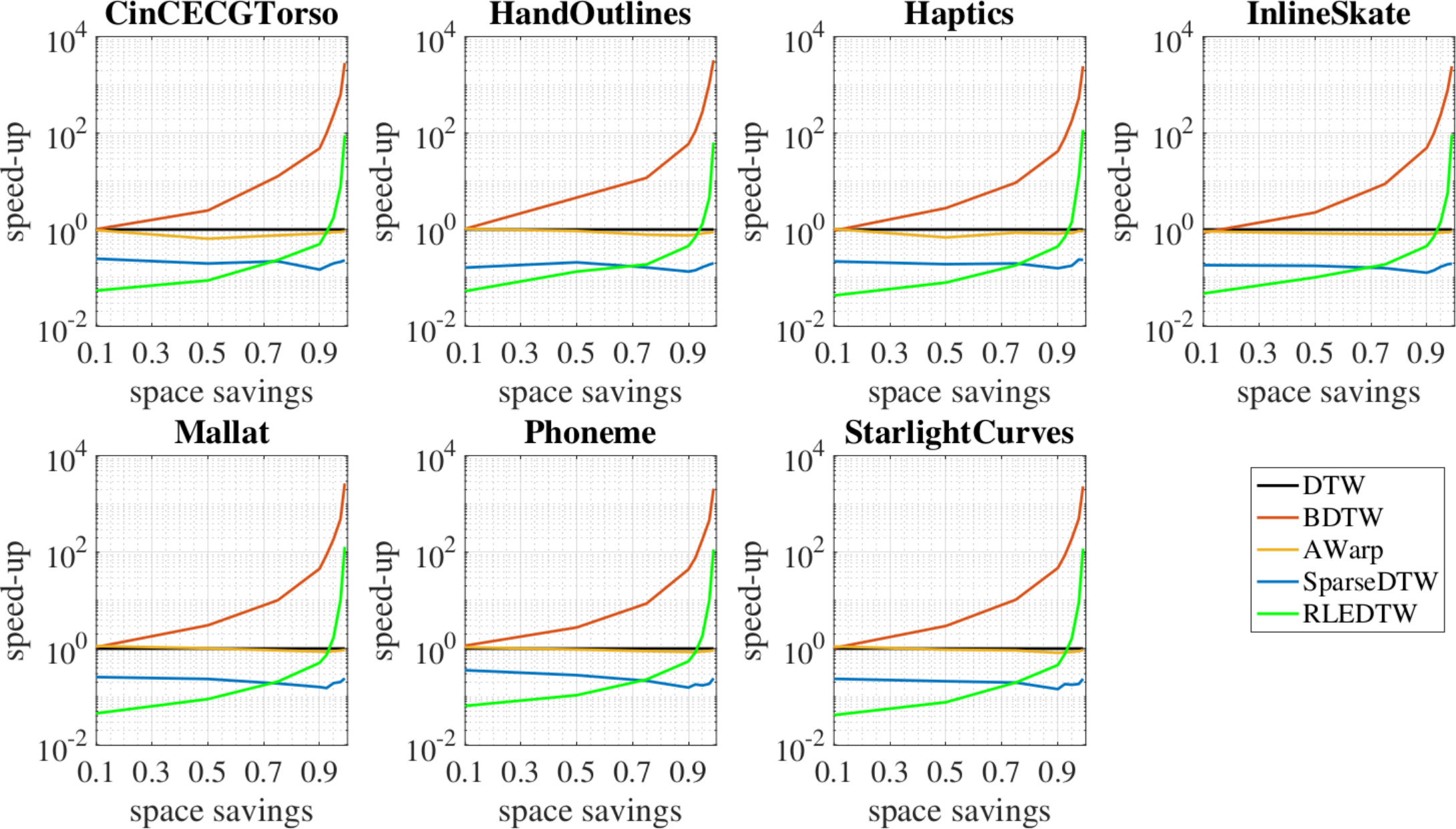 Figure 2
Peer Reviews
No public reviews on file for this paper yet. If you reviewed it on a platform where reviews are public (OpenReview, ICLR, NeurIPS, ICML), you can paste yours below so the community can read it here.
Videos
No videos yet. Explain this paper in a talk, walkthrough, or lecture? Add one.