Real-Time Experimental Demonstration of Multi-band CAP Modulation in a VLC System with Off-the-Shelf LEDs
Paul Anthony Haigh, Izzat Darwazeh

TL;DR
This paper presents the first real-time experimental demonstration of multi-band CAP modulation in visible light communication using standard LEDs, achieving high data rates suitable for HD streaming.
Contribution
It introduces a real-time VLC system employing off-the-shelf LEDs with m-CAP modulation, validated through FPGA-based USRPs, demonstrating practical high-speed optical communication.
Findings
Achieved data rates up to ~30 Mb/s.
First real-time demonstration of m-CAP in VLC with off-the-shelf LEDs.
Supports high-definition television streaming.
Abstract
We demonstrate, for the first time, m-CAP modulation using off-the-shelf LEDs in a VLC in real time experimental setup using field programmable gate arrays based in universal software radio peripherals (USRPs). We demonstrate transmission speeds up to ~30 Mb/s can be achieved, which supports high definition television streaming.
Click any figure to enlarge with its caption.
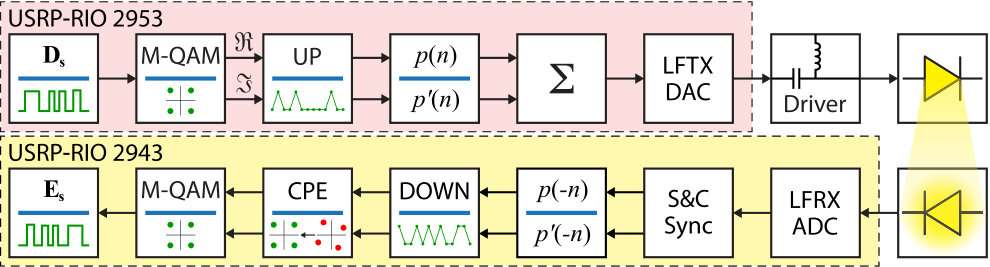 Figure 1
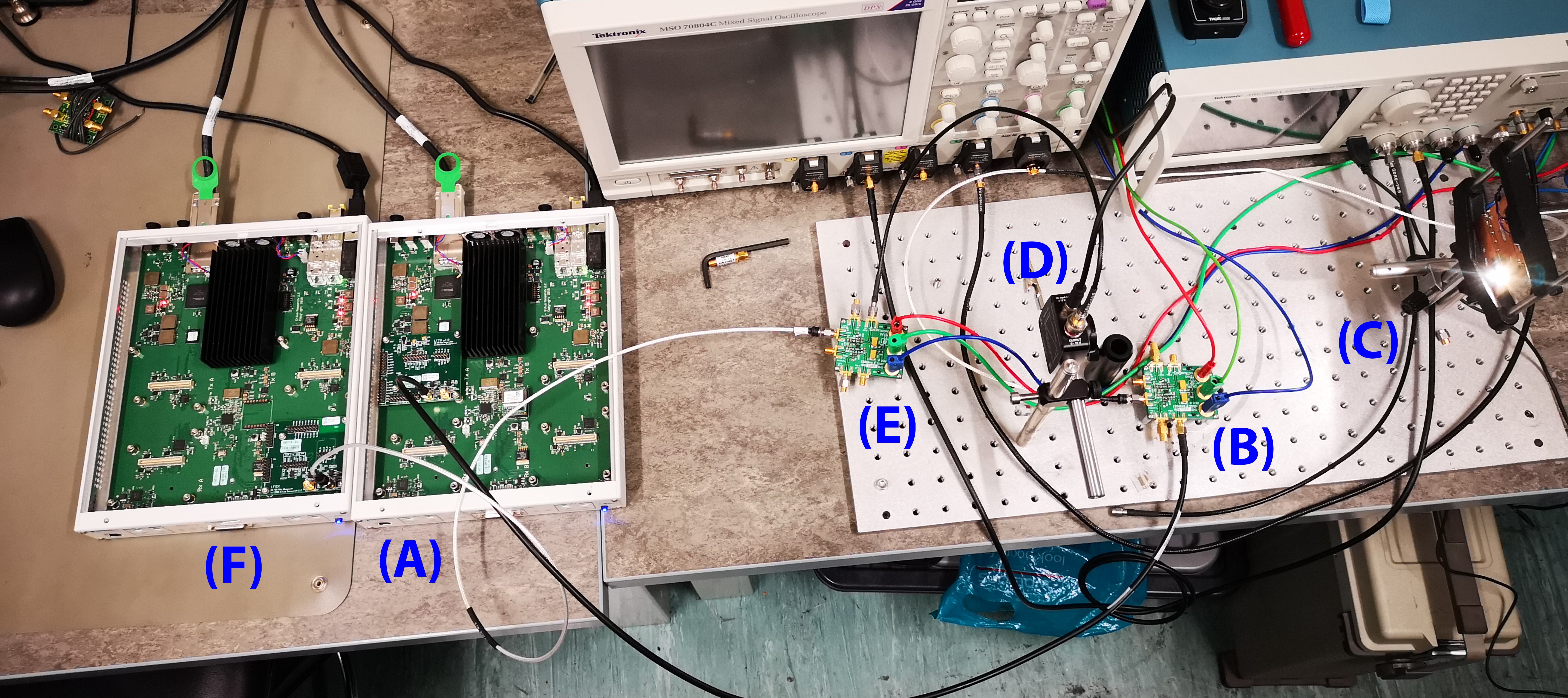 Figure 2
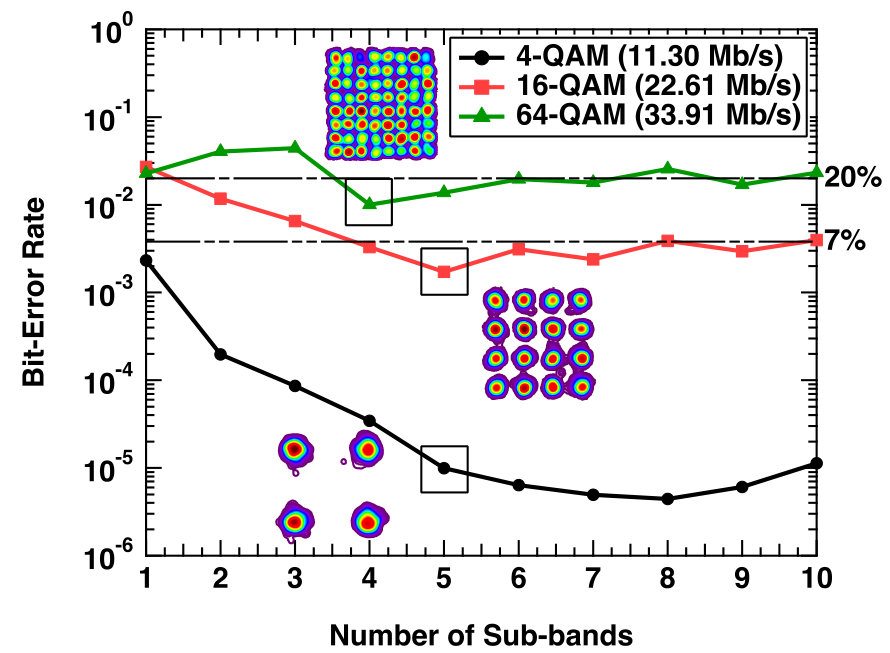 Figure 3
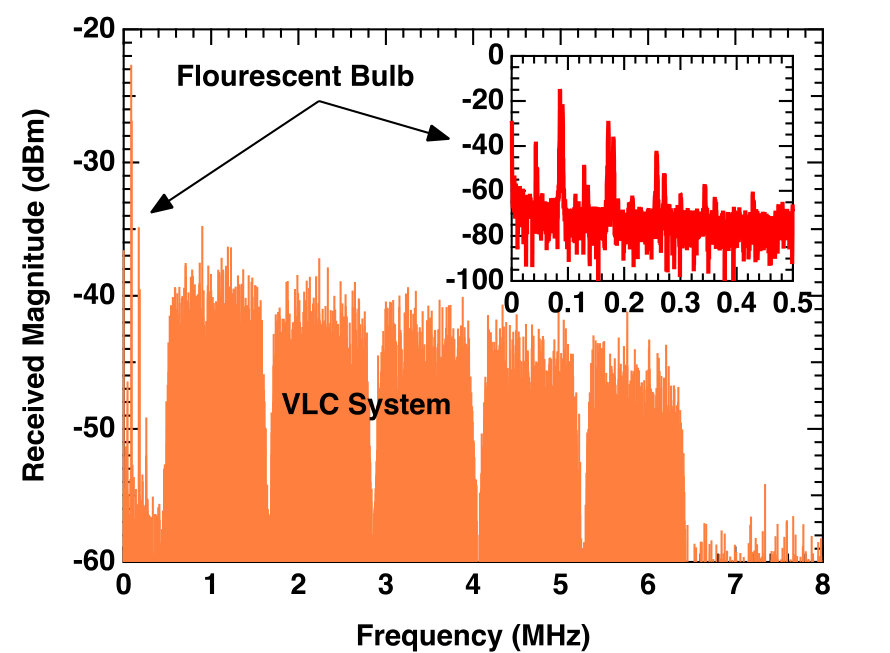 Figure 4
Peer Reviews
No public reviews on file for this paper yet. If you reviewed it on a platform where reviews are public (OpenReview, ICLR, NeurIPS, ICML), you can paste yours below so the community can read it here.
Videos
No videos yet. Explain this paper in a talk, walkthrough, or lecture? Add one.
Real-Time Experimental Demonstration of Multi-band CAP Modulation in a
VLC System with Off-the-Shelf LEDs
††thanks: This work is supported by EPSRC MARVEL (EP/P006280/1).
Paul Anthony Haigh and Izzat Darwazeh
*Communications and Information Systems Group, University College London, Gower Street, WC1E 6BT, United Kingdom
*{p.haigh;i.darwazeh}@ucl.ac.uk
Abstract
We demonstrate, for the first time, -CAP modulation using off-the-shelf LEDs in a VLC in real time experimental setup using field programmable gate arrays based in universal software radio peripherals (USRPs). We demonstrate transmission speeds up to 30 Mb/s can be achieved, which supports high definition television streaming.
Index Terms:
Digital signal processing, field programmable gate array, modulation, real time, visible light communications
I Introduction
Advanced modulation formats are commonly used to increase transmission speeds in visible light communications (VLC), where modulation bandwidths are typically limited to several MHz [1, 2, 3, 4]. They allow, in principle, additional spectral efficiency and hence, higher data rates [3]. One of the most popular formats is carrier-less amplitude and phase (CAP) modulation, which, in 2013 [1], was shown to outperform experimentally orthogonal frequency division multiplexing (OFDM) in terms of bit-error rate (BER). Since the report in [1], several variations of CAP have been proposed, the most significant of which is the multi-band system (-CAP) that protects against chromatic dispersion in fibres [5]. Subsequently, -CAP was adopted in VLC [2], it was shown that reducing subcarrier bandwidths led to tolerance of out-of-band attenuation caused by the low LED modulation bandwidths, and thus, higher spectral efficiencies.
In recent years, there have been only a limited number of studies of real-time VLC systems, where the two most recent examples are reported in [6, 7]. Both reports utilise OFDM modulation rather than CAP due to the ease of deploying an (inverse) fast Fourier transform ((I)FFT) pair. The computational complexity of the (I)FFT pair increases with , where is the number of subcarriers, while -CAP requires finite impulse response (FIR) pulse-shaping filters whose complexity increases with , where is the number of taps and is the number of subcarriers [8]. Clearly, -CAP has a higher computational requirement than OFDM, however recent reports have shown that look-up tables at the transmitter can reduce this by 50%, and when used together with new receiver architectures and pulse shapes, the computational load can be reduced by a up to 90% [9], meaning straightforward implementation.
Here, we experimentally demonstrate a real-time -CAP system for the first time over a VLC system using white LEDs. Two field programmable gate arrays (FPGAs) are used in this real-time demonstration to ensure fair synchronisation and BER measurement across two independent clocks. We show that transmission speeds up to 30 Mb/s can be supported with a 20% forward error correction (FEC) code, and 20 Mb/s with a 7% FEC code. These rates are sufficient to support full high-definition television (HDTV) transfer, as will be demonstrated, across real VLC links using off-the-shelf LEDs.
II Experimental Real Time Demonstrator Setup
The system block diagram is shown in Fig. 1. Details of the generation of -CAP signals may be referred to in the literature, due to space considerations, in [2, 5]. We tested -CAP signals, varying from to , using the 4-, 16- and 64-QAM constellations for each subcarrier, with a fixed bandwidth of 6.5 MHz and roll-off factor of 0.15 as used in [2]. The incoming information is modulated into the -CAP signal format inside the transmitter FPGA, which is a Xilinx Kintex 7 (410T) contained within a National Instruments universal software radio peripheral reconfigurable input/output (USRP-RIO) 2953. The FPGA outputs the signal to an Ettus Research LFTX digital-to-analogue converter (DAC) daughtercard, which has an analogue bandwidth up to 30 MHz. The signal is then passed through a Texas Instruments THS3202 amplifier with 4 times gain, before superimposing on a 250 mA bias current.
The biased signal that intensity modulates the Osram Golden Dragon LED (optoelectronic characteristics can be referred to in [10]) for transmission over a 0.5 m link, which is fixed to maintain a compact demonstrator, however operation can also be supported at 1 m distances. No bulk optics, such as lenses, are used and a Thorlabs PDA100A2 packaged receiver is used, which consists of a silicon -- photodiode and an in-built transimpedance amplifier. The amplifier output is further amplified () by a Texas Instruments THS3202 amplifier to maximize symmetrical swing at the receiver input. The receiver is a National Instruments USRP-RIO 2943 with the same Xilinx Kintex 7 FPGA on-board, but running independently from the transmitter. An Ettus Research LFRX analogue-to-digital converter (ADC) daughtercard (0-30 MHz) is used to digitise the data and direct it to the FPGA, for demodulation and BER measurements. Synchronisation is obtained using the Schmidl and Cox [11] method while the demodulation of -CAP signals may be referred to in [2, 5]. A photograph of the experimental setup is shown in Fig. 2.
III Results
The total accumulated BER is shown in Fig. 3, and symbols were transmitted. A clear trend is evident; a low order of indicates a high BER, which reduces as increases. The reason for this is due to inter-symbol interference (ISI) caused by attenuation of high frequencies as documented in [2]. However, there is another contributor to this, which is the slight impact of fluorescent light bulbs present in the laboratory. A dark environment is unrealistic in a real-world scenario, and hence, a 500 kHz frequency offset was introduced to the signals allow co-existence of fluorescent bulbs alongside the VLC system, as illustrated in Fig. 4, which resulted in minor intermodulation. This effect reduces with increasing m as the aggregated roll-off at the bandwidth edges becomes sharper. The transmission rate is sufficient to demonstrate HDTV streaming.
IV About the Demonstrator and Conclusion
This demonstration is a self-contained and flexible test environment that supports HDTV video streaming in real time. Modulation formats can be adapted in real-time, albeit with an interruption in service before data recovery. Attendees will be able to block physically the optical path and observe the impact of a degradation in BER on the video quality. Wireless internet access will also be available via the VLC system through the demonstrator, which reports a real-time -CAP VLC system, for the first time.
The reference list from the paper itself. Each links out to its DOI / PubMed record.
- 1[1] F. M. Wu, C. T. Lin et al. , “Performance comparison of OFDM signal and CAP signal over high capacity RGB-LED-based WDM visible light communication,” IEEE Photonics Journal , vol. 5, no. 4, 2013.
- 2[2] P. A. Haigh, A. Burton et al. , “A multi-CAP visible-light communications system with 4.85-b/s/Hz spectral efficiency,” IEEE Journal on Selected Areas in Communications , vol. 33, no. 9, pp. 1771–1779, Sept 2015.
- 3[3] Y. Wang, L. Tao et al. , “8-Gb/s RGBY LED-based WDM VLC system employing high-order CAP modulation and hybrid post equalizer,” IEEE Photonics Journal , vol. 7, no. 6, Dec 2015.
- 4[4] H. Li, X. Chen et al. , “High bandwidth visible light communications based on a post-equalization circuit,” IEEE Photonics Technology Letters , vol. 26, no. 2, pp. 119–122, Jan 2014.
- 5[5] M. I. Olmedo, T. Zuo et al. , “Multiband carrierless amplitude phase modulation for high capacity optical data links,” Journal of Lightwave Technology , vol. 32, no. 4, pp. 798–804, Feb 2014.
- 6[6] Z. Li, C. Zhang et al. , “A real-time high-speed visible light communication system based on RGB-LE Ds,” in 2017 IEEE International Symposium on Broadband Multimedia Systems and Broadcasting (BMSB) , June 2017.
- 7[7] F. Wang, J. Yin et al. , “Real-time bi-directional 800mbs visible light communication system utilizing commercial leds,” in Asia Communications and Photonics Conference 2016 . OSA, 2016, p. AF 3A.5.
- 8[8] J. L. Wei, C. Sanchez, and E. Giacoumidis, “Fair comparison of complexity between a multi-band CAP and DMT for data center interconnects,” Opt. Lett. , vol. 42, no. 19, pp. 3860–3863, Oct 2017.