
TL;DR
This paper reviews the construction of M2-brane superconformal field theories, emphasizing 3-algebras, and discusses the challenges and progress in formulating M5-brane SCFTs, exploring their connections.
Contribution
It provides a detailed review of M2-brane SCFTs with a focus on 3-algebras and discusses recent developments and challenges in constructing M5-brane SCFTs.
Findings
Highlighting the role of 3-algebras in M2-brane theories
Discussing obstacles in formulating M5-brane SCFTs
Exploring potential relations between M2 and M5-branes
Abstract
In this talk we will review the construction of M2-brane SCFT's highlighting some novelties and the role of 3-algebras. Parts of our discussion will closely follow parts of arXiv:1203.3546. Next we will discuss M5-branes: the basics, the obstacles as well as various attempts to construct the associated SCFT and potential relations between M2-branes and M5-branes.
Click any figure to enlarge with its caption.
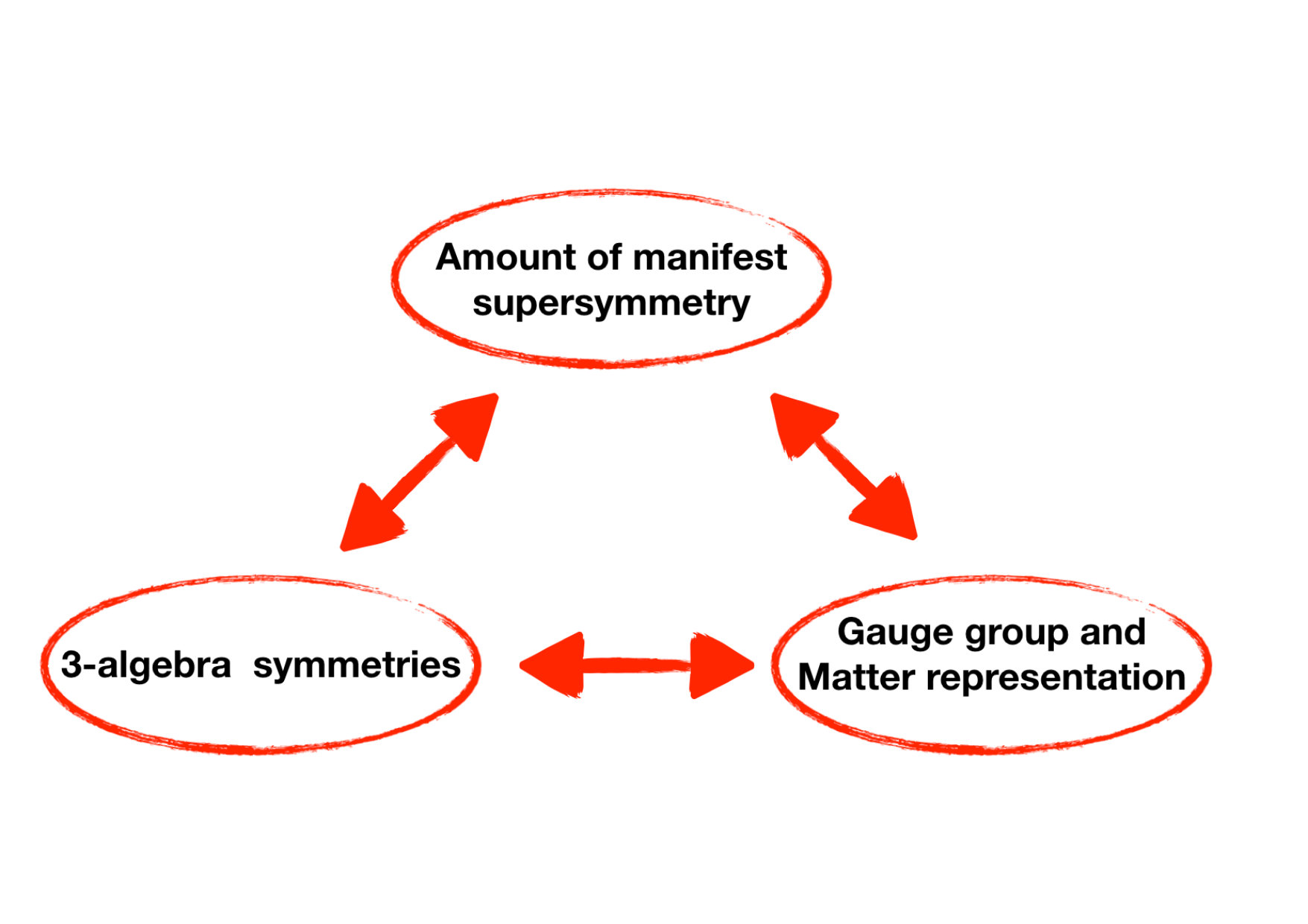 Figure 1
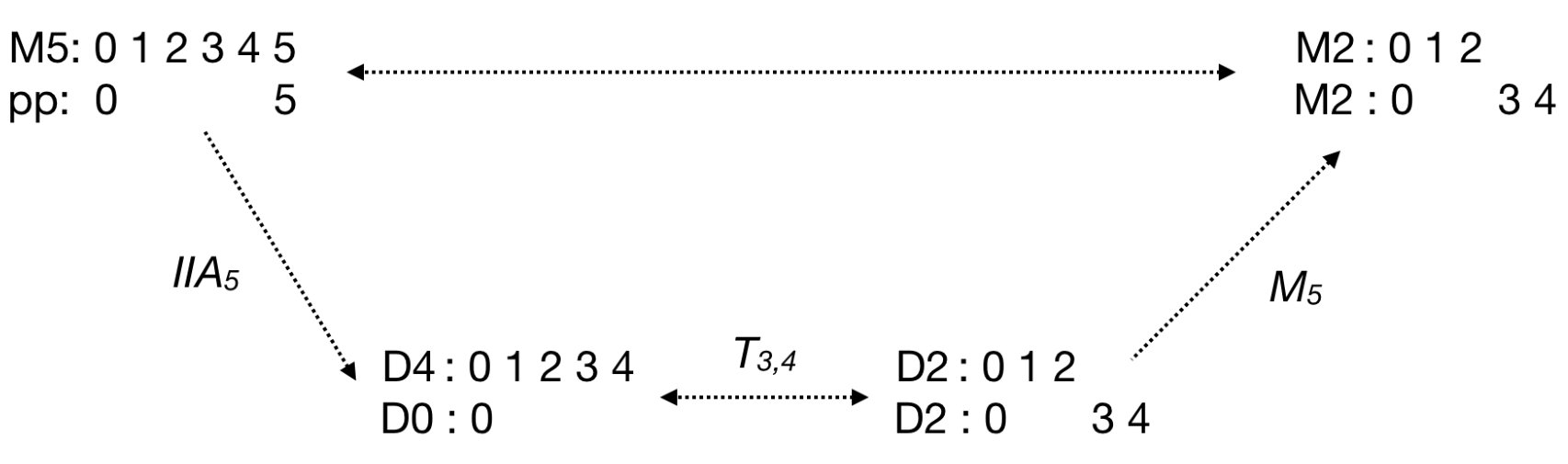 Figure 2
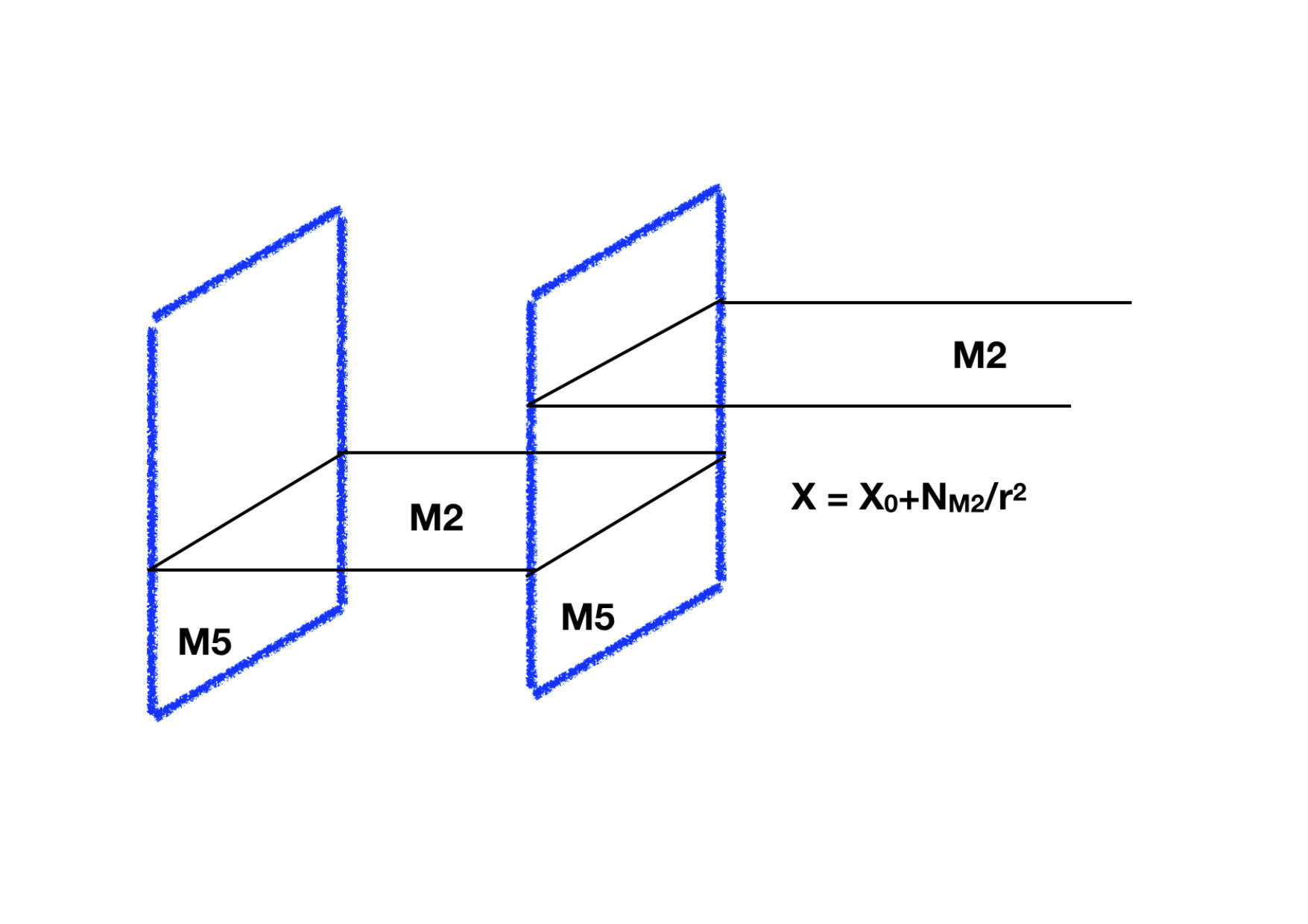 Figure 3
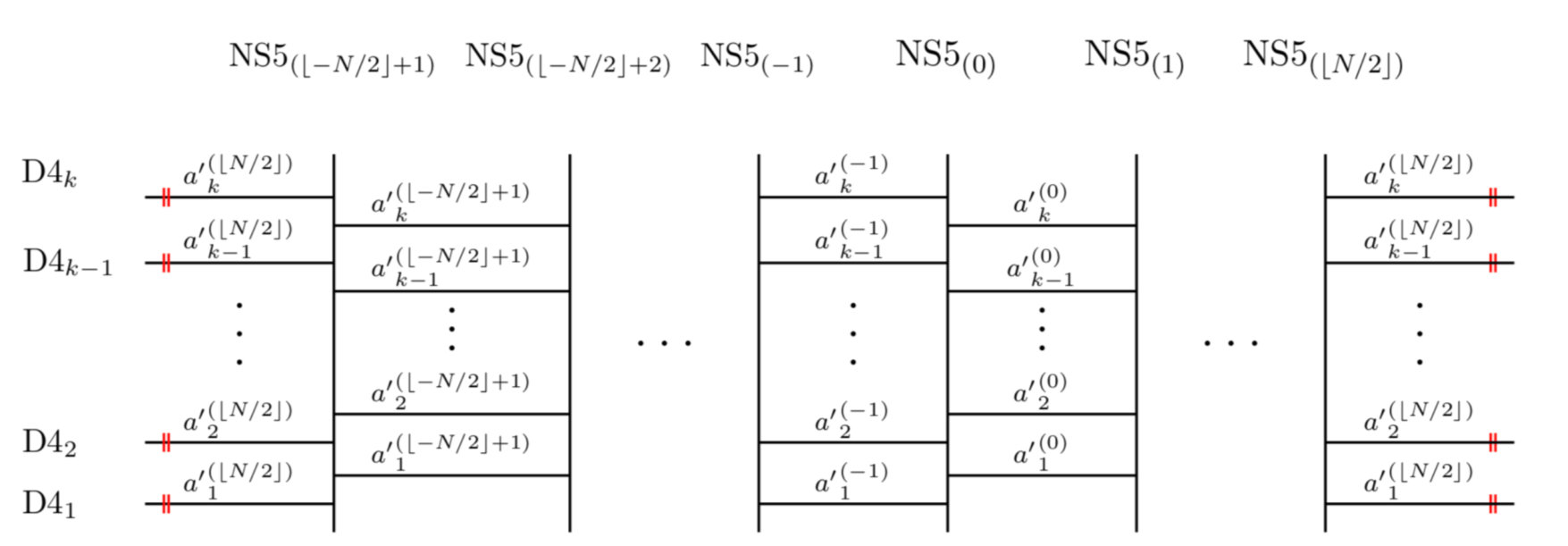 Figure 4
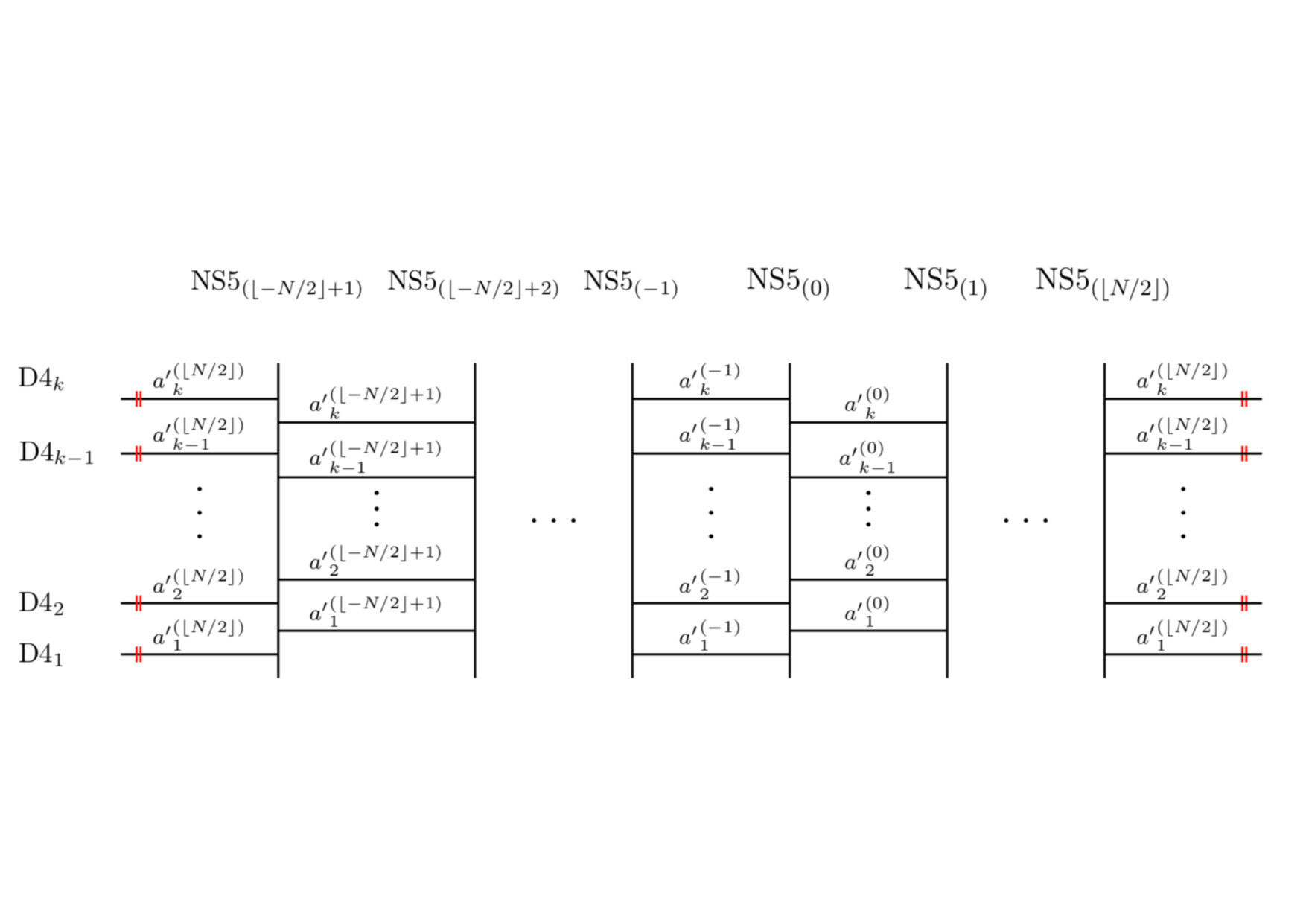 Figure 5
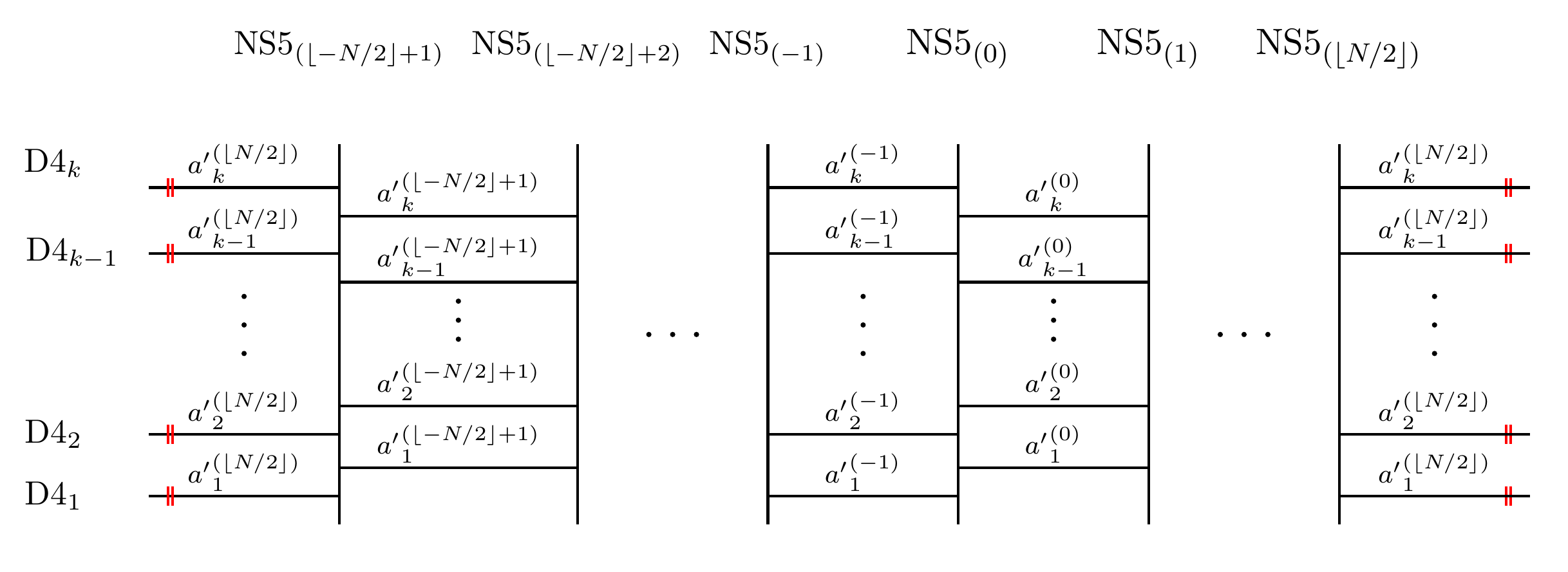 Figure 6
Peer Reviews
No public reviews on file for this paper yet. If you reviewed it on a platform where reviews are public (OpenReview, ICLR, NeurIPS, ICML), you can paste yours below so the community can read it here.
Videos
No videos yet. Explain this paper in a talk, walkthrough, or lecture? Add one.
M-Branes: Lessons from M2’s and Hopes for M5’s
LMS/EPSRC Durham Symposium on Higher Structures in M theory
Neil Lambert111Corresponding author e-mail: [email protected] aa Department of Mathematics, King’s College London, The Strand, WC2R 2LS, United Kingdom
Abstract
In this talk we will review the construction of M2-brane SCFT’s highlighting some novelties and the role of 3-algebras. Parts of our discussion will closely follow parts of [1]. Next we will discuss M5-branes: the basics, the obstacles as well as various attempts to construct the associated SCFT and potential relations between M2-branes and M5-branes.
category:
Proceedings
\shortabstract
1 Introduction
I was asked to give a review talk on the construction of the M2-brane SCFT’s and also to detail the issues and problems associated to the infamous M5-brane SCFT’s. Not wanting to feel left out I also tried to add something of my own recent work which I hoped would be of interest to my colleagues at the conference. Therefore the plan of this talk is split into three themes:
- i)
M2-branes and 3-algebras 2. ii)
M5-branes and the theory 3. iii)
A system
The aim of the first theme is to review the construction of the M2-brane Chern–Simons SCFT’s with a view to emphasising the role of 3-algebras. However I also want to point out that although we have Lagrangian descriptions for arbitrary numbers of M2-branes in many eleven-dimensional backgrounds, these Lagrangians do not have all the symmetries that one expects. Instead these only arise in the quantum theory at strong coupling through non-perturbative operators. In the second theme I will discuss the objections to obtaining a Lagrangian description of M5-branes and review a few attempts to define the associated SCFT using lower dimensional Lagrangian theories. Finally in the remaining theme I would like to present an explicit representation of the super-algebra on a set of fields and show that by making certain choices for the solutions to the constraints one recovers various Lagrangian descriptions of M5-branes and M2-branes.
On the other hand there is much work on M5-branes that I will not discuss. Not out of a lack of interest but out of a lack of time and knowledge. Amongst the plethora of work that I will not mention are:
- i)
Results arising from reduction to 4D and below such as novel non-Lagrangian field theories, dualities, surface operators, AGT etc (e.g. [2], ) 2. ii)
Bootstrap results for M5-branes (e.g. [3], ) 3. iii)
The moral of this talk is that although M2-branes are essentially a done deal there are details in the fine print that could hold lessons for M5-branes. And furthermore although an explicit M5-brane construction from some Lagrangian-like system seems unlikely there is still hope that novel techniques and physics can emerge and that we will learn new things about quantum field theory.
2 M2-branes
The M2-brane SCFT arises as the strong coupling limit of D2-branes. These are described in the decoupling limit by 3D maximally supersymmetric Yang–Mills (MSYM) with gauge group . The strong coupling limit corresponds to the IR limit. However the lift to M-theory implies that at strong coupling an extra eleventh dimension arises and the R-symmetry is thereby increased from to :
[TABLE]
here stands for Lorentz symmetry and R for R-symmetry. Ultimately these are subgroups of the ten and eleven-dimensional Lorentz groups. Therefore the standard type IIA/M-theory dictionary predicts that there is a 3D SCFT with maximal supersymmetry and R-symmetry corresponding to the IR limit of 3D super-Yang–Mills. Thus although we started with string theory and M-theory we have reached a conclusion that is simply about gauge theory and QFT. A prediction so to speak.
The relevant Lagrangians for these theories have now been constructed. The first example with maximal () manifest supersymmetry is BLG [6, 7]. It is a Chern–Simons-matter theory with gauge group or . However it is limited in that it only describes two or three M2’s on an orbifold.
For arbitrary number of M2-branes one has manifest SUSY and the ABJM or ABJ models [8, 9]. Here one gives up manifest maximal supersymmetry and instead has only 12 supercharges. It is again a Chern–Simons-matter theory but with gauge group and it describes branes in an eleven-dimensional orbifold.
There is now a zoology of Chern–Simons-matter theories with extended SUSY corresponding to a motley list of gauge groups. For there is no restriction on the gauge group [10].
2.1 3-algebras
A central ingredient to all these theories is a 3-algebra. This is a vector space with a triple product
[TABLE]
such that the endomorphism , for fixed , is a derivation. This leads to the so-called fundamental identity:
[TABLE]
For physics we require that there is a positive definite inner product on :
[TABLE]
which induces an invariant inner product on the space of derivations:
[TABLE]
There is also a complex version of a 3-algebra:
[TABLE]
with complex positive definite inner product: For physics we require that there is a positive definite inner product on :
[TABLE]
Again the analogue of adjoint map
[TABLE]
is a derivation
[TABLE]
The fundamental identity tells us that the action of on is that of a Lie algebra generated by for all . In other words is representation of . Thus a 3-algebra defines a Lie algebra along with a preferred representation.
In fact the reverse is also true: given a Lie algebra and a representation (along with invariant inner products) one can always construct a triple product satisfying the fundamental identity via the so-called Faulkner map. Such 3-algebras, including ones with mixed signature inner products (which also have applications to gauge theory) have been classified, see for example [11, 12]
One need not think of a 3-algebra and just think of the gauge group and matter representation. However the triple product fixes all the terms in the Lagrangian. Furthermore the amount of manifest supersymmetry fixes the symmetry properties of the triple product which in turn restricts the choice of 3-algebra and hence which gauge algebras and representations arise. This is a rather novel situation as the amount of manifest supersymmetry is determined by the gauge algebra and matter representations, unlike the case of super-Yang–Mills theories where the gauge group is arbitrary. Furthermore even though the gauge fields are related to the matter fields by supersymmetry they do not sit in the same representation of the gauge group. This is possible as the Chern–Simons structure means that the gauge fields do not carry on-shell degrees of freedom.
2.2 Examples
Let us look at some examples.
2.2.1 supersymmetry: BLG
We take real and totally antisymmetric and
[TABLE]
(here and ). The Lagrangian is
[TABLE]
But for a positive definite choice of inner product (which we take to be the identity) there is just one finite-dimensional solution [13, 14]:
[TABLE]
The gauge algebra generated by is and
[TABLE]
so we find an Chern–Simons Lagrangian with opposite levels:
[TABLE]
The fields , are in the = bifundamental. A standard result tells us that - no continuous parameter.
2.2.2 supersymmetry: ABJM
We need a little less symmetry and a complex . To this end we write as four complex scalar fields in of with charge 1. And is now written as 4 complex fermions in with charge 1. Lastly the 16 components of are reduced to in of with charge 0. We can now write down the supersymmetry transformations:
[TABLE]
and Lagrangian
[TABLE]
An infinite class of solutions are given by complex matrices with and
[TABLE]
The gauge transformation generated by is
[TABLE]
where are and matrices respectively and
[TABLE]
Thus we find the gauge group with matter in the bi-fundamental. Cases with are known as the ABJ theories. For one actually just finds but the missing factors can be added in by hand as they are supersymmetry singlets. In the special case of we recover the BLG theory in complex notation.
The list of examples continues with less supersymmetry depending on the symmetry properties of the structure constants
[TABLE]
but the actions are essentially the same.
2.3 Novelties
As we have mentioned above these actions ‘break’ some supersymmetry ‘rules’.
- i)
Gauge fields and matter fields are in the same multiplet but not in the same representation of the gauge group. 2. ii)
The amount of supersymmetry is determined by the gauge group
In particular (for example see [15]):
[TABLE]
The 3-algebra formalism is a neat way of encoding all this data even though in the end one is always just talking about a Chern–Simons-matter field theory based on a gauge group and choice of representation.
2.4 Essential dynamics
Having constructed these theories it begs the question as to whether or not they really describe M2-branes. For a start there is no obvious free centre of mass multiplet. I warn you now that his is a rather lengthy and detailed section so please bare with me (or skip to the end). I am mentioning it here to help illustrate some points later: namely that one has to work hard, and within the quantum theory, to see the correct physics.
The first thing to look at is the vacuum moduli space. This tells us the space of all the zero-energy configurations of the M2-branes. We will just stick to ABJM:
[TABLE]
Generically this implies that all the commute (c.f. D-branes):
[TABLE]
To see that this is all requires one to evaluate the mass formula for small fluctuations which one finds is non-zero (generically: there are special points where extra massless modes arise but are expected to be lifted by non-perturbative effects).
We must identify fields that differ by gauge transformations:
[TABLE]
We could set so that this is an adjoint action, as with D-branes. This allows us to put in diagonal form (as we have already done) and in addition acts as
[TABLE]
e.g. for these are generated by
[TABLE]
These generate the action of the symmetric group on .
Unlike D-branes we also have continuous gauge transformations:
[TABLE]
These arise from taking
[TABLE]
To see the effect of this on the vacuum moduli space we must examine the Lagrangian for the moduli , including the gauge fields. The Lagrangian on the moduli space is
[TABLE]
Note that only couples to and not to :
[TABLE]
with .
It is helpful to dualize by introducing a Lagrange multiplier :
[TABLE]
where .
Integrating out tells us and everything is pure gauge:
[TABLE]
where is gauge invariant. Next we observe that is periodic:
[TABLE]
because of the Dirac quantization rule
[TABLE]
as well as the fact that implies .222NB: This is very sensitive to the global choice of gauge group . This means that (recall )
[TABLE]
Thus there is an extra orbifold action in space-time
[TABLE]
and the vacuum moduli space is
[TABLE]
Corresponding to M2-branes in an transverse space. And indeed and M2-brane in this orbifold preserves 12 supersymmetries. This explains why there is no translational mode for generic (including the classical, large , limit). But it should be there for and we will find it later.
Let us return to the moduli space. It follows that we can think of
[TABLE]
as describing the positions of M2-branes in . Furthermore the natural circle for the M-theory direction is the over-all phase.
Suppose we wanted to describe M2-branes moving along the M-theory circle with different speeds. One might expect that this corresponds to
[TABLE]
But this is pure gauge! We can un-do it by taking333NB: This gauge transformation is not allowed for D-branes where the scalars are in the adjoint.
[TABLE]
So how do the M2-branes ‘explore’ the full transverse space? Let us set the fermions to zero and construct the Hamiltonian
[TABLE]
As usual the time-components of the gauge field give constraints:
[TABLE]
Let us consider the vacuum moduli again:
[TABLE]
The constraint is
[TABLE]
In other words the momentum around the M-theory circle is given by the magnetic flux. In spirit this is the same as dualization:
[TABLE]
This raises the next question: how do we compute quantities with eleven-dimensional momentum. In particular the gauge invariant observables appear to only carry vanishing charges:
[TABLE]
and hence don’t really explore all eleven dimensions.
This brings us to monopole or ’t Hooft operators: we want to create states that carry magnetic charge. These operators are defined as a prescription for computing correlators in the path integral. They are not constructed as a local expression of the fields. In particular, a monopole operator is defined by modifying the boundary conditions of the fields about the point in the path integral
[TABLE]
in other words we require the fields in the path integral to have a specific singularity
[TABLE]
is the magnetic flux and is subject to the standard Dirac quantization condition
[TABLE]
Next we note that due to the Chern–Simons term monopole operators transform locally under a gauge transformation (with at infinity) as
[TABLE]
Note that by construction we have broken the gauge group to . This is enough to tell us that under full gauge transformations the monopole operators transform in the representation of whose highest weight is
[TABLE]
(actually because of the sign the second factor is the lowest weight).
This is all very abstract (and tricky to calculate with). Consider the Abelian case (from the moduli space calculation and Wick rotated):
[TABLE]
The monopole operators are just
[TABLE]
since
[TABLE]
This is the same as taking
[TABLE]
i.e. inserting a magnetic charge at .
Thus our gauge invariant operator on the moduli space is just
[TABLE]
and indeed has charge under .
Even at translations in the transverse space are not symmetries of the Lagrangian:
[TABLE]
But now we can construct the conserved current (but only for ):
[TABLE]
as well as the additional two supersymmetries that enhance :
[TABLE]
Finally we ask how BLG fits in? To cut a long story short [16, 17, 18]:
- i)
BLG at is dual to ABJM at , i.e. 2 M2’s in 2. ii)
BLG at is dual to ABJM at , i.e. 2 M2’s in 3. iii)
BLG at is dual to ABJ at , i.e. 2 M2’s in with torsion i.e. 2 M2’s in 4. iv)
BLG at is dual to ABJM at without the centre of mass multiplet, i.e. the interacting part of 3 M2’s in
So BLG describes 2 or even 3 M2-branes in or with all symmetries manifest (although not translations in the former case).
2.5 Lessons and questions
So let me close the discussion of M2-branes with some lessons and a question. It is in general too much to ask for all symmetries to be manifest in the classical Lagrangian. In particular the true symmetries and dynamics only arise in the quantum theory using ‘quantum’ operators, i.e. operators that are not constructed directly out of the fields and which do not have a classical analogue. Furthermore the role of the gauge group is very non-trivial and global issues matter.
Lastly my question is: is there a role for the general BLG theories (i.e. for )? They exist as maximally supersymmetric field theories which have a weakly coupled limit as . Due to their moduli space they seem rather non-geometric but perhaps slightly deeper in the sense that one can find the M2-brane theories by taking a quotient of them [16].
3 M5-branes
The decoupling limit of M5-branes leads to an interacting CFT in 5+1 dimensions with an R-symmetry coming from rotations in the transverse 5-plane in eleven dimensions. In the Abelian case the dynamics are known [19, 20, 21].
The field content consists of five scalars (so now and ), a 2-form with self-dual field strength and a 16-component fermion . At the linearised level we simply have
[TABLE]
For one finds the interacting theory.
The dynamics are thought to arise from self-dual strings associated to M2-branes ending on M5-branes, just as D-brane dynamics arise from the end point of open stings (see figure 2). These are the natural BPS states and Wilson-lines are replaced by surface operators. The Abelian case has been long understood [22] however the non-Abelian case of great interest as a higher gauge theory analogue of the Nahm transform [23]. Finally we mention that AdS/CFT predicts that the number of ‘degrees of freedom’ of M5-branes scales as [24].
3.1 Reduction on
Let us wrap M5-branes on of radius . According to the M-theory dictionary this leads to D4-branes in type IIA string theory with coupling . These are in turn described by 5D MSYM and coupling . So the theory is a UV completion of 5D MSYM with enhanced Lorentz symmetry [25]
[TABLE]
This is another ‘prediction’ of M-theory for quantum field theory: there exists a 6D SCFT that provides a UV completion of 5D MSYM.
In this story the Kaluza-Klein momenta are carried by instanton-solitons [26]:
[TABLE]
These states carry charges of the topological current
[TABLE]
for which all perturbative states are uncharged.
3.2 Reduction on
Let us reduce again on another with radius . Here we find 4D MSYM with coupling . This theory has an S-duality that swaps perturbative modes with monopoles and . However from the 6D point of view this is a modular transformation of which is a diffeomorphism and hence is, or should be, a manifest symmetry of the theory.4444D MSYM is only self-dual for ADE gauge groups so the theory can only exist for ADE gauge groups. Indeed it was first constructed by a decoupling limit of type IIB on with an ADE singularity [27].
3.3 No Action?!
There are several arguments/challenges/opportunities555Delete as appropriate. against constructing a 6D action for the theory. Let us discuss some.
- i)
Even without worrying about self-duality there are no ‘good’ interacting Lagrangians in 6D. In particular the Lagrangian must take the form
[TABLE]
which is problematic as the interactions are either non-renormalizable or unbounded or both. So what would the Lagrangian look like? In what space of classical theories does it exist? 2. ii)
How can one obtain the 4D MSYM action which takes the form
[TABLE]
from the standard Kaluza-Klein result
[TABLE]
since the dependence on is inverted between the two [28]? 3. iii)
Let us consider dimensional reduction to on some . This leads to a 2D theory with chiral bosons and anti-chiral bosons. However it is known that there is no modular invariant partition function if . On the other hand there is Rohlin’s theorem which states that for compact 4D spin-manifolds . Thus it almost seems as if things should go the other way: the existence of a action would imply a weaker version of Rohlin’s theorem (weaker by a factor of 2). However one knows that non-spin manifolds, such as with , can arise in M-theory and hence the M5-brane on should make sense. But it cannot have an action, so therefore no diffeomorphism invariant action in 6D [29]. 4. iv)
We have seen that the theory exists for ADE gauge groups but it is also known that reduction on with a boundary condition that twists by an outer-automorphism gives 5D MSYM with gauge groups. Thus if one had an action it should be subjected to the Tachikawa Test [30]: given a theory action with an twist along , does it give 5D MSYM?666NB: .
3.4 Constructions
Let us now review some constructions of the theory that have been proposed.
3.4.1 DLCQ
Consider null-compactification: ,
[TABLE]
We should view this as the limit of an infinite boost of a space-like compactification resulting in
[TABLE]
To keep finite one must shrink and hence the theory on is well described 5D MSYM with fixed . In this limit is given by the instanton number
[TABLE]
and we are looking at the sector of 5D MSYM with instanton number . Thus the dynamics are reduced to quantum mechanics on the moduli space of instantons with instanton number [31].777NB: This relies heavily on the fact that so we find weakly coupled 5D MSYM, which is a unique feature of the theory compared with compactifications of Lagrangian theories.
3.4.2 Deconstruction
Construct a quiver (moose) diagram arising from the brane diagram in figure 3 (which was stolen from [32]), where the left and right sides are identified into a periodic direction. The D4-branes are described by SYM with fields in the bi-fundamental of each .888NB: The roles of here is the same as elsewhere in our discussion and the role of here has no analogue elsewhere. This gives a 4D SCFT.
The next step is to go out on the Higgs’ branch breaking . A careful tuning of parameters: scalar vev’s, coupling and number of nodes leads to a well-defined limit as .
The periodicity leads to a finite but large tower of states which for low energy look like a KK-tower. However there is also an S-duality of the quiver field theory so that the KK-tower is enhanced non-perturbatively to an multiplet of two towers. Thus as one reconstructs a 6D theory with R-symmetry [33].
This has recently been successfully used to make exact localization calculations [32].
3.4.3 5D MSYM
Here the idea is that maybe 5D MSYM is actually well defined non-perturbatively, despite being perturbatively non-renormalizable, and it is an exact description of the theory on [34, 35]. In particular it contains a complete KK tower of soliton states so any UV completion would have to remove these and replace them with Fourier modes of some fields. So why bother? Then one must hope that the perturbative divergences are removed by small instanton-soliton effects [36]. In addition it seems that for this to work we need to include zero-sized instantons but one can see behaviour [37, 38].
In this scenario the extra momentum can be inserted by ‘instanton’ operators [39, 40]
[TABLE]
which are analogous to the monopole operators that we saw before for M2-branes.
If so then 5D MSYM does provide an ‘action’ for the theory on for any radius. We note that if then and hence no-chiral modes, in agreement with the discussion above.
We could consider instead as multi-Taub-NUT space with . This is non-compact but has a nontrivial fibration. Reducing to IIA on the fibre leads to D4-branes intersecting with D6-branes. Here there are 2D chiral charged modes that are localised where fibration shrinks to zero size. The 5D MSYM that arises from reduction on a circle fibration has been discussed by [41, 42]. In this case one finds that the required chiral modes exist as solitons [43, 44] and are described by a 5D version of a WZWN model.
There is a related proposal where the theory on is reduced to to 5D MSYM on with a Chern–Simons term [45]. In this case the coupling is related to the Chern–Simons level and so quantised.
3.4.4 Interrelations and other proposals
In fact these three descriptions are all related:
- i)
The DLCQ description of the theory must also give the UV completion of 5D MSYM. But it only uses information arising from the classical IR dynamics of instanton-solitons of 5D MSYM. So somehow the IR behaviour of the theory is enough to determine its UV completion. This suggests that 5D MSYM is indeed well-defined without additional degrees of freedom. 2. ii)
The action obtained from deconstruction is a ‘lattice’-like regularization of the 5D MSYM action [46]. 3. iii)
One cannot define 5D MSYM without also defining the theory on .
In addition to these proposals there also exist some action constructions in the literature. Let us list a few here:
- i)
Twistor-inspired and higher gauge theory action [47, 48] 2. ii)
5D MSYM with KK-tower [49] 3. iii)
Mixed 5D/6D action [50] 4. iv)
action [51] 5. v)
Non-local 6D action [52] 6. vi)
Lagrangians and tensor hierarchy [53]
3.5 Relations to M2-branes
There are also a few ways that we expect M5s to arise from M2’s.
3.5.1 ‘T-duality’
Here we consider a three-torus and reduce to IIA on the first , T-dualize to type IIB on the second , T-dualize back to IIA on the third and finally lift back up to M-theory, now on a dual . Using the standard rules we find that
- i)
M5’s on map to M2’s orthogonal to 2. ii)
M2’s orthogonal to map M5’s on
However we must take the decoupling (low energy) limit to isolate the M-brane field theories. This requires that we take in the original (so in the dual ).
The first relation is rather trivial: the M5-brane on gives 3D MSYM and shrinking the torus takes it to strong coupling. Thus we recover the M2-brane SCFT as a strong coupling IR limit of 3D MSYM.
The second relation says that we can construct M5-branes by looking at M2-branes in a shrinking transverse . However enacting this is more tricky because translational symmetry is not manifest in the M2-brane Lagrangian. An attempt was tried in [54] and gives a modified version of 5D MSYM.
3.5.2 Flux background
When M2-branes are placed in a background 3-form flux they expand into M5-branes on by the Myers effect. The resulting M5-brane action was constructed from the M2-brane action in [55] but one finds 5D MSYM on . However when the monopole states in ABJM are included one finds that these map to instanton-soliton states 5D MSYM [56].
3.5.3 M2’s with a Nambu bracket
There are infinite dimensional 3-algebras that can be used in the BLG theory. In particular the Nambu bracket
[TABLE]
is an example where are functions of some three-manifold . It has been observed that substituting this into BLG leads to an Abelian M5-brane wrapped on an auxiliary [57, 58].
3.6 Open problems and wishes
Let me close this discussion of M5-branes with some open problems and wish list of results:
- i)
Provide a field definition/construction of the theory i.e. without recourse to String Theory or M theory 2. ii)
Find the mathematical structures that best capture aspects of the theory e.g. Non-Abelian periods of 2-forms. Twistors, Lie-2-Groups etc. 3. iii)
Obtain calculable formulations of the theory with 6D Diffeomorphisms and Lorentz! 4. iv)
Construct an action (?!), Partition function(s), families of actions or something action-like. 5. v)
Better understand ‘quantum operators’ such monopole and instanton operators. 6. vi)
Explore the relation between M2’s and M5’s more 7. vii)
Make S-duality manifest? 8. viii)
Make the behaviour more apparent
4 A representation of the superalgebra
Finally in this last section I wanted to indulge myself by reporting on my own recent work that I hope is of interest to the conference crowd and I welcome any suggestions. In particular in [59, 60] my collaborators and I constructed a representation of the superalgebra acting on a set of fields:
[TABLE]
Here , and are dynamical taking values in a totally anti-symmetric 3-algebra, and are auxiliary and is a background (Abelian) three-form. Lastly we have
[TABLE]
A standard (but trust me tedious) calculation shows that this system indeed closes on the following equations of motion (in this section we will omit fermions as much as possible for the sake of clarity)
[TABLE]
as well as constraints:
[TABLE]
There is a conserved energy-momentum tensor:
[TABLE]
One can also compute the supercurrent, superalgebra and central charges but lets not list those here.
Even I think this is an unconventional system and cannot decide if it is ugly (probably) or beautiful (possibly). But let us explore it.
4.1 M5-branes
Let us start with the case . Here and we can fix
[TABLE]
where is some generator of the 3-algebra and a constant vector. All components of the fields along become free - the 6D centre of mass (2,0) multiplet. The remaining modes are acted on by an gauge algebra. The constraint implies that these modes only depend on the coordinates orthogonal to . We also note that we can extend to any gauge group by taking a Lorentzian 3-algebra.
But there are still some choices for .
4.1.1 Space-like
First we take . The constraints then say that the remaining dynamical fields only depend on and
[TABLE]
The dynamical equations then all arise from the action
[TABLE]
i.e. 5D MSYM, corresponding to M5-brane on and KK-modes are instanton-solitons:
[TABLE]
4.1.2 Time-like
Secondly we can set (i.e. time-like). Now and the dynamical equations all arise from a 5D Euclidean MSYM. It is similar in form to the familiar MSYM but with some different signs but still with an R-symmetry, so we will not bother to write the action here. Such a Euclidean theory with compact R-symmetry was noted by [61] as a time-like reduction of the M5-brane. This is somewhat novel as typically Euclidean MSYM theories have non-compact R-symmetry. This one arises from reduction of super-Yang–Mills in dimensions. Just as the usual 5D MSYM secretly has an extra hidden compact dimension this field theory has an emergent compact time [62].
4.1.3 Light-like
Note that we can also choose to set so . Here we find
[TABLE]
and self-duality of leads to self-duality of . Similarly is anti-self-dual (but does not satisfy Bianchi). The fields now depend on , .
The dynamics can all be derived from the action [63]
[TABLE]
This is a novel field theory in 4+1 dimensions invariant under 16 supersymmetries, translations in space and time, spatial rotations and an R-symmetry, but no boost symmetry.
Observe that acts as a Lagrange multiplier imposing
[TABLE]
This restricts the dynamics to motion on the moduli space of self-dual gauge fields.
The action reduces to a sigma model on the ADHM moduli space of fixed instanton number [64]:
[TABLE]
Here are vectors on moduli space determined by the vev’s of and .
We can view a null choice of as a limit of an infinite boost of a space-like where we saw that the spatial momentum was . Thus we are looking at an M5-brane with . This reproduces the DLCQ description of the dynamics of M5-brane.
4.2 M2-branes
Let us take now turn on the constant three-form .
4.2.1 Space-like
First take non-vanishing. The constraint
[TABLE]
suggests setting , and , . In this case the constraint
[TABLE]
implies
[TABLE]
From this the remaining constraints can be solved leading to
[TABLE]
Let us write , then everything is derived from the action (taking )
[TABLE]
i.e. BLG .
This is consistent with a T-duality along the directions of :
[TABLE]
4.2.2 Time-like
We can also take a ‘time-like’ . This leads to a Euclidean M2-brane theory with R-symmetry. The Lagrangian is similar in structure to the normal maximally supersymmetric M2-brane case but with some funny signs so we won’t bother to give it here.
This is consistent with [65] where a time-like T-duality of M-theory leads to M*-theory with signature
[TABLE]
And thus an E3-brane in this theory would indeed have R-symmetry.
4.2.3 Light-like
We can also take a null [66] which leads to a rather odd system. In particular the fields depend only on and now are non-zero. Furthermore joins up with to form an multiplet which we denote by . As before is largely determined in terms of but self-duality implies is holomorphic where . Lastly is undetermined.
One finds that the dynamics can be obtained from the action [63]
[TABLE]
where .
This is a novel field theory in 2+1 dimensions invariant under 16 supersymmetries, translations in space and time, spatial rotations and an R-symmetry, but again no boost symmetry.
Note that acts as a Lagrange multiplier imposing
[TABLE]
Furthermore there is a Gauss Law constraint arising from the equation of motion:
[TABLE]
Thus the motion is constrained to the Hitchin moduli space.
As above we can view as the limit of an infinite boost along of the case. Indeed the Hitchin-system gives rise to a momentum along :
[TABLE]
which appears as a winding of the M2-branes around .
So we are looking at intersecting M2-branes that have been boosted along . This is a T-dual relation to momentum modes of the M5-brane (see figure 4).
4.3 Observations and provocations
So our representation of the superalgebra gives various field theories associated to M-branes.
- i)
5D MSYM as the M5 on 2. ii)
Maximally supersymmetric M2 branes 3. iii)
Null M5-branes: QM on instanton moduli space 4. iv)
Null intersecting M2-branes: QM on Hitchin moduli space
The later two are novel non-Lorentz invariant field theories whose on-shell dynamics reduces to one-dimensional motion on moduli space and breaks 1/2 the supersymmetry.
The field theories that we obtain from this system are all consistent with the notion of ‘T-duality’ (really a U-duality) in M-theory on along with radii and
[TABLE]
but one needs to generalise all this to more than two branes in order to make it more concrete!
This system is reminiscent of doubled field theory where is a position coordinate and is a winding coordinate. Under T-duality along the corresponding ’s become position coordinates. Furthermore the constraint is like a section condition. Although it should be noted that the fields are only functions of ordinary 6D coordinates (i.e. not of the winding coordinates). It would be interesting to see if there is a deeper geometrical significance to the various constraints of the system.
The reference list from the paper itself. Each links out to its DOI / PubMed record.
- 1[1] J. Bagger, N. Lambert, S. Mukhi, and C. Papageorgakis, Multiple membranes in M-theory, Phys. Rept. 527 (2013) 1 [ 1203.3546 [hep-th] ]. · doi ↗
- 2[2] D. Gaiotto, 𝒩 = 2 𝒩 2 \mathcal{N}=2 dualities, JHEP 1208 (2012) 034 [ 0904.2715 [hep-th] ]. · doi ↗
- 3[3] C. Beem, M. Lemos, L. Rastelli, and B. C. van Rees, The ( 2 , 0 ) 2 0 (2,0) superconformal bootstrap, Phys. Rev. D 93 (2016) 025016 [ 1507.05637 [hep-th] ]. · doi ↗
- 4[4] P. Heslop and A. E. Lipstein, M-theory beyond the supergravity approximation, JHEP 1802 (2018) 004 [ 1712.08570 [hep-th] ]. · doi ↗
- 5[5] S. Chester and E. Perlmutter, M-theory reconstruction from ( 2 , 0 ) 2 0 (2,0) CFT and the chiral algebra conjecture, JHEP 1808 (2018) 116 [ 1805.00892 [hep-th] ]. · doi ↗
- 6[6] J. Bagger and N. D. Lambert, Gauge symmetry and supersymmetry of multiple M 2-branes, Phys. Rev. D 77 (2008) 065008 [ 0711.0955 [hep-th] ]. · doi ↗
- 7[7] A. Gustavsson, Algebraic structures on parallel M 2-branes, Nucl. Phys. B 811 (2009) 66 [ 0709.1260 [hep-th] ]. · doi ↗
- 8[8] O. Aharony, O. Bergman, D. L. Jafferis, and J. M. Maldacena, 𝒩 = 6 𝒩 6 \mathcal{N}=6 superconformal Chern–Simons-matter theories, M 2-branes and their gravity duals, JHEP 0810 (2008) 091 [ 0806.1218 [hep-th] ]. · doi ↗