Weyl Anomaly and Vacuum Magnetization Current of M5-brane in Background Flux
Chong-Sun Chu

TL;DR
This paper explores the relationship between Weyl anomaly and vacuum magnetization currents in M5-brane theories, extending known four-dimensional effects to six dimensions using holography, and predicts a new anomaly contribution for (2,0) superconformal theory.
Contribution
It generalizes the magnetic Casimir effect and Weyl anomaly connection from 4D to 6D, providing new insights into M5-brane dynamics and anomaly structures via holography.
Findings
Induces a string current in 6D boundary CFT under H-flux.
Determines gauge contribution to Weyl anomaly in 6D.
Predicts N^3 scaling of degrees of freedom in (2,0) theory.
Abstract
It was recently discovered that for a boundary system in the presence of a background magnetic field, the quantum fluctuation of the vacuum would create a non-uniform magnetization density for the vacuum and a magnetization current is induced in the vacuum. It was also shown that this magnetic Casimir effect of the vacuum is closely related to another quantum effect of the vacuum, the Weyl anomaly. Furthermore, the phenomena can be understood in terms of the holography of the boundary system. In this article, we review the derivation of this phenomena from QFT as well as the derivation of it using AdS/BCFT. We then generalize this four dimensional effect to six-dimensions. We use the AdS/BCFT holography to show that in the presence of a 3-form magnetic field strength , a string current is induced in a six-dimensional boundary conformal field theory. This allows us to determine the…
Click any figure to enlarge with its caption.
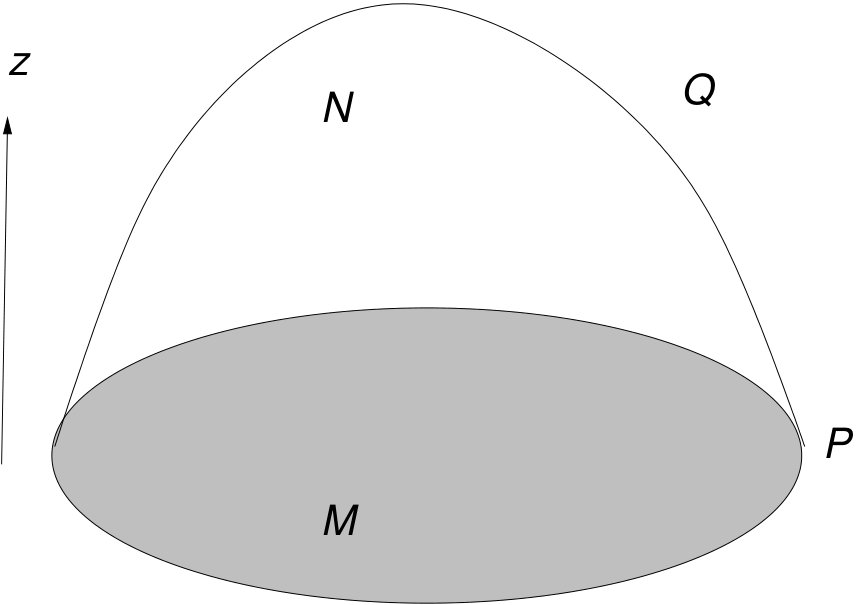 Figure 1
Peer Reviews
No public reviews on file for this paper yet. If you reviewed it on a platform where reviews are public (OpenReview, ICLR, NeurIPS, ICML), you can paste yours below so the community can read it here.
Videos
No videos yet. Explain this paper in a talk, walkthrough, or lecture? Add one.
\shortabstract
Weyl Anomaly and Vacuum Magnetization Current of M5-brane in Background Flux
LMS/EPSRC Durham Symposium on Higher Structures in M theory
Chong-Sun Chu111Corresponding author e-mail: [email protected] aabb Physics Division, National Center for Theoretical Sciences,
National Tsing-Hua University, Hsinchu, 30013, Taiwan
Department of Physics, National Tsing-Hua University, Hsinchu 30013, Taiwan
Abstract
It was recently discovered that for a boundary system in the presence of a background magnetic field, the quantum fluctuation of the vacuum would create a non-uniform magnetization density for the vacuum and a magnetization current is induced in the vacuum. It was also shown that this ‘magnetic Casimir effect’ of the vacuum is closely related to another quantum effect of the vacuum, the Weyl anomaly. Furthermore, the phenomena can be understood in terms of the holography of the boundary system . In this article, we review the derivation of this phenomena from QFT as well as the derivation of it using AdS/BCFT. We then generalize this four dimensional effect to six-dimensions. We use the AdS/BCFT holography to show that in the presence of a 3-form magnetic field strength , a string current is induced in a six-dimensional boundary conformal field theory. This allows us to determine the gauge field contribution to the Weyl anomaly in six-dimensional conformal field theory in a -flux background. For the (2,0) superconformal field theory of M5-branes, the current has a magnitude proportional to for large . This suggests that the degree of freedoms scales as in the (2,0) superconformal theory of multiple M5-branes. Our result for the Weyl anomaly is a new prediction for the (2,0) theory.
category:
Proceedings
1 M5-branes
The decoupling limit of coincident M5-branes is given by an interacting (2,0) superconformal theory in six-dimensions [1]. The understanding of the dynamics of this system is of utmost importance. It will not only improve our understanding of the AdS/CFT correspondence for the AdS background [2]; in addition, as the problem involves a mathematical formulation of a self-duality equation for a non-Abelian 3-form gauge field strength, one may suspect that it may have an impact on mathematical physics in a way similar to its lower-dimensional cousin, the self-dual Yang–Mills equation.222Some of the important mathematical results and applications are, for example, the ADHM construction of instantons [3], the Hitchin integrable system [4] and the classification of 4-manifolds [5].
On general grounds, the theory of multiple M5-branes does not have a free dimensionless parameter and is inherently non-perturbative. It does not mean that an action does not exist, though it does mean that the action will be of limited use, probably no more than giving the corresponding equation of motion. This is still very interesting since one can expect that non-trivial space-time physics of M-theory could be learned from the physics of the solitonic objects of the world-volume theory of M5-branes, much like the cases of M2-branes and D-branes. See for example, [6].
In the paper [7], a consistent self-duality equation of motion for a non-Abelian tensor gauge field in six-dimensions has been constructed and proposed to be the low energy equation of motion of the self-dual tensor field living on the world-volume of a system of multiple M5-branes. The self-dual equation of motion proposed in [7] is meant to be an effective description for the M5-branes in the long length limit, just like the supergravity equation of motion provides an effective description for the M-theory. The non-Abelian self-duality equation constructed in [7] generalizes the equation of motion for a single M5-brane of [8, 9, 10, 11, 12, 13]. It was constructed in the gauge () and is a non-Abelian generalization of the Henneaux–Teitelboim–Perry–Schwarz construction for the case [10, 14]. The construction of [7] involves the introduction of a set of non-propagating non-Abelian 1-form gauge fields which was motivated originally by the boundary analysis in [15] and further analyzed [16]. This aspect is very similar to the BLG [17, 18, 19] and ABJM model [20] of multiple M2-branes where a set of non-propagating Chern–Simons gauge fields was introduced in order to allow for a simple representation of the highly non-linear and non-local self interactions of the matter fields of the theory.
The proposed self-duality equation reads
[TABLE]
All fields are in the adjoint representation of the Lie algebra of the gauge group , and is a free parameter.
Evidence that this self-duality equation describes the physics of multiple M5-branes was provided in [7], and further in [21, 22, 23, 24]. In [21, 22], non-Abelian self-dual string solutions were constructed and a precise agreement [22] of the field theory results and the supergravity descriptions [25, 26] was found. Moreover it was found that the constant is fixed by quantization condition of the self-dual strings solution of the theory:
[TABLE]
where the second relation holds for large . This is satisfying as otherwise would be a free dimensionless constant in the theory and hence contradicts with what we know about M5-branes in flat space. One thing interesting about the self-dual string solutions constructed in [21, 22] is that the auxiliary gauge field is always given by a magnetic monopole which gives rise to the charge of the self-dual string. This was shown to be case for the original Perry–Schwarz self-dual string and the Wu–Yang self-dual string [21], as well as for the generalized Wu–Yang self-dual string [22], with the corresponding monopole configurations given by the Dirac monopole, the Wu–Yang monopole and the generalized Wu–Yang monopole. In the paper [24], the construction of self-dual string solutions to the non-Abelian two-form self-duality equation proposed in [7] was generalized to cover the general case of having a four dimensional non-Abelian BPS monopoles in its core. The self dual string charge is given by the charge of the monopole. The construction suggests a Nahm-like construction for non-Abelian self-dual string, which has been speculated and analyzed by other authors [27, 28, 29]. In [23], non-Abelian wave configurations which are supported by Yang–Mills instanton were constructed and they were found to match up precisely with the description of M-wave on the world-volume of M5-branes system.
There exists a number of proposals for the fundamental formulation of the six-dimensional (2,0) theory: most notably, these include the discrete light-cone quantisation definition based on quantum mechanics on the moduli space of instantons [30, 31], a definition based on deconstruction from four dimensional superconformal, quiver field theories [32], and the conjecture that the (2,0) theory compactified on a circle is equivalent to the five-dimensional maximally supersymmetric Yang–Mills theory [33, 34]. And despite an extensive amount of work on this topic, see for example, [16, 35, 36, 37, 38, 39, 40, 41, 42, 43, 44, 45, 46, 47, 48], the multiple M5-branes theory remains mysterious. In addition to consistency and symmetry requirement, the fundamental theory, no matter how it is defined, should reproduce properties that are expected of the multiple M5-branes system. For example, it should describe a non-trivial interacting theory of (2,0) superconformal multiplets. It should contain BPS states of self-dual strings which corresponds to boundaries of M2-branes ending on the stack of M5-branes [49, 50]. It should explain the S-duality of the supersymmetric Yang–Mills theory [51]. It should also make apparent the entropy behaviour [52]. In particular it should explain whether this is due to novel degrees of freedom of the (2,0) theory or not.
To this end, a novel approach was adopted in the paper [53]. There a boundary was introduced to the M5-brane system. By using a holographic duality for BCFT [54, 55, 56], it was found that in the presence of a 3-form magnetic field strength , a string current is induced in a six-dimensional boundary conformal field theory. This allows us to determine the gauge field contribution to the Weyl anomaly in six-dimensional conformal field theory in a -flux background. For the (2,0) superconformal field theory of M5-branes, the current has a magnitude proportional to for large . This suggests that the degree of freedoms scales as in the (2,0) superconformal theory of multiple M5-branes 333 An dependence has also been found for the conformal -anomaly, the Euler density contribution, by relating the six-dimensional the Coulomb branch of the (2, 0) theory with the Coulomb branch interactions in four dimensions using supersymmetry [57, 58].. The prediction we have for the induced string current and the Weyl anomaly is a new criteria that the (2,0) theory should satisfy.
2 Holographic boundary current
2.1 Induced particle current
It was recently discovered that for a boundary system in the presence of a background magnetic field, the quantum fluctuation of the vacuum would create a non-uniform magnetization density for the vacuum and a magnetization current is induced in the vacuum [59]. It was also shown that this ‘magnetic Casimir effect’ of the vacuum is closely related to another quantum effect of the vacuum, the Weyl anomaly. Furthermore, the phenomena can be understood in terms of the holography of the boundary system [60]. We review the derivations of this result below.
In general, for a boundary quantum field theory (BQFT), the renormalized current is generally singular near the boundary and the expectation value takes the asymptotic form:
[TABLE]
where is the proper distance from the boundary and depend only the background geometry, the background vector field strength and the type of fields under consideration. Hereafter we will drop the symbol for the expectation value. A similar expansion has been considered for the renormalized stress tensor [61]. We consider current that is conserved
[TABLE]
up to possibly an anomaly term. Since this term is finite, it is irrelevant to the divergent part of renormalized current (3). Substituting (3) into (4), we obtain the gauge invariant solution
[TABLE]
where , , , , and are respectively the background field strength, Hodge dual of field strength, the normal vector, induced covariant derivative, extrinsic curvature and induced metric of the boundary. Note that in (5) we have re-expressed in terms of extrinsic curvatures by using the Gauss–Codazzi equation . Here the coefficients are arbitrary and the expression (5) gives the most general form of boundary behavior of the current that is consistent with the conservation law and gauge invariance.
Consider a conformal field theory (CFT) with partition function and the effective action . The scaling symmetry of CFT is generally broken due to quantum effects and the breaking is measured by the Weyl anomaly
[TABLE]
The metric contribution to the Weyl anomaly is well understood. For example in even dimensions, the bulk part of the Weyl anomaly takes the form [62]
[TABLE]
Here is the Euler density in dimensions, are independent Weyl invariants of weight and the subscript labels the Weyl invariants. The boundary terms of the Weyl anomaly has also been studied and classified recently in [63]. In general, in addition to a nontrivial background metric, one may also turn on a gauge field background and the loops of matter fields will give a Weyl anomaly. For example in four dimensions, vector gauge field (Abelian or non-Abelian) is classically conformal and there is a Weyl anomaly [64]
[TABLE]
Here and is the beta function of the theory .
In [60] the following relation was observed and proven:
[TABLE]
where a regulator to the boundary is introduced for the integral on the right hand side of (9). The relation (9) holds in general for a boundary conformal field theory (BCFT) [65] and identifies the boundary contribution of the variation of the Weyl anomaly under an arbitrary variation of the gauge field with the UV logarithmic divergent part of the integral involving the expectation value of the renormalized current.
Using the relation (9) one can fix the current coefficients in terms of the boundary central charges of the theory. For four-dimensional unitary quantum field theories (QFTs) without the parity odd anomaly term, one has
[TABLE]
and hence the vacuum expectation value of the current
[TABLE]
near the boundary. The universal law (11) for the boundary behavior of the current holds for general BQFTs which are covariant, gauge invariant, unitary and renormalizable, or equivalently, for BQFTs whose Weyl anomaly is given by (8). In a material system, the dependence of the current is expected to be suppressed exponentially at large distances due to effects of dimensional operators. This can be verified with a holographic calculation [66]. This has also been verified recently by first principle calculation for the spatial component of the current [67]. There is also an interesting proposal to measure the beta function by using the time component of the current (11) near the boundary of semimetals [68].
2.2 Holographic boundary conformal field theory
The above derivation is quantum field theoretic. The same result can also be established from holography. BCFT [69, 70] describes the fixed point of renormalization group flow in boundary quantum field theory and has important applications in quantum field theory, string theory and condensed matter system such as, for example, renormalization group flows and critical phenomena [69] or the topological insulator [71]. For general shape of the boundary, traditional perturbative analysis of BCFT becomes exceedingly complicated. In addition to traditional field theory techniques, see, e.g. [72, 63, 65, 73, 74, 75, 76, 77], the need of a non-perturbative approach using symmetries or dualities is evident. A non-perturbative holographic dual description to BCFT was initiated by Takayanagi in [54] and later developed for general shape of boundary geometry in [55, 56]. The duality has been extensively studied in the literature, with many interesting results obtained. See, for example [78, 79, 80, 81, 82, 83, 84, 85, 86, 87, 88].
To investigate the renormalized current in holographic models of BCFT, let us add a gauge field to the holographic model and consider the following gauge invariant action for holographic BCFT ()
[TABLE]
Here is the bulk field strength which reduces to on the boundary . The bulk indices are denoted by the capital Roman letters and the indices of the four-dimensional manifolds and are denoted by Greek letters etc. It should be clear from the context whether we are refering to the manifold or . As in standard AdS/CFT correspondence, the field is completely arbitrary and does not need to satisfy any equation of motion. The constant parameter is a measure of the boundary degree of freedom of the BCFT. The holographic dual (33) is defined once the shape of is known. As is of codimension one, the location of is determined by a single function. A consistent model of holographic BCFT was found by considering a mixed boundary conditions on and the following trace condition [55, 56]
[TABLE]
was obtained. The employment of a mixed boundary conditions is a reasonable assumption if one think of as a brane and then there should be a single embedding equation for it. In addition, we impose a Neumann boundary condition for the gauge field,
[TABLE]
Here is the inward-pointing normal vector on , the beginning Greek letters etc denote indices on , and is the projection operator which gives the vector field and metric on : and .
We note that [65] the manifold is actually singular since the normal of is discontinuous at the junction . Due to this discontinuity, an expansion in small in the form of Fefferman–Graham (FG) asymptotic expansion [89] would not be sufficient, and one needs to have a full analytic control of the metric near , i.e. near . The need of a non-FG expanded bulk metric was already anticipated in [79]. The general form of this non-FG expanded bulk metric that is analytic near was successfully constructed in [65] by considering an expansion in small exterior curvature of the boundary surface . Moreover it was found that [65] by using the non-FG expansion of the metric in the bulk, the tensor embedding equation
[TABLE]
for as proposed originally by Takayanagai [54] is also consistent: with the tensor model (15) considered as a special case of the scalar model (13).
Now back to our system. Let us denote the five-dimensional bulk indices by , and the six-dimensional field theory indices by with . For simplicity, let us consider the case of a flat half space . The bulk metric reads
[TABLE]
In this case, (15) reduces to (13), and is given by [54]
[TABLE]
where we have reparametrized . As for the solution for the vector field, due to the planar symmetry of the boundary, we consider that depends only on the coordinates and . The Maxwell equations can be solved with , and satisfying,
[TABLE]
One can solve the above equation by separation of variables , and then substitute the general solutions to (14) to obtain the solution by brute force. However there is a quicker trick. Inspired by similar considerations in [65], let us take the following ansatz for the vector field
[TABLE]
where we set so that reduce to the gauge field at the AdS boundary . Here are the expansion coefficients of about the boundary:
[TABLE]
In particular, is given by the field strength at the boundary:
[TABLE]
Note that in the derivative expansions we have . Substituting (19) into (18) we get
[TABLE]
at the linear order . Recall that , we have the solution , and (19) reads
[TABLE]
where we have ignored the higher order terms since they are irrelevant to the current (11) of order , or equivalently, . Note also that we have analytic continuated to in order to get smooth solution at . Imposing the boundary condition (14) on , we get . One can check directly that the solution and
[TABLE]
is indeed an exact solution to the Maxwell equations and the boundary condition (14) in AdS.
From the gravitational action (12), we can derive the holographic current [59]
[TABLE]
Substituting the solutions (16), (24) into (25), we obtain
[TABLE]
where we have used (21). On the other hand, the holographic Weyl anomaly of (12) is obtained in [90] with the central charge given by
[TABLE]
Now it is clear that the holographic BCFT satisfies the universal law of current (11). It is remarkable that current (26) is independent of the parameter , which shows that near-boundary current for 4d BCFT is indeed independent of boundary conditions.
2.3 Induced string current
Let us consider a six-dimensional BCFT with gauge symmetry defined on a manifold . The Yang–Mills gauge field is not conformal invariant in six-dimensions, instead a 2-form gauge field is. For simplicity, we consider Abelian gauge field here. The 2-form gauge potential is naturally coupled to the world-sheet of a string with the minimal coupling
[TABLE]
where
[TABLE]
is a two-form string current that arises from the motion of the string and is the string charge density. Next let us introduce a boundary . This breaks the bulk conformal symmetry and the one point function of the current can become nontrivial now. As the current has a mass dimension 4, the vacuum expectation value of the renormalized current generally takes the form
[TABLE]
near the boundary. Here we have used gauge invariance and the conservation law
[TABLE]
to rule out terms like . In (30), denotes terms that are regular at , and and are functions of dimension 3 and 4 respectively. Their form are constrained by (31) and the Lorentz and gauge symmetries of the theory. For example, one can easily determine that
[TABLE]
where are respectively the background 3-form field strength, normal vector to the boundary, induced covariant derivative and the extrinsic curvature of the boundary. The coefficients are arbitrary and contain important physical information of the theory. Unlike the four dimensional case, the background gauge field part of the Weyl anomaly is unknown. Therefore, instead of trying to determine the induced current in terms of the Weyl anomaly, let us proceed first with the holographic analysis and determine the near boundary current using boundary holography.
For six-dimensional BCFT, we include a 2-form potential in the bulk whose boundary value is dual to the string current , the holographic dual of the BCFT is described by the gravitational action
[TABLE]
Here is the Newton constant in 7 dimensions and . is the bulk gauge field whose boundary value is given by the gauge field on the boundary . The induced current can be calculated in a similar way as above and we obtain [53]
[TABLE]
where is a constant. As in the four dimensional case, the current (34) is independent of boundary condition.
3 Weyl anomaly and induced current for six-dimensional CFT
In the above, we have shown that for a four-dimensional BCFT with a gauge symmetry generated by a gauge field , the relation (9) implies the existence of an induced current, and determine its form near boundary in terms of the Weyl anomaly of the theory. In general the Weyl anomaly can be computed from the quantum effects of matter loops on the path integral with external gauge fields.
In higher dimensions, the gauge field contribution to the Weyl anomaly is unknown. Nevertheless, even without any knowledge of the path integral or how the higher rank gauge field, one can establish a similar relation (9) between the Weyl anomaly and the boundary current. couples to the other fields of the system. For example in , we have the relation [53]
[TABLE]
Using the holographic result (34), one can verify that (9) is satisfied with given by
[TABLE]
Note that one can also use the AdS/BCFT to compute the holographic stress tensor and the Weyl anomaly [55, 56]. The same result is obtained. This is our prediction for the form of the gauge field contribution in the Weyl anomaly in 6d CFT with tensor gauge field.
A particularly interesting setting where a tensor gauge potential appears is in the theory of multiple M5-branes. The maximal supersymmetric M5-brane has (2,0) supersymmetry and admits a self dual tensor multiplet with a self-dual gauge potential . For this theory, we can work out the value of in the current (36). The holographic dual of a system of coincident M5-branes is given by M-theory on the AdS background with a constant 4-form field strength and the metric
[TABLE]
where , and is the 11-dimensional Planck length. Since the 7-dimensional Newton and , we obtain
[TABLE]
The tensor multiplet obeys a nonlinear self-duality relation [91] and the anomaly (36) is non-trivial. We note that in four-dimensions, the coefficient is given by the beta function of the theory and is proportional to the number of degree of freedom that couple to the gauge field. Here we expect that to be proportional to the degrees of freedom that couple to the 2-form gauge field. Our result (38) suggests that the number of degree of freedom in the (2,0) theory is proportional to for large . We note that a factor of also appear in the entropy of a system of coincident near extremal black 5-branes solution [52]. However we emphasis that the associated physical mechanism is different: here there is no horizon in the geometry and a different observable, a conserved current, is considered.
4 Open problems
In view of the research presented here, there are a number of questions that one can ask naturally.
Is it possible and how to derive the result of Weyl anomaly from a fundamental quantum computation? D-branes in the presence of a constant 2-form NS-NS -field background is described by a non-commutative geometry of Moyal type. This can be derived by considering open string quantisation. For a M5-brane in the presence of a constant 3-form -field background, there must be some kind of non-commutative geometry. However it is completely mysterious. All we know is that it must reduce to a Moyal type non-commutative geometry upon a dimensional reduction. It may be possible to learn more about this geometry by establishing a link between the quantum geometry on the brane with the magnetic Casimir current, both consequence of the background flux.
The reference list from the paper itself. Each links out to its DOI / PubMed record.
- 1[1] E. Witten, Some comments on string dynamics, proceedings of “Strings ‘95”, USC, 1995 [ hep-th/9507121 ].
- 2[2] J. M. Maldacena, The large N 𝑁 N -limit of superconformal field theories and supergravity, Adv. Theor. Math. Phys. 2 (1998) 231 [ hep-th/9711200 ]. · doi ↗
- 3[3] M. F. Atiyah, N. J. Hitchin, V. G. Drinfeld, and Y. I. Manin, Construction of instantons, Phys. Lett. A 65 (1978) 185 . · doi ↗
- 4[4] N. Hitchin, Stable bundles and integrable systems, Duke Math. J. 54 (1987) 91 . · doi ↗
- 5[5] S. K. Donaldson and P. B. Kronheimer, Geometry of four-manifolds, Oxford University Press, 1997.
- 6[6] D. Tong, TASI lectures on solitons, hep-th/0509216 .
- 7[7] C.-S. Chu and S.-L. Ko, Non-Abelian action for multiple M 5-branes, JHEP 1205 (2012) 028 [ 1203.4224 [hep-th] ]. · doi ↗
- 8[8] P. S. Howe and E. Sezgin, D = 11 𝐷 11 D=11 , p = 5 𝑝 5 p=5 , Phys. Lett. B 394 (1997) 62 [ hep-th/9611008 ]. · doi ↗