Perfect Discrimination of Non-Orthogonal Separable Pure States on Bipartite System in General Probabilistic Theory
Hayato Arai, Yuuya Yoshida, Masahito Hayashi

TL;DR
This paper investigates perfect discrimination of two separable pure states within a general probabilistic framework, revealing conditions for perfect distinguishability and showing some non-orthogonal states can be perfectly identified.
Contribution
It provides a necessary and sufficient condition for perfect discrimination of separable pure states in a generalized measurement framework, including explicit measurement constructions.
Findings
Some non-orthogonal separable states are perfectly distinguishable.
The framework does not increase the maximum number of states that can be perfectly distinguished.
Explicit measurements for perfect discrimination are derived.
Abstract
We address perfect discrimination of two separable states. When available states are restricted to separable states, we can theoretically consider a larger class of measurements than the class of measurements allowed in quantum theory. The framework composed of the class of separable states and the above extended class of measurements is a typical example of general probabilistic theories. In this framework, we give a necessary and sufficient condition to discriminate two separable pure states perfectly. In particular, we derive measurements explicitly to discriminate two separable pure states perfectly, and find that some non-orthogonal states are perfectly distinguishable. However, the above framework does not improve the capacity, namely, the maximum number of states that are simultaneously and perfectly distinguishable.
Click any figure to enlarge with its caption.
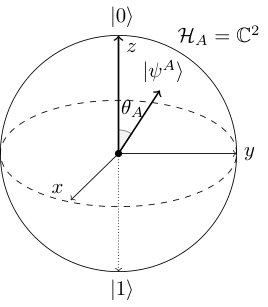 Figure 1
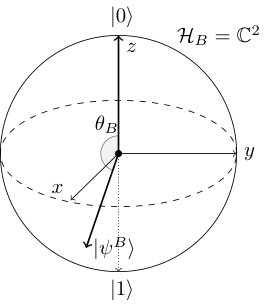 Figure 2
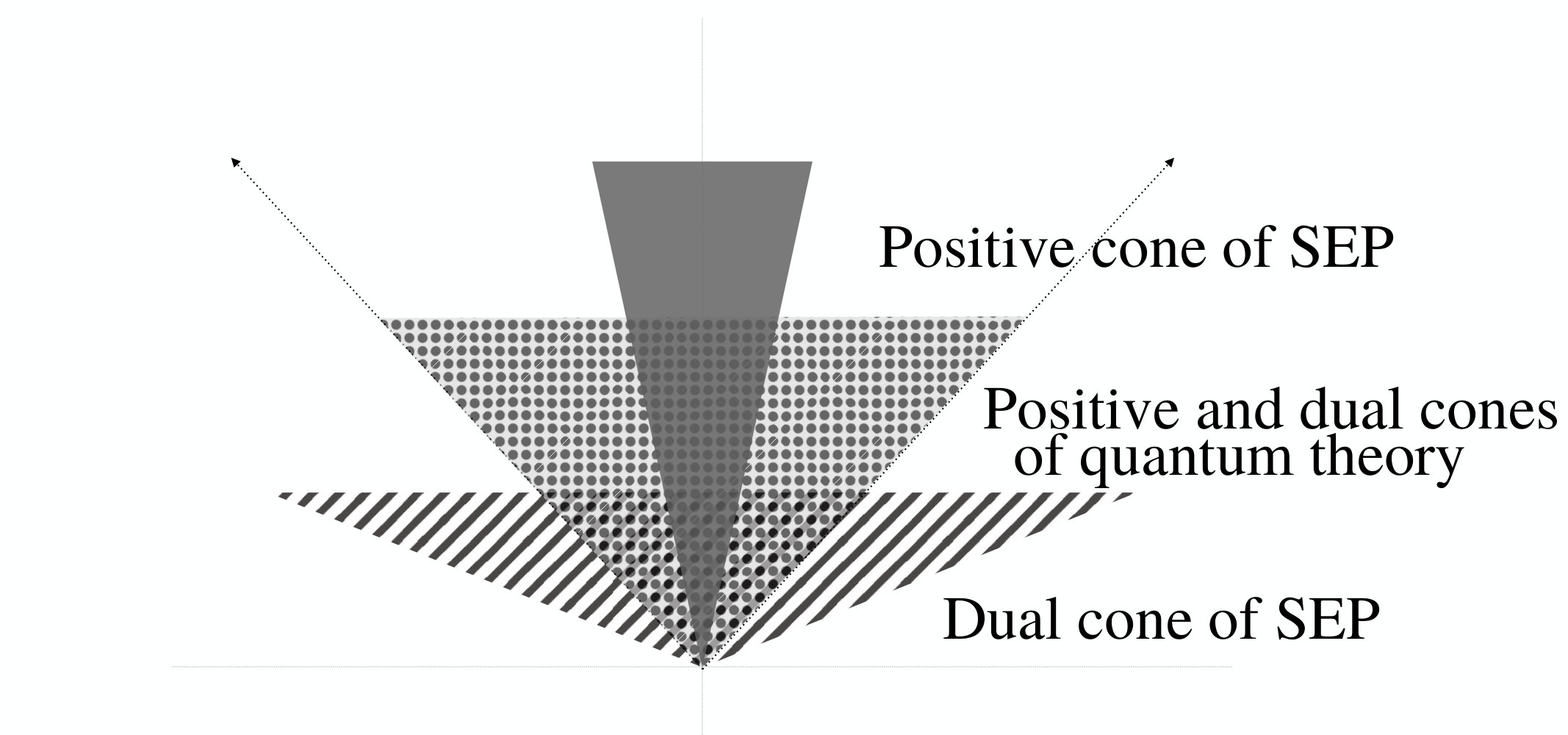 Figure 3
| GPTs | SEP | Quantum theory |
|---|---|---|
| Necessary and sufficient | ||
| condition | ||
| of perfect discrimination | ||
| Capacity |
Peer Reviews
No public reviews on file for this paper yet. If you reviewed it on a platform where reviews are public (OpenReview, ICLR, NeurIPS, ICML), you can paste yours below so the community can read it here.
Videos
No videos yet. Explain this paper in a talk, walkthrough, or lecture? Add one.
, ,
Perfect Discrimination of Non-Orthogonal Separable Pure States on Bipartite System in General Probabilistic Theory
Hayato Arai1, Yuuya Yoshida1, and Masahito Hayashi1,2,3
1 Graduate School of Mathematics, Nagoya University, Nagoya, Japan
2 Shenzhen Institute for Quantum Science and Engineering, Southern University of Science and Technology, Nanshan District, Shenzhen 518055, People’s Republic of China
3 Centre for Quantum Technologies, National University of Singapore, 3 Science Drive 2, 117542, Singapore
Abstract
We address perfect discrimination of two separable states. When available states are restricted to separable states, we can theoretically consider a larger class of measurements than the class of measurements allowed in quantum theory. The framework composed of the class of separable states and the above extended class of measurements is a typical example of general probabilistic theories. In this framework, we give a necessary and sufficient condition to discriminate two separable pure states perfectly. In particular, we derive measurements explicitly to discriminate two separable pure states perfectly, and find that some non-orthogonal states are perfectly distinguishable. However, the above framework does not improve the capacity, namely, the maximum number of states that are simultaneously and perfectly distinguishable.
Keywords: perfect discrimination, separable states, general probabilistic theories
1 Introduction
Entanglement is a resource for miracle performance of quantum information processing [1, 2]. Even when a quantum state has no entanglement, entanglement in a measuring process brings us performance that measuring processes without quantum correlation cannot realize. In fact, when we discriminate the -fold tensor products of two quantum states, the performance of measurements with quantum correlation is beyond that of any measurement without quantum correlation, e.g., local operation and classical communication (LOCC) and separable measurement [3, 4, 5, 6, 7]. The difference between the first and second performance can be derived from the following two classes of measurements. One is the class of measurements allowed in quantum theory and the other is the class of measurements with only separable form. The first class achieves strictly better performance than the second class in the above discrimination.
All the above studies of state discrimination considered classes of measurements allowed in quantum theory, but there is a theoretical possibility that a larger class of measurements brings us more miracle performance of state discrimination than that of quantum theory. In order to consider a larger class of measurements, we need to restrict available states. Such a framework is discussed in general probabilistic theories (GPTs) [8, 9, 10, 11, 12, 13, 14, 15, 16, 17, 18, 19, 20, 21, 22, 23], which are a generalization of quantum theory and classical probability theory. GPTs are the most general framework to characterize states, measurements, and time evolution. Although some preceding studies compared GPTs with quantum theory [13, 16, 17, 15, 11, 18], few studies clarified the difference between quantum theory and other GPTs in the viewpoint of state discrimination. Hence, to clarify the difference, we focus on the following typical GPT on a bipartite system: we restrict available states to separable states on the composite system and this restriction allows us to consider theoretically measurements that are not allowed in quantum theory. The framework composed of the class of separable states and the class of such measurements is a typical example of GPTs and is denoted by SEP.
The difference between quantum theory and SEP can be characterized by the relation between the positive and dual cones appeared in quantum theory and SEP, as illustrated in figure 1. A positive cone defines the set of all states in a GPT so that a state is given as an element of a positive cone whose trace is one. For example, the positive cone of quantum theory is the set of all positive semi-definite matrices and the positive cone of SEP is the set of all matrices with separable form. Thus, states in SEP are restricted to separable states, and the positive cone of SEP is smaller than that of quantum theory. This restriction makes bit commitment possible under SEP [14]. Furthermore, the dual cone of a positive cone defines measurements of a GPT so that a measurement is given as a decomposition of the identity matrix . More precisely, all elements lie in the dual cone and satisfy . For example, the dual cone of quantum theory is also the set of all positive semi-definite matrices and the dual cone of SEP is the set of all matrices that satisfy for all matrices with separable form. Thus the dual cone of SEP is larger than that of quantum theory. Therefore, measurements of SEP contain not only those of quantum theory but also those that quantum theory cannot realize.
In this paper, we address perfect discrimination of two pure states in SEP. A main goal of this paper is to reveal how much better the performance of perfect discrimination in SEP is than that in quantum theory. In quantum theory, it is well-known that orthogonality of two states is necessary and sufficient to discriminate two states perfectly [24]. This fact is not changed even if we restrect the class of measurements to LOCC [25]. However, as shown in this paper, there exists a non-orthogonal pair of two separable pure states that can be discriminated in SEP. Moreover, we derive a necessary and sufficient condition for state discrimination in SEP. The necessary and sufficient condition implies that -copies and of pure states are perfectly distinguishable for a sufficiently large if . In this sense, SEP is completely different from quantum theory.
Since our necessary and sufficient condition reveals that some non-orthogonal states in SEP can be discriminated perfectly, one might think that the capacity in SEP is improved in comparison with the capacity in quantum theory. Here the capacity in a GPT is the maximum number of states that are simultaneously and perfectly distinguishable in the GPT, and expresses the limit of communication quantity per single use of quantum communication. The capacity in quantum theory is equal to the dimension of a quantum system, and an interesting relation for the capacities in GPTs has been derived [10]. Using the relation [10, lemma 24], we find that the capacity in SEP is equal to that in quantum theory.
The remaining of this paper is organized as follows. The beginning of section 2 formulates our extended class of measurements and gives a perfectly distinguishable pair of two separable pure states that are not orthogonal. The latter of section 2 gives a necessary and sufficient condition to discriminate two separable pure states in SEP perfectly (theorem 2.4). Also, the latter of section 2 discusses the capacity in SEP (theorem 2.5). Section 3 proves the sufficiency of theorem 2.4 and section 4 does the necessity of theorem 2.4. Section 5 is devoted to further discussion.
2 Perfectly distinguishable pairs of two pure states in SEP
First, let us describe our framework SEP and notational conventions. Let and be two finite-dimensional complex Hilbert spaces. We denote by and the set of all Hermitian matrices on and the set of all positive semi-definite matrices on , respectively. The sets , , , and are defined similarly. In quantum theory, available states are elements of with trace one. However, in this paper we look at the scenario where the only available states are separable states we restrict available states to separable states, i.e., elements of
[TABLE]
with trace one. In order to address state discrimination, we must also define measurements of SEP. In quantum theory, measurements are given as positive-operator valued measures (POVMs). That is, a measurement satisfies and for any outcome . However, since we restrict available states to separable states, measurements of SEP form a larger class than those of quantum theory. A measurement of SEP is defined by the conditions
[TABLE]
where denotes the dual cone of and is defined as
[TABLE]
Since the inclusion relation holds, measurements of SEP form a larger class than those of quantum theory.
Remark 2.1**.**
For readers’ convenience, we describe SEP again according to GPTs. Let be a finite-dimensional real vector space with an inner product . We say that is a (proper) positive cone if is a closed convex set satisfying the following conditions:
- •
for all and ,
- •
,
- •
The interior of is non-empty.
Also, the dual cone of a positive cone is defined as
[TABLE]
A GPT consists of a real vector space , a positive cone , and an element of the interior of . A state of a GPT is given as an element of satisfying . Also, a measurement of the GPT is given as a family composed of elements in satisfying . As a framework of states and measurements, quantum theory is equivalent to the GPT , and our framework SEP is equivalent to the GPT . Also, SEP is a composite system of two quantum subsystems and . Since the dual cone includes any entanglement witness, the framework SEP is often called witness theory [17]. Moreover, the positive cone SEP is the smallest cone of all positive cones of composite systems of two quantum subsystems, and thus it is called the minimal tensor product [12].
Now, let us consider state discrimination in SEP. Let be a family of states. Then we say that is perfectly distinguishable in SEP (resp. quantum theory) if there exists a measurement of SEP (resp. quantum theory) such that , where denotes the Kronecker delta. It is well-known that is perfectly distinguishable in quantum theory if and only if any two distinct states of are orthogonal, i.e., for all . In this paper, we address the case mainly.
Example 2.3 gives an example that two states are perfectly distinguishable and not orthogonal. For this purpose, we consider the case where and are two-dimensional (hereinafter, it is called the -dimensional case). In this case, the dual cone can be expressed explicitly by using the partial transpose operation , which throughout the paper we assume to be on subsystem . Since for matrices and the tensor product matrix is expressed as
[TABLE]
the partial transpose of a matrix is
[TABLE]
As stated above, we can express the dual cone explicitly. Indeed, the combination of [26] and [27] implies the following proposition.
Proposition 2.2**.**
If , then
[TABLE]
Next, we give an example of two pure states that are perfectly distinguishable in SEP despite being non-orthogonal. What follows is also a special case of our main result.
Example 2.3** (Perfect discrimination of non-orthogonal pure states in SEP).**
Suppose that two pure states are given as
[TABLE]
where , , and for all . Assume here. Then we show that and are perfectly distinguishable in SEP. Let us give a measurement with positive semi-definite matrices and . Since and are positive semi-definite, proposition 2.2 implies that for all . Now, we set the positive semi-definite matrices and as
[TABLE]
Then is a measurement of SEP because . The measurement discriminates and perfectly. Let us verify it. First, the equation follows from the definitions. Next, note that the assumption implies . Since (i) and (ii) (), we have
[TABLE]
Thus the equation also follows. Finally, the equation follows from and for all . Therefore, the measurement discriminates and perfectly. Here, note that and are not orthogonal if . Thus perfect discrimination of two pure states in SEP is possible even when the two states are not orthogonal.
Figure 2 illustrates this example by using the two Bloch spheres. Let be an orthonormal basis of a qubit. Then the state can be expressed as . Since is also a separable pure state, there exist two unit vectors and such that . The condition given above corresponds to the condition of the angles in figure 2.
Example 2.3 gives a sufficient condition of perfect discrimination, but it does not give a necessary condition. Thus we give the following theorem as a necessary and sufficient condition for two pure states to be discriminated perfectly.
Theorem 2.4**.**
Two pure states and are perfectly distinguishable in SEP if and only if
[TABLE]
Here, let us compare the necessary and sufficient condition in SEP with that in quantum theory. In quantum theory, the condition is necessary and sufficient to discriminate the two state in theorem 2.4 perfectly. Thus we can find that measurements of SEP improve the performance of state discrimination. The sufficiency of theorem 2.4 is proved in section 3 and the necessity of theorem 2.4 is proved in section 4.
Measurements of SEP improve the performance of multiple-copy state discrimination more dramatically. To see this fact, let us consider perfect discrimination of -copies and of pure states. Then is a separable pure state on a bipartite system for . Thus and are perfectly distinguishable in SEP if
[TABLE]
This inequality always holds for a sufficiently large if . Therefore, and are perfectly distinguishable in SEP. Of course, such a measurement to realize the above perfect discrimination is impossible in quantum theory.
Next, we discuss how many states are simultaneously and perfectly distinguishable in SEP. That is, our interest is the capacity defined as the maximum number of simultaneously and perfectly distinguishable states in SEP:
[TABLE]
where and are a family of states in SEP and a measurement of SEP, respectively. As stated in the previous paragraph, the performance of state discrimination in SEP is higher than that in quantum theory. Hence one might guess that the capacity in SEP is greater than that in quantum theory. However, the following proposition shows that this is not the case.
Proposition 2.5**.**
The capacity is .
Since the capacity in quantum theory is equal to the dimension of a quantum system, proposition 2.5 asserts that has the same capacity as quantum theory. Actually, proposition 2.5 follows from [10, lemma 24 (iii)] which is a more general statement on capacities of composite systems of two quantum subsystems.111The statement [28, theorem 3] is also the same statement on capacities as [10, lemma 24 (iii)]. However, it assumes the additional requirement [28, requirement 3] that all systems of the same type with the same capacity are equivalent up to invertible linear transformation, and it is not clear that SEP satisfies the requirement. Therefore, we do not use [28, theorem 3] here. To use [10, lemma 24 (iii)], we need to verify the transitivity of quantum theory on () and SEP on . When we give a group of transformations mapping states to states in quantum theory (resp. SEP), transitivity asserts that, for any pair of two pure states and in quantum theory (resp. SEP), there exists a transformation such that . For , quantum theory on is transitive because the group
[TABLE]
satisfies the assertion of transitivity. Also, SEP on the composite system is also transitive because the group
[TABLE]
satisfies the assertion of transitivity. Additionally, we need the maximally mixed condition: for each system, the average is equal to the state for any pure state , where is the Haar measure on and is the dimension of the system. To use [10, lemma 24 (iii)], the groups , , and need to satisfy the maximally mixed condition. Fortunately, this is indeed the case. Therefore, SEP on the composite system satisfies the assumption of [10, lemma 24 (iii)] and thus proposition 2.5 follows.
Table 1 summarizes the necessary and sufficient conditions of perfect discrimination and the capacities in quantum theory and SEP. The performance of perfect discrimination in SEP is better than that in quantum theory but the capacity in SEP is equal to that in quantum theory.
3 Proof of the sufficiency of theorem 2.4
In this section, we prove the sufficiency of theorem 2.4. Any pair of two pure states and in SEP can be expressed as by using unit vectors and . Thus there exist two-dimensional subspaces and such that . Hence, for all integers , the -dimensional case can be reduced to the -dimensional case. Without loss of generality, the above states and can be written as (1). After all, it suffices to prove the following theorem.
Theorem 3.1** (Sufficiency of theorem 2.4).**
Assume that two pure states in SEP are given as (1). If , then and are perfectly distinguishable in SEP.
We prove theorem 3.1 by giving measurements of SEP explicitly. It is the most difficult point in the proof of theorem 3.1 to prove that elements of measurements belong to . Since proposition 2.2 can be applied to the -dimensional case, elements of measurements are give as the form in proposition 2.2. Thus the proof of theorem 3.1 requires us to prove that certain matrices are positive semi-definite. To prove positive semi-definiteness, we need to investigate principal submatrices. For a matrix and a set , the principal submatrix is defined as the matrix . As a criterion of positive semi-definiteness, the following proposition is well-known.
Proposition 3.2** (Section 7 in [29]).**
Let be a Hermitian matrix whose rank is . If any integer satisfies , then is positive semi-definite.
Having fixed the notation according to the above explanation, let us prove theorem 3.1.
Proof of theorem 3.1.
The case has been already proved in example 2.3. Thus we assume in this proof. Then the condition holds due to and . Now, we define the matrices and as
[TABLE]
Let us show that is a measurement of SEP and discriminates and perfectly. That is, let us verify that
[TABLE]
The equation (2) follows from the definitions of and . The equation (2) and the invariance of under reduce (3) to and . Since the equation follows from the definitions of and , the remaining of (3) is . Define the two unit vectors and as
[TABLE]
Then . Noting , , and
[TABLE]
we find that all entries of vanish:
[TABLE]
The above fact implies . Therefore, (3) holds.
Finally, we verify (4). As already stated, (4) follows from the positive semi-definiteness of and . Since , the rank of is at most three. Moreover, the determinants of , , and are positive due to the assumption . Thus proposition 3.2 implies that is positive semi-definite. The remaining of (4) is the positive semi-definiteness of . To prove it, we verify the positive definiteness of . First, the inequality of arithmetic and geometric means yields (i) . The inequality (i) and the assumption (ii) imply
[TABLE]
Second, the determinant of can be calculated as follows:
[TABLE]
Since the determinants of , , and are positive, proposition 3.2 implies that is positive semi-definite. Therefore, is also positive semi-definite and then we finish this proof. ∎
4 Proof of the necessity of theorem 2.4
In this section, we prove the necessity of theorem 2.4. As stated in section 3, for all integers , the -dimensional case can be reduced to the -dimensional case. Although and in theorem 2.4 are pure states, we address not necessarily pure product states in the -dimensional case. Hence, without loss of generality, it suffices to prove the following theorem.
Theorem 4.1** (Necessity of theorem 2.4).**
Assume that two product states and in SEP are given as
[TABLE]
where , , and for all . If and are perfectly distinguishable in SEP, then
[TABLE]
If the additional condition holds, then (6) can be reduced to
[TABLE]
If the additional condition holds, the equation (5) turns to (1). Hence (7) means the necessity of theorem 2.4. Since theorem 4.1 handles mixed states, another additional condition leads to a result which theorem 2.4 does not imply. For instance, theorem 2.4 does not imply the following: if the additional condition holds, then (6) implies that and are orthogonal. Thus, if and are diagonal matrices, the perfect discrimination of and in SEP implies the orthogonality of and .
Proof of theorem 4.1..
Proposition 2.2 implies that any element of can be expressed as with positive semi-definite matrices and . Thus we assume that a measurement with positive semi-definite matrices , , and discriminates and perfectly in SEP. That is, the equation
[TABLE]
holds. Since fixes and , the equation
[TABLE]
also holds. Put for all . Then is a measurement of SEP and satisfies
[TABLE]
Since fixes and , the above equation can be reduced to
[TABLE]
Furthermore, the matrix satisfies
[TABLE]
Thus the positive semi-definite matrix can be written as
[TABLE]
for some and . From the positive semi-definiteness of , the inequality follows.
Now, we show (6). Since (8) implies , we obtain
[TABLE]
Hereinafter, denotes the real part of a matrix . Then the matrices and are calculated as follows:
[TABLE]
Since all entries of and are real, the equation
[TABLE]
holds. Thus it follows that
[TABLE]
Therefore, the inequality and (9) imply (6).
Next, assuming the additional condition , we show (7). The inequality and (6) imply that
[TABLE]
whence (7) holds. ∎
5 Discussion
In this paper, we have discussed perfect discrimination in SEP, and has revealed that a necessary and sufficient condition to discriminate two pure states in SEP perfectly is that the inequality be satisfied. More generally, let us consider perfect discrimination of two mixed states in SEP. Two states can be written as and , where and are separable pure states; and . In this case, perfect discrimination of and is equivalent to that of any and by a common measurement. Hence the tuple of the above inequalities for any and is a necessary condition for perfect discrimination. However, a sufficient condition must be more strict because the tuple of the above inequalities for any and does not imply the existence of a common measurement. Since a necessary and sufficient condition for perfect discrimination of two mixed states in SEP is not given yet, it is a future study.
As a related study, Maruyama et al. [30] pointed out the possibility of the break of the second thermodynamical law when non-orthogonal states can be discriminated perfectly. Since we have shown the above perfect discrimination in SEP, it is another interesting future study to investigate the second thermodynamical law in SEP. As another future study, we might apply our result to the calculation of the various type of information quantity defined in [22, eqs. (18), (26), and (29)]. This application is expected to bring us more information-theoretical study on SEP.
MH is grateful to Prof. Giulio Chiribella, Prof. Oscar Dahlsten, and Dr. Daniel Ebler for helpful discussions. He is also thankful to Mr. Kun Wang for his comments. The authors are grateful to Mr. Seunghoan Song for providing many helpful comments for this paper. MH was supported in part by Japan Society for the Promotion of Science (JSPS) Grant-in-Aid for Scientific Research (A) No. 17H01280, (B) No. 16KT0017, and Kayamori Foundation of Informational Science Advancement. YY was supported by JSPS Grant-in-Aid for JSPS Fellows No. 19J20161.
References
- [1]
Bennett C H, Brassard G, Crepeau C, Jozsa R, Peres A and Wootters W K 1993 Phys. Rev. Lett. 70 1895–1899
- [2]
Bennett C H and Wiesner S J 1992 Phys. Rev. Lett. 69 2881–2884
- [3]
Hiai F and Petz D 1991 Comm. Math. Phys. 143 99–114
- [4]
Nagaoka H and Ogawa T 2000 IEEE Trans. Inf. Theory 46 2428–2433
- [5]
Audenaert K M R, Calsamiglia J, Muñoz Tapia R, Bagan E, Masanes L, Acin A and Verstraete F 2007 Phys. Rev. Lett. 98 160501
- [6]
Nussbaum M and Szkola A 2009 Ann. Stat. 1040–1057
- [7]
Hayashi M 2017 Quantum Information Theory Mathematical Foundation 2nd ed (Verlag Berlin Heidelberg: Springer)
- [8]
Kimura G, Nuida K and Imai H 2010 “Physical equivalence of pure states and derivation of qubit in general probabilistic theories” arXiv:1012.5361
- [9]
Kimura G, Ishiguro J and Fukui M 2016 Phys. Rev. A 94
- [10]
Müller M P, Dahlsten O C O and Vedral V 2012 Comm. Math. Phys. 316 441–487
- [11]
Janotta P and Lal R 2013 Phys. Rev. A 87(5) 052131
- [12]
Janotta P and Hinrichsen H 2014 J. Phys. A 47 323001
- [13]
Barnum H, Barrett J, Leifer M and Wilce A 2006 “Cloning and broadcasting in generic probabilistic theories” arXiv:quant-ph/0611295
- [14]
Barnum H, Dahlsten O C, Leifer M and Toner B 2008 “Nonclassicality without entanglement enables bit commitment” Proceedings of IEEE Information Theory Workshop pp 386–390
- [15]
Barnum H, Beigi S, Boixo S, Elliott M B and Wehner S 2010 Phys. Rev. Lett. 104 14 140401
- [16]
Dahlsten O C O, Lercher D and Renner R 2012 New J. Phys. 14 063024
- [17]
Lami L, Palazuelos C and Winter A 2017 “Ultimate data hiding in quantum mechanics and beyond” arXiv:1703.03392
- [18]
Hamamura I 2018 Phys. Lett. A 382 2573–2577
- [19]
Yoshida Y and Hayashi M 2018 “Mixing and asymptotically decoupling properties in general probabilistic theory” arXiv:1801.03988
- [20]
Aubrun G, Lami L, Palazuelos C, Szarek S J and Winter A 2018 “Universal gaps for xor games from estimates on tensor norm ratios” arXiv:1809.10616
- [21]
Matsumoto K and Kimura G 2018 “Information storing yields a point-asymmetry of state space in general probabilistic theories” arXiv:1802.01162
- [22]
Short A J and Wehner S 2010 New J. Phys. 12 033023
- [23]
Bae J, Kim D G and Kwek L 2016 Entropy 18 39
- [24]
Nielsen M A and Chuang I L 2000 Quantum Computation and Quantum Information (New York: Cambridge University Press)
- [25]
Walgate J, Short A J, Hardy L and Vedral V 2000 Phys. Rev. Lett. 85(23) 4972–4975
- [26]
Horodecki M, Horodecki P and Horodecki R 1996 Phys. Lett. A 223 1–8
- [27]
Lewenstein M, Kraus B, Cirac J I and Horodecki P 2000 Phys. Rev. A 62 052310
- [28]
Masanes L and a P Müller 2011 New J. Phys. 13 063001
- [29]
Horn R A and Johnson C R 2012 Matrix Analysis 2nd ed (New York: Canbride University Press)
- [30]
Maruyama K, Nori F and Vedral V 2009 Rev. Mod. Phys. 81 1–23
The reference list from the paper itself. Each links out to its DOI / PubMed record.
- 1[1] Bennett C H, Brassard G, Crepeau C, Jozsa R, Peres A and Wootters W K 1993 Phys. Rev. Lett. 70 1895–1899
- 2[2] Bennett C H and Wiesner S J 1992 Phys. Rev. Lett. 69 2881–2884
- 3[3] Hiai F and Petz D 1991 Comm. Math. Phys. 143 99–114
- 4[4] Nagaoka H and Ogawa T 2000 IEEE Trans. Inf. Theory 46 2428–2433
- 5[5] Audenaert K M R, Calsamiglia J, Muñoz Tapia R, Bagan E, Masanes L, Acin A and Verstraete F 2007 Phys. Rev. Lett. 98 160501
- 6[6] Nussbaum M and Szkola A 2009 Ann. Stat. 1040–1057
- 7[7] Hayashi M 2017 Quantum Information Theory Mathematical Foundation 2nd ed (Verlag Berlin Heidelberg: Springer)
- 8[8] Kimura G, Nuida K and Imai H 2010 “Physical equivalence of pure states and derivation of qubit in general probabilistic theories” ar Xiv:1012.5361