Spectral enclosures for a class of block operator matrices
Juan Giribet, Matthias Langer, Francisco Mart\'inez Per\'ia, Friedrich, Philipp, Carsten Trunk

TL;DR
This paper develops new spectral enclosures for certain block operator matrices, including a Gershgorin-like theorem, with applications to J-frame operators, advancing understanding of their spectral properties.
Contribution
It introduces novel spectral enclosures for block operator matrices with self-adjoint diagonal entries, extending Gershgorin's theorem to this operator class.
Findings
Derived spectral enclosures for non-real spectra.
Extended Gershgorin's circle theorem to block operator matrices.
Applied results to analyze J-frame operators.
Abstract
We prove new spectral enclosures for the non-real spectrum of a class of block operator matrices with self-adjoint operators and on the diagonal and operators and as off-diagonal entries. One of our main results resembles Gershgorin's circle theorem. The enclosures are applied to -frame operators.
Click any figure to enlarge with its caption.
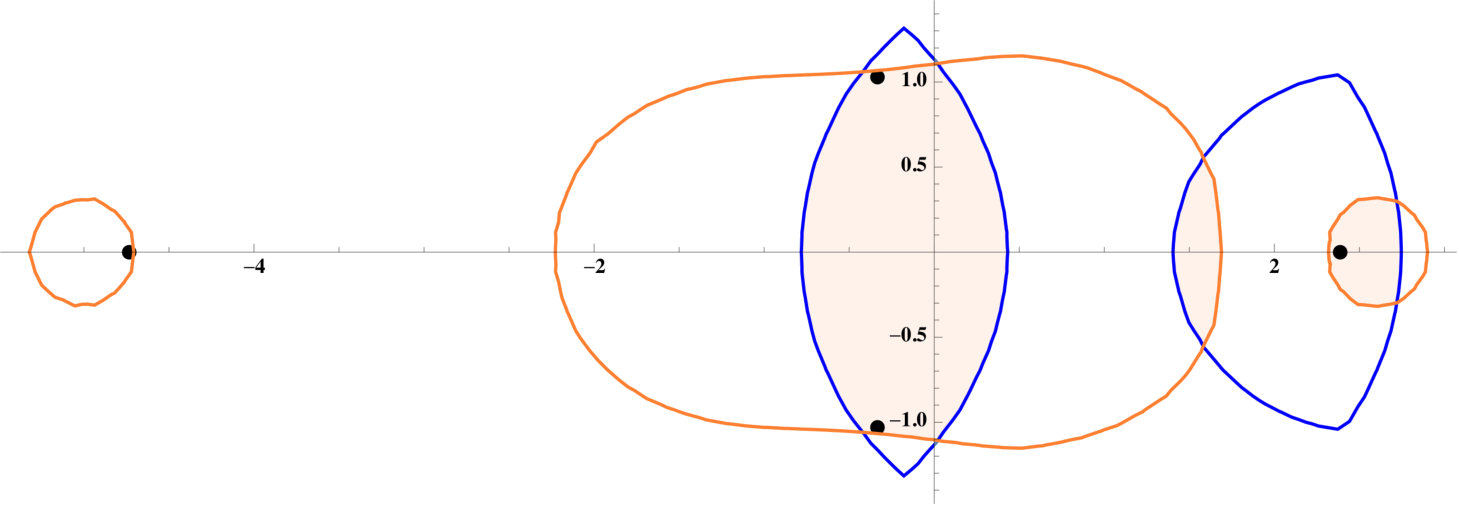 Figure 1
Peer Reviews
No public reviews on file for this paper yet. If you reviewed it on a platform where reviews are public (OpenReview, ICLR, NeurIPS, ICML), you can paste yours below so the community can read it here.
Videos
No videos yet. Explain this paper in a talk, walkthrough, or lecture? Add one.
Spectral enclosures for a class of block operator matrices
Juan Giribet
Matthias Langer
Francisco Martínez Pería
Friedrich Philipp
Carsten Trunk
Instituto Argentino de Matemática “Alberto P. Calderón” (CONICET), Saavedra 15 (1083) Buenos Aires, Argentina
Departamento de Matemática – FI-Universidad de Buenos Aires, Paseo Colón 850 (1063) Buenos Aires, Argentina
Department of Mathematics and Statistics, University of Strathclyde, 26 Richmond Street, Glasgow G1 1XH, United Kingdom
personal.strath.ac.uk/m.langer
Centro de Matemática de La Plata – FCE, Universidad Nacional de La Plata, C.C. 172, (1900) La Plata, Argentina
Katholische Universität Eichstätt-Ingolstadt, Ostenstraße 26, 85072 Eichstätt, Germany
Institut für Mathematik, Technische Universität Ilmenau, Postfach 100565, D-98684 Ilmenau, Germany
www.tu-ilmenau.de/de/analysis/team/carsten-trunk
Abstract
We prove new spectral enclosures for the non-real spectrum of a class of block operator matrices with self-adjoint operators and on the diagonal and operators and as off-diagonal entries. One of our main results resembles Gershgorin’s circle theorem. The enclosures are applied to -frame operators.
keywords:
Block operator matrices, quadratic numerical range, spectral enclosure, Gershgorin’s circle
1. Introduction
We consider block operator matrices acting in the orthogonal sum of two Hilbert spaces,
[TABLE]
where and are (possibly unbounded) self-adjoint operators in and , respectively, and is a bounded operator from to .
Such operators play an important role in various applications. For instance, they appear in the study of so-called floating singularities [6, 14, 15, 19, 21], in the perturbation theory for equations of indefinite Sturm–Liouville type [5], and also in frame theory [12, 13].
Clearly, is not self-adjoint in unless . However, it is self-adjoint if we introduce the indefinite inner product
[TABLE]
for bounded this means that for all . The indefinite inner product turns into a Krein space, i.e. it is the orthogonal sum of a Hilbert space and an anti-Hilbert space. Actually, every bounded self-adjoint operator in a Krein space can be written in the form (1.1).
Of particular interest is the location of the spectrum of . In [18, 23, 30] spectral enclosures were obtained via the quadratic numerical range, and in [4, 5] in terms of the spectra of and . Gershgorin-type results for more general operator matrices were presented in [9] and [28]. Moreover, in [1, 14, 20, 21] the essential spectrum was investigated, and in [19] variational principles and estimates for eigenvalues were proved. Invariant subspaces and factorizations of Schur complements were considered in [24] and [2], and in [3] conditions were presented for an operator of the form (1.1) to be similar to a self-adjoint operator in a Hilbert space. For an overview we refer to the monograph [29].
In general, the spectrum of block operator matrices as in (1.1) is not contained in the real line. The self-adjointness of in the Krein space with the inner product (1.2) implies only that the spectrum of is symmetric with respect to the real axis. The aim of this paper is to prove enclosures for the (non-real) spectrum of in terms of (spectral) quantities of the operators , , and .
We start with a general enclosure for the (closure) of the quadratic numerical range of , formulated in terms of the numerical ranges of and and the norm of ; see Proposition 3.3 below. The quadratic numerical range of a block operator matrix was introduced in [22] and its closure contains the spectrum of ; see (2.2). Although similar enclosures for the spectrum of were already known, one of the advantages of having a spectral enclosure for the quadratic numerical range is that it leads also to estimates of the norm of the resolvent; see the discussion in Remark 3.4. Moreover, Proposition 3.3 is sharp in the sense that the enclosures for the quadratic numerical range cannot be improved if just the numerical ranges of and and the norm of are known; see Theorem 3.5.
The main contribution of this paper is a spectral enclosure for the operator matrix , which is connected with the Schur complements. It is well known and follows from a relatively simple Neumann series type argument applied to the first and second Schur complement that
[TABLE]
see [9, Theorem 1.1], [4, Lemma 5.2 (ii)] or [29, Section 2.3]. Here we prove that
[TABLE]
see Theorem 4.8 below. The enclosures (1.3) and (1.4) are independent of each other in the sense that none of the sets in the right-hand sides of (1.3) and (1.4) is strictly contained in the other one. However, since the norm inequalities in (1.4) deal separately with the resolvent functions of and it is easy to construct examples where the enclosure in (1.4) is strictly contained in the one in (1.3), see Example 4.14.
Note that the spectral enclosures in (1.3) and (1.4) are not explicitly formulated in terms of the spectra of and . However, it is one of our main observations that (1.4) allows a reformulation in a more geometric manner. In particular, given , if and only if for all positive continuous functions with some specific behaviour at infinity we have
[TABLE]
where is a specific closed subset of and stands for the closed ball of radius around ; for details we refer to Proposition 4.12 below. A similar interpretation can be obtained for the inequality in terms of continuous functions defined in a closed subset of the spectrum of . Therefore, the enclosure for the non-real part of the spectrum of in (1.4) implies a family of enclosures which resemble Gershgorin’s circle theorem: for any two positive continuous functions and with some specific behaviour at infinity we have that
[TABLE]
see Theorem 4.13 below.
Maybe the most interesting situations appear when one chooses the functions and explicitly. For instance, if is boundedly invertible and then (1.5) implies
[TABLE]
Moreover, if then these balls are contained in a double-sector with half opening angle , see Figure 1 below.
It is worth mentioning that (1.4) also improves the following spectral enclosure obtained in [5]: if then
[TABLE]
In fact, obviously implies and the latter is equivalent to . A similar argument with and instead of and completes the proof.
Finally, in Section 5 we apply the spectral enclosures obtained in Section 4 to operator matrices of the form (1.1) which appear in frame theory. The so-called -frame operators were introduced in [13] and further investigated in [12]. Our findings lead to significant improvements of the spectral enclosures for -frame operators obtained in [12].
2. Preliminaries
If and are Hilbert spaces, we denote by the space of all bounded linear operators mapping from to . As usual, we set . For and we set
[TABLE]
If , we also write for the closed disc with centre and radius .
The numerical range of a linear operator in the Hilbert space is defined by
[TABLE]
It is well known that the numerical range is convex and that has at most two (open) connected components (see [16, V.3.2]). Moreover, it is immediate from the definition of that , where stands for the point spectrum of . If is closed, and , , then
[TABLE]
This shows that is closed and . Hence, if each of the (at most two) components of contains points from the resolvent set , then . This holds in particular if is bounded. The next lemma is now immediate.
Lemma 2.1**.**
Let , where is a self-adjoint operator in a Hilbert space and . Then and for we have
[TABLE]
Let us also recall the definition of the quadratic numerical range, which was introduced in [22]; see also [29, Definition 1.1.1]. Assume that the Hilbert space is the orthogonal sum of two Hilbert spaces, and . Let be a bounded operator in decomposed as
[TABLE]
where , , , and . For and with we introduce the matrix
[TABLE]
The set
[TABLE]
is called the quadratic numerical range of . It is no longer a convex subset of , but it has at most two connected components.
One of the advantages of the quadratic numerical range is that it is contained in the numerical range: and that we have the following refined spectral inclusions
[TABLE]
see [29, Theorem 1.3.1]. Moreover, the resolvent can be estimated in terms of the distance to :
[TABLE]
see [29, Theorem 1.4.1]. If with disjoint non-empty closed sets and , then
[TABLE]
see [29, Theorem 1.4.5].
The quadratic numerical range definition can be easily extended to unbounded block operator matrices, restricting the vectors and in (2.1) to the proper domains and , respectively. For details see [29, Definition 2.5.1].
In the following we recall the definition of the Schur complements of a block operator matrix, which are powerful tools to study the spectrum and spectral properties. Let and be closed operators in and , respectively, , and . For the block operator matrix
[TABLE]
the first and second Schur complements of are defined by:
[TABLE]
These are analytic operator functions defined on the resolvent sets of and , respectively.
In the next sections we shall make use of the following auxiliary result from [25]; see also [29, Theorem 2.3.3].
Lemma 2.2** ([25, Theorem 2.4]).**
Let and be closed operators in and , respectively, let and , and consider the block operator matrix
[TABLE]
*Then the following statements hold:
- (i)
For one has if and only if .
- (ii)
For one has if and only if .
Moreover, if , then
[TABLE]
3. Sharp enclosures for the quadratic numerical range
Let be as in (1.1) with bounded operators
[TABLE]
where and are self-adjoint in the Hilbert spaces and , respectively. Hence, the numerical ranges and are real intervals. We introduce the following numbers, which are used for the description of the enclosures that are proved below:
[TABLE]
If , then is the midpoint of the gap between and , and is half the length of the gap; e.g. if , then
[TABLE]
The following proposition contains enclosures of the closure of the quadratic numerical range of operators of the form (1.1). Due to (2.2) these yield also enclosures for the spectrum. Note that the enclosures in Proposition 3.3 depend only on , and . They are illustrated in Figures 2–5 below.
Proposition 3.3**.**
Given a Hilbert space , consider the block operator matrix
[TABLE]
where , and and are bounded self-adjoint operators in and , respectively. Further, let the constants , , , and be as in (3.1)–(3.4). Then
[TABLE]
Moreover, in the special case where
[TABLE]
we have
[TABLE]
in particular, both the quadratic numerical range and the spectrum of are real.
Proof.
Inclusion (3.6) follows from [29, Proposition 1.2.6]. It is sufficient to show (3.7) and (3.9) without the closures on the left-hand sides because the right-hand sides are closed sets. Let . Then there exist and with such that is an eigenvalue of the matrix in (2.1) with , and , which satisfies . By [18, Theorem 2.1] and [5, Theorem 3.5] the inclusion (3.7) holds for replaced by . Applying this to the matrix we obtain that in the case when is non-real, is contained in
[TABLE]
and hence in the right-hand side of (3.7).
It remains to show (3.9). We assume without loss of generality that , in which case and . By (3.7), , and hence or where
[TABLE]
It is easy to see that is increasing in and decreasing in . Therefore
[TABLE]
and, similarly, . Together with (3.6), this shows the inclusion (3.9). ∎
Remark 3.4**.**
- (a)
Parts of Proposition 3.3 are known: inclusion (3.6) is from [29, Proposition 1.2.6].
- (b)
Inclusion (3.7) is an improvement of a similar result in [29, Proposition 1.2.6]. To be more precise, in [29, Proposition 1.2.6] the following inclusion is proved, when ,
[TABLE]
cf. also [29, Proposition 1.3.9]. It is easy to see that the right-hand side of (3.7) is contained in the right-hand side of (3.10), and in most cases the inclusion is strict; see also Figures 2–5 below.
- (c)
Inclusion (3.9) improves [29, Proposition 1.2.6] significantly, namely, the former implies that the interval
[TABLE]
has empty intersection with if . A similar result for the spectrum of (which is, in general, a smaller set) can be found in [8, Theorem 4.2] and, in a somehow different form, in [3, Theorem 5.8] and [4, Theorem 5.4].
- (d)
For enclosures for the quadratic numerical range and the spectrum where all entries , , and are allowed to be unbounded see [23, Proposition 4.10 and Theorem 4.13].
Figures 2–5 below show the enclosures for from Proposition 3.3. In Figures 2 and 3 the situation where is considered. If is less than or equal to
[TABLE]
the non-real spectrum is contained in . When then the enclosure in , the third set on the right-hand side of (3.7), has to be taken into account as well.
The case when there is a gap between and is considered in Figures 4 and 5. When is small, then is contained in the union of the two real intervals on the right-hand side of (3.9). When is larger, then the spectrum may be non-real, and the right-hand sides of (3.6) and (3.7) have to be used.
The next theorem shows that Proposition 3.3 is sharp in the sense that given , and , the enclosures for the spectrum and the quadratic numerical range of cannot be improved, i.e. an operator is constructed for which equality holds in (3.6) and (3.7), and in (3.9) if (3.8) is satisfied.
Theorem 3.5**.**
Let such that , , and . Then there exist separable Hilbert spaces , self-adjoint operators and in and , respectively, and such that
[TABLE]
and (with the notation from (3.3)–(3.4)) the operator from (3.5) satisfies
[TABLE]
if and
[TABLE]
if .
Proof.
Let and define the operators
[TABLE]
with numbers
[TABLE]
, which are chosen later. Let , , be such that is a dense subset of the right-hand sides of (3.11) or (3.12), respectively. Below we construct such that
[TABLE]
where
[TABLE]
Since then is an eigenvalue of and is closed, this, together with the enclosures in Proposition 3.3, shows equality in (3.11) and (3.12).
Let us first consider the case when . Then is in the right-hand side of (3.11). If , then set
[TABLE]
Clearly,
[TABLE]
and (3.14) is satisfied. Now assume that . Without loss of generality we can assume that
[TABLE]
which implies that . Let us consider the case when ; the case is analogous. Set
[TABLE]
Clearly, . From we obtain that
[TABLE]
If , then and hence . If , then the inequality in (3.16) is equivalent to , which implies that
[TABLE]
hence also in this case we have . Moreover,
[TABLE]
It is easy to check that (3.14) is satisfied.
Next we consider the case when . If , then choose , arbitrary in and . Then
[TABLE]
and hence (3.14) holds. The case when is similar. If , then all cases of real are covered. Finally, assume that and . Without loss of generality we can assume that ; then . Let us consider the case when ; the other case is similar. Set
[TABLE]
It is easy to check that . If , then . If , then the form of the right-hand side of (3.12) implies that
[TABLE]
which yields
[TABLE]
The relations in (3.13) imply that the operators , and are bounded with . If we had , then we would obtain a strictly smaller enclosure for the spectrum from Proposition 3.3, which contradicts the already obtained equality in (3.11) or (3.12), respectively. ∎
4. Gershgorin-type enclosure for the spectrum of block operator matrices
In this section we provide another spectral enclosure for the non-real spectrum of the block operator matrix
[TABLE]
As already indicated by (4.1), we also allow unbounded entries and . The operator remains bounded in our considerations. The result has similarities with Gershgorin’s circle theorem for matrices [11] and block operator matrices [27, 28, 29, 9] since we show that the non-real spectrum of the operator matrix is contained in the union of a family of closed balls, centred along parts of the spectrum of the block in the diagonal of (see (4.3)). To formulate the result, for a closed set define the following class of continuous functions:
[TABLE]
The last two conditions obviously only matter if is unbounded. If is compact, then is the set of positive continuous functions on . Note that any positive constant function is contained in and also if .
Theorem 4.6**.**
Given a Hilbert space , consider the block operator matrix in (4.1), where and and are self-adjoint operators in and , respectively. Then, for any and we have
[TABLE]
Remark 4.7**.**
If we set in Theorem 4.6, then the spectral inclusion (4.3) becomes
[TABLE]
which was already proved in [5, Theorem 3.5].
Theorem 4.6 will follow from Theorem 4.8 below, which is an improvement of [5, Theorem 3.5]. The spectral inclusion (4.4) means that a non-real point in the spectrum of satisfies and . This is equivalent to and . Hence, the spectral enclosure given in (4.5) is sharper.
Theorem 4.8**.**
Given a Hilbert space , consider the block operator matrix in (4.1), where and and are self-adjoint operators in and , respectively. Then
[TABLE]
Moreover, given then
[TABLE]
Before we prove Theorem 4.8, we provide a couple of remarks and an example.
Remark 4.9**.**
(a) The same conclusions as in Theorem 4.8 hold, if we drop the boundedness assumption on and, instead, assume that is -bounded with -bound less than one and is -bounded with -bound less than one. The arguments in the proof are essentially the same.
(b) Note that both and the right-hand side of (4.5) are sets which are symmetric with respect to the real axis.
(c) There is another spectral enclosure for the operator matrix that results from a relatively simple argument (see [9, Theorem 1.1] or [4, Lemma 5.2 (ii)]). Consider the second Schur complement for . Applying from the right and from the left, respectively, we obtain
[TABLE]
That is, if one of
[TABLE]
is less than , then the Schur complement is boundedly invertible and so . Hence,
[TABLE]
A similar reasoning applies to the first Schur complement and gives
[TABLE]
where . This implies that
[TABLE]
(d) The spectral enclosures (4.5) and (4.8) are independent of each other, meaning that, in general, none of the corresponding sets on the right-hand sides of the two relations contains the other. Consequently, if we intersect the right-hand side of the already known enclosure (4.8) with the new one (4.5), we obtain a better bound for the non-real spectrum of , as illustrated in Example 4.10 below. However, Example 4.14 shows a situation, where (4.5) is in fact strictly better than (4.8).
(e) Both spectral enclosures (4.5) and (4.8) require complete knowledge about the functions , , and . In contrast, Theorem 4.6 basically only requires knowledge about and and is therefore better suited for computations.
Example 4.10**.**
We let and
[TABLE]
The four eigenvalues of are depicted as black dots in the figure below. Note that two of them are real. They are (approximately) , , . The region from (4.8) is bounded by the three red curves, while the two blue curves bound the region on the right-hand side of (4.5). The orange filled region is the intersection of the two enclosures.
Proof of Theorem 4.8.
We use the first Schur complement of the block operator matrix in (4.1), which is given by
[TABLE]
for ; see (2.5).
For we have and, setting we obtain
[TABLE]
If , then for arbitrary with we have
[TABLE]
In particular, if , then and therefore ; see Lemma 2.1. Now Lemma 2.2 implies that . A similar reasoning applies to the case . This proves that
[TABLE]
Applying the same arguments to the second Schur complement , we obtain
[TABLE]
which completes the proof of the inclusion (4.5).
Note also that (4.9) implies that
[TABLE]
if . Let us now prove the estimate (4.7) for the resolvent of . For this, let such that , where as above. By Lemma 2.2 we have
[TABLE]
Denote the first factor by . Then
[TABLE]
Since is normal, we have
[TABLE]
which implies that for the last factor in (4.11) we have the same estimate as for the first one. It remains to estimate the middle factor in (4.11). To this end, note that Lemma 2.1 and (4.10) yield
[TABLE]
Since , we obtain
[TABLE]
Hence
[TABLE]
The estimate (4.6) can be derived similarly by using the second Schur complement. ∎
In the following we are going to show that Theorem 4.6 is just a consequence of Theorem 4.8. However, since the enclosure in Theorem 4.6 is expressed in terms of the spectral quantities of and , compared with Theorem 4.8 it gives a more intuitive and explicit insight into the location of the spectrum of .
Lemma 4.11**.**
Let . Then there exists (depending on ) such that
[TABLE]
for all and all .
Proof.
Let . By the mean value theorem applied to the function there exists a such that
[TABLE]
If , then
[TABLE]
If and , then
[TABLE]
This proves the lemma. ∎
Let and be Hilbert spaces, a self-adjoint operator in and . Then by we denote the support of the positive operator-valued measure , where stands for the spectral measure of . Clearly, is a closed subset of . It is compact if and only if for some bounded set .
Proposition 4.12**.**
Let be a self-adjoint operator in and . Then for the following statements are equivalent:
- (a)
;
- (b)
for all we have .
Proof.
(b) (a). Let , . Then and thus, by (b), we have for some . This means that
[TABLE]
which is (a).
(a) (b). Let . It is obvious that can be extended to a function in . Choose such an extension and also denote it by . For we set
[TABLE]
Then each is continuous and positive. Note that for , where , we have and hence , which is bounded below by a positive constant. This implies that . Thus, for each there exists such that .
On the other hand, and . For arbitrary with define the positive measure , which has support contained in . Then,
[TABLE]
and hence
[TABLE]
Now, consider the functions , , and . Since for all , it follows from Lemma 4.11 that there exists such that for all . This, together with (a), implies that
[TABLE]
which, for sufficiently large , yields
[TABLE]
As the right-hand side tends to as , there exists such that \big{\|}|T-\lambda|^{-1-1/n}V\big{\|}\geq\gamma^{1/n} for all . Hence, if there exists some such that , we find from (4.12) that , which means that . Otherwise, there exists a subsequence such that as with . In this case, replacing by in (4.12) and letting we obtain
[TABLE]
that is, . ∎
Proposition 4.12 and Theorem 4.8 now immediately imply the following slight improvement of Theorem 4.6.
Theorem 4.13**.**
Let be the block operator matrix in (4.1). Then, for any and we have
[TABLE]
We shall now check the performance of several spectral enclosures for block operator matrices from above and from the literature on a specific example. The result is illustrated in Figure 7 below.
Example 4.14**.**
Let , consider the matrices
[TABLE]
and let be as in (4.1). The eigenvalues of are given by
[TABLE]
The spectral enclosure from [28, Theorem 2.7] states that
[TABLE] 2. 2.
The spectral enclosure from [27, Theorem 6.4] is slightly better than the previous one:
[TABLE]
However, since
[TABLE]
this yields the same enclosure as before: . 3. 3.
The enclosure in [5, Theorem 3.5] (see also (4.4)) yields the estimate
[TABLE] 4. 4.
The next enclosure that we check is (4.8). Since all matrices are diagonal, we have . Thus (4.8) is
[TABLE]
We have
[TABLE]
and hence
[TABLE]
Therefore a non-real complex number is in the right-hand side of (4.16) if and only if
[TABLE]
Since the first inequality implies the second, we obtain that (4.16) is equivalent to
[TABLE] 5. 5.
To compute (4.5) in Theorem 4.8, we use (4.15) to get
[TABLE] 6. 6.
Let us now discuss our spectral enclosure from Theorem 4.6. Choose , which is valid since and are invertible. Then
[TABLE]
Hence, (4.3) yields
[TABLE]
which is the same as (4.18).
The right-hand side of (4.18) (or (4.19)) is obviously contained in the right-hand side of (4.17); actually, it is significantly smaller (e.g. the interval is in the right-hand side of (4.17) but not in the right-hand side of (4.19)). Note that the first four enclosing sets have the eigenvalues in their interior, while all four eigenvalues of lie on the boundary of the region given in (4.18).
In the following corollary we consider a useful special case of Theorem 4.6. We denote by and the open right and left half-planes, respectively. The enclosure described in Corollary 4.15 is illustrated in Figure 1.
Corollary 4.15**.**
Let be the block operator matrix in (4.1) and assume that . Then
[TABLE]
Assume, in addition, that . Then the right-hand side of (4.20) is contained in the set
[TABLE]
which is a double-sector with half opening angle ; moreover,
[TABLE]
and
[TABLE]
Proof.
Since , the inclusion (4.20) follows from Theorem 4.6 by setting . Now assume also that . It is elementary to check that the lines
[TABLE]
touch the discs , , tangentially. Further, these discs are contained in the double sector enclosed by the two lines (see (4.21)). Hence, the right-hand side of (4.20) is contained in (4.21).
Finally, if , then, for every and , we have
[TABLE]
Similarly, if , then, for every and , we have
[TABLE]
This shows the inclusions for and . ∎
A similar result holds when one replaces and by and , respectively. More precisely, if then
[TABLE]
If it is also assumed that , then
[TABLE]
which is a double-sector with half opening angle ; moreover,
[TABLE]
and
[TABLE]
5. Application to -frame operators
Originally, frame theory has been developed for Hilbert spaces; see, e.g. [7] and the references therein. A frame for a Hilbert space is a family of vectors for which there exist constants such that
[TABLE]
The optimal constants and for which (5.1) holds are known as the frame bounds of .
Recently, various approaches have been suggested to introduce frame theory also to Krein spaces; see [10, 13, 26]. In this section we apply our results to -frame operators as introduced in [13]; see also [12]. In particular, we improve the enclosure for the non-real spectrum of -frame operators obtained in [12]; see Theorem 5.17 below.
An indefinite inner product space is a (complex) vector space endowed with a Hermitian sesquilinear form . Given a subspace of , the orthogonal subspace to is defined by
[TABLE]
and is called non-degenerate if . If and are subspaces of , the notation stands for .
A Krein space is a non-degenerate indefinite inner product space which admits a decomposition such that and are Hilbert spaces. Such a decomposition is often called a fundamental decomposition and it is denoted .
The Hilbert spaces induce in a natural way a positive definite inner product on such that is a Hilbert space. Observe that the inner products and of are related by means of a fundamental symmetry, i.e. a unitary self-adjoint operator that satisfies
[TABLE]
Although the fundamental decomposition is not unique, the norms induced by different fundamental decompositions turn out to be equivalent; see, e.g. [17, Proposition I.1.2]. Therefore, the (Hilbert space) topology in does not depend on the chosen fundamental decomposition.
Let us now introduce -frames. Given a Krein space , consider a frame for the associated Hilbert space and set
[TABLE]
Then is called a -frame for if and are non-degenerate subspaces of and there exist constants such that
[TABLE]
see [13, Theorem 3.9]. The spaces are then Hilbert spaces by [13, Proposition 3.8] and the optimal constants are called the -frame bounds of .
Note that (5.2) says that and are frames for the Hilbert spaces and , respectively. Moreover, the frame bounds for and are and , respectively. Also note that not necessarily .
The -frame operator associated with is defined by
[TABLE]
It plays a fundamental role in the indefinite reconstruction formula (see [13]). The operator is an invertible, bounded, self-adjoint operator in the Krein space . The following representation for -frame operators was obtained in [12, Theorems 3.1 and 3.2].
Theorem 5.16**.**
Given a bounded self-adjoint operator in a Krein space , the following conditions are equivalent.
- (i)
* is a -frame operator.*
- (ii)
There exists a fundamental decomposition
[TABLE]
such that admits a representation with respect to (5.3) of the form
[TABLE]
where is a uniformly positive operator in the Hilbert space , is a uniform contraction111The operator norm used depends on the norm induced by the respective fundamental decomposition (5.3) or (5.5).* *(i.e. ), and is a self-adjoint operator such that is uniformly positive in the Hilbert space .
- (iii)
There exists a fundamental decomposition
[TABLE]
such that admits a representation with respect to (5.5) of the form
[TABLE]
where is a uniformly positive operator in , is a uniform contraction1, and is a self-adjoint operator such that is uniformly positive in .
The representations for the -frame operator given in Theorem 5.16 were used to show that the -frame bounds for are related to the boundary of the spectrum of the uniformly positive operators and . More precisely, [12, Proposition 4.1] says that if is represented as in (5.4), then
[TABLE]
On the other hand, if is represented as in (5.6), then
[TABLE]
Given a -frame for with -frame operator , the canonical dual -frame of is defined as . It is also a -frame for such that are frames for , i.e. there exist constants such that
[TABLE]
The -frame bounds of are also related to the representations in Theorem 5.16: if is represented as in (5.6) then
[TABLE]
and if is represented as in (5.4) then
[TABLE]
see [12, Proposition 4.2].
The following theorem gives an enclosure for the non-real spectrum of the -frame operator of a -frame in terms of the -frame bounds associated with and its canonical dual -frame .
Theorem 5.17**.**
Let be a -frame for with -frame operator . Then,
[TABLE]
where is the angular operator appearing in (5.4). Also,
[TABLE]
where is the angular operator appearing in (5.6). The sets on the right-hand sides of (5.11) and (5.12) are contained in sectors of the form with half opening angles and , respectively.
Proof.
Let be defined as before Proposition 4.12. Obviously we have , where the constants are defined in (3.1). Applying Corollary 4.15 to represented as in (5.4) we obtain that
[TABLE]
Moreover, according to (5.10) we have that and . On the other hand, is also a -frame operator and it is easy to check that
[TABLE]
where is a uniformly positive operator; cf. Theorem 5.16. Therefore Corollary 4.15 applied to represented as above implies
[TABLE]
where is the closure of the numerical range of . Also, (5.7) says that and . With it follows that
[TABLE]
Recall that if and only if . Moreover, observe that for
[TABLE]
Therefore,
[TABLE]
and (5.11) follows by intersecting (5.13) and (5.14).
The proof of (5.12) is similar. It follows from Corollary 4.15 applied to represented as in (5.6), and also to represented as
[TABLE]
with .
The statement about the sectors is clear from Corollary 4.15. ∎
In the following, we compare Theorem 5.17 with the enclosure for the non-real spectrum of -frame operators obtained in [12].
Let be a -frame for a Krein space with -frame operator and -frame bounds . Assume also that are the -frame bounds of its canonical dual -frame . In [12, Corollary 5.3] it was shown that
[TABLE]
Here, denotes the interior of . Let us show that the intersection of the sets on the right-hand sides of (5.11) and (5.12) are (strictly) contained in the right-hand side of (5.15).
For every it is easy to see that is strictly contained in . Therefore,
[TABLE]
On the other hand, given , if , then . Thus,
[TABLE]
Similarly, it is easy to see that
[TABLE]
and
[TABLE]
Hence, Theorem 5.17 improves the enclosure (5.15) for the non-real spectrum of the -frame operator obtained in [12].
Acknowledgements
F. Martínez Pería and C. Trunk gratefully acknowledge the support of the DFG (Deutsche Forschungsgemeinschaft) from the project TR 903/21-1. In addition, J. I. Giribet and F. Martínez Pería gratefully acknowledges the support from the grant PIP CONICET 0168.
The reference list from the paper itself. Each links out to its DOI / PubMed record.
- 1[1] A. Adamjan and H. Langer, Spectral properties of a class of rational operator valued functions, J. Operator Theory 33 (1995), 259–277.
- 2[2] S. Albeverio and A. K. Motovilov, On invariant graph subspaces of a J 𝐽 J -self-adjoint operator in the Feshbach case, Math. Notes 100 (2016), 761–773.
- 3[3] S. Albeverio, A. K. Motovilov and A. A. Shkalikov, Bounds on variation of spectral subspaces under J 𝐽 J -self-adjoint perturbations, Integral Equations Operator Theory 64 (2009), 455–486.
- 4[4] S. Albeverio, A. K. Motovilov and C. Tretter, Bounds on the spectrum and reducing subspaces of a J 𝐽 J -self-adjoint operator, Indiana Univ. Math. J. 59 (2010), 1737–1776.
- 5[5] J. Behrndt, F. Philipp and C. Trunk, Bounds on the non-real spectrum of differential operators with indefinite weights, Math. Ann. 357 (2013), 185–213.
- 6[6] E. P. Bogomolova, Some questions of the spectral analysis of a nonselfadjoint differential operator with a ”floating” singularity in the coefficient, Differential Equations 21 (1985), 1229–1234.
- 7[7] O. Christensen, An Introduction to Frames and Riesz Bases , Birkhäuser, Boston, 2003.
- 8[8] J.-C. Cuenin and C. Tretter, Non-symmetric perturbations of self-adjoint operators, J. Math. Anal. Appl. 441 (2016), 235–258.