Eliminating Interference in LOS Massive Multi-User MIMO with a Few Transceivers
Uri Erez, Amir Leshem

TL;DR
This paper demonstrates that in LOS massive MIMO systems, a small number of transceivers can effectively eliminate interference for multiple users by using antenna selection, achieving near-optimal performance with simple linear processing.
Contribution
It proves that a single extra transceiver chain beyond the number of users suffices for interference elimination, showing near-optimal performance of antenna selection in LOS massive MIMO.
Findings
A single additional transceiver chain reduces interference to desired levels.
Simple linear receivers achieve near-optimal rates with the proposed antenna selection.
No complex coding is needed in the downlink, and joint decoding offers minimal gains in uplink.
Abstract
Wireless cellular communication networks are bandwidth and interference limited. An important means to overcome these resource limitations is the use of multiple antennas. Base stations equipped with a very large (massive) number of antennas have been the focus of recent research. A bottleneck in such systems is the limited number of transmit/receive chains. In this work, a line-of-sight (LOS) channel model is considered. It is shown that for a given number of interferers, it suffices that the number of transmit/receive chains exceeds the number of desired users by one, assuming a sufficiently large antenna array. From a theoretical point of view, this is the first result proving the near-optimal performance of antenna selection, even when the total number of signals (desired and interfering) is larger than the number of receive chains. Specifically, a single additional chain suffices…
Click any figure to enlarge with its caption.
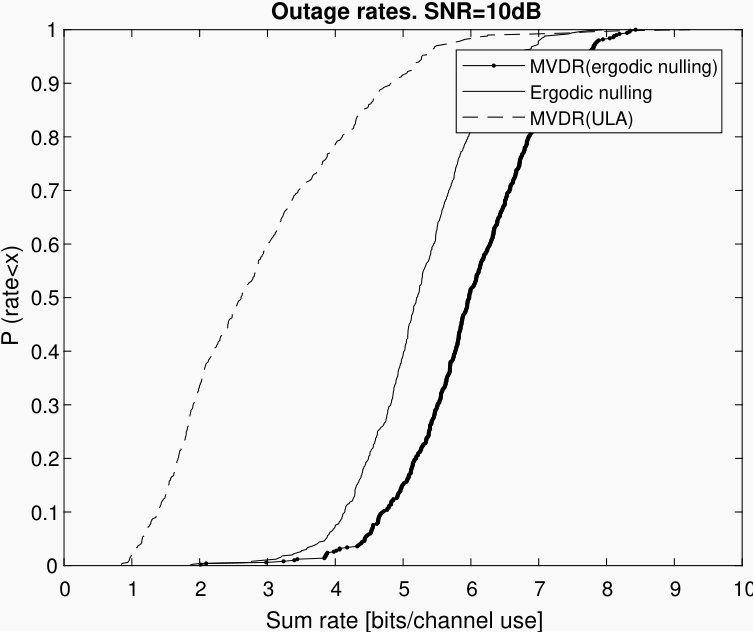 Figure 1
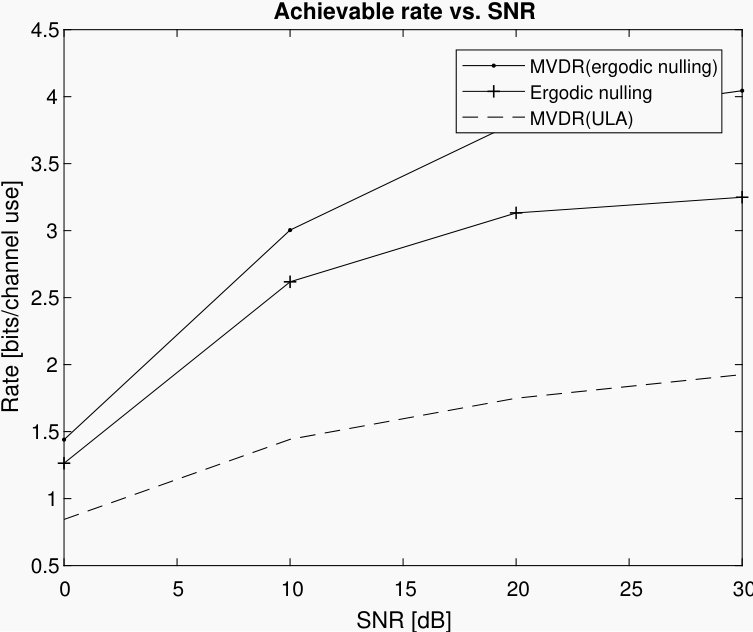 Figure 2
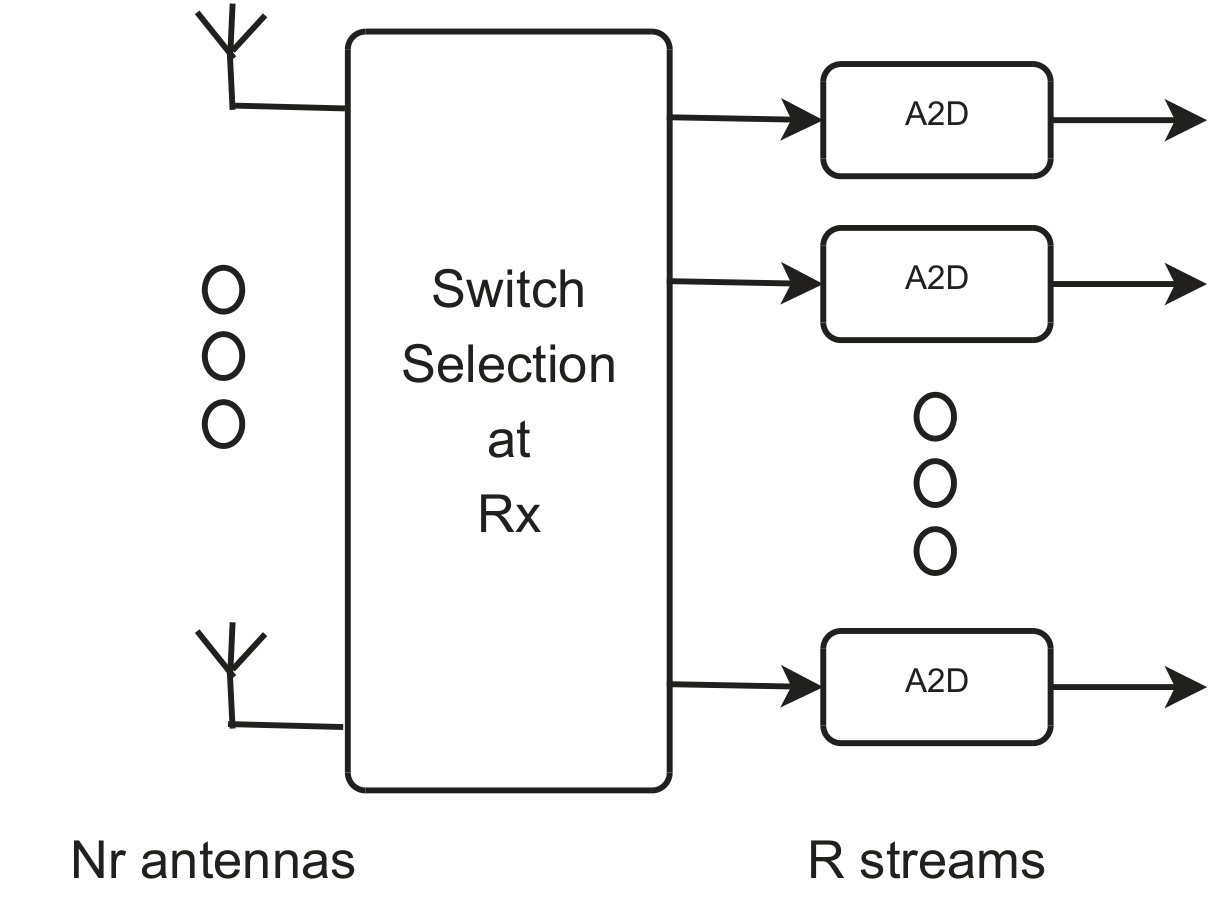 Figure 3
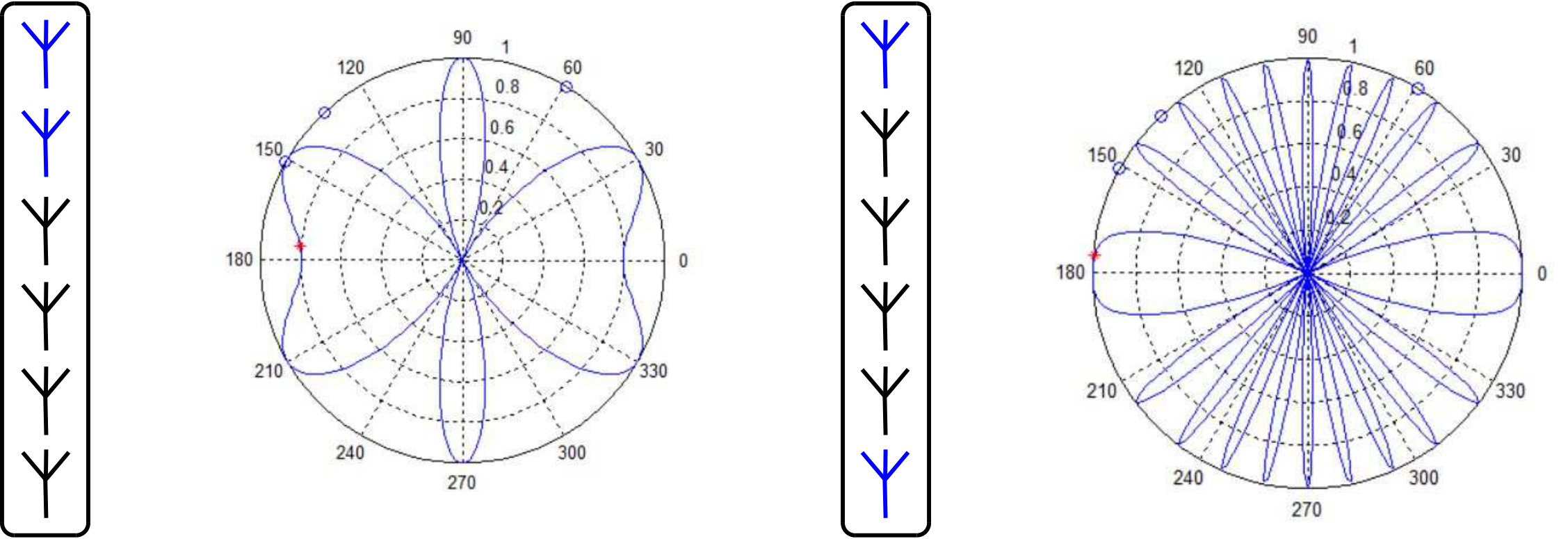 Figure 4
Peer Reviews
No public reviews on file for this paper yet. If you reviewed it on a platform where reviews are public (OpenReview, ICLR, NeurIPS, ICML), you can paste yours below so the community can read it here.
Videos
No videos yet. Explain this paper in a talk, walkthrough, or lecture? Add one.
Taxonomy
TopicsAdvanced MIMO Systems Optimization · Cooperative Communication and Network Coding · Advanced Wireless Communication Techniques
Eliminating Interference in LOS Massive Multi-User MIMO with a Few Transceivers
Uri Erez and Amir Leshem U. Erez is with Tel Aviv University, Tel Aviv, Israel (email: [email protected]). The work of U. Erez was supported by by the ISF under Grant 1956/15.Amir Leshem is with Faculty of Engineering, Bar-Ilan University ([email protected]). The work of Amir Leshem was partially support by ISF grant 1644/18 and ISF-NRF grant 2277/16.
Abstract
Wireless cellular communication networks are bandwidth and interference limited. An important means to overcome these resource limitations is the use of multiple antennas. Base stations equipped with a very large (massive) number of antennas have been the focus of recent research. A bottleneck in such systems is the limited number of transmit/receive chains. In this work, a line-of-sight (LOS) channel model is considered. It is shown that for a given number of interferers, it suffices that the number of transmit/receive chains exceeds the number of desired users by one, assuming a sufficiently large antenna array. From a theoretical point of view, this is the first result proving the near-optimal performance of antenna selection, even when the total number of signals (desired and interfering) is larger than the number of receive chains. Specifically, a single additional chain suffices to reduce the interference to any desired level. We prove that using the proposed selection, a simple linear receiver/transmitter for the uplink/downlink provides near-optimal rates. In particular, in the downlink direction, there is no need for complicated dirty paper coding; each user can use an optimal code for a single user interference-free channel. In the uplink direction, there is almost no gain in implementing joint decoding. The proposed approach is also a significant improvement both from system and computational perspectives. Simulation results demonstrating the performance of the proposed method are provided.
I Introduction
It is well known that given an adaptive array with receive chains, one can null out (single-antenna) interferers and enjoy a full degree-of-freedom (DoF) for one desired source. Such an architecture, often referred to as receive beamforming, is attractive due to its ease of implementation, as well as robustness. Nonetheless, it leads to low spectral utilization.
A line of work that has emerged in recent years, starting with the seminal work of [1], is the use of massive multi-input multi-output (MIMO) technology as a promising practical means to boost the throughput of wireless networks. In a nutshell, assuming a rich scattering environment or alternatively that the number of antennas at the base station is much larger than the total number of users, one can leverage channel hardening arguments to conclude that the channel vectors of the users will be approximately orthogonal. Under these conditions, beamforming will be near optimal on both uplink and downlink.
Nonetheless, massive MIMO technology faces some considerable challenges, including the overhead incurred by the need for transmission of many pilots, and the substantial cost of radio frequency (RF) chains. Specifically, we consider the class of line-of-sight wireless channels [2] which are very relevant in recent applications of mm wave wireless communications, see e.g., [3] and references therein. In the present paper, we demonstrate that one can attain the performance gains of massive MIMO technology while employing a minimal number of receive chains.
Our main result is as follows: For any number of interferers, given receive chains and a large enough number of antennas, one can approximately null out all interferers while simultaneously affording (with probability one) a full DoF to single-antenna sources. This corresponds to a utilization of of the DoFs available. In a practical system implementation, employing a linear massive MIMO array (assuming planar geometry), this may be accomplished by judiciously selecting antennas out of a large array of antennas. The output of the selected antennas is then fed into receive chains as depicted in Figure 1.
I-A Related Work
Massive multi-user MIMO (MU-MIMO) emerged from the realization that when the number of antenna elements is much larger than the number of users, the inner product between different users’ channels becomes negligible with respect to the norm of each user’s channel, leading to “channel hardening”. Under such conditions, linear processing in conjunction with single-user encoding/decoding (for the downlink/uplink respectively) is near optimal [1, 4, 5].
Digitally sampling a very large antenna array entails a prohibitively large hardware complexity. Hence, substantial research efforts have been devoted to alleviating this burden. Among the proposed techniques are hybrid analog/digital beamforming, low resolution ADCs and antenna selection. An overview of these various techniques can be found in, e.g., [6, 7, 8].
One may think of the selection mechanism as a means of altering the physical communication channel to attain some benefit. The idea of of changing the physical propagation channel bears some relation to “media-based modulation”, “spatial modulation” and “index modulation” schemes; see [9, 10] for an overview of these inter-related concepts. In all of these works, the physical medium is modulated based on the information-bearing signal. In contrast, in the present work the physical medium is altered depending only on the location of the desired and interference sources, independent of the transmitted data.
II System Model
For simplicity, we consider the uplink portion of the communication link in a cellular MU-MIMO scenario. We begin by defining the system configuration of a single link between a single (possibly MIMO) transmitter and the base station.
Denote by a transmit/receive MIMO configuration utilizing antenna selection. Thus, the uplink of a massive MIMO cell with a total of single-antenna users will consist of links of the form as depicted in Figure 1. .
III Line-of-Sight Channel Model
We consider the LOS channel model. This channel model is important in its own right, e.g., for millimeter-wave communication [11]. Moreover, this channel model can serve as the basis for a more elaborate, specular multipath MU-MIMO channel model.
Denoting the channel vector from transmitter to the antennas by \mbox{{\bf h}}_{k}\in\mathbb{C}^{N_{r}\times 1}, the received signal is given by
[TABLE]
where is i.i.d. circularly-symmetric complex Gaussian noise with variance . The receiver decodes the messages of users whereas the signals , are interference.
We note that the MU-MIMO interference channel is equivalent to requiring that the receiver must employ a linear front-end selection matrix \mbox{{\bf S}}_{R}\in\{0,1\}^{N_{r}\times N_{r}}, having exactly non-zero elements which are not in the same row or column. Applying selection matrix \mbox{{\bf S}}_{R} (1) becomes
[TABLE]
From a practical perspective, implementing the selection mechanism yields a substantial reduction in hardware complexity.
We consider the LOS channels. Specifically, we make the following assumptions:
- A1
For simplicity we assume planar geometry where all sources are far field point sources. 2. A2
The vectors \mbox{{\bf h}}_{k} consist of array manifold vectors
[TABLE]
where
[TABLE] 3. A3
For sake of analysis, the dimensions of the array are taken to be unbounded similarly to [1]. 4. A4
We assume that the receiver has perfect CSI w.r.t. all channel gains corresponding to impinging signals. Transmitters on the other hand need not have access to any CSI beyond the rate at which they should communicate. 5. A5
Without loss of generality, we use the array manifold as the channel, since the signal attenuation can be absorbed in the power of . 6. A6
For simulations we assume that the locations of the sources are independently uniformly distributed in angle with respect to the receiver. 7. A7
We assume that the transmit power of all transmitters is bounded by .
Under these assumptions for the MU-MIMO channel equation (2) reduces to
[TABLE]
In the next section we prove that there is a selection such that with a proper linear processing we only receive the desired signals, and attenuate the interfering signals to any prescribed level, with negligible noise amplification.
IV Ergodic Beamforming
Selection methods for reducing the complexity of massive MU-MIMO systems is a widely explored field [8, 12, 13, 14]. There are many works related to antenna selection in LOS channels, see e.g., [15, 16]. The optimal selection of antennas is very complicated. Therefore, many innovative techniques for antenna selection have been proposed [8, 15, 14, 17]. Our contribution is establishing fundamental limits for antenna selection in LOS channels. Namely, it is shown that, any number of interferers can be suppressed with the number of receive chains exceeding the number of desired users by one.
Classical signal processing literature is focused on Nyquist beamformers, where at least some antennas are separated by at most . In this case, the array has a single main lobe at the desired direction, and the resolution of the array is determined by the farthermost elements. The reason for this is that when all distances between antennas are larger than , an ambiguous beam pattern occurs. An example of this phenomenon is depicted in Figure 2. Interestingly, ambiguous arrays can prove extremely advantageous when dealing with interference since such arrays have multiple nulls. We will show that by judiciously designing the beam pattern, we can simultaneously point multiple nulls at the multiple interferers.
Using a beamforming vector , the received signal becomes:
[TABLE]
The support of \mbox{{\bf w}}_{k},k=1,\ldots,K implicitly defines the selection matrix \mbox{{\bf S}}_{R}. For each desired user define the beamformer \mbox{{\bf w}}_{n_{k}} by
[TABLE]
where \mbox{{\bf e}}_{n}\in{\mathbb{C}}^{N_{r}}\times 1 are the standard unit vectors. Denote
[TABLE]
where \mbox{{\bf h}}(\theta) is defined in (4). We now show that by selecting a common reference antenna, we can choose one antenna ( ) per desired source ( ) such that the beamformer satisfies:
[TABLE]
where without loss of generality the desired users are .
Theorem 1** (Receiver for a desired direction [18]).**
Assume that the directions are such that are independent over . Then for every and every , one can find such that beamforming with the vector \mbox{{\bf w}}_{n_{i}} yields:
[TABLE]
The proof is based on the uniform distribution property of sequences modulo [19]. The proof can be found in [18].
A simple corollary of Theorem 1 is that one can simultaneously receive data streams using receive chains, while suppressing any number of external interferers.
Corollary 1* (Receiver for desired directions).*
Assume that we have desired users where is the number of receive chains over a LOS channel as defined in (5). Then, for any rate satisfying:
[TABLE]
there is a sufficiently large array with antennas and a selection matrix \mbox{{\bf S}}_{R}, such that for all users , error-free transmission is achievable.
Proof.
The claim follows by assigning one of the antennas as a reference for interference cancellation and applying Theorem 1 to every desired direction and choosing the second antenna with the appropriate spacing and a beamforming \mbox{{\bf w}}_{n_{i}}. ∎
Denote
[TABLE]
be an beamforming matrix as constructed in Corollary 1. The following theorem characterizes the achievable sum rate for the LOS massive MU-MIMO channel.
Theorem 2** (Main Theorem).**
Choosing W as defined in (13) for almost all channel realizations the achievable sum-rate satisfies
[TABLE]
for every .
Proof.
let
[TABLE]
be the channel matrix including the desired and interfering signals. Denote the effective channel matrix
[TABLE]
Let \hbox{{\bf Q}}=\mbox{{\bf\tilde{H}}}\mbox{{\bf\tilde{H}}}^{H}. By the choice of W we obtain that
[TABLE]
where , for .
Using Gershgorin’s theorem [20] we obtain that
[TABLE]
where are the eigenvalues of Q. Hence
[TABLE]
where
[TABLE]
for all . The second inequality follows from the MIMO capacity in the absence of external interference. Choosing sufficiently small and by continuity of the claim follows. ∎
V Algorithms and implementation
Theorem 2 guarantees that interference can be suppressed to any desired level. However, it does not exploit the full optimization parameter space. Ultimately, our goal is to maximize the signal to interference plus noise ratio by properly choosing the antennas and the beamformers corresponding to each source . The straightforward approach would be to enumerate over all subsets of antennas and evaluating the SINR, for the optimal linear receiver. The complexity of this algorithm is prohibitive and simpler algorithms are required. For instance, we can select a single antenna as a reference antenna and choose one antenna per desired user.
V-A Pairwise antenna selection
The simplest approach is to use Theorem 2 directly where for each use we choose the antenna which maximizes the SINR for this user. To that end, define
[TABLE]
where is the norm.
Each signal is obtained by beamforming the output of the reference antenna and a second antenna which provides the interference free reception. However, since we have receivers, it is reasonable to improve the performance by optimizing the receive vector for each signal jointly, over all the selected receive chains. To that end let be the indices of the selected antennas and let \mbox{{\bf S}}_{R} be the corresponding selection matrix defined by . We can now maximize the SINR of each user by optimizing
[TABLE]
where defines the support. Since the directions of interferers are assumed known, we can use the interference covariance based beamformer [21]
[TABLE]
where {\rm supp}(\mbox{{\bf w}}_{i}) is the support of \mbox{{\bf w}}_{i}.
[TABLE]
As discussed in [22], there is significant benefit in terms of robustness when using the interference covariance as a basis for beamforming instead of the received signal covariance matrix.
VI Simulations
To test the proposed MU-MIMO scheme for a LOS channel, we assumed that we have two desired users and 3 undesired users which serve as out of cell interference. We used 100 antennas with spacing.We performed 500 experiments. In each experiment we randomly picked the direction of all 5 signals. We assumed three receive chains (). The first array element served as a common reference and the other elements were optimized for each desired user, respectively.
VII Extensions and Conclusions
In this paper we proposed a novel technique for interference mitigation in LOS massive MIMO cellular networks employing a minimal number of receive chains. Simulation results demonstrate the effectiveness of the approach.
The paper focused on the uplink direction. However, by invoking a simple uplink-downlink duality argument, the same architecture applies for the downlink, assuming that directional CSI is available to the base-station. In LOS channel this assumption is mild, since practically all receiver have GPS receivers. Alternatively, the directions can be estimated using the well known techniques of [23], [24].
The reference list from the paper itself. Each links out to its DOI / PubMed record.
- 1[1] T. L. Marzetta, “Noncooperative cellular wireless with unlimited numbers of base station antennas,” IEEE Transactions on Wireless Communications , vol. 9, no. 11, pp. 3590–3600, 2010.
- 2[2] P. Almers, E. Bonek, A. Burr, N. Czink, M. Debbah, V. Degli-Esposti, H. Hofstetter, P. Kyösti, D. Laurenson, G. Matz et al. , “Survey of channel and radio propagation models for wireless MIMO systems,” EURASIP Journal on Wireless Communications and Networking , vol. 2007, no. 1, p. 019070, 2007.
- 3[3] T. S. Rappaport, S. Sun, R. Mayzus, H. Zhao, Y. Azar, K. Wang, G. N. Wong, J. K. Schulz, M. Samimi, and F. Gutierrez Jr, “Millimeter wave mobile communications for 5g cellular: It will work!” IEEE access , vol. 1, no. 1, pp. 335–349, 2013.
- 4[4] F. Rusek, D. Persson, B. K. Lau, E. G. Larsson, T. L. Marzetta, O. Edfors, and F. Tufvesson, “Scaling up MIMO: Opportunities and challenges with very large arrays,” ar Xiv preprint ar Xiv:1201.3210 , 2012.
- 5[5] E. G. Larsson, O. Edfors, F. Tufvesson, and T. L. Marzetta, “Massive MIMO for next generation wireless systems,” IEEE Communications Magazine , vol. 52, no. 2, pp. 186–195, 2014.
- 6[6] L. Liang, W. Xu, and X. Dong, “Low-complexity hybrid precoding in massive multiuser MIMO systems,” IEEE Wireless Communications Letters , vol. 3, no. 6, pp. 653–656, 2014.
- 7[7] C. Mollén, J. Choi, E. G. Larsson, and R. W. Heath, “Uplink performance of wideband massive MIMO with one-bit adcs,” IEEE Transactions on Wireless Communications , vol. 16, no. 1, pp. 87–100, 2017.
- 8[8] O. Mehanna, N. D. Sidiropoulos, and G. B. Giannakis, “Joint multicast beamforming and antenna selection,” IEEE Transactions on Signal Processing , vol. 61, no. 10, pp. 2660–2674, 2013.