This paper identifies new irreducible components in the moduli space of rank 2 semistable sheaves on projective space, showing their growth, rationality, and connectedness, with explicit counts for certain Chern classes.
Contribution
It describes new irreducible components of the moduli space, computes their number for specific Chern classes, and proves their rationality and connectedness.
Findings
01
Number of components grows with second Chern class
02
All components are rational
03
Moduli spaces are connected and some sheaves are smoothable
Abstract
We describe new irreducible components of the moduli space of rank 2 semistable torsion free sheaves on the three-dimensional projective space whose generic point corresponds to non-locally free sheaves whose singular locus is either 0-dimensional or consists of a line plus disjoint points. In particular, we prove that the moduli spaces of semistable sheaves with Chern classes (c1,c2,c3)=(−1,2n,0) and (c1,c2,c3)=(0,n,0) always contain at least one rational irreducible component. As an application, we prove that the number of such components grows as the second Chern class grows, and compute the exact number of irreducible components of the moduli spaces of rank 2 semistable torsion free sheaves with Chern classes (c1,c2,c3)=(−1,2,m) for all possible values for m; all components turn out to be rational. Furthermore, we also prove that these moduli spaces are connected,…
No public reviews on file for this paper yet. If you reviewed it on a platform where reviews are public (OpenReview, ICLR, NeurIPS, ICML), you can paste yours below so the community can read it here.
Videos
No videos yet. Explain this paper in a talk, walkthrough, or lecture? Add one.
Full text
Irreducible components of the moduli space of rank 2 sheaves of odd determinant on the projective space
We describe new irreducible components of the moduli space of
rank 2 semistable torsion free sheaves on the
three-dimensional projective space whose generic point
corresponds to non-locally free sheaves whose singular locus
is either 0-dimensional or consists of a line plus disjoint
points.
In particular, we prove that the moduli spaces of semistable
sheaves with Chern classes (c1,c2,c3)=(−1,2n,0) and
(c1,c2,c3)=(0,n,0) always contain at least one rational
irreducible component. As an application,
we prove that the number of such components grows as the
second Chern class grows, and compute the exact number of
irreducible components of the moduli spaces of rank 2
semistable torsion free sheaves with Chern classes
(c1,c2,c3)=(−1,2,m) for
all possible values for m; all components turn out to be
rational. Furthermore, we also prove that these moduli spaces
are connected, showing that some of sheaves here considered
are smoothable.
Following the proof of existence of a projective moduli
scheme parametrizing S-equivalence classes of semistable
sheaves on a projective variety by Maruyama [25],
the study of the geometry of such moduli spaces has been a
central topic of research within algebraic geometry. Although
a lot is known for curves and surfaces, general results for
three dimensional varieties are still lacking. In fact,
moduli spaces of sheaves on 3-folds turn out to be quite
complicated spaces (as it is illustrated by Vakil’s Murphy’s
law [37]), particularly with several irreducible
components of various dimensions.
The goal of this paper is to advance on the study of the
moduli space of semistable rank 2 sheaves on P3 with fixed
Chern classes (c1,c2,c3), which we will denote by
M(c1,c2,c3). Additionally, we will also consider the
open subset consisting of stable reflexive sheaves, denoted
by R(c1,c2,c3); when c3=0, this is actually the
moduli space of stable locally free sheaves, and this will be
denoted by B(c1,c2). Questions on the geometry of
such spaces, such as connectedness, or the number of
irreducible components, seem to be less explored if compared
to the study of the geometry of the Hilbert schemes of curves
in the projective 3-space for instance; some results for
Hilbert schemes of curves can be found in [12, 20, 21, 30, 31].
A rich literature on these moduli spaces was produced,
especially in the 1980’s and 1990’s, studying
R(c1,c2,c3) and B(c1,c2) for specific values
of the Chern classes. For instance, the geometry of
B(0,c2) and B(−1,c2) is completely understood
for c2 up to 5, see [3, 14, 5, 9, 1] for c1=0, and [15, 2] for c1=−1.
In addition, Ein characterized a infinite series of
irreducible components of B(c1,c2) and proved that
the number of irreducible components of B(c1,c2) goes to infinity as the c2 goes to infinity [8].
Regarding reflexive sheaves, R(c1,c2,c3) is known
for c2≤3 and all possible values for c3, see
[6] and the references therein. Some extremal values
are also known, namely, R(−1,c2,c22) was studied
by Hartshorne in [13], Chang described
R(0,c2,c22−2c2+4) in [7], while
Miró-Roig studied R(−1;c2;c22−2c2+4) in
[28], and the moduli spaces R(−1,c2,c22−2rc2+2r(r+1)) for 1≤r≤(−1+4c2−7)/2, and c2 greater than 5, and R(−1,c2,c22−2(r−1)c2) for c2 greater than 8 in
[27].
Even less is known for torsion free sheaves. Okonek and
Spindler proved in [32] that
M(0,c2,c22−c2+2) and M(−1,c2,c22) are
irreducible for c2≥6. For small values of c2,
Miró-Roig and Trautmann proved in [29]
that M(0,2,4) is irreducible, while Le Potier showed in
[24, Chapter 7] that M(0,2,0) has exactly 3
irreducible rational components; more recently, it was shown
in [19] that M(0,2,0) is connected. Trautmann has
also argued that M(0,2,2) has exactly 2 irreducible
components [36]. More recently, Schmidt proved in
[34], that M(0,c2,c22−c2+2) and
M(−1,c2,c22) are irreducible for any c2≥0,
using methods different from the ones employed by Okonek and Spindler and by Miró-Roig and Trautmann.
M(0,c2,0) for c2≥2 was studied in [19],
where new infinite series of irreducible components are
described. The starting point is the identification of three
different types of torsion free sheaves; more precisely, let
E be a torsion free sheaf on P3, and set QE:=E∨∨/E, which we assume to be nontrivial; we have
the following fundamental sequence
[TABLE]
and say that E has
•
0-dimensional singularities if dimQE=0;
•
1-dimensional singularities if QE has pure
dimension 1;
•
mixed singularities if dimQE=1, but
QE is not pure.
With this definition in mind, a systematic way of producing
examples of irreducible components of M(0,c2,0) whose
generic point corresponds to a torsion free sheaf with
[math]-dimensional and 1-dimensional singularities is given in
[19]. Furthermore, the third author and Ivanov
[18] constructed irreducible components of
M(0,3,0) whose generic point corresponds to a torsion
free sheaf with mixed singularities. Additionally, in a
recent paper [17], Ivanov proved that M(0,3,0)
has at least 11 irreducible components.
Our first goal in this paper is to generalize the results
presented in [18, 19], and show how to produce
irreducible components of M(c1,c2,c3), for values of
c1, c2 and c3 also including cases with c1=−1 and
c3=0, for sheaves with [math]-dimensional,
1-dimensional, and mixed singularities. More precisely, we
prove the following two statements.
Main Theorem 1**.**
For each e∈{−1,0}, let n and m be positive
integers such that en≡m(mod\leavevmode2). Let
R∗ be a nonsingular, irreducible component of
R(e,n,m) of expected dimension 8n−3+2e.
(i)
For each l≥1, there exists an irreducible component
[TABLE]
of dimension 8n−3+2e+4l whose generic sheaf [E] satisfies
[E∨∨]∈R∗ and
length(QE)=l.
(ii)
For each r≥2 and s≥1 such that 2r+2s≤m+e+2, or r=1 and s=0 when −e=n=m=1, there exists an
irreducible component
[TABLE]
of dimension of dimension 8n+4s+2r+2+e, whose generic sheaf
[E] satisfies [E∨∨]∈R∗ and QE
is supported on a line plus s points.
The case e=0 of the first part of the previous theorem is
just [19, Theorem 7]; we prove here the case e=−1.
The second part is a generalization of [18, Theorem 3],
which covers the cases e=0, n=2, m=2,4.
Our second goal in this paper concerns the problem of
rationality of irreducible components of the moduli spaces
M(e,n,m).
The study of this problem for the moduli components of
locally free sheaves, which are contained in M(−1,2n,0)
and M(0,n,0),n≥1, dates back to late 70-ies and
early 1980-ies. The rationality of these
moduli components was proved for n≤3 in case e=0
[3, 14, 9, 15]. The first infinite series of
rational moduli components were constructed and studied in
[4, 9, 38, 39]. Recently, A. Kytmanov, A. Tikhomirov
and S. Tikhomirov [22] showed that there is a large
infinite series of rational moduli components of locally free
sheaves from M(−1,2n,0) and M(0,n,0) which
includes the above mentioned series. These are the so-called
Ein components which were first found and studied by
A. P. Rao [33] and L. Ein [8]. However, it is
still an open question whether these components exist for every
n sufficiently (there are gaps for some small values of n,
see [22] for details). One of the central results of our
paper states that, for any n≥1 there exist
rational irreducible components of M(−1,2n,0) and of
M(0,n,0). The precise statement
is given by the following theorem.
Main Theorem 2**.**
(i)
For any n≥1, the scheme M(−1,2n,0) contains
at least one rational, generically reduced, irreducible
component with generic sheaf having 0-dimen-sional
singularities. For any n≥3, M(−1,2n,0)
contains at least one rational, generically reduced,
irreducible component with generic sheaf having purely
1-dimensional singularities, respectively, at least
2(n2−n−1) rational, generically reduced, irreducible
components with generic sheaves having singularities of
mixed dimension.
(ii)
For any n≥2, the scheme M(0,n,0) contains at least one rational, generically reduced, irreducible component
with generic sheaf having 0-dimensional singularities. For
any n≥3, the scheme M(0,n,0) contains at least one
rational, generically reduced, irreducible component with
generic sheaf having purely 1-dimensional singularities. For
any n≥4, the scheme M(0,n,0) contains at least
2n(n−3) rational, generically reduced, irreducible
components with generic sheaves having singularities of
mixed dimension.
In addition, we also show that M(e,n,m) has rational irreducible components for e=−1,0 and n,m varying in a wide range (see Theorem 13 for the precise statement).
The proof of this theorem is based on the above
mentioned results of Chang [7], Miró-Roig
[27], Okonek–Spindler [32] and
Schmidt [34] on reflexive sheaves, and uses
elementary transformations of reflexive
sheaves along finite sets of points.
We give two applications of our constructions. First, we
prove that the number of irreducible components of
M(−1,n,0) whose generic point corresponds to a sheaf
with mixed singularities grows as n grows, see Theorem
11 below. Second, we provide a full description
of the irreducible components of M(−1,2,m).
Main Theorem 3**.**
The moduli spaces M(−1,2,m) are connected and
(i)
M(−1,2,4)* is irreducible and rational of
dimension 11;*
(ii)
M(−1,2,2)* is connected and has exactly 2
irreducible rational components of dimensions 11, and 15;*
(iii)
M(−1,2,0)* is connected and has exactly 4
irreducible rational components of dimensions 11, 11, 15, and
19.*
Note that the rationality of all of these components of
follows directly from Main Theorem 2.
We emphasize that proving that these moduli spaces are
connected is quite relevant, since it is not known whether
moduli spaces of rank 2 sheaves are in general connected, as
it is the case for Hilbert schemes. In addition, we also
provide very concrete descriptions of the generic points in
each irreducible component; for a more detailed statement,
see Theorems 25 and 26 for the
cases c3=2 and c3=0, respectively. A representation of
the geography of M(−1,2,0) is presented in Figure
1, showing how the various irreducible components
intersect one another.
Another important aspect of the proof of the connectedness
part of Main Theorem 3 is that we are implicitly
showing that some of the sheaves presented in Main Theorem
1 are smoothable. To be more precise, a semistable
non locally free sheaf with c3=0 is said to be
smoothable if it can be deformed into a stable locally
free sheaf, that is, if it lies in the closure of an
irreducible component of B(c1,c2) within
M(c1,c2,0). In the observations following the proof
of Theorem 28 we provide certain sufficient
conditions for smoothability of sheaves in M(−1,2,0).
The paper is organized as follows. In Section 2 we build up some basic techniques, and
preliminary results. We compute the dimensions of the Ext
groups of torsion free sheaves in terms of their Chern
classes, and use it in Section 3 in order to produce the examples of irreducible
components of the moduli space of torsion free sheaves, and
to prove Main Theorem 1. These results are then
explored in end of Section 3
to prove that the number of irreducible components of
M(c1,c2,0) whose generic point correspond to a sheaf
with mixed singularities goes to infinity as c2 goes to
infinity, thus providing our first application. Main Theorem
2 is proved in Section 4.
The remainder of the paper is occupied with the proof of Main
Theorem 3.
The irreducibility of M(−1,2,4) is established in
Section 5. After further
technical results in Sections 6 and
7 regarding the families of sheaves introduced
in Main Theorem 1, we dedicate Sections
8 and 9 to describing all irreducible components of
M(−1,2,m) for c3=2 and c3=0, respectively. The
connectedness of M(−1,2,m) is finally established in
Section 10.
Acknowledgements.
This work started with discussions among the authors during a visit to SISSA in May 2016; we thank Ugo Bruzzo and SISSA for its support and hospitality. CA was supported by the FAPESP grants number 2014/08306-4 and 2016/14376-0; part of this work was made when he was visiting the University of Barcelona, and he is grateful for its warm hospitality, also thanking Rosa Maria Miró Roig for the several useful discussions on this topic. MJ is partially supported by the CNPq grant number 302889/2018-3 and the FAPESP Thematic Project 2018/21391-1; part of this work was done during a visit to the University of Edinburgh, and later completed during a visit to the Simons Center for Geometry and Physics; MJ is grateful for the hospitality of both institutions. AT was supported by funding within the framework of the State Maintenance Program for the Leading Universities of the Russian Federation ”5-100”. AT also thanks the Max Planck Institute for Mathematics in Bonn for hospitality, where this work was partially done during the winter of 2017. This work was also partially funded by CAPES - Finance Code 001.
2. First computations
In order to study the moduli spaces of torsion free sheaves
on P3 we will need an explicit method to compute dimExt1(E,E), which gives us the dimension of the tangent
space of the isomorphism class of a stable torsion free sheaf
E as a point the moduli space. Our main goal in this
section is to prove the following theorem.
Theorem 1**.**
Let E be a stable rank 2 torsion free sheaf on P3 with
e:=c1(E)∈{−1,0}. Then
[TABLE]
Note that this result generalizes [19, Lemma 5d)] and
[19, Lemma 10], which establish the formula above for
stable rank 2 torsion free sheaves with 0- and 1-dimensional
singularities, respectively, in the case c1(E)=0. The
proofs for sheaves with 0- and 1-dimensional singularities
with arbitrary c1 are quite similar to the one in
[19]; therefore, we only include here the proof for
sheaves with mixed singularities.
Theorem 1 together with the deformation theory
yields
Corollary 2**.**
Any irreducible component of the moduli space
M(e,c2,c3) has dimension at least 8c2−3+2e.
Lemma 3**.**
If E is a torsion free sheaf on P3, then:
(i)
Ext1(E,E)=H1(Hom(E,E))⊕kerd201;
(ii)
Ext2(E,E)=kerd302⊕kerd211⊕cokerd201;
(iii)
Ext3(E,E)=cokerd302.
Here, djpq are the differentials in the j-th page of
the spectral sequence for local to global ext’s
E2pq:=Hp(Extq(E,E)). In particular, we have
[TABLE]
Proof.
The first part is a standard calculation with the spectral
sequence E2pq:=Hp(Extq(E,E)), which converges in
its forth page, because the spectral maps vanish. Note that
Hp(Extq(E,E))=0 for p≥2
and q≥1, since dimExtq(E,E)≤1 for q≥1.
Furthermore, applying the functor Hom(⋅,E) to the
fundamental sequence (1), we get an
epimorphism Ext3(E∨∨,E)↠Ext3(E,E) and
the isomorphism Ext2(E,E)≃Ext3(QE,E); however,
the sheaf on the left vanishes because E∨∨ is
reflexive, so Ext3(E,E)=0 as well. Finally, we also
check that dimExt2(E,E)=0; indeed,
E admits a resolution of the form
[TABLE]
where Lk are locally free sheaves; we then get an
epimorphism
[TABLE]
which implies that dimExt3(QE,E)=0 since
dimExt3(QE,OP33)=0.
The second claim is an immediate consequence of the first,
since dimExt2(E,E)=0.
∎
Assuming that E is μ-semistable provides a useful
simplification of the previous general result.
Lemma 4**.**
If E be a μ-semistable torsion free sheaf on P3,
then:
(i)
Ext1(E,E)=H1(Hom(E,E))⊕kerd201;
(ii)
Ext2(E,E)=H0(Ext2(E,E))⊕H1(Ext1(E,E))⊕cokerd201;
(iii)
Ext3(E,E)=0.
Here, d201 is the spectral sequence differential
d201:H0(Ext1(E,E))→H2(Hom(E,E)).
Proof.
The last item follows from Serre duality, we have
[TABLE]
with the vanishing given by μ-semistability.
In addition, we argue that μ-semistability also implies
that H3(Hom(E,E))=0. Indeed, applying the functors
Hom(⋅,E) and Hom(E∨∨,⋅) to the
fundamental sequences (1) we obtain,
respectively,
[TABLE]
and
[TABLE]
In both sequences, the rightmost sheaf has dimension at most
1, hence so does the cokernel of the leftmost monomorphism,
and it follows that
[TABLE]
However
[TABLE]
the first equality follows from the spectral sequence for
local to global ext’s for E∨∨, the isomorphism in
the middle is given by Serre duality, and the vanishing is a
consequence of the μ-semistability of E∨∨.
It follows that d2pq=0 except for d201, while
d3pq=0 for every p and q. This means that
E2pq converges in its third page, providing the desired
result.
∎
The following technical lemma will be helpful in our next
argument.
Lemma 5**.**
Let F be a torsion free sheaf. If E is a subsheaf of F
for which the quotient sheaf Z:=F/E is 0-dimensional, then
[TABLE]
Proof.
Break a locally free resolution of E as in (2)
into two short exact sequences
[TABLE]
Applying functor Hom(Z,−) and passing to Euler
characteristic on the first sequence, we have:
[TABLE]
[TABLE]
since
χ(Ext3(Z,Lk))=χ(Ext3(Z,OP3)⊗Lk)=rk(Lk)⋅χ(Z). Now, applying the functor
Hom(Z,−) to the second exact sequence we obtain the
isomorphism Ext1(Z,E)≃Ext2(Z,K) and passing to
the Euler characteristic we have
[TABLE]
Subtracting χ(Ext1(Z,E)) from the left hand side and
χ(Ext2(Z,K)) from the right hand side, and then
substituting for (4) we have:
[TABLE]
Since dimExtj(Z,E)=0, we have
[TABLE]
[TABLE]
where the supercript SD indicates the use of Serre duality.
The formula (5) applied to the sheaf F then yields
[TABLE]
The fact that rk(F)=rk(E) provides the desired identity.
∎
Lemma 6**.**
Let E be a rank 2 torsion free sheaf with mixed
singularities. Then:
[TABLE]
Proof.
Let ZE↪QE the maximal 0-dimensional subsheaf of
QE, and set
TE:=QE/ZE to be the pure 1-dimensional quotient; we
assume that both ZE and TE are nontrivial. Let E′ be
the kernel of the composed epimorphism E∨∨↠QE↠TE; note that it also fits into the following short
exact sequence
[TABLE]
Note that c1(E′)=c1(E) and c2(E′)=c2(E). In addition,
(E′)∨∨≃E∨∨, and QE′≃TE,
thus E′ is a torsion free sheaf with 1-dimensional
singularities. It follows that E′ has homological dimension
1 (that is Extp(E′,G)=0 for p≥2 and every coherent
sheaf G), so the proof of [13, Proposition
3.4] also applies for E′, and we
conclude that
To see this, note that applying the functor Hom(E′,−) to
the sequence (6) we obtain:
[TABLE]
Next, applying the functor Hom(−,E) to the sequence
(6) we have
[TABLE]
Taking the difference between these last two equations we
obtain
[TABLE]
[TABLE]
[TABLE]
with the second equality following from applying the formula
established in Lemma 5 to the sheaves E and
E′. Applying the functor Hom(−,E) to the sequences
[TABLE]
we conclude that Ext3(TE,E)=0 and
Ext3(QE,E)≃Ext3(ZE,E). We already noticed in
the proof of Lemma 3 that
Ext3(QE,E)≃Ext2(E,E), thus
[TABLE]
as desired.
∎
Gathering the above results we are in position to prove the
Theorem 1.
By Lemma 6, it is enough to show that dimHom(E,E)=1 and Ext3(E,E)=0, but these follow
easily from the stability of E.
∎
The following proposition will be a technical tool that will
help us to compute explicitly the dimension of Ext1(E,E)
for certain torsion free sheaves.
Proposition 7**.**
Let F be a stable rank 2 reflexive sheaf on P3, with
dimExt2(F,F)=0. Let Z be an artinian sheaf, and T
be a sheaf of pure dimension 1 such that H1(Hom(F,T))=0;
set Q:=Z⊕T and assume also that
Sing(F)∩Supp(Q)=∅. If φ:F→Q is an
epimorphism, then, for E:=kerφ,
(i)
E* is a stable rank 2 torsion free sheaf;*
(ii)
c1(E)=c1(F)* and c2(E)=c2(F)+mult(T), where mult(T) denotes the multiplicity of the
sheaf T;*
(iii)
Ext2(E,E)=H0(Ext3(Z,E))⊕Ext3(T,E).
Proof.
The items (i) and (ii) are straightforward calculations; we
will prove (iii).
First we will show that the spectral sequence map
[TABLE]
is an epimorphism.
Consider the exact sequence:
[TABLE]
Applying the functor Hom(F,−) to (7), once
coker{Hom(F,E)→Hom(E,E)} is supported in
dimension 1, we have
[TABLE]
Next apply Hom(F,−) in the sequence (7), by
hypothesis, Ext2(E,E)=0, then we have
[TABLE]
To see that Ext1(F,Q) vanishes, note that Extp(F,Q)=0 for p=2,3 because F is reflexive. Ext1(F,Q)=0
because Sing(F)∩Supp(Q)=∅.
In addition,
Hp(Hom(F,Q))=0 for p=2,3 because dimQ=1. From
the spectral sequence, Ext1(F,Q)=H1(Hom(F,Q)) which
vanishes by hypothesis. Therefore d201:H0(Ext1(F,E))→H2(Hom(F,E)) is surjective. Then
we have
[TABLE]
where the vertical arrow in the left is the natural
map coming from the exact sequence (7), and
horizontal maps came from the spectral sequence. Since the
top row map, and the right vertical map are surjective, we
have that the bottom map is surjective as we wanted.
Now, applying Hom(−,E) to the sequence (7)
we have
[TABLE]
Furthermore, there is an exact sequence
[TABLE]
where dimkerf=0, since dimExt1(F,E)=0. Thus
[TABLE]
Since F is reflexive, from [16, Proposition
1.1.6], we have Extp(T,F)=0 for p=0,1 and
codim\leavevmodeExtp(T,F)≥p for p=2,3.
Clearly, dimExtp(T,E)≤1 for p>0, while
Hom(T,E)=0; using these facts, we obtain from the
spectral sequence for Ext⋅(T,E) that
[TABLE]
Putting together the equations (10) and
(11) we obtain item (iii).
∎
Remark 1**.**
Item (iii) of Proposition 7 also holds when
T=0 without assuming that Ext2(F,F)=0, see the proof of
Main Theorem 2, starting in page 13 below.
An important ingredient of the Proposition 7 is
a family of stable reflexive sheaves, that fills out an
irreducible component of the moduli space, with the expected
dimension. A priori, it is not clear why such family should
exist. In [19] the authors proved that, indeed, such
families exists for infinitely many values of the second
Chern class, provided that the first Chern class is even.
Below we state a theorem that shows that this happens also
for sheaves with odd first Chern class. For simplicity of notation, we define
[TABLE]
Theorem 8**.**
For each triple (a,b,c) of positive integers such that
3a+2b+c is odd, the family of rank 2 reflexive
sheaves F obtained as the cokernel of the maps α
below
[TABLE]
where k:=(3a+2b+c+1)/2, fills out a nonsingular irreducible component
S(a,b,c) of R(−1;n;m) of expected dimension 8n−5, with n and m are given by the expressions:
[TABLE]
More precisely, let S(a,b,c)⊂Hom(G(a,b,c),(a+b+c+2)⋅OP3)
be the open subset consisting of monomorphisms with
0-dimensional degeneracy loci; then
[TABLE]
Proof.
Let a,b,c∈Z, such that 3a+2b+c is odd and non zero, and consider morphisms of the form
[TABLE]
If the degeneracy locus
[TABLE]
is 0-dimensional, then the cokernel of α is a rank 2 reflexive sheaf F on P3, which we twist by
k:=(3a+2b+c+1)/2, so that c1(F)=−1, and the exact sequence in display (12) is satisfied.
The dimension of this family of rank 2 reflexive sheaves is given by
[TABLE]
[TABLE]
Note that for such sheaf F satisfies h0(F(−1))=0, thus F is always stable. It only remains for us to check that dimExt2(F,F)=0. This follows from applying the functor Hom(⋅,F(k)) to the exact sequence in display (12), and observing that H1(F(t))=0 for every t∈Z and that H2(F(k))=0. Therefore the family of sheaves given by (12) provides a component of the moduli space of stable rank 2 reflexive sheaves on P3.
∎
The case that deserves special attention is the case a=b=0 and c=1, that give us c1(F)=−1, c2(F)=c3(F)=1. In [13, Lemma 9.4] is shown that
every reflexive sheaf in R(−1,1,1) admits a
resolution of the form:
[TABLE]
From this sequence we can easily deduce the splitting behaviour of a
sheaf F in R(−1,1,1). Indeed, each one of the 3 rows
of the map α can be viewed as the equation of a
hyperplane in P3, since α is injective,
the hyperplane must intersect in exactly one point p, that
coincides with the singularity of the sheaf F. Thus, if l⊂P3 is a line, if p∈/l, then the restriction
of F on l, F∣l, is isomorphic to Ol(−1)⊕Ol. On the other hand, if p∈l, from
sequence (14), we have that F∣l≃Op⊕2Ol(−1). Summarizing, we
have:
[TABLE]
Remark 2**.**
From [13, Example 4.2.1] it follows that R(−1,1,1)
is irreducible non-singular and rational of dimension 3.
Moreover, there is an isomorphism
R(−1,1,1)≃P3,[F]↦Sing(F), and every sheaf [F]∈R(−1,1,1)
fits in an exact triple 0→OP33(−2)→3⋅OP33(−1)→F→0. This yields that Ext2(F,F)=0. Also Theorem
8 implies that S(0,0,1)=R(−1,1,1). Besides, under the isomorphism
R(−1,1,1)≃P3, the above exact triple
globalizes to the exact triple over P3×P3:
[TABLE]
where F is the universal family of reflexive
sheaves over R(−1,1,1), the morphism α is the
composition OP33(−2)⊠OP33i(−1)⊠id4⋅OP33(−1)⊠OP33id⊠ϵOP33(−1)⊠TP3(−1), and i,ϵ are the morphisms in the
Euler exact triple 0→OP33(−1)i4⋅OP33ϵTP3(−1)→0.
3. Sheaves with 0-dimensional and mixed
singularities
In [19] the authors produced examples of irreducible
components with [math]-dimen-sional singularities and pure
1-dimensional singularities, in the moduli space of rank 2
stable torsion free sheaves with first Chern class equals to
0, and in [18] the authors proved the existence of
irreducible components in M(0,3,0) whose generic point
is a sheaf with mixed singularities, with first Chern class
equals to 0. The first natural question that arises is that
if similar constructions can be made for sheaves with odd
first Chern class, and if it is possible similar irreducible
components for non zero third Chern class.
We will explicit construct examples of irreducible
components of the moduli space of torsion free sheaves with
mixed singularities. We refer the reader to [18] for
some examples in M(0,3,0).
For the rest of this work,
let e∈{−1,0}, and n, m be two integers such
that en≡m(mod\leavevmode2). Let
[TABLE]
By semicontinuity, R∗(e,n,m) is an open smooth
subset of R(e,n,m) such that, in view of Theorem
1 and Corollary 2,
[TABLE]
(Here and below by the dimension dimxX of a given scheme
X locally of finite type at a point x∈X we mean the
maximum of dimensions of irreducible components of X
passing through the point x.)
Let (P3)0s be the open dense subset of (P3)s
consisting of disjoint unions of s distinct points in
P3. For any closed point [F]∈R∗(e,n,m),
define the sets
[TABLE]
[TABLE]
Note that, since any reflexive sheaf F from R∗(e,n,m) has 0-dimensional singularities, the set
[TABLE]
is a dense open subset in R∗(e,n,m)×(P3)s,
hence by (18) it is smooth equidimensional of
dimension
[TABLE]
Respectively, by the Grauert–Mülich Theorem, the set
[TABLE]
is a dense open subset in R∗(e,n,m)×G(2,4)×(P3)0s, hence by (18) it is smooth
equidimensional of dimension
[TABLE]
For a pair ([F],S)∈(R∗(e,n,m)×(P3)0s)0, consider the
2s-dimensional vector space Hom(F,OS) and
its open dense subset Hom(F,OS)e of epimorphisms
F↠OS. By construction, the group
Aut(OS) acts on Hom(F,OS)e, and it
follows that the quotient space Hom(F,OS)e/Aut(OS) is a smooth irreducible scheme isomorphic to
a product of projective spaces, where S=(q1,...,qs):
[TABLE]
and where Pqi1=Hom(F,Oqi)e/Aut(Oqi), i=1,...,s.
Now, for any element ϕ∈Hom(F,OS)e the torsion
free sheaf Eϕ:=ker(ϕ:F↠OS)
is stable, and defines a closed point in M(e,n,m−2s). Furthermore, Eϕ≃Eϕ′ if, and only
if, there is a g∈Aut(OS) such that
ϕ=g∘ϕ′. Denote by [ϕ] the equivalence class
of ϕ modulo Aut(OS) and consider the set
[TABLE]
By definition, T~(e,n,m,s) is fibered over
(R∗(e,n,m)×(P3)0s)0
with fiber Hom(F,OS)e/Aut(OS)
over a given point ([F],S). Thus by (18) and
(30) we conclude that T~(e,n,m,s) is
naturally endowed with a structure of smooth equidimensional
scheme of dimension
[TABLE]
and the number of irreducible components of T~(e,n,m,s) is equals to the number of those of
R∗(e,n,m).
Furthermore, for any point t=([F],S),[ϕx])∈T~(e,n,m,s), the sheaf E(t):=ker{ϕ:F↠OS} is a stable sheaf from
M(e,n,m−2s). Hence there is a well-defined
modular morphism
[TABLE]
Φ is clearly an embedding, since the data x=([F],(l,S),[ϕx]) are recovered uniquely from [E(t)]:F≃E(t)∨∨,S=Supp(E(t)∨∨/E(t))
and ϕ is the canonical quotient morphism
E(t)∨∨↠OS≃E(t)∨∨/E(t). We thus set
[TABLE]
Let T(e,n,m,s) be the closure T(e,n,m,s) of T(e,n,m,s) in
M(e,n,m−2s). Formula (18) yields:
[TABLE]
Respectively, let r≥e. For a triple ([F],(l,S))∈(R∗(e,n,m)×G(2,4)×(P3)0s)0,
set
[TABLE]
where i:l↪P3 is a closed immersion. Consider the
(2r+2s+2−e)-dimensional vector space Hom(F,Q(l,S),r)
and its open dense subset Hom(F,Q(l,S),r)e of
epimorphisms F↠Q(l,S),r. By
construction, the group Aut(Q(l,S),r) acts on Hom(F,Q(l,S),r)e, and it follows that the quotient space
[TABLE]
is a smooth irreducible scheme isomorphic to a product of
projective spaces:
For any element ϕ∈Hom(F,Q(l,S),r)e the torsion
free sheaf Eϕ:=kerϕ is stable, and defines a
closed point in M(e,n+1,m−2r−2s−2−e).
Furthermore, Eϕ≃Eϕ′ if, and only
if, there is a g∈Aut(Q(l,S),r) such that
ϕ=g∘ϕ′. Denote by [ϕ] the
equivalence class of ϕ modulo Aut(Q(l,S),r) and consider the set
[TABLE]
By definition, X~(e,n,m,r,s) is fibered
over
(R∗(e,n,m)×G(2,4)×(P3)0s)0
with fiber
Hom(F,Q(l,S),r)e/Aut(Q(l,S),r)
over a given point ([F],(l,S)). Thus by (18) and
(30) X~(e,n,m,r,s) is
naturally endowed with a structure of smooth equidimensional
scheme of dimension
[TABLE]
and the number of irreducible components of X~(e,n,m,r,s) equals the number of those of
R∗(e,n,m).
Furthermore, for any point
[TABLE]
the sheaf E(x):=ker{ϕ:F↠Q(l,s),r} is a stable sheaf from
M(e,n+1,m+2+e−2r−2s). Hence there is a
well-defined modular morphism
[TABLE]
Ψ is clearly an embedding, since the data x=([F],(l,S),[ϕx]) are recovered uniquely from [E(x)]:F≃E(x)∨∨,l⊔S=Supp(E(x)∨∨/E(x)) and ϕ is the canonical quotient morphism
E(x)∨∨↠Q(l,S),r≃E(x)∨∨/E(x). We thus set
[TABLE]
Let X(e,n,m,r,s) be the closure X(e,n,m,r,s) of X(e,n,m,r,s) in M(e,n+1,m+2+e−2r−2s). Formula (33) yields:
[TABLE]
Remark 3**.**
By Remark 2, R∗(−1,1,1)=R(−1,1,1) is smooth irreducible of the expected
dimension
3. Thus (35) yields that X(−1,1,1,−1,0) is an irreducible scheme of dimension 7.
We now prove the following general result about the schemes T(e,n,m,s).
Theorem 9**.**
Given s>0, we have:
(i)
For any nonsingular irreducible component
R∗ of of R(e,n,m) there corresponds an
irreducible component of T(e,n,m,s) of dimension
8n−3+2e+4s which is also an irreducible component of
M(e,n,m−2s). In particular, if R(e,n,m) is
irreducible, then T(e,n,m,s) is also irreducible.
(ii)
The generic sheaf [E] of any irreducible
component of T(e,n,m,s) satisfies the conditions
that [E∨∨]∈R∗(e,n,m) and
QE=E∨∨/E is an artinian sheaf of length s.
Proof.
For the statement (i) of Theorem, it is enough to prove that,
for each [E(t)]∈T(e,n,m,s), Ext2(E(t),E(t))=4s.
Indeed, in this case Theorem 1 yields that dimExt1(E(t),E(t))=8n−3+2e+4s=, and this dimension coincides
with the dimension of T(e,n,m,s) by
(28), and therefore by the deformation
theory any irreducible component of T(e,n,m,s) is
an irreducible component of M(e,n,m−2s).
where Q=E(t)∨∨/E(t).
To compute this group, note that, since, by the definition of
T(e,n,m,s), Q=OS, where S={q1,…,qs}∈(P3)0s and S∩Sing(E(t)∨∨)=∅, we
have
[TABLE]
Take a point q=qj for some 1≤j≤s, and an open
subset
U in P3 not containing other points of Sing(E(t)).
Consider the exact sequence 0→E(t)→E(t)∨∨→Q→0 and restrict it onto U. We then obtain the following
exact sequence of sheaves on U:
[TABLE]
where Iq,U denotes the ideal sheaf of the point p∈U and Oq denotes the structure sheaf of the point
q as a subscheme of U. In particular, E(t)∣U≃OU⊕Iq,U, so that
[TABLE]
Applying the functor Hom(−,Iq,U) to the sequence
0→Iq→OU→Oq→0, we obtain:
ExtOU3(Oq,Iq,U)≃ExtOU2(Iq,U,Iq,U). The last sheaf is an
artinian sheaf of length 3 by the proof of [19, Proposition 6]. Thus, since ExtOU3(Oq,OU))≃Oq, it follows from
(37) that each point in S contributes with 4 to
the dimension of Ext2(E(t),E(t)), hence, by (36), dimExt2(E(t),E(t))=4s. The other claims in the statement of Theorem are clear from the definition of T(e,n,m,s).
∎
We next proceed to a general result about the schemes
X(e,n,m,r,s).
Theorem 10**.**
Let e,n,m,r,s be integers such that
e∈{−1,0},
n,m>0, r≥e and s≥0. Then the scheme X(e,n,m,r,s) is equidimensional of dimension 8n+4s+2r+2+e,
and the number of irreducible components of X(e,n,m,r,s) is the same as that of R∗(e,n,m).
Furthermore, X(e,n,m,r,s) contains a dense open
subset X(e,n,m,r,s) such that, for [E]∈X(e,n,m,r,s), the following statements hold.
(i)
If r≥1, then dimExt1(E,E)=8n+4s+2r+2+e=dimX(e,n,m,r,s). Hence, if R∗(e,n,m) is
irreducible, then X(e,n,m,r,s) is an irreducible
(8n+4s+2r+2+e)-dimensional component of M(e,n+1,m+2+e−2r−2s).
(ii)
If 0≥r≥e, then dimExt1(E,E)=8n+4s+5+2e>dimX(e,n,m,r,s).
Proof.
The first claim follows from
(35) and the above considerations. For the
statements (i) and (ii), consider any sheaf [E]∈X(e,n,m,r,s). By definition [E] defines a line l and a
set of s points S considered as a reduced scheme as:
l⊔S=Supp(E∨∨/E). Note that, by
Proposition 7.(iii) in which we set T=i∗Ol(r),Z=OS, where i:Z↪P3 is the
embedding, one has
[TABLE]
First, one has
[TABLE]
The proof of this equality is given in [19, Proof of
Prop. 6] in the case e=0. However, since Ext2(E,E) is 0-dimensional, the computation of h0(Ext2(E,E))
is purely local, and gives the same result for e=−1.
Next, Ext3(i∗Ol(r),E)≃Hom(E,i∗Ol(r−4))∨ by Serre duality, and
[TABLE]
To compute h0(Hom(E,i∗Ol(r−4))),
apply the functor i∗(−⊗i∗Ol) to the triple
[TABLE]
Using the fact that E∨∨∣l≃Ol⊕Ol(e) we obtain the exact sequence
[TABLE]
Whence kerg≃Ol(−r+e), and since
i∗Tor1(i∗Ol(r),i∗Ol)≃Nl/P3∨⊗Ol(r)≃2⋅Ol(r−1), we obtain an exact sequence
0→2⋅Ol(r−1)→E∣l→Ol(−r+e)→0.
This triple easily implies that h0(Hom(E,i∗Ol(r−4))) equals 2r−3−e for r≥1 and,
respectively, equals 0 for 0≥r≥e. This together with
(38), (39) and Theorem 1 with
c2(E)=n+1 yields the statements (i) and (ii) of Theorem.
∎
We conclude this section with our first application of
Theorem 10.
The case of moduli spaces M(−1,n,0) is interesting from
the point of view that it contains, among others, all those
irreducible components that have locally free sheaves (i. e.,
vector bundles) as their generic points. Ein had shown in
[8] that the number of these components for given
number n is unbounded as n grows infinitely. Therefore,
it is important to understand whether the components of
M(−1,n,0) with non-locally free sheaves as their generic points
satisfy the similar property. In this section we give an
affirmative answer to this question in Theorem 11
below. Namely, the components X(−1,n,m,r,s)
described in Theorem 10 will serve for
this purpose, with the numbers n,m,r,s chosen
appropriately.
Theorem 11**.**
Let ηn and ξn denote the number of irreducible
components of M(−1,n,0) whose generic point
corresponds to a non-locally free sheaf with mixed
singularities and with 1-dimensional singularities,
respectively. Then
[TABLE]
Proof.
For any odd integer q≥1 set nq=9q2−9q+1, and for any
integer i such that 0≤i≤q−1, set aq,i=i,bq,i=3q−3i−3,cq,i=3i+1. Then, according to Theorem 8
of [19], for an odd integer mq,i=m(aq,i,bq,i,cq,i) given by (13) the scheme
R∗(−1;nq,mq,i) defined in (17) is nonempty. Thus, by
Theorem 10, to any integers s and r
such that 0≤s≤nq−1, r=21(mq,i+1−2s),
there corresponds an equidimensional union X(−1,nq−1,mq,i,r,s) of irreducible components of M(−1,nq,0) of dimension 8nq+2s+mq,i+3, where the
number of irreducible components of X(−1,nq−1,mq,i,r,s) is the same as that of R∗(−1;nq,mq,i).
Therefore, since 0≤i≤q−1, for each odd q we obtain
at least q different irreducible components of X(−1,nq−1,mq,i,r,s),i=0,...,q−1, which are irreducible
components of M(−1,nq,0), generic points of which are
sheaves with mixed singularities. Taking s=0 we obtain the
claim about sheaves with 1-dimensional singularities.
∎
A similar result also holds for sheaves with 0-dimensional
singularities. The proof is very similar to [19, Theorem
9], using the series of components of R(−1,n,m)
produced in Theorem 8. More precisely:
Theorem 12**.**
Let ζn denote the number of irreducible components
of M(−1,n,0) whose generic point corresponds to a non-locally free sheaf with
0-dimensional singularities. Then
[TABLE]
4. Infinite collections of rational moduli components
In this section we will construct an infinite collection of
rational moduli components of the spaces M(−1,n,m) and
M(0,n,m) with generic sheaves E satisfying
dimSing(E)=0. This collection will include all previously
known rational moduli components of M(−1,n,m) and
M(0,n,m) whose generic sheaf has the property above. As
a consequence, we can conclude that the moduli schemes
M(−1,n,m) and M(0,n,m) contain at
least one rational irreducible components for all n≥1 and
all admissible m.
The desired collection will be constructed via elementary
transformations at sets of points from certain moduli
components of stable reflexive rank 2 sheaves on
P3. For this, we invoke results of Chang
[6, 7], Miró-Roig [27],
Okonek–Spindler [32] and Schmidt [34]
on the moduli spaces of reflexive sheaves R(e,n,m)
, e∈{0,1}. These are the results
concerning the moduli spaces of reflexive sheaves with
Chern classes belonging to the set of triples of integer
numbers
[TABLE]
where Σ−1 and Σ0 being respectively given by
[TABLE]
and
[TABLE]
According to [7, 27, 32, 34],
for each triple (e,n,m)∈Σ, the moduli space of
stable rank 2 reflexive sheaves R(e,n,m)
satisfies the following properties:
(I) Each R=R(e,n,m) is an irreducible,
nonsingular and rational scheme, and it is a dense open
subset of an irreducible component of M(e,n,m);
(II) R is a fine moduli space, i. e., there exists a
universal family of reflexive sheaves
F on R×P3. (In the
case e=−1 this a well-known property the moduli spaces of
rank 2 sheaves on P3 with odd determinant - see
for instance [16, Thm. 4.6.5]. In the case e=0 this
follows from the explicit constructions of reflexive sheaves
from R as extensions of standard sheaves. These
constructions are provided in
[7, 27, 32, 34].)
(III) The dimension of each R is given by:
[TABLE]
[TABLE]
(IV) For e=−1 and arbitrary integer n≥1, the maximal
possible m such that M(−1,n,m)=∅ equals
n2; note that (−1,n,n2)∈Σ−1 for n≥1.
For e=0 and arbitrary integer n≥1, the maximal possible
m such that M(−1,n,m)=∅ equals n2−n+2;
note that (−1,n,n2−n+2)∈Σ0.
(V) The dimensions of the components R(e,n,m)
satisfy the relations:
[TABLE]
Now take an arbitrary scheme R=R(e,n,m) for
(e,n,m)∈Σ and, similarly to (21), set
[TABLE]
[TABLE]
where Π[F] is defined in (19) for any
reflexive sheaf [F]∈R. In particular, for s=1 we have
[TABLE]
By property (III) above there is a universal sheaf
F on R×P3, and the definition
(48) yields that
[TABLE]
is a locally free rank 2 sheaf. Hence, there exists an open
subset U of (R×P3)0 such that
[TABLE]
and we have dense open inclusions
[TABLE]
Now introduce a piece of notation. Let s be a positive
integer and let f:X→Y be an arbitrary morphism of
schemes. The symmetric group G=Ss acts on
W=∏1sX by permutations of factors, and the
s-fold fibered product X×Y⋯×YX naturally
embeds in W as a G-invariant subscheme. We will denote by
Syms(X/Y) the quotient scheme (X×Y⋯×YX)/G and call this quotient the fibered symmetric
product of X over Y.
Fix an integer s≥1. The composition of projections
[TABLE]
where π is the structure morphism, defines the
fibered symmetric product Syms(P(F)/R) together with the projection
fs:Syms(P(F)/R)→R which
factorizes as
[TABLE]
The open embedding (P3)0s↪Syms(P3) together with the above projection
πs defines an open dense embedding of the fibered product
[TABLE]
By the definition of YR, its set-theoretic description
is the same as that of T~(e,n,m,s), with
R∗(e,n,m) substituted by R:
Now define a new set XR by the formula similar to
(32), with R∗(e,n,m) substituted by R:
[TABLE]
where (R×G(2,4)×(P3)0s)0 and
Q(l,S),r are defined in (47) and
(29), respectively. There is a well-defined projection
[TABLE]
such that
[TABLE]
is a dense open subset of YR×G(2,4), and
[TABLE]
where Pl2r+1−e is described in (31) and
(29). Let Γ⊂G(2,4)×P3 be the
graph of incidence with projections G(2,4)←Γ→P3. Consider the natural projections
[TABLE]
and a locally free sheaf E defined as
[TABLE]
Then
[TABLE]
is a locally trivial P2r+1−e-fibration with
fibre Pl2r+1−e described in (55).
From the definition (46) of (R×(P3)0s)0 it follows that πs(YR)⊂(R×(P3)0s)0. We thus consider the composition
[TABLE]
Note that the open embeddings in (50)
commute with the natural projections
f:P(F)→R, f′:U×P1→R and f′′:R×P3×P1→R and therefore
define the induced dense open embeddings
[TABLE]
which commute with the induced projections
fs:Syms(P(F)/R)→R, fs′:Syms(U×P1/R)→R and
fs′′:Syms(R×P3×P1/R)→R.
The diagram (58) yields a birational
isomorphism
Syms(P(F)/R)⇠⇢birSyms(R×P3×P1/R), hence the
dense open embedding (51) leads to a birational
isomorphism
[TABLE]
On the other hand, from the definition of
Syms(R×P3×P1/R) follows an
isomorphism
[TABLE]
Since any symmetric product of a rational variety is also
rational (see for instance [10, Ch. 4, Thm. 2.8]), it
follows from (60) and the property (I) that
Syms(R×P3×P1/R) is a
rational irreducible scheme of dimension 4s+dimR. Hence
by (59)
[TABLE]
This together with the the description (56)
yields:
[TABLE]
Theorem 13**.**
For any (e,n,m)∈Σ−1∪Σ0 and R irreducible component of R(e,n,m), we have:
(i)
for any integer s such that 0≤2s≤m there exists a
rational, generically reduced, irreducible component
YR of the moduli space M(e,n,m−2s) having
the dimension 4s+dimR(e,n,m), where dimR(e,n,m)
is given by one of the corresponding formulas (43)-(44). A generic sheaf from YR has 0-dimensional singularities;
(ii)
for any integers r,s such that s≥0, r≥3 and 2r+2s≤m+2+e there exists a rational, generically reduced, irreducible and component XR of the moduli space
M(e,n+1,m+2+e−2r−2s) having the dimension 4s+2r+5−e+dimR(e,n,m), with dimR(e,n,m) given by the
formulas mentioned above. A generic sheaf from
XR has singularities of pure dimension 1 for
s=0, and, respectively, of mixed dimension for s≥1.
Proof.
Item (i). We are going to show that YR is an open dense subset
of an irreducible component YR of
M(e,n,m−2s), where R=R(e,n,m).
To this aim, we first construct a family of sheaves on
P3 with base YR which are obtained from reflexive
sheaves [F]∈R via elementary transformations along sets
of s points. Let H=Hilbs(P3) be the Hilbert
scheme of 0-dimensional subschemes of length s in P3,
together with the universal family of 0-dimensional schemes
ZH↪H×P3. We have an open embedding
(P3)0s↪H and the induced family
Z=ZH×H(P3)0s↪(P3)0s×P3.
Given a point {S}∈(P3)0s, we will denote also by S
the corresponding 0-dimensional subscheme Z×H(P3)0s{S} in P3. (This will not cause an ambiguity since
S is a reduced scheme by the definition of (P3)0s.)
According to [11, Ch. II, Prop. 7.12], for a given sheaf
[F]∈R and the above point {S} such that S∩Sing(F)=∅, choosing a class [φ] modulo
Aut(OS) of an epimorphism
[TABLE]
is equivalent to choosing a section [φ] of the
structure morphism π:P(F∣S)→S,
[TABLE]
By the construction of YR (see (51)), the section
[φ] is just a point of YR lying in the fiber
πs−1([F],ξ) of the projection πs:YR→(R×(P3)0s)0 defined in (57). Using this
description of points of YR, define a family
[TABLE]
Here, by definition, for each y=([F],S,[φy])∈YR,
the sheaf E=Ey satisfies the exact triple
[TABLE]
In particular, this triple, together with the stability of
F, yields by usual argument the stability of E, i. e., the
definition of the family (63) is consistent.
The family {Ey}y∈YR globalizes in a standard way
to a sheaf E on YR×P3 such that, for any
y∈YR, E∣{y}×P3≃Ey. We thus
have a natural modular morphism
[TABLE]
The morphism Ψ is clearly an embedding, since a point
{y} is recovered from E=ker(φy) as the (class
of the) quotient map F=E∨∨↠E∨∨/E. We therefore identify YR with its image
in M(e,n,m−2s). Let YR be the closure
of YR in M(e,n,m−2s).
We have to show that YR is an irreducible
rational component of M(e,n,m−2s), where R=R(e,n,m). Here the rationality and the dimension of YR are given in display (61). Since
YR is irreducible, to prove that
YR is an irreducible and generically reduced
component of M(e,n,m−2s), it is enough to show that,
for an arbitrary point y∈YR the sheaf
E=Ey satisfies the equality
[TABLE]
(Note that the equality (66) is beyond the scope of Theorem 9, since we cannot assume that
Ext2(F,F)=0 here).
Indeed, let E satisfy the triple (64). Then,
since S is 0-dimensional and F is reflexive, it follows
that dimSing(E)=dimSing(F)=0, and therefore dimExt1(E,E)=dimExt1(F,E)=0. Thus,
[TABLE]
[TABLE]
The first equality in (67) and Lemma
4.(ii) yield the equality
Ext2(E,E)=H0(Ext2(E,E))⊕cokerd201
where d201 is the differential d201:H0(Ext1(E,E))→H2(Hom(E,E)) in the spectral sequence of
local-to-global Ext’s. Moreover, this spectral sequence
together with (68) yields an exact sequence
[TABLE]
Note that, since the reflexive sheaf F has homological
dimension 1, it follows that
[TABLE]
Therefore, applying to the triple (64) the
functor Ext2(−,E) we obtain
[TABLE]
Here, as in (39), one has h0(Ext3(OS,E))=4s, so that
[TABLE]
Next, the equality Ext2(F,E)=0 (see (70))
together with the second equality in (67)
yields an exact sequence similar to (69):
[TABLE]
The exact sequences (69) and (73) fit
in a commutative diagram extending (9)
[TABLE]
Here the second vertical map is an isomorphism. Indeed,
applying to the exact triple (64) the functor
Hom(−,E) we obtain an exact sequence 0→Hom(F,E)→Hom(E,E)→A→0, where dimA≤0
since A is a subsheaf of the sheaf Ext1(OS,E) of dimension ≤0. Now passing to
cohomology of the last exact triple we obtain the desired
isomorphism. The diagram (74)
together with (72) yields the relation
[TABLE]
Now applying to (64) the functor
Hom(F,−) we obtain the exact sequence
[TABLE]
Since Supp(OS)∩Sing(F)=∅ and F is
reflexive, it is easy to show that
[TABLE]
see, e. g., [19, Proof of Prop. 6] for the case
e=0; in case e=−1 this argument goes on without changing.
Thus, from (76) it follows that
dimExt2(F,E)=dimExt2(F,F), and the relation
(75) yields
[TABLE]
Next, since in (64) dimOS=0, it
follows that ci(E)=ci(F),i=1,2. Thus, since both E
and F are stable, Theorem 1 implies that
dimExt1(E,E)−dimExt2(E,E)=dimExt1(F,F)−dimExt2(F,F). Hence, by (78)
dimExt1(E,E)=dimExt1(F,F)+4s. This together with
(45) implies (66).
Item (ii).
We have to show that XR, where R=R(e,n,m), is
an open dense subset of an irreducible component XR of M(e,n+1,m+2+e−2r−2s).
Using the pointwise description (53) of
XR, we consider similarly to (63) a family
[TABLE]
The rest of the argument below is parallel to that in the
proof of statement (i) above. The difference is due to the
fact that the triple (64) is modified as
[TABLE]
As for the sheaf E in (64), a standard
argument for the sheaf E in the last triple in view of the
stability of F yields the stability of E, i. e., the
definition of the family (79) is consistent.
This family {Ex}x∈XR globalizes in a standard way
to a sheaf E on XR×P3 such that, for any
x∈XR, E∣{x}×P3≃Ex. We thus
have a natural modular morphism similar to (65):
[TABLE]
The morphism Ψ is clearly an embedding, since a point
{x} is recovered from E=ker(φx) as the (class
of the) quotient map F=E∨∨↠E∨∨/E. We therefore identify XR with its image
in M(e,n+1,m+2+e−2r−2s). Let XR be the
closure of XR in M(e,n,m−2s).
We have to prove that, for R=R(e,n,m), the scheme
YR is an irreducible rational component of
M(e,n+1,m+2+e−2r−2s). Here the rationality and the
dimension of XR are given in display
(62). Since XR is
irreducible, to prove that XR is an irreducible
and generically reduced component of M(e,n+1,m+2+e−2r−2s), it is enough to show that, for an arbitrary point
x∈XR the sheaf E=Ex satisfies the equality
[TABLE]
(Remark that the equality (82) is beyond the
scope of Theorem 9, since we cannot assume that
Ext2(F,F)=0 here).
Indeed, let E satisfy the triple (80).
This triple and the definition (53) of XR
yield that
[TABLE]
Hence, since F is reflexive,
[TABLE]
[TABLE]
Since F is locally free along l (see (83))
the isomorphisms F∣l≃Ol(e)⊕Ol and
Ext2(i∗Ol,OP33)≃Ol(2) imply that
[TABLE]
[TABLE]
By the same reason, Extj(F,i∗Ol(r))=0,j>0, so
that, since r≥3, we have
[TABLE]
Applying to the triple (80) the functor
Hom(i∗Ol(r),−) and using (86),
(87) and the isomorphisms
[TABLE]
we obtain an exact sequence
[TABLE]
Here one easily sees that Supp(Ext3(i∗Ol(r),E))=l, hence γ is an isomorphism
[TABLE]
and (89) yields an exact triple
0→2Ol(1)→Ext2(i∗Ol(r),E)→Ol(2−r+e)⊕Ol(2−r)→0. Passing to cohomology of this triple
and using the condition r≥3 we get
[TABLE]
Next, applying to the triple (80) the
functor Hom(−,E) we obtain a long exact sequence
[TABLE]
Denoting A=im(∂) we obtain an
exact triple
[TABLE]
Since A is a subsheaf of Ext1(Qx,E) and
by (83) dimExt1(Qx,E)≤1, it follows
that H2(A)=0, and the triple (93)
yields an epimorphism
[TABLE]
Next, restricting the sequence (92) onto
P3∖Sing(F) and using (85)
we obtain the isomorphism
[TABLE]
Since by (80) the sheaves E and F
coincide outside Supp(Qx), it follows from
(95) and the reflexivity of F that
The spectral sequence of local-to-global Ext’s for the pair
(E,E) together with (99) yields the exact
sequences
[TABLE]
[TABLE]
[TABLE]
Note that, since the sheaf F is reflexive, the equalities
(70) are still true, so that the rightmost part
of the long exact sequence (92) yields the
isomorphisms
[TABLE]
Here, as in (39), one has h0(Ext3(OS,E)=4s, and by (90) we have h0(Ext3(OS,E))=3, so that (103) implies
[TABLE]
Besides, similar to (100)-(102),
the spectral sequence of local-to-global Ext’s for the pair
(F,E) together with (98) and the first
equality (70) yields the exact sequence
[TABLE]
The exact sequences (100) and (105) in view of (94) fit in a commutative diagram
[TABLE]
Now applying to (80) the functor
Hom(F,−) we obtain the exact sequence
[TABLE]
Recall that Qx=OS⊕i∗Ol(r), and the
equalities (77) are still true. This together
with (88) yields Exti(F,Qx)=0,i=1,2,
and (107) implies the isomorphism.
[TABLE]
Now (101), (102), diagram
(106) and (108) imply
the inequality
[TABLE]
which in view of (97) and (104)
can be rewritten as
[TABLE]
Next, since c1(Qx)=0,c2(Qx)=−1, it follows from
(80) that c1(E)=c1(F),i=1,2. Thus,
since both E and F are stable, Theorem 1
implies that dimExt1(E,E)−dimExt2(E,E)=dimExt1(F,F)−dimExt2(F,F)+8. Hence, by (109)
dimExt1(E,E)≤dimExt1(F,F)+4s+2r+5−e. This
inequality in view of (62) and
(45) can be rewritten as
[TABLE]
On the other hand, since in (81)
the modular morphism Ψ:XR→M(e,n+1,m+2+e−2r−2s) is
an embedding, it follows that dimExt1(E,E)≥dimXR. Thus, the last inequality is a strict
equality, and we obtain (82).
∎
We are finally in position to give the proof of Main Theorem 2.
Proof of Main Theorem 2.Item (i).
It follows from Theorem 13 (i) and the property (IV). Namely, take
R=R(−1,2n,(2n)2). If n≥1, then take s=2n2, so
that, for this s, YR is a rational generically reduced
component of M(−1,2n,0), with generic sheaf having
0-dimensional singularities. If n≥3, then for
(s,r)=(0,2(n2−n−1)), the scheme XR is a rational
generically reduced component of M(−1,2n,0), with
generic sheaf having purely 1-dimensional singularities;
b) for each pair (s,r) such that 1≤s≤2(n2−n−1) and
r=2(n2−n)+1−s, the scheme XR is a rational
generically reduced component of M(−1,2n,0), with
generic sheaf having singularities of mixed dimension.
Item (ii).
It follows from Theorem 13 (i) and the property (IV). Take R=R(0,n,n2−n+2). If n≥1, then for s=2n2−n+2,
the scheme YR is a rational generically reduced component
of M(−0,n,0), with generic sheaf having 0-dimensional
singularities. If n≥3, then for (s,r)=(0,2n(n−3)+3), the scheme XR is a rational generically reduced
component of M(0,n,0), with generic sheaf having purely
1-dimensional singularities. If n≥4, then for each pair
(s,r) such that 1≤s≤2n(n−3) and
r=2n(n−3)+3−s, the scheme XR is a rational
generically reduced component of M(0,n,0), with
generic sheaf having singularities of mixed dimension.
Main Theorem 2 is proved. □
Remark 4**.**
As it was shown by Le Potier in [24], the moduli
scheme M(0,2,0) consists of three irreducible
components: one is the closure of locally free sheaves, while
the other two have, as a general point, sheaves with
0-dimensional singular locus obtained via elementary
transformations of reflexive sheaves in R(0,2,2) and
R(0,2,4) at points. While the results of this section
do not cover these irreducible components, Le Potier has
shown that they are also rational, via a different method.
5. Irreduciblility of M(−1,2,4)
In the previous sections our results ensured the existence of
irreducible components of the moduli spaces of torsion free
sheaves with prescribed singularities, without focusing on
the description of all irreducible components of the moduli
space for given Chern classes. The aim of this
and subsequent sections is to consider this problem for
smallest value c2=2 of the second Chern class. Namely, in
Sections
5-9
we will obtain the complete characterization of the moduli
spaces M(−1,2,c3) for all possible values of c3.
These results will illustrate why this study becomes too
complicated for large values of c2.
More precisely, in this section we will describe the
irreducible components of the moduli spaces M(−1,2,c3)
for possible values c3=0,2,4 of the third Chern class.
For the convenience of the reader, in the following
proposition we will fix some numerical invariants of torsion
free sheaves that we will use in this section.
Proposition 14**.**
Let E be a torsion free sheaf, E∨∨ its double dual
and QE:=E∨∨/E. The following holds:
(i)
dimQE≤1* and c1(E∨∨)=c1(E);*
(ii)
if dimQE=1 then c2(E∨∨)=c2(E)−mult(QE), c3(E∨∨)=c3(E)+c3(QE)−c1(E)⋅multQE,
where mult(QE) is the multiplicity of the sheaf QE;
(iii)
if dimQE=0 then c2(E∨∨)=c2(E),
c3(E∨∨)=c3(E)+2⋅length(QE).
If, in addition E is stable with c1(E)=−1, then
(iv)
E∨∨* is stable;*
(v)
If dimQE=1 then c2(E)≥multQE≥1.
Proof.
Since E is torsion free, it fits in the following exact
sequence:
[TABLE]
The statement (i) is clear, since E is torsion free.
Therefore, computing the Chern classes we have the items (ii)
and (iii). To show (iv), it is enough to consider the triple
0→AiE∨∨→B→0 where both A
and B are rank-1 torsion free sheaves with c1(A)+c1(B)=c1(E∨∨)=−1. Since dimQ≤1, it follows that
dimim(ε∘i)≤1, where ε
is the epimorphism in (110).
Therefore, the rank 1 sheaf A′=ker(ε∘i)
satisfies the equality c1(A′)=c1(A). On the other hand,
since A′ is a subsheaf of the stable sheaf E, it follows
that c1(A′)≤c1(E)≤−1. Hence, c1(A)≤c1(E∨∨)=−1 and c1(B)≥0, which implies that
the reduced Hilbert polynomial
of A is less than that of E∨∨, that is E∨∨ is stable. In particular, c2(E∨∨)≥1,
see [13, Cor. 3.3]. Thus, if dimQE=1
then, by (iv), c2(E)≥multQE≥1.
∎
The next Lemma is an easy technical result that we use later in this section.
Lemma 15**.**
For each F∈R(−1,1,1), consider the set YF:={l∈G(2,4);\leavevmodeSing(F)⊂l}, and the set
[TABLE]
Then, for each r∈{−1,0,1}, the set Y(r) is an
irreducible scheme of dimension 8+2r. In addition, the
closure in M(−1,2,2−2r) of the image of the morphism
Y(r)→M(−1,2,2−2r),(F,l,φ)↦[kerφ]
is never an irreducible component of M(−1,2,2−2r).
Proof.
For each [F]∈R(−1,1,1), Sing(F) is a unique
point,
so that the set YF is a surface in the Grassmannian
G(2,4) isomorphic to P2. Therefore it is
irreducible of dimension 2. To see that the dimension of
Hom(F,i∗Ol(r)e/Aut(F,i∗Ol(r)} is 3+2r, apply the functor
Hom(−,i∗Ol(r)) to the sequence
(14), and recall that
dimH0(Ext1(F,i∗Ol(r)))=1.
Putting all these data together, we define the set
Y(r) by (111).
By construction it is an irreducible scheme of dimension
8+2r. Indeed one has the surjective projection
[TABLE]
onto an irreducible scheme R(−1,1,1)×YF of
dimension 5 (see Remark 2), with fibers
[TABLE]
which have dimension 3+2r.
∎
With the previous Lemma, we are already in position to
prove the first main result of this section.
Theorem 16**.**
The moduli space M(−1,2,4) of rank 2 stable sheaves
on P3 with Chern classes c1=−1,c2=2,c3=4 is
the closure R(−1,2,4) of the moduli space
R(−1,2,4) of the rank 2 reflexive sheaves with Chern
classes c1=−1,c2=2,c3=4. Hence M(−1,2,4) is irreducible, rational,
generically smooth, and of dimension 11. Moreover,
[TABLE]
Proof.
By [13, Thm 9.2], R(−1,2,4) is
irreducible of dimension 11, and R(−1,2,4)
is an irreducible component of M(−1,2,4).
Consider [E]∈M(−1,2,4)∖R(−1,2,4). By Proposition 14, since
E∨∨ is stable, and either dimQE=1 and 1≤multQE≤c2(E)=2, or dimQE=0. We will study the
possibilities for dimQE and multQE.
i) If dimQE=1,multQE=2, then by Proposition
14.b) c2(E∨∨)=0,
and by [13, Thm 8.2],
[TABLE]
since E∨∨ is stable. Therefore c3(E∨∨)=0, that is E∨∨ is a stable locally free
rank 2 sheaf. Since c1(E∨∨)=−1,c2(E∨∨)=0, this contradicts to [14, Cor. 3.5].
ii) If dimQE=multQE=1, then c2(E∨∨)=1
and, as above, 0≤c3(E∨∨)≤c22(E∨∨)=1.
Moreover, the equality multQE=1 implies that QE is
supported on a line, say, l and it fits in an exact
sequence of the form:
[TABLE]
where ZE is the maximal [math]-dimensional subsheaf of QE
of length s≥0, and Ol is the structure
sheaf of the line l. This sequence and Proposition
14.b) yield
[TABLE]
and c2(E∨∨)=1,c3(E∨∨)=2r+2s+3≥0. (Here the inequality c3(E∨∨)≥0 follows
from [13, Prop. 2.6].) Thus from
(113) we obtain r+s=−1, i. e.
[TABLE]
As E∨∨ is stable, this means that
[E∨∨]∈M(−1,1,1).
Note that, by (114), there is an epimorphism
E∨∨↠QE, so that from
(114) and the formula (15) in
which we set F=E∨∨ it follows that r≥−1. This
together with the relation r+s=−1 and the inequality
s≥0 shows that the only possible values for r and s
are r=−1,s=0. We thus have QE/ZE=i∗Ol(−1). This together with (116) yields that, if
l∩Sing(E∨∨)=∅, then, since
[E∨∨]∈M(−1,1,1), it follows that [E]
belongs to the scheme X(−1,1,1,−1,0) defined in display
(34). Note that dimX(−1,1,1,−1,0)=7
by Remark 3. Since by the deformation
theory (see Theorem 1) any irreducible component
of M(−1,2,4) has dimension at least 11, the last
equality shows that the dimension of X(−1,1,1,−1,0)
is too small to fill an irreducible component of
M(−1,2,4).
iii) If dimQE=0, then s=length(QE)>0
and, by Proposition 14.c), c2(E)=c2(E∨∨)=2, c3(E∨∨)=c3(E)+2s=4+2s≥6. Therefore, 4=c22(E∨∨)<c3(E∨∨). But this inequality contradicts the stability of
E∨∨ by [13, Thm. 8.2(d)].
In conclusion, we have proved that M(−1,2,4)=R(−1,2,4), and the equality in display
(112) follows from iii) above.
The rationality of R(−1,2,4) is known from
[7]. Hence, M(−1,2,4) is rational.
∎
As a by product of the previous proof, we obtain the
following interesting result.
Corollary 17**.**
The complement of R(−1,2,4) in M(−1,2,4) is
precisely X(−1,1,1,−1,0).
6. Description of families with 0-dimensional
singularities
In this section we describe explicitly the sheaves in the
families T(−1,2,2,1), T(−1,2,4,1) and
T(−1,2,4,2). This description will be used later
in the study of irreducible components of the moduli spaces
M(−1,2,c3) for c3=2 and c3=4. Everywhere
below for a coherent sheaf F on a given scheme X
we denote by P(F) the projective spectrum of the
symmetric algebra SymOX(F). Besides, as
before, for any point p∈P3 we denote Ap=Aut(Op)≃k.
We start with the following theorem describing, for i=1
and i=2, the irreducible families T(−1,2,2i,1)
defined in Section 3 as
the closures in
M(−1,2,2i−2) of their open subsets T(−1,2,2i,1). For these i, consider the moduli spaces
Ri:=R(−1,2,2i) and the universal OP3×Ri-sheaves Fi, respectively.
Theorem 18**.**
The scheme T(−1,2,2i,1), for i∈{1,2}, is an irreducible
15-dimensional component of M(−1,2,2i−2). This component
contains an open subset of T(−1,2,2i,1), isomorphic
to P(Fi), which consists of all the points
[E]∈M(−1,2,2i−2) such that E∨∨/E is a
0-dimensional scheme of length 1. This subset P(Fi) contains the open subset T(−1,2,2i,1).
Proof.
Let i∈{1,2}. For any point y∈Ri we denote
Fi,y=Fi∣P3×{y}. By [35, Lemma
4.5] P(Fi,y) is an irreducible
4-dimensional scheme for any y∈Ri. Hence, since
dimRi=11, i=1,2, it follows that P(Fi) is an irreducible 15-dimensional
scheme. Consider the structure morphisms πi:P(Fi)→P3×Ri and the
compositions θi=pr1∘πi:P(Fi)→P3. By the functorial
property of projective spectra [11, Ch. II, Prop.
7.12] we have for i=1,2:
[TABLE]
Hence, each point z=(p,[Fi],[ψ])∈P(Fi) defines an exact triple
[TABLE]
This triple is globalized to an OP3×Ri-triple in the following way. Namely, let F~i=Fi⊗ORiOP(Fi) and consider the ”diagonal”
embedding j:P(Fi)↪P3×P(Fi),z↦(θi(z),z).
By construction, j∗F~i=πi∗Fi and we obtain the composition of surjections
ψ:F~i↠j∗j∗F~i=j∗πi∗Fi↠j∗OP(Fi)(1) which yields an exact
OP3×P(Fi)-
triple, where Ei:=kerψ:
[TABLE]
By construction, the sheaves in this triple are flat over
Ri,
hence its restriction onto P3×{z} for any z=(p,[Fi],[ψ])∈P(Fi) yields the triple
(118) with Ei,z=Ei∣P3×{z}.
Thus we obtain the modular morphism
[TABLE]
This morphism is clearly an embedding, since the data
([Fi],p,[ψ]) in the triple
(118) are uniquely recovered from
the point [E=Ei,z]∈M(−1,2,2i−2); namely, Fi:=E∨∨,p:=Supp(QE), whereQE:=E∨∨/E≃Op since length\leavevmodeQE=1
and ψ:Fi↠Op is the quotient
epimorphism. We therefore identify P(Fi) with its image under the morphism fi.
Last, under the description (117) of
P(Fi) we have, by the definition of
T(−1,2,2i,1), that T(−1,2,2i,1)={z=(p,[Fi],[ψ])∈P(Fi)∣p∈Sing(Fi)} is an open subset of
P(Fi) which is dense since P(Fi) is irreducible. Hence, by definition, its
closure
in M(−1,2,2i−2) coincides with T(−1,2,2i,1).
In addition, it is an irreducible component of M(−1,2,2i−2) by Theorem 9.
∎
Let us introduce one more piece of notation. For any
y∈R2, let Fy:=F2∣P3×{y} and
let pr2:P3×R2→R2 be the projection.
Besides, for an arbitrary OP3×R2-sheaf A
and an integer m∈Z let A(m):=A⊗(OP33(m)⊠OR2). The following remark will be
important below in the study of the scheme P(E2) for the OP3×P(F2)-sheaf E2 defined in (119) for i=2.
Remark 5**.**
From [13, Lemma 9.6 and Proof of Lemma 9.3] it follows that, for any y∈R2,
the sheaf Fy fits in an exact triple
[TABLE]
This triple clearly globalizes to a locally free
OP3×R2-resolution of the universal sheaf
F2:
[TABLE]
explicitly, L1 fits in the exact triple
0→OP33(−1)⊠M0→L1→OP33(−2)⊠M1→0 and L2=OP33(−3)⊠M2,
where M0,M1,M2 are locally free
OR2-sheaves
of ranks 2, 1, 1, respectively, which are determined by
F2 as: M0=pr2∗(F2(1)),
M1=pr2∗(F2(2))/pr2∗(im(ev)), where
ev:OP33(1)⊠M0→F2(2) is the evaluation
morphism, and M2=ker(pr2∗L1(3)pr2∗Φpr2∗F2(3)).
Consider the structure morphism π2:P(F2)→P3×R2. Note that the triple
(121) immediately yields that π2−1(p,y) equals to P1 if p∈Sing(Fy), respectively, equals P2 if p∈Sing(Fy). As codim(Sing(Fy),P3)=3,
it follows by the definition of T(−1,2,2i,1) that
[TABLE]
Now proceed to the study of the scheme P(E2) endowed with the structure morphism π:P(E2)→P3×P(F2)
and consider the composition τ=pr1∘π:P(E2)→P3. Similarly to (117),
in view of the functorial property of projective spectra
[11, Ch. II, Prop. 7.12] we obtain the following
description of the scheme P(E2):
[TABLE]
It follows now that each point w=(q,[E2],[φ])∈P(E2) defines an exact triple
[TABLE]
This triple is globalized to an OP3×P(F2)-triple which is constructed completely
similar to the triples (119). Namely, let
E~2=E2⊗OP(F2)OP(E2) and consider the ”diagonal”
embedding j:P(E2)↪P3×P(E2),w↦(τ(w),w). Then
j∗E~2=π∗E2 and we obtain
the composition of surjections φ:E~2↠j∗j∗E~2=j∗π∗E2↠j∗OP(E2)(1) which yields an exact OP3×P(E2)-triple, where E:=kerφ:
[TABLE]
By construction, the restriction of this triple onto
P3×{w} for any w=(p,[E2],[φ])∈P(E2) yields the triple (125), where Ew=E∣P3×{w} and where [E2]∈P(F2) by
Theorem 18,(ii) fits in the triple
(118) for i=2: 0→E2→F2ψOp→0, F2=E2∨∨.
Combining this triple with (125), we
obtain the equality F2=Ew∨∨ and two exact
triples, where E=Ew:
[TABLE]
Besides, we have a modular morphism
f:P(E2)→M(−1,2,0),w↦[Ew]. From (127) and the
definition of the family T(−1,2,4,2) given in
Theorem 9 it follows that
[TABLE]
Theorem 19**.**
The scheme T(−1,2,4,2) is an irreducible
19-dimensional component of M(−1,2,0). This component
contains a dense subset, isomorphic to f(P(E2)), which consists of all the points
[E]∈M(−1,2,2) such that E∨∨/E is a
0-dimensional scheme of length 2. This subset f(P(E2)) contains T(−1,2,4,2) as the
dense open subset described in (128).
Proof.
We have to prove the irreducibility of P(E2). Since P(F2) is
irreducible, it is enough to prove that, for an arbitrary
point z=(p,[F2],[ψ])∈P(F2),
the fiber pE−1(z) of the composition pE:P(E2)πP3×P(F2)pr2P(F2) is irreducible
of dimension 4. Note that the sheaves F2 and
E2=E2∣P3×{z} fit in the exact triple
(118) for i=2. Besides, F2 fits in the
exact triple (121) in which we set Fy=F2. These two triples are included in a commutative diagram
[TABLE]
where λ:=ψ∘ϕ and G=ker(λ).
Here, the surjection λ induces an embedding of a
point
[TABLE]
and from standard properties of projective spectra it
follows that P(G) is a small
birational modification of W. More precisely, this
modification as the composition
of the blowing up σw of W at the point w and the
contraction of the proper preimage of the fiber
πW−1(p,z) under σw, where πW:W→P3 is
the structure morphism. In particular,P(G) is an irreducible projective scheme of dimension
dimP(G)=5. By the same reason, from the
rightmost vertical triple of (129) it follows
that, if p∈Sing(F2), the scheme
P(E2) is a small birational modification of
P(F2). Namely, this modification
is the composition of the blowing up σp of
P(F2) at its smooth point P(Op),
and the contaraction of the proper preimage of the fiber
π−1(p,z) under σp. Therefore, since by
[35, Lemma 4.5] P(F2) is irreducible,
P(E2) is an irreducible scheme of dimension
dimP(E2)=4, if p∈Sing(F2),
i. e. when z∈T(−1,2,4,1).
This implies that the scheme P(E2)0:=pE−1(T(−1,2,4,1)) is irreducible of
dimension 19, since by Theorem 9T(−1,2,4,1) is irreducible of dimension 15.
Next, an easy computation with the diagram (129)
yields: (E2⊗Op)∨⊂(G⊗Op)∨=k5, hence
[TABLE]
Now, acccording to Remark 5, the
middle horizontal triple in (129) globalizes
to the exact OP3×P(F2)-triple 0→L~2→L~1→F~2→0
obtained by lifting the exact triple (122)
from P3×R2 onto P3×P(F2). Similarly, the rightmost vertical, the
middle vertical and the upper horizontal triples in
(129) globalize, respectively, to the triple
(119) for i=2, the triple 0→G→L~1→j∗OP(F)(1)→0 and the triple
[TABLE]
where G is an OP3×P(F2)-sheaf such that G∣{z}×P3=G.
Consider the composition
[TABLE]
where πG is
the structure morphism of P(G). Note
that the sheaf L~2 in the triple
(131) is invertible, hence this triple
shows that P(E) is a Cartier divisor
in P(G) defined as the zero-set of
some section 0=s∈H0(OP(G)(1)⊗pG∗L~2∨). On the other
hand, the fibers pG−1(z)=P(G) of
pG are irreducible projective schemes, that is pG is a
projective morphism with irreducible 5-dimensional fibers
over the irreducible 15-dimensional scheme P(F2). It follows that, if P(E2) is reducible, then any its irreducible
component U has dimension
[TABLE]
Note that, for any z=(p,[F2],ψmodAp)∈P(F2), we have F2∣P3∖{p}=E2∣P3∖{p}, hence, since dimP(F2)=4, P(E2∣P3∖{p}) is a 4-dimensional scheme. On the other hand, by
definition,
This together with (123) implies that
P(E2)∖P(E2)0 has codimension 2 in P(E2). Therefore, by (132), P(E2) is irreducible and contains P(E2)0 as a dense open subset.
Finally, remark that, by the description given in display (128), the set T(−1,2,4,2) is a nonempty open subset of
P(E2)0, hence it is dense in
P(E2).
∎
7. Description of families with mixed
singularities
We now proceed to the description of the sets X(−1,1,1,−1,1) and X(−1,1,1,0,1). Our aim is to construct explicitly
certain open dense subsets of them, together with a universal
family of sheaves over these subsets, which will be used in
our further results. We start with the following lemma.
Lemma 20**.**
Let G:=G(2,4) be the Grassmannian of lines in P3 and M=M(−1,1,1)≃P3 (see Remark
2). Consider [F]∈M, and let E
and E be the sheaves on P3 fitting in the exact triples
[TABLE]
[TABLE]
for some line l∈G and some point p∈P3. Then
P(E) and P(E) are irreducible
generically smooth schemes of dimension 4.
Proof.
We first show that E fits in the exact triple:
[TABLE]
Let x0:=Sing(F) (see Remark 2).
Consider the two possible cases (a) x0∈l and (b)
x0∈l.
Case (a): x0∈l. Note that from the definition of the
sheaf F it follows easily that F fits in the exact triple
0→OP33(−1)→FδIl,P3→0. Since Il,P3⊗Ol=Nl/P3∨≃2⋅Ol(−1), it follows that there exists an epimorphism
β:Il,P3↠Ol(−1) such that β∘δ=ε, where ε is the epimorphism in
(134). Besides,kerβ≃IC,P3, where C is a nonreduced conic supported on
l, and we obtain exact triples
[TABLE]
These two triples yield the resolution (136) by
push-out, since Ext1(OP33(−1)⊕OP33(−2),OP33(−1))=0.
Case(b): x0∈l. Note that, by Remark
(2),
F fits in the exact triple 0→OP33(−2)→3⋅OP33(−1)αF→0. Since clearly ker(ε∘α:3⋅OP33(−1)↠Ol(−1))≅2⋅OP33(−1)⊕Il,P3(−1), the last triple
together with the triple (134) yields the
exact triple
[TABLE]
Let c:2⋅OP33(−1)⊕Il,P3(−1)↠Il,P3(−1) be the canonical epimorphism and consider
the composition c∘i:OP33(−2)→Il,P3(−1). If
this composition is the zero map, then im(i)⊂2⋅OP33(−1) and coker(i)⊂E. Since
E is torsion free, it follows that coker(i)=Im,P3 for some line m distinct from l, and
E fits in the exact triple 0→Im,P3→E→Il,P3(−1)→0. This triple implies
that m⊂Sing(E), contrary to the
evident equality Sing(E)=x0⊔l.
Hence the composition c∘i is a nonzero morphism, so
that coker(c∘i)≅OP2(−2) for some
projective plane P2 in P3. We thus obtain an
exact triple 0→2⋅OP33(−1)→E→OP2(−2)→0. This triple and and the exact
triple 0→OP33(−3)→OP33(−2)→OP2(−2)→0 by push-out yield (136), since
Ext1(OP33(−2),2⋅OP33(−1))=0.
Now from (136) it follows that P(E) is a Cartier divisor in W:=P(OP33(−2)⊕2⋅OP33(−1), and the same argument as in the proof
of Theorem 19 shows that P(E) is irreducible. Next, the triples (135)
and (136) yield exact triples
[TABLE]
The second triple here shows that G is
irreducible as a small birational modification of the scheme
W defined above, hence it is irreducible. On the other
hand, the first triple shows that P(E) is a
Cartier divisor in G, and again the same
argument as in the proof of Theorem 19 yields
the irreducibility of P(E). ∎
Now, let and Γ={(x,l)∈P3×G∣x∈l}
the graph of incidence, and
OP3×M-sheaf (see Remark 2).
for l∈G denote Al:=Aut(Ol(−1)),Al′:=Aut(Ol),Al≃k∗≃Al′. Define the sets
[TABLE]
[TABLE]
We have the following proposition.
Proposition 21**.**
The following claims
are true.
(i)
B, respectively, B′ is the set of closed points of an
irreducible scheme of dimension 7, respectively, of dimension 9.
(ii)
There is an OP3×B-sheaf E and an invertible
OΓ-sheaf
L fitting in the exact triple
0→E→FBεL→0, where
FB=FOM⊗OB
and Γ=Γ×MB.
Respectively, there is an OP3×B′-sheaf
E′ and an invertible OΓ′-sheaf L′ fitting in the exact triple
0→E′→FB′εL′→0, where
FB′=FOM⊗OB′ and Γ′=Γ×MB′. These triples,
being restricted onto P3×{b}, respectively, onto
P3×{b′} for any points b=(l,[F],ϵmodAl)∈B, b′=(l,[F],ϵ′modAl′)∈B, yield:
[TABLE]
[TABLE]
(iii)
P(E), respectively,
P(E′) is an irreducible
generically smooth scheme of dimension 11, respectively, of
dimension 13.
Proof.
It is enough to argue fiberwise over M, i.e. for a fixed sheaf
[F]∈M. Let y=Sing(F) and consider the sets
By=B×M{y} and By′=B′×M{y}.
Any points b=(l,[F],ϵ)∈By and b′=(l,[F],ϵ′)∈By′ define the exact triples (139)
and
(140) with Eb=ker(ϵ)
and E′b′=ker(ϵ′), respectively. These
triples, together with the exact triple 0→OP33(−2)→3⋅OP33(−1)δF→0 from Remark
2,
yield commutative diagrams with G=ker(ϵ∘δ) and G′=ker(ϵ′∘δ),
respectively:
[TABLE]
Consider the scheme Π:=P(3⋅OP33(−1))≅P3×P2. To the epimorphism ϵ∘δ
in the left diagram (141) there corresponds an
injective morphism i:P(Ol(−1))↪Π which defines a point x∈P2 such that
im(i)=lx:={x}×l.
Respectively, to the epimorphism ϵ′∘δ in the
right diagram (141) there corresponds an
injective morphism i′:P(Ol)↪Π
which defines a point x′∈(Pl)e, where
(Pl)e is the set of epimorphisms 3⋅OP33(−1)↠OlmodAl′
considered as a dense open subset of the projective 5-space
P(Hom(3⋅OP33(−1),Ol)). For this point
x′, we denote lx′:=im(i′).
Besides, to the epimorphism δ in both diagrams there
corresponds an injective morphism iδ:P(F)↪Π. From now on we will identify
P(F) with its image under iδ. Now by
(141) the condition b∈By and the
condition b′∈By′, yield the inclusions
[TABLE]
Next, by the middle horizontal triple in diagrams (141), P(F) is a Cartier divisor on Π such
that OΠ(P(F))≅OP33(2)⊠OP2⊗OΠ(1)≅OP33(1)⊠OP2(1)). Hence
[TABLE]
and the conditons (142) mean that s∣lx=0,
respectively, s∣lx′=0.
Consider the first of these conditions s∣lx=0.
Let Π=P3×P2pΓ×P2qG×P2 be the projections.
Then by construction the sheaf q∗p∗(OP33(1)⊠OP2(1)) is isomorphic to the sheaf
A=OP2(1)⊠Q,
where
Q is the universal quotient rank 2 bundle on G.
In addition, under the natural isomorphism of spaces of
sections
H0(OOP33(1)⊠P2(1))≅H0(A), the section s from (143)
corresponds to the section s~∈H0(A).
The above condition s∣lx=0 then means that the section
s~ vanishes at the point (l,x)∈G×P2.
On the other hand, by the universal property of P(F)
(see [11, Ch. II, Prop. 7.12]) it follows that to give an
epimorphism ϵ:F↠Ol(−1))modAl is equivalent to give an embedding
lx↪P(F) in (142).
This together with the condition (l,x)∈(s~)0 yields a natural
isomorphism of schemes
[TABLE]
Under this isomorphism the fiber of the projection
By≃(s~)0→G,(l,x)↦l is naturally
identified with P(Hom(F,Ol(−1))). By
(15) this projective space is a point if
l∈Zy:={l∈G∣y∈l}, respectively, is
P1 if l∈Zy. This together with the universal
property of blowing ups [11, Ch. II, Prop. 7.14] implies
that By is isomorphic to the blow-up of G along the smooth
center Zy≃P2. In particular, By is
irreducible, of dimension 4. Hence B is irreducible of
dimension 7.
Now proceed to the second condition s∣lx′=0. For this,
consider the scheme G′={(l,x′)∣l∈G,x′∈(Pl)e} with the projection ψ:G′→G,(l,x′)↦l,
and the graph of incidence Γ′={(z,l,x′)∈Π×G′∣z∈lx′} with the projections Πp′Γ′q′G′. One checks that OΠ(P(F))∣lx≅OP1(2). This implies that,
applying
the functor q∗′p′∗ to the section s from (143) we obtain the section s~′∈H0(ψ∗S2Q⊗D) for some invertible OG′-sheaf
D such that the condition s∣lx′=0 is
equivalent to the condition (l,x′)∈(s~′)0. This
similarly to (144) yields By′≃(s~′)0.
Under this isomorphism the fiber of the projection
ψ∣By′:By′≃(s~′)0→G,(l,x′)↦l
is naturally identified with P(Hom(F,Ol)). By
(15) this projective space is P2 if
l∈Zy, respectively, is P3 if l∈Zy. This
implies that s~′ as a section of a rank 3 vector
bundle
is regular, and its zero locus By′ is irreducible. Hence
B′ is irreducible of dimension 9. We thus have proved the
statement (i) of Lemma.
The statement (ii) is clear. To prove the statement (iii), it is
also enough to argue fiberwise over M. For the above point
b∈By, we have to prove the irreducibility and generic
smoothness of the scheme P(Eb). This is
just the statement of Lemma (20) in which we set
E=Eb. The irreducibility and generic
smoothness of P(Eb′′) for b′∈By′
is completetly similar.
∎
Let ρ:P(E)→P3×B
be
the structure morphism, and consider the compositions θ=pr1∘ρ:P(E)→P3 and
τ=pr2∘ρ:P(E)→B.
Set E~:=(idP3×τ)∗E=E⊗OBOP(E)
and consider the ”diagonal” embedding
j:P(E)↪P3×P(E),z↦(θ(z),z).
By construction, j∗E~=ρ∗E and we obtain the composition of
surjections
e:E~↠j∗j∗E~=j∗ρ∗E↠j∗OP(E)(1) which yields an
exact OP3×P(E)-
triple, where E:=kere:
[TABLE]
In a similar way we define the morphisms ρ′:P(E′)→P3×B′, θ′=pr1∘ρ′:P(E′)→P3,
j′:P(E′)↪P3×P(E′),z↦(θ′(z),z),
the sheaf E~′:=E′⊗OB′OP(E′), and the surjection e′:E~′↠j∗′OP(E′)(1) which yields an
exact OP3×P(E′)-
triple, where E′:=kere′:
[TABLE]
Below we will also consider extensions of OP33-sheaves of the
form
[TABLE]
[TABLE]
where (q,l)∈P3×G and i:l↪P3 is the
embedding. Below we also set AQ:=Aut(Q) for Q in
(147) and (148).
Proposition 22**.**
The following are true.
(i)
There are isomorphisms of schemes Φ:P(E)≃X and Φ′:P(E′)≃X′,
where
[TABLE]
[TABLE]
(ii)
There are inclusions of dense open subschemes
[TABLE]
The modular morphisms
[TABLE]
are injective, and the closures of their images are X(−1,1,1,−1,1) and X(−1,1,1,0,1),
respectively.
Proof.
(i) It is enough to consider P(E), since the argument with P(E′) is similar.
For any point z∈P(E) let
(q,b)=ρ(z). By definition the triple (145)
resricted onto P3×{z} is the triple
[TABLE]
On the other hand, by Proposition 21.(ii),
b=(l,[F],ϵmodAl) and
Eb fits in the triple (139) in
which F=Eb∨∨, ι:Eb→Eb∨∨ is the canonical morphism and
ϵ:Eb∨∨↠Ol(−1)
is the quotient morphism. Since Eb∨∨=Ez∨∨, the composition τ:Ez→EbιEz∨∨ is the canonical morphism
of the sheaf Ez into its reflexive hull, and Q:=coker(i)
fits in the triple (147). We thus have an exact triple
[TABLE]
where δ is the quotient morphism. This defines a morphism
[TABLE]
To construct the inverse morphism
Φ−1, take a point x=([F],Q,δmodAQ) and set
E=ker(γ∘δ:F↠Ol(−1)), where γ in (147) is the morphism
of factorization of Q by its maximal artinian subsheaf
Oq.
We thus obtain the induced epimorphism e:E↠ker(γ)=Oq, hence a
point [e]=emodAq∈P(E). This yields the desired morphism Φ−1:X≃P(E),x↦[e].
(ii) The injectivity of the modular morphism f is clear from
the above. In addition, under the description (149), the
scheme X(−1,1,1,−1,1) is the set of those points
z=([F],Q,δmodAQ)∈P(E), with (q,l)=ρ(z), for which q∈l,
q=Sing(F)∈l. This is clearly a nonempty
open subset of the scheme
P(E)
which is dense since P(E)
is irreducible by Proposition 21.(ii).
∎
Consider the sheaf E defined in (145). Let
r:P(E)→P3×P(E) be the structure morphism, and
consider the composition t=pr1∘r:P(E)→P3 and the ”diagonal” embedding
j:P(E)↪P3×P(E),w↦(t(w),w).
Set P(E~):=E⊗OP(E)OP(E). By construction, j∗E~=r∗E and we obtain the
composition of surjections
e~:E~↠j∗j∗E~=j∗r∗E↠j∗OP(E)(1) which yields an exact
OP3×P(E)-triple, where
E^:=kere~:
[TABLE]
We will also consider the exact triples of the form
[TABLE]
where i:l↪P3 is the embedding of a line l∈G.
Proposition 23**.**
The sheaf E^ defined in (153)
determines the modular morphism
[TABLE]
and the closure Φ^(P(E)) of its image in
M(−1,2,0) coincides with the scheme X(−1,1,1,−1,2). In particular, X(−1,1,1,−1,2)
contains all the points [E] such that Q=E∨∨/E
fits in the triple of the form (154).
Proof.
First note that, by the definition of the sheaf E,
the scheme P(E) is fibered over the scheme
P(E) with fiberes of the form
P(E) described in Lemma 20. Hence by
that Lemma, these fibers are irreducible of dimension 4.
Besides, the
scheme P(E) is also
irreducible of dimension 11 by Proposition 21.(iii). Hence the scheme P(E) is
irreducible of dimension 15. The fact that it contains the
scheme X(−1,1,1,−1,2) as a dense open subset is
proved in the same way as the statement of item (ii) of Proposition
22, based on the universal property of
P(E) from [11, Ch. II, Prop. 7.12].
∎
Proposition 24**.**
The following claims hold.
(i)
The scheme X(−1,1,1,−1,1) is contained in
T(−1,2,4,1).
(ii)
The scheme X(−1,1,1,−1,2) is contained
in T(−1,2,4,2).
(iii)
The scheme X(−1,1,1,0,1) is contained
in T(−1,2,2,1).
Proof.
(i) We will construct a flat family E={Et}t∈P1 of sheaves from T(−1,2,4,1) such
that,
for a certain point t0∈P1, Et0 is a smooth
point of M(−1,2,2) lying in X(−1,1,1,−1,1)∩T(−1,2,4,1). From this the statement (i) will follow.
Fix a plane P2 in P3 and choose a pencil of
conics in P2 considered as a divisor D in
P2×P1, with the projection
DpP1, and, for t∈P1,
denote Ct=p−1(t). We choose the pencil D in such a way
that, for two distinct marked points t0,t1∈P1,
Ct0=l1∪l2 is a union of two distinct lines and
Ct1 is a smooth conic intersecting Ct0 at 4 distinct
points. Fix a point q∈P3∖P2, and
on Σ=P3×P1 consider the line L={q}×P1 and the extension of sheaves, where
A=OP33(−1)⊠OP1(−1):
[TABLE]
The extension group corresponding to (155) is
V:=Ext1(ID,Σ,A⊗IL,Σ)≃Ext1(ID,Σ,A)≃H0(Ext1(ID,Σ,A))≃H0(Ext2(OD,A))≃H0(OP33(2)⊠OP1∣D)≃H0(OP2(2)).
Thus the element of V defining the extension (155) is
understood as a section 0=s∈H0(OP2(2)). Now pick the section s such that it vanishes on the
line l1 and doesn’t vanish on the line l2; hence it also
doesn’t vanish on the conic Ct1. Then by the Serre
construction we obtain the following properties of sheaves
Et=E∣P3×{t}.
(i.a) Under the generic choice of the conic Ct1, for
generic
t∈P1, the sheaf [Et] is a generic sheaf from
T(−1,2,4,1). In other words, P1⊂T(−1,2,4,1).
In particular, [Et0]∈T(−1,2,4,1).
(i.b) The sheaf Et0 fits in the exact triple
0→Et0canEt0∨∨→Ol(−1)⊕Oq→0, where [Et0∨∨]∈M and, by the construction of Et0, q∈Sing(Et0∨∨)∪l. This means that
[Et0]∈X(−1,1,1,−1,1), and
Theorem 10.(iii) implies that
dimExt1(Et0,Et0)=15. Hence, since
dimT(−1,2,4,1)=15 (see Theorem 9), it
follows that Et0 is a smooth point of T(−1,2,4,1) and of M(−1,2,2) as well.
(ii) This is completely similar to the statement (i) above.
The only difference is that, instead of fixing a point
q∈P3∖P2, we fix two distinct points
q1,q2∈P3∖P2, and on Σ=P3×P1 consider the two corresponding lines
Li={qi}×P1 and the extension of sheaves
similar to (155): 0→A⊗IL1⊔L2,Σ→E→ID,Σ→0. Respectively,
for V we take the group Ext1(ID,Σ,A⊗IL1⊔L2,Σ)≃H0(OP2(2)). The rest of the argument is
literally the same as in (i).
(iii) Similar to the above we construct a flat family E={Et}t∈A1 of sheaves from T(−1,2,2,1)
such that, for a
certain point t0∈A1, Et0 is a smooth point
of M(−1,2,0) lying in X(−1,1,1,0,1)∩T(−1,2,2,1).
From this the statement (ii) will follow. We will use the
description of sheaves from M(−1,2,2) given in
[6, Lemma 2.4]. Thus, instead of the above family of
conics D={Ct}t∈P1 we take for Ct,t∈A1, a
fixed union Y=l1⊔l2 of two disjoint lines in P3,
fix a point q∈P3∖Y, set D=Y×A1, L={q}×A1. For these data consider
the extension (155), where we set
A=OP33(−1)⊠OA1, and then d
the extension group
V=Ext1(ID,Σ,A⊗IL,Σ) as above. One easily see that V≅H0(Ol1)⊕H0(Ol2). For i=1,2 pick a
nonzero vector vi∈H0(Oli) and identify the base
A1 of the family {Ct},t∈A1, with
the subset {(v1,tv2)∣t∈k}. By the Serre
construction we obtain the following properties of sheaves
Et=E∣P3×{t}.
(a) For t∈A1∖{0}, the sheaf
[Et] by definition belongs to T(−1,2,2,1). It
it follows that A1⊂T(−1,2,2,1).
In particular, [E0]∈T(−1,2,2,1).
(b) The sheaf E0 fits in the exact triple
0→E0canE0∨∨→O2⊕Oq→0, where [E0∨∨]∈M
and, by the construction of E0, q∈Sing(E0∨∨)∪l. This means that [E0]∈X(−1,1,1,0,1), and Theorem 10.(iii)
implies that dimExt1(E0,E0)=15. Hence, since dimT(−1,2,2,1)=15 (see Theorem 9), it follows that
E0 is a smooth point of T(−1,2,2,1) and of
M(−1,2,0) as well. ∎
8. Irreducible components of M(−1,2,2)
Now, we are in position to prove the next main result of
this paper.
Theorem 25**.**
The moduli space M(−1,2,2) of rank 2 stable sheaves on
P3 with Chern classes c1=−1,c2=2,c3=2, has
exactly 2 irreducible rational components, namely:
(i)
the closure R(−1,2,2) of the family of
reflexive sheaves R(−1,2,2), of dimension 11;
(ii)
the irreducible component T(−1,2,4,1) given by
Theorem 9, of dimension 15, whose generic element
is a torsion free sheaf E such that E∨∨∈R(−1,2,4) and QE is a sheaf of length 1;
(iii)
in addition, M(−1,2,2)∖R(−1,2,2)=T(−1,2,4,1).
Proof.
By [6, Thm 2.5], R(−1,2,2) is
irreducible, nonsingular of dimension 11, and its closure
R(−1,2,2) in M(−1,2,2) is an
irreducible component of M(−1,2,2) of dimension 11.
Consider E∈M(−1,2,2)∖R(−1,2,2). By
Proposition 14, either dimQE=1 and
1≤multQE≤2, or dimQE=0. Consider all the
possibilities for dimQE and multQE.
i) If dimQE=1 and multQE=2, then c2(E∨∨)=0, and, as in the case i) of the proof of Theorem
16, we are led to a contradiction.
ii) If dimQE=1 and multQE=1, then c2(E∨∨)=1 and c3(E∨∨)=1 and QE is supported
on a line. Then QE fit in an exact sequence of the form
(114) where ZE is the maximal artinian
subsheaf of QE. Then the Euler characteristic of QE(t)
is given by formula (115) which together with
(110) yields:
−1=χ(E)=χ(E∨∨)−χ(QE)=−1−r−s. Hence
−r−s=0 and, since we have an epimorphism
δ:E∨∨→QE, from equation (15) it
follows that r≥−1. This implies that the possible
values for r and s are r=s=0 or r=−1, s=1.
Case ii.1) Assume that r=s=0. In this case,
QE≃i∗Ol, for some line l, where
i:l↪P3 is the embedding. If l∩SingE∨∨=∅, then E is a sheaf in
X(−1,1,1,0,0), i. e. a generic sheaf in
X(−1,1,1,0,0), where
dimX(−1,1,1,0,0)=9
by (35). However, this dimension is too
small for X(−1,1,1,0,0) to be an irreducible
component of M(−1,2,2). Next, if l∩Sing\leavevmodeE∨∨=∅, then E∈Y(0) and by
Lemma 15 also Y(0) does not fill an
irreducible component of M(−1,2,2).
Case ii.2) Assume that r=−1 and s=1. In this case, QE
fits into the exact triple (147) for some pair
(q,l)∈P3×G, where i:l↪P3 is the embedding
and Q=QE. Since [E∨∨]∈M=M(−1,1,1),
Proposition 22.(i),(ii) yields that
[δ:E∨∨↠Q]=δmodAQ is the point in
P(E), i. e., [E]∈X(−1,1,1,−1,1). This together with Proposition 24 implies that [E]∈T(−1,2,4,1).
iii) If dimQE=0, then s=length(QE)>0. By
Proposition 14, c2(E)=c2(E∨∨)=2
and c3(E∨∨)=c3(E)+2s=2+2s≥4. On the other hand,
c3(E∨∨)≤c2(E∨∨)2=4 by (113)
since E∨∨ is stable. Hence s=1,
c3(E∨∨)=4, i. e. QE≃Op for
some point p∈P3. Then by Theorem 18.(ii)
[E] belongs to the irreducible component T(−1,2,4,1) of M(−1,2,2).
In conclusion, we have proved that M(−1,2,2)=R(−1,2,2)∪T(−1,2,4,1).
Finally, remark that the rationality of R(−1,2,2) is known from [7], and the rationality of T(−1,2,4,1) follows from Main Theorem 2.
∎
9. Irreducible components of M(−1,2,0)
We are now ready to describe all the irreducible components of
M(−1,2,0).
Theorem 26**.**
The moduli space M(−1,2,0) of rank 2 stable sheaves on
P3 with Chern classes c1=−1,c2=2,c3=0, has
exactly 4 irreducible rational components, namely:
(i)
The closure of the family of stable rank 2 locally free
sheaves B(−1,2), of dimension 11;
(ii)
The irreducible component X(−1,1,1,1,0) of
dimension 11, described by Theorem 10,
whose generic element is a torsion free sheaf E such that
E∨∨∈R(−1,1,1) and QE=i∗Ol(1) for
some line i:l↪P3.
(iii)
The irreducible component T(−1,2,2,1) of
dimension 15 described in Theorem 9, whose
generic sheaf is a torsion free sheaf E such that E∨∨∈R(−1,2,2) and QE is a sheaf of length 1.
(iv)
The irreducible component T(−1,2,4,2) of
dimension 19 described by the Theorem 9, whose
generic sheaf is a torsion free sheaf E such that E∨∨∈R(−1,2,4) and QE is a sheaf of length 2,
supported at two distinct points.
Proof.
By [14, Proposition 4.1], B(−1,2) is
an irreducible component of M(−1,2,0) of dimension 11.
Consider [E]∈M(−1,2,0)∖B(−1,2); again,
By Proposition 14, either dimQE=1 and
≤multQE≤2, or dimQE=0. We will study the
possibilities for dimQE and multQE.
i) If dimQE=1, multQE=2, then
c2(E∨∨)=0,
and by (113) c3(E∨∨)=0. Thus E∨∨
is a stable rank 2 vector bundle with c1(E∨∨)=−1,c2(E∨∨)=0, contrary to [14, Cor. 3.5].
ii) If dimQE=multQE=1, then c2(E∨∨)=1.
Hence QE is supported on a line i:l↪P3 and,
possibly, isolated points and fits in the exact sequence
114,
where dimZE≤0,lengthZE=s. Then the second
formula (115) and Proposition
14.b)
yield c3(E∨∨)=2(r+s)−1. This
together with (113) implies that 0≤c3(E∨∨)=2(r+s)−1≤1. Hence, c3(E∨∨)=r+s=1, i. e.
[E∨∨]∈M(−1,1,1). Since we have an epimorphism
E∨∨↠δQE, it
follows from (15) that r≥−1. This together
with the inequality s≥0 implies that the possible values
for r
and s are: r=1 and s=0, or r=0 and s=1, or r=−1 and
s=2. Consider these three cases.
Case ii.1): r=1 and s=0. In this case, QE≃i∗Ol(1). If l∩Sing(E∨∨)=∅, then by definition [E]∈X(−1,1,1,1,0),
that is E is a generic sheaf in X(−1,1,1,1,0).
Here by Theorem 10.(i)
X(−1,1,1,1,0)
is the irreducible component of dimension 11 in
M(−1,2,0). If l∩Sing(E)=∅,
then by the Lemma 15 the family of all such
E cannot constitute an irreducible component of M(−1,2,0).
Case ii.2): r=0 and s=1. In this case, the triple
(114) is:
0→Op→QEcani∗Ol→0, where p is some point in P3.
This together with the Snake Lemma implies that the sheaf
E defined as the kernel of the composition
E∨∨↠canQE↠δi∗Ol fits
in the exact triple 0→E→E→Op→0.
This triple and the stability of E implies the stability of
E, hence [E]∈M(−1,2,2). Since
dimSing(E)=1, we have by definition that [E]∈X(−1,1,1,0,1). From Theorem 24.(iii) it follows now
that [E]∈T(−1,2,2,1).
Case ii.3): r=−1 and s=2. In this case, QE
fits into an exact sequence of the form:
0→ZE→QE→i∗Ol(−1)→0,
where ZE has length 2 and where i:l↪P3 is the
embedding of some line l. Therefore, by Proposition
23, [E]∈X(−1,1,1,−1,2). Then
from Proposition 24(ii) it follows that [E]∈T(−1,2,4,2).
iii) If dimQE=0, let s=length(QE), since
we are assuming that E is properly torsion free, it follows
that s>0. By Proposition 14, c2(E)=c2(E∨∨) and and c3(E∨∨)=c3(E)+2s. Therefore,
either s=1, c3(E∨∨)=2, or s=2, and
c3(E∨∨)=4. Consider both these cases.
Case 1: s=1, then c3(E∨∨)=2. In this case QE≃Op for some point p∈P3, so that
[E]∈T(−1,2,2,1) by Theorem Theorem 18.(i).
Case 2: s=2, then QE has length 2, and [E]∈T(−1,2,4,2) by Theorem 19.
In conclusion, we have proved that M(−1,2,0)=B(−1,2)∪T(−1,2,2,1)∪T(−1,2,4,2)∪X(−1,1,1,1,0).
Remark also that the rationality of of B(−1,2)
is proved in [15], the rationalty of
T(−1,2,2,1) and T(−1,2,4,2) follows from
Main Theorem 2, and the rationality of
X(−1,1,1,1,0) also follows from Main Theorem
2 with small additional argument due to the
elementary transformations of sheaves along the line l.
∎
Remark 6**.**
Meseguer, Sols and Strømme proved in [26] that
M(−1,2,0) contains, besides B(−1,2), at least two
families of non locally free sheaves containing sheaves that
are not limits of locally free sheaves. Zavodchikov then proved
in [40] that these families of sheaves form irreducible
components of dimension 15 and 19; they coincide with the
components we denoted by T(−1,2,2,1) and
T(−1,2,4,2), respectively. Later, Zavodchikov proved
in [41] that M(−1,2,0) consists of exactly 4
irreducible components; this article, however, is only
available in russian.
We emphasize that our proof of Theorem 26 is
completely independent from the results in [26, 40, 41],
treating M(−1,2,c3) in a uniform manner for all 3
possible values of c3. Additionally, it also provides
further information on the generic element of each component.
10. Connectedness of the spaces M(−1,2,c3)
Since the space M(−1,2,4) is irreducible, it is
obviously connected. In this section we will prove that the
spaces M(−1,2,2) and M(−1,2,0) are also connected.
Theorem 27**.**
The moduli space M(−1,2,2) is connected.
Proof.
First, remark that one easily constructs a flat family of
curves Z in P3 with base A1, i. e.,
a subscheme Z of P3×A1 with
the projection π:Z→P3×A1pr2A1 satisfying the properties:
a) for t∈A1∖{0}, the fiber Zt:=π−1(t) is a disjoint union l1t⊔l2t of two lines;
b) the zero fiber Z0:=π−1(0) as a set is the union of
two distinct lines l10 and l20 meeting at a point,
say, p such that (Z0)red=l10∪l20 and Z0 as a
scheme has p as an embedded point; more precisely, there is
an exact triple:
[TABLE]
Indeed, to construct the family Z, consider the
projective space P4 with coordinates (u:x:y:z:w)
and the affine line A1 with coordinate t. In
P4 consider a reduced subscheme W given by the
equations {xz=xw=yz=yw=0} (This W is just a union of
two projective planes in P4 intersecting at the
point p~=(1:0:0:0:0).) Next, in P4×A1 take a divizor D={tu=x+y+z+w}, and let
Z~=D∩W×A1. Furthermore,
in P4 take a hyperplane P03={x+y+z+w=0},
fix some isomorphism f:D≃P03×A1≃P3×A1 and set p=f(p~). (For instance, one can take for f a morphism
((u:x:y:z:w),t)↦((u:x:y:z:−(x+y+z)),t). Then
the subscheme Z=f(Z~) satisfies
the above properties a) and b).
Let p2:P3×A1→A1 be the
projection. One checks that, for t∈A1, Ext1(IZt,OP33(−1)) has fixed dimension 4 while the
higher Ext-groups of this pair vanish, hence the base change
for relative Ext-sheaves (see, e. g., [23, Thm. 1.4]) shows
that the sheaf A=Extp21(IZ,P3×A1,OP3(−1)⊠OA1) is a locally free OA1-sheaf and there exists a nowhere vanishing
section s∈H0(A). Furthermore, by the spectral
sequence of global-to-relative Ext we may consider s as an
element of the group Extp21(IZ,P3×A1,OP3(−1)⊠OA1). This element defines an extension of OP3×A1-sheaves
[TABLE]
The sheaf E is flat over A1and, by
construction, for t∈A1, the restriction of
(157) is a nonsplitting extension of
OP33-sheaves 0→OP3(−1)→Et→IZt,P3→0, where Et:=E∣P3×{t}.
Hence, [Et]∈M(−1,2,2), i. e., we obtain a modular
morphism Φ:A1→M(−1,2,2),t↦[Et].
Note that, for t=0, [Et]∈R(−1,2,2) by [6, Lemma 2.4], i. e. Φ(A1∖{0})⊂R(−1,2,2). It follows that [E0]∈R(−1,2,2). Besides, E0 fits the exact sequence
[TABLE]
From (156) and (158) we deduce the following
exact sequences:
[TABLE]
[TABLE]
where s is the composition morphism r in the sequece
(158) with the canonical monomorphism E0→E0∨∨. From the sequence (160) and [13, Proposition 4.2] we conclude that
E0∨∨ is stable. Moreover, by (159) and
Theorem 18.(ii), [E0]∈T(−1,2,4,1). This yields the proof since, by Theorem 25,
M(−1,2,2)=R(−1,2,2)∪T(−1,2,4,1).
∎
We are going to prove that: (i) the component B(−1,2) intersects the components T(−1,2,2,1) and T(−1,2,4,2); (ii) the component X(−1,1,1,1,0) intersects the component T(−1,2,4,2). This will imply the connectedness of M(−1,2,0).
(i) By [13, Example 3.1.2], the generic sheaf [E]∈B(−1,2)
fits into an exact triple of the form
[TABLE]
where IZ is the ideal sheaf of a disjoint union of two
conics in P3. The proof is similar to the proof of Theorem
27, with minor changes, that we will include
here for completeness.
Consider the following two 1-dimensional flat families of
curves Z1 and Z2 in P3, with
base U open subset in A1 containing the point
[math], and with projections πi:Zi↪P3×Upr2U, i=1,2, such that Zi satisfies the conditions (a) and (bi), i=1,2,
where:
(a) for t=0, the fiber Zti:=πi−1(t)
is a disjoint union of two conics;
(b1) the fiber Z01 at [math] as a set is the union of two
smooth conics, C1 and C2 meeting in a unique point, say
p, i. e., (Z01)red=C1∪C2 and p=C1∩C2,
and as a scheme Z01 has an embedded point p such that
the following triple is exact:
[TABLE]
(b2) the fiber Z02 at [math] is a union of two conics,
C1 and C2 meeting in two distinct fat points of
multiplicity 2. That is, (Z02)red=C1∪C2,
and {p1,p2}=C1∩C2, and as scheme Z02
has two embedded points p1 and p2:
[TABLE]
Now similarly to (157) we obtain the exact
triples:
[TABLE]
such that, for t∈U, the restriction of
(164) is a nonsplitting extension of
OP33-sheaves 0→OP3(−2)→Eti→IZti,P3(1)→0, where
Eti:=Ei∣P3×{t}.
Hence, [Eti]∈M(−1,2,0), i. e., we obtain modular
morphisms Φi:U→M(−1,2,0),t↦[Eti].
Note that, for t=0, each [Eti]∈B(−1,2) by
[14, Example 3.1.2]. Hence, also [E0i]∈B(−1,2), i=1,2. Besides, E0i fit in the following
exact triples:
[TABLE]
The triples (162),(163) and
(165), yield the following exact sequences:
[TABLE]
[TABLE]
[TABLE]
where si is the composition morphism ri from
(165) with the canonical monomorphism E0i→(E0i)∨∨. From sequence
(168) and [13, Proposition 4.2] we conclude that (E0i)∨∨
is stable, i. e. [(E0i)∨∨]∈M(−1,2,2i),
i=1,2. Thus, (166) and Theorem 26.(c)
yield [E01]∈T(−1,2,2,1); respectively,
(167) and Theorem 26.(d) yield [E02]∈T(−1,2,4,2). Since, by the above, [E01],[E02]∈B(−1,2), i=1,2, it follows, that
B(−1,2)∩T(−1,2,2,1)=∅ and B(−1,2)∩T(−1,2,4,2)=∅, as stated.
(ii) Fix a sheaf [F]∈R∗(−1,1,1), a line l in
P3 such that l∩Sing(F)=∅, and two distinct
points p1,p2∈l. Consider the surface S=l×A1 with the projection pr2:S→A1. The points
p1,p2 define two points p~i=(pi,0)∈pr2−1(0),i=1,2. Since F∣l≅Ol⊕Ol(−1) (see (15)), it follows that there
exists an epimorphism e:F⊠OA1↠B:=Ip~1⊔p~2,S⊗Ol(1)⊠OA1.
Consider an OP3×A1-sheaf E=kere, flat over A1 and, for t∈A1, set Et:=E∣P3×{t}. By
construction, the restriction of the exact triple 0→E→F⊠OA1→B→0
onto P3×{t} yields the exact sequences
[TABLE]
[TABLE]
and there is a modular morphism Ψ:A1→M(−1,2,0),t↦[Et]. By the definition of
X(−1,1,1,1,0) and X(−1,1,1,1,0)
(see (32) and (34)), it follows from
(169) that [Et]∈X(−1,1,1,1,0) for
t∈A1∖{0}, i. e. Ψ(A1∖{0})⊂X(−1,1,1,1,0)⊂X(−1,1,1,1,0). Hence, [E0]∈X(−1,1,1,1,0). On the other hand, by the definition of
X(−1,1,1,−1,2), [E0]∈X(−1,1,1,−1,2)⊂X(−1,1,1,−1,2). Since by Theorem 24.(ii) X(−1,1,1,−1,2) lies in T(−1,2,4,2), it follows that X(−1,1,1,1,0)∩T(−1,2,4,2)=∅.
∎
The first part of the previous proof can also be regarded as a
proof of the following claim. Let E be a stable torsion free
sheaf with (c1(E),c2(E),c3(E))=(−1,2,0) such that
(i)
there exists a nontrivial section in
H0(E∨∨(2)) that vanishes along the union of two
conics intersecting in a point p, and
(ii)
E∨∨/E=Op.
Then E is smoothable. Indeed, these two hypotheses imply that
E fits into the following exact sequence
[TABLE]
where Z coinciding the scheme Z01 described in item
(b1) above. Deforming Z into a union of disjoint conics,
we obtain a deformation of E into a locally free sheaf F
with [F]∈B(−1,2).
Similarly, if E satisfies the following two hypotheses
(i’)
there exists a nontrivial section in
H0(E∨∨(2)) that vanishes along the union of two
conics intersecting in two points p and q;
(ii’)
E∨∨/E=Op⊕Oq,
then E is smoothable.
Bibliography41
The reference list from the paper itself. Each links out to its DOI / PubMed record.
1[1] C. Almeida, M. Jardim, A. Tikhomirov, S. Tikhomirov, New moduli components of rank 2 bundles on projective space. Preprint ar Xiv:1702.06520.
2[2] C. Banica, N. Manolache, Rank 2 stable vector bundles on ℙ 3 superscript ℙ 3 \mathbb{P}^{3} , with Chern classes c 1 = − 1 , c 2 = 4 formulae-sequence subscript 𝑐 1 1 subscript 𝑐 2 4 c_{1}=-1,\ c_{2}=4 . Math. Z. 190 (1985), 315–339.
3[3] W. Barth, Some properties of stable rank-2 vector bundles on ℙ n superscript ℙ 𝑛 \mathbb{P}^{n} . Math. Ann. 226 (1977), 125–150.
4[4] W. Barth, K. Hulek. Monads and moduli of vector bundles. Manuscr. Math. 25 (1978), 323–347.
5[5] M. C. Chang, Stable rank 2 bundles on ℙ 3 superscript ℙ 3 \mathbb{P}^{3} with c 1 = 0 subscript 𝑐 1 0 c_{1}=0 , c 2 = 4 subscript 𝑐 2 4 c_{2}=4 and α = 1 𝛼 1 \alpha=1 . Math. Z. 184 (1983), 407–415.
6[6] M. Chang, Stable rank 2 reflexive sheaves on ℙ 3 superscript ℙ 3 \mathbb{P}^{3} with small c 2 subscript 𝑐 2 c_{2} and applications. Trans. Amer. Math. Soc. 284 (1984), 57–89
7[7] M. Chang, Stable Rank 2 Reflexive Sheaves on ℙ 3 superscript ℙ 3 \mathbb{P}^{3} with Large c 3 subscript 𝑐 3 c_{3} . J. Reine Angew. Math. 343 (1983), 99–107.
8[8] L. Ein, Generalized null correlation bundles. Nagoya Math. J. 111 (1988), 13–24.

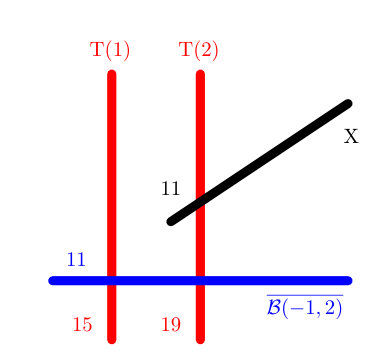 Figure 1