Robust Heteroclinic Tangencies
Pablo G. Barrientos, Sebasti\'an A. P\'erez

TL;DR
This paper constructs specific diffeomorphisms in dimensions two and higher that demonstrate robust heteroclinic tangencies, contributing to the understanding of complex dynamical behaviors.
Contribution
It introduces a method to create $C^1$-robust heteroclinic tangencies in higher-dimensional diffeomorphisms, expanding the known examples in dynamical systems.
Findings
Existence of $C^1$-robust heteroclinic tangencies in dimension $d extgreater=2$
Construction method for such diffeomorphisms
Implications for stability and bifurcation analysis in dynamical systems
Abstract
We construct diffeomorphisms in dimension exhibiting -robust heteroclinic tangencies.
Click any figure to enlarge with its caption.
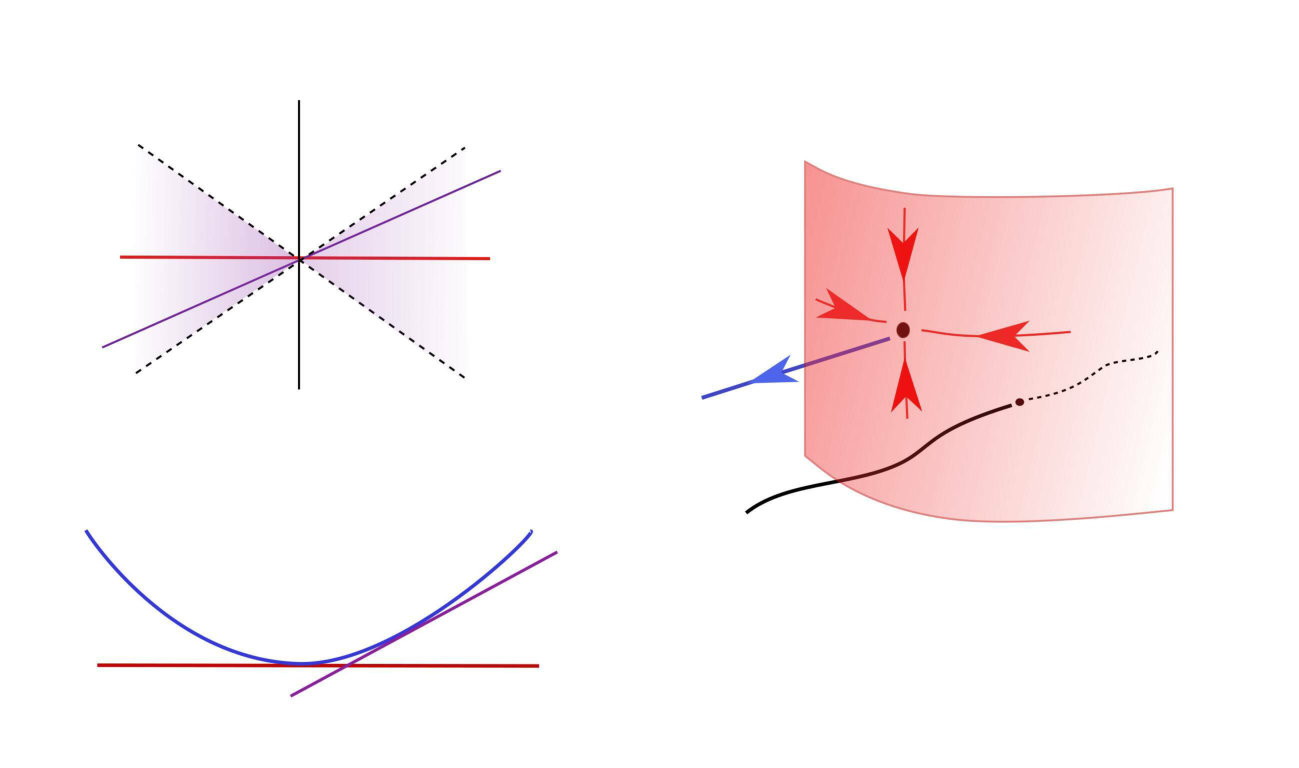 Figure 1
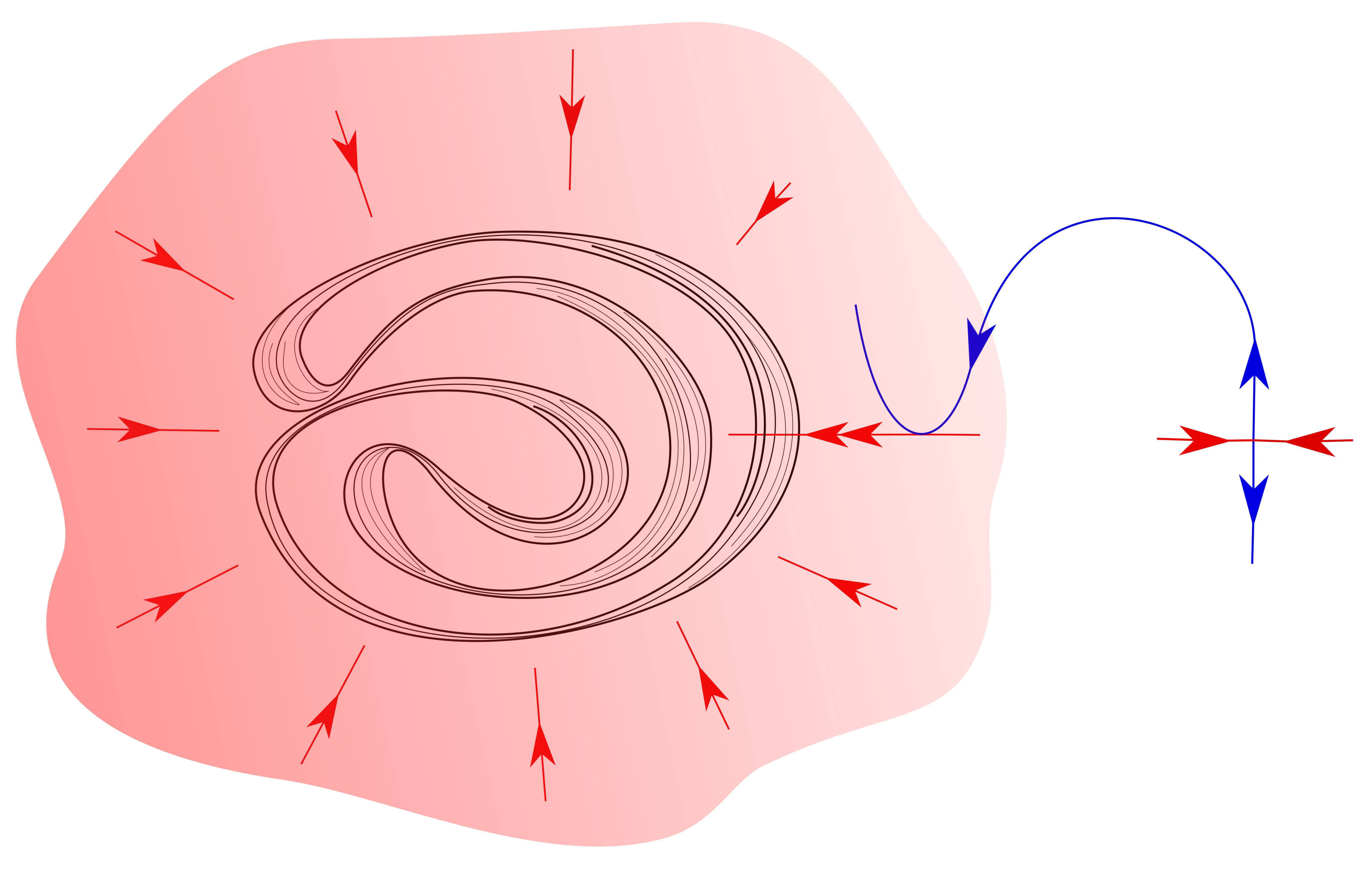 Figure 2
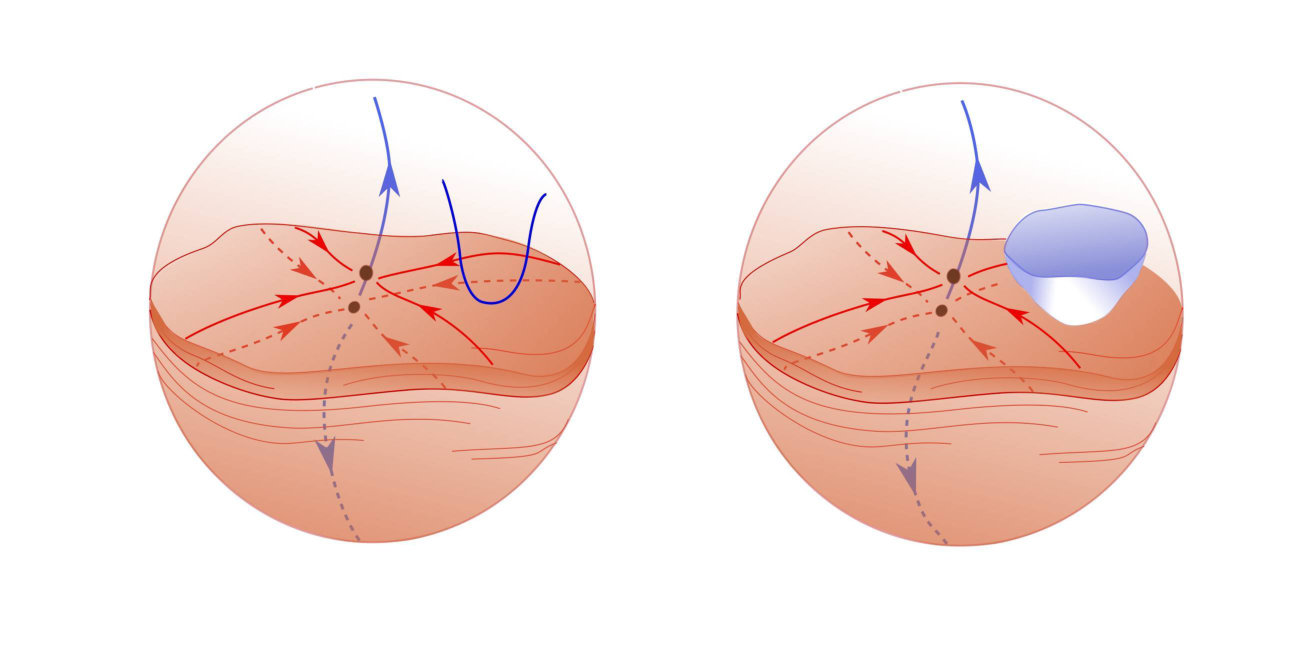 Figure 3
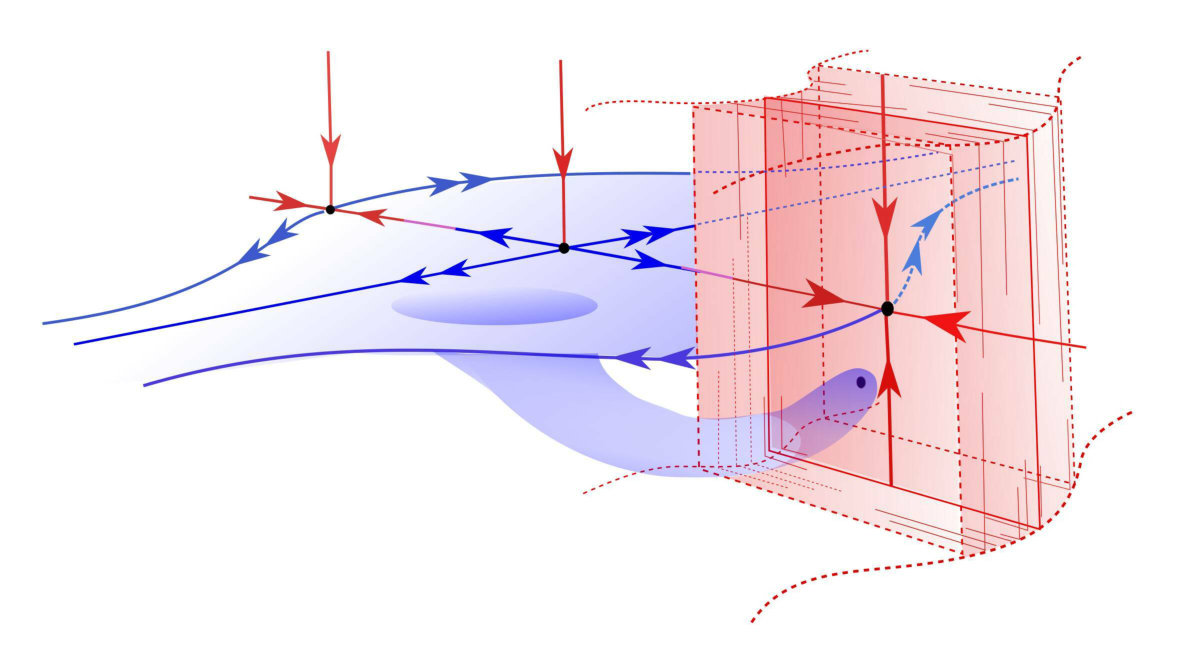 Figure 4
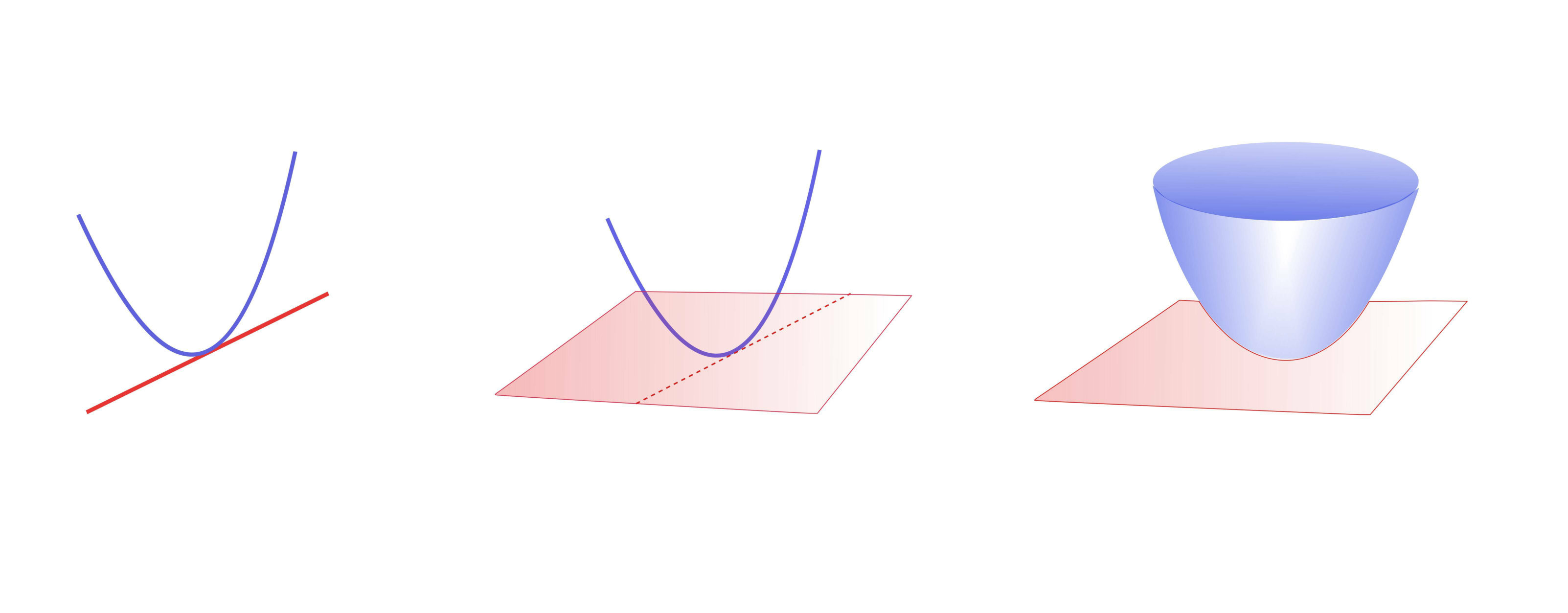 Figure 5
Peer Reviews
No public reviews on file for this paper yet. If you reviewed it on a platform where reviews are public (OpenReview, ICLR, NeurIPS, ICML), you can paste yours below so the community can read it here.
Videos
No videos yet. Explain this paper in a talk, walkthrough, or lecture? Add one.
Robust heteroclinic tangencies
Pablo G. Barrientos
Instituto de Matemática e Estatística, UFF
Rua Prof. Marcos Waldemar de Freitas Reis, s/n, Niterói, Brazil
and
Sebastián A. Pérez
Centro de Matematica da Universidade do Porto
Rua do Campo Alegre 687, 4169-007 Porto, Portugal
Abstract.
We construct diffeomorphisms in dimension exhibiting -robust heteroclinic tangencies.
Key words and phrases:
folding manifolds, robust equidimensional tangencies, robust heterodimensional tangencies.
2000 Mathematics Subject Classification:
Primary 34D30, 37D10, 37D30, 37G25.
1. Introduction
An important problem in the modern theory of Dynamical Systems is to describe diffeomorphisms whose qualitative behavior exhibits robustness under (small) perturbations and how abundant these sets of dynamics can be. Motivated by this issue, Smale introduced in [15] the hyperbolic diffeomorphisms as examples of structural stable dynamics (open sets of dynamics which are all of them conjugated). However, the transverse intersection between the invariant manifolds of basic sets was soon observed as a necessary condition [20, 13, 17]. The main goal of this article is to study the persistence of the non-transverse intersection between those manifolds. Namely, we focus in tangencial heteroclinic orbits.
A diffeomorphism of a manifold has a heteroclinic tangency if there are different transitive hyperbolic sets and , points , and such that
[TABLE]
The number is called codimension of the tangency and measures how far the tangencial intersection is from a transverse intersection. On the other hand, indicates the number of linearly independent common tangencial directions. Observe that
[TABLE]
where denotes the stable index of a (transitive) hyperbolic set . The integer is called signed co-index. Notice that when this number coincides with the classical co-index between and . Moreover, if and only if
[TABLE]
If , the heteroclinic tangency is called equidimensional and otherwise heterodimensional. Figure 1 illustrates the different types of heteroclinic tangencies in dimension three.
Heterodimensional tangencies with signed co-index was introduced in [9] where interesting dynamics consequences were obtained. Indeed, the authors showed that the -unfolding of a three dimensional heterodimensional tangency (with ) leads to -robustly non-dominated dynamics and in some cases to very intermingled dynamics related to universal dynamics, for details see [9, 6]. In the -topologies with , the bifurcation of such tangencies leads, for instance, to the existence of blender dynamics [8, 10]. Kiriki and Soma in [12] obtain the first examples of -robust heterodimensional tangencies with and in any manifold of dimension . Recently in [3] new examples of -robust heterodimensional tangencies with and were also constructed in any manifold of dimension . In the same work, -robust heteroclinic tangencies with were also obtained. In [12] it was proposed the problem of constructing -robust heterodimensional tangencies with in any dimension greater than . Motivated by this issue, the main result of this work shows that, in particular, these tangencies can be built persistently under -perturbations.
Theorem A**.**
Every manifold of dimension admits a diffeomorphism having a -robust heteroclinic tangency of codimension and signed co-index .
By constraints of the dimension, in surfaces, we only get equidimensional tangencies. In higher dimensions, we construct both type of heteroclinic tangencies: equidimensional and heterodimensional with all possible signed co-index between 0 and .
Theorem A will be proved in Section 2, by providing a local construction close to the classical examples given by Abraham and Smale [1], Simon [14] and Asaoka in [2]. In Section 3 we will give a different proof of Theorem A using ideas of the recent work [4] studying the differential cocyle in the tangent space. These new ideas allow us to generalize the construction for large codimension () in some particular cases. Namely, we get the following result.
Theorem B**.**
Given integers and , there are diffeomorphisms of the -dimensional torus with having a -robust heterodimensional tangency of codimension and signed co-index .
The proof of the above theorem will be carried on in Section 4. Finally, in Section 5 we conclude the work with a section of open questions and future directions.
2. Geometric construction of -robust heteroclinic tangencies
Let be a Plykin attractor in a disc with three holes [16]. Let be a saddle in the complement of this disc as in Figure 2. To do possible the construction we need to assume that belongs to a Plykin repellor . This figure illustrates the two-dimensional version of the Asaoka’s argument [2] (see also [14]) providing a -robust equidimensional tangency in any surface between the stable manifold of and the unstable manifold of .
Using this idea, we built a diffeomorphism on any manifold of dimension having a hyperbolic attractor whose attracting region is a connected set and foliated by -dimensional stable submanifolds. After that, we consider a fixed point in and another fixed point of of stable index where creating a heteroclinic tangency between and , so that and meet transversely. The - persistence of this last intersection provides a -robust heteroclinic tangency associated with and .
2.1. Construction
We now give the details of our construction. Since our argument is local, we can put with . First, we take a two-dimensional diffeomorphism with a Plykin attractor constructed in local coordinates inside a disk with three holes. We consider a -diffeomorphism with such that for a small , the restriction of to the set is given by
[TABLE]
Thus, the set
[TABLE]
is a hyperbolic attractor of and is a trapping region of , i.e. . The structural stability of provides the existence of a -neighborhood of such that for each , the continuation of has by trapping region the set . We remark that the local stable manifolds for provide a foliation of the set by leaves (plaques) of dimension . It is not hard to verify that this property also holds for any diffeomorphism in . We will denote by the stable local manifold at for .
Now we build the robust heteroclinc tangency of elliptic type. Recall that a heteroclinic tangency , is of elliptic type if there is a neighborhood of contained in either, or , say , such that any point in belongs to the same side of the tangent space . We consider a fixed point and a small open ball centered at such that is contained in . We observe that for every , is foliated by
[TABLE]
Consider a hyperbolic fixed point of with stable index . By means of a homotopic deformation, we force to the -dimensional unstable manifold intersects non-transversely the stable manifold in a heteroclinic tangency of elliptic type, namely . Taking a suitable iterated if necessary, we can assume that is in .
Thus, this last diffeomorphism, that again we call , has a heteroclinic tangency of codimension and signed co-index with , associated with the saddles and .
On the other hand, by definition, there exists a neighborhood of contained in such that is contained in . See Figure 3. We will see that the -persistence of these last transverse intersections provides a -robust heteroclinic tangency associated with and . Besides, for each , we consider a small curve parameterizing a small local unstable manifold of the continuation of such that
[TABLE]
Since is a heteroclinic tangency of elliptic type between and we can assume that (see Figure 3)
[TABLE]
Our conditions imply that for each , the set
[TABLE]
is inferiorly bounded where is a continuation in of the neighborhood . Thus, if is the infimum of then and meet in a heteroclinic tangency of codimension and signed co-index with . This completes the proof of Theorem A.
3. Differential construction of -robust heteroclinic
tangencies
In this section we will prove again Theorem A but now using a different argument. This different approach allows us to generalize the result to get robust heterodimensional tangencies of large codimension in the next section. In order to explain the idea behind of this new approach we will consider again the situation described in Figure 2.
By considering, if necessary, local coordinates around , define the projective cocycle where and belongs to the space of one-dimensional vector space in . Recall that the is a hyperbolic attractor of with splitting . Hence, the set is a hyperbolic set of where the direction corresponding to the variable in is uniformly expanding. Thus, is a two-dimensional manifold in the three-dimensional space as it is showed in Figure 5. On the other hand the unstable manifold of contains a folding manifold that we denote by . That is, a small piece of the unstable manifold contained the point in its interior. Namely, this manifold folds with respect to the stable cone-field of at the point as it is represented Figure 5. That is, by considering linear transport to the origin of , the union of tangent spaces where cover the cone for some small . This property allows us to see the set as a graph of a function . In other words, as a one-dimensional manifold in which is the image of a graph over and thus transversally intersecting at the point where . Since this intersection is transversal, it persists for any small perturbation. In particular, for any small perturbation of , we get a intersection point between and where is the continuation of for cocycle induced by in . Notice that this intersection point between and provides the tangency point and direction between and a stable manifold for some . Therefore, we get a robust tangency.
3.1. Construction
Now we will give the formal details. Recall the -diffeomorphism in (1) and the attractor in (2). This set has a well defined hyperbolic structure where the stable bundle of is -dimensional. Observe that can be uniquely extended to a continuous -invariant fiber bundle, which we also denote by , over each leaf , , and so to the whole set . Moreover, from the hyperbolicity of , we have that varies continuously with respect to the point and the diffeomorphism in a small neighborhood of . Thus, for each the set is foliated by -dimensional (local) stable manifolds of which are tangent to the bundle continuation of .
Fix . On the set we have defined a stable cone-field of dimension and size satisfying
[TABLE]
In what follows, for notational simplicity, we omit the subscript in the notation . The -dimensional cone-field can be seen as an open set of the Grassmannian manifold where is set of the -planes in . Observe that in the case , this Grassmannian manifold is the projective space. Now consider the differential cocycle induced by on given by
[TABLE]
Observe that is a -diffeomorphism of with . Since is a repelling point of ,
[TABLE]
is hyperbolic set of with stable index equals to . Namely, the splitting of is of the form where corresponds with the splitting of for and with the directions over . On the other hand, the local stable manifold of contains the set
[TABLE]
This is a manifold of codimension the dimension of .
We now construct the heteroclinic tangency. First, we give a more formal notion of heterodimensional tangency between any two manifolds.
Definition 3.1**.**
Let and be two submanifolds of . We say that and has a heteroclinic tangency at if where
[TABLE]
The numbers , and are called, respectively, dimension, codimension and signed co-index of the tangency between and at . The tangency is said to be heterodimensional if and equidimensional if .
For simplicity and clarity of the exposition we restrict the construction to the case of signed co-index . By means of a similar argument one can also get the other possible co-index in Theorem A. We will consider two types of tangencies: elliptical (see Section 2) and of saddle type. We recall that a tangency is of saddle type if every neighborhood of contained in either, or , say , intersects each connected component of .
Example 3.2**.**
Consider a diffeomorphism having two periodic saddles and such that , with and . Assume that, , where
[TABLE]
or
[TABLE]
Then is a heteroclinic tangency of elliptic type between and choosing as in (3) and the saddle type if is as in (4).
As it is usual, we identified the embedding (as those described above) with its image. Now, using the -dimensional manifold in (3) and (4) we create a tangency between the leaves the foliation of by stable manifold (of dimension ) of . Fix a fixed point and consider with . Modifying slightly the construction of the attractor if necessary, we can consider coordinates in neighborhood of such that
- •
is identified with and with ,
- •
the local unstable manifold is ,
- •
for each , the local stable manifold is ; and
- •
the bundle is trivial on this neighborhood.
Hence, in this local coordinates we can assume that and
[TABLE]
where is a small constant.
At this coordinates, the folding manifolds in (3) and (4) intersect at in a heteroclinic tangency of codimension and signed co-index . The next result state that this tangency persist under perturbations.
Proposition 3.3**.**
The folding manifold has a heteroclinic tangency with the stable foliation of which persists under small -perturbations of .
The proof of this proposition makes use of the following result:
Lemma 3.4**.**
The set is a manifold of dimension embedded as a disc in . Namely it is a graph of a function of the form .
Let us postpone for a while the proof of lema, to conclude the proof of the proposition.
Proof of Proposition 3.3.
Since tangentially meets at , we get that topologically transversally intersect at . The (topological) transversality follows from Lemma 3.4 since is a disc of and is a manifold of codimension . See Figure 5.
Now consider a diffeomorphism -close to . Observe that the cocycle is a homeomorphism of only -close to . However, is still a topological hyperbolic set for where and are the continuation of and for . Thus, the set contains a manifold -close to of codimension . Thus we still have a transversal intersection between and . Observe that if then , and . Thus . This provides a tangency between and the stable foliation of concluding the proof of the proposition. ∎
Remark 3.5**.**
Proposition 3.3 also holds for any small enough -perturbation of . To see this, if the perturbation is -close then we have a change of variable -close to the identity sending the perturbed manifold to the folding manifold . Hence we get a new diffeomorphism which is -close to . Thus, applying Proposition 3.3 we get a tangency.
Theorem A follows from the above proposition and remark by considering that the folding manifold is contained in the unstable manifold of a hyperbolic fixed point of of unstable index . Observe that the codimension of the tangency is given by the formula where is the number of tangent directions and is the co-indice between the hyperbolic set involved. In this case, and .
To complete our construction we give the proof of Lemma 3.4.
Proof of Lemma 3.4.
To prove that is an embedded disc in we need to show that is a graph of an injective function of the form
[TABLE]
To do this, we must associate to an unique point such that . In other words, we need to show that
[TABLE]
As above, we are standing that is a small open set in centered at and the tangent space as a vector space of . Analytically, we need to solve the following problem: given we look for such that where .
In order to do the calculation, we choose the elliptic form of the folding manifold given in (3). For folding manifold of saddle type in (4) the argument is similar. Hence,
[TABLE]
We write where for . Hence if, and only if, for all . Equivalently, if
[TABLE]
Hence,
[TABLE]
That is, we have a square linear system where and depends on the vector space . To find we need to show that is an invertible matrix. To do this, we will take as the vector space the center of where denotes the vector with a in the -th coordinate and 0’s elsewhere. We get in this case that where is the identity square matrix of order . Thus . Then by the continuity for all close to we uniquely solve (5) and thus we find such that where . This completes the proof of the lemma. ∎
4. -robust heterodimensional tangencies of large codimension
Fix and . Set . A hyperbolic set of a diffeomorphism of a manifold is said to be a codimension one expanding attractor if for every , holds that and . Let us take a codimension one expanding hyperbolic attractor of a diffeomorphism on a manifold of dimension . In order to avoid the problem of classifying the manifold that support these kind of attractors, we set as the Derived from Anosov (by short -attractor) in the -torus , see [15]. After that, we will consider a diffeomorphism of locally defined on for a fixed small and as
[TABLE]
Notice that the set is a hyperbolic attractor of whose basin of attraction contains . Moreover, is the stable bundle of where is the one-dimensional stable bundle of for . Thus, . Analogously as in previous sections, this bundle can be uniquely extended to a -invariant bundle over which we also denote by . Consequently the set is foliated by -dimensional stable manifolds of which are tangent to . This allows us to consider a stable cone-field of dimension defined in whole . As in Section 3, we defined the differential cocycle induced by on . Similarly, we have that the set is also a hyperbolic set of with stable index equals to and whose local stable manifold contains the set . Thus, this manifold has by codimension the dimension of .
Restricting us to a small ball , we can assume that the stable cone is give by
[TABLE]
where is small enough and . We will consider a folding manifold in folded with respect to which we introduce formally as follows:
Definition 4.1**.**
A manifold of dimension is called folding manifold in an open ball folded with respect to the cone if and
[TABLE]
We are understanding that is closure of the open set in centered at which we see as a cone in and the tangent space as a -dimensional vector space of . Taking tends to zero we observe that the above definition is in fact an infinitesimal property of . Thus without restriction we can assume that the tangent space of covers injectively the closure of . This means that for every we have a unique such that . Moreover, varies continuously with respect to .
Example 4.2**.**
Take . Let us consider a -dimensional manifold defined by
[TABLE]
Hence, we have that
[TABLE]
where . We write where for . Hence if, and only if, for all . Equivalently, if
[TABLE]
[TABLE]
This defines a linear system of equations and variable. Since we can write the system in the form where is a square matrix of ordem and is a vector in depending on the vector space . To find we need to show that is an invertible matrix. To do this, we will take as the vector space the center of where denotes the vector with a in the -th coordinate and 0’s elsewhere. We get in this case that . Then, by continuity, for all close to we uniquely solve the equation and thus we find such that where . Therefore is folding manifold with respect to .
As a consequence of the definition of folding manifold we get the following lemma:
Lemma 4.3**.**
Let be a folding manifold folded with respect to . Then the set
[TABLE]
contains a manifold of dimension embedded as a disc in .
Proof.
From the definition of folding manifold, we have an injective continuous function such that . This defines a subset of which is an embedding given by proving the lemma. ∎
The following result is the analogous to Proposition 3.3.
Proposition 4.4**.**
Let be a folding manifold in of dimension folded with respect to . Then has a heterodimensional tangency of codimension and signed co-index with the stable foliation of which persists under small -perturbations of .
Proof.
By assumption if then . Thus, we have that has a heterodimensional tangency of codimension with for some . Indeed, by definition of the folding manifold and the stable bundle we find and such that and . Furthermore, the signed co-index of the tangency is and the codimension is . On the other hand, the point belongs to . Moreover, from Lemma 4.3, we have that contains a disc of dimension . Additionally, has codimension . Hence transversally intersect (in a topological sense) .
Arguing as in Proposition 3.3, we still have a transversal intersection between and for any -close diffeomorphism to . Thus there is . Then , and for some . Similar as above, this implies that and has a heterodimensional tangency of codimension and signed co-index concluding the proof of the proposition. ∎
Proof of Theorem B.
It suffices to consider that the folding manifold in Proposition 4.4 is contained in the unstable manifold of a hyperbolic fixed point of of unstable index . ∎
5. Discussion and open questions
The goal of this paper was to construct heteroclinic tangencies which are robust under perturbations. This question was proposed in [12, pag. 3281] where the authors showed the existence of -robust heterodimensional tangencies. To approach this problem we have constructed -robust tangencies where one of the hyperbolic sets involved is an attractor. This limitation prevents that our construction could be carried on a heterodimensional cycle. A diffeomorphism has a heterodimensional cycle associated with two transitive hyperbolic sets if these sets have different indices (dimension of the stable bundle) and their invariant manifolds meet cyclically. This cycle is called non-transverse (heterodimensional) cycle if besides its cyclic intersections involves some heterodimensional tangency. In order to construct a robust non-transverse heterodimensional cycle one must construct the tangency involving hyperbolic sets which are not attractors. This leads to our first question:
Question 1**.**
Is it possible to construct -robust non-transverse heterodimensional cycles?
Bearing in mind the classic constructions of robust homoclinic tangencies and heterodimensional cycles ([19, 7]) via the unfolding of tangencies and cycles associated with saddles, we ask the following:
Question 2**.**
Can a diffeomorphism having a non-transverse heterodimensional cycle associated with saddles and be -approximated by a diffeomorphism with a -robust non-transverse heterodimensional cycle associated with hyperbolic sets containing the continuations and of and ?
On the other hand, we also deal in this paper with the construction of heterodimensional tangencies with signed co-index of large codimension. Robust tangencies of large codimension were discovered in [3]. Namely, the authors provided a method to construct -robust bundle tangencies which are non-trivial intersection between different fiber bundles. Bundle tangencies include homoclinic, heterodimensional and equidimensional tangencies. Recently in [4], using similar ideas similar to this paper, we have constructed new examples of robust homoclinic tangencies of large codimension. The construction also uses an abstract notion of folding manifold with respect to a cone-field extending previous approach on robust homoclinic tangencies in [5]. However, as in the case of this work, the construction are limited to consider high dimensional manifolds. The lower possible dimension that allows to have a homoclinic tangency of large codimension is . Similarly, is the lower dimension to construct a large heterodimensional tangency with signed co-index . Thus we address the following questions:
Question 3**.**
Is it possible to build a robust heterodimensional tangency with signed co-index (resp. homoclinic tangency) of codimension in dimension (resp. )?
Acknowledgements
We are grateful to Artem Raibekas for discussions and helpful suggestions. During the preparation of this article PB was supported by MTM2017-87697-P from Ministerio de Economía y Competividad de España and CNPQ-Brasil. SP were partially supported by CMUP (UID/MAT/00144/2019), which is funded by FCT with national (MCTES) and European structural funds through the programs FEDER, under the partnership agreement PT2020. SP also acknowledges financial support from a postdoctoral grant of the project PTDC/MAT-CAL/3884/2014
The reference list from the paper itself. Each links out to its DOI / PubMed record.
- 1[1] Abraham, R. and Smale, S. Nongenericity of Ω Ω \Omega -stability. Global Analysis Proc. Sympos. Pure Math., Vol. XIV, Berkeley, Calif., 1968, 5–8.
- 2[2] Asaoka, M. Hyperbolic sets exhibiting C 1 superscript 𝐶 1 C^{1} -persistent homoclinic tangency for higher dimensions. Proc. Amer. Math. Soc., 136, (2008), 677–686.
- 3[3] Barrientos, P. G. and Raibekas, A. Robust tangencies of large codimension. Nonlinearity, 30, (2017), 4369–4409.
- 4[4] Barrientos, P. G. and Raibekas, A. Robust nongeneric unfolding of cycles and tangencies. preprint (2017).
- 5[5] Bonatti, C. and Díaz, L. J. Abundance of C 1 superscript 𝐶 1 C^{1} -homoclinic tangencies. Trans. Amer. Math. Soc., 264 (2012), 5111-5148.
- 6[6] Bonatti, C. and Díaz, L. J. On maximal transitive sets of generic diffeomorphisms. Publ. Math., Inst. Hautes Étud. Sci., 96 (2003), 171–197.
- 7[7] Bonatti, C. and Díaz, L. J. Robust heterodimensional cycles and C 1 superscript 𝐶 1 C^{1} -generic dynamics. J. Inst. Math. Jussieu, 7 (2008), 469–525.
- 8[8] Díaz, L. J. and Kiriki, S. and Katsutoshi, S. Blenders in centre unstable Hénon-like families: with an application to heterodimensional bifurcations. Nonlinearity, 27 (2014), 353–378.