Quantum Thermal Hall effect of chiral spinons on a Kagome strip
Pavel Tikhonov, Efrat Shimshoni

TL;DR
This paper develops a theoretical model for the thermal Hall effect in a Kagome strip with chiral spin interactions, identifying phase-dependent behaviors and a quantized plateau in thermal conductivity related to spinon filling.
Contribution
It introduces a low-energy bosonization-based theory for spinons in a Kagome strip, revealing phase transitions and quantized thermal Hall conductance in a chiral spin liquid.
Findings
Identification of three quantum phases: VBC, MSL, CSL.
Observation of a quantized plateau in thermal Hall conductivity in the CSL phase.
Qualitative change in $ _{xy}$ behavior across phase transitions.
Abstract
We develop a theory for the thermal Hall coefficient in a spin- system on a strip of Kagome lattice, where a chiral spin-interaction term is present. To this end, we model the Kagome strip as a three-leg spin-ladder, and use Bosonization to derive a low-energy theory for the spinons in this system. Introducing further a Dzyaloshinskii-Moriya interaction () and a tunable magnetic field (), we identify three distinct -dependent quantum phases: a valence-bond crystal (VBC), a "metallic" spin liquid (MSL) and a chiral spin liquid (CSL). In the presence of a temperature difference between the top and the bottom edges of the strip, we evaluate the net heat current along the strip, and consequently the thermal Hall conductivity . We find that the VBC-MSL-CSL transitions are accompanied by a pronounced qualitative change in the behavior…
Click any figure to enlarge with its caption.
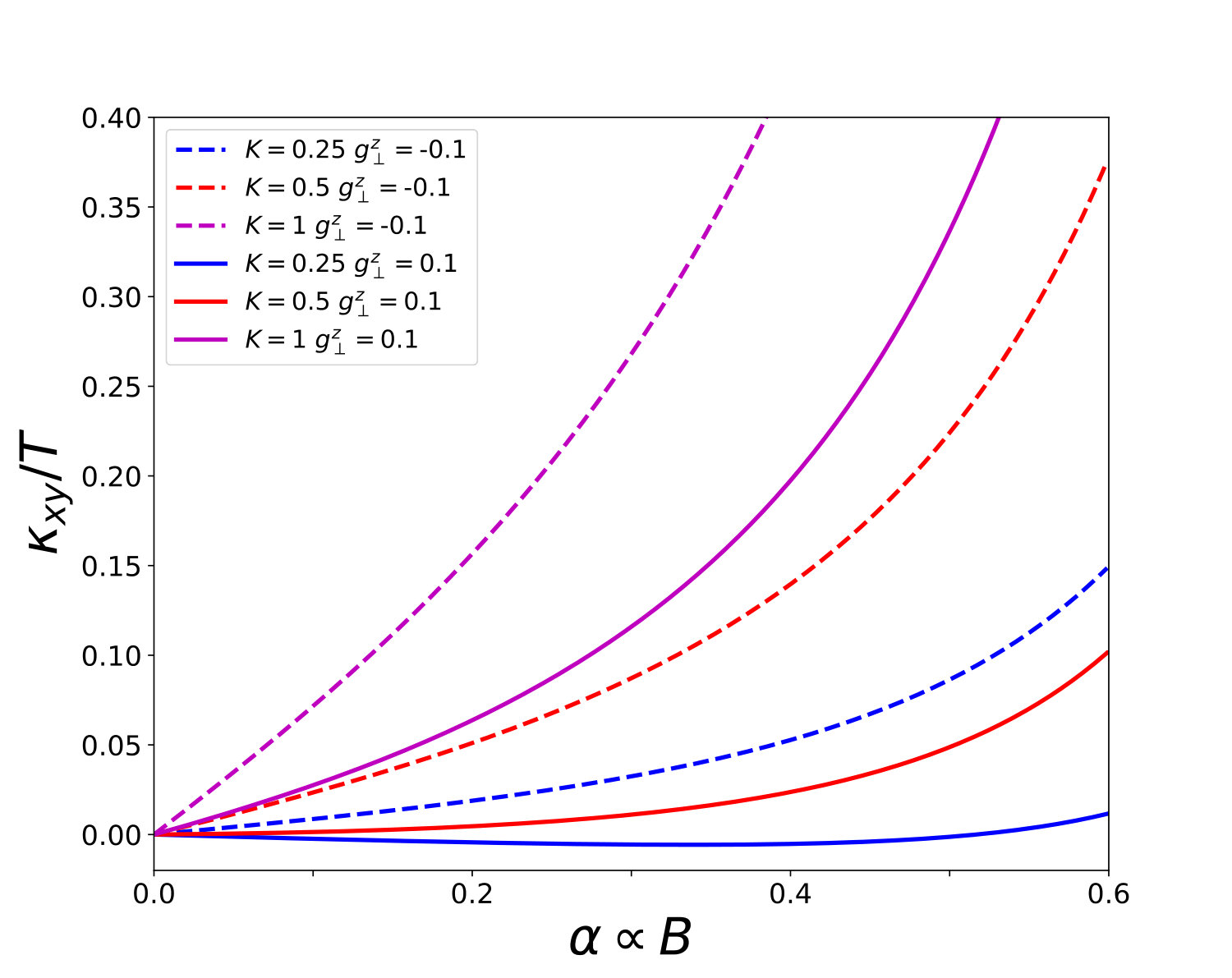 Figure 1
Peer Reviews
No public reviews on file for this paper yet. If you reviewed it on a platform where reviews are public (OpenReview, ICLR, NeurIPS, ICML), you can paste yours below so the community can read it here.
Videos
No videos yet. Explain this paper in a talk, walkthrough, or lecture? Add one.