Comment on Daya Bay's definition and use of Delta m^2_ee
Stephen J. Parke, Renata Zukanovich Funchal

TL;DR
This paper discusses and critiques Daya Bay's definition of the effective neutrino mass-squared difference Delta m^2_ee used in reactor antineutrino experiments, aiming to clarify its implications.
Contribution
It provides a detailed commentary on the definition and application of Delta m^2_ee in reactor neutrino experiments, highlighting potential issues and clarifications.
Findings
Identifies ambiguities in Daya Bay's definition of Delta m^2_ee
Clarifies the proper use and interpretation of Delta m^2_ee in experiments
Suggests improvements for consistent application in future analyses
Abstract
We comment on Daya Bay's latest definition of the effective Delta m^2 for short baseline reactor electron antineutrino disappearance experiments used in arXiv:1809.02261 (Phys. Rev. Lett. 121, no. 24, 241805 (2018))
Click any figure to enlarge with its caption.
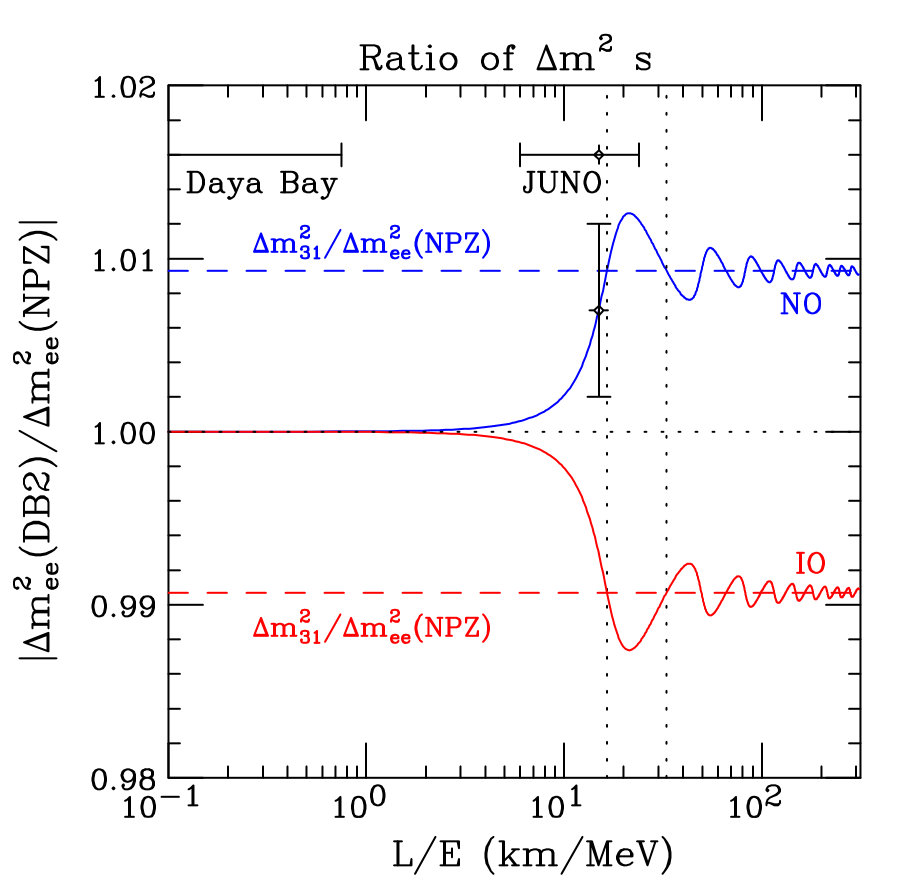 Figure 2
Peer Reviews
No public reviews on file for this paper yet. If you reviewed it on a platform where reviews are public (OpenReview, ICLR, NeurIPS, ICML), you can paste yours below so the community can read it here.
Videos
No videos yet. Explain this paper in a talk, walkthrough, or lecture? Add one.
Taxonomy
TopicsNeutrino Physics Research · Atomic and Subatomic Physics Research · Nuclear Physics and Applications
Comment on Daya Bay’s definition and use of
Stephen J. Parke
[email protected] orcid:0000-0003-2028-6782
Theoretical Physics Department, Fermi National Accelerator Laboratory, P.O.Box 500, Batavia, IL 60510, USA
Renata Zukanovich Funchal
[email protected] orcid:0000-0001-6749-0022
Instituto de Física, Universidade de São Paulo, C. P. 66.318, 05315-970 São Paulo, Brazil
Abstract
We comment on Daya Bay’s latest definition of the effective for short baseline reactor disappearance experiments used in Adey:2018zwh .
††preprint: FERMILAB-Pub-19-078-T
In Adey:2018zwh , Daya Bay (DB) uses their latest definition of which obfuscates the simple relationship between such an effective and the fundamental parameters of the neutrino sector. Furthermore, this definition of is baseline divided by neutrino energy () dependent. Dependence on L/E implies dependence on the proper time between production and detection of the observed neutrinos, i.e. the proper age of the neutrinos propertime . This new definition is approximately constant for the Daya Bay experiment ( km/MeV), unlike DB’s earlier definition, DB1 . However, for the JUNO experiment ( km/MeV), currently under construction, this new definition has a 1% jump between smallest and largest values for the observed neutrinos. The expected precision on the measurement of at JUNO is 0.5%, see An:2015jdp , and therefore comparable in size to this jump.
Daya Bay’s latest definition of is given by
[TABLE]
using , see An:2015rpe . is clearly (proper time of the neutrino) dependent and it is far from transparent the relationship to the fundamental neutrino parameters.
The original definition of an effective for disappearance experiments, , given by Nunokawa, Parke and Zukanovich Funchal (NPZ) , is simply Nunokawa:2005nx
[TABLE]
The independence of this definition is manifest and so is the relationship to the fundamental parameters of the neutrino sector. is “the average of and ”. RENO uses this definition RENO:2015ksa .
Since there is no review of in the PDG, clarification of the relationship between these different definitions of is pertinent for understanding short baseline reactor neutrino oscillation physics. To start, consider the small and large limits of : for (),
[TABLE]
In Fig. 1, the ratio of to is plotted as a function of . Clearly, for the Daya Bay experiment, km/MeV, these two definitions are essentially identical as the second term in eqn. Comment on Daya Bay’s definition and use of is always smaller than 1 of . Whereas for the JUNO experiment, km/MeV, there is a significant jump, 1%, in the value between the smallest and largest .
In summary, Daya Bay’s new definition of , eq. 1, does not manifestly show the simple relationship to the fundamental parameters of the neutrino sector for short baseline reactor experiments, such as Daya Bay and RENO. Nor is it useful for future medium baseline experiments like JUNO due to the 1% jump, precisely in the range of this experiment uniqueness . The original definition of , eq. 2, is clearly independent, the relationship to the fundamental parameters of the neutrinos sector is manifest and useful for both the short, Daya Bay and RENO, and medium baseline, JUNO, reactor neutrino experiments.
Acknowledgements.
We acknowledge discussions with our long time collaborator Hiroshi Nunokawa who is currently a member of the JUNO collaboration. Fermilab is operated by the Fermi Research Alliance under contract no. DE-AC02-07CH11359 with the U.S. Department of Energy. SP thanks IFT of Madrid for wonderful hospitality while this comment was written.. This project has received funding/support from the European Union’s Horizon 2020 research and innovation programme under the Marie Sklodowska-Curie grant agreement No 690575 and. No 674896. RZF was partially supported by Fundação de Amparo à Pesquisa do Estado de São Paulo (FAPESP) and Conselho Nacional de Ciência e Tecnologia (CNPq).
The reference list from the paper itself. Each links out to its DOI / PubMed record.
- 1(1) D. Adey et al. [Daya Bay Collaboration], Phys. Rev. Lett. 121 , no. 24, 241805 (2018) doi:10.1103/Phys Rev Lett.121.241805
- 2(2) L/E is proportional to the proper time of the neutrino, as τ ν = 0.3 ( L / E 1 km / Me V ) ( m ν 100 me V ) × 10 − 12 subscript 𝜏 𝜈 0.3 𝐿 𝐸 1 km Me V subscript 𝑚 𝜈 100 me V superscript 10 12 \tau_{\nu}=0.3\left(\frac{L/E}{1~{}\rm km/Me V}\right)\left(\frac{m_{\nu}}{\,100\,\rm me V}\right)\times 10^{-12} sec.
- 3(3) In [ar Xiv:1310.6732 [hep-ex]] , the Daya Bay experiment defined Δ m e e 2 ( DB 1 ) ≡ Δ subscript superscript 𝑚 2 𝑒 𝑒 DB 1 absent \Delta m^{2}_{ee}(\rm DB 1)\equiv ( 4 E L ) arcsin ( cos 2 θ 12 sin 2 Δ 31 + sin 2 θ 12 sin 2 Δ m 32 2 ) 4 𝐸 𝐿 arcsine superscript 2 subscript 𝜃 12 superscript 2 subscript Δ 31 superscript 2 subscript 𝜃 12 superscript 2 Δ subscript superscript 𝑚 2 32 \left(\frac{4E}{L}\right)\arcsin{\sqrt{\cos^{2}\theta_{12}\sin^{2}\Delta_{31}+\sin^{2}
- 4(4) F. An et al. [JUNO Collaboration], J. Phys. G 43 , no. 3, 030401 (2016) doi:10.1088/0954-3899/43/3/030401 [ar Xiv:1507.05613 [physics.ins-det]].
- 5(5) F. P. An et al. [Daya Bay Collaboration], Phys. Rev. Lett. 115 , no. 11, 111802 (2015) doi:10.1103/Phys Rev Lett.115.111802. Supplemental material.
- 6(6) H. Nunokawa, S. J. Parke and R. Zukanovich Funchal, Phys. Rev. D 72 , 013009 (2005) doi:10.1103/Phys Rev D.72.013009 [hep-ph/0503283].
- 7(7) J. H. Choi et al. [RENO Collaboration], “Observation of Energy and Baseline Dependent Reactor Antineutrino Disappearance in the RENO Experiment,” [ar Xiv:1511.05849 [hep-ex]] .
- 8(8) S. Parke, Phys. Rev. D 93 , no. 5, 053008 (2016) doi:10.1103/Phys Rev D.93.053008 [ar Xiv:1601.07464 [hep-ph]].