Curing velocity superselection in non-relativistic QED by restriction to a lightcone
Daniela Cadamuro, Wojciech Dybalski

TL;DR
This paper demonstrates that restricting electron states to the future lightcone in non-relativistic QED resolves velocity superselection, addressing a key aspect of the infrared problem and supporting the Buchholz-Roberts approach.
Contribution
It shows that velocity superselection can be resolved in non-relativistic QED models by focusing on the algebra of fields localized in the future lightcone, linking to a broader equivalence of GNS representations.
Findings
Velocity superselection is resolved by lightcone restriction.
Equivalence of GNS representations for coherent states is established.
Supports the Buchholz-Roberts approach to infrared issues.
Abstract
It is physically expected that plane-wave configurations of the electron in QED induce disjoint representations of the algebra of the electromagnetic fields. This phenomenon of velocity superselection, which is one aspect of the infrared problem, is mathematically well established in non-relativistic (Pauli-Fierz type) models of QED. We show that velocity superselection can be resolved in such models by restricting the electron states to the subalgebra of the fields localized in the future lightcone. This actually follows from a more general statement about equivalence of GNS representations for coherent states of the algebra of the future lightcone in free electromagnetism. Our analysis turns out to be meaningful in the non-relativistic setting and provides evidence in favour of the Buchholz-Roberts approach to infrared problems.
Click any figure to enlarge with its caption.
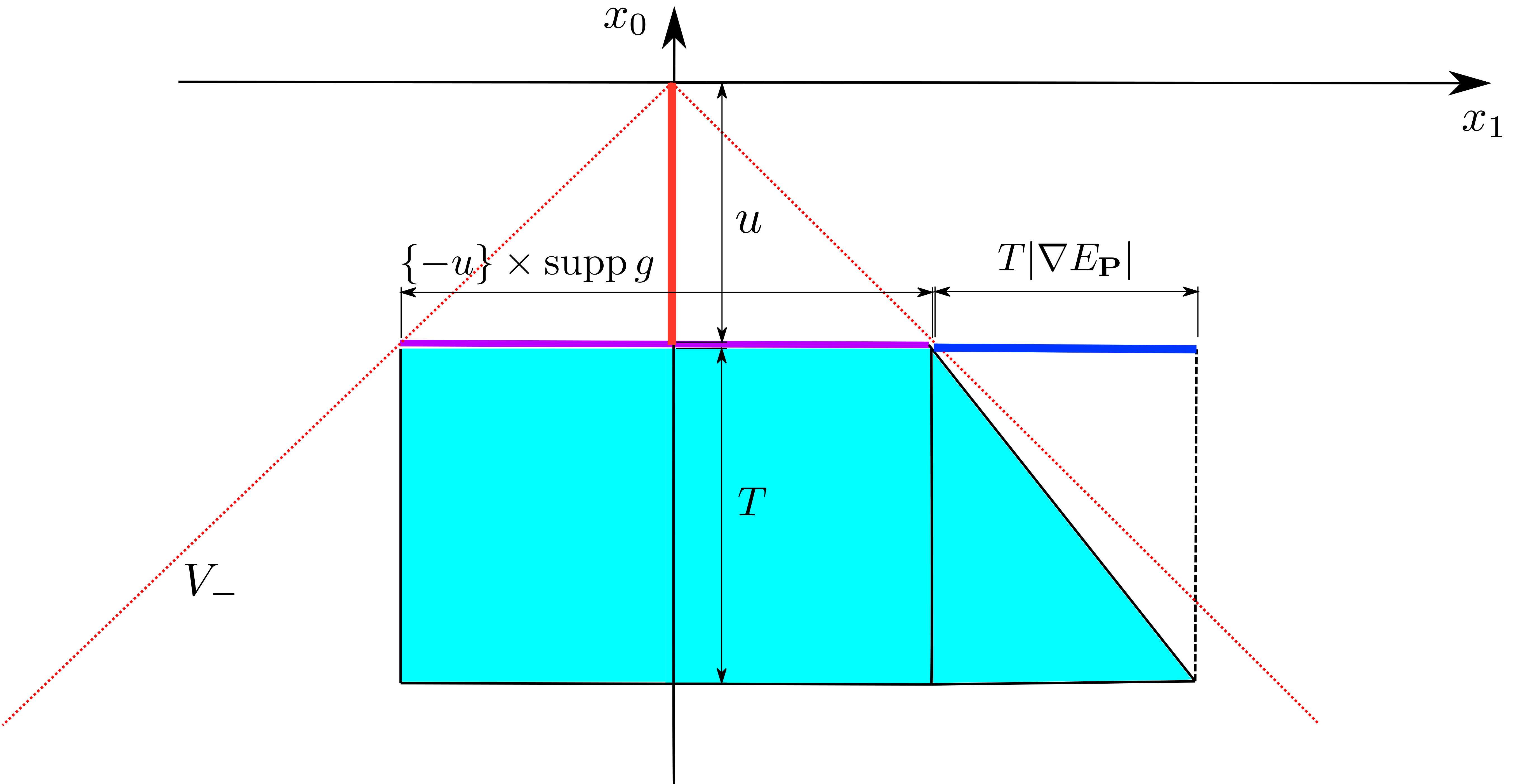 Figure 1
Peer Reviews
No public reviews on file for this paper yet. If you reviewed it on a platform where reviews are public (OpenReview, ICLR, NeurIPS, ICML), you can paste yours below so the community can read it here.
Videos
No videos yet. Explain this paper in a talk, walkthrough, or lecture? Add one.
Curing velocity superselection in non-relativistic QED
by restriction to a lightcone
**Daniela Cadamuro
**Institute for Theoretical Physics, University of Leipzig,
E-mail: [email protected]
Wojciech Dybalski
Zentrum Mathematik, Technische Universität München,
E-mail: [email protected]
Abstract
It is physically expected that plane-wave configurations of the electron in QED induce disjoint representations of the algebra of the electromagnetic fields. This phenomenon of velocity superselection, which is one aspect of the infrared problem, is mathematically well established in non-relativistic (Pauli-Fierz type) models of QED. We show that velocity superselection can be resolved in such models by restricting the electron states to the subalgebra of the fields localized in the future lightcone. This actually follows from a more general statement about equivalence of GNS representations for coherent states of the algebra of the future lightcone in free electromagnetism. Our analysis turns out to be meaningful in the non-relativistic setting and provides evidence in favour of the Buchholz-Roberts approach to infrared problems.
1 Introduction
In the framework of local relativistic QFT D. Buchholz and J. E. Roberts proposed a novel approach to infrared problems, by focusing attention on measurements performed in some future lightcone [BR14]. They defined a family of charged representations, localizable in certain subsets of the future lightcone, and developed for them a meaningful superselection theory in the spirit of the Doplicher-Haag-Roberts (DHR) analysis. As the Buchholz-Roberts approach invalidates the standard no-go theorems [Bu86], also a resolution of the infraparticle problem, i.e., a demonstration of a sharp mass-shell for the electron, was posed as a question for future research in [BR14]. It was later shown by S. Alazzawi and one of the present authors in [AD17] that in the absence of the infraparticle problem one can construct Compton scattering states in the Buchholz-Roberts representations of QED. However, the question of a sharp mass of the electron was not addressed in this work and it appears to be too specific to tackle it in the axiomatic setting. On the other hand, concrete non-perturbative models of QED, amenable to a rigorous mathematical treatment, are non-relativistic due to severe ultraviolet problems. As the algebra of observables localized in a lightcone is a priori not available in such models, they may not appear suitable to test the Buchholz-Roberts approach. It is the goal of the present paper to show that such a conclusion would in fact be pre-mature. We consider the well-established property of velocity superselection in non-relativistic QED, which says that plane-wave configurations of the electron with distinct velocities induce disjoint representations of the algebra of the electromagnetic fields. We show that a restriction to the subalgebra of the future lightcone is meaningful in this context and that the phenomenon of velocity superselection disappears after such restriction. This means that the plane-wave configurations become coherent and can, in principle, be superposed into normalisable states of the electron with sharp mass. However, this latter step is not considered in this work.
Let us explain in non-technical terms how velocity superselection is defined in models of non-relativistic QED and how we resolve it by restriction to a lightcone. The Hilbert space of the model is , where carries the degrees of freedom of a spinless electron and is the Fock space of the physical photon states. The Hamiltonian has the textbook form (cf. [Sp])
[TABLE]
where is the coupling constant, is the position of the electron, is the electromagnetic potential in the Coulomb gauge with fixed ultraviolet regularization and is the Hamiltonian of free photons. Due to the translation invariance, we can decompose into the fiber Hamiltonians at fixed momentum :
[TABLE]
where is a certain unitary map. The Hamiltonians , given by (4.1) below, are self-adjoint operators acting on the so called fiber Fock space which we denote by . A manifestation of the infraparticle problem in this model is the absence of the ground states of , which is known for small and for in some ball around zero [HH08, CFP09]. On the other hand, for any infrared cut-off in the interaction, the resulting fiber Hamiltonians do have (normalised) ground states in the same region of parameters . Although these vectors tend weakly to zero as [CFP09], they define states on a certain -algebra :
[TABLE]
These states can be interpreted as plane-wave configurations of the electron moving with momentum . It is well known that in (1.1), and in similar models of non-relativistic QED, the GNS representations of the states are disjoint for different values of [Fr73, CF07, CFP09, KM14, CD18]. To our knowledge, this mathematical formulation of velocity superselection was first introduced by Fröhlich in [Fr73]. In our recent work [CD18] we showed that all the states belong to a suitably defined equivalence class, similar in intention to the charge classes from [BR14]. We also could resolve the velocity superselection by inserting certain infravacuum automorphisms [KPR77] between the ‘bare electron’ and ‘soft-photon dressing’ constituting the states . In the present paper we cure velocity superselection in a more geometric manner, which we now briefly explain.
It follows from the proof of Proposition 5.1 below that the choice of the algebra in (1.3) is largely arbitrary, as long as it acts irreducibly on and the states (1.3) are well-defined. In our paper we choose as the algebra of observables of the free electromagnetic field. As this theory is local and relativistic, we have a subalgebra of the fields localised in the future lightcone. While , are disjoint as representations on the full algebra , we show that they are unitarily equivalent after restriction to . Actually we even show that are lightcone normal, i.e., unitarily equivalent to the vacuum representation after restriction to the lightcone.
Let us explain the idea behind the proof in heuristic terms: Consider the formal expression
[TABLE]
where denotes the infimum of the spectrum of , is a smearing function, and is sufficiently large. The problem of convergence of the -integral above will be left aside in this introductory discussion. Up to a phase and the shift , the expression is the incoming Dyson wave operator for the electromagnetic field interacting with an external current. As expected, this current corresponds to an electron moving with velocity , whose charge distribution is described by , (cf. [DH19, Section 6]). Using standard results from [CF07, CFP09] on the states (1.3), it is easily seen that their GNS representations are unitarily equivalent to . We show that all , , are unitarily equivalent to by verifying that commute with . If was a local field, the expression would clearly be localized in the backward lightcone. Since this is not the case, we need one more step: using we express as an integral of the free electric field , i.e.,
[TABLE]
which is manifestly localised in the backward lightcone . Now by the Huyghens principle so we obtain lightcone normality of .
The above intuitive arguments can be made rigorous by a careful control of the -integrals in (1.5). As this discussion is quite technical, we postpone it to Appendix A. In Section 3 we give a less technical but also less insightful complex function argument, relying heavily on the fact that is a coherent state. Although coherent states are well studied [Ro70], their behaviour under restrictions to lightcones seems to be a ‘forgotten chapter’, perhaps familiar to some experts but never published. We believe that there is a good reason to revisit this subject. Namely, the general discussion of Buchholz and Roberts [BR14] may suggest that all the coherent states from [Ro70] with the usual infrared singularity are lightcone normal. We show in Theorem 3.1 below that this is not the case. Specifically, consider functions of the form
[TABLE]
where is Hölder continuous at zero, is square-integrable outside zero and is non-zero and transverse. Then coherent state representations given on Weyl operators by are lightcone normal if and only if
[TABLE]
As coherent states discussed above satisfy this condition, this general result gives lightcone normality of the states and the absence of velocity superselection on the lightcone algebra. In the same time, Theorem 3.1 raises the question if coherent states with are relevant for infrared problems. We remark here that coherent states considered in [DW19], related to certain gauge transformations in external current QED, violate condition (1.7). However, as of (1.7) is a distribution in this case, Theorem 3.1 does not apply directly. A further analysis of this issue, which is left for future research, may help to understand if different gauges can be distinguished inside the future lightcone. This in turn may shed light on the limitations of the Buchholz-Roberts approach.
Acknowledgements: We would like to thank Detlev Buchholz and Henning Bostelmann for helpful discussions. We also thank Paweł Duch for a useful hint in the second part of the proof of Lemma B.1. Furthermore, we thank an anonymous referee for pointing out to us the computation (3.11). This work was supported by the DFG within the Emmy Noether grants DY107/2-1, DY107/2-2 and CA 1850/1-1.
2 Free electromagnetic field
We set and denote the scalar product by . The single-photon Hilbert space is spanned by the transverse functions
[TABLE]
and we denote by the orthogonal projection on . We set , write for the unit sphere in 3 and introduce the polarisation vectors , given by, e.g., [LL04]
[TABLE]
which satisfy and for . With the help of these vectors we can write
[TABLE]
and note that the right hand side of the latter equality is actually meaningful for any function . For a given choice of the polarisation vectors we can identify with via
[TABLE]
Next, we denote by the symmetric Fock space over :
[TABLE]
The dense domain of finite particle vectors will be denoted by and will denote the subspace of finite particle vectors with Schwartz-class wave functions.
Let be the creation and annihilation operators on this Fock space and the improper creation and annihilation operators on such that and all other commutators vanish. These operators are related by , for .
Now we define the electromagnetic potential in the Coulomb gauge as an operator valued distribution on Fock space111We skip the usual normalisation constant for consistency with [CFP09].
[TABLE]
More precisely, for any , (the space of smooth, compactly supported functions from 4 to 3), the expression
[TABLE]
defines an essentially self-adjoint operator on , whose self-adjoint extension will be denoted by the same symbol (cf. [RS2, Section X.7]). The same applies to the electromagnetic fields, which are defined as distributions by
[TABLE]
In contrast to the electromagnetic potential above, the electromagnetic fields are Wightman fields. They give rise to a Haag-Kastler net of local -algebras which is constructed in a standard manner: For any double cone222A double cone is a spacetime translate of a set , . We also say that is the base of . we define the local algebra as the -algebra generated by exponentials of the smeared fields:
[TABLE]
The algebras associated with any (possibly unbounded) open regions are obtained by the -inductive limit, i.e.,
[TABLE]
This gives, in particular, the quasi-local algebra and the algebras of the future (+) and backward (-) open lightcone with a tip at zero.
The net of algebras is local, i.e., , where and are spacelike-separated and the prime denotes the commutant in . Even more importantly, the Huyghens principle holds, that is,
[TABLE]
We will also use the translation covariance property, which gives
[TABLE]
where the energy-momentum operators
[TABLE]
are essentially self-adjoint on and their self-adjoint extensions are denoted by the same symbol.
It will be convenient to express the algebras above as CCR algebras in the Fock representation. For this purpose, for any , we write
[TABLE]
where tilde denotes the Fourier transform333We use the conventions for the Fourier transform from [RS2], i.e., . We define the real-linear vector spaces
[TABLE]
and equip them with the symplectic form . Then satisfy the Weyl relations
[TABLE]
We note that , and , where denotes the -algebra generated by , . Since is dense in , the quasi-local algebra acts irreducibly on . The defining representation of will be denoted . It is the GNS representation of the vacuum state . We say that a given representation of is lightcone normal if
[TABLE]
where denotes the unitary equivalence. Lightcone normality of states is defined w.r.t. their GNS representations.
3 Lightcone normality of coherent states
In this section we investigate lightcone normality of coherent states on the algebra of the free electromagnetic field. Although coherent states have been well studied, e.g. by Roepstorff [Ro70], we are not aware of any treatment of this particular aspect in the literature. Theorem 3.1 below gives an exact characterization of lightcone normality for coherent states with the usual infrared singularity. Our analysis reveals that the lightcone normality for such states is not automatic but requires an additional ‘reality assumption’ on the defining functional.
Consider functions of the form
[TABLE]
Here , , and is a measurable function which satisfies
- (a)
Hölder continuity at zero, i.e., for some and all , 2. (b)
\int_{\sigma}^{\infty}d|\boldsymbol{k}||\boldsymbol{k}|^{2}\big{|}\frac{1}{|\boldsymbol{k}|^{3/2}}F(|\boldsymbol{k}|)\big{|}^{2}<\infty for any .
As are not square-integrable, it is convenient to introduce an approximating sequence of -functions:
[TABLE]
where is the characteristic function of a set . Now we consider coherent automorphisms of defined by
[TABLE]
The main result of this section is now a characterization of lightcone normality of the coherent states above under mild regularity conditions.
Theorem 3.1**.**
For as in (3.1), satisfying properties (a), (b), we have
[TABLE]
if and only if .
Proof.
First suppose that . Then we can find a real-valued function , supported in the interior of the negative real axis, s.t. and define an auxiliary function
[TABLE]
It follows from properties (a), (b) and that . Thus, by standard arguments (e.g. Lemma 1 of [Ro70]), for some unitary . Therefore, to conclude the proof of the if-part of Theorem 3.1, it suffices to show that , where is the identity mapping. This is a consequence of (3.3) and Lemma 3.2 below.
Now suppose that . Then gives the corresponding decomposition , where is as in the first part of the proof and
[TABLE]
Let us show that is not lightcone normal by the method of central sequences. Suppose, by contradiction, that for some unitary on . This implies
[TABLE]
Since the representation of is irreducible, then by [KR, Theorem 10.2.1] there exists such that . Thus we can write, for all ,
[TABLE]
Now let . We introduce the sequence , , and set in (3.8). By Lemma 3.3, we have
[TABLE]
Since is constant in and non-zero, and since we could always change by a multiplicative constant, we arrive at a contradiction, considering Lemma 3.4 below.
Finally, recalling that and that is lightcone normal by the first part of the proof, we conclude that cannot be lightcone normal if .
Lemma 3.2**.**
For as in (3.5), with real-valued and supported in the interior of the negative real axis, and any
[TABLE]
Proof.
We write \mathbf{f}(\boldsymbol{k}):=-i(2\pi)^{2}\bigg{(}|\boldsymbol{k}|^{1/2}P_{\mathrm{tr}}\tilde{\mathbf{f}}_{\mathrm{e}}(|\boldsymbol{k}|,\boldsymbol{k})+|\boldsymbol{k}|^{-1/2}(\boldsymbol{k}\times\tilde{\mathbf{f}}_{\mathrm{b}}(|\boldsymbol{k}|,\boldsymbol{k}))\bigg{)}=:\mathbf{f}^{\mathrm{e}}+\mathbf{f}^{\mathrm{b}} and consider the resulting two contributions:
[TABLE]
Now we want to close the contour in the upper complex half-plane. We write and note
[TABLE]
Since is supported in the future lightcone, we have , uniformly in . Hence
[TABLE]
Moreover, considering that is supported in , for some , we have
[TABLE]
Thus we can close the contour and conclude that . To show that we proceed analogously.
Lemma 3.3**.**
For and defined below (3.8) we have .
Proof.
For any we can find an observable localized in some double cone such that . Thus we can write
[TABLE]
Now it suffices to show that for any fixed we have . For this purpose, we note that , with some . For sufficiently large , the vector is in the future of and thus by the Huyghens principle (2.11). This concludes the proof.
Lemma 3.4**.**
Let , where are as in (3.1) and in addition is non-zero and real. Then, for any there exists such that
[TABLE]
Proof.
Proceeding as in computation (3.11) we get
[TABLE]
Setting we obtain and
[TABLE]
Now we use that is real to get in the limit
[TABLE]
In the remaining part of the proof we will exhibit such that (3.19) is different from zero thus proving our claim with .
The integration in in (3.19) can be computed by means of Fourier transforms of distributions [GS, Sec. 3], and its real part yields
[TABLE]
Note that since is supported inside the future light cone, there is no singularity at in the above expression, and the regularization there can be dropped. Inserting into (3.19), we have
[TABLE]
Now, since the function
[TABLE]
is analytic in as the integration region is compact, then it either does not vanish except on a null set, or it vanishes identically. In the first case, one can find such that (3.19) is non-zero, finishing the proof. In the second case, we will construct a contradiction. We expand the function around , and obtain
[TABLE]
If the r.h.s. vanishes identically for all , it follows that
[TABLE]
Now for , the unit vector in the direction of the -axis, we have in usual spherical coordinates,
[TABLE]
thus is orthogonal to all .
Since the representation of the rotation group is irreducible at every fixed angular momentum , we can use our choice of to show orthogonality to all rotated , and therefore to all . Thus which is a contradiction.
4 Pauli-Fierz model of non-relativistic QED
Our aim is to apply the results from the previous section in the Pauli-Fierz model of non-relativistic QED. We now summarize some known facts about this model, as used in [CD18, Subsection 4.1]. By analogy with (2.6), we define the quantized electromagnetic vector potential with infrared and ultraviolet cut-offs as the following operator on
[TABLE]
where denotes the characteristic function of a set . The fiber Hamiltonians from the decomposition (1.2) are given by
[TABLE]
They are self-adjoint, positive operators on a domain in , which is independent of (see, e.g., [Sp, Hi00, KM14]). The infima of the spectra of , , denoted by , are rotation invariant functions of .
Now we recall some spectral results, mostly from [CFP09, FP10], which will be used in the next section. From now on we discuss the regime of low coupling and momenta restricted to the ball
[TABLE]
It is well known that for any the operators have ground-states , , so that are eigenvalues. The dependence is analytic for any fixed by the Kato perturbation theory. In the limit the vectors tend weakly to zero [CFP09, Fr73, Fr74, Ch08] and the Hamiltonians do not have ground-states for [HH08]. To analyze this phenomenon, one introduces the auxiliary vectors
[TABLE]
where has the form
[TABLE]
and we set and . (By a slight abuse of notation, we use in (4.4) the notation also for which are not in the spaces (2.15)). The following lemma collects some facts from [CFP09, FP10].444Precisely, for (a) and (b) see [FP10, Theorem III.3 and Corollary III.4], for (c) see [CFP09, Eq. (III.2) and formula (V.6)] and for (d) [CFP09, Theorem III.1].
Lemma 4.1**.**
Let be sufficiently small and . Then
- (a)
The function is rotation invariant, twice differentiable and has a strictly positive second derivative with respect to . 2. (b)
* exists and equals for .* 3. (c)
* and for some constant , uniformly in and in .* 4. (d)
* exists in norm for a suitable choice of the phases of .*
In the following we assume that the phases of are fixed as in Lemma 4.1 (d). Using Lemma 4.1 (b) we can define the pointwise limit
[TABLE]
We note that the expressions and in the denominators of (4.5) and (4.6) are different from zero by Lemma 4.1 (c). Furthermore, acting in (4.6) on a function which is not in is defined by the right hand side of (2.3). The fact that is not in for will be important below.
5 Curing velocity superselection
Now let us consider a special example of the state (3.1) which is relevant in the Pauli-Fierz model and related to the problem of velocity superselection. On the CCR algebra over the symplectic space as introduced above, we define
[TABLE]
where the automorphism is defined as in (3.3) and is given by (4.5). These states describe plane-wave configurations of the electron with velocity . Now let be the GNS representation of . By formula (5.1) and standard arguments (see, e.g., [CD18, Lemma A.1]), we have
[TABLE]
where is the defining Fock vacuum representation and denotes unitary equivalence. Thus, in particular, are irreducible representations.
The mathematical formulation of velocity superselection, consisting in the disjointness of for distinct , was introduced by Fröhlich in [Fr73] and established later by various authors in different models and for varying choices of the algebra [CFP09, CF07, Fr73, KM14, CD18]. From the argument below it is clear that the details of the construction of are largely arbitrary.
Proposition 5.1**.**
Let , . Then and are disjoint.
Proof.
We adapt Lemma 1 of [Ro70]. Suppose by contradiction that there is a unitary such that
[TABLE]
Since is dense and is not square-integrable, we can find a sequence in s.t.
[TABLE]
By evaluating both sides of the second relation in (5.3) on and using that in the strong operator topology, we conclude the proof.
The main result of this section is the following theorem, which says that velocity superselection can be resolved by restriction to the future lightcone.
Theorem 5.2**.**
For any we have .
In view of (5.2), this is a consequence of Theorem 3.1 above. A different argument, which is applicable only to representations , is given in Appendix A.
6 Conclusions
In this paper we showed that the problem of velocity superselection of the electron can be resolved by restriction to the algebra of the future lightcone . We considered only the lightcone with a tip at zero, but a generalisation to shifted lightcones is straightforward. As expected from the time-reversal symmetry of QED, restriction to a backward lightcone , , has the same effect. We showed that the GNS representations of are unitarily equivalent for a large class of coherent states, of which those in the Pauli-Fierz model are an example. We are confident that analogous results hold in other models of non-relativistic QED by suitably adapted arguments. For example in the Nelson model, which describes the electron interacting with the massless scalar field, already a counterpart of (1.4) would give an approximating sequence localised in the backward lightcone, and a double-integral formula (1.5) would not be needed.
Proceeding towards future research directions, we recall that there is a more satisfactory concept of velocity superselection in non-relativistic QED, which uses the algebra generated by [CFP07]
[TABLE]
and are suitable functions. The representations induced by the infraparticle scattering states on this algebra have a direct integral decomposition into disjoint representations labelled by the electron’s asymptotic velocity. We conjecture that also in this context the algebra of the future lightcone can be found, on which these representations are unitarily equivalent. Such analysis may pave the way to suitably dressed Hamiltonians of non-relativistic QED, for which the infraparticle problem disappears. We hope to come back to this problem in a future investigation.
Appendix A An alternative proof of Theorem 5.2
Theorem 5.2 follows immediately from Lemmas A.1 and A.2 below.
First, we introduce an auxiliary function given by
[TABLE]
where is a smooth function with compact support, with , and is so large that for all . Since , we have by standard arguments (e.g. Lemma 1 of [Ro70]):
Lemma A.1**.**
\alpha_{{\color[rgb]{0,0,0}\definecolor[named]{pgfstrokecolor}{rgb}{0,0,0}\pgfsys@color@gray@stroke{0}\pgfsys@color@gray@fill{0}-i\mathbf{v}_{\mathbf{P}}}}\circ\alpha_{{\color[rgb]{0,0,0}\definecolor[named]{pgfstrokecolor}{rgb}{0,0,0}\pgfsys@color@gray@stroke{0}\pgfsys@color@gray@fill{0}-i\rm}}^{-1}* acts by the adjoint action of a unitary on the -algebra {\color[rgb]{0,0,0}\definecolor[named]{pgfstrokecolor}{rgb}{0,0,0}\pgfsys@color@gray@stroke{0}\pgfsys@color@gray@fill{0}\mathfrak{A}}.*
Now it suffices to prove the following:
Lemma A.2**.**
The automorphism \alpha_{{\color[rgb]{0,0,0}\definecolor[named]{pgfstrokecolor}{rgb}{0,0,0}\pgfsys@color@gray@stroke{0}\pgfsys@color@gray@fill{0}-i\rm}} acts like the identity on .
Proof.
We only need to show that \alpha_{{\color[rgb]{0,0,0}\definecolor[named]{pgfstrokecolor}{rgb}{0,0,0}\pgfsys@color@gray@stroke{0}\pgfsys@color@gray@fill{0}-i\rm}}(W(\mathbf{f}))=W(\mathbf{f}) for all and . As remarked in the Introduction, this is achieved by approximating with functions localized in the (standard) backward light cone, and using timelike commutativity of the free electromagnetic field. Hence we define the approximant, ,
[TABLE]
This suggests an approximating sequence for ,
[TABLE]
considering that with our conventions,
[TABLE]
The region of integration in (A.3) is depicted in Figure 1. As remarked above, is chosen so large that is contained in and thus (see Lemma B.2). Therefore if , see (2.11).
It now suffices to check that for all . Then and hence \alpha_{{\color[rgb]{0,0,0}\definecolor[named]{pgfstrokecolor}{rgb}{0,0,0}\pgfsys@color@gray@stroke{0}\pgfsys@color@gray@fill{0}-i\rm}}(W(\mathbf{f}))=W(\mathbf{f}) by its definition (3.3).
To that end, we first perform the - and -integrations in (A.2), which give
[TABLE]
We need to show that the last two terms in (A.5) vanish weakly in the limit . The last of these terms gives a contribution to of
[TABLE]
This vanishes in the limit due to the dominated convergence for the angular integration in , and by applying the Riemann-Lebesgue lemma to the one-dimensional integration in with oscillating factor . For the relevant majorants, note that is Schwartz and that the integrand behaves like at small , which remains integrable with respect to .
The second term of (A.5) gives the contribution
[TABLE]
Integrating by parts twice in we obtain:
[TABLE]
up to boundary terms which vanish for any fixed since vanishes as together with its derivative with respect to (cf. Eq. (2.14)), and since are chosen independent of . We estimate the above integral as follows:
[TABLE]
using that . Taking into account that and that is Schwartz, one finds that the second derivative is integrable in with a bound for the integral uniform in . Hence the integrals are all finite, and (A.9) vanishes in the limit .
Appendix B Equivalence of two definitions of the symplectic space
Lemma B.2 from this appendix is used in the proof of Lemma A.2 above.
Let be an open ball of radius centered at zero and let be the complex conjugation in configuration space. Following [BJ87] we define the symplectic space
[TABLE]
We recall that the spaces and the symplectic space were defined in (2.15) and note the following lemma. (A similar discussion of the scalar field can be found in [Bo00, Section 7.4.1]).
Lemma B.1**.**
For any we have where is the double cone centered at zero whose base is . Hence, .
Proof.
In order to show , we decompose given in (2.14) into its real and imaginary part in configuration space
[TABLE]
Next, exploiting that , we obtain
[TABLE]
It is easy to see that
[TABLE]
The rapid decay of (B.5) and (B.6) as implies smoothness of their inverse Fourier transforms. By choosing the polar coordinates, we compute the inverse Fourier transform of (B.6):
[TABLE]
By this formula, implies that the expression in (B.7) is supported in in the variable. An analogous argument applies to (B.5). Also, the analysis of the second term on the right hand side of (B.3) follows the same steps.
To justify , we choose an arbitrary and consider a smooth solution of the wave equation of the form
[TABLE]
which is compactly supported in space for any fixed and satisfies , . Thus we can write
[TABLE]
where in the last step we made use of the time-invariance of the symplectic form on the space of solutions of the wave equation to integrate with such that , whose support is chosen in a sufficiently small neighbourhood of zero. Considering that an analogous equality holds for the components of the magnetic field and acting with both sides of (B) on the vacuum, we conclude from the finite propagation speed of that .
As an application of Lemma B.1, we show that the expression in (A.3) is an element of the -algebra (and not only of its weak closure).
Lemma B.2**.**
In the notation from the proof of Lemma A.2, we have
[TABLE]
Proof.
We note the equality
[TABLE]
We recall that is chosen so large that . Following the steps from the proof of Lemma B.1, one can show that the integral on the right hand side of (B.11) belongs to . Considering this, by Lemma B.1 it belongs to , where is the double cone whose base is . Then, by equality (B.11), .
The reference list from the paper itself. Each links out to its DOI / PubMed record.
- 1[AD 17] S. Alazzawi and W. Dybalski. Compton scattering in the Buchholz-Roberts framework of relativistic QED . Lett. Math. Phys. 107 , (2017) 81–106.
- 2[Bo 00] H. Bostelmann. Lokale Algebren und Operatorprodukte am Punkt . Ph D thesis, University of Göttingen, (2000).
- 3[Bu 86] D. Buchholz. Gauss’ law and the infraparticle problem . Phys. Lett. B 174 , (1986) 331–334.
- 4[BJ 87] D. Buchholz and P. Jacobi. On the Nuclearity Condition for Massless Fields . Lett. Math. Phys. 13 , (1987) 313–323.
- 5[BR 14] D. Buchholz and J.E. Roberts. New light on infrared problems: sectors, statistics, symmetries and spectrum. Commun. Math. Phys. 330 , (2014) 935–972.
- 6[CD 18] D. Cadamuro and W. Dybalski. Relative normalizers of automorphism groups, infravacua and the problem of velocity superselection in QED . Commun. Math. Phys. 372 , (2019) 769–796 .
- 7[CF 07] T. Chen and J. Fröhlich. Coherent infrared representations in non-relativistic QED . Spectral Theory and Mathematical Physics: A Festschrift in Honor of Barry Simon’s 60th Birthday, Vol. I, Proc. Symp. Pure Math., AMS (2007).
- 8[CFP 07] T. Chen, J. Fröhlich and A. Pizzo. Infraparticle scattering states in non-relativistic QED: I. The Bloch-Nordsieck paradigm. Commun. Math. Phys. 294 , (2010) 761–825.