Third-order momentum correlation interferometry maps for entangled quantal states of three singly trapped massive ultracold fermions
Constantine Yannouleas, Uzi Landman

TL;DR
This paper analytically derives higher-order momentum correlation functions for three entangled ultracold fermions in a trap, advancing matter-wave interferometry and quantum state characterization beyond standard methods.
Contribution
It introduces a novel methodology for calculating third- and second-order momentum correlations in tripartite entangled fermionic states, surpassing Wick's factorization approach.
Findings
Derived explicit third- and second-order momentum correlations for GHZ and W states.
Demonstrated potential for matter-wave interference studies with trapped massive particles.
Extended the scope of quantum-optics interferometry to ultracold fermionic systems.
Abstract
Analytic higher-order momentum correlation functions associated with the time-of-flight spectroscopy of three ultracold fermionic atoms singly-confined in a linear three-well optical trap are presented, corresponding to the W- and Greenberger-Horne-Zeilinger-type (GHZ) states that belong to characteristic classes of tripartite entanglement and represent the strong-interaction regime captured by a three-site Heisenberg Hamiltonian. The methodology introduced here contrasts with and goes beyond that based on the standard Wick's factorization scheme; it enables determination of both third-order and second-order spin-resolved and spin-unresolved momentum correlations, aiming at matter-wave interference investigations with trapped massive particles in analogy with, and having the potential for expanding the scope of, recent three-photon quantum-optics interferometry.
Click any figure to enlarge with its caption.
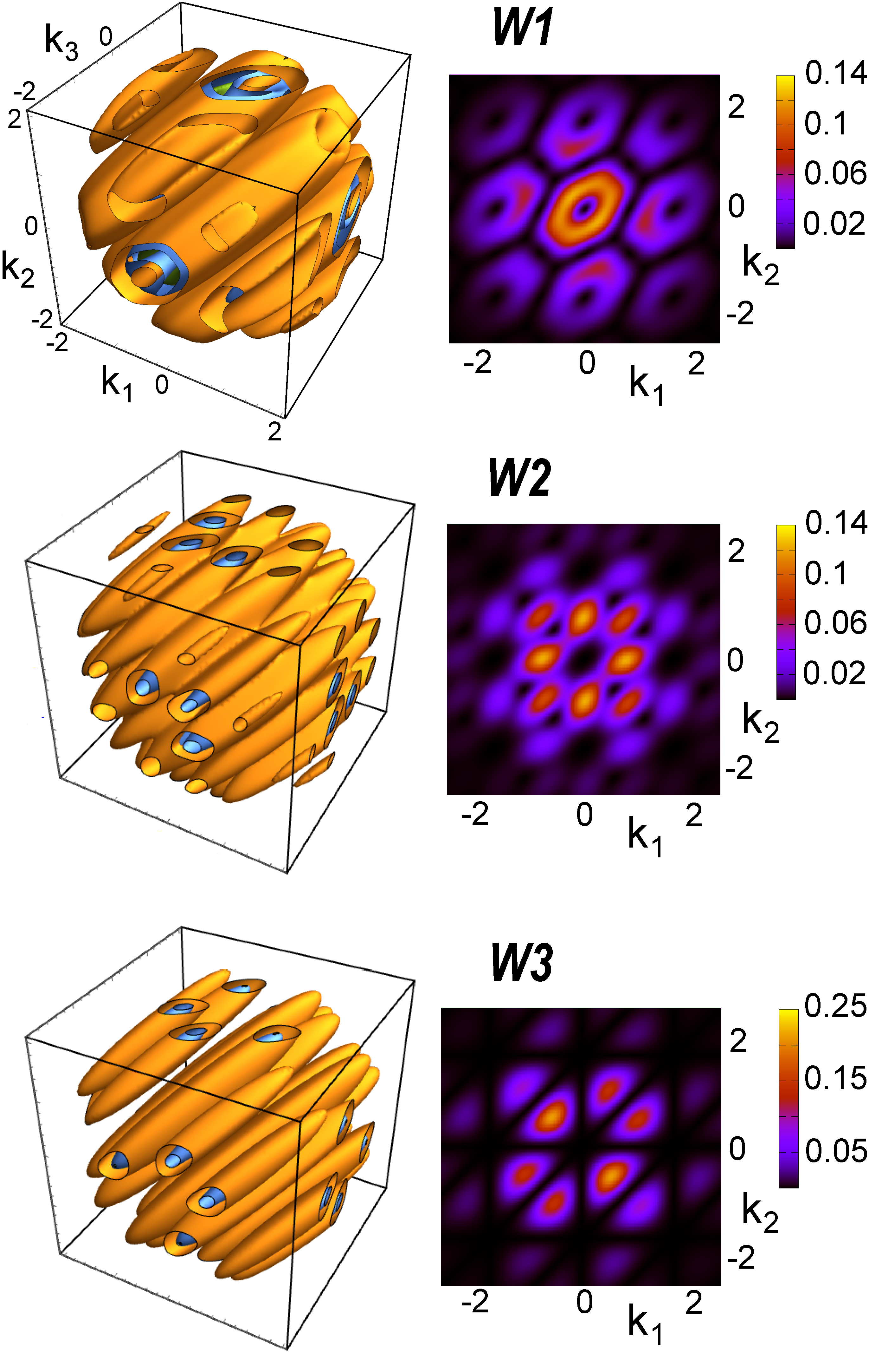 Figure 1
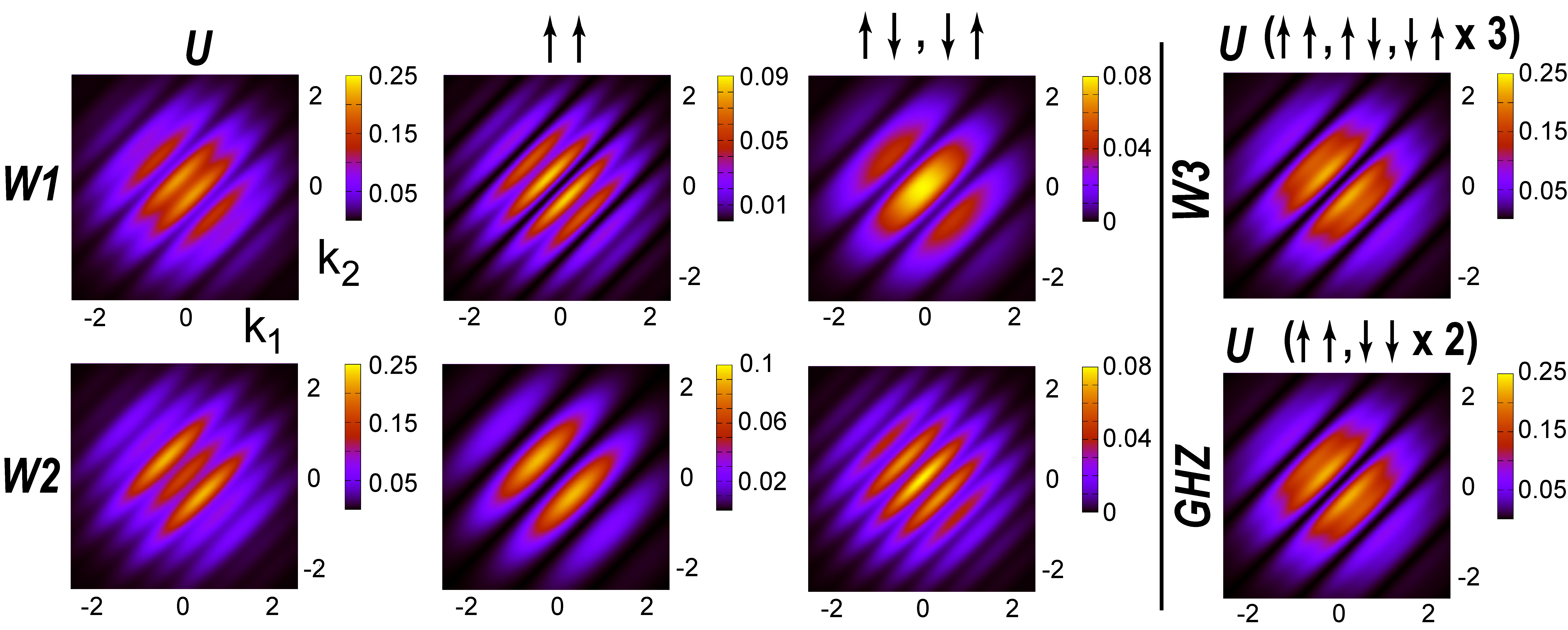 Figure 2
| 3 | 0 | -2 | -1 | 2 |
|---|---|---|---|---|
| 2 | -1 | 1 | -1 | |
| 1 | 1 | -1 | -1 |
| -state | ||||||||||
|---|---|---|---|---|---|---|---|---|---|---|
| -4 | -4 | -4 | -2 | -2 | -2 | 4 | 4 | 4 | ||
| -4 | -4 | -4 | -2 | -2 | -2 | 4 | 4 | 4 | ||
| -4 | -4 | -4 | -2 | -2 | -2 | 4 | 4 | 4 | ||
| -6 | 0 | 0 | 0 | 3 | 3 | -6 | 0 | 0 | ||
| 0 | -6 | 0 | 3 | 0 | 3 | 0 | 0 | -6 | ||
| 0 | 0 | -6 | 3 | 3 | 0 | 0 | -6 | 0 | ||
| -2 | 4 | 4 | -4 | -1 | -1 | 2 | -4 | -4 | ||
| 4 | -2 | 4 | -1 | -4 | -1 | -4 | -4 | 2 | ||
| 4 | 4 | -2 | -1 | -1 | -4 | -4 | 2 | -4 |
| 3 | 0 | -4 | -2 | -4 | -2 | -4 | -2 |
|---|---|---|---|---|---|---|---|
| 2 | -6 | 0 | 0 | 3 | 0 | 3 | |
| 1 | -2 | -4 | 4 | -1 | 4 | -1 | |
Peer Reviews
No public reviews on file for this paper yet. If you reviewed it on a platform where reviews are public (OpenReview, ICLR, NeurIPS, ICML), you can paste yours below so the community can read it here.
Videos
No videos yet. Explain this paper in a talk, walkthrough, or lecture? Add one.
Third-order momentum correlation interferometry maps for entangled quantal states of three singly
trapped massive ultracold fermions
Constantine Yannouleas
Uzi Landman
School of Physics, Georgia Institute of Technology, Atlanta, Georgia 30332-0430
(23 February 2019)
Abstract
Analytic higher-order momentum correlation functions associated with the time-of-flight spectroscopy of three ultracold fermionic atoms singly-confined in a linear three-well optical trap are presented, corresponding to the - and Greenberger-Horne-Zeilinger-type states that belong to characteristic classes of tripartite entanglement and represent the strong-interaction regime captured by a three-site Heisenberg Hamiltonian. The methodology introduced here contrasts with and goes beyond that based on the standard Wick’s factorization scheme; it enables determination of both third-order and second-order spin-resolved and spin-unresolved momentum correlations, aiming at matter-wave interference investigations with trapped massive particles in analogy with, and having the potential for expanding the scope of, recent three-photon quantum-optics interferometry.
I Introduction
Matter-wave simulations, with highly-controlled ultracold atoms, of well-known photon physics have been pursued along two quantum-optics central themes: (i) the coherence properties glau63 ; glau06 of thermal or chaotic light (in contrast to laser light), studied via second- and higher-order correlations (including the Hanbury Brown-Twiss effect twis56 ), and (ii) two-photon (or biphoton) interference effects mand99 ; shihbook ; oubook associated with fully quantal and entangled photon states (including the Hong-Ou-Mandel effect hong87 ).
Knowledge of high-order correlations of a quantum many-body system has been long recognized to fully characterize the system under study schw51.1 ; schw51.2 ; schm17 ; kher17 ; glau63 . Most recently progress has been demonstrated bran17 ; bran18 ; yann18 ; yann19 in the development of matter-wave interferometry through the use of second-order momentum correlations,
measureable in time-of-flight (TOF) laboratory experiments note2 ; note1 ; berg19 ; prei19 ,
yielding exact closed-form results based on first-principles (configuration interaction bran17 ; bran18 ) and model Hamiltonian (Hubbard yann18 ; yann19 ) methods.
Here we formulate and implement an accurate and practical methodology for determining higher-order momentum correlation functions for strongly interacting and entangled many-particle systems (beyond the bosonic or fermionic quantum-statistics entanglement contributions), expanding and generalizing the above-mentioned work bran17 ; bran18 ; yann18 ; yann19 .
In particular, our present methodology and derivation of higher-order momentum correlations (here, spin-resolved and spin-unresolved third-order correlations) based on the Heisenberg Hamiltonian for three singly-trapped ultracold atoms, differs from that relying on the standard Wick’s factorization scheme wick50 . That latter scheme is central to investigations of many-particle correlations in varied fields (including nuclei, condensed matter, atoms and molecules note1 ; prei19 and optics), allowing, in the absence of interactions, full factorization (with the use of the Wick method wick50 ; zinnbook of the -particle correlation function (Green’s function in the original formulation wick50 ), , , as a sum of terms containing antisymmetrized/symmetrized (corresponding to fermions/bosons) products of only ’s with .
The Wick’s factorization has been employed for Gaussian-type, or single-determinantal, ground states of ultracold atomic clouds hodg11 ; hodg11b ; hodg13 ; west06 ; prei19 ; aspe19 ,
mimicking the methodology, introduced earlier glau63 ; glau06 for addressing coherence properties of thermal or chaotic light, which was not focused on quantal effects (such as entanglement) at zero temperature. In contrast, these fundamental quantum effects, which are targeted (see, e.g., isla15 ) in current ultracold atom research relating to fundamentals of quantum information are central to our present work.
Indeed, in light of the limitation of the standard Wick’s method cede74 ; wagn91 ; stef12 to determinantal spin-non-degenerate ground states (being restricted to the highest-spin fermionic component cede74 ; prei19 or to spinless bosons aspe19 ), and thus the inability of that scheme to treat spin-degenerate ground-states (ubiquitous in investigations of quantum chemistry, condensed-matter, and quantum information, e.g., the and states studied herein), our methodology and the results we uncovered (including the highlighting and demonstration of the important role of spin-resolved momentum correlations), open avenues for analysis, characterization, and understanding of recent and ongoing experiments (particularly TOF of trapped, interacting, ultracold atoms) with a focus on relevant highly-entangled states as a resource in quantum information.
To put this development in context, we note here recent progress in the experimental processing of data and control and manipulation of ultracold atoms in colliding free-space beams or clouds (including free fall under the cloud’s gravity) aspe07 ; hodg11 ; hodg13 ; kher13 ; aspe15 ; kher17 ; schm17 or in optical traps and tweezers (in situ or TOF) foel05 ; kauf14 ; joch15 ; kauf18 , which has motivated a growing number of both experimental aspe07 ; hodg11 ; kher13 ; aspe15 ; kher17 ; schm17 ; foel05 ; kauf14 ; joch15 ; kauf18 and theoretical kher14 ; bran17 ; bran18 ; bonn18 ; yann18 ; yann19 studies concerning the analogies between quantum optics and matter-wave spectroscopy.
The paper is organized as follows: In Section II, we outline the three-site Heisenberg model and its solutions. Section III presents background material for the many-body methodology used for obtaining the momentum correlation functions, whereas Section IV gives results for the states. The cases of spin unresolved momentum correlations for the states are presented in Sect. IV.A (third order) and in Sect. IV.B (second order). Spin resolved momentum correlations for the states are discussed in Sect. IV.C. (third order), and in Sect. IV.D. (second order). Results for the momentum correlation functions for the state are discussed in Section V. Our conclusions are given in Section VI.
II Outline of three-site Heisenberg model and its solutions
The three-fermion and strongly entangled three-qubit states zeil90 ; cira00 that are the focus of this paper are solutions raja02 of the following three-site linear-spin-chain Heisenberg Hamiltonian (which describes the strong-interaction limit of the Hubbard model auerbook )
[TABLE]
where is the exchange coupling between sites and is the spin operator of the particle associated with the th site.
First we will address the case of the states, which are the eigenstates of the above Heisenberg Hamiltonian raja02 .
Using the three-member ket-basis , , and , the above Hamiltonian is written in matrix form
[TABLE]
The eigenvalues of the matrix in Eq. (5) are:
[TABLE]
The corresponding (normalized) eigenvectors and their total spins are given by:
[TABLE]
III Many-body methodology for momentum correlations: Preliminaries
To generate the third-order momentum correlation maps , , corresponding to the three -type solutions in Eq. (7) of the Heisenberg Hamiltonian, one needs to transit to the first-quantization formalism using momentum-dependent Wannier-type spin-orbitals. To this effect, each fermionic particle in any of the three wells is represented by a displaced Gaussian function bran17 ; bran18 ; yann19 , which in momentum space is given by
[TABLE]
In Eq. (8), () denotes the position of each of the three wells, is the width of the Gaussian function.
is a shorthand notation for the spin-up, , or spin-down, , single-particle spin functions. The two spin functions are orthonormal according to the formal way szabobook , .
Employing the fact that in the first-quantization representation the basis kets, , , and , correspond for fermions to determinants built out from the , , spin orbitals, one finds that the general form of the many-body wave functions associated with the three vectors in Eq. (7) is
[TABLE]
where the three spin primitives are given by , , and .
IV Results: The states
IV.1 Spin unresolved third-order momentum correlations
Since the spin primitive functions ’s form an orthonormal set, one gets for the spin unresolved third-order correlations bran17 (i.e., summing over all possible spin cases using the formal integration over spins)
[TABLE]
The calculations of the ’s out of the determinants are straighforward, but lengthy. We have used the algebraic language MATHEMATICA math18 to carry them out. Below, we present the final analytic results.
Assuming equal separations between the central and the outer wells (i.e., taking , , ), the analytic expressions for the spin unresolved third-order momentum correlations corresponding to the three entangled Heisenberg states are given by the same general formula
[TABLE]
where takes only the three values , , and . The associated coefficients , , and are given in TABLE 1.
Illustrations of the unresolved third-order momentum correlations for the three states in Eq. (7) are displayed in Fig. 1. The left column displays 3D isosurface contours, , while the right column displays corresponding 2D cuts by keeping the third momentum fixed at . The plots illustrate visually that the three in Eq. (11) exhibit sufficiently different map landscapes, which could be explored with experimental measurements.
Characteristic landscape patterns that allow differentiation between the -states remain also prominent in the case of both spin-unresolved and spin-resolved second-order correlation maps, which are investigated next.
IV.2 Spin unresolved second-order momentum correlations
When the -particle many-body wave function is available in the coordinate space, it is well-known that the -order ( space correlations are obtained by carrying out the integrations of over the remaining variables lowd55 ; bran17 . In this case the corresponding -order momentum correlations are determined via an appropriate Fourier transform of the space correlations bran17 . Here, the third-order correlations are already available in momentum space at the very beginning; see Eqs. (10) and (11). Thus the lower spin unresolved second-order correlations can be obtained simply from Eq. (11) by integrating over the third momentum variable. Then, neglecting the vanishing contributions from the orbital overlaps (i.e., assuming ), one finds:
[TABLE]
where the coefficients and are the same as in TABLE I.
The spin-unresolved second-order correlations for the three states are plotted in the first column (for and ) and the fourth column, top row (for ) of Fig. 2. It is characteristic that the main diagonal () acquires nonvanishing values for the two states with (i.e., for and ), while it exhibits vanishing values all along its extent for the third state with . Furthermore, the interference between the two length scales, and [see Eq. (12)], generates a wavy doubling (cases of and ) or tripling (case of ) of the dominant peaks of the fringes, which experimentally could be seen as broadening of the fringes. Note that this wavy broadening of the fringes was reported in Ref. bran17 for the partial case of the ground state.
IV.3 Spin resolved third-order correlations
Spin resolved correlations impose specific values for the spins associated with the momenta variables ’s. We note that knowledge of the spin resolved correlations provides a more complete degree of characterization of the many-body state compared to that obtained from knowledge of the spin unresolved correlations.
When the spins for all three momenta ’s are fixed, each vector solution in Eq. (7) allows three spin arrangements according to the three spin primitives , and . As a result, the following third-order three-spin resolved correlations for the three , , states can be specified:
[TABLE]
The explicit analytic expressions (a total of nine) for the above three-spin resolved correlations, which are different from each other, are given in a compact form by the same general expression:
[TABLE]
where the corresponding coefficients are listed in TABLE 2.
IV.4 Spin resolved second-order correlations
We turn now to studying second-order spin resolved correlations. The spin resolved correlations for the three states in Eq. (7) have the general form:
[TABLE]
where the coefficients and are given in TABLE 3. Similarly, the other two second-order spin resolved correlations, namely the , , and the , yield the same general form as in Eq. (17), with the specific values of the and coefficients displayed in TABLE 3.
The second-order spin-resolved correlation maps for the two and states (with ) are displayed in the second and third column of Fig. 2, respectively; for the state (with ), see below. The and maps for both states coincide, as indicated in the figure. The main diagonal in these maps () is associated with vanishing values (resulting in fringe valleys) for the same-spin cases (), while it exhibits nonvanishing values (resulting in fringe ridges) for the different-spin cases ( or ); this is consistent with the Pauli exclusion principle for same-spin fermions and the property that fermions with different spins are distinguishable. Furthermore, there is a clear contrast regarding the number of fringes for the spin-resolved maps of the and states; indeed for the same-spin cases (second column of Fig. 2), there are eight visisble fringes for conmpared to only four visible fringes for . For the different-spin cases (third column of Fig. 2), the opposite trend appears, namely, there are only five visible fringes for compared to nine visible fringes for . Note that the sum of the three spin-resolved correlations equals the spin-unresolved one, symbolically .
For the case (with , ), all three spin-resolved maps coincide. Each one of these maps multiplied by a factor of three equals the spin-unresolved map; this is symbolically denoted at the top of the frame situated on the top row, fourth column of Fig. 2.
V Results: The state
The state is a linear superposition of the two fully polarized eigenstates of the Heisenberg Hamiltonian in Eq. (1), that is,
[TABLE]
The corresponding energy is and the total spins are (a spin eigenvalue) and (an expectation value, not a spin eigenvalue). The second-order spin-unresolved correlation map for the state is displayed in Fig. 2 (second row, fourth column). It is immediately seen that the spin-unresolved map coincides with that of the spin-unresolved map displayed also in Fig. 2, top of fourth column. This result was also explicitly verified by deriving via our methodology the corresponding analytic expression and comparing it with that in Eq. (12) (for ). Namely starting from the associated determinants for the two and kets in Eq. (18), we calculated first the third-order momentum correlations and subsequently we derived the second-order correlations through an integration over the third momentum variable. Furthermore, the second-order spin-resolved correlation maps, and , coincide and equal the spin-unresolved one when multiplied by a factor of two. Finally and consistent with the above, we found through our analytic calculations (not shown) that the third-order spin-unresolved correlation maps coincide with those associated separately with each fully polarized state (, ) or (, ), as well as with that of the state (which also has ); see Eq. (11), for .
VI Conclusions
Analytical expressions for the third-order and second-order spin-resolved and spin-unresolved momentum correlations for the strongly-entangled and states zeil90 ; cira00 of three singly-trapped ultracold fermionic atoms have been derived. The associated correlation patterns and maps are related yann19 to nowadays experimentally accessible TOF measurements; they enable matter-wave interference studies in analogy with recent three-photon interferometry agne17 ; mens17 ; tamm15 ; tamm18 . A main finding is that knowledge of the spin-unresolved correlation maps is required to fully characterize the strongly-entangled states.
This work uncovers and demonstrates a methodology which allows treatment of strongly interacting entangled states which are outside the scope of the standard Wick’s factorization scheme hodg11 ; aspe19 ; prei19 , thus opening the door and providing the impetus for experimental investigations, using coincidence time-of-flight measurements on trapped ultracold atom systems, of entangled states (like the and ones treated here) which are ubiquitous in quantum information theory and protocols in quantum communication and cryptography and studies of the fundamentals of quantum mechanics gree89 .
VII Acknowledgments
This work has been supported by a grant from the Air Force Office of Scientic Research (AFOSR, USA) under Award No. FA9550-15-1-0519. Calculations were carried out at the GATECH Center for Computational Materials Science.
The reference list from the paper itself. Each links out to its DOI / PubMed record.
- 1(1) R. J. Glauber, The Quantum Theory of Optical Coherence, Phys. Rev. 130 (1963).
- 2(2) R. J. Glauber, Nobel Lecture: One hundred years of light quanta, Rev. Mod. Phys. 78 , 1267 (2006).
- 3(3) R. Hanbury Brown and R. Q. Twiss, Correlation between photons in two coherent beams of light, Nature 177 , 27 (1956).
- 4(4) L. Mandel, Quantum effects in one-photon and two-photon interference, Rev. Mod. Phys. 71 , S 274 (1999).
- 5(5) Y. H. Shih, An Introduction to Quantum Optics: Photon and Biphoton Physics (CRC Press, Boca Raton, Florida, 2011)
- 6(6) Z. Y. Ou, Multi-photon Quantum Interference (Springer, New York, 2007).
- 7(7) C. K. Hong, Z. Y. Ou, and L. Mandel, Measurement of subpicosecond time intervals between two photons by interference, Phys. Rev. Lett. 59 , 2044 (1987).
- 8(8) J. Schwinger, On the Green’s functions of quantized fields. I., Proc. Natl Acad. Sci. USA 37 , 452 (1951).