A gas-phase primordial origin of O2 in comet 67P/Churyumov-Gerasimenko
Jonathan M.C. Rawlings, Thomas G. Wilson, David A. Williams

TL;DR
This paper proposes a primordial gas-phase origin for molecular oxygen in comet 67P, supported by astrochemical modeling of ice evolution from dark clouds to the protosolar nebula, explaining observed O2 levels.
Contribution
It introduces a new gas-phase formation pathway for O2 in comets, contrasting with surface chemistry hypotheses, supported by detailed astrochemical simulations.
Findings
O2 abundance can be produced in primordial gas-phase conditions.
Models match observed O2:H2O ratios in the comet.
N2 is over-produced, suggesting a unique thermal history.
Abstract
Recent observations made by the Rosetta/ROSINA instrument have detected molecular oxygen in the coma of comet 67P/Churyumov-Gerasimenko with abundances at the 1-10% level relative to H2O. Previous studies have indicated that the likely origin of the O2 may be surface chemistry of primordial (dark cloud) origin, requiring somewhat warmer, denser and extreme H-atom poor conditions than are usually assumed. In this study we propose a primordial gas-phase origin for the O2 which is subsequently frozen and effectively hidden until the ice mantles are sublimated in the comet's coma. Our study presents results from a three-phase astrochemical model that simulates the chemical evolution of ices in the primordial dark cloud phase, its gravitational collapse, and evolution in the early protosolar nebula. We find that the O2 abundance can be produced and is fairly robust to the choice of the free…
Click any figure to enlarge with its caption.
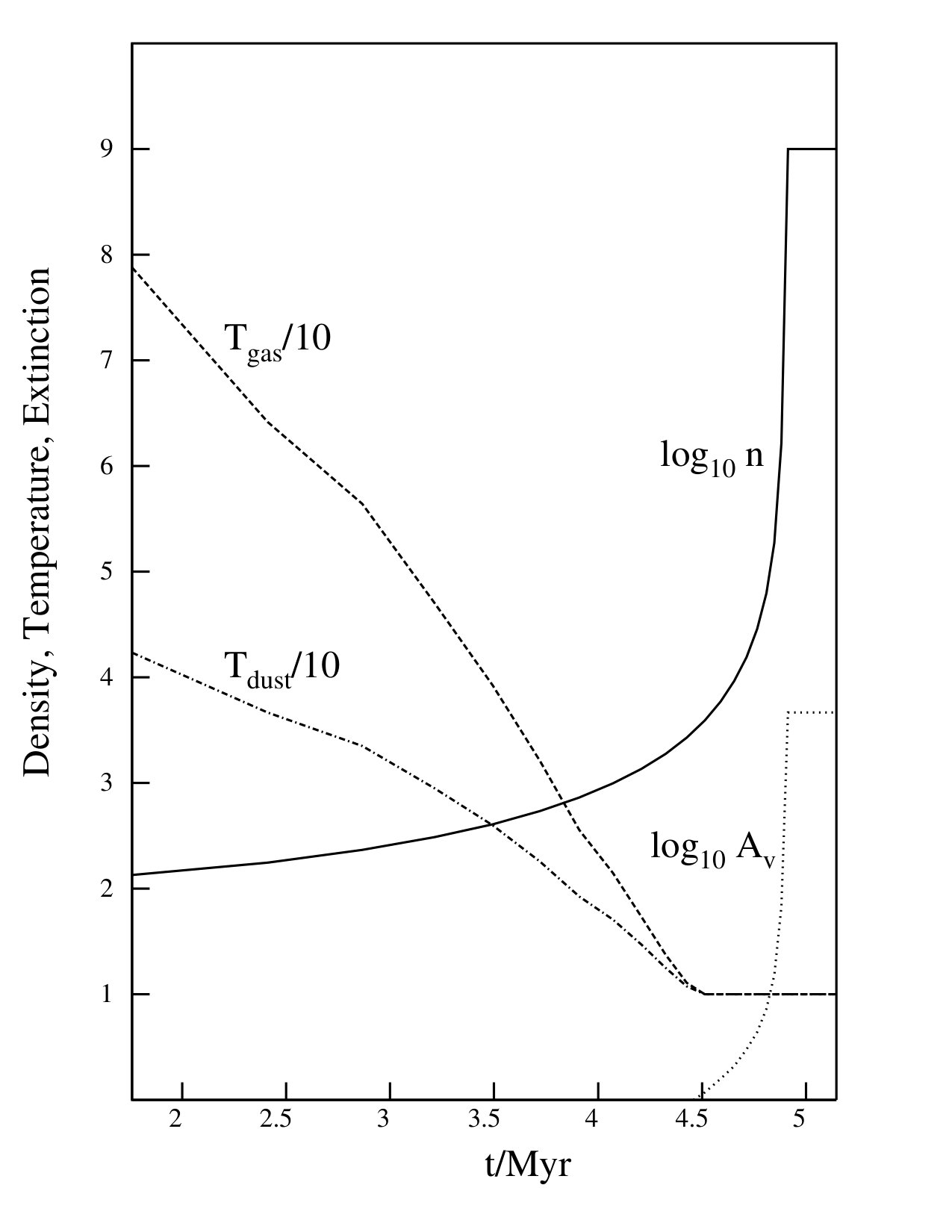 Figure 1
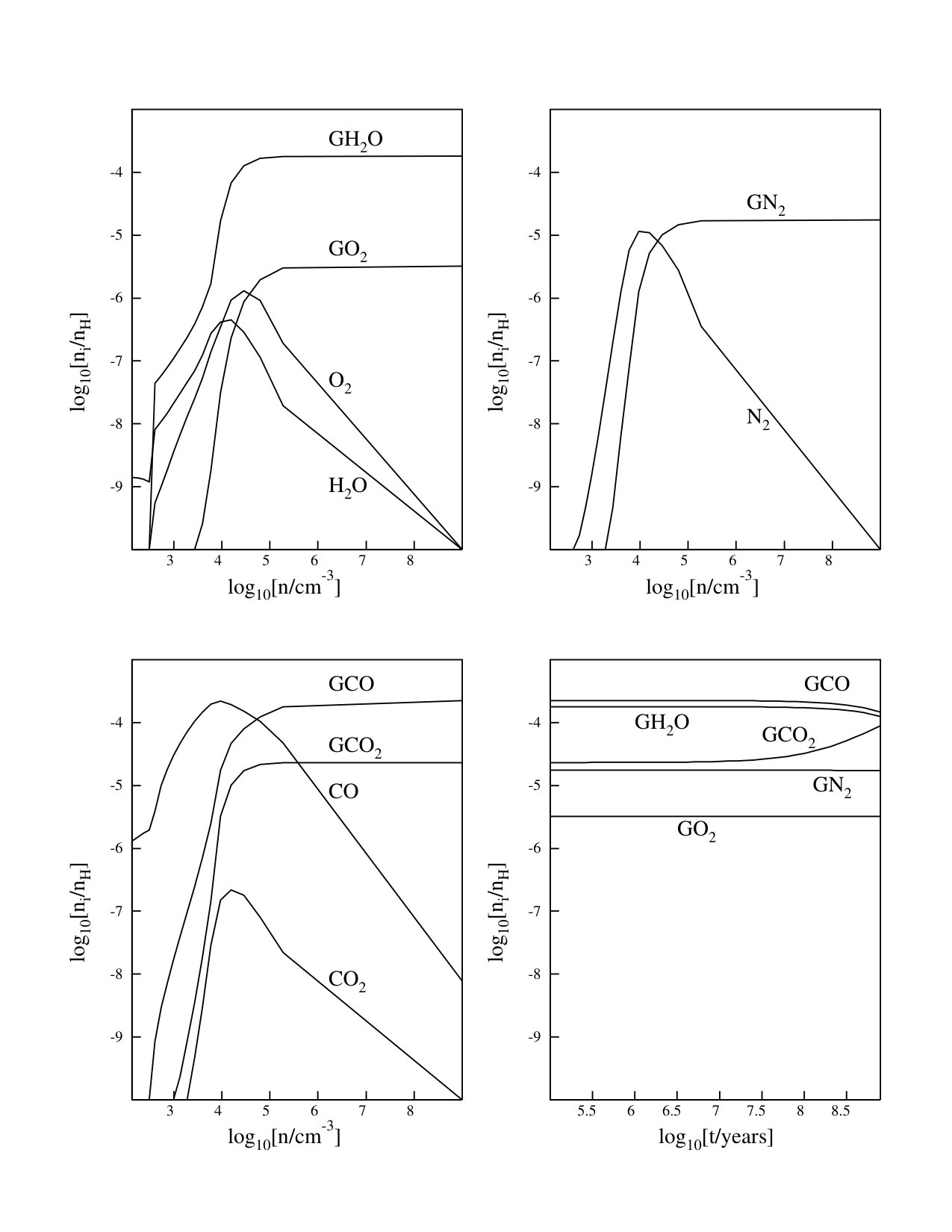 Figure 2
| Parameter | Symbol | Value |
| Phase I density | 100 cm-3 | |
| Phase I gas temperature | 100 K | |
| Phase I dust temperature | 50 K | |
| Phase I extinction | 0.1 magnitudes | |
| Phase II free-fall retardation factor | B | 1.0 |
| Phase III density | 109 cm-3 | |
| Phase III gas temperature | 10 K | |
| Phase III dust temperature | 10 K | |
| Cosmic ray ionization rate | s-1 | |
| Mean grain radius | 83Å | |
| Mean grain surface area/H-nucleon | cm2 | |
| Helium abundance | He/H | 0.1 |
| Carbon abundance | C/H | 2.55 |
| Nitrogen abundance | N/H | 6.1 |
| Oxygen abundance | O/H | 4.58 |
| Abundance of S, Si and Na | S,Si,Na/H | |
| CO binding energy | ECO/k | 960 K |
| H2O binding energy | E/k | 5770 K |
| O2 binding energy | E/k | 1210 K |
| N2 binding energy | E/k | 710 K |
| Parameter | Nominal value | Notes |
| O2:H2O | 3.8% | Well-correlated (1-10%) |
| HO2:O2 | 0.19% | interstellar value |
| H2O2:O2 | 0.06% | interstellar value |
| O3:O2 | 0.0025% | Non-detection (upper limit) |
| N2:CO | 0.57% | Moderate correlation (0.17-1.6%) |
| N2:H2O | 0.011-0.26% | - |
| CO:H2O | 13-400% | Coma, general, highly variable |
| 10-30% | Sunlit hemisphere | |
| CO2:H2O | 8-800% | Highly variable |
| CO:CO2 | 50-162% | Coma |
| 7% | Surface |
| O2:H2O | N2:H2O | N2:CO | CO:H2O | |||||||||
| a | b | a | b | a | b | a | b | |||||
| 1.0 | 109 | 10 | 1.0 | 1.0 | 1.78% | 1.86% | 9.70% | 10.10% | 7.77% | 8.15% | 124% | 123% |
| 0.1 | 109 | 10 | 1.0 | 1.0 | 2.94% | 3.07% | 10.66% | 11.12% | 10.08% | 10.67% | 105% | 104% |
| 1.0 | 107 | 10 | 1.0 | 1.0 | 1.78% | 1.17% | 9.68% | 5.52% | 7.80% | 17.23% | 124% | 32% |
| 1.0 | 108 | 10 | 1.0 | 1.0 | 1.78% | 1.72% | 9.70% | 9.20% | 7.77% | 8.73% | 124% | 105% |
| 1.0 | 1010 | 10 | 1.0 | 1.0 | 1.78% | 1.88% | 9.70% | 10.20% | 7.76% | 8.10% | 125% | 126% |
| 1.0 | 1011 | 10 | 1.0 | 1.0 | 1.78% | 1.88% | 9.70% | 10.21% | 7.76% | 8.09% | 125% | 126% |
| 1.0 | 109 | 20 | 1.0 | 1.0 | 1.67% | 1.75% | 8.81% | 9.20% | 7.16% | 7.50% | 123% | 123% |
| 1.0 | 109 | 10 | 0.1 | 1.0 | 0.80% | 0.81% | 7.77% | 7.81% | 6.19% | 6.22% | 125% | 125% |
| 1.0 | 109 | 10 | 10.0 | 1.0 | 1.89% | 2.18% | 13.41% | 12.98% | 13.42% | 139% | 100% | 9.34% |
| 1.0 | 109 | 10 | 1.0 | 0.5 | 1.90% | 1.98% | 8.89% | 9.26% | 7.08% | 7.43% | 126% | 125% |
| 1.0 | 109 | 10 | 1.0 | 10.0 | 1.46% | 1.53% | 12.19% | 12.70% | 9.99% | 10.51% | 122% | 121% |
| 0.1 | 109 | 10 | 0.1 | 1.0 | 3.11% | 3.13% | 4.31% | 4.34% | 3.08% | 3.10% | 139% | 140% |
| 0.1 | 109 | 20 | 0.1 | 1.0 | 3.72% | 3.74% | 6.49% | 6.52% | 4.58% | 4.59% | 142% | 142% |
| 0.1 | 109 | 10 | 0.1 | 10.0 | 3.09% | 3.10% | 6.88% | 6.92% | 4.92% | 4.94% | 140% | 140% |
| 0.1 | 1011 | 10 | 0.1 | 0.5 | 3.14% | 3.15% | 3.76% | 3.78% | 2.69% | 2.70% | 140% | 140% |
| 0.1 | 107 | 20 | 10.0 | 0.5 | 0.31% | 0.10% | 3.97% | 0.00% | 20% | 1.70% | 0.15% | 0.03% |
Peer Reviews
No public reviews on file for this paper yet. If you reviewed it on a platform where reviews are public (OpenReview, ICLR, NeurIPS, ICML), you can paste yours below so the community can read it here.
Videos
No videos yet. Explain this paper in a talk, walkthrough, or lecture? Add one.
A gas-phase primordial origin of O2 in comet 67P/Churyumov-Gerasimenko
J. M. C. Rawlings1 T. G. Wilson1 and D. A. Williams1
1Department of Physics and Astronomy, University College London, Gower Street, London, WC1E 6BT E–mail: [email protected]
Abstract
Recent observations made by the Rosetta/ROSINA instrument have detected molecular oxygen in the coma of comet 67P/Churyumov-Gerasimenko with abundances at the 1-10% level relative to H2O. Previous studies have indicated that the likely origin of the O2 may be surface chemistry of primordial (dark cloud) origin, requiring somewhat warmer, denser and extreme H-atom poor conditions than are usually assumed. In this study we propose a primordial gas-phase origin for the O2 which is subsequently frozen and effectively hidden until the ice mantles are sublimated in the comet’s coma. Our study presents results from a three-phase astrochemical model that simulates the chemical evolution of ices in the primordial dark cloud phase, its gravitational collapse, and evolution in the early protosolar nebula. We find that the O2 abundance can be produced and is fairly robust to the choice of the free parameters. Good matches for the O2:H2O ratio and, to a lesser extent, the N2:CO and CO:H2O ratios are obtained, but the models significantly over-produce N2. We speculate that the low value of N2:O2 that is observed is a consequence of the specific thermal history of the comet.
keywords:
astrochemistry – ISM: molecules – ISM: individual objects: comet 67P/Churyumov-Gerasimenko
1 Introduction
Comets are believed to be among the most primitive objects in the Solar System and potentially carry within them the chemical signatures of molecular clouds from which the nascent protosolar nebula (PSN) formed. However, cometary material and ices may be created by and subject to a wide variety of chemical processing mechanisms including; chemistry in the molecular cloud as well as the PSN, solid-state chemistry in or on the ices, heating by collisions as well as internal radiogenic heating, surface radiation processing by impacting high energy particles (radiolysis), condensation/sublimation and the effects of Solar irradiation (photolysis).
Comet 67P/Churyumov-Gerasimenko (hereafter referred to as comet 67P/C-G) is a Jupiter-family comet, which is thought to have originated from the trans-Neptunian Kuiper belt, but has been perturbed by a close encounter with Jupiter (in 1959) into an inner Solar-System orbit (Maquet, 2015). These comets do not form a homogenous class and significant chemical variations exist; for example the D/H ratio in 67P/C-G is larger than in other Jupiter-family comets, such as Hartley 2, Balsiger et al. (2015), and the orbits/dynamical histories may be quite different (e.g. 67P/C-G has had just 10 apparitions in its present orbit, whilst the short-period comet P/Halley has had 2000 apparitions, Hughes, 1985).
Comet 67P/C-G has merited detailed attention in the wake of the Rosetta mission. This yielded many interesting and unexpected results, not least the realisation that comets of this type cannot be represented by ‘dirty snowballs’ as previously thought, but are essentially ‘dry’ with ices and volatiles amounting to 15% of the cometary mass, embedded within a rocky matrix (Fulle et al., 2016). The outgassing from the comets is believed to be characterised by the sublimation of successive layers of ancient icy material (in onion-skin fashion) in the vicinity of perihelion on each orbit (Guilbert-Lepoutre et al., 2015).
One of the many intriguing results from the Rosetta mission has been the discovery of a larger-than-expected abundance of molecular oxygen (O2) in the cometary coma. Cometary gases are typically primarily composed of H2O, CO and CO2 with small traces of other atomic and molecular species (Bockelée-Morvan et al., 2004). However, the ROSINA-DFMS device (Rosetta Orbiter Spectrometer for Ion and Neutral Analysis - Double Focusing Mass Spectrometer) determined the presence of O2 at the 1-10% level relative to H2O, with a mean value of ; significantly larger than the gas-phase values determined for interstellar dark clouds and protostellar sources (e.g. O2:H2O in NGC1333-IRAS4A, Yildiz et al., 2013). This is well below the observational upper limits of 15% and 39% for O2:H2O in the interstellar ices associated with low and high star-forming regions, respectively (Boogert, Gerakines & Whittet, 2015), although it is interesting to note that the O2:CH3OH ratio in the warm (sublimated) gas of IRAS 16293-2422 is lower than that in 67P/C-G (Taquet et al., 2018). Moreover, the O2 appears to be distributed isotropically and the O2:H2O ratio is not obviously correlated to the heliocentric distance of the comet. Nor is the O2 well-correlated with N2 and CO, molecules of similar volatility/binding energy (Bieler et al., 2015).
This suggests that the O2 permeates the cometary ice to some depth and is not merely confined to the surface layers. It has been shown that erosion of 67P/C-G causes loses of metres to tens of metres of material per apparition (Keller et al., 2015) so that in its 10 orbits, 67P/C-G will have lost surface material up to depths of hundreds of metres.
Studies based on the structure, morphology and composition of 67P/C-G indicate that is essentially a ‘primordial rubble pile’ formed by the agglomeration of material in the protosolar nebula that remained after the formation of trans-Neptunian objects (TNOs) as opposed to ‘collisional rubble piles’ formed as a result of the disruption of larger parent bodies (Weissman, Asphaug & Lowry, 2004; Davidsson et al., 2016). The comet is thus believed to have grown slowly at very low temperatures, from aged material in the inner Solar System, and avoided thermal processing by the decay of short-lived radionuclides (e.g. 26Al) or collisional processing
- that would otherwise lead to a loss of the volatile species, such as CO, CO2 and O2. This agglomeration could have been hierarchical (Davidsson et al., 2016; Bentley et al., 2016), or even just via a gentle assembly of mm-sized ‘pebbles’ and ices (Blum et al., 2017). Moreover, the bi-lobe structure of 67P/C-G probably resulted from a very low velocity (<1ms*-1*) collision (Massironi, et al., 2015; Blum et al., 2017) and that collision possibly occurred within the last 1Gy (Jutzi et al., 2016).
As the significance of the delivery of cometary H2O to terrestrial oceans continues to be debated (Altwegg et al., 2015; Willacy et al., 2015), we need to understand the origin and evolution of the cometary ices. It is possible that ratios of simple molecular species, such as O2:H2O, can provide us with information about the chemical and physical conditions in which comets were formed. Importantly, following the detection of the higher than expected O2 abundance in 67P/C-G, Giotto/Neutral Mass Spectrometer data of the coma of Oort Cloud comet 1P/Halley have been re-analysed and an O2 abundance of % with respect to H2O was found (Rubin, Altwegg, van Dishoeck & Schwehm, 2015), making O2 the third most abundant species in the coma. The datasets do not compare like for like (the 67P/C-G/ROSINA observations comprise a time-integrated dataset, whilst the Giotto/NMS data is a 4 hour snapsot), but these remarkably similar O2 abundances seen in comets with different dynamical histories may add weight to the theory that the O2 is of a primordial (pre-PSN) origin and has survived the expected bulk thermal processing (sublimation, freezing, and re-accretion onto the comet). Whilst the O2 abundances are nearly identical, the situation for other molecular species is more complex; e.g.the abundances of methanol (CH3OH) and carbon disulfide (CS2) are very different - both species being significantly more abundant in 1P/Halley (see Table 3 of Rubin, Altwegg, van Dishoeck & Schwehm, 2015). There is an interesting corollary to this; if O2 is universally abundant in comets then the rate of its delivery to the early atmosphere of the Earth should be correlated to that of H2O. The fact that there is little evidence of pre-biogenic O2 in the atmosphere of the Earth could be seen as mitigating evidence against the delivery of significant H2O to Earth by comets.
In addition to O2, molecular nitrogen (N2) was also detected (for the first time in a comet) in 67P/C-G (from ROSINA data) with an abundance, relative to CO, of (5.700.66). Assuming that, as in other objects with a trans-Neptunian origin, N2 is the dominant component of the nitrogen budget this implies that N2 is significantly depleted (by a factor of ) (Rubin et al., 2015). As N2 and O2 have similar volatilities, this is also a rather surprising result.
In this paper, we address several questions: (i) Assuming a primordial origin for the O2, what does the observed abundance of O2 tell us about the physical conditions and dynamical evolution in the molecular cloud out of which the Solar System formed?, (ii) What additional constraints are placed by the N2 obervations in Comet 67P/C-G, and (iii) How can these volatile ices survive the conditions in the early PSN?
In this study we revisit the possibility that the O2 may indeed be primordial in nature, and that the O2:H2O ratio is effectively locked into the cometary ice through its delivery by the icy dust grains that agglomerate to form comets. However, we propose that the O2 is mainly formed in a transient gas-phase chemistry and then stored in the dust ices. If conditions encourage the build up of ices, then they are deposited on dust grains in layers. If we make the gross simplification that no surface or solid-state ice-phase chemistry occurs then the bulk compositions of these ices represents a (time-integrated) ‘fossil’ record of the evolution of the gas-phase chemistry, moderated by the varying physical conditions (density, temperature) and freeze-out/desorption characteristics. This means that the ice compositions are not just dependent on the instantaneous conditions in the molecular cloud in which they formed, they also depend on the evolutionary history of the cloud. In particular, the mean molecular abundances in the bulk of the ices may be very different to those in the gas-phase, or in the surface layers of those ices, particularly if the ices are primarily formed during a period of transient gas-phase enhancement that is significantly less than the age of the cloud.
The validity of this hypothesis and the sources of uncertainty are discussed in Section 2.3 below. However, it is a key aim of this paper to investigate what (range of) physical parameters could yield the observed O2:H2O ratio and what diagnostic power those observations may therefore have concerning the origins of comets.
The nature and possible origins of the O2 excess, together with our hypothesis are discussed in Section 2. Our physical and chemical models are described in Section 3, and the results are presented and discussed in Section 4. In Section 5 we consider the survivability of interstellar O2 ices in the PSN, whilst in Section 6 we address the observed and modelled abundances of N2. Our key conclusions are given in Section 7.
2 Possible origins of the O2 excess
2.1 A primordial origin for the O2
If the assumption is made that the O2 is primordial in nature (i.e. reflecting the abundances in the nascent molecular clouds from which the comets formed) then the high O2 abundances that are detected in comet 67P/C-G would seem to be at odds with both observations and (equilibrium) astrochemical models; which predict O2 abundances of at least an order of magnitude lower in dark clouds than these values (e.g. Wirström, Charnley, Cordiner & Ceccarelli, 2016), although there may be an obvious reason for this - as discussed above.
In a very detailed dynamical/chemical study, linked to a specific model of protostellar disk formation and evolution, Taquet et al. (2016) considered three possibilities: (i) a primordial (dark cloud) origin, (ii) formation during protostellar disk formation, and (iii) production during luminosity outbursts in the disk. The latter two rely on O2 formation as a photolytic product of ice desorption, followed by freeze-out in semi-porous or clathrate ices. The authors favour (i); the O2 can be produced in primordial dark clouds and survive until accretion into cometary bodies, although the models require an exceptionally low H/O ratio (), a ‘warm’ temperature of 20 K and high densities (cm*-3*) in the primordial cloud. Chemically, in these models, the dominant formation channels for O2 are solid-state reactions occurring in the surface layers of ices. In the denser regions of clouds, the dominant pathways for the surface chemistry of O2 and the formation of hydrogen oxides approximately simplify to:
[TABLE]
[TABLE]
[TABLE]
[TABLE]
Whilst this last reaction has a significant activation barrier in the gas-phase, tunnelling in (predominantly water) ices allows it to proceed rapidly, even at very low temperatures (15K), via surface reactions (Lamberts et al., 2016). Note that the first of these reactions is in competition with
[TABLE]
preferentially leading to the formation of water, so that the OH ratio is critical in defining the O2 formation efficiency. In this scheme, therefore, the relative timescales for freeze-out and free-fall have a major controlling influence. Additionally, the warm temperatures encourage oxygen atom mobility and hence O2 formation, whilst at the same time enhancing the sublimation of atomic hydrogen. The O2 can be further oxidised to O3, which itself can then be hydrogenated to OH (e.g. Ioppolo et al., 2008). Thus, the surface formation of O2 should be accompanied by the presence of HO2, H2O2 and O3.
Whilst the models do not give an obvious explanation for the low observed absence of N2, they suggest that if the N2 chemistry is somewhat slower than the oxygen chemistry, then it could freeze out at later times. A similar result could obtain if N2 is slightly more volatile than CO. Both possibilities would result in a layered ice in which the N2 is not so closely associated with the water ice and hence is significantly more volatile, perhaps not surviving transport into the PSN.
The models of Taquet et al. (2016) provide a viable mechanism that may explain the observed O2:H2O ratio as well as the good correlation between these species, albeit for somewhat anomalous physical conditions (warmer and denser than is typical for a dark cloud). This finding is only robust if the O2 is formed on the primordial dust grains - a key result being that these ice compositions can survive into the forming protosolar nebula. However, the models are somewhat less successful at explaining the low abundances of some other species, such as O3 and HO2. The authors postulate that this could be explained by the presence of a barrier (of 300K) for the O+O2 and H+O2 reactions, effectively suppressing much of the O2 surface chemistry.
2.2 Alternative origins for the O2 excess
A number of other theories have been postulated that might explain the origin of the O2 (and the relative absence of O2H, H2O2 and other species). These are based on the idea that the O2 may be formed in situ. by a variety of mechanisms, including radiolysis (by high energy particles), photolysis (by solar photons), dismutation of H2O2, and high energy ion-surface reactions.
Radiolysis, the chemical consequence of the impact and penetration of high energy particles into ices can result in the splitting of H2O into O2:
[TABLE]
The hydrogen atoms and molecules produced in this process would then diffuse out of the ice, so that O2 is not re-hydrogenated to H2O. However, the particles in the Solar wind have limited pentration depths and would only affect the outermost ice layers of the comet itself. Instead, it has been shown that the observed O2 abundance in 67P/C-G can be produced solely via the radiolysis of primordial grains in the early, dense, PSN - prior to their agglomeration into the comet (Mousis et al., 2016b). Various dynamical/thermal scenarios have been considered; trapping of the O2, or sublimation, followed by re-freezing in ice ‘cages’ or clathrates, or else as pure ices. There are a number of problems with this theory: (i) the process is very slow (so the molecular cloud would have to have been very old), (ii) it requires all of the energy absorbed by the water ice to be used in this reaction, with no local heating or ionization, and (iii) radiolysis may produce significant amounts of H2O2, HO2 and, most significantly, O3.
A possible explanation for the relative absence of H2O2 is that the molecule is subject to a redox (dismutation/disproportionation) reaction
[TABLE]
during the sublimation of H2O ice (Dulieu, Minissale & Bockelée-Morvan, 2017). This has the advantage of by-passing the activation barrier problem described above, and provides a mechanism whereby O2 can be produced at late times, when trapped H2O2 is desorbed. However, the hypothesis requires efficient incorporation of H2O2 into the ice and complete conversion to O2 to explain both the observed O2 abundance and the low relative abundance of H2O2.
A very different suggestion (Yao & Giapis, 2017) is that the O2 does not originate in the cometary ices at all but, instead, is formed following the prompt (Eley-Rideal) reaction of energetic H2O+ ions with surface oxides (in silicates etc.). This results in the production of excited ‘oxy-water’ (H2O-O⋆) isomeric to, but the not the same as, hydrogen peroxide. This dissociates to H+ and the excited state HO cation, which in turn dissociates to O. This ion is subject to photodetachment, yielding O2. Such a mechanism naturally explains the absence of O3 and the presence of HO2 whose abundance, although low, is still some three times larger than what is inferred for interstellar clouds. However, the model has yet to be analysed carefully in the context of the temporal correlations of the various molecular species detected by ROSINA (Hässig et al., 2015).
2.3 A gas-phase primordial origin of O2
Starting from OH - either produced in gas-phase ion-neutral reactions, or via surface chemistry - the gas-phase chemistry of O2 in dark cloud conditions is relatively simple, the formation being dominated by
[TABLE]
This reaction is in competition with the freeze-out and hydrogenation of atomic oxygen:
[TABLE]
The main destruction channel of O2 is
[TABLE]
whilst O2 is also lost from the gas-phase by freeze-out into grain ice mantles:
[TABLE]
There are several competing reactions here and modern studies of the O2-chemistry in interstellar cloud conditions (e.g. Yildiz et al., 2013) have found that the depletion of O-atoms by freeze-out and conversion to H2O and/or the destruction of O2 by C-atoms (before CO formation is complete) yields low values of the O2 abundance - typically an order of magnitude or more smaller than what is found in comet 67P/C-G. However, these models also show that the O2 abundance rises significantly after the efficient conversion of C to CO has occurred (Wirström, Charnley, Cordiner & Ceccarelli, 2016). Moreover, the models also assume that the freeze-out of O-atoms and conversion to H2O, which is fully retained in the ices is efficient. The gas-phase reactions are relatively fast at interstellar cloud temperatures, so that the abundance of O2 is essentially determined by the abundances of free oxygen atoms (formation) and carbon atoms (destruction). These, in turn, are controlled by the efficiency of CO formation, and also the freeze-out of the residual oxygen atoms (assuming that OC).
There are thus three competing timescales: O to O2 conversion, CO formation and O-atom freeze-out. Wirström, Charnley, Cordiner & Ceccarelli (2016) argue that, in dense cores where (a) CO conversion is complete and (b) the effective rate for O-atom freeze-out may be reduced if the chemical conversion of O to OH and H2O is inhibited due to the low abundance of atomic hydrogen; the O2 abundance might be significantly enhanced in transient peaks; the competing timescales resulting in significant chemical non-linearities. There is some evidence to suggest that large O/CO ratios may exist in dense, dark clouds (e.g. Vastel et al., 2000).
The possible existence of this transient phenomenon raises the possibility that O2 abundances in the PSN may be significantly different to those predicted in models of quasi-static molecular clouds. These differences could arise from non-linearities in the time-dependencies - perhaps enhanced by the dynamical history of collapsing clouds, coupled with the fact that the dust ice mantles have the ability to preserve a ‘fossil record’ of gas-phase chemical evolution. The magnitude of these deviations from equilibrium will therefore depend on a number of factors, including the dynamics of the flow, the freeze-out and desorption characteristics of O, O2 and other species, and the physical conditions within the gas (the temperature, density, and cosmic ray ionization rate etc.).
An additional benefit of this hypothesis is that it would help to explain the relatively low abundances of HO2, H2O2 and O3 which are part of the same surface-chemistry network that produces O2.
3 The physical and chemical model
We have constructed a model that adopts these ideas to study how the dust ice-mantle composition depends on the physical and chemical evolution of the material from which comets form. Recognising that protoplanetary and protosolar disk physical/chemical models are not at a sufficient maturity to identify a ‘standard’ model of the origin and evolution of cometary bodies, we do not elaborate on the poorly-constrained details of this evolution, but instead opt to implement a simple physical representation of the physical evolution, coupled with a more complex chemical model. This model tests the sensitivity of the chemical evolution to the dynamical evolution of the gas, and identifies how the abundances depends on key physical parameters, rather than resulting from artefacts of a detailed, specific model.
To represent the collapse and evolution of the protosolar nebula into the protosolar disk we therefore implement a simple model, specifically created for this study, that follows the chemical and physical evolution of the gas in three phases:
- I.)
A static, diffuse or dark cloud phase, of duration years, to simulate the chemical conditions in the interstellar cloud from which the Solar System formed.
- II.)
A collapse phase - which we model as a free-fall collapse with a simple infall velocity retardation scaling factor (B, which simulates the effects of quasi-static contraction, magnetic braking, non-spherical effects, disk vorticity etc.). The formulation for the free-fall contraction is as given in Rawlings et al. (1992). This leads to
- III.)
A final, static, high density, phase which represents the conditions in the early Kuiper Belt/Oort Cloud.
The model follows the time-dependence of the chemistry of a single (representative) point as the physical conditions (density, gas and dust temperatures, extinction etc.) evolve through these three phases. The differential equations describing the chemistry and dynamics are co-integrated with the DLSODE package (Hindmarsh, 1983).
We again emphasise that the physical properties of all three phases are very poorly constrained. Our approach is somewhat different to the physical models adopted by other studies such as that of Taquet et al. (2016). Although those models include considerable physical complexity, the initial conditions (prior to dynamical collapse and disk evolution) are modelled by steady-state evolution of a cloud for a time equivalent to the free-fall timescale. This will have considerable bearing on the assumed composition of the ices and, unsurprisingly, that approach yields very low (quasi-equilibrium) values for the O2 abundances in both the gas-phase and in the ices.
However, as explained above, the ices effectively contain a fossil record of the dynamical and chemical evolution and the relative contributions of the chemistry in each of the three dynamical phases will depend on the competitions between relevant timescales, such as those for gas-phase chemistry, freeze-out/desorption and dynamical evolution.
In those situations where the conditions in Phase I are equivalent to those of a diffuse cloud, freeze-out of icy mantles will not occur until that time in Phase II when the density has risen (and the dust temperature fallen) such that thermal desorption is quenched. In Phase II we simply assume homologous collapse, in which case the extinction (Av) scales as , yielding very large extinctions by the beginning of phase III. The dependency of and on Av is taken from semi-empirical modelling studies (e.g. Keto & Caselli, 2010), constrained by the boundary conditions imposed by the specified temperatures in Phases I and III. The mean dust grain radius and surface area per hydrogen nucleon (given in Table 1) imply a normal interstellar dust to gas ratio.
In Figure 1 we show the evolution of the density, extinction and the temperatures of the gas and dust components in the collapse phase (Phase II).
It seems likely that the cosmic ray flux will be modulated (reduced) due to exclusion by young stellar winds (Cleeves, Bergin & Adams, 2014) and/or magnetic field channelling (Fatuzzo & Adams, 2014) in the early PSN, and the assumption that typical (interstellar) cosmic ray ionization fluxes apply throughout the protostellar/protoplanetary evolution is almost certainly inaccurate. We have therefore considered a range of cosmic ray ionization rates in our models. However, we found that the results are insensitive to the time-dependence of the cosmic ray ionization rate during the collapse pahse so, for the sake of simplicity and lacking any empirical constraints, we make the simpliying assumption that it is constant throughout all three phases.
Our chemistry includes a comprehensive network of 1296 neutral-neutral and ion-neutral gas-phase reactions and 134 gas-grain (freeze-out and desorption) and surface reactions, between 96 gas-phase chemical species and 22 solid-state species. This gives good coverage of the formation and destruction channels for O2. The relevant oxygen-bearing species in the solid state include: O, O2, OH, H2O, CO, and CO2.
We use a highly simplified representation of the surface chemistry, so that we can differentiate between the gas-phase processes that we are studying, and the surface reactions leading to O2 formation and destruction, that have been reported elsewhere.
Thus, whilst we include the surface oxidations and hydrogenation of O, O+, OH, OH+, O2 to oxygen hydrides, O3, and (in reactions with CO) to CO2, the rate coefficients are set to zero for many of these reactions in our standard model. We do, however, assume efficient hydrogenation of O and OH, so that all O and OH species that impact and stick to grains are fully hydrogenated to H2O ice. We further assume that all H2O so-formed remains in the ice. We do not allow for any conversion of surface O or OH to O2 (possibly underestimating the O2:H2O ratio), but nor do we allow for the hydrogenation or oxidation of surface O2 to products such as O3, and leading to H2O formation. Obviously, these processes would lead to lower O2:H2O ratios. However, we also note that there is a notable deficiency of H2O2 in the coma of comet 67P/C-G so that it would seem that the sublimation conversion of O2 to H2O via H2O2 (Dulieu, Minissale & Bockelée-Morvan, 2017) may not be efficient in these conditions. We have therefore chosen not to include this channel - but recognise that its omission may result in our overestimating the O2:H2O ratio.
We also allow for surface reactions of CO with O and OH to form CO2 with 10% efficiency, yielding the empirical CO:CO2 ratio of (e.g. Chiar et al., 2011). As dictated by laboratory experiments and the observed abundances of complex organic molecules in astrophysical sources, surface CO is assumed to convert to CH3OH and H2CO with an efficiency of 10% (Watanabe & Kouchi, 2002).
We have included a full range of thermal and non-thermal desorption mechanisms, including; photodesorption, cosmic-ray induced photodesorption, cosmic ray heating (hot-spot and whole grain) and formation-enthalpy driven desorption. The desorption that is induced by cosmic ray heating results from the bulk heating of the ice mantles, or even the whole grains. However, photodesorption (due to to both the primary interstellar radiation field and that induced by cosmic rays) only affects the surface layers of the ices. To ensure that these processes are correctly modelled, we determine the chemical composition of the ices on a layer-by-layer basis, and consider the desorption efficiencies for each layer. We adopt commonly used values for the the yields for the various desorption processes (e.g. Hollenbach et al., 2009) although, in our standard model, we assume that the yield for H2-formation-induced desorption is zero, in line with results from models of starless cores (Rawlings, Keto & Caselli 2019).
As the nature of the cometary ices is not necessarily similar to that which exists in interstellar dark clouds and the roles of photolysis/radiolysis are not clear we consider that the inclusion of more elaborate surface chemistries (e.g. to form complex organic molecules) is not justified in this study.
The standard physical parameters, together with key chemical parameters (abundances and binding energies) that we use in this model are summarised in Table 1. The chemical initial conditions in the diffuse gas (Phase I) are taken to be atomic
- H2. The model results are not sensitive to variations in this assumption.
3.1 Observational constraints
The rather simplistic assumption that measurements made with ROSINA, and other instruments on the Rosetta mission, represent the mean abundance ratios throughout the coma has subsequently given way to the realisation that there are significant diurnal variations (due to the rotation of the comet) - essentially deriving from variations in illumination conditions (e.g. Raponi et al., 2017), seasonal variations (i.e. resulting from the tilt in the comet’s spin axis), and variations due to morphological and compositional variations over the comet’s surface (e.g. differences exist between the composition and outflow properties of the gas outgassing from the neck and the poles of the two lobes; Fougere et al., 2016). Morever, there are probably significant variations in the ice compositions as a function of depth (Brugger et al., 2016). However, interestingly, observations with VIRTIS show that the refractory compositions of both lobes are similar, suggesting that the cometesimals formed in the same region (Capaccioni et al., 2015).
In this section we briefly summarise the observational data for comet 67P/C-G and identify the constraints that we use to test the success of our model:
The O2:H2O ratio was measured by ROSINA to be 3.800.85% (and a similar value was obtained for comet 1P/Halley: O2/H2O=3.71.7%, Rubin, Altwegg, van Dishoeck & Schwehm, 2015). The variations in the O2 and H2O are fairly well-correlated and, in addition, the O2 distribution is approximately isotropic and does not vary significantly with time or with heliocentric distance (Bieler et al., 2015). The same study also found low values for the abundances of other oxygen hydrides; HO2:O2 = 0.19%, H2O2:O2 = 0.06%, and also O3:O0.0025%.
ROSINA observations yielded an N2:CO ratio of 0.17-1.6%, with a mean of 0.57%. The two species, of similar volatility, were found to be only moderately correlated, and vary with position above the surface of the comet. The N2 and CO are poorly correlated with H2O (Bieler et al., 2015). Because of this, and the fact that the H2O production rate may change with heliocentric distance, Rubin et al. (2015) consider the N2:CO ratio to be a better metric of the N2 abundance than the N2:H2O ratio. Making the reasonable assumption that N2 and CO are the dominant reservoirs of nitrogen and carbon in the PSN and that the conversion of N to N2 is essentially complete (Rubin et al., 2015), the N2:CO ratio should reflect the elemental abundances of N and C in the PSN, yielding an expected (undepleted) ratio of 14.5%. The observed value therefore suggests that N2 is depleted by a factor of (Rubin et al., 2015). In addition Balsiger et al. (2015) found that 36Ar is well-correlated to N2 (which has a similar volatility) so that 36Ar:N2 = 0.90.03%. The poor correlation of both species with H2O means that the inferred N2:H2O ratio is somewhat less well-constrained at 0.011-0.26%.
The relationship between CO/CO2 and H2O is very much more complex and ill-defined. Whilst CO:H2O = 10-30% over the sunlit hemisphere (Rubin et al., 2015), the CO:H2O and CO2:H2O ratios are highly variable; qualitatively they are reasonably well-correlated, but there are huge variations in the abundance ratios, both diurnal and seasonal/morphological, so that the ratios can exceed unity. Thus CO/H2O ranges from 0.13(0.07) to 4(1), and CO2/H2O ranges from 0.08(0.05) to 8(2). There is less variation in the CO and CO2 abundances than in that of H2O, and the H2O peaks when oberving the neck, whilst the CO2 peaks when observing the underside of the body of the larger of the two lobes (Hässig et al., 2015). The surface CO:CO2 ratio was also measured to be 0.07 with Ptolemy (the mass spectrometer aboard the Philae lander), significantly smaller than the values inferred in the coma from ROSINA measurements ( 0.50-1.62) (Brugger et al., 2016). Taken together, these facts may indicate that there are possible compositional inhomogeneities and that the CO and CO2 sublimate from greater depths in the ice than the H2O, although the possibility remains that these could simply be the result of variations in illumination. In their anaylsis, Brugger et al. (2016) found that there was no clear distinction as to whether the H2O ice is primarily crystalline, amorphous, or composed of clathrates; to which we return in section 5 below.
Finally, we note that other more complex organic molecules (some of which are nitrogen-bearing) have also been detected. Many sulfur-bearing molecules were also detected by ROSINA (Calmonte et al., 2016), although they are notably absent in COSAC measurements (Goesmann et al., 2015). As our understanding of sulfur chemistry (and particularly surface reactions) is very poor, we have not attempted to model the sulfur chemistry. To summarize the data that are relevant to this study, in Table 2 we specify the observational constraints that we use to test our model. Note that we do not include an accurate representation of the surface chemistry of HO2, H2O2 and O3 and so the observed abundances of these species are not used to constrain our model.
4 Results
We initially applied a simple (static) model to perform an analysis that allowed us to determine which physical parameters are the most significant in determining the O2:H2O ratio. We found that enhanced O2:H2O ratios (of the order of 1%) are obtained if the number density lies in the range cm*-3*. The abundance of O2 is also enhanced if we make the assumption that a fraction (10%) of the H2O that is formed by surface reactions on dust grains is desorbed via the enthalpy of formation of the molecule.
In the density range; cm*-3*, the O2:H2O ratio is found to be particularly sensitive to the cosmic ray ionization rate, primarily due to the relatively high efficiency of O2 desorption by cosmic-ray heating of grain mantles. If is as low as s*-1*, then O2:H2O may be as high as % in equilibrium.
From this initial analysis, we deduced that the key free parameters are; the density and temperature in phase III, the free-fall collapse retardation factor () and the cosmic-ray ionization rate (). The range of parameters that we have investigated in the full model are: , =107-1011cm*-3*, =10-20 K, /=0.1-10.0 (s*-1*), and = 0.5-10.0 (where G0 is the standard interstellar radiation field).
We have considered all possible parameter combinations and present a selection of representative results in Figure 2 and Table 3.
In Figure 2 we show the time-evolution of the abundances of relevant gas-phase and ice-phase species in the collapse phase (Phase II) and the final, steady state phase (Phase III). The figure shows many of the key features of the chemical behaviours. Thus, there is a clearly visible threshold density for the onset of ice formation, above which the extinction is sufficiently high and the dust temperature drops sufficiently low that the rates for accretion exceed those for desorption. The effects of the non-linearities in the chemistry are also visible in the transient behaviours of species such as O2 and N2; the abundances of which show strong peaks in the collapse phase, but then decline at later times. It is worth noting (see section 6 below) that there is very little qualitative difference between the evolution of the O2 and N2 abundances. It is also evident that the non-linear behaviour is limited to the collapse phase (Phase II); there is very little chemical evolution in the PSN phase (Phase III), where the main chemical processes are surface reactions (e.g. the gradual conversion of CO to CO2) and a slow response to the changing balance between the freeze-out and desorption processes. Comparing the evolution of the abundances in Figure 2 to the dynamical evolution in Figure 1 it can be seen how the period of O2 enhancement is relatively short (Myr) compared to the dynamical age of the cloud but, crucially, occurs at the time of bulk ice mantle accretion. The ices therefore contain abundances of O2 that are significantly larger than stochastically observed gas-phase abundances in dark clouds.
The essential numerical output from the model consists of the abundance ratios of key species at snapshots in time. In Table 3 we give the values of the (solid state) abundance ratios of O2:H2O, N2:H2O, N2:CO, and CO:H2O (a) at the end of the collapse phase (Phase II), and (b) after 100 Myrs evolution in the final, dense phase (Phase III). From this table we can see some of the sensitivities of these ratios to the various free parameters but, overall, we can see that the modelled abundance ratios are fairly close to the observationally inferred values in most cases and are quite robust to variations in the values of the free parameters. Specifically, the O2:H2O, N2:H2O, N2:CO and CO:H2O ratios typically lie in the ranges of 1-3.7%, 5-13%, 5-17%, and 100-142% respectively. In a few cases (e.g. for =107cm*-3* or ) there is a strong late-time evolution of the N2:CO and CO:H2O ratios, which is primarily driven by long-term desorption effects.
The important quantitative results that we have obtained from the three-phase model are:
- •
A good fit to the O2:H2O ratio (2-5%) is obtained whenever and , regardless of the values of and . A lower, but reasonable ratio 1-2% is obtained for .
- •
The modelled N2:CO abundance ratio is closest to the observed values (0.17-1.6%) when the collapse is slow (). Values of 1.5-2% can be obtained in somewhat extreme conditions (cm*-3*, and K) but these also result in low O2:H2O ratios of %. At higher densities (cm*-3*) and when and K, slightly larger values (%) are obtained but these models also yield O2:H2O %. In general, the ratio is found to be very sensitive to the cosmic ray ionization rate, so that for , desorption leads to CO-poor ices and very large values result.
- •
N2:H2O ratios of 4-15% are produced in most of the models, considerably larger than the observed values. A good fit can be obtained for low values of nIII, coupled with high values of ; especially at late times - but these largely result from the effect of efficient desorption, which also leads to very low O2 abundances. However, an O2:H2O ratio of 1% can be obtained if G/G0=1 and B=1.0.
- •
The modelled CO:H2O abundance ratio is typically very large (of order unity) which is compatible with observations. Values of 10-40% (as measured for the sunlit hemisphere) can be reproduced for low values of nIII (107-108cm*-3*), and . This ratio is also very sensitive to , being strongly suppressed for high cosmic ray ionization rates.
Taken together, the best fits for the O2:H2O and N2:CO ratios are obtained for , , =10K and any value of . For these parameters CO/H2O1.
We therefore find that, for a reasonably large volume of the parameter space that we have investigated, we can obtain a good match to the observed values of the O2:H2O ratio and a resonable match to the observed N2:CO ratio. A good match to the N2:H2O ratio can only be obtained with a more contrived parameter combination, and most of our models yield CO:H2O abundance ratios of order unity, comparable to the obserationally inferred values.
5 The survival of O2 in the PSN
Having determined that O2 can be formed in the gas-phase and retained in ice mantles, we now address the issue of whether or not this can be incorporated, without substantial modification due to thermal processing, into the young PSN. There is some debate as to the efficiency of the delivery of primordial volatiles from molecular clouds into the protosolar nebula, although models show that the abundance of H2O and the HDO:H2O abundance ratio are preserved, indicating that interstellar water ice is efficiently delivered to protoplanetary disks (Furuya et al., 2017).
To answer this question we need to know both how volatile species are trapped in the more abundant water ices and how they respond to thermal processing. The phases and morphology of water ice are extremely complex but, for the purpose of our discussion, we can identify three ways in which (mixed-in) volatiles can be retained in water ices: (i) in crystalline water ice, which can only include very small fractions of volatiles, such as O2, (ii) in amorphous water ice, which can hold signficant amounts of volatiles, but which is very susceptible to thermal processing, and (iii) in closed cages of water molecules, or ‘clathrates’.
Previous studies of the chemistry of (primordial) cometary ices have tended to ignore the processing of the pre-cometary material by the Sun’s protostellar precursor, whose luminosity at the top of the Hayashi track was very much greater than that of the present-day Sun.
In this context, Mousis et al. (2016a) identify two possible reservoirs for ices and trapped O2: (i) in the 5-30au range; where interstellar ices have been sublimated and re-frozen (as the PSN cooled) into crystalline and clathrate ices, and (ii) in the outer regions (30au); in which interstellar ices are pristine, amorphous and semi-porous. Unfortunately the boundary between the two is poorly determined so that there is some ambiguity as to which source dominates in Jupiter-family comets, such as 67P/C-G, which originated in the trans-Neptunian Kuiper belt. Mousis et al. (2016a) favour (i) as the best way of explaining the N2 and Ar abundances in 67P/C-G; with clathrate formation on grains at 44-50K in the cooling PSN; the comet forming from the agglomeration of these grains, with any untrapped volatiles frozen out as pure crystalline ices.
The efficiency with which volatile species, such as O2, can be retained in ices and their susceptibility to desorption is thus obviously more than a simple dependence on the binding energies. In general, it depends very strongly on the degree of mixing with the water ice and the solid-state phase of the ice itself as indicated above. Experimentally, studies have shown that, as icy grains are gradually heated, species such as O2 and N2 can desorb in four distinct bands; (i) from the (multi-layered) pure species (at K), (ii) from a monolayer on the water ice (at K), (iii) resulting from the amorphous to crystalline phase transition in the water ice, that releases volatiles trapped in closed pore clathrates and is exothermic (at K), and (iv) co-desorption of the the remaining, trapped, volatiles with the sublimation of the water ice itself (at K) (Collings et al., 2004; Viti et al., 2004). This desorption band structure is a consequence of a rather simplified unmixed/‘onion-skin’ representation of the layering of the ices with the amorphous water ice being ‘doped’ by thermal diffusion from surrounding apolar ice layers. Such a stratified structure is probably not representative of cometary ice grains, and also does not consider the possibility of volatile species formation as a result of internal solid-state reactions. In these discussions we must also be very careful to remember that the comet is best represented as an aggregate of icy grains and not to conceptualize it as a ‘giant grain’ with distinct ice layers.
However, the key findings of these desorption experiments have been confirmed by more recent studies (e.g. Collings et al., 2015). Specifically; (i) O2 and N2 have very similar desorption characteristics and will compete for available binding sites in the ice, and (ii) water ice has the ability to both trap the volatile species in closed-pore clathrates (formed in the phase change from a more porous amorphous state, that occurs at K) and semi-porous ice, and this hugely modifies the binding property of the volatiles themselves. It is therefore evident that the desorption properties are critically dependent on the way in which the volatiles are deposited and mixed with the water ice. For co-deposited ices, only the crystallisation and co-desorption bands are relevant, with the crystallisation desorption accounting for up to 67% of the total volatile desorption. If the bulk ice is formed from the accumulation of very small interstellar grains, then it may well have a porous structure, so that most of the O2 could be trapped in clathrates, to be released in the amorphous to crystalline phase change.
This phase change is very rapid at high temperatures ( 130K), but even at temperatures as low as 90K, the transition only takes 103years, with 80K for long-term stability. Such conditions are unlikely in the early PSN. As well as stellar radiation, the phase change can also be effected by micrometeoritic impact heating and internal radiogenic heating etc. Here it is worth noting that studies have shown that both crystalline and amorphous water ice are present in trans-Neptunian objects (Terai et al., 2016).
Indeed, it has been speculated that exothermic transition of amorphous to crystalline ice may be a significant energy source that drives outgassing from comet 67P/C-G (Agarwal et al., 2017).
6 N2 in Comet 67P/C-G
The apparent absence of N2 in 67P/C-G is puzzling, and is not well-reproduced by our models. N2 has similar desorption characteristics to CO; the desorption energies of both species are highly dependent on the degree of interaction with water ice, but - irrespective of environment - the ratio of the desorption energies for N2 and CO is 0.9, implying that the desorption temperatures are within a few Kelvin of each other (Fayolle et al., 2016).
As with the chemistry of O2, N2 formation competes with the hydrogenation of nitrogen to NH3 - both in the gas-phase and on the surface of grains. The chemistry of N2 is somewhat different and less well understood than that of O2. In our models we find that, typically, the N2:NH3 ratios are of order unity, although there are significant margins of error in these values.
Another possibility is that the strong dependence of the binding energy on the presence of water implies that the desorption properties of N2 and CO would be very different if, for example, the N2 predominantly resides in a less water-rich environment than the CO; in which case the N2 would effectively be much more volatile. However, our modelling shows little evidence for significant differences in the time-dependencies of the chemistry of O2 and N2 which would be necessary to explain this layering.
Alternatively, laboratory experiments show that N2 may be inefficiently trapped in water ices as compared to CO, to a degree that could explain the observed N2/CO ratio. Thus Rubin et al. (2015) speculate that N2 is inefficiently trapped above 24K, and it may also be inefficiently trapped in clathrates.
However, the observed strong correlation between Argon and N2 is consistent with both species being included in ices at very low temperatures (Balsiger et al., 2015). A possibility is that the N2 could have been trapped more efficiently at lower temperatures (K) but then subject to efficient thermal sublimation in the high luminosity protostellar phase.
Other mechanisms that may result in suppressed N2 abundances include radiogenic heating due to the decay of Aluminium and Iron isotopes, which could result in the desorption of volatiles, such as N2, Ar and CO, during the accretion phase. Indeed, the available energy may be sufficient to result in the conversion of simple nitrogen-bearing species, such as N2, HCN, and NH3, into complex organics and possibly even amino acids (Mousis et al., 2017).
Finally, we should note that the nitrogen budget in the early PSN may not be simple: there are strong variations of the 14N/15N isotopic ratio throughout the Solar System, which is indicative of the presence of more than one reservoir of volatile nitrogen (Hily-Blant et al., 2017). It is in fact possible that the N2/CO ratio observed in 67P/C-G is not at all typical. Measurements for other comets indicate a range of 1-6%, whilst recent observations of Comet C/2016 R2 (which has a long period of 20,550 years, originated in the Oort Cloud, has a semi-major axis of 1,500 AU and a perihelion distance of 2.6 AU) imply values of N2:CO 6%. The absence of any detection of NH2 suggests that N2 is the dominant reservoir for the nitrogen content of the ice (Cochran & McKay, 2018; Opitom et al., 2019). It is also worth noting that major trans-Neptunian objects (such as Triton or Pluto) are very N2-rich.
7 Discussion and Conclusions
Bearing in mind that there are several hypotheses that have been postulated to explain the high O2 abundance in the coma of Comet 67P/C-G it is apparent that, despite the claims often made in the literature, the gas-grain chemistries of even simple molecules such as O2 and H2O are still highly uncertain and subject to debate.
The most successful previous studies have explained the relatively low abundance of O2 in interstellar clouds as resulting from long static evolution, leading to the freeze-out of oxygen atoms and molecules and conversion to H2O in normal circumstances (Yildiz et al., 2013). The relatively high abundance of O2 in comet 67P/C-G is then explained by conditions that yield an exceptionally low H:O ratio in the ices, resulting in the partial inhibition of the conversion of O and O2 to H2O (Taquet et al., 2016).
Instead, we propose that sufficient O2 may be produced by gas-phase reactions, and in a way that is robust to variations in certain free parameters and hence circumvents the necessity for these rather stringent physical conditions. In this scenario, the observed ‘O2 excess’ derives from a ‘fossil record’, retained in the stratified ices, of the chemical and dynamical evolution of the molecular cloud from which the protosolar nebula formed. Using a representative model of the time-dependent collapse of a primordial cloud into the pre-Solar nebula, coupled to a gas-phase and gas-grain chemistry we find that a gas-phase primordial origin of cometary O2 is both very viable and is fairly robust to the physical parameters (such as temperature and density).
Our key findings for Comet 67P/C-G are:
- •
As a result of the non-linearities due to the competing timescales for gas-phase chemistry, freeze-out and collapse, significant O2 can be produced in transient peaks in the collapse phase.
- •
The O2 is trapped in stratified ice mantles that retain a temporal record of the chemical evolution during the dynamical evolution of the cloud.
- •
The outer ice-layers are O2-poor, so that the low gas-phase and solid-state abundances that are inferred for molecular clouds are not incompatible with the existence of a significant reservoir of hidden O2.
- •
Our results are robust to the choice of values for free parameters, but show sensitivity to the assumed cosmic ray ionization rate and the rate of collapse. The most favourable conditions for the formation of O2 (and other species) at values that match observations are when the cosmic ionization rate is 0.1 the interstellar value (i.e. s*-1*) and the collapse rate is ten times slower than free-fall.
- •
Other abundance ratios, such as N2:CO and CO:H2O are also reasonably consistent with observations.
- •
The gas-phase origin provides a natural explanation for the relatively low observed abundances of HO2, H2O2 and O3.
- •
Unless quite specific conditions prevail, the model significantly overproduces the N2:H2O ratio.
- •
Several mechanisms have also been proposed in which the O2 is created subsequent to sublimation from the cometary ice in the gas-phase coma chemistry. Whilst these have some drawbacks they cannot be excluded as possible sources of the O2 excess.
- •
Finally, it is quite possible that the chemical composition of the coma of Comet 67P/C-G is anomalous and may not be representative of Jupiter-family comets.
On the assumptions that the O2 abundances that are determined from the ROSINA data are representative of the composition of the cometary ice and are primordial in nature, then the results that we have obtained suggest that the observed enhancement of O2 mainly originates from the phase in which the primordial cloud is collapsing to form the proto-solar nebula and is is not strongly sensitive to the physical conditions in that epoch.
The relationship between the abundances in primordial molecular clouds and the pre-solar nebula is complex and not well-defined, as the abundance ratios will inevitably be modified by thermal processing in the early stages of the evolution of the Solar System. Therefore, our results are somewhat compromised by the fact that pristine amorphous ices will almost certainly not survive intact into the protosolar nebula. Instead there will be a degree of thermal processing; heating, annealing and possibly re-freezing which will result in ices of varying compositions. Thus, O2 can be included, or trapped, in amorphous ices or clathrates - the latter being the more resilient to thermal processing. It seems like that some degree of sublimation, followed by re-freezing (possibly into clathrates) will occur but, in any case, the abundances of O2 that we obtain must be regarded as upper limits for what will be retained in the ices in the proto-Solar nebula. This obviously leads to significant ambiguity in the determintion of the origin of the O2 in Comet 67P/C-G.
The low observed abundance of N2 relative to O2 is surprising and is not predicted by the primordial ice origin models. As there are no significant differences in the time-dependencies of the O2 and the N2 chemistries, and both species have very similar binding energies in the various ice phases, it is unlikely that this is an affect of compositional stratification in the ices. The fact that N2 has been detected at significant levels in other comets suggests that the most likely cause is related to the specific thermal processing history of Comet 67P/C-G.
Acknowledgements
TGW acknowledges the financial support of the Science and Technology Facilities Council via a postgraduate studentship.
The reference list from the paper itself. Each links out to its DOI / PubMed record.
- 1Agarwal et al. (2017) Agarwal J., Della Corte V., Feldman P.D. et al., 2017, MNRAS, 469, S 606
- 2Altwegg et al. (2015) Altwegg K., Balsiger, H., Bar-Nun, A. et al., 2015, Science, 347, 387
- 3Balsiger et al. (2015) Balsiger H., Altwegg K., Bar-Nun A., et al., 2015, AGU Fall Meeting Abstracts, P 43D, 08
- 4Bentley et al. (2016) Bentley M.S., Schmied R., Mannel T. et al., 2016, Nature, 537, 73
- 5Bieler et al. (2015) Bieler A., Altwegg K., Balsiger H., et al., 2015, Nature, 526, 678
- 6Blum et al. (2017) Blum J., Gundlach B., Krause, M. et al., 2015, MNRAS, 469, 755
- 7Bockelée-Morvan et al. (2004) Bockelée-Morvan D., Crovisier J., Mumma M. J., Weaver H. A., 2004, in Comets II, M.C. Festou, H.U. Keller and H.A. Weaver (eds.) University of Arizona Press, Tucson, 391
- 8Boogert, Gerakines & Whittet (2015) Boogert A.C.A., Gerakines P.A., Whittet D.C.B., 2015, ARA&A, 53, 541