Hardy spaces on weighted homogeneous trees
Laura Arditti, Anita Tabacco, Maria Vallarino

TL;DR
This paper develops an atomic Hardy space on an infinite weighted homogeneous tree with exponential growth, addressing challenges due to the non-doubling measure and exploring properties like interpolation and singular integral boundedness.
Contribution
It introduces a new Hardy space framework on non-doubling, exponentially growing trees and analyzes its key functional properties.
Findings
Constructed an atomic Hardy space H^1 on the tree
Studied real interpolation properties of H^1
Established boundedness of singular integrals on H^1
Abstract
We consider an infinite homogeneous tree V endowed with the usual metric d defined on graphs and a weighted measure \mu. The metric measure space V,d,\mu) is nondoubling and of exponential growth, hence the classical theory of Hardy spaces does not apply in this setting. We construct an atomic Hardy space H^1 on (V,d,\mu) and investigate some of its properties, focusing in particular on real interpolation properties and on boundedness of singular integrals on H^1.
Click any figure to enlarge with its caption.
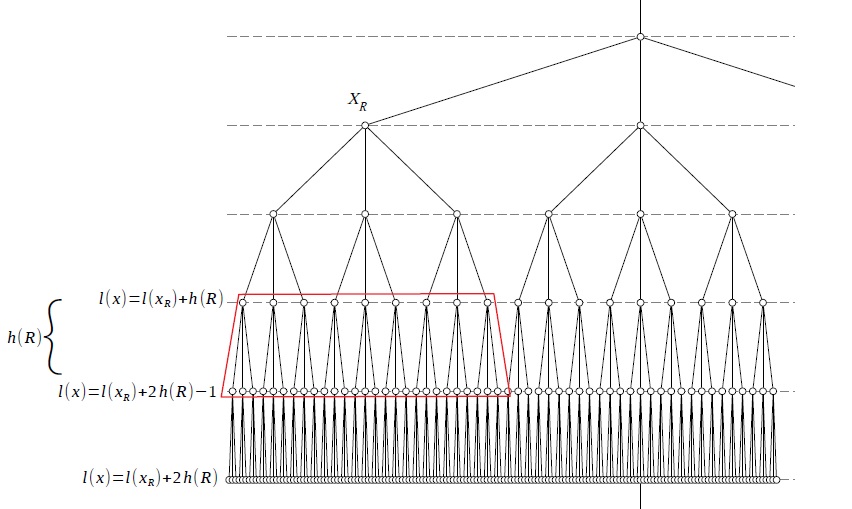 Figure 1
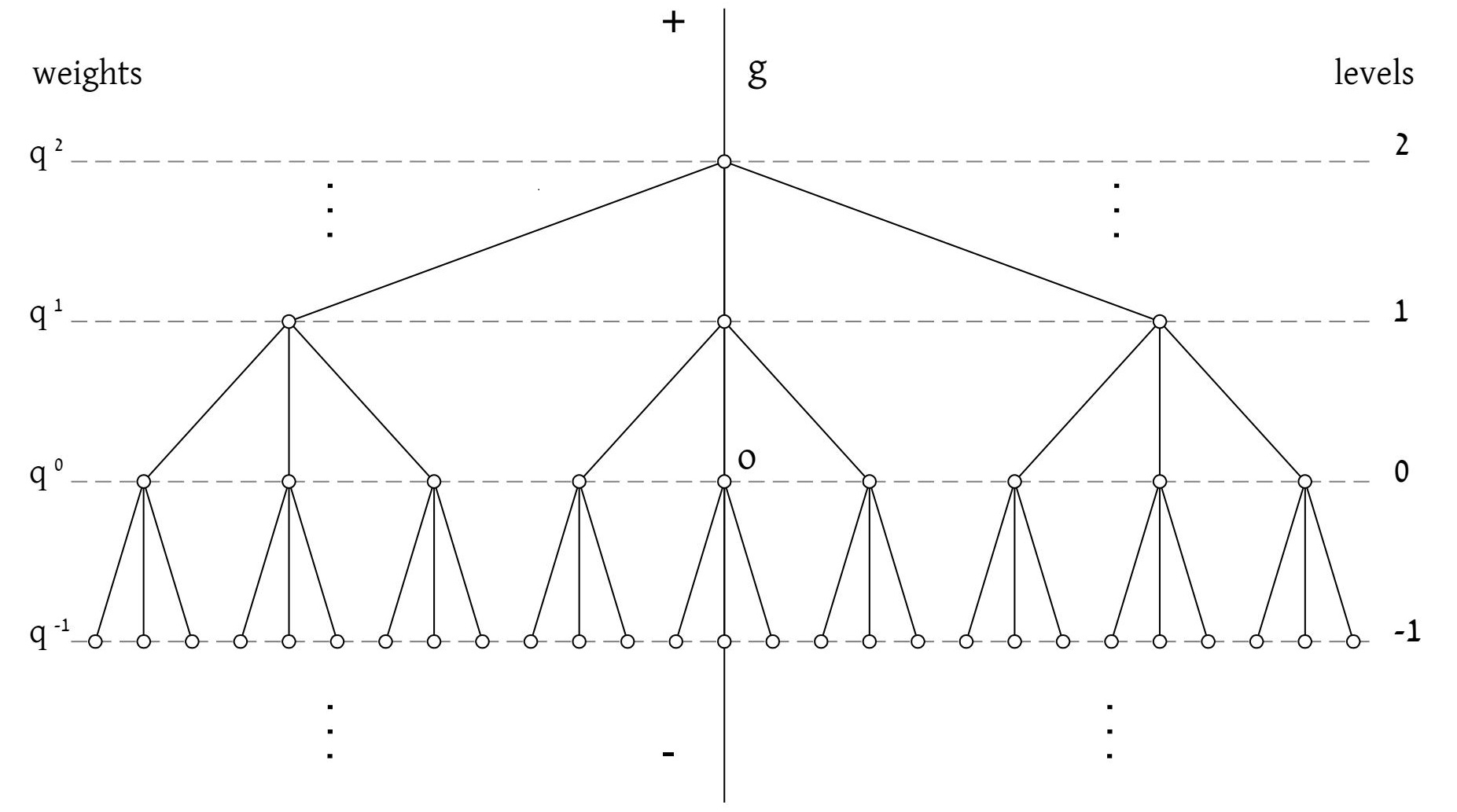 Figure 2
Peer Reviews
No public reviews on file for this paper yet. If you reviewed it on a platform where reviews are public (OpenReview, ICLR, NeurIPS, ICML), you can paste yours below so the community can read it here.
Videos
No videos yet. Explain this paper in a talk, walkthrough, or lecture? Add one.
Taxonomy
TopicsAdvanced Harmonic Analysis Research · Advanced Mathematical Physics Problems
Hardy spaces on weighted homogeneous trees
Laura Arditti, Anita Tabacco amnd Maria Vallarino
Laura Arditti, Anita Tabacco, Maria Vallarino: Dipartimento di Scienze Matematiche ”Giuseppe Luigi Lagrange”
Politecnico di Torino
corso Duca degli Abruzzi 24
10129 Torino
Italy [email protected], [email protected], [email protected]
Abstract.
We consider an infinite homogeneous tree endowed with the usual metric defined on graphs and a weighted measure . The metric measure space is nondoubling and of exponential growth, hence the classical theory of Hardy spaces does not apply in this setting. We construct an atomic Hardy space on and investigate some of its properties, focusing in particular on real interpolation properties and on boundedness of singular integrals on .
Key words and phrases:
Hardy spaces; homogeneous trees; exponential growth.
The second and third authors are members of the Gruppo Nazionale per l’Analisi Matematica, la Probabilità e le loro Applicazioni (GNAMPA) of the Istituto Nazionale di Alta Matematica (INdAM).
1. Introduction
Let be an infinite homogeneous tree of order endowed with the usual distance defined on a graph (see Section 2 for the precise definitions). Fix a doubly-infinite geodesic in and define a mapping such that
[TABLE]
We define the level function as
[TABLE]
where is the only vertex in such that . Let be the measure on defined by
[TABLE]
for every function defined on . Then is a weighted counting measure. We shall show in Subsection 2.1 that the space is nondoubling and it is of exponential growth. In particular on such space the classical Calderón–Zygmund theory does not hold.
Hebisch and Steger [8] developed a new Calderón–Zygmund theory which can be applied also to nondoubling metric measure spaces and showed that such a theory can be applied to the space . In particular they proved that there exists a family of appropriate sets in , which are called Calderón–Zygmund sets, which replace the family of balls in the classical Calderón–Zygmund theory. We mention also that some properties of the space were investigated in more detail in [1].
The purpose of this work is to develop a theory of Hardy spaces on , which is a natural development of the Calderón–Zygmund theory introduced in [8]. Following the classical atomic definition of Hardy spaces [5], for each in we define an atomic Hardy space . Atoms are functions supported in Calderón–Zygmund sets, with vanishing integral and satisfying a certain size condition. We shall prove that all the spaces , , coincide and we simply denote by this atomic Hardy space.
We then find the real interpolation spaces between and , . The interpolation results which we prove are the analogue of the classical interpolation results (see [7, 11, 13, 14]), but the proofs are different. Indeed, in the classical setting the maximal characterization of the Hardy space is used to obtain the interpolation results, while the Hardy space introduced in this paper has an atomic definition.
Further, we show that a singular integral operator whose kernel satisfies an integral Hörmander condition, extends to a bounded operator from to . As a consequence of this result, we show that spectral multipliers of a distinguished Laplacian and the first order Riesz transform associated to extend to bounded operators from to .
It would be also interesting to characterize the dual space of and to obtain complex interpolation results involving , its dual and the -spaces. This will be the object of further investigations.
All the results described above may be considered as an analogue of the classical theory of Hardy spaces.
The classical Hardy space [5, 6, 15] was introduced in , where is the Euclidean metric and denotes the Lebesgue measure and more generally on a space of homogeneous type, i.e. a metric measure space where the doubling condition is satisfied, i.e., there exists a constant such that
[TABLE]
Extensions of the theory of Hardy spaces have been considered in the literature on various metric measure spaces which do not satisfy the doubling condition (1.3). The literature on this subject is huge and we shall only cite here some contributions [3, 4, 12, 16] which are strictly related to our work.
In particular, we mention that Celotto and Meda [4] studied various Hardy spaces on a homogeneous tree endowed with the metric and the counting measure, which is not the measure that we consider here. Their theory is useful to study the boundedness of singular integral operators related to the standard Laplacian defined on trees which is self-adjoint with respect to the counting measure and not to the measure . The theory we develop here instead is useful to study singular integral operators related to a distinguished Laplacian self-adjoint on (see Subsection 4.3).
We mention that in [12, 16] the authors used the Calderón–Zygmund theory introduced by Hebisch and Steger in [8] to construct Hardy spaces on some solvable Lie groups of exponential growth and studied their properties. Our work can be thought as a counterpart in a discrete setting of the results in [16], and some of our proofs are strongly inspired by it.
Positive constants are denoted by ; these may differ from one line to another, and may depend on any quantifiers written, implicitly or explicitly, before the relevant formula.
2. Weighted homogeneous trees
In this section we introduce the infinite homogeneous tree and we define a distance and and a measure on it. We show that the corresponding metric measure space does not satisfy the doubling property. We then introduce a family of sets, called trapezoids, which will be fundamental in the construction of Hardy spaces.
Definition 2.1**.**
An infinite homogeneous tree of order is a graph , where denotes the set of vertices and denotes the set of edges, with the following properties:
- (i)
is connected and acyclic; 2. (ii)
each vertex has exactly neighbours.
On we can define the distance between two vertices and as the length of the shortest path between and . We also fix a doubly-infinite geodesic in , that is a connected subset such that
- (i)
for each element there are exactly two neighbours of in ; 2. (ii)
for every couple of elements in , the shortest path joining and is contained in .
We define a mapping such that
[TABLE]
This corresponds to the choice of an origin (the only vertex for which ) and an orientation for ; in this way we obtain a numeration of the vertices in . We define the level function as
[TABLE]
where is the only vertex in such that . For we say that lies above if
[TABLE]
In this case we also say that lies below .
Let be the measure on such that for each function
[TABLE]
Then is a weighted counting measure such that the weight of a vertex depends only on its level and the weight associated to a certain level is given by times the weight of the level immediately underneath (see Figure 1).
2.1. Doubling and local doubling properties
Observe that the space exhibits exponential volume growth. Indeed given and consider the sphere and the closed ball A direct computation shows that for their measures are given by:
[TABLE]
We notice that they depend on the level of the center and grow exponentially with respect to the radius . As a consequence we can prove the following.
Proposition 2.2**.**
The space is not doubling but it is locally doubling.
Proof.
Fix and notice that
[TABLE]
Thus the doubling property (1.3) fails.
Instead, we show that is locally doubling. Indeed, fix and and consider ; one has
[TABLE]
with independent of and . ∎
2.2. Admissible trapezoids and Calderón–Zygmund sets
In this subsection we introduce the notion of trapezoid and recall the definition and the main properties of the admissible trapezoids introduced in [8].
Definition 2.3**.**
We call trapezoid a set of vertices for which there exist and such that
[TABLE]
In the following we will refer to as the root node of the trapezoid. Among all trapezoids we are mostly interested in those where and are related by particular conditions, as specified in the following definitions.
Definition 2.4**.**
A trapezoid is an admissible trapezoid if and only if one of the following occurs:
- (i)
with , that is consists of a single vertex ; 2. (ii)
such that
[TABLE]
We set in the first case and in the second case. In both cases can be interpreted as the height of the admissible trapezoid, which coincides with the number of levels spanned by (see Figure 2).
Definition 2.5**.**
We call width of the admissible trapezoid the quantity
[TABLE]
We have that:
[TABLE]
We now introduce the family of Calderón–Zygmund sets. They are trapezoids, even if not of admissible type; they consist of suitable enlargements of admissible trapezoids, constructed according to the following definition.
Definition 2.6**.**
Given an admissible trapezoid , the envelope of is the set
[TABLE]
and we set . The envelope of an admissible trapezoid is also called a Calderón–Zygmund set.
Proposition 2.7**.**
Let be an admissible trapezoid. Then:
[TABLE]
Proof.
In the degenerate case one has and then . In the nondegenerate case
[TABLE]
which concludes the proof. ∎
Proposition 2.8**.**
Let and be two admissible trapezoids. If
[TABLE]
then
[TABLE]
Proof.
The only nontrivial case is when neither nor is composed of a single vertex. Let and be the two root nodes of and , respectively. Then
[TABLE]
Moreover, since , is below and so is every vertex of . In the following we denote and . Let . Then we obtain the following constraints:
[TABLE]
Let ; then lies below . Moreover
[TABLE]
[TABLE]
So , and this shows that . ∎
Proposition 2.9**.**
Given a Calderón–Zygmund set , we have that for all
[TABLE]
Proof.
Fix a point . Every vertex has distance . Indeed, starting from it is possible to reach passing through at most edges, moving from to the root node of the trapezoid and then from the root node to . ∎
Definition 2.10**.**
Given a Calderón–Zygmund set , we define the set
[TABLE]
It is easy to see that there exists a positive constant such that for every Calderón–Zygmund set
[TABLE]
See [1, p.75] for a proof of this fact.
3. The maximal function
In this section we define two maximal functions and describe a way to construct a covering of their level sets which will be useful in the sequel.
Definition 3.1**.**
Given , we define the maximal function as
[TABLE]
where the supremum is taken over all admissible trapezoids containing .
Consider a function and let . We are interested in constructing a covering of the level set
[TABLE]
Define as the family of all admissible trapezoids such that
[TABLE]
Since is countable, we can introduce an ordering in . All trapezoids in have bounded measure and bounded width, because we have
[TABLE]
So it is possible to choose in a trapezoid of largest width (in case of ties, we choose that trapezoid of largest width which occurs earliest in the ordering). Then we proceed inductively:
- (i)
is the family of all admissible trapezoids disjoint from ; 2. (ii)
is the trapezoid of largest width in which occurs earliest in the ordering.
Let . Then by construction intersects some with .
Indeed, there exists a number such that and , i.e. in the previous construction there exists a step in which one of the following occurs:
- (1)
either is the trapezoid of largest width that occurs earliest in the ordering, and then is selected and , so that for ; 2. (2)
or is not the trapezoid of largest width that occurs earliest in the ordering and it intersects . Then is not in and for .
To ensure that there is some with the stated property it is sufficient to avoid that can contain an infinite number of trapezoids with the same width that do not intersect each other. This possibility is excluded observing that:
[TABLE]
while if there was among the ’s an infinite number of trapezoids with constant width we would have
[TABLE]
In conclusion,
[TABLE]
By Proposition 2.8, this implies . We set . We have that and
[TABLE]
Definition 3.2**.**
Given and a Calderón–Zygmund set , we define the maximal function as follows
[TABLE]
where the supremum is taken over all admissible trapezoids containing and contained in . When we set .
Consider a function with support contained in a Calderón–Zygmund set , and let . We define
[TABLE]
Arguing as before, we can show that there exists a family of pairwise disjoint admissible trapezoids such that , and .
4. Hardy spaces
In this section we define atomic Hardy spaces replacing balls with Calderón–Zygmund sets in the classical definition of atoms.
Definition 4.1**.**
A function is a -atom, for , if it satisfies the following properties:
- (i)
is supported in a Calderón–Zygmund set ; 2. (ii)
3. (iii)
.
Observe that a -atom is in and it is normalized in such a way that its -norm does not exceed .
Definition 4.2**.**
The Hardy space is the space of all functions in such that , where are -atoms and are complex numbers such that . We denote by the infimum of over all decompositions , where are -atoms.
The space endowed with the norm is a Banach space.
4.1. Equivalence of spaces for
It easily follows from the above definitions that , whenever . Actually we shall prove that , for every . To show this fact we first prove a preliminary result.
Proposition 4.3**.**
Let be a -atom, where . Then is in and there exists a positive constant , which depends only on , such that
[TABLE]
Proof.
Let be a -atom supported in a Calderón–Zygmund set . We define .
Let be a positive number such that .
We shall prove that for all there exist functions , and admissible sets , , , such that
[TABLE]
where the following properties are satisfied:
- (i)
is a -atom supported in the Calderón–Zygmund set ; 2. (ii)
is supported in and ; 3. (iii)
\Big{(}\frac{1}{\mu(\tilde{R}_{j_{n}})}\int_{\tilde{R}_{j_{n}}}|f_{j_{n}}|^{p}\,{\rm{d}}\mu\Big{)}^{1/p}\leq 2^{1-1/p}\,(6q)^{1/p}\,(1+4^{p})^{1/p}\alpha^{n}; 4. (iv)
; 5. (v)
.
We first suppose that the decomposition (4.1) exists and we show that . Set . We prove that and that its -norm tends to zero when tends to . Indeed, by Hölder’s inequality
[TABLE]
where is the conjugate exponent of . Now by (iii) and (v) we have that
[TABLE]
which tends to zero when tends to , since .
This shows that the series converges to in . Moreover by (v) we deduce that
[TABLE]
where depends only on .
It follows that is in and Thus is in and , as required.
It remains to prove that the decomposition (4.1) exists. We prove it by induction on .
Step . Define
[TABLE]
If , then
[TABLE]
It follows that and we have so that and (4.1) is satisfied with the -atom and for every .
If , then we construct a family of trapezoids , , and the corresponding Calderón–Zygmund sets , , as in Section 3. We then define , and . One can show as in [8, p.43]
[TABLE]
See also [1, p.74] for a detailed proof of the previous inequality.
We now define
[TABLE]
Notice that is supported in and is supported in . The average of vanishes by construction. Moreover, for every we have that
[TABLE]
where we have applied (4.2) and Proposition 2.7. It follows that
[TABLE]
Moreover,
[TABLE]
This implies that
[TABLE]
We now estimate the function . If is a vertex in the complement of , then obviously . If is a vertex in , then and . Thus . Let us now take and let be the unique index such that . We distinguish two different cases. If , then and for every , so that . If , let be the unique index such that . When we have that for every and
[TABLE]
so that . When we have that for every and
[TABLE]
so that .
In conclusion,
[TABLE]
where is a -atom supported in and all properties (i)-(v) are satisfied.
Inductive step. Suppose that a decomposition
[TABLE]
holds, where properties (i)-(v) are satisfied. We shall prove that a similar decomposition of holds with in place of . To do so, we decompose each function by following the same construction applied above to with respect to . We omit the details. ∎
The following theorem is now an easy consequence of Proposition 4.3.
Theorem 4.4**.**
For any , and the norms and are equivalent.
In the sequel we denote by the space and we define .
4.2. Real interpolation properties of
In this subsection we study the real interpolation of and the spaces. We first recall some notation of the real interpolation of normed spaces, focusing on the -method. For the details see [2].
Given two compatible normed spaces and , for any and for any we define
[TABLE]
Take and . The real interpolation space \big{[}A_{0},A_{1}\big{]}_{\theta,q} is defined as the set of the elements such that
[TABLE]
is finite. The space \big{[}A_{0},A_{1}\big{]}_{\theta,q} endowed with the norm is an exact interpolation space of exponent .
We refer the reader to [10] for an overview of the real interpolation results which hold in the classical setting. Our aim is to prove the same results in our context. Note that in our case a maximal characterization of is not avalaible, so that we cannot follow the classical proofs but we shall only use the atomic definition of to prove the results.
We shall first estimate the functional of -functions with respect to the couple of spaces , .
Lemma 4.5**.**
Suppose that and let be such that . Let be in . The following hold:
- (i)
for every there exists a decomposition in such that
- (i’)
* and, if , then ;* 2. (i”)
** 2. (ii)
for any , 3. (iii)
* and *
Proof.
Let be in . We first prove (i). Given a positive , let
[TABLE]
Let be the collection of trapezoids constructed as in Section 3. We now define and ,
[TABLE]
Arguing as we did in the proof of Proposition 4.3 we can show that
[TABLE]
If , then
[TABLE]
To estimate we notice that , so that
[TABLE]
To estimate we first observe that given and there exists only two indeces and such that and . If , then
[TABLE]
so that . If , then
[TABLE]
so that . It follows that
[TABLE]
In conclusion, .
We now prove that is in . Indeed, for any , is supported in , has vanishing integral and
[TABLE]
This shows that and . Since , is in and
[TABLE]
as required.
We now prove (ii). Fix . For any positive , let be the decomposition of in given by (i). Thus
[TABLE]
where . Since
[TABLE]
we have that if , then
[TABLE]
If , then
[TABLE]
It follows that
[TABLE]
proving (ii). This implies that , so that and , as required in (iii). ∎
Following closely the proof of [16, Theorem ] we deduce from Lemma 4.5 the following result.
Theorem 4.6**.**
Let and be such that . Then
[TABLE]
4.3. Boundedness of singular integrals on
In this subsection we prove that integral operators whose kernels satisfy a suitable integral Hörmander condition are bounded from to .
Theorem 4.7**.**
Let be a linear operator which is bounded on and admits a locally integrable kernel off the diagonal that satisfies the condition
[TABLE]
where the supremum is taken over alla Calderón-Zygmund sets and is defined as in Definition 2.10. Then extends to a bounded operator from to .
Proof.
Using (4.3), by [8, Theorem 1.2] it is easy to prove that the operator is of weak type . Then it is enough to show that there exists a constant such that for any -atom .
Let be a -atom supported in the Calderón–Zygmund set . Recall that , and denote the dilated set . We estimate the integral .
We first estimate the integral on by the Cauchy-Schwarz inequality and the size estimate of the atom:
[TABLE]
We consider the integral on the complementary set of by using the fact that has vanishing integral:
[TABLE]
as required. ∎
Remark: The previous result applies to singular integral operators associated with the Laplacian on the tree defined for every function by
[TABLE]
The Laplacian is bounded on for every , it is self-adjoint on and its spectrum on is . Suppose that is bounded supported in and satisfies the following Mikhlin-Hörmander condition of order
[TABLE]
for some , , where and denotes the Sobolev space of order modelled on . Then the operator extends to a bounded operator from to . Indeed, it was shown in [8, Theorem 2.3] that the integral kernel of the operator satisfies condition (4.3). For every function we also define the gradient by the formula:
[TABLE]
Then the first order Riesz transform extends to a bounded operator from to . Indeed, it was shown in [8, Theorem 2.3] that the integral kernel of this operator satisfies condition (4.3).
The reference list from the paper itself. Each links out to its DOI / PubMed record.
- 1[1] L. Arditti. Analysis on weighted homogeneous trees. https://webthesis.biblio.polito.it/8359/, (2018).
- 2[2] J. Bergh, J. Löfström. Interpolation spaces. An introduction. Grundlehren der Mathematischen Wissenschaften, No. 223. Springer-Verlag, Berlin-New York, 1976.
- 3[3] A. Carbonaro, G. Mauceri, S. Meda. H 1 superscript 𝐻 1 H^{1} and B M O 𝐵 𝑀 𝑂 BMO for certain locally doubling metric measure spaces. Ann. Sc. Norm. Super. Pisa Cl. Sci. (5) 8 (2009), no. 3, 543-582.
- 4[4] D. Celotto, S. Meda. On the analogueue of the Fefferman-Stein theorem on graphs with the Cheeger property. Ann. Mat. Pura Appl. (4) 197 (2018), no. 5, 1637-1677.
- 5[5] R.R. Coifman, G. Weiss. Extensions of Hardy spaces and their use in analysis. Bull. Amer. Math. Soc. 83 (1977), no. 4, 569-645.
- 6[6] G. B. Folland, E. M. Stein. Hardy spaces on homogeneous groups, Princeton University Press, 1982.
- 7[7] R. Hanks. Interpolation by the real method between B M O 𝐵 𝑀 𝑂 BMO , L α ( 0 < α < ∞ ) superscript 𝐿 𝛼 0 𝛼 L^{\alpha}(0<\alpha<\infty) and H α ( 0 < α < ∞ ) superscript 𝐻 𝛼 0 𝛼 H^{\alpha}(0<\alpha<\infty) , Indiana Univ. Math. J. 26 (1977), 679-689.
- 8[8] W. Hebisch, T. Steger. Multipliers and singular integrals on exponential growth groups. Math. Z. 245 (2003), no. 1, 37-61.