Ultralow-field Nuclear Magnetic Resonance Asymmetric Spectroscopy
Min Jiang, Wenjie Xu, Yunlan Ji, Ji Bian, Shiming Song, Xinhua Peng

TL;DR
This paper investigates the asymmetric spectral amplitudes observed in ultralow-field NMR, providing a comprehensive model, new experimental observations, and methods to eliminate asymmetry, revealing additional information from the spectra.
Contribution
It introduces a comprehensive model explaining spectral asymmetry in ultralow-field NMR and demonstrates how to suppress it while extracting more information from the spectra.
Findings
Developed a model explaining spectral asymmetry.
Observed unprecedented asymmetric spectra.
Proposed methods to eliminate spectral asymmetry.
Abstract
Ultralow-field nuclear magnetic resonance (NMR) provides a new regime for many applications ranging from materials science to fundamental physics. However, the experimentally observed spectra show asymmetric amplitudes, differing greatly from those predicted by the standard theory. Its physical origin remains unclear, as well as how to suppress it. Here we provide a comprehensive model to explain the asymmetric spectral amplitudes, further observe more unprecedented asymmetric spectroscopy and find a way to eliminate it. Moreover, contrary to the traditional idea that asymmetric phenomena were considered as a nuisance, we show that more information can be gained from the asymmetric spectroscopy, e.g., the light shift of atomic vapors and the sign of Land factor of NMR systems.
Click any figure to enlarge with its caption.
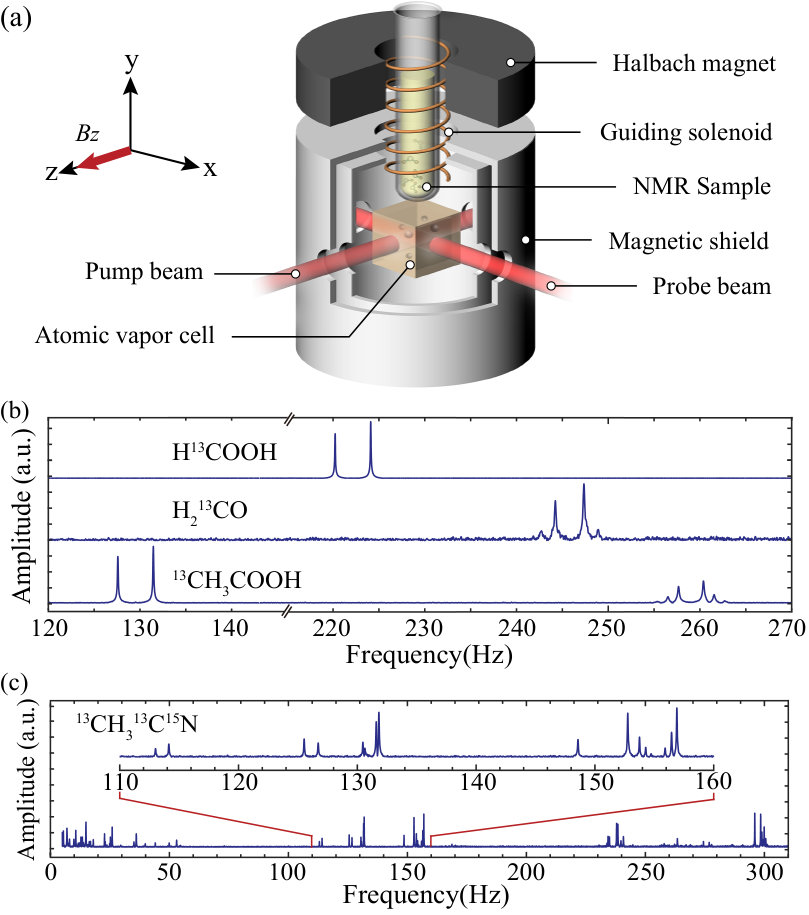 Figure 1
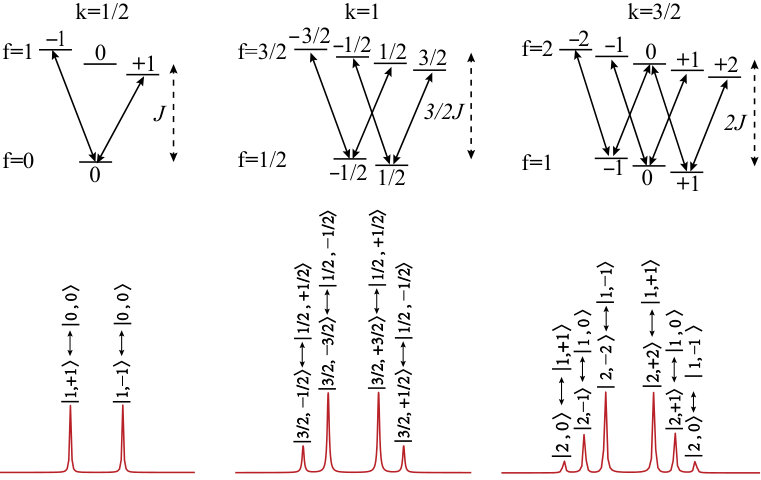 Figure 2
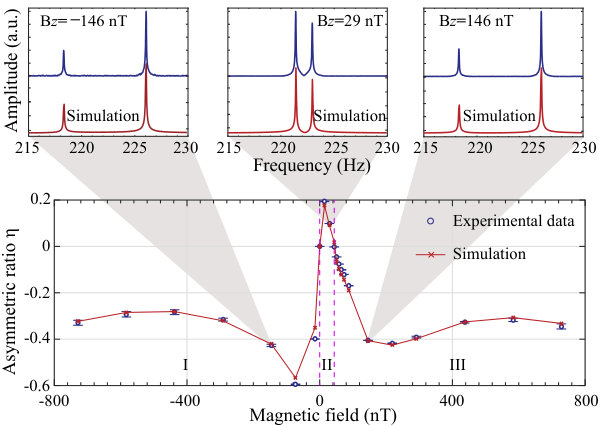 Figure 3
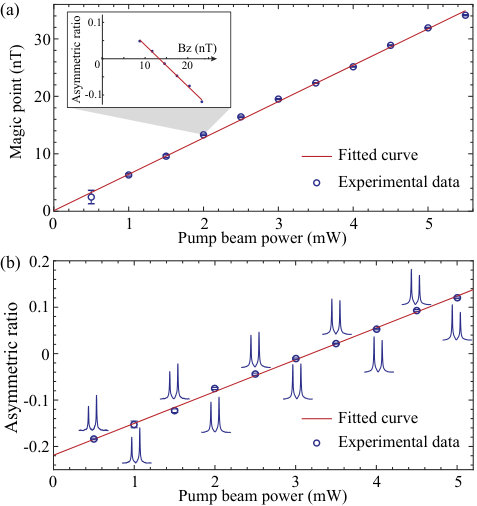 Figure 4
Peer Reviews
No public reviews on file for this paper yet. If you reviewed it on a platform where reviews are public (OpenReview, ICLR, NeurIPS, ICML), you can paste yours below so the community can read it here.
Videos
No videos yet. Explain this paper in a talk, walkthrough, or lecture? Add one.
Taxonomy
TopicsAtomic and Subatomic Physics Research · Mechanical and Optical Resonators · Advanced NMR Techniques and Applications
Ultralow-field Nuclear Magnetic Resonance Asymmetric Spectroscopy
Min Jiang
These authors contributed equally to this work
Hefei National Laboratory for Physical Sciences at the Microscale and Department of Modern Physics, University of Science and Technology of China, Hefei 230026, China
CAS Key Laboratory of Microscale Magnetic Resonance, University of Science and Technology of China, Hefei, Anhui 230026, China
Wenjie Xu
These authors contributed equally to this work
Hefei National Laboratory for Physical Sciences at the Microscale and Department of Modern Physics, University of Science and Technology of China, Hefei 230026, China
CAS Key Laboratory of Microscale Magnetic Resonance, University of Science and Technology of China, Hefei, Anhui 230026, China
Yunlan Ji
Hefei National Laboratory for Physical Sciences at the Microscale and Department of Modern Physics, University of Science and Technology of China, Hefei 230026, China
CAS Key Laboratory of Microscale Magnetic Resonance, University of Science and Technology of China, Hefei, Anhui 230026, China
Ji Bian
Hefei National Laboratory for Physical Sciences at the Microscale and Department of Modern Physics, University of Science and Technology of China, Hefei 230026, China
CAS Key Laboratory of Microscale Magnetic Resonance, University of Science and Technology of China, Hefei, Anhui 230026, China
Shiming Song
Hefei National Laboratory for Physical Sciences at the Microscale and Department of Modern Physics, University of Science and Technology of China, Hefei 230026, China
CAS Key Laboratory of Microscale Magnetic Resonance, University of Science and Technology of China, Hefei, Anhui 230026, China
Xinhua Peng
Hefei National Laboratory for Physical Sciences at the Microscale and Department of Modern Physics, University of Science and Technology of China, Hefei 230026, China
CAS Key Laboratory of Microscale Magnetic Resonance, University of Science and Technology of China, Hefei, Anhui 230026, China
Synergetic Innovation Center of Quantum Information and Quantum Physics, University of Science and Technology of China, Hefei, Anhui 230026, China
Synergetic Innovation Center for Quantum Effects and Applications, Hunan Normal University, Changsha 410081, China
Abstract
Ultralow-field nuclear magnetic resonance (NMR) provides a new regime for many applications ranging from materials science to fundamental physics. However, the experimentally observed spectra show asymmetric amplitudes, differing greatly from those predicted by the standard theory. Its physical origin remains unclear, as well as how to suppress it. Here we provide a comprehensive model to explain the asymmetric spectral amplitudes, further observe more unprecedented asymmetric spectroscopy and find a way to eliminate it. Moreover, contrary to the traditional idea that asymmetric phenomena were considered as a nuisance, we show that more information can be gained from the asymmetric spectroscopy, e.g., the light shift of atomic vapors and the sign of Land factor of NMR systems.
Introduction.**–**Nuclear magnetic resonance (NMR) is a fundamental exploratory tool in detecting, identifying, and quantifying information about the atoms and molecules Ernst1987 . With the advent of hyperpolarization methods Adams2009 ; Shchepin2015 ; Theis2012 , detection schemes using atomic magnetometers Budker2007 ; Allred2002 ; Kominis2003 ; Shah2007 or superconducting quantum interference devices (SQUIDs) Greenberg1998 and quantum control techniques Sjolander2017 ; Tayler2016 ; Bian2017 ; Jiang2017 ; Jiang2018 ; Ji2018 , ultralow-field NMR has been developed as an alternative magnetic resonance modality McDermott2002 ; Burghoff2005 ; Appelt2006 ; Theis2011 ; Ledbetter2011 ; BlanchardD2016 ; Bevilacqua2009 . Atomic magnetometers are an ideal tool because, in contrast to SQUIDs, they do not require cryogenically cooling. Recent works using atomic magnetometers in ultralow-field NMR spectroscopy have been extensively reported in Refs. Theis2011 ; Ledbetter2011 ; Ledbetter2009 ; Liu2013 . Ultralow-field NMR experiments regularly achieve nuclear spin coherence times longer than ten seconds Blanchard2013 ; Emondts2014 , and thus can be used for chemical fingerprinting and precise measurement of nuclear spin-spin couplings Theis2011 ; Blanchard2013 ; Blanchard2015 . Very recently, ultralow-field NMR has attracted renewed interest for application in fundamental physics, such as searches for molecular chirality King12017 , ultralight axions and axion-like particles Garcon2017 and nuclear spin-gravity coupling Teng2018 .
Standard ultralow-field NMR theory has been developed to analyse the spectroscopy Ledbetter2011 ; BlanchardD2016 ; Appelt2010 , i.e., predict the frequencies and amplitudes of resonant peaks. However, researchers are disconcerted to find that ultralow-field NMR spectra of even a sample as simple as formic acid (containing 13C-1H spin pairs) experimentally suffer from asymmetric amplitudes, differing greatly from those predicted by the standard theory Teng2018 ; Ledbetter2012 ; Jiang22018 . Thus, there is an urgent need to understand the asymmetric amplitude phenomena in ultralow-field NMR spectra.
In this Letter, we provide a comprehensive model for interpreting the asymmetric effect by investigating the asymmetric amplitude phenomena in ultralow-field NMR spectroscopy, where a class of unprecedented asymmetric phenomena are also present. We further find that the asymmetric phenomena can be completely eliminated when the external magnetic field is carefully chosen, as observed experimentally. Moreover, the asymmetric spectroscopy can surprisingly impart additional information, including the light shift of atomic vapors and the sign of Land factor of NMR systems.
Asymmetric spectra in ultralow-field NMR.**–**A liquid-state -spin system at a magnetic field can be described by the Hamiltonian
[TABLE]
where is the strength of the scalar spin-spin coupling ( coupling) between the th and th spins, represent the th spin with gyromagnetic ratio , and the reduced Planck constant is set to one. At zero magnetic field, eigenstates are also eigenstates of and , where f are the total angular momentum, and are denoted as . In the presence of a perturbing magnetic field, eigenstates are approximately those of the Hamiltonian described in Eq. (1) at zero field, and energies can be calculated with degenerate perturbation theory Ledbetter2011 ; Appelt2010 . The ultralow-field NMR spectrometer used in our experiments is similar to the apparatus in Refs. Ledbetter2011 ; TaylerMC2017 and is depicted in Fig. 1(a). Liquid-state NMR samples are contained in 5-mm NMR tubes, and pneumatically shuttled between a prepolarizing magnet ( T) and a rubidium (87Rb) vapor cell. During the transfer, a guiding magnetic field ( G) is applied along the axis, and is abruptly switched off within 10 s prior to signal acquisition. In the high-temperature approximation, the initial spin state is with , where is the Boltzmann constant, and is the temperature of the sample. The initial spin state then evolves under the Hamiltonian in Eq. (1), and generates a magnetization with component along axis (). The magnetization is detected with a spin-exchange relaxation-free atomic magnetometer Allred2002 ; Kominis2003 (sensitivity ), and Fourier transformed to the NMR spectrum of the sample.
We experimentally investigate the ultralow-field spectra of typical systems. In such systems, equivalent proton spins couple to a carbon spin with the same strength . Figure 1(b) shows the experimental spectra of formic acid, a doublet centered at Hz, where the characteristic of asymmetric amplitudes is obvious. Taking acetic acid as a example to illustrate, the corresponding spectra of the manifold, centered at Hz, is same with the case of formic acid. We focus on the manifold, in which the six lines centered at Hz can be divided into three pairs, and each pair consists of two transitions of and \left|{2,-{m_{f}}}\right\rangle\leftrightarrow$$\left|{1,-m_{f}-1}\right\rangle, where . These three pairs of NMR lines show asymmetric amplitudes. The asymmetric phenomena are not limited to the 13CHn systems. Figure 1(c) shows the asymmetric spectra experimentally measured in a more complex spin system (fully labeled acetonitrile) which demonstrates the asymmetric phenomena is ubiquitous for ultralow-field NMR in this kind of setup. However, for these systems, the NMR spectral asymmetry is significantly inconsistent with the theoretical predictions, as shown in Fig. 2. Even considering high-order corrections to the eigenstates which introduce some asymmetry, it still cannot account for the experimental data.
To investigate the origin of the asymmetric phenomena, we restrict our attention here to formic acid as the simplest example of general phenomena. We define an amplitude ratio of the doublet, , as a metric of the asymmetry. Here, and are the amplitudes of the peaks at lower frequency and higher frequency, respectively. The asymmetric ratios are plotted as a function of magnetic fields, as shown with the blue circles in Fig. 3. We find that the asymmetry of the doublet shows strongly dependence on the applied magnetic field. For example, in the left inset of Fig. 3, the amplitude of the peak at lower frequency is smaller than that of the peak at higher frequency when . We call this phenomena as negative asymmetry (i.e., ), and on the contrary we call it as positive asymmetry (i.e., ). When , the doublet exhibit positive asymmetry in the middle inset of Fig. 3. As described in the Supplemental Material SI , we also examine the asymmetry in acetic acid and the experimental results are similar with the case of formic acid.
We now make three observations on the plot of as a function of magnetic fields. (1) The plot has two cross points (e.g., and in Fig. 3) with , in which the corresponding spectra are symmetric. At the zero-field cross point, the spectrum corresponds to the zero-field NMR, which is trivially symmetric for only a single peak is observed. The non-zero cross point corresponds to a specific magnetic field, which allows for symmetric ultralow-field spectra. Further discussions are presented in below. (2) The plot is divided into three regions by the two cross points. The spectral doublet have same asymmetry in the regions I and III, and have opposite asymmetry in the region II. (3) The ultralow-field spectra of samples (e.g., formic acid, formaldehyde) tend to exhibit negative asymmetry in the regions I and III. We now present a comprehensive model (with a critical consideration of the magnetometer’s frequency response) to interpret the above-mentioned asymmetric phenomena.
A comprehensive model for explaining asymmetric spectroscopy.**–**To explain the asymmetric NMR spectra, we firstly consider the effect of the amplitude-frequency and phase-frequency responses of the atomic magnetometer Allred2002 ; Jiang22018 ; SI ; Li2006 . Recently, the phase-frequency response was used to correct the phase of zero-field NMR spectra Theis2011 , and compensate the phase difference between two magnetometer channels Jiang22018 . Application of a magnetic field makes the atomic magnetometer simultaneously sensitive to fields along the and axes SI . This has been applied to realize a vector atomic magnetometer Seltzer2004 . Here, we demonstrate that the phase-frequency response is different along the and axes depending on the magnetic field . This point is ignored until we recognize that it is crucial for explaining the asymmetric NMR spectra (see below). We denote the amplitude-frequency response along axis as and the phase-frequency response as . In the following discussion, a more careful analysis shows that and are key to explaining experimental asymmetric spectra.
We then calculate the magnetization signals generated by the NMR system. Calculating the spin magnetization evolution under the Hamiltonian as described in Eq. (1) shows that the formic acid simultaneously generate and with same amplitude. Here, is the component of with the frequency , and correspond to transition and , respectively. The initial phase of is ahead of the , while the initial phase of is behind of the (see Supplemental Material SI ). and generate magnetic fields on the vapor cell along axis, , and axis, , respectively. The magnetic field along is different from the magnetic field along , i.e., . Here, depends on the spatial configuration of the sample and the vapor cell. Therefore, the oscillating magnetic field produced by the spin magnetization on the vapor cell can be written as
[TABLE]
where , and .
With taking the amplitude-frequency response and phase-frequency response of the atomic magnetometer, the magnetometer signal is proportional to
[TABLE]
where
[TABLE]
Therefore, each NMR peak of the formic acid doublet at the frequency is the interference between the magnetometer’s response of the spin magnetization along and axes. As such, the interference effect causes the asymmetry of the doublet peaks of formic acid. Moreover, and vary with the magnitude of the external magnetic field , and thus the asymmetric ratio of doublet peaks varies with the magnitude of the external magnetic field . Using the experimental data SI of , and , we calculate the spectral asymmetric ratios with respect to the magnetic field, as shown in Fig. 3. The experimental results are in good agreement with the theoretical calculations by Eq. (2). Therefore, from these experimental results, our model clearly provides the explanation of the origin of the asymmetric amplitude phenomena in ultralow-field NMR spectroscopy.
The model presented above can be generalized to general quantum sensors. Ordinarily, the standard process of quantum mechanics treats a quantum sensor as an observable operator, and then focus on the dynamics of the detected quantum system. However, quantum sensors, such as SQUIDs Greenberg1998 and nitrogen-vacancy centres Taylor2008 , have frequency responses to the oscillating signals generated by detected systems Budker2007 ; Degen2017 . The normal observable operator has no ability to include the effect of the frequency response of quantum sensors. Here we show that the effect of frequency response is effectively equal to modifying the observable operator by applying specific operations. For example, the normal observable operator is the spin angular moment , which corresponds to the observation of magnetization. After introducing the phase-frequency response, the effective observable operator is the one after rotating with angle around axis SI .
Based on the model presented here, the asymmetric amplitude phenomena can be eliminated with applying a specific magnetic field (namely magic field, ). We verify that the magic field has same magnitude and but opposite direction with the light shift of atomic vapor Mathur1968 . This actually suggests a method to measure the light shift of atomic vapor. When the field is set at the magic field, the light shift compensates the external magnetic field to effective zero field for the 87Rb atoms in vapor. In this condition, the amplitude-frequency response at any frequencies SI , which results in the symmetric spectra. We also verify this experimentally. Figure 4(a) shows that the magic field follows a linear dependence with the power of the pump beam. It satisfies well with that the magic field has same magnitude with the light shift of the 87Rb atomic vapor. Additionally, we show that the asymmetric ratios of the formic acid doublet are linearly dependent on the power of the pump beam, as shown in Fig. 4(b). Similar to the magic field, there exists a specific pump beam power for observing symmetric spectra.
Asymmetric ultralow-field NMR spectroscopy provides the information of the sign of the Land factor of NMR systems. We proof that the regions I and III (see Fig. 3) have same asymmetry, which is relevant to the sign of the Land factor of NMR systems. For example, formic acid doublet both show negative asymmetry in the regions I and III. This implies that the Land factor of the manifold () in formic acid is positive. We analyse it as follows. If the Land factor is positive, in the region I, and in the region III. In the region I, the phase difference at the frequency between the magnetometer signals along and axes is equal to , which is smaller than SI . While, at the frequency , the phase difference, , is larger than . Based on the calculation of trigonometric function synthesis (see the Supplemental Material SI ), the amplitude of the NMR peak at frequency is larger than that at frequency . And because of , the spectral asymmetry is negative asymmetry. In the region III, due to , the phase difference of frequency () is larger(smaller) than . Now, the amplitude of the NMR peak at frequency is smaller than that frequency . In the region III, , and the spectra still show negative asymmetry. Thus, the regions I and III have same negative asymmetry, which corresponds to the positive Land factor. Similarly, when the sign of the Land factor of relevant manifold is negative, the NMR spectra show positive asymmetry. The above analysis is not limited to formic acid, and can be generalized to general NMR systems.
Conclusions.**–**We have developed a new comprehensive model for explaining the origin of ultralow-field NMR asymmetric spectroscopy, which keeps unclear before. The key point in the model is to introduce the response function of phase and amplitude in quantum sensor, e.g., atomic magnetometers, an important subtlety which is essential for explaining asymmetric ultralow-field NMR spectroscopy. In the meantime, we demonstrate that there exists a specific magnetic field and pump beam power for achieving symmetric NMR spectra. It is interesting to note the asymmetric spectroscopy provides an extraordinary tool to obtain additional information of systems, such as the light shift of atomic vapors and the sign of Land factor of NMR systems. Although experimentally demonstrated with atomic magnetometers, our approach could be applied to a variety of systems, such as using nitrogen-vacancy centres in NMR or electron spin resonance detections DeVience2015 ; Kong2018 .
Acknowledgment.**–**We thank Dieter Suter, Teng Wu, and Romn Picazo Frutos for useful discussions, Jiankun Chen for preparing the setup diagram, and Kang Dai for providing the atomic vapor cells. This work was supported by National Key Research and Development Program of China (Grant No. 2018YFA0306600), National Natural Science Foundation of China (Grants Nos. 11425523, 11375167, 11661161018, 11227901), Anhui Initiative in Quantum Information Technologies (Grant No. AHY050000), National Science Foundation (Grant ECCS 1710558).
The reference list from the paper itself. Each links out to its DOI / PubMed record.
- 1(1) R. R. Ernst, G. Bodenhausen, and A. Wokaun, Principles of Nuclear Magnetic Resonance in One and Two Dimensions (Clarendon Press, Oxford, 1987).
- 2(2) R. W. Adams et al. , Science 323 , 1708 (2009).
- 3(3) R. V. Shchepin et al. , J. Phys. Chem. Lett. 6 , 1961 (2015).
- 4(4) T. Theis et al. , J. Am. Chem. Soc. 134 , 3987 (2012).
- 5(5) D. Budker et al. , Nat. Phys. 3 , 227 (2007).
- 6(6) J. C. Allred et al. , Phys. Rev. Lett. 89 , 130801 (2002).
- 7(7) I. K. Kominis et al. , Nature 422 , 596 (2003).
- 8(8) V. Shah et al. , Nature Photon. 1 , 649 (2007).