Constraining the Parameter Space of a Quantum Spin Liquid Candidate in Applied Field with Iterative Optimization
William M. Steinhardt, Zhenzhong Shi, Anjana Samarakoon, Sachith, Dissanayake, David Graf, Yaohua Liu, Wei Zhu, Casey Marjerrison, Cristian D., Batista, Sara Haravifard

TL;DR
This study combines experimental measurements and computational simulations to precisely determine the magnetic Hamiltonian parameters of YbMgGaO4, a quantum spin liquid candidate, despite chemical disorder, revealing a field-induced phase crossover and proximity to the QSL state.
Contribution
The paper introduces an iterative optimization approach integrating experimental data and simulations to constrain Hamiltonian parameters in disordered QSL candidates.
Findings
Identified a field-induced crossover in YbMgGaO4.
Reproduced crossover behavior with Monte Carlo and DMRG simulations.
Constrained magnetic parameters suggest proximity to the QSL state.
Abstract
The quantum spin liquid (QSL) state is an exotic state of matter featuring a high degree of entanglement and lack of long-range magnetic order in the zero-temperature limit. The triangular antiferromagnet YbMgGaO4 is a candidate QSL host, and precise determination of the Hamiltonian parameters is critical to understanding the nature of the possible ground states. However, the presence of chemical disorder has made directly measuring these parameters challenging. Here we report neutron scattering and magnetic susceptibility measurements covering a broad range of applied magnetic field at low temperature. Our data shows a field-induced crossover in YbMgGaO4, which we reproduce with complementary classical Monte Carlo and Density Matrix Renormalization Group simulations. Neutron scattering data above and below the crossover reveal a shift in scattering intensity from M to K points and,…
Click any figure to enlarge with its caption.
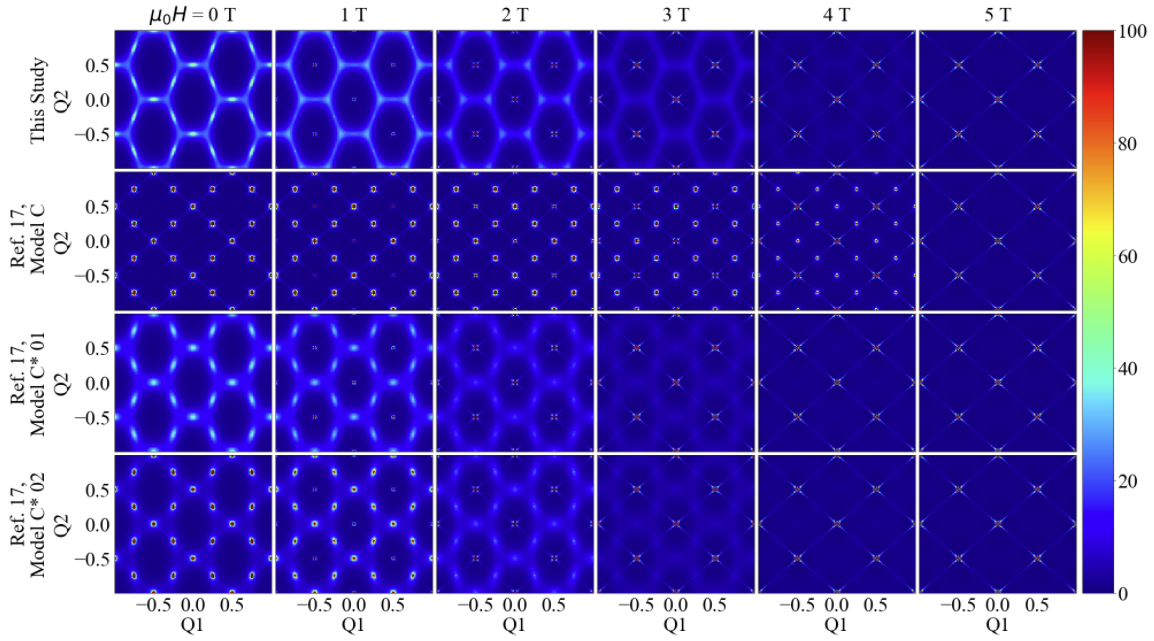 Figure 5
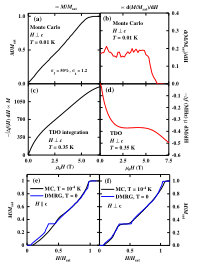 Figure 2
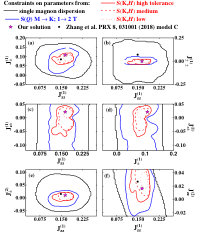 Figure 3
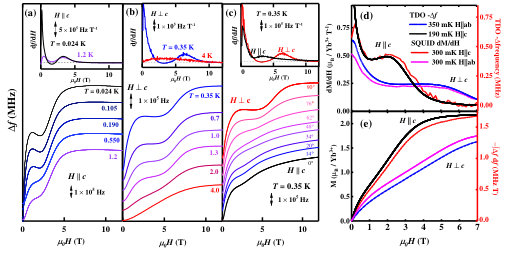 Figure 4
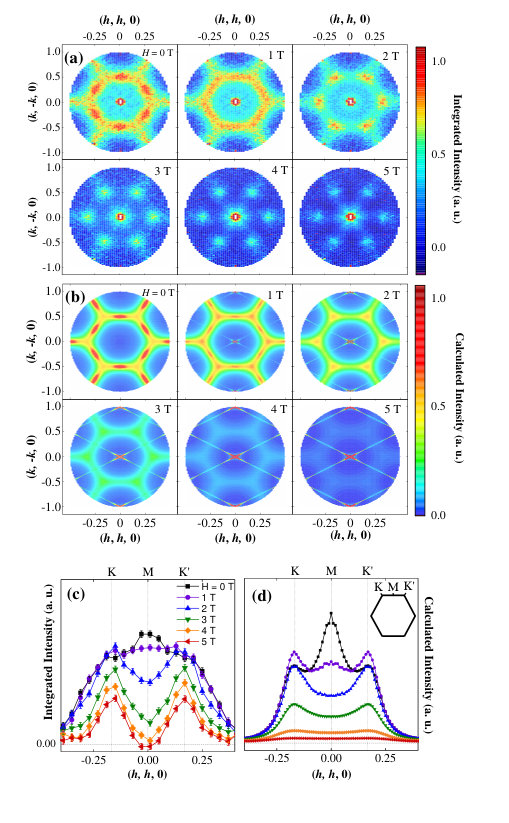 Figure 5
Peer Reviews
No public reviews on file for this paper yet. If you reviewed it on a platform where reviews are public (OpenReview, ICLR, NeurIPS, ICML), you can paste yours below so the community can read it here.
Videos
No videos yet. Explain this paper in a talk, walkthrough, or lecture? Add one.