Superconducting correlations out of repulsive interactions on a fractional quantum Hall edge
Jukka I. V\"ayrynen, Moshe Goldstein, Yuval Gefen

TL;DR
This paper demonstrates that in a fractional quantum Hall bilayer system, strong repulsive interactions can induce superconducting correlations at the edge, potentially enabling exotic anyonic excitations for topological quantum computing.
Contribution
It reveals how repulsive interactions and random tunneling can lead to superconducting correlations at quantum Hall edges, a novel mechanism for engineering topological states.
Findings
Repulsive interactions can induce superconducting correlations at the edge.
A stable fixed point with attractive interactions emerges from repulsive layers.
Observable effects include quasi-long range superconducting order on the edge.
Abstract
We consider a fractional quantum Hall bilayer system with an interface between quantum Hall states of filling fractions and , motivated by a recent approach to engineering artificial edges~\cite{2018NatPh..14..411R}. We show that random tunneling and strong repulsive interactions within one of the layers will drive the system to a stable fixed point with two counterpropagating charge modes which have attractive interactions. As a result, slowly decaying correlations on the edge become predominantly superconducting. We discuss the resulting observable effects, and derive general requirements for electron attraction in Abelian quantum Hall states. The broader interest in fractional quantum Hall edge with quasi-long range superconducting order lies in the prospects of hosting exotic anyonic boundary excitations, that may serve as a…
Click any figure to enlarge with its caption.
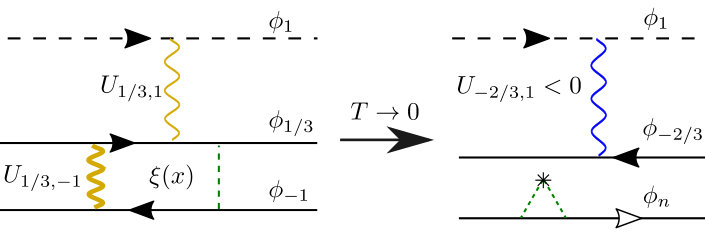 Figure 1
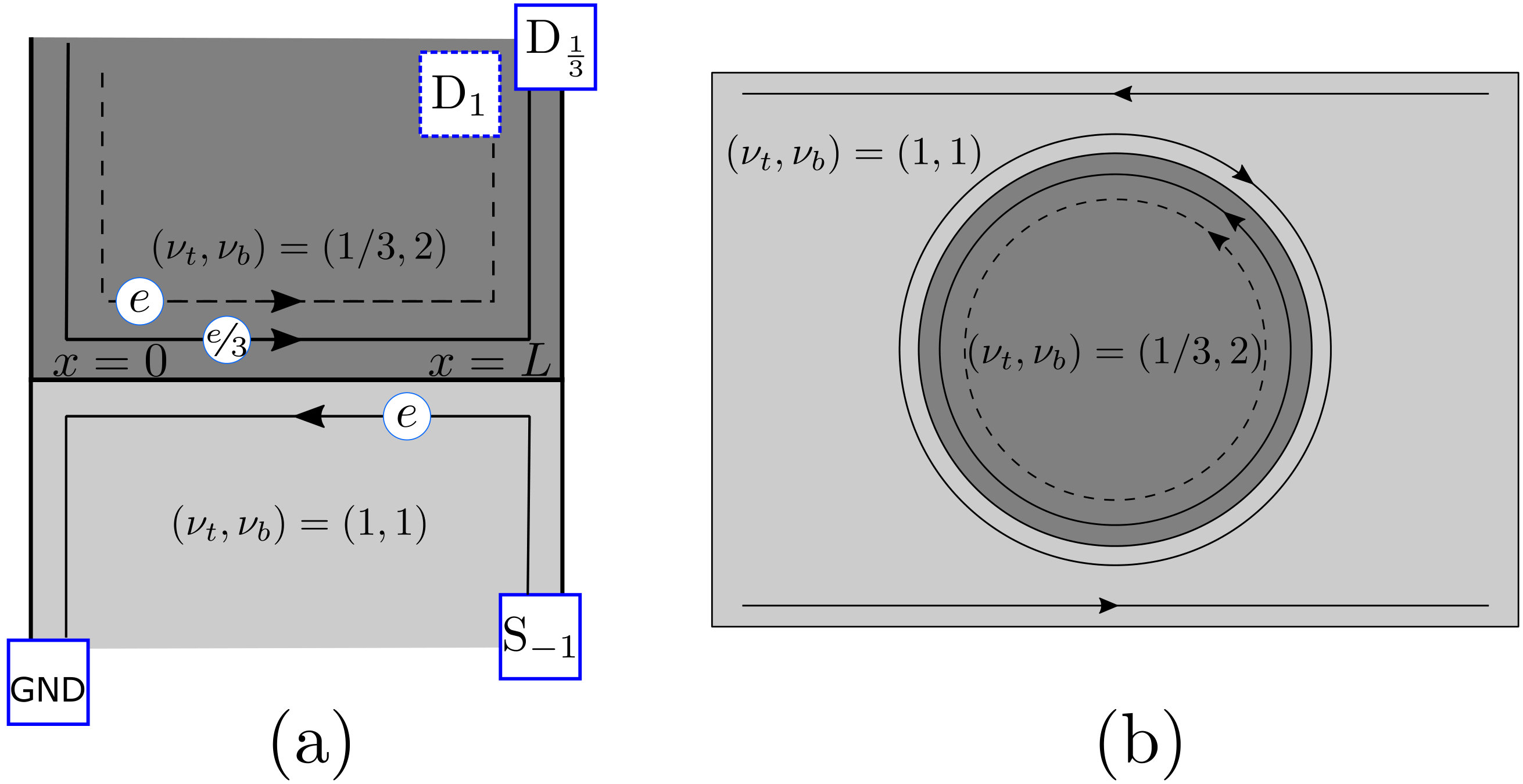 Figure 2
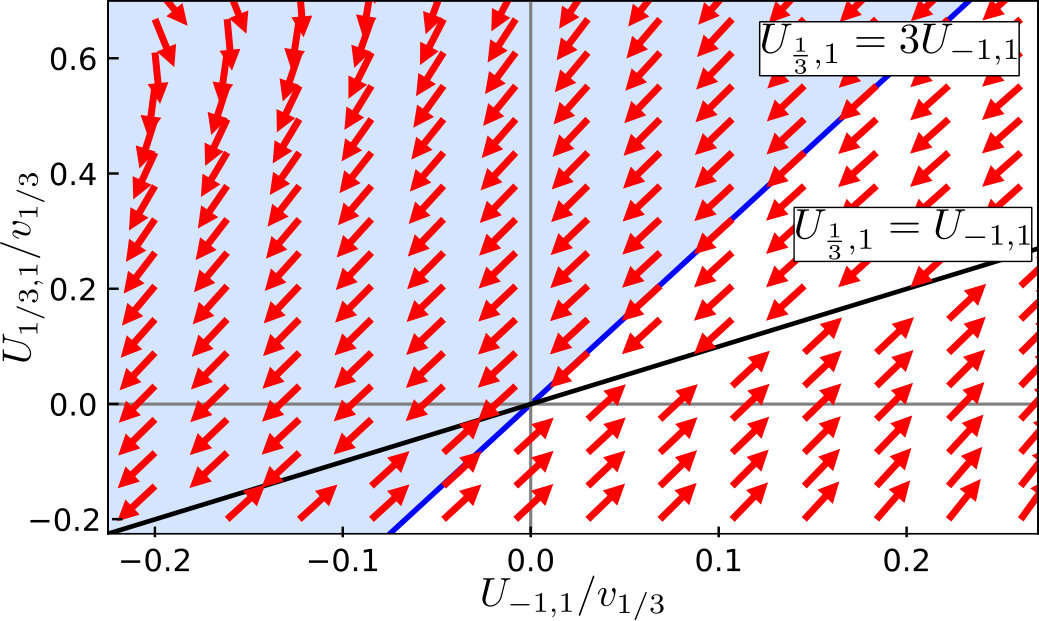 Figure 3
Peer Reviews
No public reviews on file for this paper yet. If you reviewed it on a platform where reviews are public (OpenReview, ICLR, NeurIPS, ICML), you can paste yours below so the community can read it here.
Videos
No videos yet. Explain this paper in a talk, walkthrough, or lecture? Add one.
Superconducting correlations out of repulsive interactions on a fractional
quantum Hall edge
Jukka I. Väyrynen
Microsoft Quantum, Microsoft Station Q, University of California, Santa Barbara, California 93106-6105 USA
Moshe Goldstein
Raymond and Beverly Sackler School of Physics and Astronomy, Tel Aviv University, Tel Aviv 6997801, Israel
Yuval Gefen
Department of Condensed Matter Physics, Weizmann Institute of Science, Rehovot 76100, Israel
(March 16, 2024)
Abstract
We consider a fractional quantum Hall bilayer system with an interface between quantum Hall states of filling fractions and , motivated by a recent approach to engineering artificial edges Ronen et al. (2018). We show that random tunneling and strong repulsive interactions within one of the layers will drive the system to a stable fixed point with two counterpropagating charge modes which have attractive interactions. As a result, slowly decaying correlations on the edge become predominantly superconducting. We discuss the resulting observable effects, and derive general requirements for electron attraction in Abelian quantum Hall states. The broader interest in fractional quantum Hall edge with quasi-long range superconducting order lies in the prospects of hosting exotic anyonic boundary excitations, that may serve as a platform for topological quantum computation.
**Introduction. **Combining superconductivity and fractional quantum Hall edge states opens the possibility to engineer exotic topological phases of matter with anyonic boundary excitations (Lindner et al., 2012; Clarke et al., 2013; Cheng, 2012; Vaezi, 2013; Mong et al., 2014; Hu and Kane, 2018; Alicea and Fendley, 2016). A possible route to this is by using the proximity effect with a bulk superconductor and a quantum well in a hybrid structure (Amet et al., 2016; Lee et al., 2017; Ben Shalom et al., 2016). Another, less studied possibility is that of intrinsic superconductivity on the edge. Evidently, on a one-dimensional edge there is no true long-range order and correlation functions decay algebraically. One can nevertheless refer to a superconducting phase as the one where the slowest decaying correlation function is of superconducting nature, i.e., a pairing correlator (Sólyom, 1979). Such power-law (or quasi-long-range) superconducting order may still be relevant for topological quantum computing applications (Nayak et al., 2008), c.f. (Fidkowski et al., 2011) in the context of Majorana bound states. **
In a recent experimental work Ronen et al. (2018) it has been demonstrated that in an engineered bilayer system it is possible to structure and control co- and counterpropagating edge modes in both the integer and fractional quantum Hall regimes. The present work takes advantage of this new paradigm and shows that one can design chiral modes with bare repulsive interaction in the presence of disorder to induce attractive interaction between the resulting effective modes. This gives rise to a phase with algebraically-decaying superconducting order.
To describe our results qualitatively, let us recall the pioneering work (Kane et al., 1994) of Kane, Fisher, and Polchinski (KFP) for edge hosting counterpropagating and modes. Random tunneling and sufficiently strong interaction between the two modes can drive the system to a fixed point with decoupled neutral and charge modes. The charge of the latter, , is determined by the constituent bare modes and charge conservation. The fixed point is approached upon, for example, lowering the temperature, and can be understood as a renormalization of the interaction between the neutral and charge mode (the interaction is an irrelevant perturbation and renormalizes to zero). The novel aspect in our proposal is to consider an additional () charge mode interacting with the KFP modes, see Fig. 1. As in the conventional KFP theory, both charge modes decouple from the neutral mode upon decreasing temperature. However, now there is a set of KFP fixed points, parametrized by the interaction between the and charge modes. Our main finding is that this fixed-point interaction can be attractive, even when the bare interactions of the high-temperature limit are repulsive. We further substantiate this claim by studying the renormalization group flow in a fine-tuned strongly-interacting model where the and the neutral mode are already decoupled on the level of the bare Hamiltonian. We then move on to study the new fixed point. We find that the fixed point has superconducting correlations of the charge modes: their pairing correlation function decays slower than any charge density correlation function. Finally, we outline how our model can be realized in an engineered quantum Hall bilayer system and how one can detect the attractive interactions at the fixed point by using 3 experimental probes: multiterminal shot noise, tunneling spectroscopy, and ground state charge in a quantum dot geometry.
**Model. **** We consider a system with 3 relevant edge modes. We assume a right-moving mode and a pair of counterpropagating modes. In terms of a three-component chiral boson field \boldsymbol{\phi}=(\begin{array}[]{ccc}\phi_{1/3}&\phi_{-1}&\phi_{1}\end{array})^{T}, our model is described by the imaginary-time action
[TABLE]
where in the first line and the -matrix is
[TABLE]
We assume that the mode is physically far from the other two, so that . Finally, the second line of Eq. (1) describes disordered tunneling of electrons between the counterpropagating and modes; here the tunneling vector is and is a -correlated random coefficient, , with zero average. The random tunneling term is non-linear in the boson fields and leads to non-trivial renormalization of the -matrix.
**
Let us first ignore the interactions and consider the problem of two modes . This is exactly the model studied by KFP (Kane et al., 1994) in the context of the edge of the quantum Hall state. The amplitude of random tunneling obeys the renormalization group (RG) equation (Giamarchi and Schulz, 1988) . Here the scaling dimension is where ; the perturbation is relevant, , when . Thus, for sufficiently large positive (repulsive interaction) , the random tunneling operator is a relevant perturbation and its amplitude grows upon lowering the temperature. This tunneling operator is the only relevant one as long as we ignore tunneling to the mode . The latter mode can be ignored due to its larger separation Ronen et al. (2018), see also Discussion below. Next, we study how the increasing under RG transformation affects the elements of the -matrix.
**Neutral mode basis and perturbative RG. ****Following Ref. (Kane et al., 1994), it is convenient to work in the basis where the random tunneling is diagonal. This is the basis of a right-moving neutral mode and a left-moving charge mode,
[TABLE]
The random tunneling, which conserves charge, only couples to : in this “neutral mode basis” \boldsymbol{\phi}=(\begin{array}[]{ccc}\phi_{n}&\phi_{-2/3}&\phi_{1}\end{array})_{(n)}^{T} and the tunneling vector becomes . Also, and
[TABLE]
where the matrix elements are simple linear combinations of the elements from Eq. (2). In particular, the interaction between the charge modes is . We see that the interaction is attractive, , when . This can happen when the mode is the nearest one to , as in Fig. 1. As we show below, the attractive interaction between two charge modes makes the superconducting pair correlations between them the slowest decaying correlation function in the system, which we call superconducting state in 1D.
Evidently, in the bare non-renormalized -matrix the seemingly attractive interaction is just a result of a basis change from a system with purely repulsive interactions. The off-diagonal elements that couple the neutral mode to the two charge modes ensure that there are no superconducting correlations. However, we will show next that under renormalization, the elements will flow to zero due to disorder in the neutral mode, while remains approximately constant. In the original basis this corresponds to flowing to negative values, i.e., attraction, see Fig. 2.
**
The weak-disorder RG flow of was studied by Moore & Wen (Moore and Wen, 2002), who found that a relevant disorder operator drives the -matrix towards a fixed point which is diagonal in the neutral sector. Therefore, and are both irrelevant and flow to weak coupling 111The modes and are mutually chiral and therefore a stable fixed point requires (Moore and Wen, 2002).. Furthermore, the disorder operator commutes with , so we expect to be marginal, with weak renormalization stemming from its non-commutation with (). We confirm this intuition by finding the flow equations 222See Supplementary Material, where we present the full RG equations at , discuss in more detail the signatures of attraction, and outline the geometrical requirements to find attraction from repulsion in a bilayer system. in the limit of weak disorder and weak couplings in the KFP fine-tuned (yet generic in terms of the resulting physics) point [corresponding to ]. Numerical solution of the RG equations produces the flow diagram shown in Fig. 2, presented in terms of the original couplings .
**Strong-disorder fixed point. ****Perturbative treatment of random tunneling is only valid at high energies. To describe the non-perturbative low energy regime we follow KFP and postulate a strong-disorder fixed point -matrix,
[TABLE]
At the fixed point we have a decoupled right-moving neutral mode , a right-moving charge mode , and a left-moving charge mode . The latter two are coupled via an interaction that is attractive, , as long as the bare interactions satisfy . The set of fixed point -matrices (5) can also be obtained even without random tunneling by fine-tuning the bare interactions in Eq. (2) in such a way that the neutral mode decouples. Such a fine-tuning yields , assuming repulsive bare interactions. Thus, renormalization by random tunneling is essential for obtaining an attraction out of repulsion.
The charge sector action can be diagonalized by a hyperbolic rotation
[TABLE]
**Using Eq. (6), one finds that the scaling dimension of a generic vertex operator is
[TABLE]
The attractive in Eq. (5) makes the pairing correlation function the slowest decaying one. The superconducting pairing correlation function in the original basis is [this operator creates two counterpropagating electrons in the modes]. Its dimension is calculated by first expressing in terms of and : , and then using Eq. (7). We find the scaling dimension 333The pairing (charge 2) operator has the same scaling dimension as while other pairing operators are less relevant Goldstein and Gefen (2016). The existence of these equally relevant pairing operators does not change the observable effects outlined below. . For we have , so the pairing correlator decays slower than the neutral mode correlator . Likewise, the diagonal density operator has irrespective of and so the density perturbation decays faster than pairing. Finally, we consider the off-diagonal density operator (Miranda, 2003) . We find . Since for [Eq. (6)], we always have . Thus, superconducting pair correlations are the slowest decaying ones in the strong coupling fixed point. Next, we discuss the measurable effects of this attraction.
Consequences of attraction. **The relatively long-ranged pairing correlations are a direct consequence of the attractive interaction in Eq. (5). Thus, one way to probe our proposed fixed point is to measure or its sign. Since the fixed point action is that of a non-chiral spinless Luttinger liquid, one is faced with the known task of measurement of the Luttinger liquid parameter. Next, we outline three possible ways to do this. We focus on the experimentally relevant bilayer quantum Hall system, see Fig. 3.
Signature of attraction in shot noise. It is well-known that the interaction parameter in a non-chiral Luttinger liquid can be measured with a.c. shot noise (Trauzettel et al., 2004; Berg et al., 2009; Kühne et al., 2015). The attractive interactions in our setup can be measured in a similar experiment, see Fig. 3a. Employing the theory of inhomogeneous Luttinger liquid (Safi and Schulz, 1995), we solve Note (2) the problem of a bare incoming mode scattered off an interacting region at the superconducting fixed point. In particular, the charge reflected into the mode (drain in the bottom layer) is fractional with a non-universal magnitude. Its sign however is given directly by . Thus, a smoking gun signature of the emergence of the attraction would be negative current measured at (“Andreev reflection” at the edge) 444Compare with the emergence of negative currents in Ref. (Protopopov et al., 2017).. The reflected charge can be measured in a time-domain experiment and requires access to frequencies where and is the length of the scattering region.
Signature of attraction in tunneling conductance. One can also measure from tunneling conductance (Wen, 2004; Altimiras et al., 2012; Baer et al., 2014; Sabo et al., 2017; Park et al., 2019; Goldstein and Gefen, 2016) in the interacting region, for example by using a point-contact to an auxiliary edge. For describing the tunneling Hamiltonian, consider the vertex operator that creates an excitation of total charge on the edge; here . The contribution to the tunneling current from the above operator exhibits a power-law bias voltage dependence (Wen, 2004), 555The result is valid at low temperatures . At higher temperatures the current exhibits a power-law in temperature, . where the exponent is determined by the scaling dimension [obtained from Eq. (7) after transforming the vertex operator into the neutral mode basis by using Eq. (3)] and the number of electrons removed from the auxiliary edge. The total tunneling current is a sum of elementary tunneling processes, but will be dominated at small voltages by those with a low value of . For moderate interaction strengths [Eq. (6)] the dominant contributions are the 1-electron tunneling operators and , as well as the 2-electron tunneling operator . Their respective tunneling amplitudes , , and , are in principle controllable by gating, so that different 1-electron contributions can be turned on and off. The signature of attractive interactions () is that , meaning that when tunneling to both edges is present, the current is less suppressed by a small bias than one would expect from uncorrelated tunnelings to each edge separately.
Signature of attraction in a mesoscopic droplet. Finally, one can perform a fully thermodynamic measurement in a Coulomb blockaded quantum Hall droplet, see Fig. 3b. This is akin to ideas of “attraction from repulsion” that have been implemented in other systems (Hamo et al., 2016), compare also proposals to probe neutral modes in the context of quantum Hall edges (Kamenev and Gefen, 2015). The signature of attraction in the Coulomb blockaded droplet is -periodic charge transitions as a gate charge is varied Note (2). This signature can be measured in a thermodynamic capacitive measurement of the charge or in a transport measurement of the Coulomb peak spacings.
Discussion. Our proposal relies on the tunneling between the modes and being the most RG relevant perturbation. Typically, the tunneling between the modes is also relevant and leads to a trivial localization of the modes. This effect should however be present only at very low temperatures since we expect the bare amplitude of the tunneling to be very weak due to the large separation of the modes. The tunneling can also be entirely avoided by considering a setup with spin-polarized Landau levels where and have opposite spins and the tunneling between them is forbidden by spin conservation. This can be achieved with an interface between and , assuming the state consists of opposite-polarized states. This state also satisfies the requirement that holds on both sides (Ronen et al., 2018).
In our model we assumed that is the largest interaction while the other two were treated perturbatively, which ensures that is relevant and KFP fixed point is reached. Thus, we rely on the double-inequality to approach the fixed point with attractive interactions. We find that Coulomb interaction screened by a nearby gate electrode (Raikh et al., 1996),Note (2) allows both inequalities to be satisfied.
One may ask how essential the bilayer construction is to manifest our theory. For example, edge reconstruction in a Laughlin state can give rise to a stripe in the bulk-vacuum interface. Disordered tunneling between the two inner modes gives rise to counterpropagating neutral and a charge modes. The propagation directions of these modes are determined by comparing the two filling fractions. If , the charge mode is co-propagating with the outermost mode. Therefore, there are no emerging superconducting correlations even if there is attraction between the two charge modes. (Interactions between co-propagating modes do not affect the scaling dimensions of the operators involved, since the -matrix can be diagonalized with an orthogonal transformation (Wen, 2004).) In the more interesting scenario , the charge modes are counterpropagating and superconducting correlations may in principle emerge. In this case the the interaction is attractive when . However, for an interaction falling monotonically with distance, we expect because the outermost mode is closer to rather than the bulk mode . This is why we do not expect to find superconducting correlations in such a simple model of edge reconstruction. This problem is circumvented in the bilayer setup, see Fig. 1. Here the two-dimensional electron gas (2DEG) is replaced by a bilayer of 2DEGs whose individual filling fractions can be tuned. The resulting boundary consists of chiral mode structure which can be controlled on-demand by tuning back gate voltages and the magnetic field. Finally, we note that our proposal also works for an interface between and , assuming that the edge consists of counterpropagating and modes (MacDonald, 1990; Wen, 1990).
Acknowledgements.
We thank M. Heiblum, R. Lutchyn, and D. Pikulin for discussions. J.I.V. thanks the Aspen Center for Physics which is supported by National Science Foundation grant PHY-1607611. M.G. was supported by the Israel Science Foundation (Grant No. 227/15), the German Israeli Foundation (Grant No. I-1259-303.10), the US-Israel Binational Science Foundation (Grant No. 2016224), and the Israel Ministry of Science and Technology (Contract No. 3-12419). Y.G. was supported by DFG RO 2247/11-1 and CRC 183 (project C01), and the Italia-Israel project QUANTRA.
Supplementary Material to “Superconducting correlations out of repulsive
interactions on a fractional quantum Hall edge”
In this Supplementary Material, we present the full RG equations at the fine-tuned point , discuss in more detail the signatures of attraction in the shot noise and Coulomb blockaded droplet, and finally outline the geometrical requirements to find attraction from repulsion in a bilayer system.
.1 Renormalization group flow of the -matrix
In this section we study the fine-tuned KFP fixed point which corresponds to a bare interaction which means . This fine-tuned point is easy to study because the neutral mode is automatically decoupled from , since in Eq. (4) of the main text we have :
[TABLE]
For completeness, the non-zero interactions in the original basis are and . Treating the interactions , perturbatively, we can diagonalize with a transformation that preserves :
[TABLE]
where , . The tunneling vector transforms to .
Next, we follow Ref. (Moore and Wen, 2002) to find how flows upon renormalization. To first order in , , the flow is entirely due to which couples to disordered neutral mode. The RG equation is
[TABLE]
where
[TABLE]
This corresponds to
[TABLE]
Ignoring the term in Eq. (8), the action corresponds to a neutral mode coupled to a co-moving charge mode. This system has a stable fixed point (Moore and Wen, 2002) when .
To find beyond tree-level accuracy, we can diagonalize working to 2nd order accuracy. The tunneling vector is
[TABLE]
which shows that starts at order . One therefore has to go to 3rd order to capture this accurately. Such a calculation gives
[TABLE]
Thus is irrelevant but very marginally so: only to second order in . The 3rd order corrections to Eq. (12) modify its RHS by an overall factor . This correction is inconsequential at small interaction strengths. Solving Eqs. (12) [including the aforementioned correction] and (14) numerically and expressing them in the original basis leads to Fig. 2 of the main text.
.2 Signature of attraction in shot noise
We focus on a geometry where the modes are uncoupled at . In the scattering region the modes couple as described by the bare action (1), see Fig. 3a. We assume that the fixed point of a decoupled neutral mode is reached throughout the entire scattering region. Let us consider an incoming mode from , which gets reflected at into modes upon encountering the scattering region. For , the eigenmodes of the system are . They are described by an action []
[TABLE]
For , we have first the action of decoupled neutral mode and coupled charge modes,
[TABLE]
where and . Here, we can diagonalize the charge sector by
[TABLE]
to get the diagonal action,
[TABLE]
The eigenbases at and are related by
[TABLE]
Let us next consider the following scattering problem. We suppose that there is an incoming wavepacket in the mode coming from , and that it will enter the coupled region at . The reflected waves will be and in the region . Here and are unknown. This means that there will be charges and reflected into the respective drains. For we have wave solutions for [ for and for the other two modes]. Assuming there is no incoming wave from the left, we have that for all , . From this it follows that identically. Likewise, for . Finally, continuity of the waves at gives the relation
[TABLE]
or
[TABLE]
From the last equation we find for . Note that . Thus, the function is determined fully to be . This is the transmitted wave. The remaining two equations yield and reflection coefficients
[TABLE]
where and we introduced the “Luttinger liquid parameter” . The charges reflected into the drains and are respectively and . When [repulsive interaction], we have and correspondingly . On the other hand, when [attraction], we have and . Therefore, the crucial signature of attraction is the sign of . It can be measured by measuring the current in the edge in time-domain.
.3 Signature of attraction in a mesoscopic droplet
In a periodic finite system of length , we have the mode expansion []
[TABLE]
where and commute with . Using the mode expansion, we find for the charge sector of the fixed point action [obtained from Eq. (5) of the main text, see also Eq. (16)]
[TABLE]
where
[TABLE]
For the neutral sector we have [Eq. (5) of the main text, Eq. (16)]
[TABLE]
where and .
The “charging” Hamiltonian obtained from above is
[TABLE]
The stability of requires that . This ensures that is positive,
[TABLE]
In reality, the charging Hamiltonian is dominated by the total charging energy, which arises from the long-range Coulomb interaction. The total charge is given by , and the charging energy is then
[TABLE]
where is the controllable induced gate charge. Let us see how the attractive interaction affects the -dependence of the ground state charge. Note that is integer while The total energy is
[TABLE]
We include the terms to ensure bounded spectrum. In our model is the system length. However, our bosonization does not treat accurately the long-range Coulomb interaction so we cannot obtain quantitative estimates. The qualitative findings outlined below should however remain true.
For simplicity, let us focus on the four states . Relative to the state, the other have energies
[TABLE]
We have when
[TABLE]
For this value of , the other two energies are
[TABLE]
which are positive when
[TABLE]
Under this condition we have a direct transition from ground state to ground state as is tuned. We have an earlier condition from stability. This imposes the constraint
[TABLE]
This is a condition on . For example, when , the signature transition exists when .
.4 Geometric requirements for the bilayer in the case of long-range
Coulomb repulsion
In the main text we found the requirement in order to get attraction, , between the charge modes at the disordered fixed point. In order to ensure that we flow to the disordered fixed point, we further require . In this Section, we consider Coulomb interaction and find the requirements for the bilayer geometry. (Note however that our bosonization description assumes short-range interactions; our estimates in this Section are therefore mostly qualitative.) We assume that the bilayers are separated by a distance , while in-plane the modes are at positions . Thus, we have the double inequality [recall that is separated by additional distance in the perpendicular direction]
[TABLE]
This inequality cannot be satisfied for simple Coulomb interaction . However, for a faster decaying interaction, , it can be satisfied (Raikh et al., 1996). (For example, when , we find .) The Coulomb interaction decays cubically when it is screened by an external gate. Let us consider a gate planar with the bilayer at a distance from the bottom quantum well. If we have a bottom gate [] and the mode lives in the bottom layer, we have for example . Supposing that we have then for example which decays cubically, as promised. The inequalities in this case become
[TABLE]
or
[TABLE]
The right inequality corresponds to the condition for attraction. The left one ensures that the disordered fixed point should be reachable. The RHS is less than one, . On the other hand, the LHS is always larger than one for a bottom gate, . For a top gate, , there is an upper bound .
The reference list from the paper itself. Each links out to its DOI / PubMed record.
- 1Ronen et al. (2018) Y. Ronen, Y. Cohen, D. Banitt, M. Heiblum, and V. Umansky, Nature Physics 14 , 411 (2018) , ar Xiv:1709.03976 [cond-mat.mes-hall] . · doi ↗
- 2Lindner et al. (2012) N. H. Lindner, E. Berg, G. Refael, and A. Stern, Phys. Rev. X 2 , 041002 (2012) . · doi ↗
- 3Clarke et al. (2013) D. J. Clarke, J. Alicea, and K. Shtengel, Nature Communications 4 , 1348 (2013) , ar Xiv:1204.5479 [cond-mat.str-el] . · doi ↗
- 4Cheng (2012) M. Cheng, Physical Review B 86 , 195126 (2012) , ar Xiv:1204.6084 [cond-mat.str-el] . · doi ↗
- 5Vaezi (2013) A. Vaezi, Physical Review B 87 , 035132 (2013) , ar Xiv:1204.6245 [cond-mat.str-el] . · doi ↗
- 6Mong et al. (2014) R. S. K. Mong, D. J. Clarke, J. Alicea, N. H. Lindner, P. Fendley, C. Nayak, Y. Oreg, A. Stern, E. Berg, K. Shtengel, and M. P. A. Fisher, Phys. Rev. X 4 , 011036 (2014) . · doi ↗
- 7Hu and Kane (2018) Y. Hu and C. L. Kane, Physical Review Letters 120 , 066801 (2018) , ar Xiv:1712.03238 [cond-mat.mes-hall] . · doi ↗
- 8Alicea and Fendley (2016) J. Alicea and P. Fendley, Annual Review of Condensed Matter Physics 7 , 119 (2016).