Photoinduced Floquet topological magnons in Kitaev magnets
S. A. Owerre, Paula Mellado, G. Baskaran

TL;DR
This paper demonstrates how off-resonant light can induce and control topological magnons and thermal Hall effects in Kitaev magnets, enabling ultrafast manipulation of their magnetic properties.
Contribution
It introduces a method to generate and tune Floquet topological magnons and chiral edge modes in Kitaev models using polarized light, revealing new pathways for ultrafast magnetic control.
Findings
Floquet topological magnons can be induced by off-resonant light.
The magnetic field and topological properties are tunable by light amplitude and polarization.
Thermal Hall effect is controllable via laser fields.
Abstract
We study periodically driven pure Kitaev model and ferromagnetic phase of the Kitaev-Heisenberg model on the honeycomb lattice by off-resonant linearly and circularly-polarized lights at zero magnetic field. Using a combination of linear spin wave and Floquet theories, we show that the effective time-independent Hamiltonians in the off-resonant regime map onto the corresponding anisotropic static spin model, plus a tunable photoinduced magnetic field along the direction, which precipitates Floquet topological magnons and chiral magnon edge modes. They are tunable by the light amplitude and polarization. Similarly, we show that the thermal Hall effect induced by the Berry curvature of the Floquet topological magnons can also be tuned by the laser field. Our results pave the way for ultrafast manipulation of topological magnons in irradiated Kitaev magnets, and could play a…
Click any figure to enlarge with its caption.
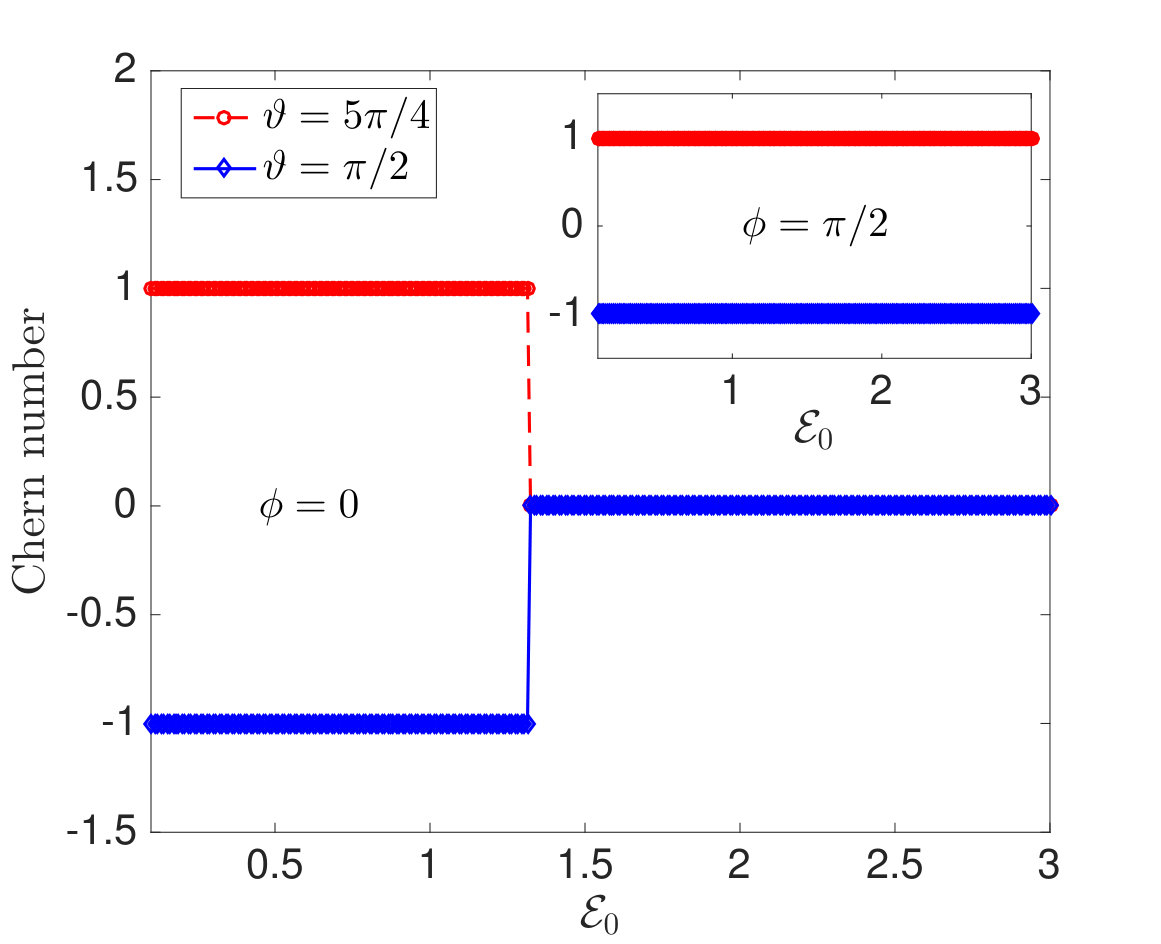 Figure 1
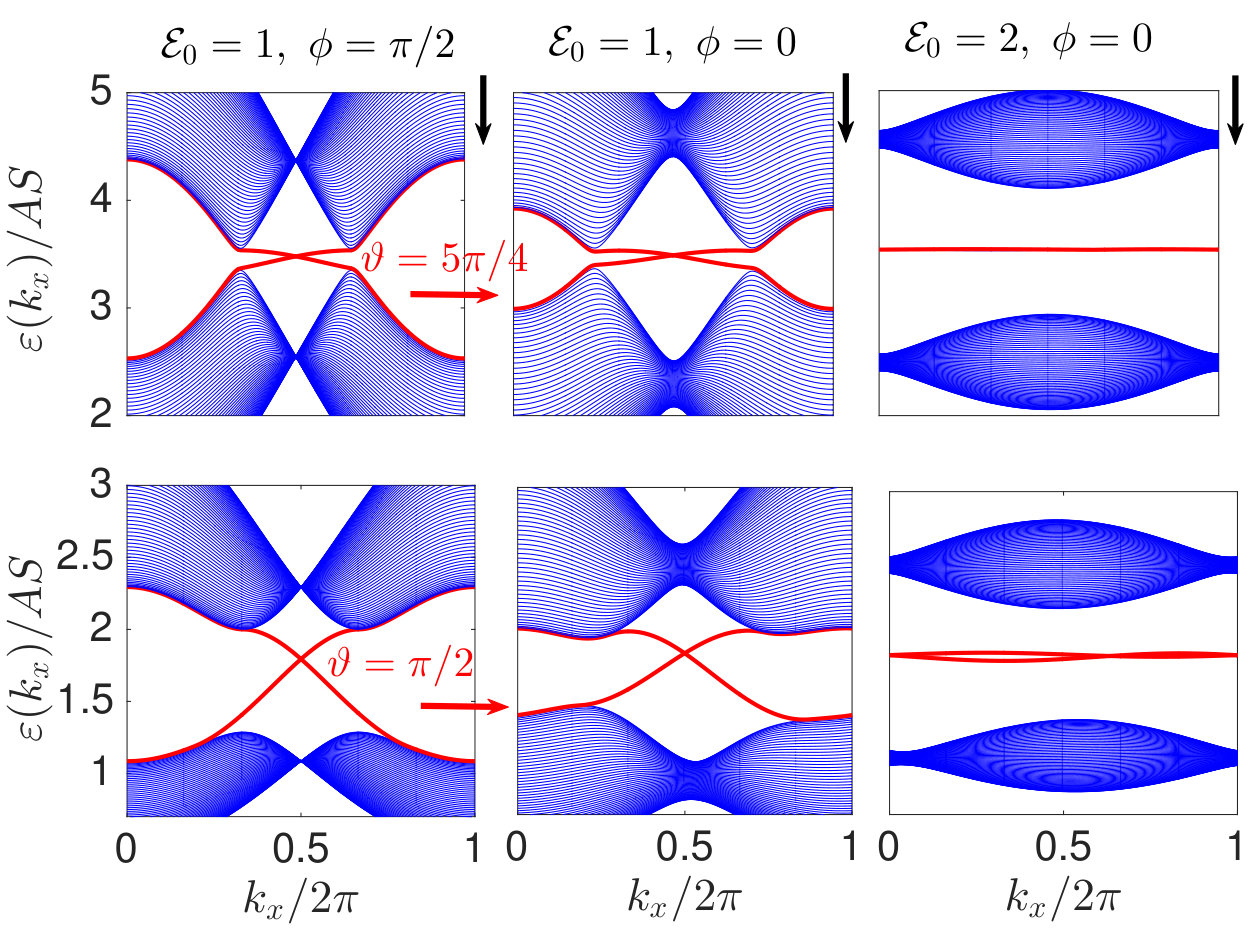 Figure 2
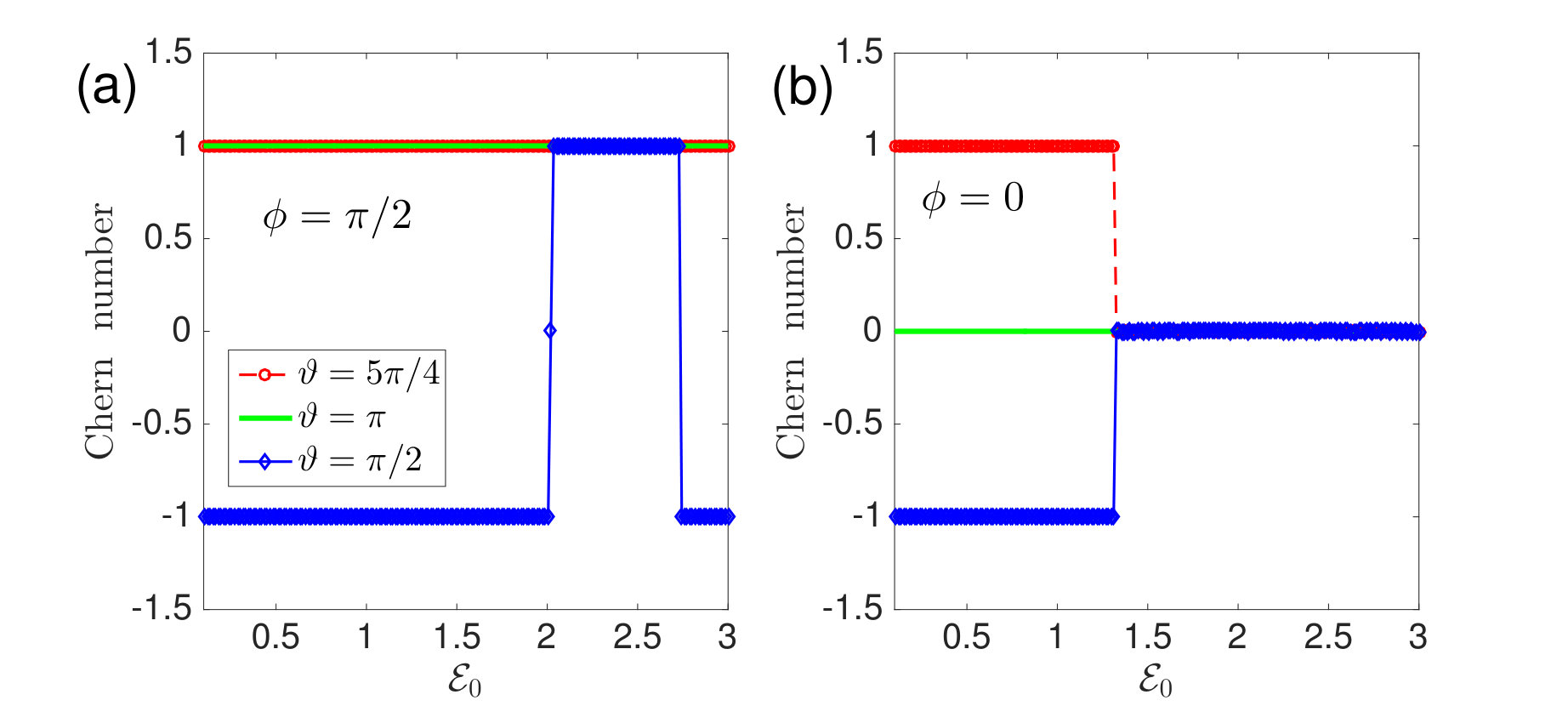 Figure 3
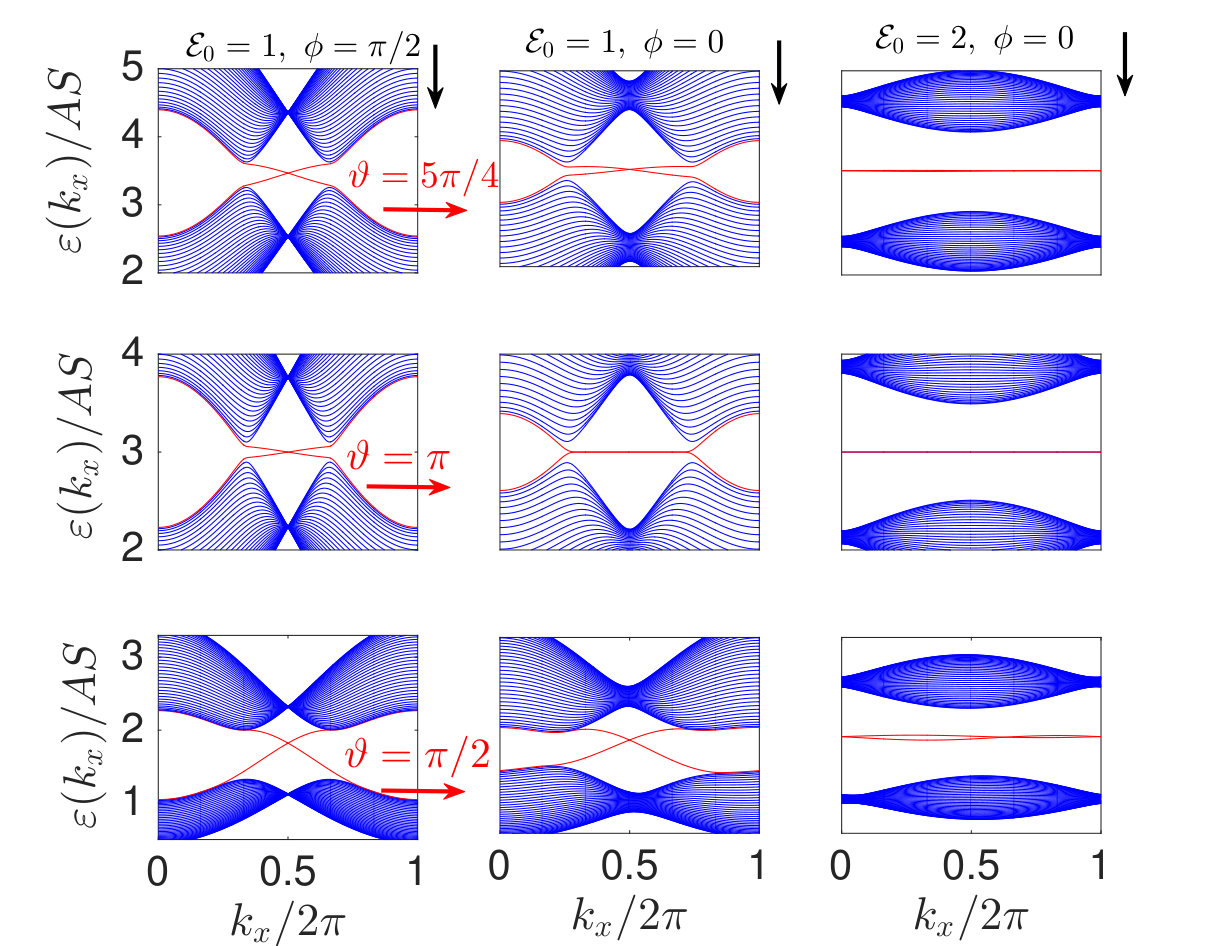 Figure 4
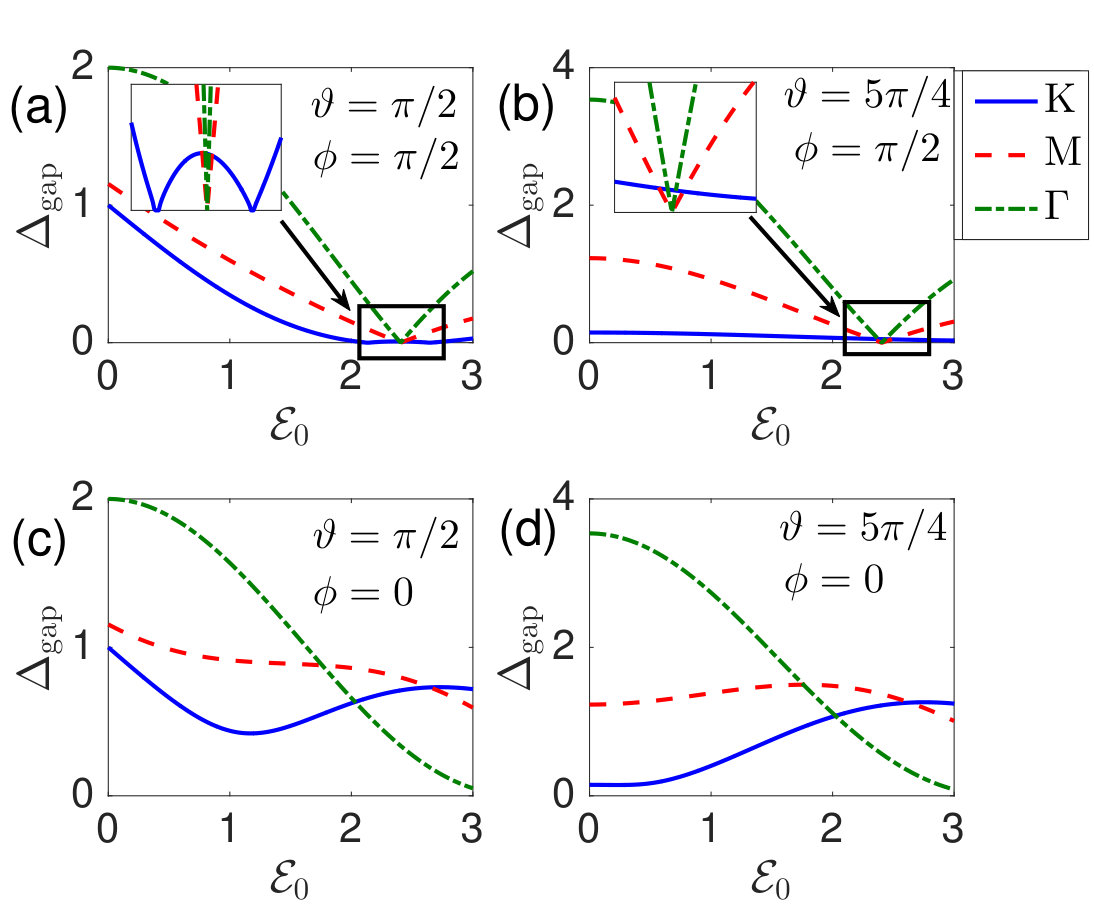 Figure 5
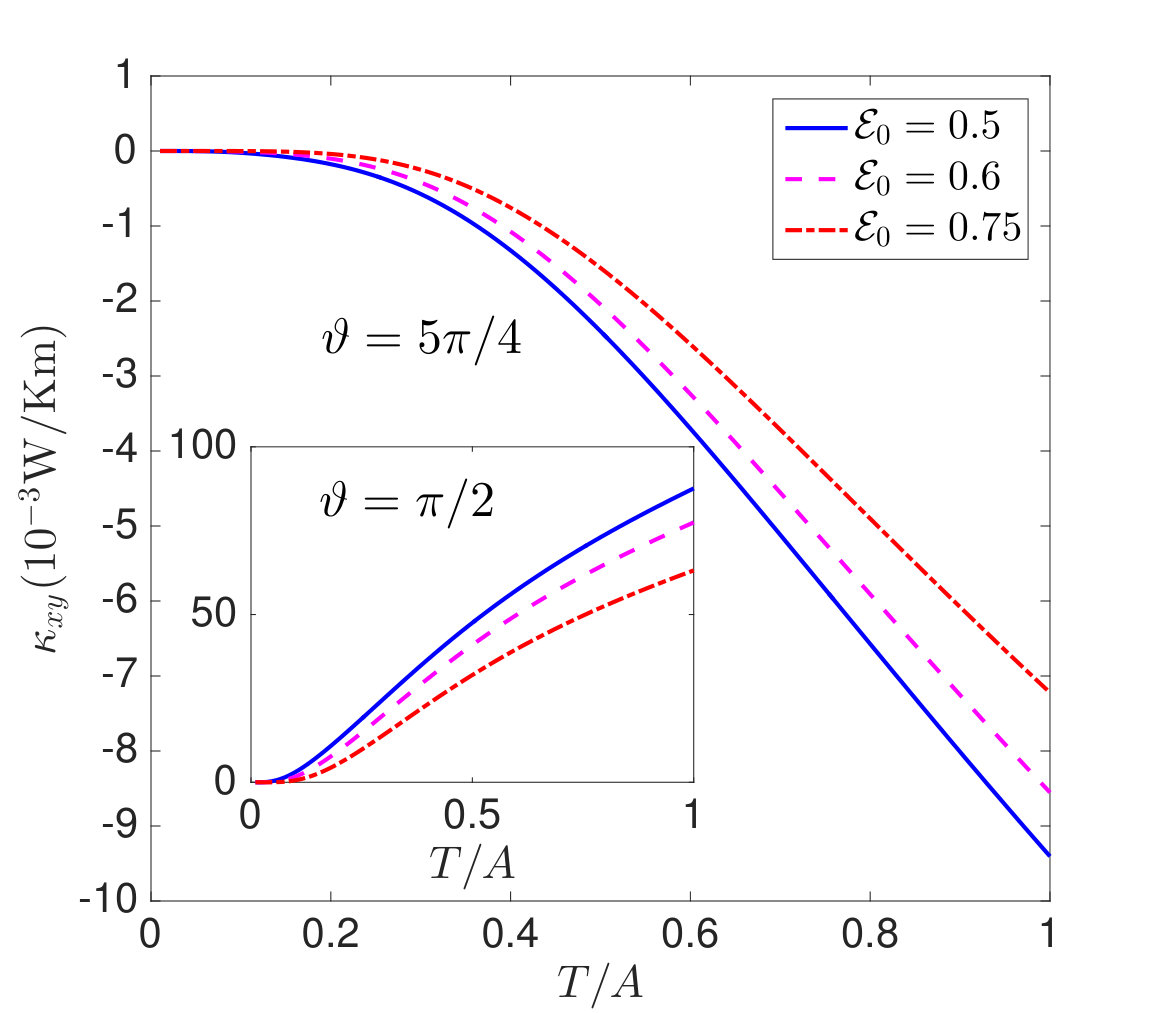 Figure 6
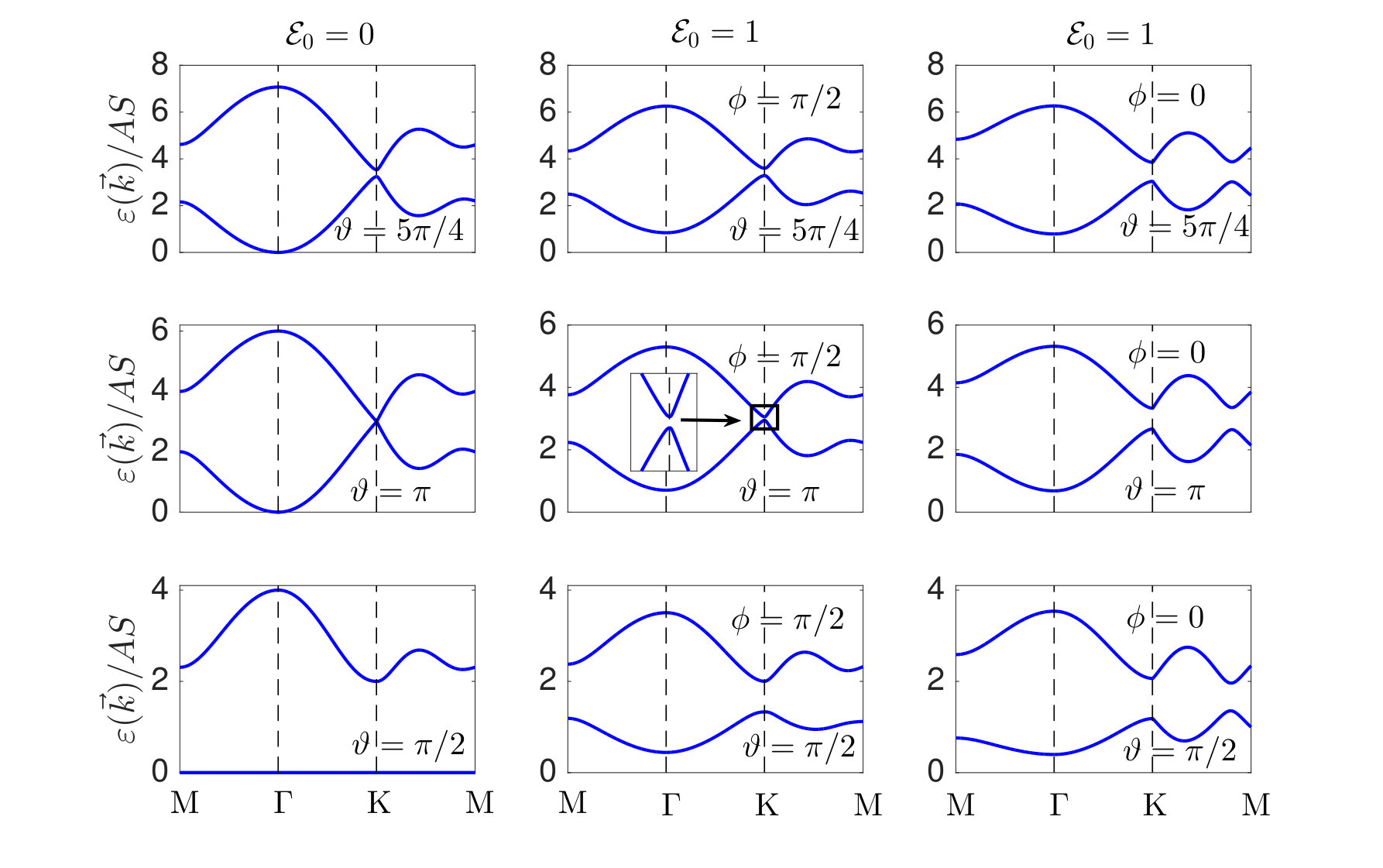 Figure 7
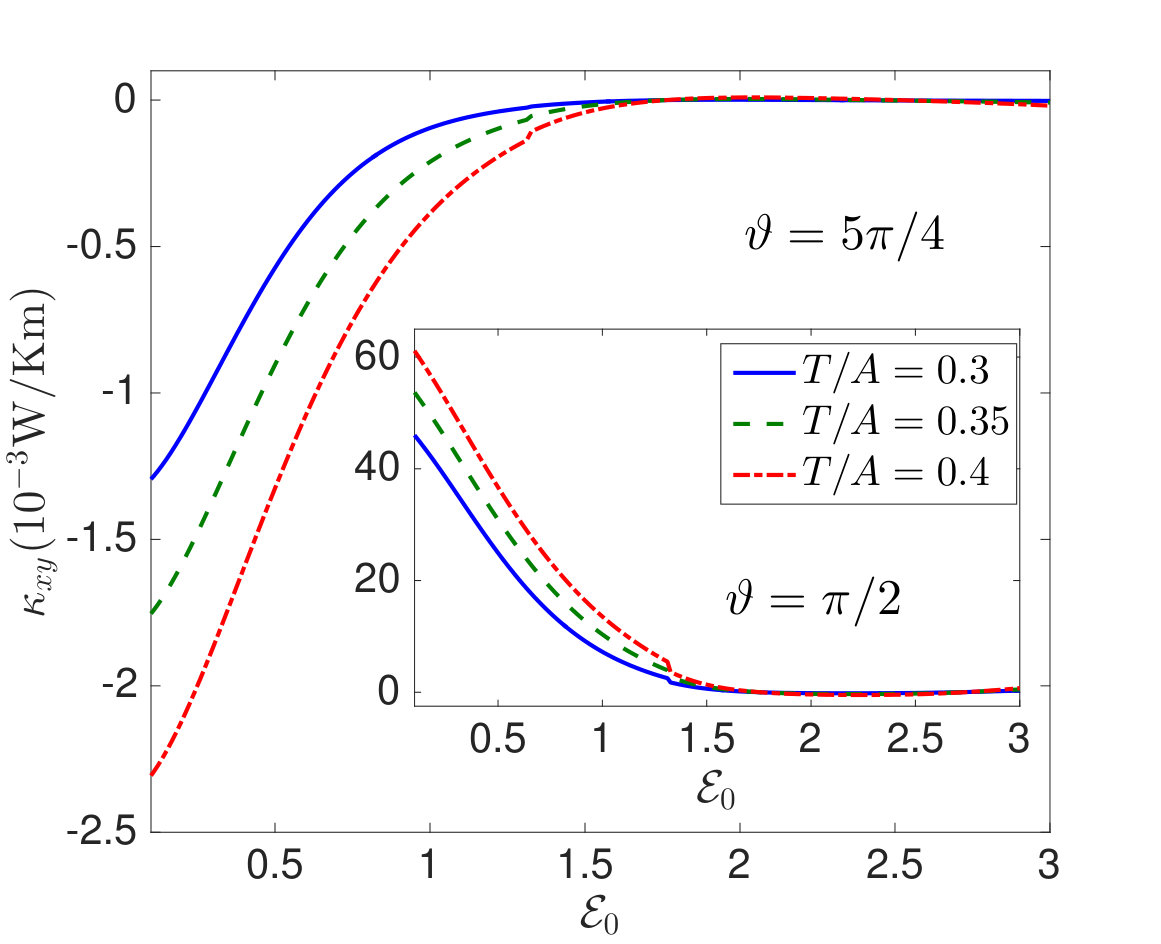 Figure 8
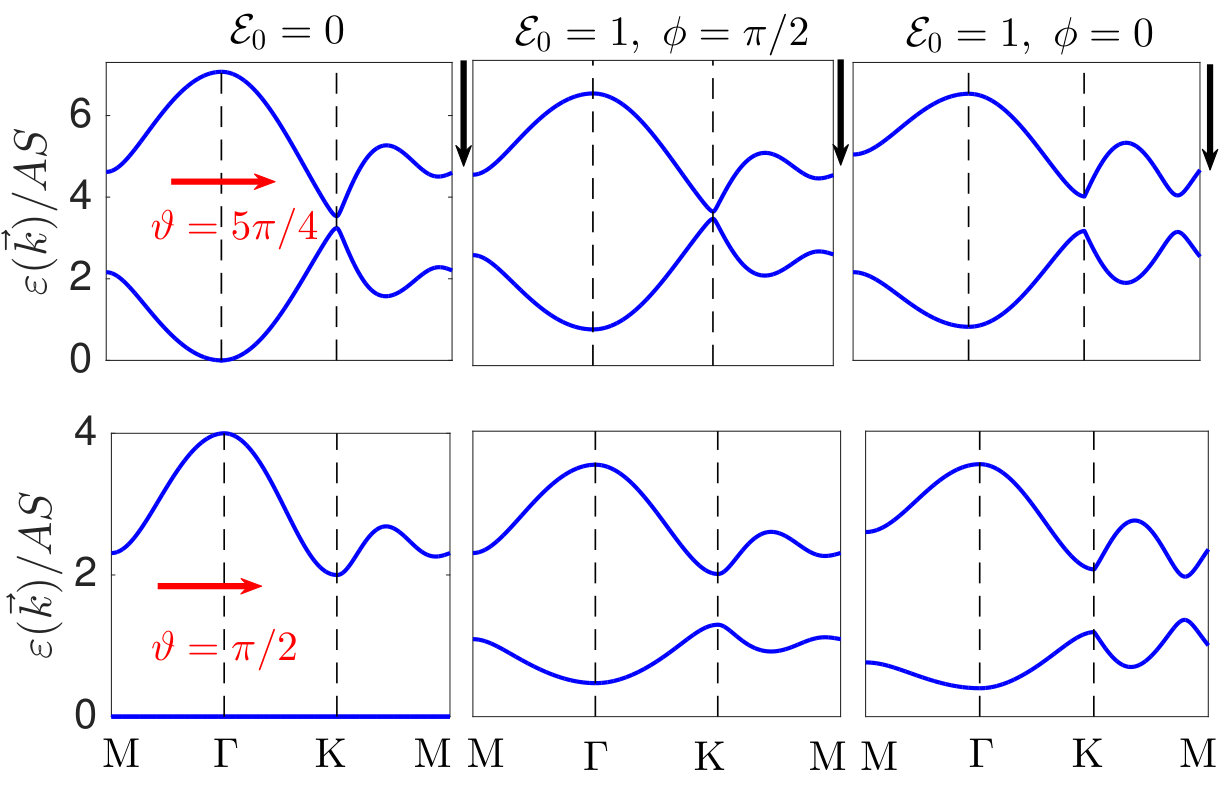 Figure 9
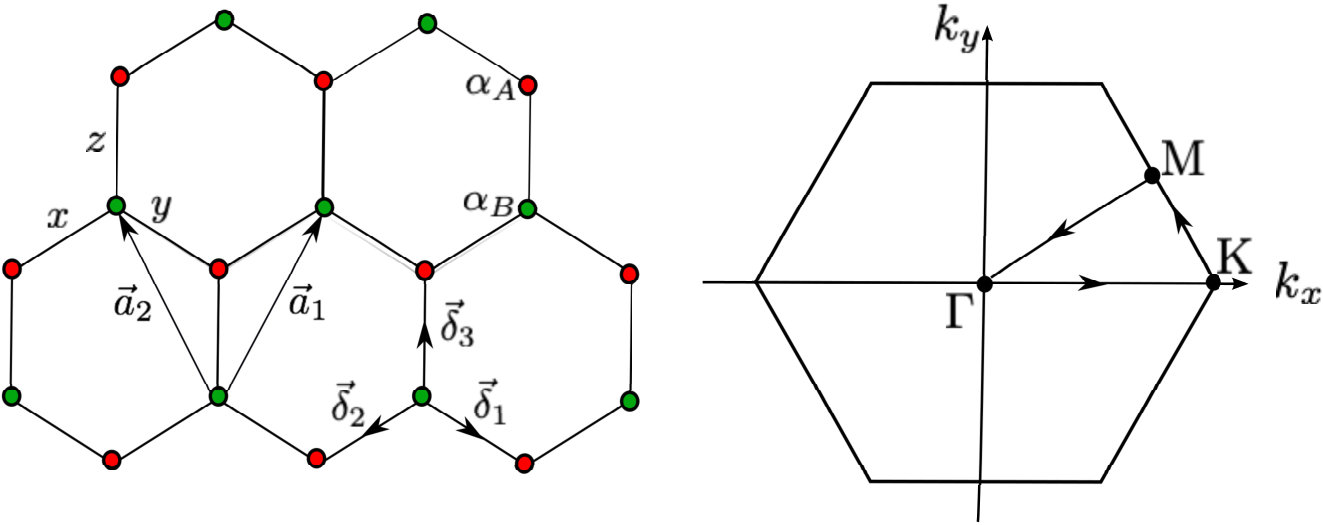 Figure 10
Peer Reviews
No public reviews on file for this paper yet. If you reviewed it on a platform where reviews are public (OpenReview, ICLR, NeurIPS, ICML), you can paste yours below so the community can read it here.
Videos
No videos yet. Explain this paper in a talk, walkthrough, or lecture? Add one.
Photoinduced Floquet topological magnons in Kitaev magnets
S. A. Owerre
Perimeter Institute for Theoretical Physics, 31 Caroline St. N., Waterloo, Ontario N2L 2Y5, Canada.
Paula Mellado
Perimeter Institute for Theoretical Physics, 31 Caroline St. N., Waterloo, Ontario N2L 2Y5, Canada.
School of Engineering and Sciences, Adolfo Ibáez University, Santiago 7941169, Chile
G. Baskaran
Perimeter Institute for Theoretical Physics, 31 Caroline St. N., Waterloo, Ontario N2L 2Y5, Canada.
The Institute of Mathematical Sciences, CIT Campus, Chennai 600 113, India
Abstract
We study periodically driven pure Kitaev model and ferromagnetic phase of the Kitaev-Heisenberg model on the honeycomb lattice by off-resonant linearly and circularly-polarized lights at zero magnetic field. Using a combination of linear spin wave and Floquet theories, we show that the effective time-independent Hamiltonians in the off-resonant regime map onto the corresponding anisotropic static spin model, plus a tunable photoinduced magnetic field along the direction, which precipitates Floquet topological magnons and chiral magnon edge modes. They are tunable by the light amplitude and polarization. Similarly, we show that the thermal Hall effect induced by the Berry curvature of the Floquet topological magnons can also be tuned by the laser field. Our results pave the way for ultrafast manipulation of topological magnons in irradiated Kitaev magnets, and could play a pivotal role in the investigation of ultrafast magnon spin current generation in Kitaev materials.
Introduction.– Topological band theory of solid-state materials has dominated many aspects of condensed-matter physics over the past decade top3 ; top4 . The original concept of topological band theory is rooted in insulating electronic systems possessing a nontrivial gap in their energy band structures. They are characterized by the appearance of gapless chiral edge electron modes traversing the bulk gap, which are topologically protected by the Chern number or the index of the bulk bands top3 ; top4 .
Generally, the concept of topological band structure is independent of the statistical nature of the quasiparticle excitations and therefore is not restricted to insulating electronic systems. Recently, there has been a tremendous interest in the topological properties of spin excitations in insulating quantum magnets. In fact, bosonic topological spin excitations (magnons and triplons) have been studied in many different insulating quantum magnets rshin ; Zhang ; th6 ; owerre ; chern ; romh ; rchi ; cr ; mcC ; Kitaeva ; Kitaevb ; flu , and the appearance of chiral edge modes and bulk Chern number have been demonstrated Zhang ; th6 ; owerre . Recently, bosonic topological spin excitations mimicking electronic topological insulators have been experimentally observed in kagome ferromagnet Cu(1,3-bdc) rchi , dimerized quantum magnet SrCu2(BO3)2 mcC , and honeycomb ferromagnet CrI3 cr .
The Mott-insulating honeycomb Kitaev magnets are currently of great interest Kitaev1 ; Kitaev2a ; Kitaev2 ; Kitaev3 ; Kitaev4 ; Kitaev4a ; Kitaev4b ; Kitaev5 ; kit1 ; kit2 ; kit3 ; kit4 ; kit5 ; kit6 ; kit7 ; kit8 ; kit9 ; kit10 ; zyou . Candidate Kitaev materials include Na2IrO3 and -RuCl3 Kitaev2 ; Kitaev3 ; Kitaev2a ; Kitaev4 ; Kitaev5 . Recently, topologically protected spin waves have been predicted in the fully-polarized phase of the pure Kitaev model Kitaeva and the Kitaev-Heisenberg model Kitaevb at high magnetic field. In the former, the topological magnons and chiral edge states present in linear spin-wave approximation survive magnon-magnon interactions and therefore are robust Kitaeva . Indeed, the manipulation of topological magnons and magnon spin currents is essential for their practical applications in ultrafast magnetic data storage, magnetic switching, and magnon spintronics magn .
The tremendous interest in topological quantum phases of matter has led to different alternative ways for inducing them in quantum materials. Recently, irradiated solid-state materials have provided an alternative route to extend the search for topological quantum materials in electronic systems pho1 ; pho2 ; pho3 ; pho4 ; pho5 ; pho5a ; pho6 . In this formalism, topologically trivial systems can be periodically driven to nontrivial topological systems termed Floquet topological insulators pho6 ; pho3 . They have an advantage over their static (equilibrium) topological counterpart, in that their intrinsic properties can be manipulated and different topological phases can be achieved. In irradiated insulating quantum magnets with charge-neutral spin excitations sowe ; kar ; ely ; claas , the Floquet physics can emerge from the coupling of the electron spin magnetic dipole moment to the laser electric field through the time-dependent version of the static Aharonov-Casher phase aha ; spin3 , which acts as a vector potential or gauge field to the spin current spin1a . In this case, the resulting Floquet physics can reshape the underlying Hamiltonian to stabilize magnetic phases and provides a promising avenue for inducing and tuning Floquet topological spin excitations sowe ; kar ; ely , with a direct implication of generating and manipulating ultrafast spin current using terahertz (THz) radiation ultra . Lately, THz electric field amplitude exceeding between () and has been reported sell . In this respect, resonant time-domain THz spectroscopy has been recently performed in the candidate Kitaev material -RuCl3 lwu .
In this paper, we propose a tunable mechanism to induce and manipulate topological magnons in irradiated Kitaev magnets at zero magnetic field. We study the pure Kitaev model kita and the ferromagnetic phase of the Kitaev-Heisenberg model, which are already present in the zero magnetic-field classical phase diagram of the Kitaev-Heisenberg model on the honeycomb lattice Kitaev2 . Using linear spin wave and Floquet theories, we show that when the models are periodically driven by off-resonant linearly- and circularly-polarized lights, they effectively map onto the corresponding static spin model plus a tunable photoinduced magnetic field along the direction, which is perpendicular to the honeycomb plane. The photoinduced magnetic field precipitates the existence of Floquet topological magnons and chiral edge modes, in a similar fashion to a homogeneous magnetic field in the undriven systems Kitaeva ; Kitaevb . However, the Floquet topological magnons can be tuned by the amplitude and polarization of the laser field. Likewise, we demonstrate that the resulting Floquet thermal Hall conductivity can be tuned by the laser field. The photoinduced magnetic field required to induce magnetic order and Floquet topological magnons in the pure Kitaev model lies in the interval , where are the amplitude and polarization of the laser field, is the overall energy scale of the spin exchange interactions and is the spin value. Therefore, is much smaller than the high magnetic field required to induce topological magnons in the undriven pure Kitaev model Kitaeva . Interestingly, the Floquet topological magnons in the irradiated Kitaev magnets do not require an explicit time-reversal symmetry breaking term from the second-order virtual-photon absorption and emission processes pho4 , which is strictly required in order to induce Floquet topological states in other irradiated quantum systems pho5a ; sowe ; kar ; pho4 ; pho1 .
Model.– We study the Kitaev-Heisenberg model on the honeycomb lattice with nearest-neighbour interaction. The spin Hamiltonian reads Kitaev1 ; Kitaev2a ; Kitaev2 ; Kitaev3 ; Kitaev4 ; Kitaev4a ; Kitaev4b ; Kitaev5
[TABLE]
where the first term corresponds to the bond-dependent Kitaev interaction and the second term to the isotropic Heisenberg interaction. The bond directions are denoted by as shown in Fig. (1). We parameterize the interactions as and , where and is the overall energy scale of the exchange interactions, with in some real materials Kitaev4 . The classical phase diagram of Eq. (1) has been established in the space Kitaev5 ; Kitaev2 . The zig-zag phase of Eq. (1) is believed to describe the honeycomb magnetic materials Na2IrO3 and -RuCl3 Kitaev2 ; Kitaev4 . Recent studies have shown that the fully-polarized phase of the pure Kitaev model () Kitaeva and the Kitaev-Heisenberg model () Kitaevb at high magnetic field possess topological magnon modes. The purpose of this paper is to periodically drive the magnon topologically trivial phases of Eq. (1) to Floquet topological magnon insulators for and .
Irradiated Kitaev magnets.– In the presence of an intense laser field with a dominant time-dependent electric field component , the spin magnetic dipole moment of an electron hopping along the magnetization direction will accumulate a time-dependent Aharonov-Casher phase sowe ; kar ; ely ; claas
[TABLE]
where , is the spin-g factor, is the Bohr magneton, is the reduced Plank’s constant, and is the speed of light. Here, with , where is the time-dependent vector potential of the applied laser field.
It is convenient to introduce orthonormal basis vectors , where points along the cubic direction, perpendicular to the honeycomb plane chal . We can now write Eq. (1) in the new basis. In this new basis, the spin dipole moment of an electron couples to the laser electric field through the Aharonov-Casher phase, in the same way the electron charge couples through the Peierls phase pho2 ; pho4 . Therefore, the terms that contribute to linear spin-wave approximation can be written as (see Supplemental material (SM) sm )
[TABLE]
where are the usual raising and lowering spin operators, and the angle comes from the rotation of the bond directions (see SM), with for bond directions respectively. The Aharonov-Casher phase acts as a vector potential or gauge field to the spin current spin1a . We consider light propagating along the [111] direction (i.e. perpendicular to the honeycomb plane), given by
[TABLE]
where is the amplitude of the time-dependent electric field, is the angular frequency of light and is the polarization. Linearly and circularly polarized lights correspond to and respectively. We perform linear spin-wave theory in the polarized phase, which is valid in the large limit and for low-energy excitations. This can be done by writing the spin operators in Eq. (3) in terms of the linearized Holstein-Primakoff bosons hp : for , and for . The resulting linear spin-wave bosonic Hamiltonian is time-periodic , where is the period of the driving field.
We can now implement the machinery of Floquet theory floq , to study the dynamics of irradiated Kitaev magnets. In the off-resonant limit , light simply modifies the band structures pho4 . The effect of such off-resonant light is captured in a static effective Hamiltonian pho4 ; pho2 , defined through the evolution Floquet operator of the system after one period as
[TABLE]
where U=\mathcal{T}\exp\big{(}-i\int_{0}^{T}\mathcal{H}_{2}(\tau)d\tau\big{)} and is the time-ordering operator. The effective Hamiltonian can be written as . We work in the off-resonant limit where the photon energy is much larger than the energy scale of the static system, i.e. . That means we focus on the zero-photon sector pho2 , , where are the discrete Fourier components and . Next, we Fourier transform into momentum space and use the basis vector \big{[}\psi^{(0)}({{{\vec{k}}}})\big{]}^{\dagger}=\big{(}a_{{{\vec{k}}},\alpha_{A}}^{(0),\dagger},b_{{{\vec{k}}},\alpha_{B}}^{(0),\dagger},a_{-{{\vec{k}}},\alpha_{A}}^{(0)},b_{-{{\vec{k}}},\alpha_{B}}^{(0)}\big{)}. The effective time-independent Hamiltonian is given by
[TABLE]
[TABLE]
[TABLE]
where
[TABLE]
[TABLE]
[TABLE]
where is the Bessel function of order , and . The dimensionless quantity that characterizes the light intensity is . The static effective Hamiltonian in Eq. (6) can be diagonalized by performing a bosonic Bogoliubov transformation (see SM).
Photoinduced topological magnon bands.– In Fig. (2), we have shown the Floquet magnon bands for the ferromagnetic (FM) Kitaev-Heisenberg model (top panel) and at the antiferromagnetic (AFM) Kitaev point (bottom panel) for , , and . In the FM Kitaev-Heisenberg model (top panel), the magnon bands for the undriven system at are already separated by a finite energy gap at the point. In this case, however, the magnon topology of the system is not well-defined and was not discussed in Refs. Kitaeva ; Kitaevb . By applying a laser drive, the gap at point does not close, however the system is now driven to a well-defined topological magnon insulator as we will show below. At the AFM Kitaev point111The antiferromagnetic Kitaev point is exactly solvable for spin- in terms of Majorana fermions kita and Jordan-Wigner transformation yong . kita ; yong (bottom panel), the lowest magnon band is a zero energy mode in the undriven system for bask . The presence of zero energy mode in the spin wave excitations of frustrated magnets is an artifact of an extensive classical degeneracy, and points to the onset of a classical spin liquid cla2 . As the laser field is applied, the zero energy mode is lifted for and , which implies a photoinduced magnetic order without a high applied magnetic field Kitaeva .
To investigate the magnon topology of the system, we define the Chern number of the Floquet magnon bands as the flux of the Berry curvature threading the entire Brillouin zone (BZ): , where is the Berry curvature of the Floquet magnon bands labeled by (see SM). The Chern number has been computed using the discretized BZ method fuk . In the main panel of Fig. (3), we show the evolution of the lowest Floquet Chern number as a function of for with and . While the inset shows the Chern number for . As we mentioned above, the magnon topology of the system is not well-defined at equilibrium , thus we do not consider this case. For and , where for (see Eq. (12) below), the Chern number of the lowest band is in the FM Kitaev-Heisenberg model and at the AFM Kitaev point ; but the Chern number is zero for . For , the Chern number is nonzero provided .
Effective spin Hamiltonian in real space.– To understand the origin of the photoinduced topological magnons, we can map the off-resonant effective static Hamiltonian in Eq. (6) back to the real-space spin operators keeping in mind the Holstein-Primakoff bosons. In the original cubic coordinate system, the real-space effective static spin Hamiltonian which reproduces Eq. (6) is given by222Note that Eq. (12) is valid in linear spin wave approximation for the magnetically-ordered state considered in this paper. Conversely, the effective static spin Hamiltonian that manifests directly from Eq. (3) will be different, because no specific magnetically-ordered state is assumed in Eq. (3).
[TABLE]
which is a renormalized Kitaev-Heisenberg model plus a photoinduced magnetic field along the direction. The anisotropic Kitaev interactions are given by , , and . The Heisenberg interactions are distorted with along the vertical bond, along the diagonal bond, and along the diagonal bond (see Fig. (1)). The photoinduced magnetic field is given by
[TABLE]
where . Eq. (13) stems from the non-renormalized Kitaev-Heisenberg interaction in Eq. (9). Note that Eq. (13) vanishes at , hence Eq. (12) reduces to Eq. (1). For , however, Eq. (13) lies in the interval . Thus, at the AFM Kitaev point , the photoinduced magnetic field is , which is much smaller than the high homogeneous magnetic field required to induce topological magnons in the undriven pure Kitaev model Kitaeva . On the contrary, at the FM Heisenberg point , the effective Hamiltonian (12) is simply a distorted fully-polarized honeycomb ferromagnet, which does not possess any topological magnon modes (see SM).
One of the hallmarks of 2D topological systems is the existence of gapless chiral edge modes on the boundary of the system top3 ; top4 . In insulating topological magnets, the chiral edge modes can play a pivotal role in spin transport Zhang . They are a consequence of the topological properties of the bulk bands. In Fig. (4), we show the tunable zigzag chiral edge modes (red curves) traversing the bulk gap for k_{x}\in\big{[}\frac{2}{3}\pi,~{}\frac{4}{3}\pi\big{]} and they cross at the time-reversal invariant momentum in the topological regime. In the non-topological regime for and with for , the chiral edge modes are completely detached from the bulk bands and they are degenerate along a continuous line, which signifies that the system is topologically trivial as the Chern number plot in Fig. (3) shows.
Photoinduced magnon thermal Hall effect.– The thermal Hall effect is a consequence of the Berry curvature of topological magnons in magnetically ordered systems kasa ; th1 ; th2 ; th5 ; th7 ; th4 . In the non-equilibrium Floquet system, we consider the limit where the Bose distribution function of magnon is close to thermal equilibrium. In this limit, the thermal Hall effect mimics that of equilibrium systems where a longitudinal temperature gradient induces a transverse heat current , where is the thermal Hall conductivity, derived in Ref. th5 (see SM sm ). In Fig. (5), we show the -dependence of for and , in the FM Kitaev-Heisenberg model and at the AFM Kitaev point (inset). We note that is ill-defined for at low temperatures (not shown). The thermal Hall conductivity is dominated by the Berry curvature of the lowest magnon band at low temperatures and its sign is consistent with the sign of the Berry curvature (Chern number) of the lowest magnon band. At low temperature and for , is very small and approaches zero consistent with the vanishing of the Chern number and the absence of traversing chiral edge modes for as shown above. The low-temperature dependence of for is shown in SM.
Conclusion and Outlook.– We have proposed the existence of Floquet topological magnon insulators in periodically driven pure Kitaev model and ferromagnetic phase of the Kitaev-Heisenberg model at zero magnetic field. The main result of our study can be summarized as follows. In the off-resonant limit, the Floquet physics stabilizes magnetic order and the effective time-independent Hamiltonians map onto the corresponding anisotropic static spin model, plus a tunable photoinduced magnetic field along the direction, which facilitates the existence of Floquet topological magnon modes in a similar fashion to a homogenous magnetic field in the undriven systems Kitaeva ; Kitaevb . One of the advantages of the current results is that the photoinduced topological magnons and the chiral edge modes can be tuned by varying the amplitude and polarization of the laser field. Another interesting feature of irradiated Kitaev magnets is that the existence of the Floquet topological magnon insulators does not require the explicit time-reversal symmetry breaking term from the second-order virtual-photon absorption and emission processes, which is mandatory for the existence of Floquet topological states in irradiated graphene pho4 ; pho1 and irradiated honeycomb ferromagnets sowe ; kar ; ely . We also showed that irradiated Kitaev magnets exhibit a tunable photoinduced thermal Hall effect. A direct experimental implication of the current proposal is that ultrafast magnon spin currents can be generated in irradiated Kitaev materials using different experimental techniques such as the inverse Faraday effect ultra and THz spectroscopy lwu . This could pave the way for topological opto-magnonics and opto-spintronics magn using Kitaev materials.
In future work, we plan to address the effect of magnon-magnon interactions and see how they modify Eq. (12). However, it has been shown that the high magnetic-field-induced undriven topological magnons and chiral edge modes present in linear spin-wave approximation remain intact in the presence of magnon-magnon interactions Kitaeva . We also plan to study the non-equilibrium distribution function deh ; gbas of magnon in this system. Moreover, it would also be interesting to investigate whether tunable topological magnons can be photoinduced in the zigzag phase of the Kitaev-Heisenberg model.
Acknowledgements.– Research at Perimeter Institute is supported by the Government of Canada through Industry Canada and by the Province of Ontario through the Ministry of Research and Innovation. PM acknowledges Fondecyt Grant No 1160239.
The reference list from the paper itself. Each links out to its DOI / PubMed record.
- 1(1) M. Z. Hasan and C. L. Kane, Rev. Mod. Phys. 82 , 3045 (2010).
- 2(2) X. -L. Qi and S. -C. Zhang, Rev. Mod. Phys. 83 , 1057 (2011).
- 3(3) R. Shindou, J. -I. Ohe, R. Matsumoto, S. Murakami, and E. Saitoh, Phys. Rev. B 87 , 174402 (2013).
- 4(4) L. Zhang, J. Ren, J. -S. Wang, and B. Li, Phys. Rev. B 87 , 144101 (2013).
- 5(5) A. Mook, J. Henk, and I. Mertig, Phys. Rev. B 89 , 134409 (2014).
- 6(6) S. A. Owerre, J. Phys.: Condens. Matter 28 , 386001 (2016).
- 7(7) A. L. Chernyshev and P. A. Maksimov, Phys. Rev. Lett. 117 , 187203 (2016).
- 8(8) J. Romhányi, K. Penc, and R. Ganesh, Nat. Commun. 6 , 6805 (2015).