Probing Muonic Forces and Dark Matter at Kaon Factories
Gordan Krnjaic, Gustavo Marques-Tavares, Diego Redigolo, Kohsaku, Tobioka

TL;DR
This paper explores the potential of kaon decay experiments, specifically NA62, to detect new light particles related to muons, which could explain the muon g-2 anomaly and relate to dark matter and cosmological tensions.
Contribution
It evaluates NA62's future sensitivity to light muon-coupled particles in kaon decays, proposing new search strategies for both invisible and muon-decaying particles, and highlights its potential to measure rare Standard Model processes.
Findings
NA62 can probe much of the parameter space for muon-coupled particles addressing the g-2 anomaly.
Dedicated triggers could detect invisible particles decaying to dark matter or neutrinos.
NA62 is sensitive to the Standard Model rate of K→3μν, which has not been measured before.
Abstract
Rare kaon decays are excellent probes of light, new weakly-coupled particles. If such particles couple preferentially to muons, they can be produced in decays. In this letter we evaluate the future sensitivity for this process at NA62 assuming decays either invisibly or to di-muons. Our main physics target is the parameter space that resolves the anomaly, where is a gauged vector or a muon-philic scalar. The same parameter space can also accommodate dark matter freeze out or reduce the tension between cosmological and local measurements of if the new force decays to dark matter or neutrinos, respectively. We show that for invisible decays, a dedicated single muon trigger analysis at NA62 could probe much of the remaining favored parameter space. Alternatively, if decays to muons, NA62 can perform a di-muon…
Click any figure to enlarge with its caption.
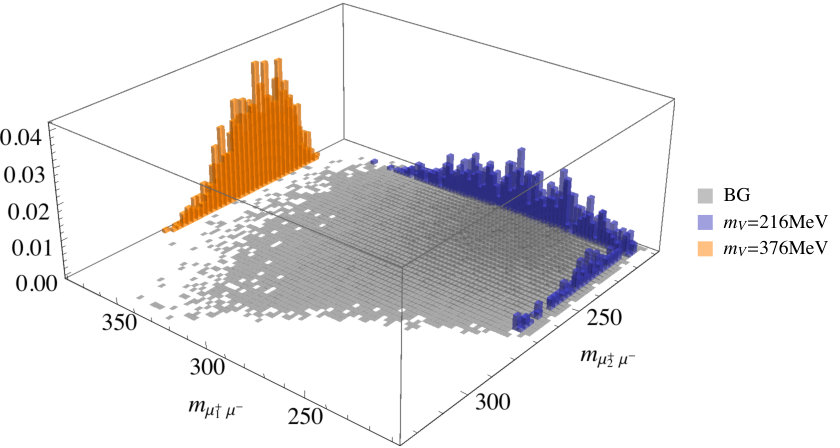 Figure 1
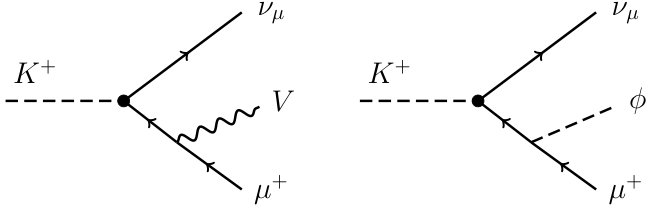 Figure 2
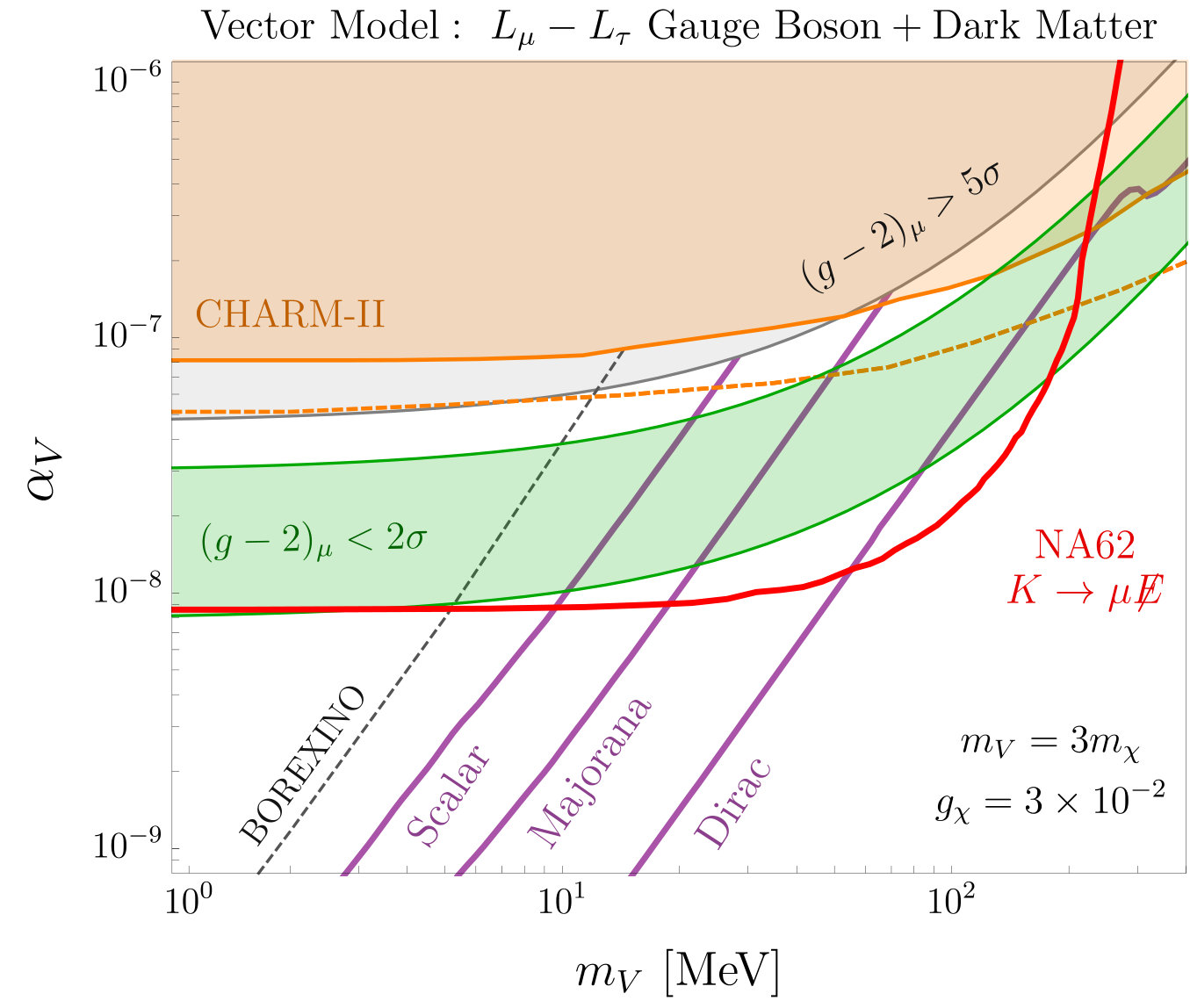 Figure 3
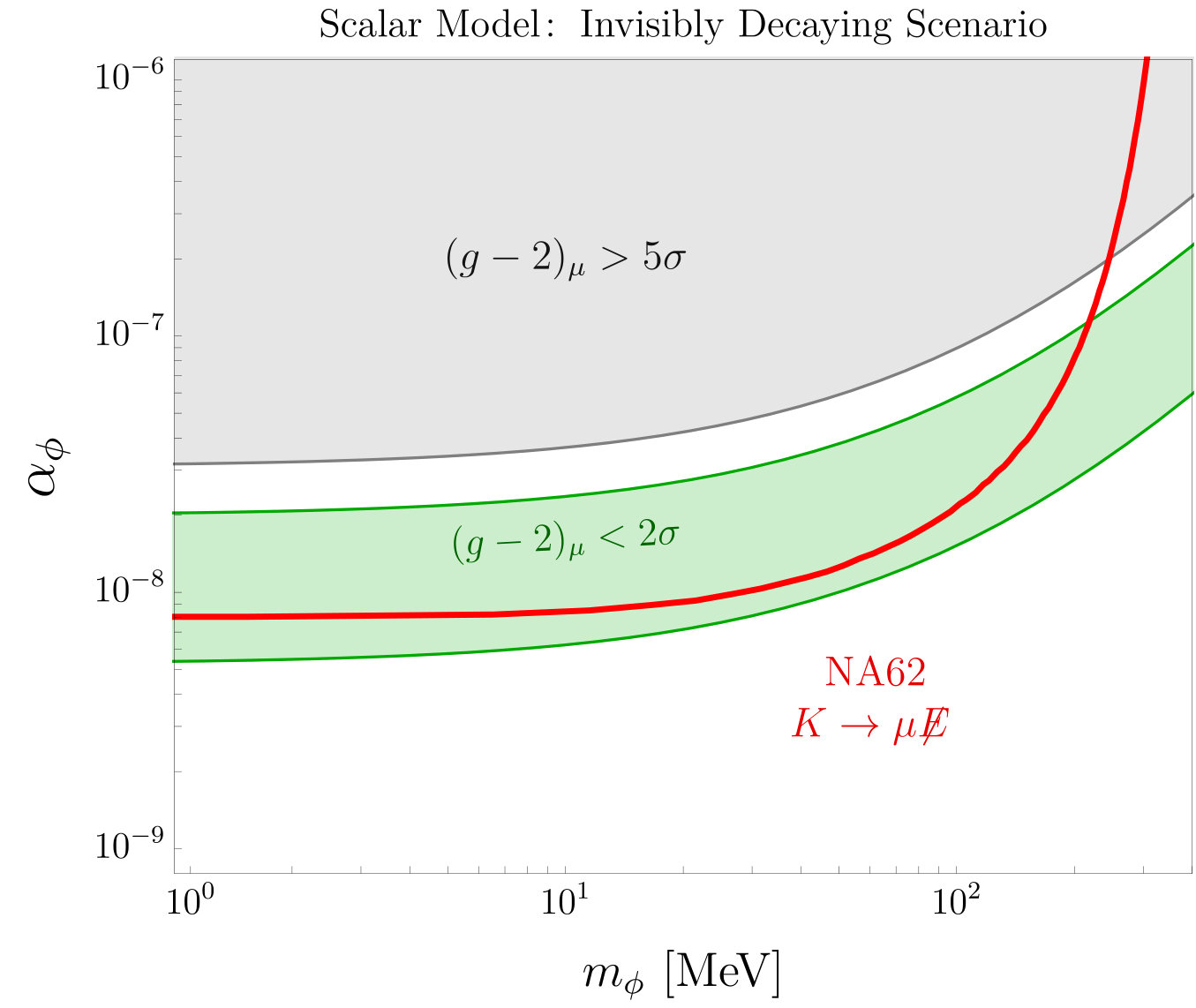 Figure 4
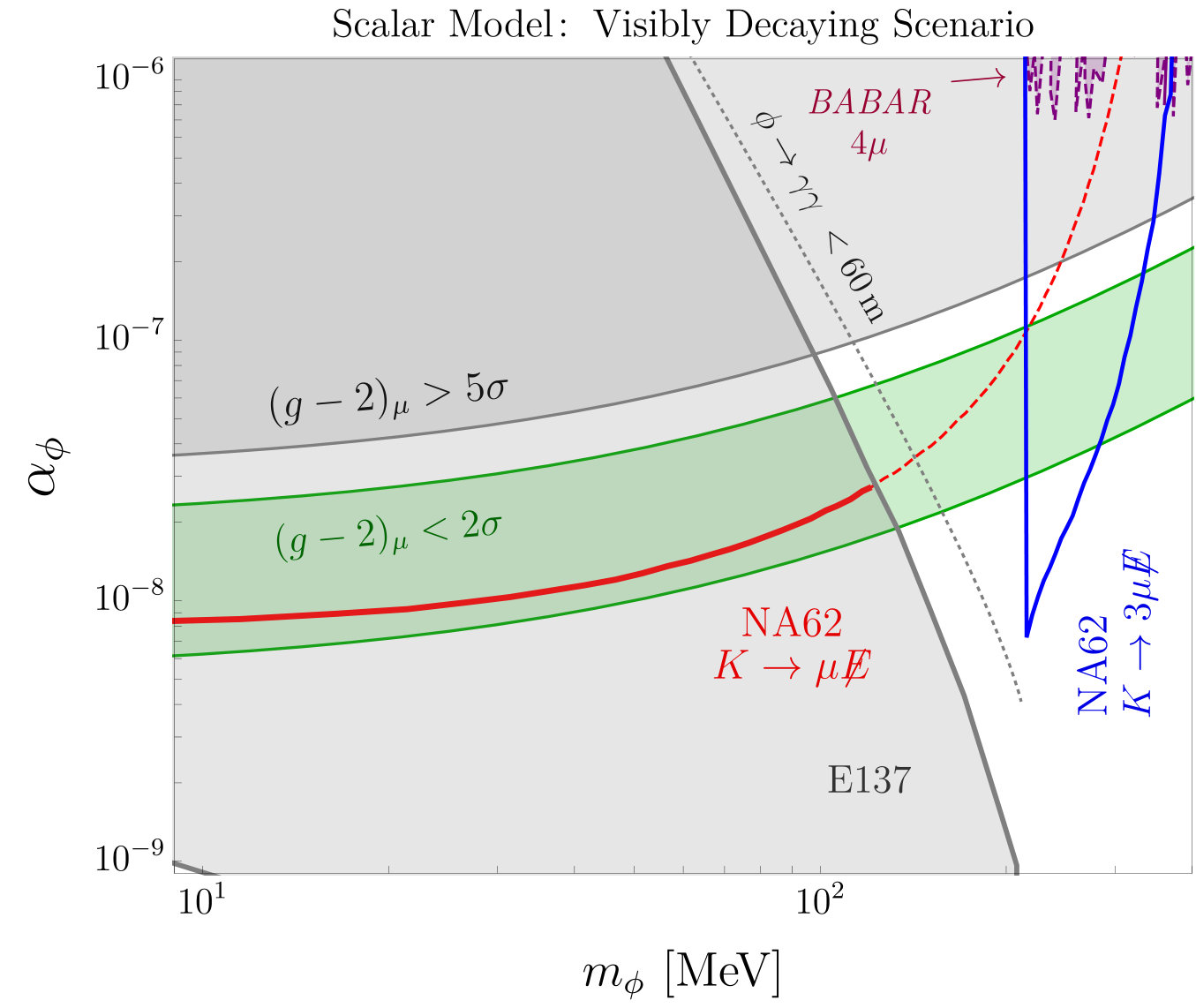 Figure 5
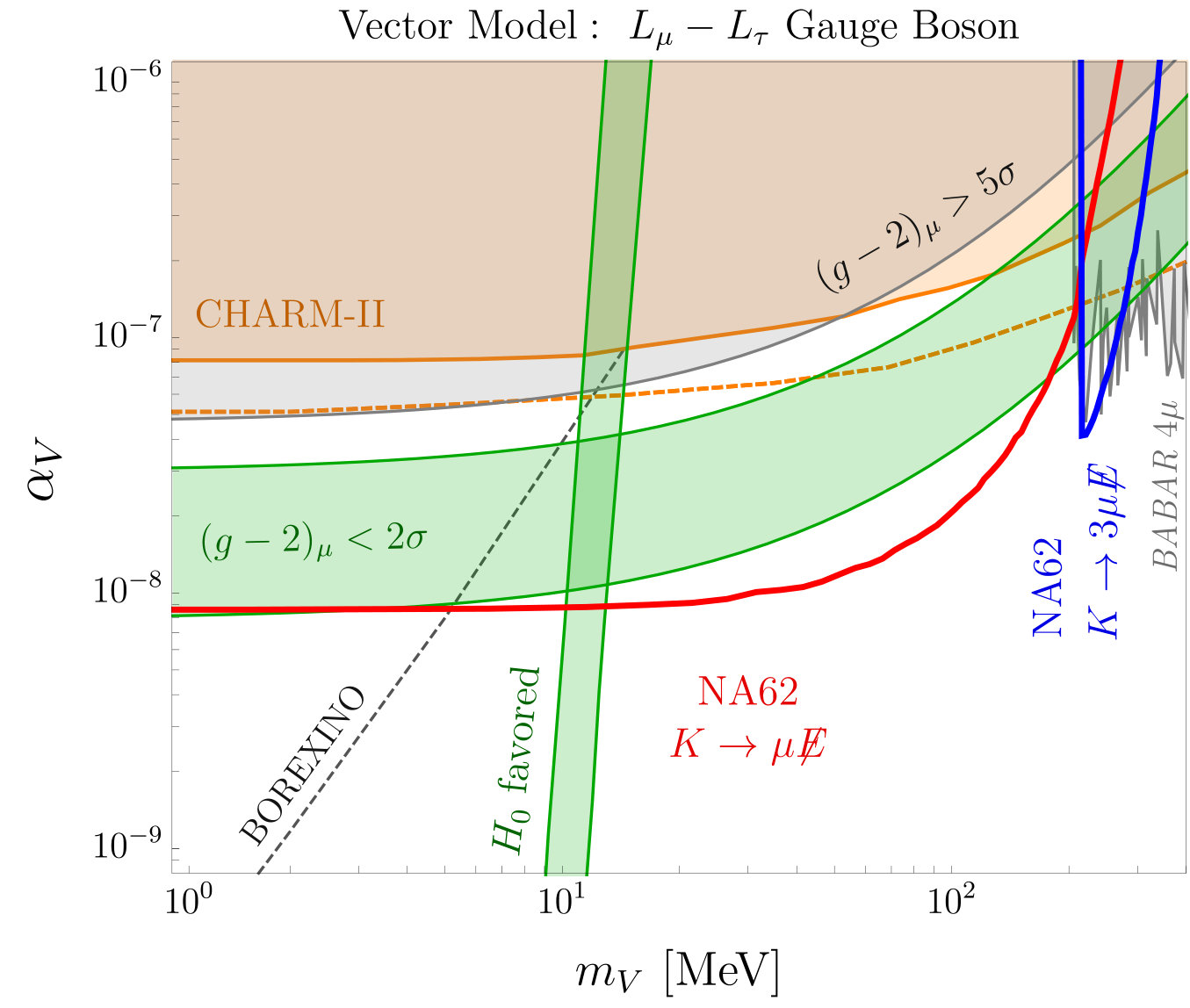 Figure 6
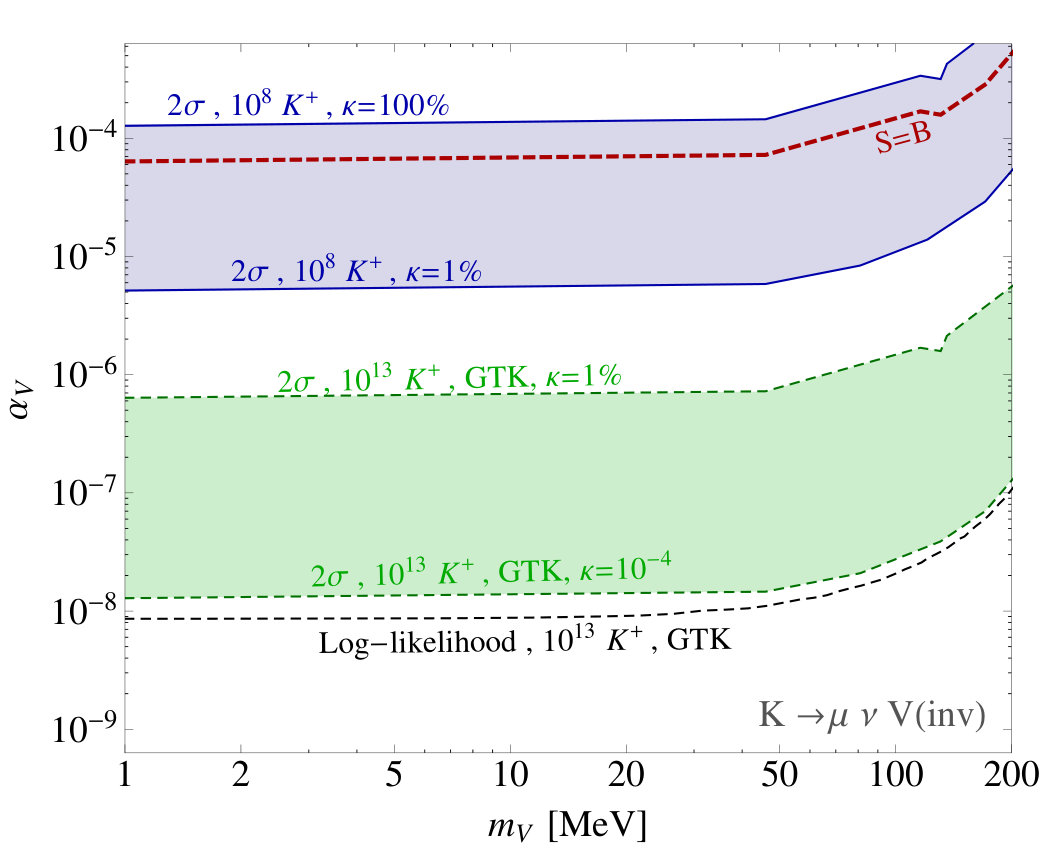 Figure 7
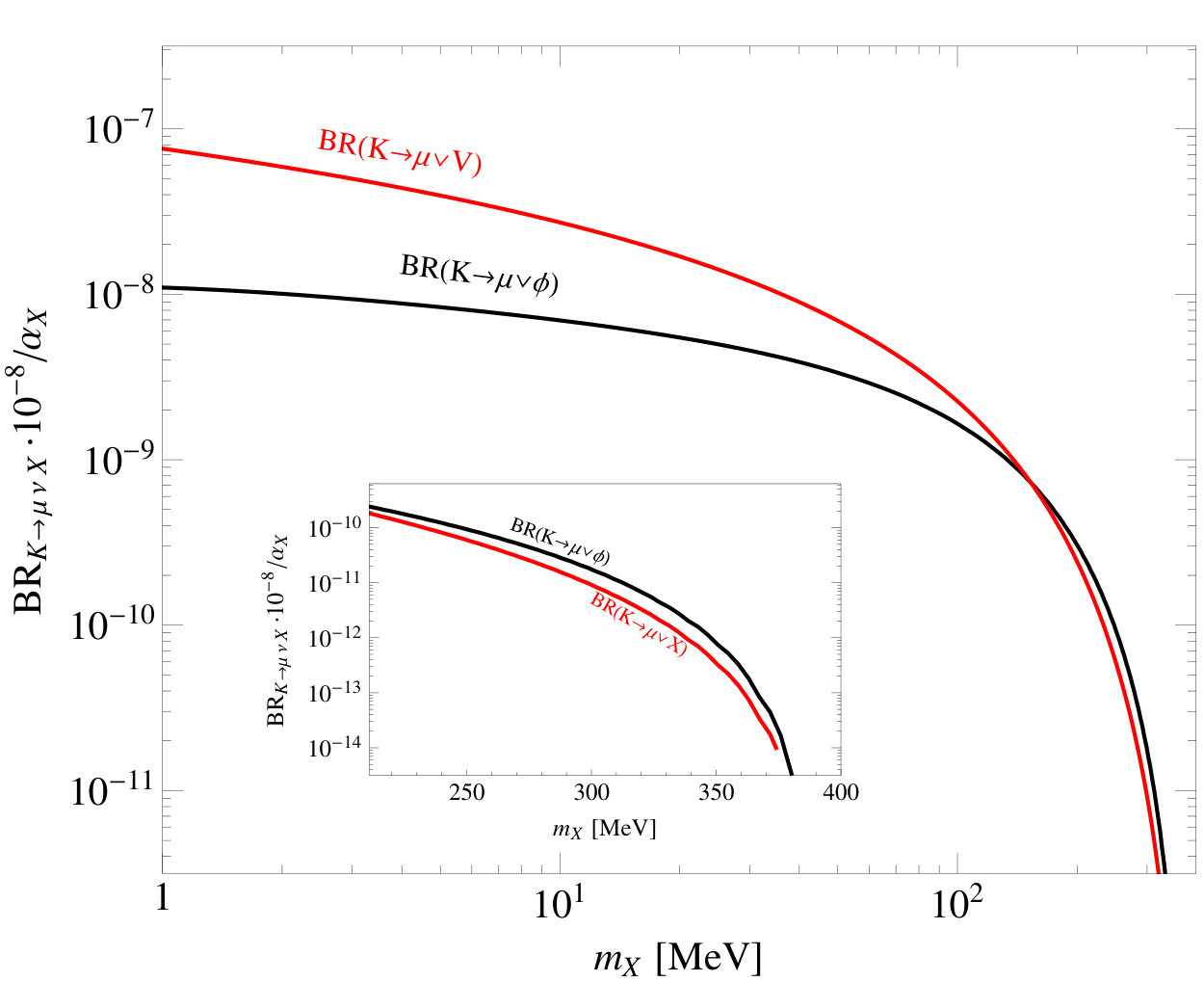 Figure 8
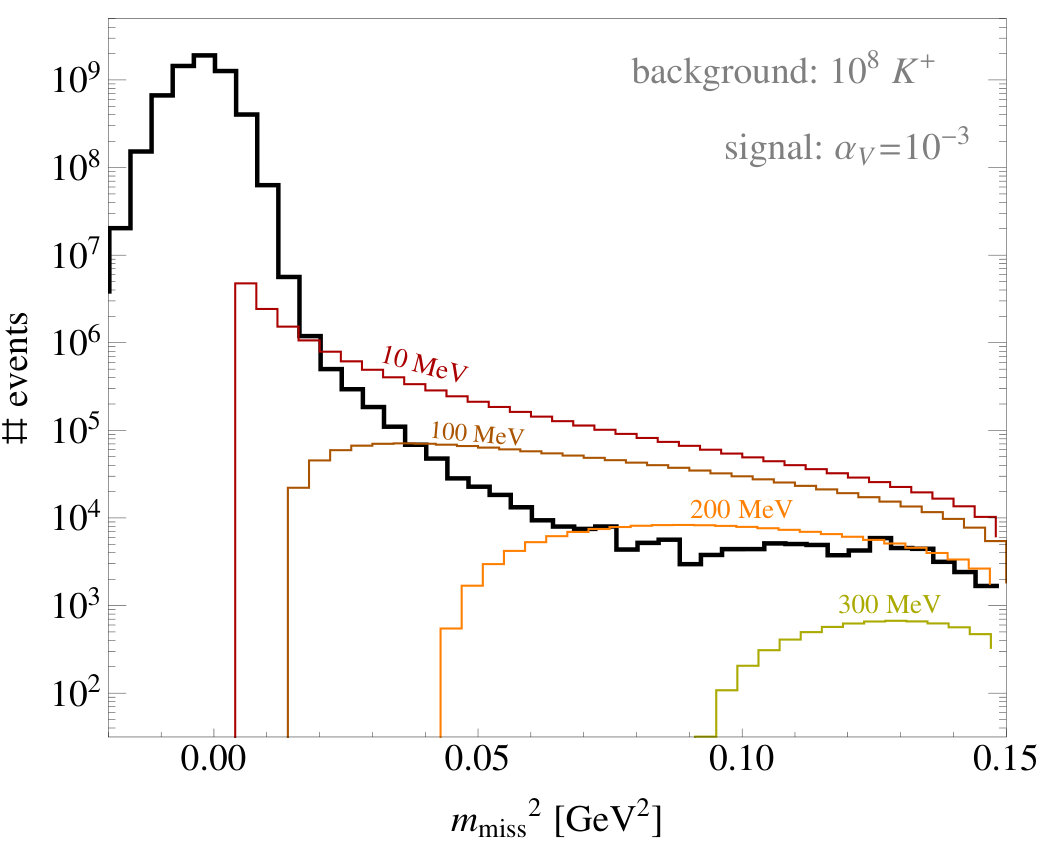 Figure 9
Peer Reviews
No public reviews on file for this paper yet. If you reviewed it on a platform where reviews are public (OpenReview, ICLR, NeurIPS, ICML), you can paste yours below so the community can read it here.
Videos
No videos yet. Explain this paper in a talk, walkthrough, or lecture? Add one.
Probing Muon-Philic Force Carriers and Dark Matter at Kaon Factories
Gordan Krnjaic
Fermi National Accelerator Laboratory, Batavia, IL
Gustavo Marques-Tavares
Maryland Center for Fundamental Physics, Department of Physics,
University of Maryland, College Park, MD 20742
Stanford Institute for Theoretical Physics,
Stanford University, Stanford, CA 94305, USA
Diego Redigolo
Tel-Aviv University, Tel-Aviv Israel
Institute for Advanced Study, Princeton, NJ USA
Weizmann Institute of Science, Rehovot Israel
Kohsaku Tobioka
Florida State University, Tallahassee, FL USA
High Energy Accelerator Research Organization (KEK), Tsukuba Japan
Abstract
Rare kaon decays are excellent probes of light, new weakly-coupled particles. If such particles couple preferentially to muons, they can be produced in decays. In this Letter we evaluate the future sensitivity for this process at NA62 assuming decays either invisibly or to di-muons. Our main physics target is the parameter space that resolves the anomaly, where is a gauged vector or a muon-philic scalar. The same parameter space can also accommodate dark matter freeze out or reduce the tension between cosmological and local measurements of if the new force decays to dark matter or neutrinos, respectively. We show that for invisible decays, a dedicated single muon trigger analysis at NA62 could probe much of the remaining favored parameter space. Alternatively, if decays to muons, NA62 can perform a di-muon resonance search in events and greatly improve existing coverage for this process. Independently of its sensitivity to new particles, we find that NA62 is also sensitive to the Standard Model predicted rate for , which has never been measured.
††preprint: FERMILAB-PUB-18-665-A††preprint: KEK-TH-2105
I Introduction
Light weakly-coupled forces arise in many compelling extensions of the Standard Model (SM) and are the focus of a broad experimental effort Essig et al. (2013); Battaglieri et al. (2017a); Alexander et al. (2016). If the corresponding force-carriers 111We refer to force carriers as “forces” throughout. couple preferentially to muons, they offer the last viable opportunity to resolve the longstanding anomaly in Bennett et al. (2006); Hagiwara et al. (2011); Davier et al. (2011) with new physics below the electroweak scale as proposed in Pospelov (2009).222Light new particles with appreciable couplings to the first generation have been excluded in simple models, including both visibly and invisibly decaying dark photons (see Alexander et al. (2016); Mohlabeng (2019)). Thus, there is strong motivation to improve experimental sensitivity to these interactions.
Furthermore, there is abundant evidence for the existence of dark matter (DM), whose microscopic properties remain elusive Bertone and Hooper (2018). One possible explanation for these null results is that DM couples more strongly to the second and third generation. Indeed, there are several consistent, viable, and predictive dark forces which mediate DM freeze-out to higher generation particles Agrawal et al. (2014); Kahn et al. (2018). Since muonic forces don’t couple directly to first generation particles, these DM candidates are difficult to probe with direct detection experiments, but can be efficiently produced at accelerators.
It is known that muonic forces lead to new rare kaon decays Reece and Wang (2009); Batell et al. (2017); Ibe et al. (2017). However, there are several timely reasons to revisit this subject:
The NA62 experiment Martellotti (2015) is currently producing unprecedented numbers of kaons, and is poised to considerably improve sensitivity to muonic forces. 2. 2.
The collaboration Grange et al. (2015) and the J-PARC experiment and (2010) will soon decisively test the anomaly. If this discrepancy is due to new physics, the particles responsible necessarily predict SM deviations in other, complementary muonic systems. 3. 3.
Recently there has been great interest in new proposals for dedicated experiments to probe muonic forces Abbon et al. (2007); Gninenko et al. (2015); Chen et al. (2017); Kaneta and Shimomura (2017); Kahn et al. (2018). To assess the merits of these ideas, it is essential to know what existing experiments can achieve.
In this Letter we show that existing kaon factories, can probe decays where is a new particle that couples preferentially to muons. Our main focus are the new physics opportunities of the NA62 experiment at CERN Collaboration , which will produce .
If decays invisibly, we find that, with a dedicated single muon trigger, NA62 could have unprecedented sensitivity to invisible) processes. Such a search could probe nearly all the remaining parameter space in which muonic forces reconcile the anomaly. If the invisible particles are DM, this also enables -mediated thermal freeze out Kahn et al. (2018); if, instead, these particles are neutrinos, this same parameter space can ease the tension in Hubble constant measurements Escudero et al. (2019).
If decays to muons, we find that an NA62 di-muon resonance search in processes could greatly improve the coverage for both scalar and vector forces, thereby covering nearly all of the favored region for . The irreducible background for this search arises from decays which have never been observed before; intriguingly, we find that NA62 can also measure this process in existing data.
II Vector Forces
II.1 Gauged
A vector gauging a spontaneously broken symmetry is a minimal candidate to explain the anomaly. The Lagrangian contains
[TABLE]
where is the gauge coupling, is the mass, and is the current He et al. (1991). Loops of taus and muons induce kinetic mixing with the photon , which also couples to the EM current in Eq. (1). The widths for are
[TABLE]
where and , and the width to neutrino flavor is . Decays through the EM current are suppressed by additional factors of , so we neglect these here. In all of the parameter space we consider here, decays promptly within the 65 m decay region of NA62.
Although we require MeV to avoid tension with cosmology Pospelov and Pradler (2010), for few MeV, decays after neutrino decoupling increase the effective number of neutrino species by , which can ameliorate the tension in Hubble rate measurements Escudero et al. (2019); lighter masses are disfavored Kamada and Yu (2015); Aghanim et al. (2018).
As shown in Fig. 1 (left), the NA62 reach with decaying invisibly could cover a large portion of the parameter space, far beyond the reach of present experiments. Conversely the search with is competitive with BABAR. The detailed study and the experimental challenges of the invisible and di-muon analyses are described in Sec. IV.1 and Sec. IV.2 respectively.
II.2 Adding Charged Dark Matter
If DM couples to , DM decays can significantly change the branching fraction above the di-muon threshold; below this boundary, always decays invisibly (either to neutrinos or DM). Here we add a DM candidate charged under and extend Eq. (1) to include a coupling to the dark current . We now have
[TABLE]
where is the DM- coupling and is the DM charger; we assume and carry unit charge. For , freeze out proceeds via -channel annihilation to SM particles for each model in Eq. (3) Kahn et al. (2018); Berlin et al. (2018a). Figure 1 shows DM production targets alongside various constraints.
III Scalar Forces
The minimal Lagrangian for a Yukawa muonic force is
[TABLE]
where is a real scalar particle. The interaction in Eq. (4) can arise, for instance, by integrating out a heavy, vectorlike lepton singlets whose mass mixes with the right handed muon as discussed in the supplementary material Supplementary Material . In the absence of additional interactions, for , the dominant decay is with partial width
[TABLE]
where . For , the dominant channel is through a muon loop with width
[TABLE]
where and the lab frame decay length is
[TABLE]
where the scaling accounts for the boost factor. In this minimal “visibly decaying” scenario, most of our favored parameter space is below the di-muon threshold, so the diphoton channel dominates and, for the maximum energy GeV, nearly all decays occur outside the NA62 detector to mimick a missing energy signature. However, a dedicated study is required to identify the distance beyond which these decays are invisible given NA62 kinematics and acceptance; we also note that it may be possible to perform a resonance search if this occurs inside the decay region.
Alternatively, may decay predominantly to undetected particles (e.g DM) in the “invisibly decaying” scenario. In both cases, the scalar is produced via processes whose width is computed in the supplementary material Supplementary Material .
Figure 2 shows the NA62 projections for visible (left) and invisible (right) decays assuming branching ratio in both channels. The main difference relative to the vector case is that the search improves considerably beyond the BABAR bounds; here the cross section is much smaller than production. We also show the E137 bound for visible decays from Marsicano et al. (2018) (see also Dolan et al. (2017)). There are additional constraints from supernovae Chen et al. (2018); Marsicano et al. (2018) not included in the figure due to their large astrophysical uncertainties and significant model dependence in the invisible decaying scenario.
IV Rare kaon Decays at NA62
The electroweak coupling governing SM decays is
[TABLE]
where is the Fermi constant, is the CKM element, and MeV is the kaon decay constant. We are interested in three-body corrections to this process: , where or , is emitted from a final state and/or line. The differential decay distribution is
[TABLE]
where is the invariant mass and
[TABLE]
The matrix element for both scenarios is calculated in the supplementary material Supplementary Material . Below we describe two different search strategies depending on whether X decays invisibly or to muons.
IV.1 Invisible analysis
If is produced in events and decays invisibly, the distribution in invisible decays differs from the SM prediction (see supplement Supplementary Material ). The sensitivity of an search in single muon events is computed using the log-likelihood ratio
[TABLE]
where , the likelihood in each bin , is constructed from a Poisson distribution,333 where , , and are data, background, and signal fraction in each bin. The maximum likelihood estimator is under the assumptions behind our projections, . and is the signal yield with acceptance . We require to define the sensitivity.
Our background sample is extracted from public NA62 data from the 2015 run in which events passing the single muon trigger were recorded Cortina Gil et al. (2018). These data yield kaons after dividing out the detector acceptance and SM branching ratio ; all events in this sample are binned in missing mass intervals of .
One of the main backgrounds for this search is , in which a radiated is not detected and contributes to the missing energy. This process peaks at and its contribution to the large missing mass tail depends on NA62’s photon rejection efficiency. Due to this large background, including missing mass bins below does not change the log-likelihood ratio defined in Eq. (11).
In the 2015 data sample, other backgrounds are present at large and exceed the tail for . These events are largely due to the muon halo and we expect their contribution to be substantially reduced in the 2017 dataset where NA62 utilizes a silicon pixel detector (GTK) to measure the timing and momentum of upstream Kaons Collaboration . To approximately account for this existing improvement, we rescale the background yield above by an additional factor of two to estimate our sensitivity.444We thank E. Goudzovski and B. Dbrich for discussions on this. For more details regarding our analysis and the challenges of maximizing signal sensitivity, see supplementary material Supplementary Material where we show how our results vary under different assumptions regarding systematic errors.
IV.2 Di-muon analysis
If is produced in events and decays visibly to di-muons, NA62 can improve upon previous experiments in the channel. The SM prediction is Bijnens et al. (1993) and currently has not been observed; the best limit comes from E787 in 1989 Atiya et al. (1989). With current luminosity ( Cortina Gil et al. (2019)), NA62 should already have recorded at least 100 such events passing the di-muon trigger. Here we propose a di-muon resonance search in events with opposite sign (OS) di-muon pairs.
Since these data have not been released yet by NA62, we estimate the sensitivity of the search from our MC simulation. We implement the effective weak interaction of Eq. (8), the electromagnetic interactions of decays, and the new physics couplings from Eqs. (1) and (4) in MadGraph 5 v2 LO Alwall et al. (2011, 2014). We neglect a subdominant contribution from a contact interaction of . Both the background and the signal in final state are simulated. In Figs 1 (left) and 2 (left) we present the results of this analysis in blue curves labeled NA62 . Systematic uncertainties on the background will affect less the result compared to the invisible channel because a data-driven background estimate would be possible. For more details about our projection, see supplementary material Supplementary Material .
V Conclusion
In this Letter we have shown that rare kaon decay searches at NA62 can probe most of the remaining parameter space for which muonic-philic particles resolve the anomaly; these are the only viable explanations involving particles below the weak scale. The same parameter space can also accommodate thermal DM production or reduce the tension if the new particle decays to DM or neutrinos, respectively.
If this new particle decays invisibly, achieving this sensitivity requires a dedicated single muon trigger to record all +invisble events with during Run 3. The ultimate reach in this channel depends crucially on the systematic uncertainties on events with these kinematics; a dedicated experimental study is needed to assess the feasibility of this requirement.
We note that if the anomaly is confirmed, NA62 can play a key role in deciphering the new physics responsible for the discrepancy. However, even if future measurements are consistent with the SM, the searches we propose can still constrain models for which muonic forces mediate dark matter freeze out. Such measurements can also inform future decisions about proposed dedicated experiments including NA64Gninenko et al. (2015), M3Kahn et al. (2018), BDX Battaglieri et al. (2017b, 2016), and LDMX Berlin et al. (2018b); Akesson et al. (2018).
Acknowledgements.
Acknowledgments : We are grateful to Todd Adams, Wolfgang Altmannshofer, Gaia Lanfranchi, Roberta Volpe and Yiming Zhong for helpful discussions and to Babette Dbrich, Evgueni Goudzovski for correspondence about NA62. We also thank Evgueni Goudzovski, Roberta Volpe and Yiming Zhong for useful feedbacks on a preliminary version of the manuscript. Fermilab is operated by Fermi Research Alliance, LLC, under Contract No. DE-AC02-07CH11359 with the US Department of Energy. GMT is supported by DOE Grant DE-SC0012012, NSF Grant PHY-1620074 and by the Maryland Center for Fundamental Physics. KT is supported by his startup fund at Florida State University. (Project id: 084011-550-042584). The authors thank the KITP where this work was initiated and the support of the National Science Foundation under Grant No. NSF PHY-1748958.
VI Decay Calculation
The SM width can be written as
[TABLE]
where the coupling
[TABLE]
sets the typical size of the kaon decay widths considered here. Note that has to be proportional to the muon mass because a chirality flip is required to make the amplitude non-zero. The kaon width is , so . Below we present the calculation for the squared matrix elements of
[TABLE]
where or is a muonic force carrier considered in this paper and and are four vectors. These results are already present in the extensive literature on muonic forces (see for example Carlson and Rislow (2012)) but we present them here for completeness.
For either scenario, the partial width for this process can be written as
[TABLE]
where the limits of integration are given by and . For a fixed the minimum and maximum of are given by
[TABLE]
where we define
[TABLE]
In Fig. 4 we plot for completeness the normalized signal rates for both the vector and the scalar model.
VI.1 Vector Mediator
For the vector model introduced in Sec. II with , our process of interest arises from the Feynman diagram in Fig. 3 and also contains an additional diagram with emitted from the . The squared matrix element is
[TABLE]
where and are respectively the and momenta and we define and . Note that the full matrix element vanishes for due to chiral symmetry.
VI.2 Scalar Mediator
For the muon-philic scalar introduced in Sec. III, the squared matrix element is
[TABLE]
where is defined below Eq. (A.7). The squared matrix element above does not vanish for because the scalar yukawa interactions with the muons in Eq. (4) breaks the chiral symmetry independently of the muon mass.
VII Complete Scalar Model
Before electroweak symmetry breaking, the Yukawa interaction in Eq. (4) is forbidden by gauge symmetry. The simplest gauge invariant operator that gives rise to this Yukawa interaction is the dimension 5 operator
[TABLE]
where is the second generation lepton doublet and the muon singlet in 2-component spinor notation.
In this section we present a UV completion of the model which gives rise to this interactions after integrating out heavy fermionic degrees of freedom (see e.g. Chen et al. (2016); Batell et al. (2017, 2018) for other alternatives). This construction differs from the ones in Chen et al. (2017) in that the coupling to muons does not arise due to the scalar mixing with the Higgs. In particular the Higgs-scalar mixing is loop suppressed in this model and can be parametrically smaller in a technically natural manner; thus, as discussed below, many of the scalar bounds presented in Batell et al. (2017) do not apply for an equivalent coupling.
The model includes an extra vector-like pair of fermions in which one of these carries the same gauge quantum numbers as and the other carries compensating quantum numbers to cancel anomalies. This extension can generate the required coupling through mixing between this new fermion and the muon. The relevant terms in the Lagrangian of the model are
[TABLE]
where is the new vector like fermion pair. Note that we chose to not include a mass mixing term which is allowed by all the symmetries, since this term can be removed by an appropriate field redefinition. Also there are additional terms such a tadpole or a cubic term which shifts mass of or mix Yukawa couplings. However these can be avoided by small values of which is allowed by spurion analysis.
Assuming , we can integrate out the new fields before electroweak symmetry breaking. This generates the following new terms
[TABLE]
where is the photon field strength. After electroweak symmetry breaking the first term in the above interaction generates the coupling in Eq. (4), with
[TABLE]
The second term in Eq. (B.3) contributes to the scalar decay to photons. Depending on the choice of parameters the contribution from this term can be larger than the IR contribution from the muon loop and the partial width to photons in Eq. (6) must be corrected. This shows that different choice of UV parameters can lead to either prompt or displaced decays to photons, which highlights the complementarity of performing both an invisible search and a diphoton resonance search.
The couplings in Eq. (B.2) induce a -Higgs mixing at loop level. We can estimate the size of the mixing from the contributions involving and to be
[TABLE]
This induces mixing angles much smaller than the bound discussed in Krnjaic (2016); Batell et al. (2017) for all of the parameter space we are interested in. One can also easily show that the decay to electrons induced by the mixing with the Higgs is small compared to the diphoton decay from the coupling.
VIII NA62 Analysis
Here we provide additional details about the procedure with which NA62 projections are computed this paper. In particular, we present the background distributions for both the visible and invisible analyses and comment on how different assumptions regarding systematic errors affect these projections. Maximizing signal sensitivity is challenging for two main experimental reasons:
Single muon trigger bandwidth: This issue is related to the large number of single muon events from SM decays. Thus, the current single muon trigger at NA62 is rescaled by Cortina Gil et al. (2019), so only one single muon event out of 400 is recorded, which reduces the sensitivity of our search. This limitation can be overcome with a dedicated single muon trigger with a lower cut on the missing mass at trigger level (or equivalently an upper cut on the muon momentum). In the 2015 data sample, despite over events passing the single muon trigger, only have . Thus, with a dedicated trigger, it would be possible to record all events with and keep the trigger rescaling for those with lower . Our search strategy exploits this possibility and utilizes the full NA62 luminosity in the decay region, which we assume for our projections. As a final remark, notice that our signal region has kinematical overlap with the region 2 of the search Cortina Gil et al. (2019). A modification of the single muon trigger prescaling could then possibly affect the background yield from muons faking pions in the R2 region. 2. 2.
Background systematics for large : These systematics are difficult to estimate from the 2015 data in which there is disagreement between data and Monte Carlo (MC) at large . A careful experimental effort is required to assess these uncertainties. Since our goal is to show how much the sensitivity of NA62 could potentially be improved, we presents results with only statistical errors; these can only be achieved once systematic uncertainties become subdominant for the full NA62 luminosity: . In Figs. 1 and 2 we presented future sensitivities assuming systematics are negligible, but note that exploring new parameter space in this plane only requires systematic uncertainties to be below .
VIII.1 Invisible analysis
In Fig. 5 left we compare the distribution for signal events for different masses using the background shape extracted from NA62 public data Cortina Gil et al. (2018). The signal here is shown for but the scalar case is qualitatively similar. Note that the signal reduction at small is dependent, so an optimal can be chosen for different values to maximize sensitivity. As discussed in Sec. IV A, the background at large missing mass does not appear to scale as one might expect if it were dominated by the QED radiative tail from decays. The reason is that other backgrounds including the halo muon background and become dominant in this regime. We believe that these backgrounds will be further suppressed in future data releases for which timing and momentum of the kaon will be measured upstream with the silicon pixel detector (GTK), which has already been used for the 2017 run. To roughly account for this improvement, we rescale the background above by an additional factor of two.
In Fig. 5 right we show estimated sensitivities for the vector case computed in a cut-and-count experiment; similar results are also found for the scalar case. This simpler analysis is performed here and compared to the likelihood analysis presented in the main text in order to quantitatively show the effects of systematic uncertainties on the background.
The sensitivity of an search in single muon events is computed by evaluating , where the is the number signal events, the number of background events and is the systematic uncertainty on the background. The signal yield is
[TABLE]
where is the the detector acceptance. is the lower cut on the missing mass, which is optimized for each value of to maximize signal sensitivity, but always satisfies ; is the maximum kinematically allowed missing mass.555Note that is the minimal missing mass cut in our cut and count analysis. This should not be confused with which is the value of the invariant mass below which adding bins to the log-likelihood ratio in Eq. (11) does not effectively improve signal sensitivity. Of course the physics behind these two quantities is very similar and related to the background shape peaking at .
From Fig. 5 it is clear that the future NA62 sensitivity depends greatly on background systematics at large missing mass. For the present/future luminosity, the blue/green lines at the bottom of these bands correspond to systematic uncertainty for which the statistical uncertainty becomes dominant. This can be estimated as a function of the luminosity and the number of background events for a given missing mass cut
[TABLE]
where the first number assumes kaons and 652 background events after a missing mass cut of and the second number assumes kaons and background events (accounting for the expected background suppression). For comparison we also show in Fig. 5 the most aggressive reach derived from our likelihood analysis. As expected, the log-likelihood improves the reach for low mass resonances where the signal spreads widely in the large background region (see Fig. 5 left) and a simple cut-and-count analysis poorly distinguishes the signal from background.
VIII.2 Di-muon analysis
In this section we describe the proposed opposite-sign di-muon resonance analysis in events, which defines the blue projections in Fig. 1 (left) and 2 (left) labeled NA62 . We assume that the irreducible SM background for our search arises from decays to three muons through an off-shell gauge boson and neglect other possible backgrounds from non-detection of photons, misidentification and decay which are expected to be in the same order or subdominant. Moreover, for simplicity, we assume acceptance for both signal and background to be 5%. This number is roughly 1/6 of the acceptance reported in Cortina Gil et al. (2018) for the single muon trigger and should roughly account for the extra cost of requiring three muons to pass trigger and identification criteria.
The other challenge of this search is the ambiguity in choosing the opposite-sign di-muon pair to reconstruct the invariant mass. To resolve this problem we choose the opposite-sign di-muon pair that gives an invariant mass closer to each test mass for the signal. Typically it is the leading muon above MeV, and the second leading one below MeV as seen in Fig. 6. After this choice is made, we select the signal and the background within a narrow invariant mass bin around each test mass . The invariant mass bin size can be determined as a function of the smearing of the muon momentum in the NA62 detector
[TABLE]
where is the muon momentum resolution of the NA62 detector, which satisfies Cortina Gil et al. (2018)
[TABLE]
where indicates a sum in quadrature. The muon momentum is fixed to be . The future sensitivities of this search at 2 in Fig. 1 (left) and Fig. 2 (left) assume kaons and uncertainties dominated by statistics. Systematic uncertainties on the background can be under control because the data-driven background estimate (side-band) is made possible by the peaked nature of the signal.
The reference list from the paper itself. Each links out to its DOI / PubMed record.
- 1Essig et al. (2013) R. Essig et al. , in Proceedings Snowmass on the Mississippi (CSS 2013): Minneapolis, MN, USA, July 29-August 6, 2013 (2013) ar Xiv:1311.0029 [hep-ph] .
- 2Battaglieri et al. (2017 a) M. Battaglieri et al. , (2017 a), ar Xiv:1707.04591 [hep-ph] .
- 3Alexander et al. (2016) J. Alexander et al. (2016) ar Xiv:1608.08632 [hep-ph] .
- 4Bennett et al. (2006) G. W. Bennett et al. (Muon g-2), Phys. Rev. D 73 , 072003 (2006) , ar Xiv:hep-ex/0602035 [hep-ex] . · doi ↗
- 5Hagiwara et al. (2011) K. Hagiwara, R. Liao, A. D. Martin, D. Nomura, and T. Teubner, J. Phys. G 38 , 085003 (2011) , ar Xiv:1105.3149 [hep-ph] . · doi ↗
- 6Davier et al. (2011) M. Davier, A. Hoecker, B. Malaescu, and Z. Zhang, Eur. Phys. J. C 71 , 1515 (2011) , [Erratum: Eur. Phys. J.C 72,1874(2012)], ar Xiv:1010.4180 [hep-ph] . · doi ↗
- 7Pospelov (2009) M. Pospelov, Phys. Rev. D 80 , 095002 (2009) , ar Xiv:0811.1030 [hep-ph] . · doi ↗
- 8Mohlabeng (2019) G. Mohlabeng, (2019), ar Xiv:1902.05075 [hep-ph] .