Optimized cavity-mediated dispersive two-qubit gates between spin qubits
M. Benito, J. R. Petta, Guido Burkard

TL;DR
This paper proposes an optimized cavity-mediated two-qubit gate for spin qubits in silicon, achieving high fidelities exceeding 90% by balancing spin-charge hybridization and mitigating decoherence effects.
Contribution
It introduces a method to optimize spin-charge hybridization for cavity-mediated two-qubit gates, enhancing fidelity in silicon quantum dot systems.
Findings
Gate fidelities exceeding 90% are achievable with current device architectures.
High fidelities are maintained even with charge noise at 2 μeV.
Optimization of hybridization improves entangling gate performance.
Abstract
The recent realization of a coherent interface between a single electron in a silicon quantum dot and a single photon trapped in a superconducting cavity opens the way for implementing photon-mediated two-qubit entangling gates. In order to couple a spin to the cavity electric field some type of spin-charge hybridization is needed, which impacts spin control and coherence. In this work we propose a cavity-mediated two-qubit gate and calculate cavity-mediated entangling gate fidelities in the dispersive regime, accounting for errors due to the spin-charge hybridization, as well as photon- and phonon-induced decays. By optimizing the degree of spin-charge hybridization, we show that two-qubit gates mediated by cavity photons are capable of reaching fidelities exceeding 90% in present-day device architectures. High iSWAP gate fidelities are achievable even in the presence of charge noise…
Click any figure to enlarge with its caption.
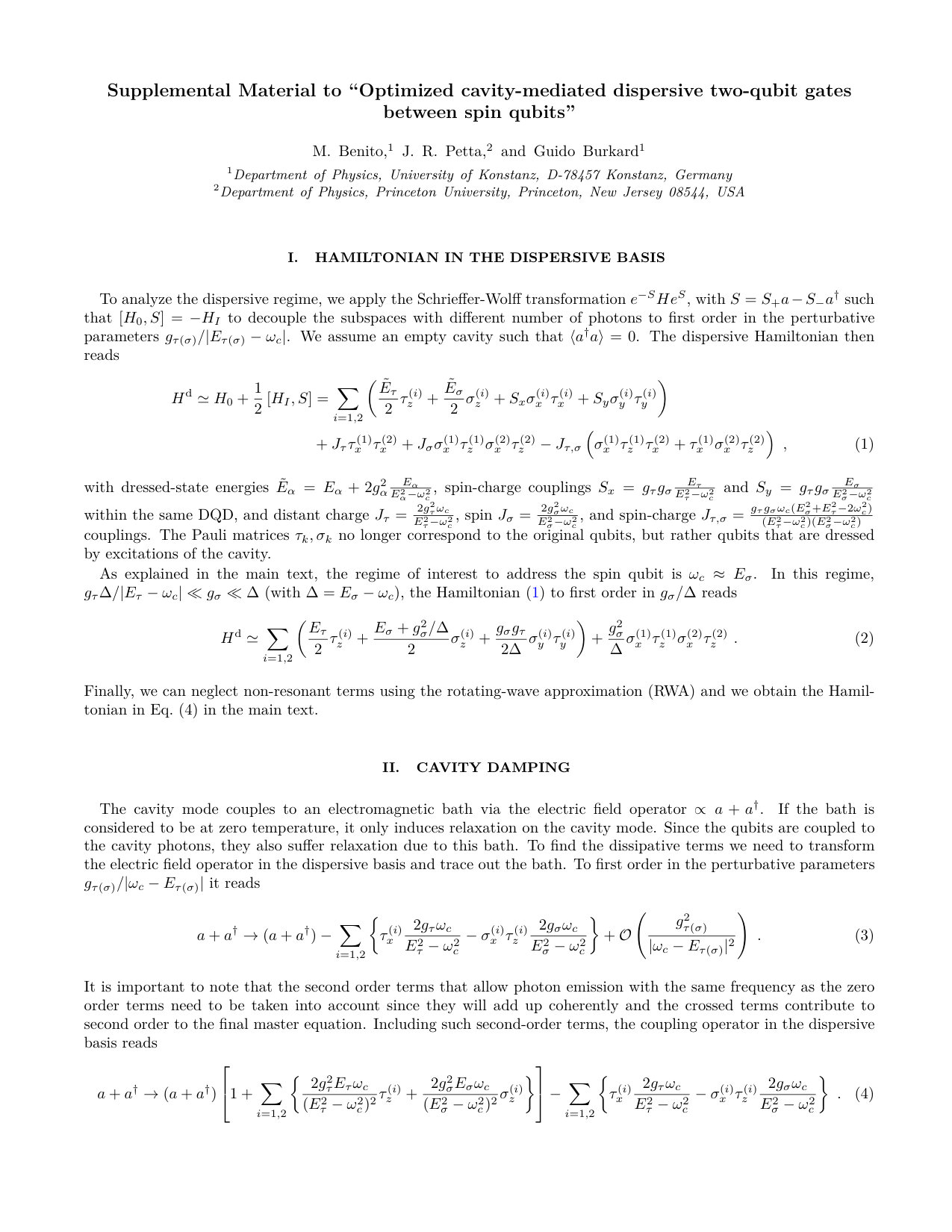 Figure 1
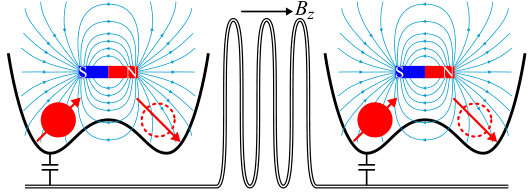 Figure 2
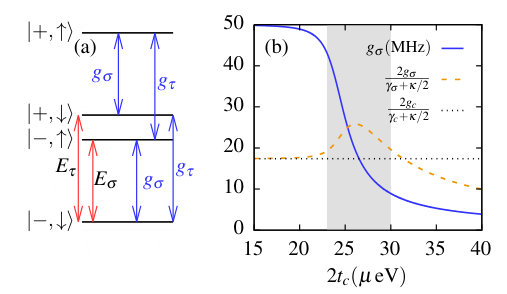 Figure 2
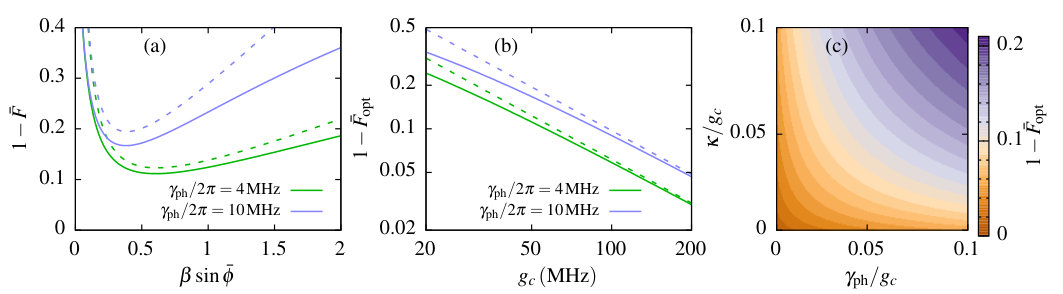 Figure 3
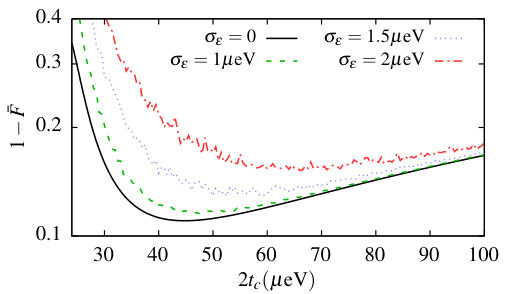 Figure 4
Peer Reviews
No public reviews on file for this paper yet. If you reviewed it on a platform where reviews are public (OpenReview, ICLR, NeurIPS, ICML), you can paste yours below so the community can read it here.
Videos
No videos yet. Explain this paper in a talk, walkthrough, or lecture? Add one.
Optimized cavity-mediated dispersive two-qubit gates between spin qubits
M. Benito
Department of Physics, University of Konstanz, D-78457 Konstanz, Germany
J. R. Petta
Department of Physics, Princeton University, Princeton, New Jersey 08544, USA
Guido Burkard
Department of Physics, University of Konstanz, D-78457 Konstanz, Germany
Abstract
The recent realization of a coherent interface between a single electron in a silicon quantum dot and a single photon trapped in a superconducting cavity opens the way for implementing photon-mediated two-qubit entangling gates. In order to couple a spin to the cavity electric field some type of spin-charge hybridization is needed, which impacts spin control and coherence. In this work we propose a cavity-mediated two-qubit gate and calculate cavity-mediated entangling gate fidelities in the dispersive regime, accounting for errors due to the spin-charge hybridization, as well as photon- and phonon-induced decays. By optimizing the degree of spin-charge hybridization, we show that two-qubit gates mediated by cavity photons are capable of reaching fidelities exceeding in present-day device architectures. High iSWAP gate fidelities are achievable even in the presence of charge noise at the level of .
Introduction. Recent advances in semiconductor fabrication, manipulation and readout techniques have situated spin qubits among the most promising candidates for quantum information processing Hanson et al. (2007); Kloeffel and Loss (2013); Awschalom et al. (2013). The degree of control over single-electron spin qubits and their exchange interaction has allowed high fidelity single Veldhorst et al. (2014); Takeda et al. (2016); Yoneda et al. (2018) and two-qubit Veldhorst et al. (2015); Zajac et al. (2018); Watson et al. (2018); Huang et al. (2018); Xue et al. gates. Moreover, recent improvements in the fabrication of semiconductor quantum dots (QDs) has pushed the limits of QD modules to sizable linear Zajac et al. (2016); Volk et al. and two-dimensional Mukhopadhyay et al. (2018); Mortemousque et al. arrays, which could allow not only the implementation of multielectron encoded qubits but also intra-module operations and electron transfer Mills et al. . Several proposals exist to create a modular quantum architecture Taylor et al. (2005); Kimble (2008) with all-to-all connectivity, which permits universal distributed quantum computation and high tolerances in error-correcting codes Preskill (1998).
Within the approach of circuit quantum electrodynamics (QED) Blais et al. (2004); Wallraff et al. (2004); Childress et al. (2004); Cottet et al. (2017); Delbecq et al. (2011), the microwave field of a superconducting transmission line resonator (or cavity) mediates interactions between qubits separated by macroscopic distances, allowing a fully scalable and modular quantum information processing device DiCarlo et al. (2009). Although electron spin qubits in semiconductor QDs promise long coherence times and potential for scalability, these photon-mediated interactions have not yet been demonstrated for spin qubits.
In this paper, we theoretically describe photon-mediated coupling of spin qubits and calculate the achievable two-qubit gate fidelities. Due to the small magnetic dipole of a single electron spin, some degree of spin-charge hybridization is needed to achieve a sizable coupling to the electric field of the cavity, a step which has recently been demonstrated for single-electron spin qubits in a double quantum dot (DQD) Viennot et al. (2015); Mi et al. (2018a); Samkharadze et al. (2018) and for a three-electron spin qubit in a triple QD Landig et al. (2018). Here we focus on the single-electron Loss-DiVincenzo qubit Loss and DiVincenzo (1998), where the mixing of orbital motion and spin is induced by an externally imposed magnetic field gradient, and show that the spin qubit outperforms the intrinsic charge qubit both in the resonant and dispersive regime for levels of decoherence encountered in state-of-the-art devices.
Although the spin-photon coupling strength is only a fraction of the charge-photon coupling Mi et al. (2018a); Samkharadze et al. (2018), the spin decoherence is much slower and can be made comparable to the cavity loss rate, which allows for the optimization of the resonant coupling Beaudoin et al. (2016); Benito et al. (2017). In the dispersive regime the qubit transition frequency is detuned with respect to the photon frequency. In this case we find that the externally-controllable spin-charge hybridization allows for optimal detuning values implying high-fidelity two-qubit gates. The dispersive coupling scheme demands a relatively small degree of spin-charge hybridization and will benefit enormously from the use of isotopically purified material Tyryshkin et al. (2012); Zwanenburg et al. (2013); Veldhorst et al. (2014); Yoneda et al. (2018).
Model. We consider two DQDs capacitively coupled to the same cavity mode with frequency (Fig. 1). Both DQDs are electrically tuned into the symmetric single-electron regime, with the electronic charge distributed between the two QDs. The tunnel coupling and the energy level detuning can be electrically controlled. The electron is capacitively coupled to the cavity electric field Childress et al. (2004); Petersson et al. (2012); Bruhat et al. (2018); Stockklauser et al. (2017); Mi et al. (2017). An externally applied global magnetic field Zeeman splits the spin states and magnetizes the micromagnets located near the DQDs. The longitudinal component of the micromagnet field adds to and the micromagnet generates a transverse field gradient (typically of order ). Each of the DQDs can be described with a model Hamiltonian with
[TABLE]
where and , for , are the position and spin Pauli matrices, respectively, and are the cavity photon operators. In the following, we will study the case of a symmetric DQD with , unless noted otherwise. Here and the magnetic fields are given in energy units. The light-matter interaction is described by , where is the electric dipole coupling strength between the DQD electron and a cavity photon. Due to the spin-orbit effect induced by , the electron spin dynamics are sensitive to the cavity electric field Cottet and Kontos (2010); Hu et al. (2012); Beaudoin et al. (2016); Benito et al. (2017).
In the following we work in the basis that diagonalizes , where bonding and antibonding states of the DQD with opposite spin are hybridized Benito et al. (2017). We define new Pauli matrices in terms of which the transformed model Hamiltonian reads
[TABLE]
with the energy levels at , where , coupled to the cavity with strength and , where is the spin-charge mixing angle, with . The corresponding level scheme is shown in Fig. 2 (a). In Fig. 2 (b) we show how the coupling strength decreases with increasing tunnel coupling for a given magnetic field profile, as a consequence of the increasing spin character of the qubit. If the qubit energy equals the photon frequency , coherent state transfer between a cavity photon and the qubit is possible whenever the coupling strength overcomes the total decoherence rate . Typical cavity photon frequencies are around . In Fig. 2 (b), we also show the ratio between coupling and decoherence for the system with (dashed line) and without (dotted line) magnetic fields, i.e., for a spin and a charge qubit respectively, where we have assumed that the decoherence rate of the former is inherited from the hybridization with charge, therefore , where is the total charge qubit decoherence rate. Although the charge qubit can be made sufficiently coherent to reach the strong coupling regime Mi et al. (2017); Stockklauser et al. (2017); van Woerkom et al. (2018), the spin qubit overcomes its performance in the shaded gray area in Fig. 2 (b) () if , where is the cavity loss rate. More precisely, we find that the spin qubit performs better than the charge qubit when in a finite interval around where denotes the spin-charge mixing angle defined above. In this regime, the gain from using the spin with a long coherence time overcompensates the decrease in coherence from spin-charge hybridization. Therefore, the advantage to be gained from using spin rather than charge as a qubit is twofold: (i) In the regime indicated by the shaded region in Fig. 2 (b), the exchange of quantum information between the qubit and the cavity photons is more efficient for the spin, and (ii) the spin-charge and spin-photon couplings can be switched off efficiently by controlling and , thus reaching a memory qubit regime where the spin qubit is far more coherent than the charge qubit. Importantly, in order to control the interaction times, there are two mechanisms to electrically switch off the spin-photon coupling: a) increasing the tunnel coupling, as shown in Fig. 2, or b) by increasing the level detuning and thereby reducing the amount of charge admixture across the DQD, such that the charge-photon coupling is reduced as .
When two subsystems (denoted with index ) as described above are coupled to the same cavity, the cavity photons can induce a long distance coupling between their spins. In the resonant regime () there is a collectively-enhanced two-qubit coupling that can be observed in a transmission experiment Majer et al. (2007); Fink et al. (2009); van Woerkom et al. (2018). Here we investigate the dispersive regime, where the photon frequency is detuned from the qubit transition frequency and a coherent long-distant interaction is mediated by the exchange of virtual photons Blais et al. (2004); Imamoglu et al. (1999); Burkard and Imamoglu (2006). This mechanism results in a smaller effective coupling but is less sensitive to photon loss in the cavity.
Dispersive regime. The light-matter interaction Hamiltonian (3) couples subspaces with different number of cavity photons. If the coupling strengths are small such that , we can decouple such subspaces to a desired order using a Schrieffer-Wolff transformation SI . From now on we assume , which ensures that the lower-energy subspace constitutes a qubit with a good coherence inherited from its spin character. Therefore the most interesting operating regime is the one with the cavity frequency being close to , therefore fulfilling the condition, , with the detuning .
Assuming identical DQDs, we find to first order in the perturbative parameter , in the limit of an empty cavity and within a rotating-wave approximation (RWA) SI , the following dispersive Hamiltonian
[TABLE]
where the Pauli matrices correspond to dressed states. The goal now is to harness the spin-spin long-distance coupling term to perform a two-qubit gate. A coupling Hamiltonian of the form performs an iSWAP gate at gate times for any integer , e.g. . A CNOT entangling gate can be constructed with two iSWAP gates and single qubit rotations Imamoglu et al. (1999); Schuch and Siewert (2003). To estimate how well such a gate can perform we take into account three sources of infidelity: (1) The full system Hamiltonian also contains cavity-mediated long-distance -coupling, and - coupling within a DQD as well as between distant DQDs (-) SI ; (2) Even for a material system with very low magnetic noise, spin-charge hybridization makes the spin qubits susceptible to charge noise. Therefore, the electron-phonon interaction and other charge fluctuations commonly present in semiconductor nano-structures will contribute to decoherence; (3) As the qubits are dressed by photonic excitations, the cavity damping will also contribute to qubit decoherence.
In order to capture dissipative effects, we model the system consisting of two DQDs using a master equation in the dispersive regime Boissonneault et al. (2009). If we assume that the system is prepared in the lower energy charge sector, we can derive an effective equation for the partial density matrix , corresponding to the spin degrees of freedom, and . In the rotating frame the master equation can be written as
[TABLE]
where represents the usual Lindblad superoperator . The first term in Eq. (5) describes the long-distance coupling mediated by the cavity, with strength , while the second term corresponds to relaxation due to phonon emission with rate (at the qubit energy ) in each DQD. Finally, the last term describes the Purcell relaxation, i.e., relaxation of the qubits with rate due to photon decay with rate . Given the reported long coherence times of electron spins in silicon QDs, we assume here that the spin qubit decoherence is mainly inherited from the hybridization with charge and we neglect other decoherence sources such as hyperfine interaction with nuclear spins Kloeffel and Loss (2013).
Results. With our effective model describing the system dynamics, we can estimate how accurately one can expect to realize a two-qubit iSWAP gate taking into account the amount of decoherence encountered in present-day experiments. We introduce the average fidelity as a measure of the quality of a quantum gate which compares the targeted pure state and the mixed state density matrix obtained from the gate including decoherence, averaged over all possible pure input states . To avoid a direct evaluation of the average over initial states, we use a method of calculating via the fidelity of entanglement , and using the relation , valid for two-qubit gates Nielsen (2002); White et al. (2007); Elman et al. (2017).
Choosing a qubit-cavity detuning with to ensure the dispersive regime and a gate time corresponding to the shortest iSWAP gate, , we find for the average fidelity corresponding to Eq. (5)
[TABLE]
with
[TABLE]
which for can be approximated as
[TABLE]
This approximated result suggests that there is an optimal value of , related to the detuning , that maximizes the average fidelity. This value is
[TABLE]
with a corresponding approximated average fidelity of
[TABLE]
Although the optimal average fidelity is determined by charge qubit and cavity parameters, via the cooperativity , the role of the spin-charge hybridization is to enable the optimization in Eq. (9), which is not accessible for charge qubits () unless (because ). From Eq. (9) we can extract that the spin qubit decoherence rate inherited from the charge at the optimal point is .
In Fig. 3(a), we show the exact average infidelity, Eq. (6), compared with the approximation, Eq. (8), as a function of for a typical value of charge-cavity coupling strength for different values of the phonon-induced charge decoherence rate . The best gate can be performed at the minimum of these curves, which can be found numerically for the exact expression by demanding . For currently available system parameters , , and , we find fidelities around . Improvements are possible via all three parameters. E.g., typical values of are around Mi et al. (2018a), but can be increased beyond with the use of high-impedance resonators (cavities) Stockklauser et al. (2017), leading to . An even higher fidelity of could be reached if e.g. and . In Fig. 3 (b) we show the predicted average infidelity at the optimal value as a function of in a double-logarithmic plot. As expected, the exact result coincides with the approximation, Eq. (10), for large and the average infidelity is inversely proportional to . Finally, in Fig. 3 (c) we show the exact predicted infidelity at the optimal value as a function of both and .
In current experiments, the magnetic field gradient and the cavity frequency are fixed, but it is possible to electrically tune the tunnel coupling between the QDs, modifying in this way the spin-charge hybridization. Therefore, one can tune and the external magnetic field such that the optimal fidelity condition is fulfilled and the spin qubits are in the dispersive regime, . In Fig. 4 (continuous line), we show the average infidelity of the dispersive iSWAP gate as a function of . The result for different values of , and the comparison with the full master equation can be found in SI .
Charge noise. The realistic entangling gates fidelities between spin qubits are currently limited by fluctuations due to charge noise. Since in our setup the qubits are at the “sweet spot” , i.e., they are first-order insensitive to onsite energies fluctuations (with amplitude ), the noise enters solely to second order. Here we include a high-frequency charge noise contribution, which can be modeled by adding dephasing Lindblad terms to the master equation (5),
[TABLE]
and a low-frequency component or quasistatic noise that randomizes the qubit energies via the Hamiltonian term
[TABLE]
Accounting for high-frequency charge noise, the approximated result in Eq (8) needs to be revised as . In order to calculate the effect of the low-frequency noise, we average the fidelity over a Gaussian distribution with standard deviation for the variables , with typical values Petersson et al. (2010); Mi et al. (2018b). The mean value of Eq. (12) only shifts the qubit energies and is included into the rotating frame transformation. In Fig. 4, we show the average infidelity of the dispersive iSWAP gate as a function of for different levels of low-frequency charge noise.
Conclusions. We have analyzed the performance of single-electron spin qubits in DQDs with respect to dispersive long-distance two-qubit gates mediated by virtual cavity photons. By solving a model master equation, our results show that this implementation benefits from the spin-charge hybridization since this allows us to optimize the average iSWAP gate fidelity , even for the decoherence rates found in state-of-the-art experiments, where the qubit decoherence is worse than the photon decoherence. We predict the degree of spin-charge hybridization, controlled via the tunnel coupling (Fig. 4), needed to optimize this gate, , and explain how the spin qubit outperforms the DQD charge qubit.
The analyzed setup is capable of reaching iSWAP gate fidelities exceeding with present-day device architectures. We expect that the same kind of analysis can be readily applied to the triple QD spin-qubit strongly coupled to a resonator Landig et al. (2018). The performance of other two-qubit gates Blais et al. (2007); Haack et al. (2010); Srinivasa et al. (2016) and other qubit-resonator coupling schemes, such as longitudinal coupling Elman et al. (2017); Harvey et al. (2018); Bosco and DiVincenzo , will be the subject of future studies.
Note added. While finalizing this work, we became aware of a recent related study Warren et al. where the transitions to excited states due to the influence of non-adiabatic effects during a cavity-mediated two-qubit gate in the dissipationless (unitary) case were studied.
Acknowledgements.
Acknowledgments.— This work has been supported by the Army Research Office grant W911NF-15-1-0149.
The reference list from the paper itself. Each links out to its DOI / PubMed record.
- 1Hanson et al. (2007) R. Hanson, L. P. Kouwenhoven, J. R. Petta, S. Tarucha, and L. M. K. Vandersypen, Rev. Mod. Phys. 79 , 1217 (2007) . · doi ↗
- 2Kloeffel and Loss (2013) C. Kloeffel and D. Loss, Annu. Rev. Condens. Matter Phys. 4 , 51 (2013) . · doi ↗
- 3Awschalom et al. (2013) D. D. Awschalom, L. C. Bassett, A. S. Dzurak, E. L. Hu, and J. R. Petta, Science 339 , 1174 (2013) . · doi ↗
- 4Veldhorst et al. (2014) M. Veldhorst, J. C. C. Hwang, C. H. Yang, A. W. Leenstra, B. de Ronde, J. P. Dehollain, J. T. Muhonen, F. E. Hudson, K. M. Itoh, A. Morello, and A. S. Dzurak, Nat. Nanotechnol. 9 , 981 (2014) . · doi ↗
- 5Takeda et al. (2016) K. Takeda, J. Kamioka, T. Otsuka, J. Yoneda, T. Nakajima, M. R. Delbecq, S. Amaha, G. Allison, T. Kodera, S. Oda, and S. Tarucha, Sci. Adv. 2 , 8 (2016) .
- 6Yoneda et al. (2018) J. Yoneda, K. Takeda, T. Otsuka, T. Nakajima, M. R. Delbecq, G. Allison, T. Honda, T. Kodera, S. Oda, Y. Hoshi, N. Usami, K. M. Itoh, and S. Tarucha, Nat. Nanotechnol. 13 , 102 (2018) . · doi ↗
- 7Veldhorst et al. (2015) M. Veldhorst, C. H. Yang, J. C. C. Hwang, W. Huang, J. P. Dehollain, J. T. Muhonen, S. Simmons, A. Laucht, F. E. Hudson, K. M. Itoh, A. Morello, and A. S. Dzurak, Nature 526 , 410 (2015) .
- 8Zajac et al. (2018) D. M. Zajac, A. J. Sigillito, M. Russ, F. Borjans, J. M. Taylor, G. Burkard, and J. R. Petta, Science 359 , 439 (2018) .