JArena: Partitioned Shared Memory for NUMA-awareness in Multi-threaded Scientific Applications
Zhang Yang, Aiqing Zhang, Zeyao Mo

TL;DR
This paper introduces JArena, a partitioned shared memory system with a NUMA-aware heap manager, significantly improving multi-threaded scientific application performance on manycore NUMA architectures.
Contribution
JArena provides a novel partitioned shared memory approach and a NUMA-aware heap manager, enabling full NUMA-awareness with minimal code changes and reducing false page-sharing.
Findings
Achieves true NUMA-awareness in multi-threaded applications
Improves scientific application performance up to 4.3 times
Reduces false page-sharing and fragmentation
Abstract
The distributed shared memory (DSM) architecture is widely used in today's computer design to mitigate the ever-widening processing-memory gap, and inevitably exhibits non-uniform memory access (NUMA) to shared-memory parallel applications. Failure to achieve full NUMA-awareness can significantly downgrade application performance, especially on today's manycore platforms with tens to hundreds of cores. Yet traditional approaches such as first-touch and memory policy fail short in either false page-sharing, fragmentation, or ease-of-use. In this paper, we propose a partitioned shared memory approach which allows multi-threaded applications to achieve full NUMA-awareness with only minor code changes and develop a companying NUMA-aware heap manager which eliminates false page-sharing and minimizes fragmentation. Experiments on a 256-core cc-NUMA computing node show that the proposed…
Click any figure to enlarge with its caption.
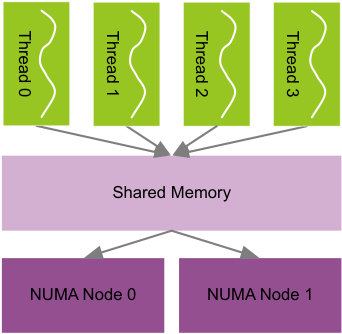 Figure 1
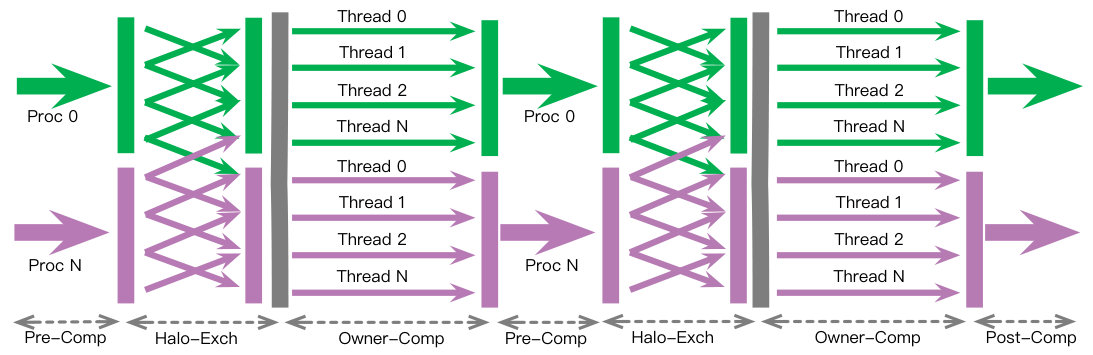 Figure 2
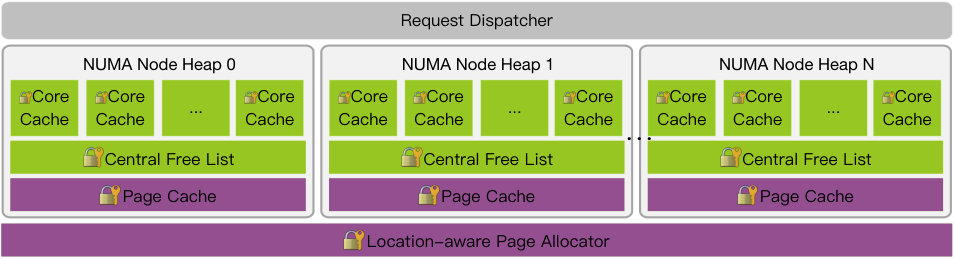 Figure 3
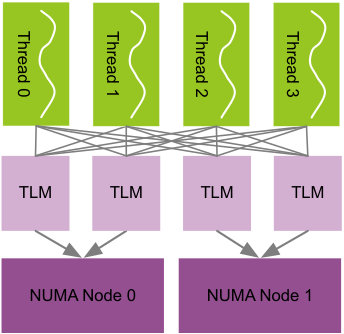 Figure 4
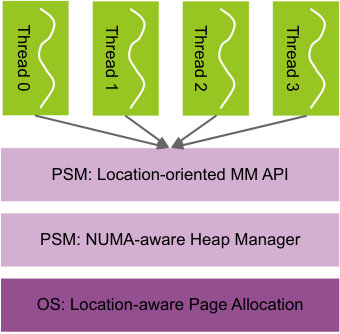 Figure 5
| Patch Size | 20x20 | 50x50 | 10x10x10 | 30x30x30 |
|---|---|---|---|---|
| Data size | 3200B | 4000B | 8000B | 216000B |
| 4K Page | 21.9% | 2.3% | 2.3% | 0.5% |
| 64K Page | 95.1% | 69.5% | 87.8% | 17.6% |
| 2M Page | 99.8% | 99.0% | 99.6% | 89.6% |
| Processor | Intel Xeon 7550 (8 Cores) |
|---|---|
| Number of Processors | 32 Sockets |
| Memory | DDR3 1600, 32GB on each socket, 1TB in total |
| Number of NUMA Nodes | 32 |
| NUMA Interconnect | SGI NumaLink 5 |
| Min/Max NUMA Distance | 1.0/6.8 (reported by the OS) |
| OS Kernel | Linux 2.6.32 |
| Threads | 8 | 16 | 32 | 64 | 128 | 192 | 256 |
|---|---|---|---|---|---|---|---|
| GLIBC | 0 | 0 | 5 | 389 | 1047 | 1962 | 2317 |
| TCMalloc | 0 | 112079 | 323038 | 779228 | 1684069 | 2598901 | N.A. |
| JArena | 0 | 0 | 0 | 0 | 0 | 0 | 0 |
| Threads | 8 | 16 | 32 | 64 | 128 | 192 | 256 |
|---|---|---|---|---|---|---|---|
| GLIBC | 0.052 | 0.227 | 1.039 | 1.907 | 5.121 | 7.957 | 11.48 |
| TCMalloc | 0.051 | 0.059 | 0.181 | 0.336 | 0.452 | 0.407 | N.A. |
| JArena | 0.039 | 0.035 | 0.041 | 0.053 | 0.078 | 0.113 | 0.134 |
| 2D Linear Advection | 3D Linear Advection | |||||||||||
|---|---|---|---|---|---|---|---|---|---|---|---|---|
| Threads | 8 | 16 | 32 | 64 | 128 | 256 | 8 | 16 | 32 | 64 | 128 | 256 |
| First Touch | 89.6 | 44.8 | 23.7 | 16.0 | 11.9 | 17.7 | 59.6 | 29.8 | 15.6 | 10.6 | 6.9 | 9.1 |
| JArena | 90.4 | 45.2 | 22.7 | 11.2 | 5.6 | 4.1 | 60.1 | 30.1 | 15.1 | 7.5 | 3.8 | 2.4 |
| Improvements | -0.01 | -0.01 | 0.04 | 0.43 | 1.1 | 3.3 | -0.01 | -0.01 | 0.03 | 0.41 | 0.82 | 2.8 |
| Threads | 8 | 16 | 32 | 64 | 128 | 256 |
|---|---|---|---|---|---|---|
| First Touch | 47.5 | 23.7 | 12.4 | 7.3 | 8.4 | 28.1 |
| JArena | 46.8 | 23.3 | 12.0 | 6.4 | 4.2 | 5.3 |
| Improvements | 0.01 | 0.02 | 0.03 | 0.14 | 1.0 | 4.3 |
Peer Reviews
No public reviews on file for this paper yet. If you reviewed it on a platform where reviews are public (OpenReview, ICLR, NeurIPS, ICML), you can paste yours below so the community can read it here.
Videos
No videos yet. Explain this paper in a talk, walkthrough, or lecture? Add one.
Taxonomy
TopicsParallel Computing and Optimization Techniques · Distributed and Parallel Computing Systems · Advanced Data Storage Technologies
lstlistingsection
11institutetext: Institute of Applied Physics and Computational Mathematics
11email: yang_zhang,zhang_aiqing,[email protected] 22institutetext: CAEP Software Center for High Performance Numerical Simulation
33institutetext: Key Laboratory of Computational Physics
JArena: Partitioned Shared Memory for NUMA-awareness in Multi-threaded
Scientific Applications
Zhang Yang 112233
Aiqing Zhang 112233
Zeyao Mo 1122
Abstract
The distributed shared memory (DSM) architecture is widely used in today’s computer design to mitigate the ever-widening processing-memory gap, and inevitably exhibits non-uniform memory access (NUMA) to shared-memory parallel applications. Failure to achieve full NUMA-awareness can significantly downgrade application performance, especially on today’s manycore platforms with tens to hundreds of cores. Yet traditional approaches such as first-touch and memory policy fail short in either false page-sharing, fragmentation, or ease-of-use. In this paper, we propose a partitioned shared memory approach which allows multi-threaded applications to achieve full NUMA-awareness with only minor code changes and develop a companying NUMA-aware heap manager which eliminates false page-sharing and minimizes fragmentation. Experiments on a 256-core cc-NUMA computing node show that the proposed approach achieves true NUMA-awareness and improves the performance of typical multi-threaded scientific applications up to 4.3 folds with the increased use of cores.
Keywords:
P
artitioned Shared Memory, NUMA-awareness, Heap Manager, Multithread, Manycore.
1 Introduction
The distributed shared-memory (DSM) architecture (a.k.a. NUMA) is becoming increasingly popular in computer design, especially in the manycore era. The Kinghts Landing generation of Intel Xeon Phi processors introduces sub-NUMA cluster modes for best possible performance, and the EPYC family of AMD processors uses NUMA as the major approach to maintain high memory bandwidth. ARM-based manycore processors such as Phytium 2000+ and Cavium ThunderX2 also incorporate NUMA either intra or inter sockets. Furthermore, most supercomputers configure their computing nodes as multiple NUMA domains.
Failure to achieve full NUMA-awareness can significantly downgrade the performance of multi-threaded parallel applications, which can go as large as 200% for memory-bounded applications on multi-socket cc-NUMA systems ([16]). Thus it is crucial for applications to achieve full NUMA-awareness to be performant. However, although special care has been taken in areas such as the MPI runtime ([15]) and graph analytics ([25]), the area of scientific applications still largely rely almost solely on OS-based approaches such as first-touch and memory policy. We argue in this paper that these approaches are far from optimal, in the sense of both performance and ease-of-use. To be short, these approaches suffer from both false page-sharing and fragmentation, due to the page-based memory management mechanism. Working around these shortcomings would require an application-specific redesign of both data structures and memory management schemes ([16]), which would soon become a burden for application developers.
To address the above problems, we propose a partitioned shared memory approach in this paper. Our approach consists of an application-level conceptual abstraction of partitioned shared memory and a companying NUMA-aware multi-threaded heap manager named JArena. The abstraction provides applications with a thread-partitioned view of shared memory and allows them to take full control of on which thread one memory block resides, thus enable them to achieve full NUMA-awareness with minor code changes. JArena in turn manages these memory blocks to make sure no page-sharing happens across NUMA nodes and reduces fragmentation with advanced segregated storage schemes, thus ensures NUMA-awareness. Compared to first-touch, our approach can improve the performance of real-world scientific applications up to 4.3 folds on a 256-core cc-NUMA system, with only minor code changes. In summary, this paper makes the following contributions:
Identify pitfalls of OS-provided NUMA-awareness approaches: We use both theoretical analysis and experiments to show that first-touch and memory policy would suffer from false page-sharing and fragmentation. 2. 2.
Propose a partitioned shared-memory NUMA-awareness approach: The proposed approach is conceptually simple yet adequate for full NUMA-awareness of multi-threaded scientific applications. 3. 3.
Design a NUMA-aware multi-threaded heap manager: We design and implement a general-purpose NUMA-aware multi-threaded heap manager which eliminates false page-sharing and reduces fragmentation.
The rest of this paper is structured as follows: We analyze the pitfalls of OS-based NUMA-awareness approaches in Sect. 2 and present the proposed partitioned shared memory approach in Sect. 3 and JArena heap manager in Sect. 4. Experimental results are shown in Sect. 5 and related works are presented in Sect. 6. Finally comes the conclusions and the outlooks in Sect. 7.
2 Pitfalls of OS-based NUMA-awareness Approaches
In this section, we analyze the pitfalls of OS-based NUMA-awareness approaches. Parallel scientific applications are often built upon the MPI+Thread model and exhibit execution patterns similar to Fig. 1. The application executes in locksteps and each lockstep often consists of a inter-thread exchange phase and an owner-computation phase. The combination of these two phases and multiple locksteps can make the memory access pattern highly irregular as those in multi-block applications[10] and sweepings[20].
The recommended approach for scientific applications to achieve NUMA-awareness is the “first-touch” approach, where the application arranges the owner of an data block to write to the pages first[11]. When first-touch is inadequate, explicit memory policy mechanisms such as “numactl”[13] are used to instruct the OS where a range of pages shall be placed. Behind the scene, the OS may introduce statistics-based automatic page migration to further “optimize” locality ([8, 9]). These OS-based NUMA-awareness approaches suffer from both performance and ease-of-use.
Firstly, since OS-based approaches can only work with fix-sized pages and applications usually work with variable-sized blocks, fragmentation can become significant. For typical single-thread patch sizes in structured-grid scientific applications such as Uintah[1] and JASMIN[19], one can computed the fragmentation rate on different page sizes as in Table 1. Even with 4K page, one can waste 21.9% the memory in extreme cases. And for huge pages such as the 2MB page on x86_64, the fragmentation is unacceptably high.
Secondly, to mitigate the fragmentation, heap managers will kick in and share the page among threads. Since a page can reside on only one NUMA node, this creates a phenomenon which we call “false page-sharing”, where although each thread instructs the heap manager the requested memory block shall be local, at least one thread will get remote blocks, which causes unnecessary remote memory access. In case of automatic page migration, false page-sharing can cause significant performance degradation like those in cache false-sharing, where the page is constantly migrated back and forth among accessing threads.
Thirdly, for real-world applications, simple approaches such as first-touch can be inviable. For example, in multi-block applications[10] and algebraic multigrid methods[6], the first thread writing to a page are often not the most frequent writer and first-touch simply would not work. The only option is to explicitly mark memory location with the numactl API, which can be extremely costly as indicated in Sect. 5. Even in cases where first-touch do work, due to the complexity of data access patterns, automatic page migration can often make wrong decisions about what page shall be moved and causes unnecessary migration overheads as in our experiments in Sect. 5.
To address the pitfalls above, applications would retreat to carefully arranging their memory access or taking control of heap management in an application-specific way, which would soon become an unacceptable burden on application developers, thus hurt the ease-of-use. These facts motivate us to seek a reliable yet general way for NUMA-awareness in multi-threaded scientific applications.
3 Partitioned Shared Memory for NUMA-awareness of Multi-threaded Applications
We propose a “partitioned shared memory” approach as a remedy to the pitfalls of OS-based NUMA-awareness approaches. This approach is a co-design among applications, runtime system and the underlying OS.
The key idea of partitioned shared memory is illustrated in Fig. 2. Similar to the idea of “partitioned global address space” idea in parallel languages such as UPC[5], threads on a computing node partition the OS-provided global view of node’s memory into several thread-local regions (thread local memory, or TLM), and each thread’s local memory is bind to the thread’s running NUMA node. This abstraction provides the application the mechanism to achieve full NUMA-awareness without the limits of OS-based ones. For applications using “owner-compute” rule, the initializing thread simply allocates data blocks in the owner thread’s local memory. This is similar to first-touch but much more flexible, since the owner does not need to be the first writer now. This directly enables NUMA-awareness in applications with complex initialization such as multi-block applications and algebraic multigrid methods where “owner-compute” still holds. Even for those do not use “owner-compute”, as long as one can infer which thread would be the most frequent consumer of a data block as in almost all scientific applications, NUMA-awareness can still be achieved by allocating the memory in that consumer’s local memory. Thus the partitioned share memory approach enables full NUMA-awareness in multi-threaded scientific applications.
The partitioned shared memory software stack as illustrated in Fig. 2c addresses other pitfalls of OS-based approaches. Firstly, unlike OS-based approaches, it works at the runtime level and serves memory as variable-sized blocks instead of fix-sized pages, thus reduces fragmentation. Secondly, since pages can be shared among threads on the same NUMA node but never shared among threads on different NUMA nodes, false page-sharing is eliminated while keeping the fragmentation low. Thirdly, this approach remains easy-to-use besides the ability to achieve full NUMA-awareness in complex real-world applications, since the only changes to application code are memory allocation calls where the allocator shall supply on which thread shall the memory block resides. Lastly, since this approach only requires the OS to ensure a page is bind to the specified NUMA node, it is portable.
The key ingredient of partitioned shared memory is that the heap management shall be NUMA-aware and shall be able to handle allocation requests with location constraints, which will be addressed by our JArena heap manager in Sect. 4.
4 JArena: A NUMA-aware Multi-threaded Heap Manager
To support the partitioned shared memory abstraction, as well as to eliminate false page-sharing, reduce fragmentation and mitigate overhead caused by page allocation and binding, we design and develop a NUMA-aware multi-threaded heap manager JArena. JArena provides two fundamental memory management APIs:
location-aware allocation: void* psm_alloc(size_t bytes, int owner) 2. 2.
location-free deallocation: void psm_free(void* p)
The challenges for JArena heap manager come from three aspects: firstly, the manager shall always return blocks from correct locations; secondly, the manager shall eliminate false page-sharing and reduce fragmentation; thirdly, the implementation shall be thread-safe and scalable with tens to hundreds of cores.
4.1 NUMA-aware and multithread-optimized design of JArena
JArena stems from the TCMalloc heap manager[7]. TCMalloc is a heap manager optimized for multicore systems, with the ability of low fragmentation from the carefully-designed segregated storage scheme. To improve scalability, TCMalloc introduces per-core block caches and a two-level block management scheme consisting of “thread cache + central free list”. However, TCMalloc is not NUMA-aware and suffers from both false page-sharing and returning remote blocks.
We extend the TCMalloc design to that in Fig. 3. Instead of treating the heap as a whole, we divide it into several independent NUMA node heaps, each manages memory blocks belonging to one NUMA node in the same way as TCMalloc. Threads are binding to cores and the pcm_alloc(bytes, tid) call will be satisfied by the heap on whose NUMA node tid resides. This design eliminates false page-sharing, and reduces fragmentation by making use of the advanced segregated storage scheme in TCMalloc, thus achieves NUMA-awareness. This design also improves the scalability, since except for the location-aware page allocator which allocates pages on a certain NUMA node, all locks are local to a NUMA node heap. Together with the multicore optimization of TCMalloc, this design can scale to tens to hundreds of cores.
4.2 Location-aware block serving and recycling
With the NUMA-aware design, the remaining problem is how to ensure the blocks are served correctly with the multi-level block caching. This property is ensured by the location-aware block serving and recycling algorithm, which is an extension of corresponding algorithms in TCMalloc[7].
To serve an allocation request psm_alloc(bytes, tid), JArena first identifies the core on which thread tid resides, then locks and asks the corresponding core cache to serve the block. If the core cache can not serve the block, it will lock the connected central free list and ask for a run of blocks matching the requested size, who will in turn lock and asks the page allocator to allocate and bind new pages if not able to fulfill that request. Since many threads may request blocks from the same thread, the lock on core cache are mandatory. But in case where these concurrent requests are sparse, these locks shall not have a significant impact on performance.
To recycle a memory block, JArena first queries all NUMA node heaps for who owns the block, which is done by checking the address against a two-level page map in “Page Cache”. Then if the block belongs to the same NUMA node heap the requesting thread resides, the block is simply returned to the corresponding core cache for recycling. Otherwise, the block is returned to the central free list of the owning NUMA node heap for recycling. Further recycling is done by each NUMA node heap using the same algorithm as TCMalloc.
With the above location-aware block serving and recycling and the above NUMA-aware multithread-optimized design, JArena addresses the challenges as in the beginning of this section.
5 Experimental Evaluation
In this section, we evaluate the performance of the proposed partitioned shared memory NUMA-awareness approach. We first verify that the design and algorithms in JArena ensures correct location-aware block serving. Then we compare our partitioned shared memory against the widely used first-touch approach with real-world multi-threaded scientific applications.
Details of our experimental platform is shown in Table 2. This platform exhibits similar NUMA effect to modern manycore processors with a cc-NUMA architecture with 32 NUMA nodes. To bind threads and avoid performance jitters, all threads are bind the CPU cores with KMP_AFFINITY=compact in all our experiments. Thus thread is always bind to core and NUMA node .
5.1 Verification of NUMA-awareness in JArena
We design a synthetic benchmark to check if heap managers ensure local allocation as LABEL:lst:jarena-verify-bench. To emulate the complex but common case where thread other than the owner frees the memory (for examples modern C++ applications using smart pointers), each thread will allocate 64 1MB block, write to them, and free those of the left neighbour. The benchmark kernel is run once to warm-up the heap manager, then repeated 5 times, where remote pages are checked using the get_mempolicy system call or the page writing time is measured. We want to check if the heap manager is able to retain memory pages as local. Obviously, a NUMA-aware heap manager shall contains zero remote pages. We compare JArena with the default heap manager in GLIBC (namely ptmalloc2) and TCMalloc.
The remote page counts for for GLIBC, TCMalloc and JArena are shown in Table 3. It indicates that JArena correctly returns local pages and is NUMA-aware while TCMalloc returns more remote pages with the increase of threads due to its NUMA-unawareness and block caching design. It is surprising that GLIBC returns several remote pages, since for 1MB memory block, it retreats to system mmap and is actually first-touch. It reveals that spurious remote page allocation can happen on such cc-NUMA systems even when first-touch is used.
The page writing time as presented in Table 4 shows a similar trend. Memory blocks from JArena take the least time to write since pages are local, while those from TCMalloc take 4 times more time since there are many remote pages. Those from GLIBC take surprisingly long time (100 times more with 256 threads) because the page allocation under the scene dominates the overall time. This fact indicates that naive first-touch or memory policy can be extremely costly on such cc-NUMA systems and block-caching heap managers are necessary.
5.2 Application performance with partitioned shared memory
We now test the effectiveness of the proposed partitioned shared memory approach with real-world multi-threaded scientific applications. We choose two applications: a 2D/3D linear advection application sample[19] and an electromagnetic package JEMS-FDTD[14] with FDTD scheme. Both applications are memory-bounded and adhere to the “owner-compute” rule and static load balancing, thus make a good candidate to compare the performance of first-touch and partitioned shared memory. We modify the memory allocation in these applications so either the owner thread of a patch first-touches the memory or make use of psm_alloc to allocate memory locally.
We first show result of the linear advection application sample in Table 5, where the wall time of numerical computing for 100 time steps is aggregated. It concludes that with the increase of NUMA nodes, the application performs increasingly better than first-touch. JArena starts to gain advantage at 64 threads and achieves maximum improvements of 3.3 and 2.8 folds for 2D/3D cases respectively. Further investigation shows that in case where multiple halo-exchange and computation locksteps are involved, under first-touch, the OS either places pages in remote NUMA nodes or migrates pages at times, thus it is necessary for approaches such as partitioned shared memory proposed in this paper.
We then show results of JEMS-FDTD solving a plane-wave scattering problem with 100 time steps in Table 6. The data show similar trends as of the linear advection application sample, where JArena performs increasingly better than first-touch with the increase of NUMA nodes. JArena starts to gain advantage at 64 threads and achieves maximum improvements of 4.3 folds at 256 threads. The spurious increase of computation with 256 threads needs further investigation, but may be caused by overhead in the cc-NUMA protocols.
6 Related Works
First-touch has long been recommended as the major approach for multi-threaded scientific applications as suggested in [23, 11] and practiced by applications such as stencils[24]. Beyond first-touch, advanced page placements such as the numactl API[13] and automatic page migration[8] and balancing[9] are introduced in the Linux kernel. However, these OS-based approaches can suffer from false page-sharing and fragmentation, as well as imperfect OS optimization as suggested by this paper and in algorithmic skeletons by [18].
To hide the complexity of NUMA while optimizing the performance, runtime-based approaches are widely exploited, such as NUMA-aware OpenMP[3] and TBB[17]. Task-based runtimes and frameworks also make extensive NUMA-aware optimizations as those in PaRSEC[2], Charm++[21] and Boxlib[26]. Except for domain-specific frameworks such as Boxlib and Uintah, these optimizations can not achieve full NUMA-awareness in complex applications since they rely on assumptions of applications’ data access patterns. And domain-specific frameworks can be restricted in their application domains.
Similar to the co-design idea in this paper, Pousa Ribeiro et.al. proposed Minas to allow application to explicitly manage or automatically tune their memory affinity in [22]. Their approach does not introduce the partitioned shared memory abstraction thus leaves all complexity to the application. Other approaches based on NUMA-aware heap managers include a NUMA-aware TCMalloc [12] and memkind [4], which also fall short of application-level conceptual abstractions such as partitioned shared memory. The partitioned shared memory approach borrows from the PGAS idea in parallel languages such as UPC[5].
7 Conclusion and Outlook
To address the drawbacks of traditional OS-based NUMA-awareness approaches and achieve full NUMA-awareness in multi-threaded parallel scientific applications, we propose a partitioned shared memory approach in this paper, which consists of an application-level conceptual abstraction of partitioned shared memory and a companying NUMA-aware multi-threaded heap manager named JArena. The partitioned shared memory abstraction enables parallel applications to explicitly reason which thread shall own the allocated block, thus maximizes their ability to achieve NUMA-awareness and preserve locality. JArena then ensures allocated blocks are pinned to the owner’s local memory. JArena manages memory at the block granularity which eliminates false page-sharing and minimizes fragmentation. Owing to the full NUMA-awareness possibility of this approach, real-world multi-threaded scientific applications such as JEMS-FDTD can improve up to 4.3 folds the performance on a 256-core cc-NUMA system.
One shortcoming of the proposed approach is that the application shall label explicitly which thread shall own the block to allocate. We would like to investigate the possibility to infer this information with the help of a task-based runtime such as Legion, StarPU, and PaRSEC. We also plan to optimize the heap manager algorithms for better performance and scalability.
Acknowledgments
The authors would like to thank Dr. Linping WU from High Performance Computing Center of Institute of Applied Physics and Computational Mathematics for his help on understanding the OS interferences on cc-NUMA systems. Dr. Xu LIU and Dr. Xiaowen XU contribute several key ideas to the refinement of this paper.
The reference list from the paper itself. Each links out to its DOI / PubMed record.
- 1[1] Berzins, M., Beckvermit, J., Harman, T., Bezdjian, A., Humphrey, A., Meng, Q., Schmidt, J., Wight, C.: Extending the Uintah Framework through the Petascale Modeling of Detonation in Arrays of High Explosive Devices. SIAM Journal on Scientific Computing 38 (5), S 101–S 122 (2016)
- 2[2] Bosilca, G., Bouteiller, A., Danalis, A., Faverge, M., Herault, T., Dongarra, J.J.: Pa RSEC: Exploiting heterogeneity to enhance scalability. Computing in Science and Engineering 15 (6), 36–45 (2013)
- 3[3] Broquedis, F., Furmento, N., Goglin, B., Wacrenier, P.A., Namyst, R.: Forest GOMP: an efficient Open MP environment for NUMA architectures. International Journal of Parallel Programming 38 (5-6), 418–439 (2010)
- 4[4] Cantalupo, C., Venkatesan, V., Hammond, J., Czurlyo, K., Hammond, S.D.: memkind: An extensible heap memory manager for heterogeneous memory platforms and mixed memory policies. Tech. rep., Sandia National Lab.(SNL-NM), Albuquerque, NM (United States) (2015)
- 5[5] El-Ghazawi, T., Smith, L.: UPC: unified parallel C. In: Proceedings of the 2006 ACM/IEEE conference on Supercomputing. p. 27. ACM (2006)
- 6[6] Falgout, R.D., Yang, U.M.: hypre: A library of high performance preconditioners. In: International Conference on Computational Science. pp. 632–641. Springer (2002)
- 7[7] Ghemawat, S., Menage, P.: TC Malloc: Thread-caching malloc (2009), https://gperftools.github.io/gperftools/tcmalloc.html
- 8[8] Goglin, B., Furmento, N.: Enabling high-performance memory migration for multithreaded applications on Linux. In: Proceedings of the 2009 IEEE International Symposium on Parallel & Distributed Processing (IPDPS 09). pp. 1–9. IEEE (2009)