Transferring the quantum state of electrons across a Fermi sea with Coulomb interaction
H. Duprez, E. Sivre, A. Anthore, A. Aassime, A. Cavanna, U. Gennser,, F. Pierre

TL;DR
This paper demonstrates a novel quantum teleportation mechanism for electrons across a metallic island using Coulomb interactions, enabling high-fidelity quantum state transfer over large distances in the quantum Hall regime.
Contribution
It introduces a new method of electron quantum state transfer leveraging Coulomb interactions and charge freezing, with potential for entanglement of flying qubits.
Findings
Quantum teleportation of electron states demonstrated.
High-fidelity state imprinting achieved over separated locations.
Potential for decoherence-free entanglement of propagating electrons.
Abstract
The Coulomb interaction generally limits the quantum propagation of electrons. However, it can also provide a mechanism to transfer their quantum state over larger distances. Here, we demonstrate such a form of teleportation, across a metallic island within which the electrons are trapped much longer than their quantum lifetime. This effect originates from the low temperature freezing of the island's charge which, in the presence of a single connected electronic channel, enforces a one-to-one correspondence between incoming and outgoing electrons. Such high-fidelity quantum state imprinting is established between well-separated injection and emission locations, through two-path interferences in the integer quantum Hall regime. The added electron quantum phase of can allow for strong and decoherence-free entanglement of propagating electrons, and notably of flying qubits.
Click any figure to enlarge with its caption.
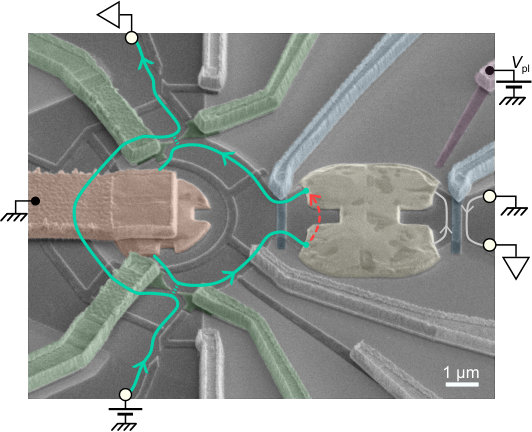 Figure 1
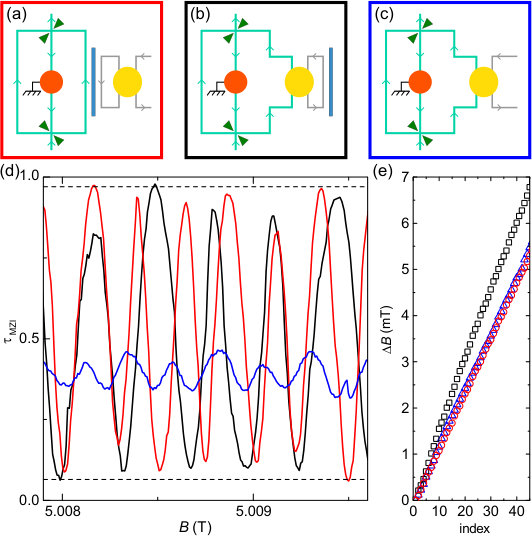 Figure 2
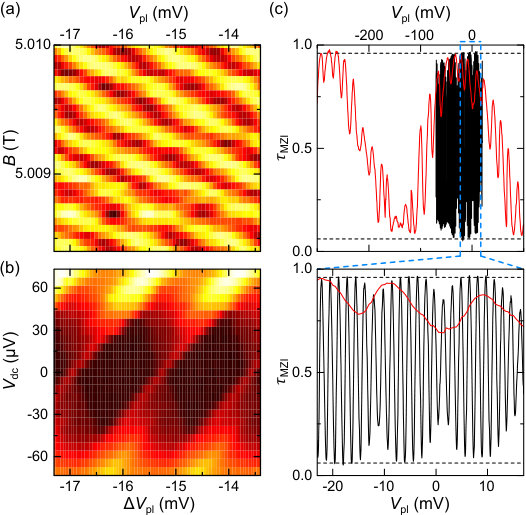 Figure 3
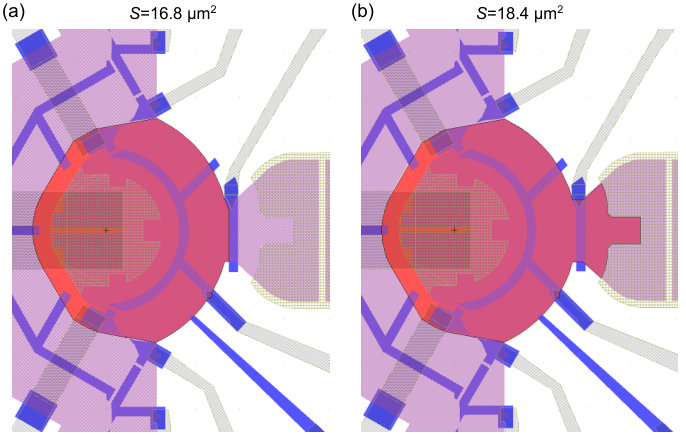 Figure 4
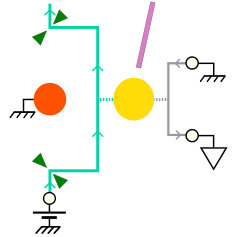 Figure 5
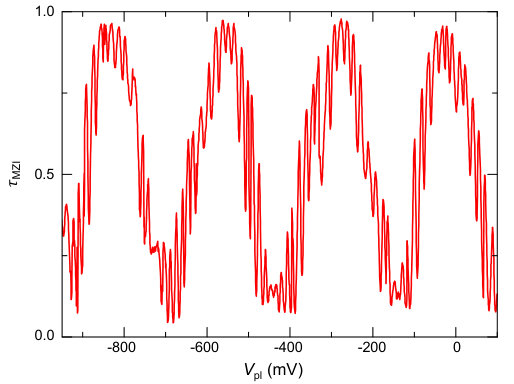 Figure 6
 Figure 7
Peer Reviews
No public reviews on file for this paper yet. If you reviewed it on a platform where reviews are public (OpenReview, ICLR, NeurIPS, ICML), you can paste yours below so the community can read it here.
Videos
No videos yet. Explain this paper in a talk, walkthrough, or lecture? Add one.
Transferring the quantum state of electrons across a Fermi sea with Coulomb interaction
H. Duprez
These authors contributed equally to this work.
Centre de Nanosciences et de Nanotechnologies (C2N), CNRS, Univ Paris Sud, Université Paris-Saclay, 91120 Palaiseau, France
E. Sivre
These authors contributed equally to this work.
Centre de Nanosciences et de Nanotechnologies (C2N), CNRS, Univ Paris Sud, Université Paris-Saclay, 91120 Palaiseau, France
A. Anthore
Centre de Nanosciences et de Nanotechnologies (C2N), CNRS, Univ Paris Sud, Université Paris-Saclay, 91120 Palaiseau, France
Univ Paris Diderot, Sorbonne Paris Cité, 75013 Paris, France
A. Aassime
Centre de Nanosciences et de Nanotechnologies (C2N), CNRS, Univ Paris Sud, Université Paris-Saclay, 91120 Palaiseau, France
A. Cavanna
Centre de Nanosciences et de Nanotechnologies (C2N), CNRS, Univ Paris Sud, Université Paris-Saclay, 91120 Palaiseau, France
U. Gennser
Centre de Nanosciences et de Nanotechnologies (C2N), CNRS, Univ Paris Sud, Université Paris-Saclay, 91120 Palaiseau, France
F. Pierre [email protected] [email protected]
Centre de Nanosciences et de Nanotechnologies (C2N), CNRS, Univ Paris Sud, Université Paris-Saclay, 91120 Palaiseau, France
Abstract
The Coulomb interaction generally limits the quantum propagation of electrons. However, it can also provide a mechanism to transfer their quantum state over larger distances. Here, we demonstrate such a form of teleportation, across a metallic island within which the electrons are trapped much longer than their quantum lifetime. This effect originates from the low temperature freezing of the island’s charge which, in the presence of a single connected electronic channel, enforces a one-to-one correspondence between incoming and outgoing electrons. Such high-fidelity quantum state imprinting is established between well-separated injection and emission locations, through two-path interferences in the integer quantum Hall regime. The added electron quantum phase of can allow for strong and decoherence-free entanglement of propagating electrons, and notably of flying qubits.
A disordered environment, with a large number of interacting degrees of freedom, is generally considered as the nemesis of quantum technologies. This is exemplified by a metallic island, often pictured as a reservoir of thermal electrons, with its large energy density of states and limited number of connected electronic channels. Indeed, the interval between inelastic collisions destroying the quantum coherence of the electrons Nazarov & Blanter (2009); Pierre et al. (2003) is typically much smaller than their dwell time inside the island ( for perfect channels Brouwer & Büttiker (1997), with the Planck constant). However, we show experimentally that the Coulomb interaction in such an island can, under the right circumstances, lead to a near perfect preservation of the quantum state of electrons transferred across it. In the employed quantum Hall regime implementation, where injection and emission points are physically separated by chirality, this constitutes a form of teleportation of the electrons’ states without transmitting the physical particles themselves. This phenomenon is different from the standard ‘quantum teleportation’ protocol Bennett et al. (1993), and similar to the ‘electron teleportation’ proposed in Fu (2010).
The voltage probe model of a metallic Fermi sea Büttiker (1988) is widely used to mimic the electrons’ quantum decoherence and energy relaxation toward equilibrium (see e.g. Blanter & Büttiker (2000) and references therein). However, independent absorption and emission of electrons result in fluctuations of the total island charge , with a characteristic charging energy (with the geometrical capacitance of the island and the elementary electron charge). At low temperatures (with the Boltzmann constant) this energy is not available, and the macroscopic quantum charge state is effectively frozen Slobodeniuk et al. (2013); Idrisov et al. (2018) (although not quantized in units of as long as one channel is perfectly connected Matveev (1995); Nazarov (1999); Jezouin et al. (2016)). Consequently, correlations develop between absorbed and emitted electrons. These culminate if only one transport channel is connected to the island, in which case theory predicts that the electrons entering it and those exiting it are in identical quantum states Clerk et al. (2001); Idrisov et al. (2018). Effectively, the electronic states within the connected quantum channel are decoupled from the many quasiparticles within the island, despite the fact that the incoming (outgoing) physical electron particles penetrate into (originate from) the island. Another consequence is that heat evacuation from the island’s internal states along the channel is fully suppressed Slobodeniuk et al. (2013). In contrast, in the presence of two or more open channels the coherence is lost Idrisov et al. (2018), and heat evacuation is restored in agreement with the recently observed systematic heat Coulomb blockade of one ballistic channel Sivre et al. (2018). Interestingly, the ‘electron teleportation’ proposed in Fu (2010) also relies on the ‘all-important’ Coulomb charging energy of a small island, although combined in that case with Majorana bound states in an altogether different mechanism.
We demonstrate the high-fidelity replication of electron quantum states across a metallic island through quantum interferences. For this purpose, an injected current is first split along two separate paths that are subsequently recombined, thereby realizing an electronic Mach-Zehnder interferometer (MZI). In contrast with usual MZI implementations Ji et al. (2003); Roulleau et al. (2007); Litvin et al. (2007); Bieri et al. (2009); Duprez et al. (2019), one of the paths can controllably be diverted toward a small floating metallic island (see Fig. 1). In that case, any two-path quantum interferences involve both the initial electrons (direct left path) and the reemitted ones (interrupted right path, assuming a perfect contact with the island). Therefore a high interference visibility directly ascertains a high fidelity of the electron state replication.
A colorized e-beam micrograph of the measured device is shown in Fig. 1. The sample was nanofabricated from a high-mobility Ga(Al)As two dimensional electron gas, and immersed in a perpendicular magnetic field T corresponding to the integer quantum Hall filling factor . In this regime, two quantum Hall channels co-propagate along the edges (the electron gas was etched away in the brighter areas), and the MZI is formed using only the outer edge channel. The followed paths are represented by thick lines with arrows for the configuration where one MZI arm goes through the floating metallic island (corresponding schematic shown in Fig. 2(b)). The two MZI beam splitters, each tuned to half transmission, are realized with quantum point contacts formed by field effect using split gates (colored green; the inner quantum Hall channel, not shown, is fully reflected). One of the two MZI outputs is the small central metallic electrode (orange), which is grounded through a suspended bridge. The quantum interferences are characterized by the oscillations of the current transmitted to the second MZI output formed by a much larger electrode 60 m away (represented in Fig. 1 by the top white circle), while sweeping either the magnetic field or the voltage applied to a lateral plunger gate (purple). The floating metallic island (yellow) consists of of a gold-germanium-nickel alloy diffused into the Ga(Al)As heterojunction by thermal annealing. From the typical metallic density of states of such metals ( for gold, the main constituent), the electronic dwell time is s. This is much longer, by more than three orders of magnitude, than the energy relaxation and phase decoherence times of electrons observed in similar metals, which is at most in the ns range Pierre et al. (2003); Bäuerle et al. (2005). In the absence of Coulomb-induced correlations, no interferences would therefore be expected from the reemitted electrons, by a wide margin. The gates barring the broad way on each side of the floating island (blue) are normally tuned to either fully reflect or fully transmit the outer edge channel, in order to implement the MZI configurations schematically represented Figs. 2(a,b,c). Note that the second (inner) quantum Hall edge channel is always completely reflected at the barring gate, and can therefore be ignored Idrisov et al. (2018). The island charging energy K was obtained from standard Coulomb diamond measurements (in a specifically tuned tunnel regime, see Fig. 3(b) and sm (????)). At the experimental electronic temperature mK (measured on-chip from shot noise Iftikhar et al. (2016)), the criterion for fully developed Coulomb-induced correlations is therefore well verified. Note the previous experiments performed in the opposite ‘high-temperature’ regime of negligible Coulomb correlations, in which case, unsurprisingly, a complete quantum decoherence Roulleau et al. (2009) and energy relaxation Altimiras et al. (2010) of electrons were observed with a single connected channel. Finally, the transparency of the contact between the floating island and the outer quantum Hall edge channel plays an essential role since, if it is poor, many electrons would simply be reflected at the interface. Here, % of the incoming current penetrates into the floating island sm (????), which is also ascertained by the striking changes of behavior detailed later.
In Fig. 2, we show illustrative MZI oscillations versus of , the fraction of outer edge channel current transmitted across the device. The measurements were performed in the three configurations depicted in Figs. 2(a,b,c). The red continuous line in Fig. 2(d) corresponds to a standard electronic MZI, with the floating metallic island bypassed (schematic in Fig. 2(a)). In that case, the oscillations are of high visibility and, as expected for the Aharonov-Bohm phase, the magnetic field period of T (red symbols in Fig. 2(e) show consecutive extrema positions) closely corresponds to one flux quantum ( using the nominal area ). A small asymmetry in the data (the average is slightly above ) results from a small reflection of the outer edge channel on the grounded central ohmic contact (of , see sm (????)). The black continuous line in Fig. 2(d) was measured with the right MZI arm deviated to go through the floating ohmic island (edge channel paths displayed in Fig. 1, and schematic in Fig. 2(b)). We observe first that the quantum interferences’ visibility remains of the same high amplitude, which corresponds to a perfect fidelity (at experimental accuracy) of the replicated quantum states imprinted on the electrons reemitted from the island, in agreement with low temperature predictions Clerk et al. (2001); Idrisov et al. (2018). Second, the magnetic field period of T is found to be larger than in the standard MZI configuration of Fig. 2(a) (see black symbols in Fig. 2(e)). This increase is opposite to the reduction that would be expected from the Aharonov-Bohm period with the larger surface enclosed by the outer channel path and the inner boundary of the floating metallic island (see sm (????) for a graphical representation, would correspond to an Aharonov-Bohm period of ). Such opposite evolution and relatively important discrepancy (36%) establish that the MZI phase does not reduce to the usual Aharonov-Bohm phase acquired by a single electron propagating along two different paths. Instead, the larger period corroborates the transfer of the electrons’ state across the island, thereby amputating the electron path from a section (the 2DEG/metal interface) and making the Aharonov-Bohm notion of enclosed surface ill-defined.
The blue continuous line in Fig. 2(d) was measured with one MZI arm going through the floating island, and in the presence of a second electronic channel connected to it (configuration schematically displayed in Fig. 2(c)). We find strongly suppressed conductance oscillations corresponding to a full decoherence of the electrons going through the island. The residual visibility is consistent with the proportion of reflected electrons, not penetrating into the island. Indeed, the MZI contribution of the reflected electrons at small reads , with the MZI visibility in the standard configuration Roulleau et al. (2009); sm (????). The magnetic field period of T for these smaller oscillations (see blue symbols in Fig. 2(e)) is found close to the period observed in the standard MZI configuration shown in Fig. 2(a), suggesting that the residual reflections take place at the level of the barring gate (colored blue, left of island in Fig. 1). Note that the average is shifted below because part of the injected current is evacuated toward a remote electrical ground through the second channel connected to the floating island ( expected from current conservation for a floating island and a central ohmic contact both perfectly connected).
We now investigate the relation between the island’s charge and the electron phase shift associated with the quantum state transfer. For this purpose, Fig. 3 focuses on the influence on of the voltage applied to a plunger gate (colored purple in Fig. 1) which is relatively far from the MZI outer quantum Hall channel, but close to the island. The equivalent role on the MZI phase of and is first directly established, in Fig. 3(a), with the device set in the floating island MZI configuration (schematic in Fig. 2(b)). Figure 3(b) displays Coulomb diamond measurements of the conductance across the island as a function of the same plunger gate voltage , with here the island weakly connected through tunnel barriers such that is quantized in units of (only in that specific case) and without two-path interferences (see device schematic in sm (????)). Remarkably, the MZI gate voltage period in Fig. 3(a) precisely matches the Coulomb diamonds’ period in Fig. 3(b), as can be seen by directly comparing the two panels plotted using the same scale. In the floating MZI limit of strongly connected channels , with mV the Coulomb diamond period Matveev (1995); Nazarov (1999); Jezouin et al. (2016). A quantum phase shift of therefore applies to the transferred electrons, as specifically predicted theoretically Clerk et al. (2001); Idrisov et al. (2018), and in agreement with Friedel’s sum rule. Comparing with the device set in the standard MZI configuration, we show in Fig. 3(c) that the oscillations (red line) are of identical maximum visibility than with one arm going through the metallic island (black line), as also seen versus magnetic field in Fig. 2(d). However, the period is increased by a large factor of 160, from mV to 270 mV, which reflects the weak coupling of the plunger gate voltage to the MZI outer edge channel (see sm (????) for an extended range). This provides a final evidence that the electrons contributing to the quantum oscillations in the floating island configuration indeed penetrate into the metal. Note the presence of an additional, smaller signal of fixed period 15 mV visible in both configurations (in the form of direct oscillations or of an amplitude modulation), which might originate from the progressive charging of a nearby defect.
This experimental work demonstrates that the Coulomb interaction has two facets. It can both destroy and preserve quantum effects. Although a metallic island is often pictured as a floating reservoir of uncorrelated electrons Büttiker (1988); de Jong & Beenakker (1996), we establish that a high-fidelity electron quantum state transfer can take place across it, enforced by the Coulomb charging energy. This provides a mean to overcome limitations imposed by the decoherence of individual electrons. Moreover, the observed universal electron phase shift for one elementary charge on the island allows for a strong entanglement of single-electron states, both between themselves or with other quantum degrees of freedom, with a negligible loss of coherence. Such controllable, strong-coupling mechanism constitutes a key element in the context of quantum Hall edges envisioned as platforms for the manipulation and transfer of quantum information via propagating electrons Bertoni et al. (2000); Ionicioiu et al. (2001); Stace et al. (2004); Bocquillon et al. (2014); Glattli & Roulleau (2017); Bäuerle et al. (2018); Duprez et al. (2019). In particular, it is remarkably well suited to implement quantum gates for these ‘flying qubits’, such as the CNOT proposal involving a conditional phase shift of described in Glattli & Roulleau (2017).
Acknowledgments
This work was supported by the French RENATECH network, the national French program ‘Investissements d’Avenir’ (Labex NanoSaclay, ANR-10-LABX-0035) and the French National Research Agency (project QuTherm, ANR-16-CE30-0010).
E.S. and H.D. performed the experiment and analyzed the data with inputs from A.Aa., A.An. and F.P.; F.P. fabricated the sample with inputs from E.S and H.D.; A.C., and U.G. grew the 2DEG; F.P. led the project and wrote the manuscript with inputs from A.Aa., A.An., E.S., H.D. and U.G.
We thank P. Brouwer, L. Glazman, C. Mora, Y. Oreg and E. Sukhorukov for illuminating discussions.
The reference list from the paper itself. Each links out to its DOI / PubMed record.
- 1Nazarov & Blanter (2009) Nazarov, Y. & Blanter, Y. Quantum Transport (Cambridge University Press, 2009).
- 2Pierre et al. (2003) Pierre, F. et al. Dephasing of electrons in mesoscopic metal wires. Phys. Rev. B 68 , 085413 (2003).
- 3Brouwer & Büttiker (1997) Brouwer, P. & Büttiker, M. Charge-relaxation and dwell time in the fluctuating admittance of a chaotic cavity. Europhys. Lett. 37 , 441–446 (1997).
- 4Bennett et al. (1993) Bennett, C. et al. Teleporting an unknown quantum state via dual classical and Einstein-Podolsky-Rosen channels. Phys. Rev. Lett. 70 , 1895–1899 (1993).
- 5Fu (2010) Fu, L. Electron Teleportation via Majorana Bound States in a Mesoscopic Superconductor. Phys. Rev. Lett. 104 , 056402 (2010).
- 6Büttiker (1988) Büttiker, M. Coherent and Sequential Tunneling in Series Barriers. IBM J. Res. Dev. 32 , 63–75 (1988).
- 7Blanter & Büttiker (2000) Blanter, Y. M. & Büttiker, M. Shot Noise in Mesoscopic Conductors. Phys. Rep. 336 , 1–166 (2000).
- 8Slobodeniuk et al. (2013) Slobodeniuk, A., Levkivskyi, I. & Sukhorukov, E. Equilibration of quantum Hall edge states by an Ohmic contact. Phys. Rev. B 88 , 165307 (2013).