A remark on Gromov-Witten-Welschinger invariants of $\mathbb{C} P^3\#\overline{\mathbb{C} P}^3$
Yanqiao Ding

TL;DR
This paper extends the formula for Gromov-Witten-Welschinger invariants from complex projective space to a blow-up of it, linking real and complex enumerative invariants through geometric constructions.
Contribution
It generalizes existing invariants formulas to a new class of complex surfaces, connecting invariants of blow-ups with those of simpler surfaces using pencils of quadrics.
Findings
Formulas for invariants of P^3 P^3A0# P^3 P^3A0 with explicit computations.
Expresses invariants of the blow-up as combinations of invariants of P^2 P^2A0 blown up at two real points.
Provides tools for calculating real enumerative invariants in more complex geometries.
Abstract
We generalize the formula of Gromov-Witten-Welschinger invariants of established by E. Brugall\'e and P. Georgieva in [BG16b] to . Using pencils of quadrics, some real and complex enumerative invariants of can be written as the combination of the enumerative invariants of the blow up of at two real points.
Click any figure to enlarge with its caption.
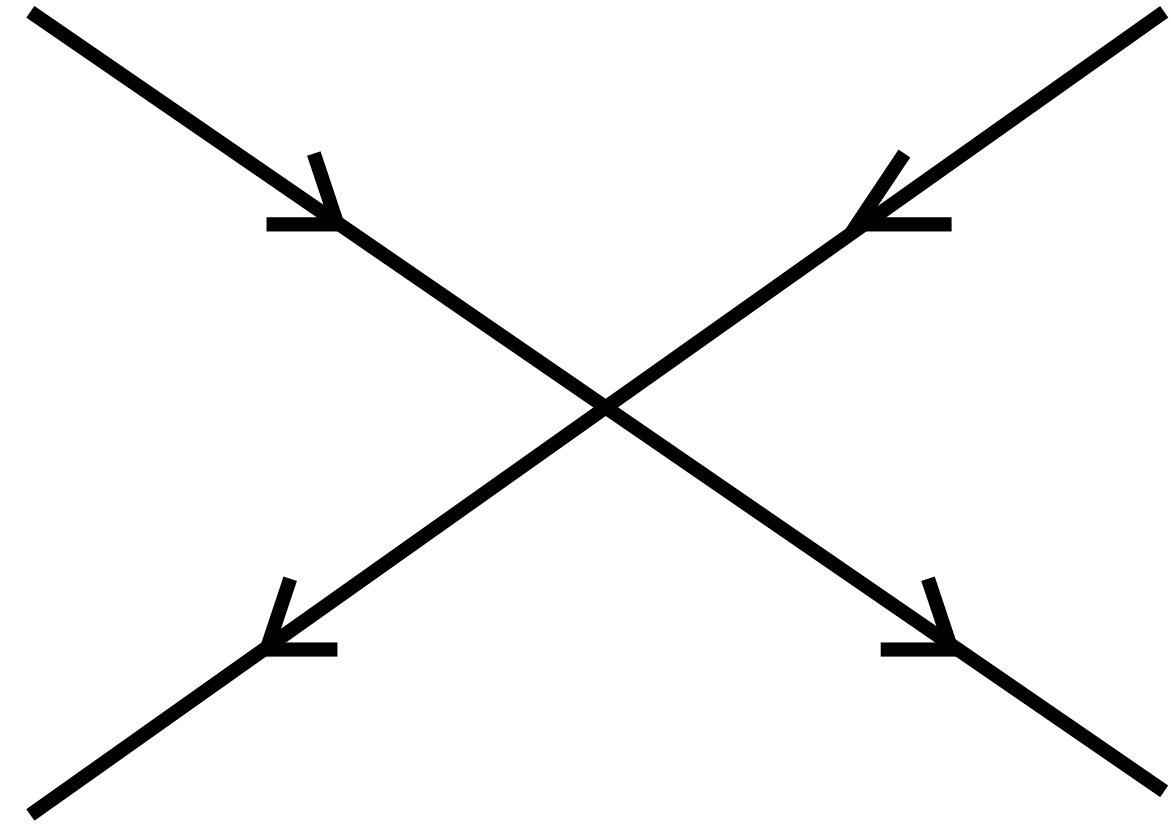 Figure 1
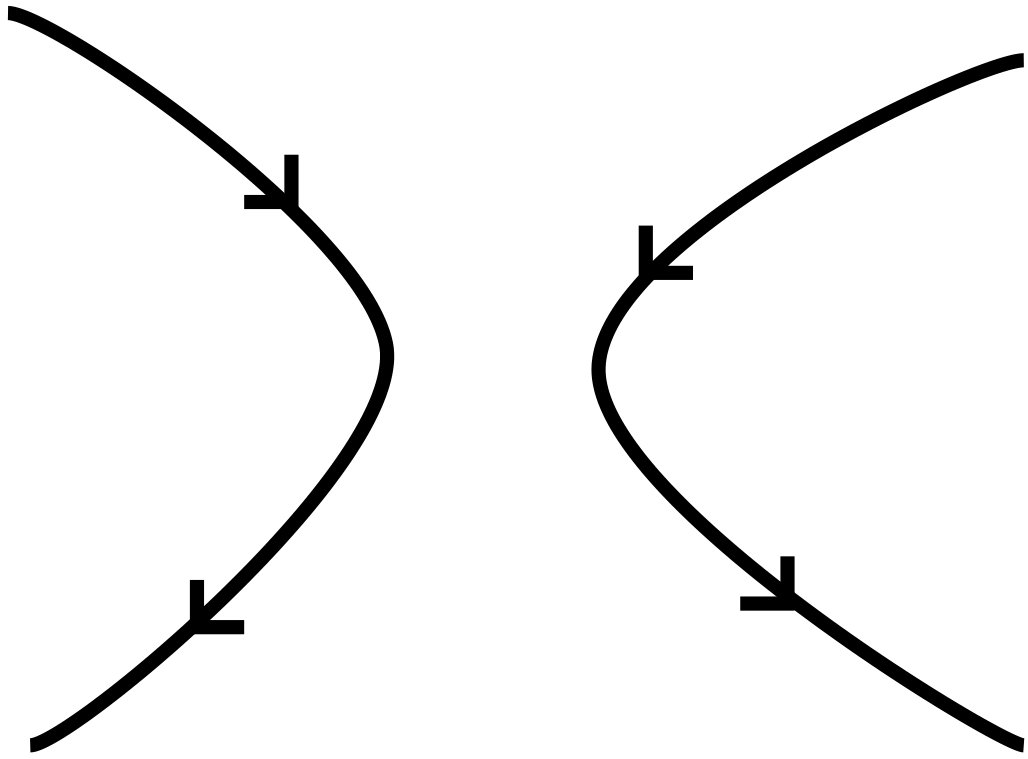 Figure 2
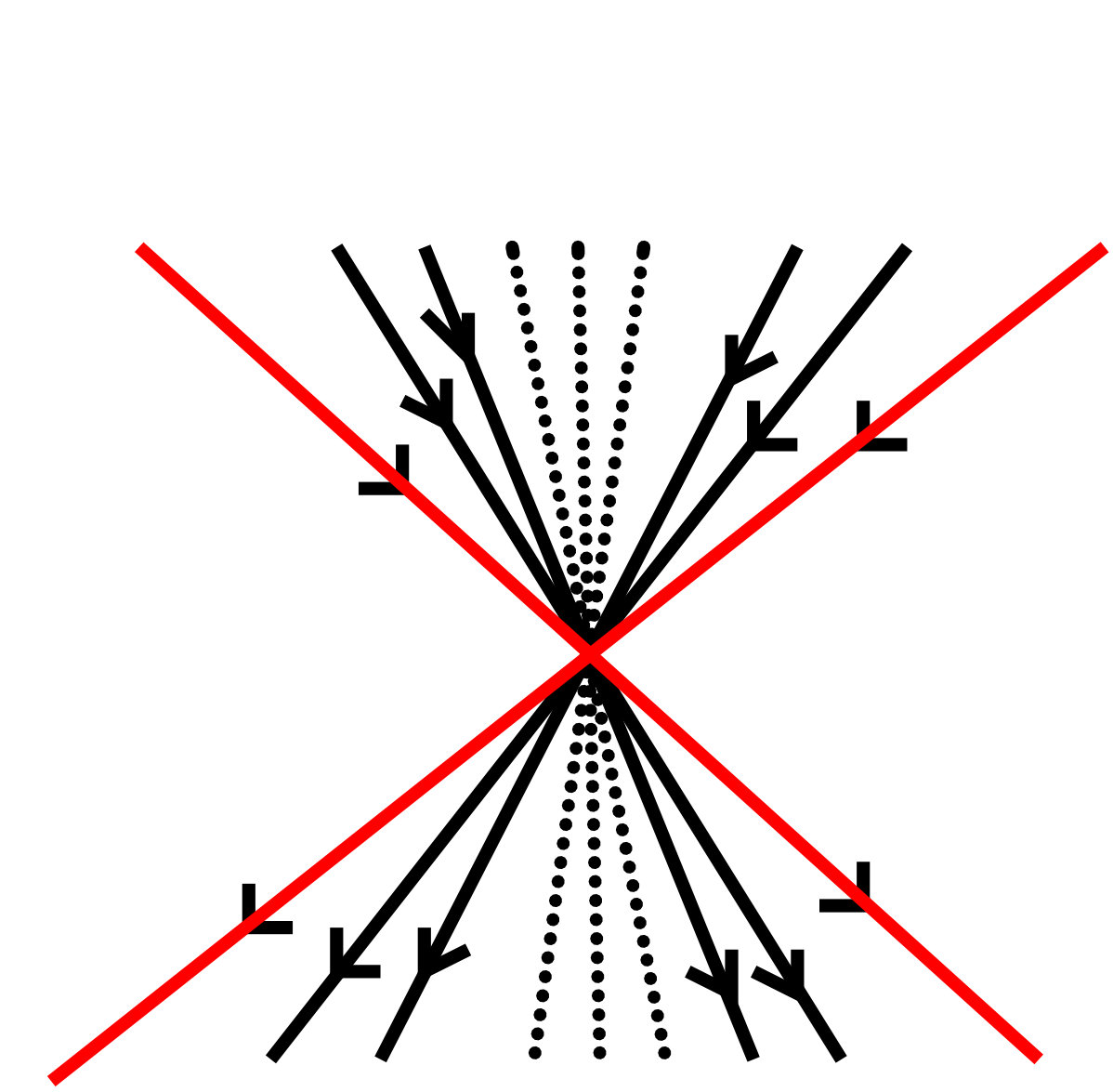 Figure 3
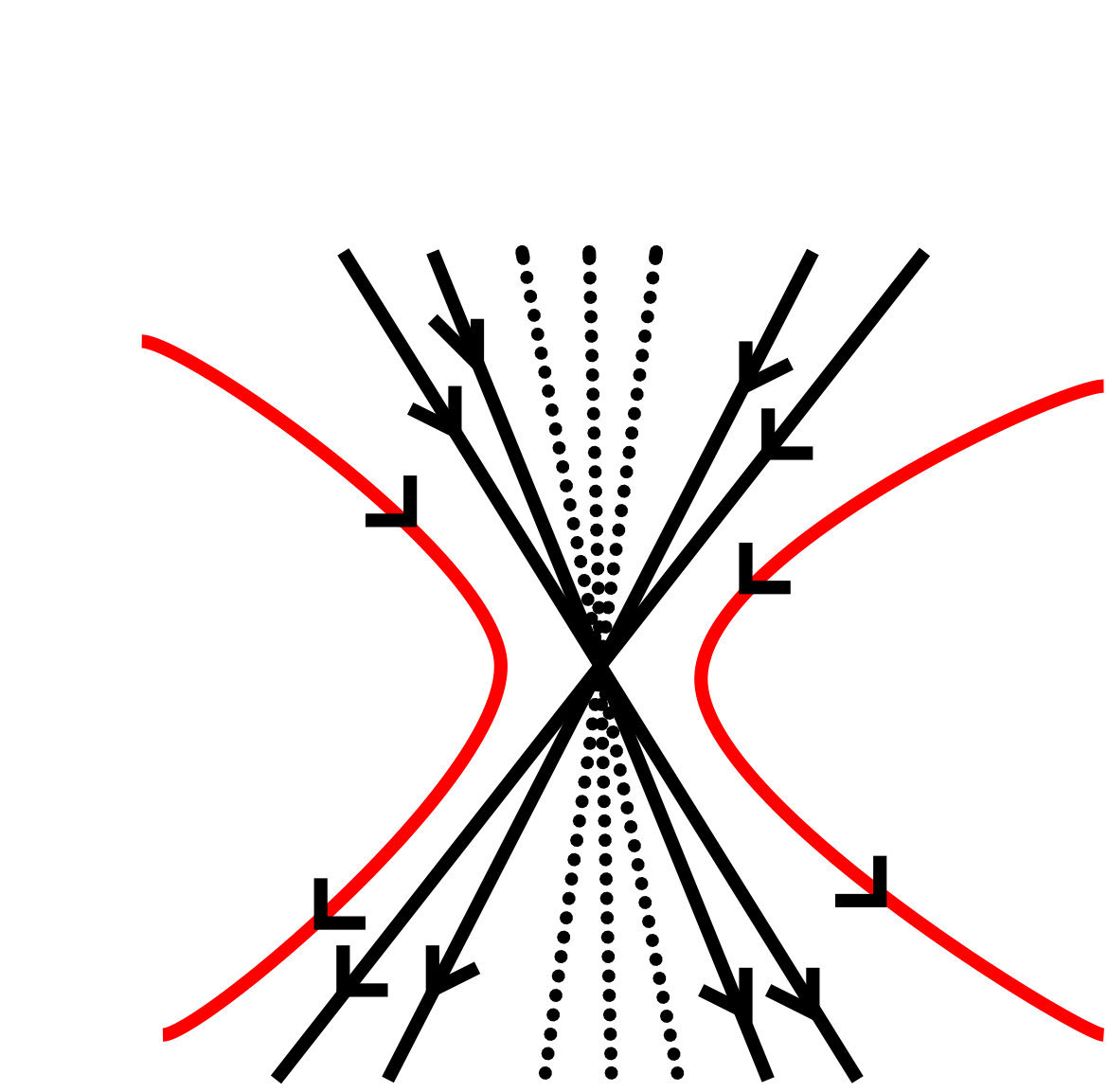 Figure 4
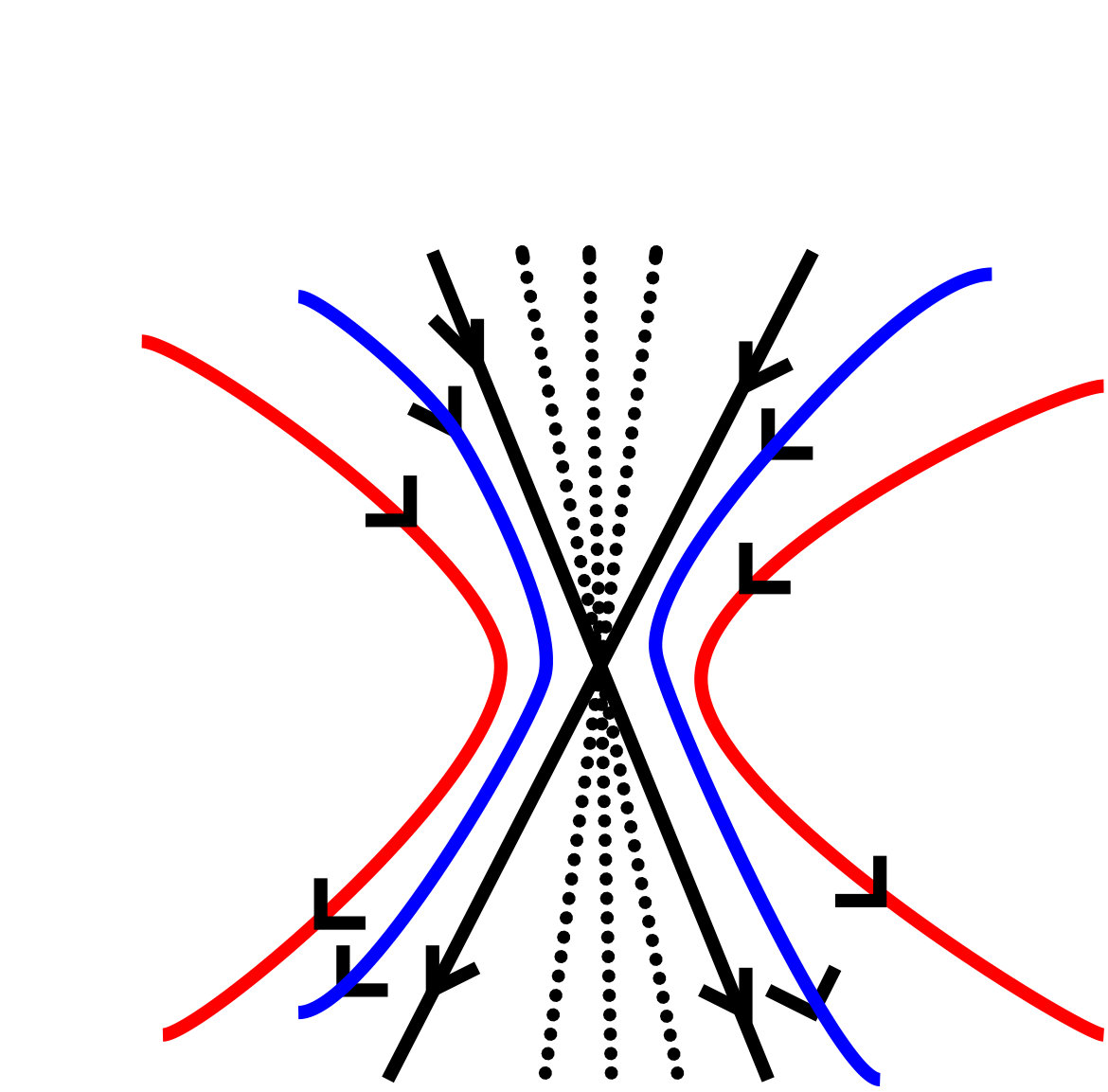 Figure 5
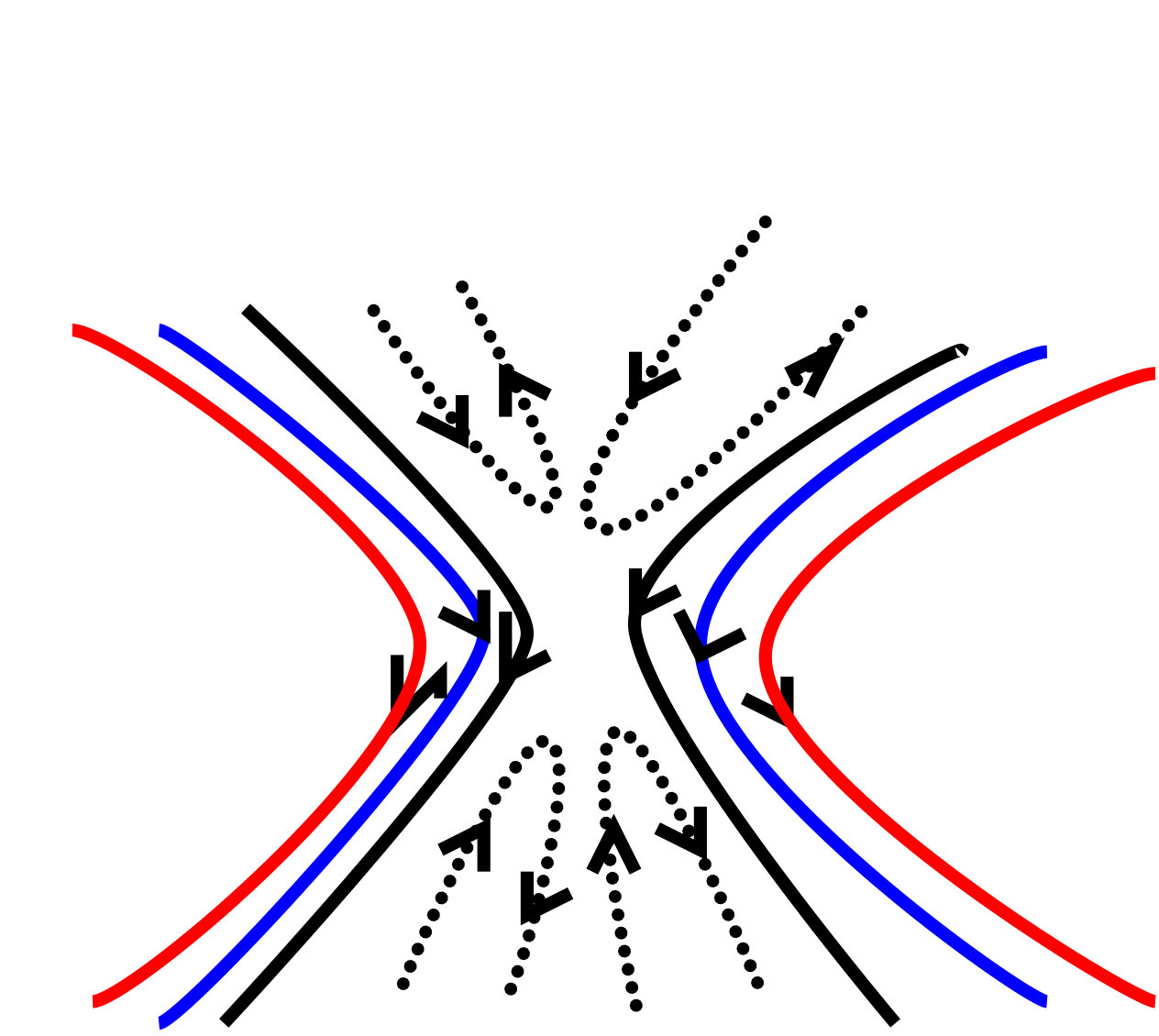 Figure 6
Peer Reviews
No public reviews on file for this paper yet. If you reviewed it on a platform where reviews are public (OpenReview, ICLR, NeurIPS, ICML), you can paste yours below so the community can read it here.
Videos
No videos yet. Explain this paper in a talk, walkthrough, or lecture? Add one.
Taxonomy
TopicsGeometric and Algebraic Topology · Algebraic Geometry and Number Theory · Advanced Algebra and Geometry
A remark on Gromov-Witten-Welschinger invariants of
Yanqiao Ding
School of Mathematics and Statistics
Zhengzhou University
Zhengzhou, 450001
P. R. China
Abstract.
We generalize the formula of Gromov-Witten-Welschinger invariants of established by E. Brugallé and P. Georgieva in [BG16b] to . Using pencils of quadrics, some real and complex enumerative invariants of can be written as the combination of the enumerative invariants of the blow up of at two real points.
Key words and phrases:
Real enumerative geometry, Welschinger invariants, Gromov-Witten invariants.
2010 Mathematics Subject Classification:
Primary 14P05, 14N10; Secondary 14N35, 14P25
1. Introduction
It is a long history for mathematicians to find appropriate way to count curves. Almost 24 years ago, inspired by string theory [Wit91], Y. Ruan and G. Tian introduced the definition of Gromov-Witten invariants on semi-positive symplectic manifolds [RT95]. Then the definition of Gromov-Witten invariants was generalized to symplectic manifolds [Rua99, FO99, LT98b] and algebraic varieties [LT98a, Beh97]. With the help of Gromov-Witten invariants, complex enumerative geometry experiences a rapid development. The emergence of real enumerative invariants, such as Welschinger invariants [Wel05a, Wel05b], real Gromov-Witten invariants [GZ18], and refined tropical enumerative invariants [BG16a], also prompts the development of real enumerative geometry significantly.
Welschinger invariant is a sign counting of real curves in real rational surfaces or real convex algebraic threefolds. There are many methods, for example, tropical geometry and degeneration formula, to investigate the Welschinger invariants of real rational surfaces [IKS09, IKS13, IKS15, BP15, Bru18, BM07, Bru15, Bru18, DH18, Din17]. However, the methods for computation of Welschinger invariants of threefolds are limited. For instance, some particular cases of Welschinger invariants of threefolds were calculated in [BM07, GZ17, Wel07, PSW08]. Kollár proposed pencils of quadrics of can be used to compute the enumerative invariants of [Kol15]. E. Brugallé and P. Georgieva completely computed the Welschinger invariants of [BG16b]. They estiblished a relation between the GWW invariants of and the GWW invariants of . In this note, we generalize this relation to .
Equip and with the standard real structure which is the complex conjugation. Denote by the blow-up of at a real point , by the strict transform of a line in which does not pass through , by the exceptional divisor, and by a quadric surface in passing through . According to the classification results of real surfaces [Kol97, DK00, DK02], the blow-up at a real point of the quadric surface is real deformation equivalent to the blow up of at two real points . Let , be the strict transforms of two lines, which are and up to interchanging with each other, in not passing . The homology group is generated by the classes , and , where is the exceptional divisor of . We use as an abbreviation of the class in .
Let and be two positive integers with . Given a generic real configuration of points in which contains pairs of complex conjugated points. Denote by the Welschinger invariant “counting” the real rational curves passing through and representing the class in , where is a line in the exceptional divisor . Denote by the Welschinger invariant “counting” the real rational curves passing through , which is a generic real configuration of points in with pairs of complex conjugated points, and representing the class in .
Theorem 1.1**.**
For any , with , and , we have
[TABLE]
By Remark 4.4, , where , are positive even integers and . Since Welschinger invariants of any blow-up of the real projective plane and the real quadric in are computed by Horev and Solomon in [HS12], one can use equation (1) to determine all the Welschinger invariants with is even.
A similar result of Gromov-Witten invariants can also be derived. Denote by the Gromov-Witten invariant counting the rational curves in passing through generic points and representing the class . Denote by the Gromov-Witten invariant counting the rational curves in passing through generic points and representing the class .
Theorem 1.2**.**
Let , and . Then
[TABLE]
Acknowledgments: The author would like to thank Jianxun Hu for his continuous support and encouragement as well as enlightening discussions.
2. Welschinger invariants
2.1. Welschinger invariants of
Given with . Let which is real deformation equivalent to and be a real configuration of points with pairs of complex conjugated points. Denote by the set of real rational curves representing the class and passing through in . If is generic enough, the set is finite, and every curve is an immersion with only nodal points. Denote by the number of real isolated nodes (nodes with two complex conjugated branches) of . The integer
[TABLE]
is independant of the choice of the real configuration , and it only depends on , , , and the number of pairs of complex conjugated points in (see [Wel05a]).
2.2. Welschinger invariants of
Given with , and let be a generic real configuration, which contains pairs of complex conjugated points and at least one real point, of points in . Denote by the set of irreducible real rational curves in of class passing through . The set is finite, and every element of is a balanced curve, i.e. is an immersion and the quotient is isomorphic to the holomorphic bundle . Fix a spin structure on and a spin structure on . They can induce a spin structure on . Then the integer
[TABLE]
is independant of the choice of , where is the spinor state of . It depends only on the class , the number of complex conjugated pairs in and the spin structure (see [Wel05b]). Since we only deal with the case when is even in this note, we always assume is even. The spinor state is defined as follows.
Let be a balanced real algebraic immersion. Fix an orientation on and equip with a Riemannian metric . Choose an orientation on which is induced by the orientation on . The tangent bundle is a subbundle of . The real vector bundle , which is isomorphic to the orthogonal subbundle of in , has an induced orientation such that a positive orthonormal frame of followed by a positive orthonormal frame of provides a positive orthonormal frame of for every . Denote by the class of the real part of a section of having vanishing self-intersection, by the class of a real fiber of . The orientations on , and are induced by the orientations on and respectively. Choose a real holomorphic line subbundle such that is a section of bidegree whose real part is homologous to . The bundle is equipped with a Riemannian metric induced by the one of . Choose a loop of positive orthonormal frames of such that is a loop of positive orthonormal frames of . Let be the unique section of such that is a loop of positive orthonormal frames of . Define if this loop of the -principal bundle of orthonormal frames of lifts to a loop of the associated -principal bundle , and otherwise. Note the spinor state depends only on the spin structure and the isotopy class of .
A more geometric way to explain the construction of the holomorphic line bundle is as follows. The choice of the class is equivalent to choice a direction to rotate the ribbon of provided by the real holomorphic section such that the ribbon after rotated is orientable. The isotopy class of is the isotopy class of the real part of the degree line subbundle of whose real fibers rotate positively with respect to the positive basis of in local holomorphic coordinates on defining a real holomorphic splitting (see [BG16b, Section 2.2] and [Wel05b, Section 2.2] for more details).
3. Rational curves on a blow-up of smooth quadric of
3.1. Elliptic curves, pencils of quadrics and blow-up
Let be a complex elliptic curve. The choice of a point in will induce an isomorphism between the elliptic curve and the group . This isomorphism gives a group structure on . If is considered as the quotient of by a full rank lattice for which is identified with [math], the group structure induced by is the same with the group structure induced from by the quotient map. also induces a series of isomorphisms between and (see [BG16b, Section 3.1] for more details). In this note, is always regarded as under the isomorphism . If is also real, with , and , there are two cases as follows (see [BG16b, Section 3.1]):
- •
has two connected components: if is even, both components contain torsion points of order on ; if is odd, the connected component of containing contains torsion points of order ;
- •
is connected, and contains torsion points of order ;
Let be a non-degenerate elliptic curve of degree in , and be the pencil of quadrics in determined by . Let be the hyperplane section class. There is a ramified covering map of degree two. From analysing the ramification value of , one can get contains singular quadrics. If is real and , there are three cases as follows (see [BG16b, Section 3.2]):
- •
is not connected, and , are not on the same component: there is no real singular quadric in ;
- •
is not connected, and , are on the same component: there are real singular quadrics in ;
- •
is connected: there are real singular quadrics in ;
Let be the blow-up of at . Denote by and the strict transforms of and respectively. Denote by the strict transform of a hyperplane in which does not pass , and by the hyperplane section class. The map induces a ramified covering map of degree two, where , , is the strict transform of . If is real, with , and , there are three cases as follows:
- •
is not connected, and , are not on the same component: there is no blow-up of real singular quadric in ;
- •
is not connected, and , are on the same component: there are blow-up of real singular quadrics in ;
- •
is connected: there are blow-up of real singular quadrics in ;
3.2. Rational curves on blow-up of smooth quadrics
Let be a configuration of distinct points, and . Denote by the set of connected algebraic curves of arithmetic genus 0 representing in and passing through .
Lemma 3.1**.**
Suppose the points in are in general position in . Then every curve in is irreducible and is contained in a blow-up of quadric of . Furthermore, the blow-up of quadrics of which contain a curve in correspond to the solutions of the equation
[TABLE]
with .
A curve in is linearly equivalent in such a blow-up of quadric to , where (resp. ) is a line in whose intersection with is (resp. ). Any irreducible rational curve in representing and passing through points of is in .
Proof.
The proof is similar to the proof of [Kol15, Proposition 3]. For the completeness, we give it in the following. Suppose the curve is irreducible. Since any point of is contained in some , and intersect at points which implies that . Hence is linearly equivalent to for some . So
[TABLE]
For the points in are in general position, the case is excluded and is the blow-up of a smooth quadric.
In the case is reducible, let be a connected curve passing through representing . If there is a component passes through more than points of , it intersects with every of at points. Therefore, which is a contradiction. So every component passes through exactly points . Since , is the union of the disjoint sets .
If there are two curves , contained in different blow-up of quadrics , we have . However, we know different curves pass through different points . The curve has to be disconnected which is a contradiction. Therefore, the curve is contained in one blow-up of quadric .
Suppose is linearly equivalent to , we have
[TABLE]
Combined with equation , we obtain
[TABLE]
We can choose the points of such that , and generate a free subgroup of rank in . So equation is impossible unless . Therefore, there is no reducible curve for a general choice of the points . ∎
Given a quadric of , and let be an algebraic immersion whose image is contained in passing through . Suppose . Let , , and be the normal bundle of in . Let be the strict transform of . Denote by , , and the normal bundle of in . We can get an exact sequence of holomorphic vector bundles over :
[TABLE]
If and are both real, we can also obtain an exact sequence fitted by the real bundles , and .
The morphism induces morphisms between the bundles associated to and which are isomorphisms everywhere except and vanish at . Since is an immersion, one can see the vanishing order is in local coordinates. Therefore, , , and . It follows that if is balanced, so is . From [BG16b, Proposition 4.1], we know that if has bidegree with , then is balanced. So the strict transform of the algebraic immersion which is contained in with bidegree , , passing through is also balanced.
Let be the real part of the normal bundle of in which is a subbundle of the real part of its normal bundle in . From [BG16b, Proposition 4.2], one has . Following [BG16b], is called a positive basis of if .
Proposition 3.2**.**
Let be a real algebraic immersion, whose image is contained in , passing through such that it has bidegree in the positive basis with . Suppose contains points, and is even. Let be the strict transform of in . Then the holomorphic real line subbundle of realises the real isotopy class if and only if .
Proof.
Recall that the isotopy class is constructed as follows: in the local holomorphic coordinates on defining a real holomorphic splitting , the isotopy class of is the isotopy class of the real part of the degree line subbundle of whose real fibers rotate positively with respect to the positive basis of . Note that there are two holomorphic real line subbundles of of degree depending on whether the real part of a fiber rotates in positively. Since and , we can get that the fibers of rotate positively with respect to the positive basis of if and only if the fibers of rotate positively with respect to the positive basis of . From [BG16b, Proposition 4.4], we know the holomorphic real line subbundle of realises the real isotopy class if and only if . ∎
Lemma 3.3**.**
Let be a real algebraic immersion, whose image is contained in , passing through such that it has bidegree in the positive basis with . Suppose contains points, and is even. Let be the strict transform of in . Then
[TABLE]
Proof.
The idea of the proof is similar to the proofs of [BG16b, Lemma 2.1, Corollary 4.3] and [Wel05b, Theorem 4.4]. Let be a loop in the -principal bundle of orthonormal frames of constructed in Section 2.2. Fix an orientation of which induces an orientation of the normal bundle . Assume . Since is even, must be even too. Construct a loop of as the concatenation of the following paths. For the convenience, let be the same point. When , first, choose . Then construct a path completely included in the fiber of over . This path is obtained from by having this frame turning of half a twist in the positive direction around the axis generated by . Note that the end point of this path is the frame . Next, the piece is chosen to be the path . Last, we construct a path completely included in the fiber of over . This piece is obtained from by having this frame turning of half a twist in the negative direction around the axis generated by . Note that the end point of this frame is . For , we just repeat the above construction. Finally, we constructed a loop in which is homotopic to . is the connected sum of and in a neighborhood of . Let the radius of the ball used to construct the connected sum converge to zero, then the curve will degenerate to the union of the curve and lines ,…, of passing through . The loop degenerates to the union of a loop of and loops , …, of . From the above construction, we know the loops differ from by a non-trivial loop in a fiber of . So is odd. Therefore,
[TABLE]
For the loop , we first smooth each node of as Figure 1, then smooth the order singular point of at as Figure 2.
We get a collection of disjoint oriented circles embedded in . And
[TABLE]
where is the number of hyperbolic nodes of . The loops of do not intersect with each other, so the non-trivial loops can only realize the same class with and relatively prime. The loop realising the trivial class defines a non-trivial loop in , and the non-trivial loop defines times the non-trivial loop in , because is a positive basis. Suppose . So . It means
[TABLE]
From the adjunction formula, has exactly nodes which contains hyperbolic nodes and elliptic nodes. Thus,
[TABLE]
Note that is even and . So is even if and only if both and are even. Hence
[TABLE]
Since and is even, we get
[TABLE]
∎
4. Proof of the main results
Denote by the space of genus [math] stable maps
[TABLE]
from with marked points whose images represent the class in . Note that the stable maps are considered up to reparametrization. There is a natural map:
[TABLE]
which is called the evaluation map. Let be the set of configurations of distinct points on .
Let be the blow-up of a quadric, and . Denote by the set of stable maps , where is a connected nodal curve of arithmetic genus [math], such that represents the class and .
Proposition 4.1**.**
There exists a dense open subset such that for any , , and for every stable map , we have:
- •
* is non-singular,*
- •
* is an immersion.*
For any , contains exactly rational curves of class and passing through .
Proof.
Let be the set of irreducible nodal rational curves in of class . By the proof of Lemma 4.2, we know . Therefore, is a quasi-projective subvariety of dimension of the linear system . Let be the Zariski closure of and . In , represents class , so the degree of linear system is . As the genus of is , every element of is determined by its points. Therefore, an element of induces an element of . is not a component of any curve in , we can define a map
[TABLE]
Note that . The image of every element , with such that , is a nodal irreducible rational curve, and is an immersion. The rest of the proof follows from Lemma 4.2. ∎
Lemma 4.2**.**
A map is regular for the corresponding evaluation map if and only if it is an immersion.
Proof.
From the proof of [Wel05b, Lemma 1.3], we know the cokernel of is identified with the cokernel of the following composition:
[TABLE]
where is the quotient sheaf, and the first morphism of equation is surjective. Let . The short exact sequence of sheaves implies the long exact sequence
[TABLE]
If is an immersion, we know and . Actually, from the exact sequence , we also can get . So the cokernel of
[TABLE]
Now suppose is a regular point of , then
[TABLE]
From the cohomology of , we obtain . Therefore, with . By the adjunction formula, . So , and is an immersion. ∎
Remark 4.3**.**
By using [Wel05b, Lemma ], one can prove, similar to the proof of [BG16b, Proposition 5.3], that the regular values of
[TABLE]
contained in form a dense open subset and the set , , contains exactly elements.
Proof of Theorem 1.2.
Choose , where is the set defined in Remark 4.3, and a set consisting of points. Denote by the set of blow-up of quadrics in corresponding to a solution of equation which consists of elements. From Lemma 3.1 , we have
[TABLE]
According to Remark 4.3, . We can get every map is an immersion with the help of [Wel05a, Lemma 1.3, Lemma 4.3], for is a regular value of the corresponding evaluation map . By Proposition 4.1, we have . ∎
Proof of Theorem 1.1.
Let be a real elliptic curve of degree 4 in and . Denote by the blow-up of at , and by the strict transform of . Let , with . Choose a real configuration of points which contains at least one real point. From Lemma 3.1 , we know the image of every real map represents class or , where , in the positive basis of the blow-up of quadric containing . From Proposition 3.2 and Lemma 3.3, we can obtain
[TABLE]
The sum of spinor states of real elements of whose images are contained in is if is even and if is odd. Since equation always has a real solution and two real solutions differ by a real torsion element of order , we know equation has real solutions for every . Then one can complete the rest part of the proof with the same argument of the proof of Theorem 1.2. ∎
Remark 4.4**.**
The vanishing of for positive even with and can also be proved in this way. If and are on the same component of with and is on the component which does not contain , then equation has no real solution.
The reference list from the paper itself. Each links out to its DOI / PubMed record.
- 1[Beh 97] K. Behrend. Gromov-Witten invariants in algebraic geometry. Invent. Math. , 127(3):601–617, 1997.
- 2[BG 16a] F. Block and L. Göttsche. Refined curve counting with tropical geometry. Compos. Math. , 152(1):115–151, 2016.
- 3[BG 16b] E. Brugallé and P. Georgieva. Pencils of quadrics and Gromov-Witten-Welschinger invariants of ℂ P 3 ℂ superscript 𝑃 3 \mathbb{C}P^{3} . Math. Ann. , 365(1-2):363–380, 2016.
- 4[BM 07] E. Brugallé and G. Mikhalkin. Enumeration of curves via floor diagrams. C. R. Math. Acad. Sci. Paris , 345(6):329–334, 2007.
- 5[BP 15] E. Brugallé and N. Puignau. On Welschinger invariants of symplectic 4 4 4 -manifolds. Comment. Math. Helv. , 90(4):905–938, 2015.
- 6[Bru 15] E. Brugallé. Floor diagrams relative to a conic, and GW-W invariants of del Pezzo surfaces. Adv. Math. , 279:438–500, 2015.
- 7[Bru 18] E. Brugallé. Surgery of real symplectic fourfolds and Welschinger invariants. J. Singul. , 17:267–294, 2018.
- 8[DH 18] Y. Ding and J. Hu. Welschinger invariants of blow-ups of symplectic 4-manifolds. Rocky Mountain J. Math. , 48(4):1105–1144, 2018.