Asymptotically Exact Solution of the Fredrickson-Andersen Model
Koray \"Onder, Matthias Sperl, W. Till Kranz

TL;DR
This paper provides an asymptotically exact analytical solution for the dynamical behavior of the Fredrickson-Andersen model on the Bethe lattice, revealing critical exponents and proposing an approximate dynamics for broader regimes.
Contribution
It derives an exact expression for the memory kernel of the FA model, enabling explicit calculation of critical exponents and offering an approximate dynamics description.
Findings
Exact solution for the memory kernel of the FA model.
Explicit critical exponents satisfying a scaling relation.
Approximate dynamics matching numerical data away from criticality.
Abstract
The Fredrickson-Andersen (FA) model---a kinetically constrained lattice model---displays an ergodic to non-ergodic transition with a slow two-step relaxation of dynamical correlation functions close to the transition point. We derive an asymptotically exact solution for the dynamical occupation correlation function of the FA model on the Bethe lattice by identifying an exact expression for its memory kernel. The exact solution fulfills a scaling relation between critical exponents and allows to calculate the exponents explicitly. In addition, we propose an approximate dynamics that describes numerical data away from the critical point over many decades in time.
Click any figure to enlarge with its caption.
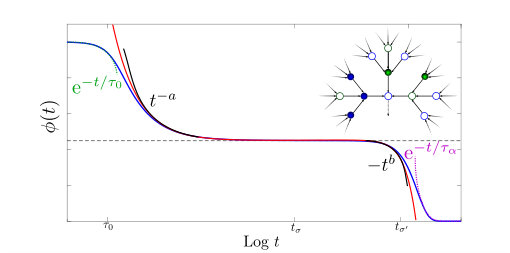 Figure 1
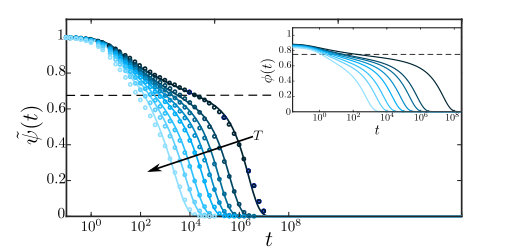 Figure 2
Peer Reviews
No public reviews on file for this paper yet. If you reviewed it on a platform where reviews are public (OpenReview, ICLR, NeurIPS, ICML), you can paste yours below so the community can read it here.
Videos
No videos yet. Explain this paper in a talk, walkthrough, or lecture? Add one.
Taxonomy
TopicsMarkov Chains and Monte Carlo Methods · Stochastic processes and statistical mechanics · Theoretical and Computational Physics
Asymptotically Exact Solution of the Fredrickson-Andersen Model
Koray Önder
Institut für Theoretische Physik, Universität zu Köln, 50937 Köln, Germany
Institut für Materialphysik im Weltraum, Deutsches Zentrum für Luft- und Raumfahrt (DLR), 51170 Köln, Germany
Matthias Sperl
Institut für Materialphysik im Weltraum, Deutsches Zentrum für Luft- und Raumfahrt (DLR), 51170 Köln, Germany
Institut für Theoretische Physik, Universität zu Köln, 50937 Köln, Germany
W. Till Kranz
Institut für Theoretische Physik, Universität zu Köln, 50937 Köln, Germany
Abstract
The Fredrickson-Andersen (fa) model—a kinetically constrained lattice model—displays an ergodic to non-ergodic transition with a slow two-step relaxation of dynamical correlation functions close to the transition point. We derive an asymptotically exact solution for the dynamical occupation correlation function of the fa model on the Bethe lattice by identifying an exact expression for its memory kernel. The exact solution fulfills a scaling relation between critical exponents and allows to calculate the exponents explicitly. In addition, we propose an approximate dynamics that describes numerical data away from the critical point over many decades in time.
Slow relaxation is not restricted to molecular fluids dominated by pairwise interactions. On the contrary, systems abound where the effective dynamics is facilitated by the number of neighbors in a favorable state exceeding a threshold. Dynamic facilitation applies to opinion dynamics Ramos et al. (2015), voter models Castellano et al. (2009); Jędrzejewski (2017), and infection spreading Chae et al. (2015) but has also been used to understand the low temperature phase of magnetic alloys Pollak and Riess (1975); Chalupa et al. (1979), granular compaction Brey et al. (1999), rigidity percolation Moukarzel et al. (1997), and the jamming transition Toninelli et al. (2006); Schwarz et al. (2006). Most prominently it lies at the heart of the dynamic facilitation picture Glarum (1960); Fredrickson and Andersen (1984); Garrahan and Chandler (2002); Evans (2002); Ritort and Sollich (2003); Chandler and Garrahan (2010) of the glass transition Angell et al. (2000); Berthier and Biroli (2011); Hunter and Weeks (2012); Biroli and Garrahan (2013). The k-core decomposition of graphs Seidman (1983); Dorogovtsev et al. (2006) yields a statistical description of, e.g., social groups Seidman (1983) and the brain Turova (2012). K-core decomposition can be framed as a dynamic facilitation problem Baxter et al. (2015) yielding, e.g., insight into the resilience of social network data sets against de-anonymization Yartseva and Grossglauser (2013).
A paradigmatic example of a kinetically constraint model Ritort and Sollich (2003); Garrahan et al. (2011) implementing dynamic facilitation is the Fredrickson-Andersen (fa) model which is defined on a lattice with sites decorated with occupation numbers . The Hamiltonian is trivial and favors the empty lattice. A site may, however, only change its state if it has at least empty nearest neighbors Fredrickson and Andersen (1984); Cancrini et al. (2009). Bootstrap percolation Chalupa et al. (1979); Adler (1991); Dorogovtsev et al. (2008); Saberi (2015) is concerned with the ground state of the fa model that is kinetically reachable from an initial condition with an occupation probability . For , clearly the occupation probability in the ground state , whereas for an empty ground state, , can be reached almost surely. The question arises, if there is a nontrivial concentration, , for the emergence of an infinite occupied cluster in the ground state, . For and for arbitrary on hypercubic lattices it has been shown that van Enter (1987); Cancrini et al. (2009). Bootstrap percolation on the Bethe lattice and on random graphs, however, feature a transition at a finite Chalupa et al. (1979); Balogh and Pittel (2007); Janson et al. (2012).
At finite temperatures 111Temperature is measured in units of we equip the fa model with transition rates that satisfy detailed balance. Without constraints, the Hamiltonian would entail an equilibrium mean occupation . This still holds under the constrained dynamics as long as , however, for , the dynamics is restricted to the sites that are not permanently constrained by the frozen percolating cluster Cancrini et al. (2008). For , numerical simulations of the fa model Sellitto et al. (2005); Arenzon and Sellitto (2012); Sellitto (2015); de Candia et al. (2016) show a two-step relaxation of time-correlation functions, , with a fast relaxation to a plateau value, , followed by a second relaxation, , on a time scale that diverges towards . A two-step relaxation with a divergent relaxation time is one of the experimental fingerprints of the glass transition Angell et al. (2000) and motivated the fa model as an effective description of the glass transition. Close to the plateau, , the relaxation is generically well described by power laws Götze and Sjögren (1992),
[TABLE]
A complementary description of the glass transition, independent of the dynamic facilitation picture, is provided by mode-coupling theory (mct) Cummins (1999); Götze (2009); Janssen (2018) which starts from the formally exact equation of motion
[TABLE]
where the dot denotes the time derivative and is the short time relaxation rate. The eponymous mode-coupling approximation (mca) expresses the unknown memory kernel by a polynomial in . Standard mct predicts a scaling relation,
[TABLE]
between the exponents in Eq. (1) involving the Euler Gamma-function. mcas have been attempted for the fa model Eisinger and Jäckle (1993); Pitts et al. (2000); Pitts and Andersen (2001); Einax and Schulz (2001); Schulz and Trimper (2002) starting with Fredrickson and Andersen (1984) but were of limited success. In particular, mct for the fa model has a tendency to predict spurious transitions Ritort and Sollich (2003). Also other approaches did not capture the slow relaxation Fennell et al. (2014).
Recent numerical evidence, however has shown that despite these reservations, the scaling relation (3) seems to be verified in the fa model on the Bethe lattice modeled as a random regular graph (rrg) Sellitto et al. (2005, 2010); Arenzon and Sellitto (2012); Sellitto (2015); de Candia et al. (2016). Proof for this surprising discovery is highly desired Cancrini et al. (2009); Rizzo (2018) but missing so far.
In this letter we derive an asymptotically exact solution of Eq. (2) for the fa model on the Bethe lattice. We show that Eq. (1) constitutes the lowest order in a series expansion of this solution and that the scaling relation (3) holds exactly. Encouraged by these results we propose an approximate, regularized memory kernel valid for all times. Comparing with numerical data far away from the critical point, we are able to describe the two step relaxation of the fa model over many decades in time.
*Model.—*We consider the oriented fa model (ofa) with facilitation parameter on the Bethe lattice. To be precise, we define the Bethe lattice Mézard and Parisi (2001) as the infinite -ary rooted tree Martinelli and Toninelli (2013), . In line with Sellitto’s numerical work Sellitto et al. (2005); Arenzon and Sellitto (2012); Sellitto (2015) we assume Metropolis dynamics with transition rates . Here denotes the set of children of site and implements the kinetic constraint 333C_{f}(\mathcal{K}_{i})=\Theta\big{(}k-f+\nicefrac{{1}}{{2}}-\sum_{j\in\mathcal{K}_{i}}n_{i}\big{)}, with the Heaviside step-function . (cf. Fig. 1).
For simplicity we aim to describe the relaxation to equilibrium from a well defined initial condition. Assume the initial are drawn from a Bernoulli distribution with 444Think of this distribution as the unconstrained model’s equilibrium for . To assure ergodicity, we limit our discussion to .
*Percolation Transition.—*Recall that the probability, , that a site is occupied in the ground state can be given implicitly as Chalupa et al. (1979)
[TABLE]
Note that as , the largest real solution of Eq. (4) is physically relevant. Trivially, is always a solution of Eq. (4). The critical probability locates a bifurcation to additional solutions. Generically, Eq. (4) displays a fold bifurcation (Arnold’s type A2 Arnol’d (1992)) with a finite and close to the transition .
*Equation of Motion.—*We wish to describe the single site occupation correlation function
[TABLE]
where denotes the occupation number of an arbitrary but fixed site and the average is taken with respect to the initial distribution. Note that is normalized such that and .
For , the ofa is a Markov process obeying detailed balance. Hence standard techniques allow to give the time evolution of the distribution function in terms of an effective Hamiltonian Risken (1996). Applying a Mori projector, , and rewriting the memory kernel in terms of its irreducible counterpart, , yields Eq. (2) Kawasaki (1995). The rate can be calculated explicitly 555. The memory kernel, however, is only known formally.
*Critical Dynamics.—*It is instructive to rewrite Eq. (2) in the Laplace domain, 666. For one finds
[TABLE]
In particular . Comparing this with Eq. (4) we arrive at our central result: Asymptotically the memory kernel of the ofa on the Bethe lattice is given exactly as
[TABLE]
Sufficiently close to the critcial point, , we expect a growing window in time, centered around a diverging time scale where such that is small, , and slowly varying, , where . To this end we expand Eq. (6) around to lowest order in Götze (1984, 2009),
[TABLE]
where 777. As can be calculated exactly for the ofa, the same holds for . Eq. (8) can be solved by standard numerical techniques (cf. Fig. 1) but more information can be gained analytically.
At the critical point, , Eq. (8) is solved by , provided Götze (1984). Asymptotically, , the smallest negative will dominate. Away from the critical point, for finite , acquires a square-root dependence on . Eq. (8) still admits power law solutions, , iff the left hand side dominates over the right hand side. For the approach to the plateau, , , as long as . Matching for , yields, , where Götze (1984). For and times , the decay away from the plateau is governed by the smallest positive , , as soon as , i.e., dependent on () for times (). For long times the validity of this law is limited by the slowly varying condition, , i.e., for times , where Götze (1984).
The above constitutes a precise statement of Eq. (1) for the ofa and proves that the scaling relation (3) holds exactly. We summarize the (numerically) exact results we obtain for the simplest model, and in Tab. 1.
Asymptotic Relaxation.— The asymptotic relaxation to zero, , on times is governed by a scaling function, Götze (1984). For the ofa it has been shown that where and the exponent could only be bounded from below Cancrini et al. (2015). In terms of the scaling function we find and in particular the preceding analysis determines the exponent compatible with the bound.
*Persistence Function.—*The persistence function yields the fraction of sites that have not changed their state since . Its asymptotic value, , does not only include the persistently occupied sites but also a fraction of the empty sites that are permanently frozen, . Close to the plateau, , we can expand
[TABLE]
i.e., . In particular, the persistence function is governed by the same critical exponents and master function that apply to .
*The FA Model on Random Regular Graphs.—*It is known that bootstrap percolation on the oriented and unoriented Bethe lattice of coordination Martinelli and Toninelli (2013) as well as on random -regular graphs Balogh and Pittel (2007) have the same critical concentration . Not much is known regarding the dynamic equivalence. Here we conjecture that due to the bifurcation dominating close to the critical point, the fact that the critical point does not change translates to dynamic equivalence close to . For the unoriented fa model the expression for the persistence function, , is slightly more involved Sellitto et al. (2005). Nevertheless, is finite and therefore Eq. (9) applies and is still governed by the critical exponents and scaling function of the ofa.
Simulations Sellitto et al. (2005); Sellitto (2015); de Candia et al. (2016); Arenzon and Sellitto (2012); Sellitto (2013) of the fa model are conveniently being performed on rrgs with a finite number of sites . rrgs do not, however, admit an orientation. The effective system size is given by the size of the largest embedded tree Makover and McGowan (2006) which grows with but is still small even for . Therefore the existing numerical data is relatively far from the critical point. In addition the fa model is known to display strong finite size effects Aizenman and Lebowitz (1988) which, so far, have not been analyzed in detail for rrgs. As a consequence, the empirical critical exponents (Table 1) are effective exponents and deviate from the analytical predictions. In the following we propose a memory kernel that allows us to solve Eq. (2) for all times and for appreciable distances from the critical point relevant to the numerical data.
*Approximate Memory Kernel.—*To close Eq. (2) we propose to approximate the memory kernel by Eq. (7) for all times as . Unfortunately this is not viable as diverges for small times, . In order to regularize the memory kernel we assume the divergent term, , to be a resummation of many-site interactions. On a finite lattice, the order of interactions should be finite, . Therefore we propose a regularized approximate memory kernel whose time-dependence is completely determined by ,
[TABLE]
With this Eq. (2) can be numerically solved for by standard techniques Fuchs et al. (1991).
*Discussion.—*Considering the occupation correlation function , Eq. (5), of the ofa on the Bethe lattice, we have identified an explicit expression, Eq. (7), for the long time limit of its memory kernel. Expanding around the bifurcation at that signals the ergodic to non-ergodic transition of the ofa, we find that close to the transition, , the time evolution of around its plateau value is asymptotically exactly given, , in terms of a one-parameter scaling function , Eq. (8). The exponent parameter is known explicitly in terms of the lattice coordination and the facilitation parameter . The properties of Eq. (8), finally, imply Eq. (1) together with the scaling relation (3), for , times , and not too close to the plateau, .
The scaling function , however, goes beyond Eq. (1) as it provides a faithful description of for , , bounded only by the requirements (cf. Fig. 1). On the fast end this could be complemented by ever more sophisticated short-time expansions. On the long-time end, , with a relaxation time .
Considering the asymptotic dynamics only, we did not gain information about processes on intermediate time scales. Could we have missed an additional process that will always mask the bifurcation scenario? The answer is no: Any unidentified process must occur on a time scale, , that remains finite as . Otherwise it would contribute to Eq. (4). Therefore we can always find a such that for , and we have a time window which is dominated by the bifurcation.
Given that close to the critical point the persistence function, , is governed by the same scaling function , Eq. (9) provides an asymptotically exact description of the persistence function in a divergent time window before the asymptotic exponential relaxation. The form of Eq. (1) and the scaling relation (3) equally apply to with the qualifications given above. Thereby we confirm the empirical observation of Sellitto (2015) and de Candia et al. (2016).
To close Eq. (2), we proposed a memory functional, Eq. (10), regularized by a finite length scale we conjecture to be related to the system size. Formally, Eq. (10) looks like a mca but let us stress that it was not derived by considering a (physically motivated) coupling of modes, but ultimately from the bifurcation equation (4) of the underlying bootstrap percolation.
To determine the persistence function of the unoriented fa model for all times, we use the knowledge gained so far and interpolate
[TABLE]
where is the short time relaxation rate of . We determine by solving Eq. (2) with the regularized memory kernel [Eq. (10)] and treat as a fit parameter 888Fitted –23 increase with as expected.. Fig. 2 shows excellent agreement between Eq. (11) and the numerical data for all temperatures and over many decades in time.
The success of this approach, derived for the ofa on the Bethe lattice, in describing simulations of the unoriented fa model on rrgs provides reasons to assume that the similarity between the oriented and unoriented fa model extends beyond a common critical point to a universal dynamics close to . It is, however, obvious, that simulations much closer to the critical point are needed to challenge the conjectures put forward here and to confirm the critical exponents.
While for sake of brevity we have only presented explicit results for the simplest case, , our approach holds for more general coordinations , and facilitation parameters provided . The consequences of a tunable will be discussed elsewhere, but let us note that for some combinations , . As a result the exponents increase which may be favorable for simulations.
The signature of a fold bifurcation, , with a finite critical is observed as a hybrid phase transition in a variety of models Silbert et al. (2005); Cai et al. (2015); Cho et al. (2016). A similar analysis to the one introduced here could lead to new insights in those systems as well. Reconciling mct and replica methods led to many new insights provided by the random first order theory (rfot) Wolynes and Lubchenko (2012). A deeper analysis of the overlap between mct and dynamic facilitation theory that has been started here and rfot and dynamic facilitation Foini et al. (2012) is likely to provide additional understanding of the glass transition.
In summary we have provided an asymptotically exact description of the slow relaxation of the oriented Fredrickson-Andersen model on the Bethe lattice close to its critical point, valid over a divergent window in time. We believe our method can be applied to other time correlation functions of the fa and related kinetically constraint models and can provide new insights into the phenomena which can be mapped onto these models.
Acknowledgements.
We are indebted to Wolfgang Götze for posing the initial questions that led to this work. We thank Mauro Sellitto for sharing his simulation data and acknowledge additional insight from discussions with Thomas Franosch and Thomas Voigtmann. Partial funding was provided by the dfg through KR 4867/2-1 (W.T.K.) and by the BMWi through 50 WM 1651 (K.Ö.).
The reference list from the paper itself. Each links out to its DOI / PubMed record.
- 1Ramos et al. (2015) M. Ramos, J. Shao, S. D. S. Reis, C. Anteneodo, J. S. Andrade, S. Havlin, and H. A. Makse, Sci. Rep. 5 , 10032 (2015).
- 2Castellano et al. (2009) C. Castellano, M. A. Muñoz, and R. Pastor-Satorras, Phys. Rev. E 80 , 041129 (2009).
- 3Jędrzejewski (2017) A. Jędrzejewski, Phys. Rev. E 95 , 012307 (2017).
- 4Chae et al. (2015) H. Chae, S.-H. Yook, and Y. Kim, New J. Phys. 17 , 023039 (2015).
- 5Pollak and Riess (1975) M. Pollak and I. Riess, phys. stat. sol. (b) 69 , K 15 (1975).
- 6Chalupa et al. (1979) J. Chalupa, P. L. Leath, and G. R. Reich, J. Phys. C 12 , L 31 (1979).
- 7Brey et al. (1999) J. J. Brey, A. Prados, and B. Sánchez-Rey, Phys. Rev. E 60 , 5685 (1999).
- 8Moukarzel et al. (1997) C. Moukarzel, P. M. Duxbury, and P. L. Leath, Phys. Rev. E 55 , 5800 (1997).