Universal quantized thermal conductance in graphene
Saurabh Kumar Srivastav, Manas Ranjan Sahu, K. Watanabe, T. Taniguchi,, Sumilan Banerjee, and Anindya Das

TL;DR
This study demonstrates universal quantized thermal conductance in graphene quantum Hall states, indicating the absence of edge reconstruction and highlighting graphene's suitability for studying exotic quasiparticles.
Contribution
The paper provides the first measurement of quantized thermal conductance in graphene, showing high accuracy and suggesting no edge reconstruction in fractional quantum Hall states.
Findings
Quantized thermal conductance observed within 5% accuracy for multiple filling factors.
Results indicate the absence of edge reconstruction in graphene fractional quantum Hall states.
Graphene's edge states are suitable for interference experiments with exotic quasiparticles.
Abstract
The universal quantization of thermal conductance provides information on the topological order of a state beyond electrical conductance. Such measurements have become possible only recently, and have discovered, in particular, that the value of the observed thermal conductance of the 5/2 state is not consistent with either the Pfaffian or the anti-Pfaffian model, motivating several theoretical articles. The analysis of the experiments has been made complicated by the presence of counter-propagating edge channels arising from edge reconstruction, an inevitable consequence of separating the dopant layer from the GaAs quantum well. In particular, it has been found that the universal quantization requires thermalization of downstream and upstream edge channels. Here we measure the thermal conductance in hexagonal boron nitride encapsulated graphene devices of sizes much smaller than the…
Click any figure to enlarge with its caption.
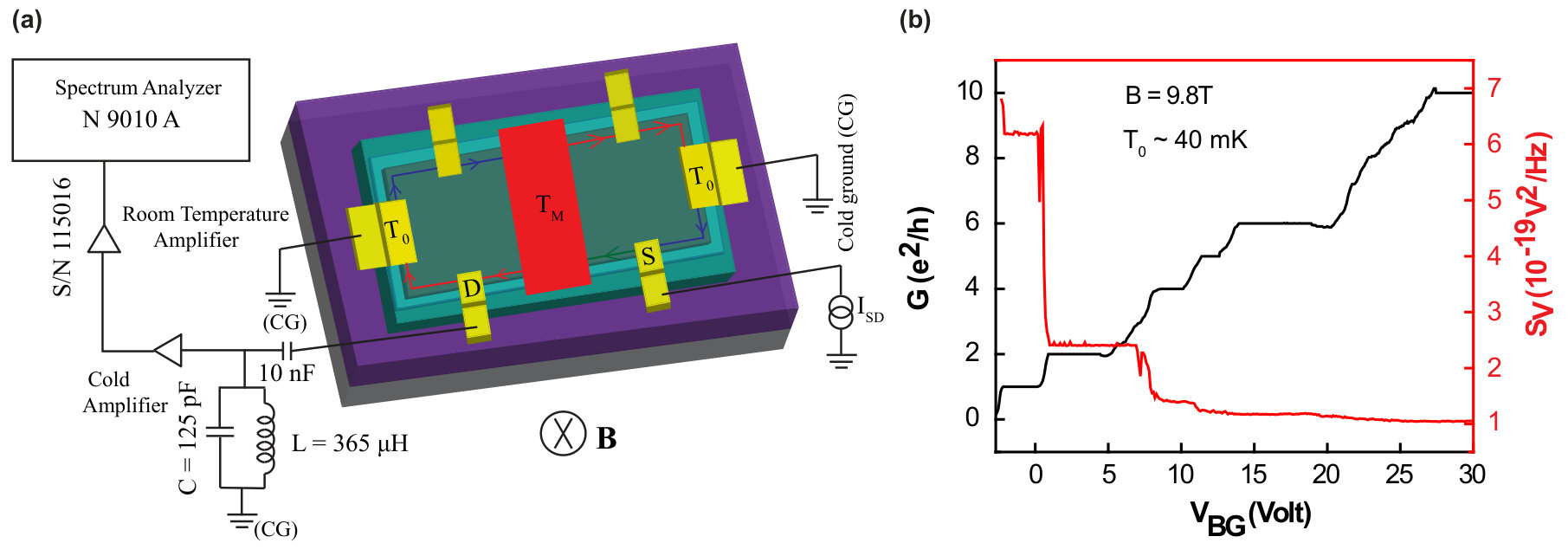 Figure 1
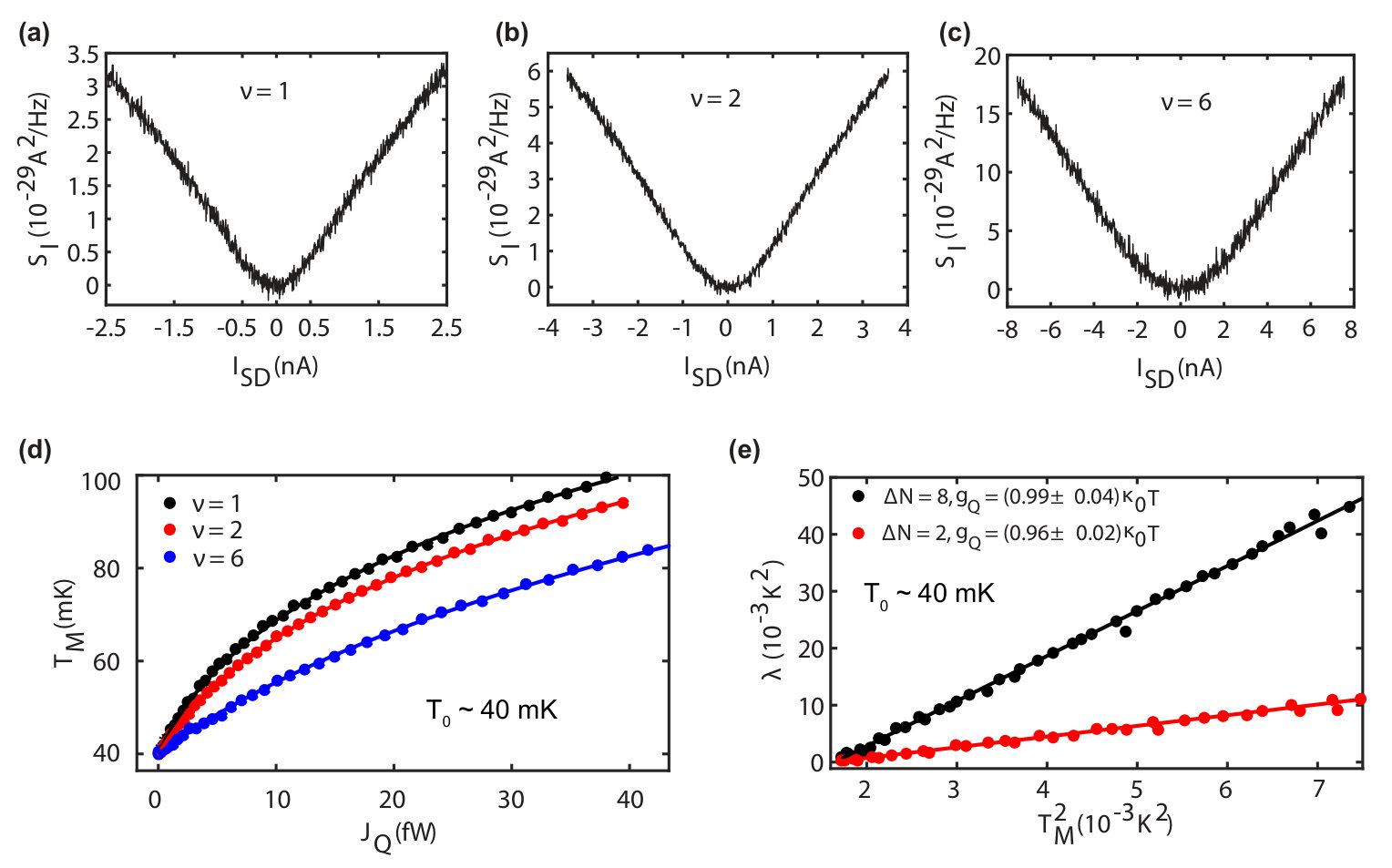 Figure 2
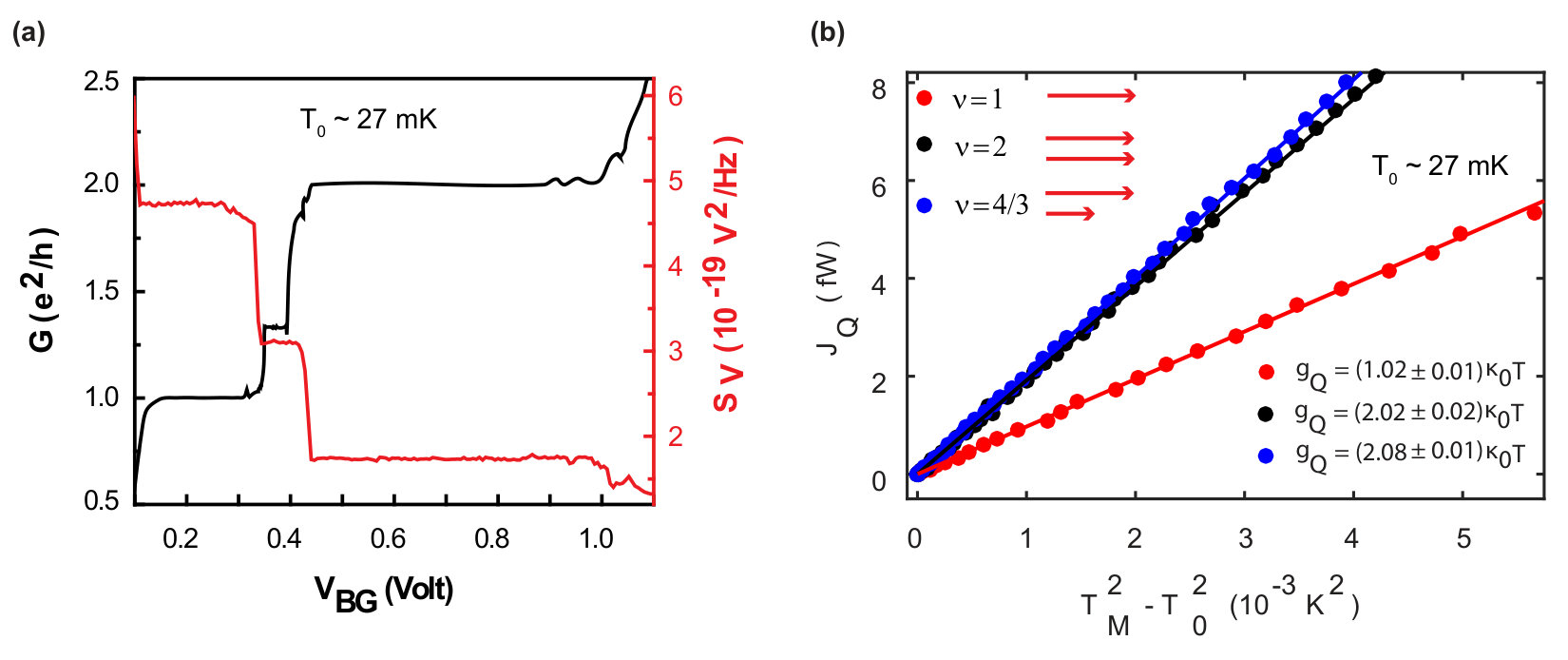 Figure 3
 Figure 4
Peer Reviews
No public reviews on file for this paper yet. If you reviewed it on a platform where reviews are public (OpenReview, ICLR, NeurIPS, ICML), you can paste yours below so the community can read it here.
Videos
No videos yet. Explain this paper in a talk, walkthrough, or lecture? Add one.
Taxonomy
TopicsGraphene research and applications · Quantum and electron transport phenomena · Topological Materials and Phenomena
Universal quantized thermal conductance in graphene
Saurabh Kumar Srivastav,1 Manas Ranjan Sahu,1 K. Watanabe,2 T. Taniguchi,2
Sumilan Banerjee,1 and Anindya Das,1∗
1Department of Physics,Indian Institute of Science, Bangalore, 560012, India.
2National Institute of Material Science, 1-1 Namiki, Tsukuba 305-0044, Japan.
∗ E-mail: [email protected]
The universal quantization of thermal conductance provides information on the topological order of a state beyond electrical conductance. Such measurements have become possible only recently, and have discovered, in particular, that the value of the observed thermal conductance of the state is not consistent with either the Pfaffian or the anti-Pfaffian model, motivating several theoretical articles. The analysis of the experiments has been made complicated by the presence of counter-propagating edge channels arising from edge reconstruction, an inevitable consequence of separating the dopant layer from the GaAs quantum well. In particular, it has been found that the universal quantization requires thermalization of downstream and upstream edge channels. Here we measure the thermal conductance in hexagonal boron nitride encapsulated graphene devices of sizes much smaller than the thermal relaxation length of the edge states. We find the quantization of thermal conductance within 5% accuracy for = and plateaus and our results strongly suggest the absence of edge reconstruction for fractional quantum Hall in graphene, making it uniquely suitable for interference phenomena exploiting paths of exotic quasiparticles along the edge.
Introduction
Measurement of quantization of thermal conductance at its quantum limit () and showing its universality irrespective of the statistics of the heat carriers has been an important quest in condensed matter physics since the quantization can reveal the exotic topological nature of the carriers, not accessible via electrical conductance measurement[1, 2]. Although, the thermal conductance has been measured for phonons[3], photons[4] and fermions[5, 6, 7] but the definitive proof of universality of quantum limit of thermal conductance remained elusive for more than two decades[8, 9, 1, 10] until being reported very recently in fractional quantum Hall (FQHE) of GaAs based two dimensional electron gas (2DEG)[11, 12]. However, due to soft confining potential the egde-state reconstruction leads to extra pairs of counter-propagating edges in the FQHE of GaAs[13, 14, 15, 16, 17] and makes it complicated to interpret the exact value of the thermal conductance. In this case, for the particular experimental set up, the measured value of thermal conductance can vary from the theoretically[1] predicted to depending on full thermal equilibriation to no thermal equilibriation of the counter propagating edges[11, 12], where and are the number of downstream and upstream edges, respectively. Obtaining full thermal equilibriation at very low-temperature is quite challenging as the thermal relaxation length ( 50 m) could be much bigger than the typical device dimensions[11, 12]. Therefore, the precise measurement of universal thermal conductance requires a system having no such edge reconstruction. Here we demosntrate that graphene, a single carbon atomic layer, which offers unprecedented universal edge profile[18, 19] due to atomically sharp confining potential, is an ideal platform to probe universal quantized thermal conductance and unambiguously reveal the topological order of FQHE. The sharp edge potential profile in graphene is easily realized using few nanometers thick insulating spacer like hexagonal boron nitride (hBN) between the graphene and the screening layer[18]. Furthermore, quantum Hall (QH) state of graphene has higher symmetry in spin-valley space (), which is tunable by electric and magnetic field, and thus exhibit a plethora of exciting phases, ranging from spontaneously symmetry-broken states [20, 21, 22, 23, 24, 25, 26, 27] to protected topological states like quantum spin Hall state near the Dirac point[28]. More interestingly, compared to GaAs, bilayer graphene has several additional even-denominator quantum Hall fractions[29] like and , which has topologically exotic ground states with possible non-abelian excitations and some of these exotic phases can be uniquely identified by thermal conductance measurement[20, 1, 2].
In this report we have carried out the thermal conductance measurement in the integer as well as FQHE of graphene devices with channel length of 5m by sensitive noise thermometry setup. We first establish the quantum limit of thermal conductance for integer plateaus of and in hBN encapsulated monolayer graphene devices gated by back gate. We then further study the thermal conductance for fractional plateau of = in a hBN encapsulated graphene device gated by graphite back gate, such that the distance (hBN 20 nm) between the graphene and the gate is comparable to the magnetic length scale. We show that the values of thermal conductance for = and are same even though they have different electrical conductance. These results indeed show the universality of thermal conductance with its quantum limit as predicted by theory[1]. More importantly, measuring exact value of universal quantum limit of thermal conductance in such a short graphene channel strongly suggest the absence of any edge reconstruction in graphene QH as the thermal relaxation length[30] is much larger than the channel length. Thus, our work is an important step to measure half of a thermal conductance and to demonstrate the topological non-Abelian excitaton in graphene hybrids in future.
We have used two and one graphite back gated devices for our measurements, where the hBN encapsulated devices are fabricated using standard dry transfer pick-up technique[31] and followed by edge contacting method (see the SI section-1). The schematic is shown in Fig. 1a, where the floating metallic reservoir in the middle connects the both sides by edge contacts. The measurements are done in a cryofree dilution refrigerator having base temperature of mK. The thermal conductance was measured employing noise thermometry based on LCR resonant circuit at resonance frequency of kHz and amplified by preamplifiers and finally measured by a spectrum analyzer (SI figure-2). The conductance measured at the source contact in Fig. 1a for device 1 has been plotted as a function of back gate voltage () at B = 9.8T shown in Fig. 1b, where the clear plateaus at =1, 2, 4, 5, 6, 10 are visible. The thermal noise (including amplifier noise) measured across the LCR circuit is plotted as a function of in Fig. 1b, where the plateaus are also evident.
A DC current , injected at the source contact (Fig. 1a), flows along the chiral edge towards the floating reservoir. The outgoing current from the floating reservoir splits into two equal parts, each propagating along the outgoing chiral edge from the floating reservoir to the cold grounds. The floating reservoir reaches a new equilibrium potential with the filling factor of graphene determined by the , whereas the potential of the source contact is . Thus, the power input to the floating reservoir is , where the pre-factor of results due to the fact that equal power dissipates at the source and the floating reservoirs in Fig. 1a. Similarly, the outgoing power from the floating reservoir is . Thus, the resultant injected power dissipation in the floating reservoir due to joule heating is and as a result the electrons in the floating reservoir will get heated to a new equilibrium temperature () such that the following heat balance equation,
[TABLE]
is satisfied. Here, is the heat current carried by the chiral ballistic edge channels from the floating reservoir () to the cold ground () and the is the heat loss rate from the hot electrons of the floating reservoir to the cold phonon bath. In Eq. (1), and are the only unknowns to determine the quantum limit of thermal conductance (). The of the floating reservoir in our experiment is obtained by measuring the excess thermal noise, [7, 11, 12], along the outgoing edge channels as shown in Fig. 1a. After measuring the accurately one can determine using Eq. (1) by tuning the number of outgoing channels ().
Fig. 2a-c shows the measured excess thermal noise for device 1 as a function of source current for = 1, 2 and 6 at . In our experiment, for a filling factor , the chiral edge modes impinge the current in the floating reservoir and chiral edge modes leave the floating reservoir in the integer QH regime, out of them half propagate towards the left cold reservoir and other half towards the right cold reservoir. The heating of floating reservoir is exhibited in the increase of at finite current . The -axis and -axis of the Fig. 2 (top panel) are converted to and , respectively, and plotted in Fig. 2d for different , where each solid circles are generated after averaging 9 consecutive data points (raw data - SI section-7). The without DC current was determined from the thermal noise measurement and shown in SI section-3. As expected we observe that is higher for lower as less number of chiral edges has to carry the heat away. Similarly, to maintain a constant , higher is required for higher . In Fig. 2e we have plotted where , as a function of for two different configuration of and . It can be seen that the is proportional to as expected from Eq. (1). The solid lines in Fig. 2e represent the linear least square fits and gives the values of 1.92 and 7.92 for and , respectively. Similarly, we have repeated the experiment at for device 1 and device 2 and the linear fits give values of 7.76 and 8.64 (SI figure-13 and 14) for , respectively. Thus, the average thermal conductance of single edge state () from the four linear fittings is found to be upto the second place of decimal, where and the error is the standard deviation.
In order to measure the thermal conductance for FQHE state we have used a graphite back gated device (device 3), where the graphene channel is isolated from the graphite gate by bottom hBN ( 20 nm). We have also introduced extra low pass filter at the mixing chamber in order to get the lower electron temperature, mK (SI section-3). The conductance plateaus and the thermal noise as a function of at B = 7T are shown in Fig. 3a, where the = 1, and 2 are clearly visible in both measurements. The plots for versus are shown in the SI figure-16. In Fig. 3b we have plotted the (solid circles) as a function of for = 1, and 2 over the temperature window (up to 60-70mK) where the curve is linear, implying the dominance of the electronic contribution to the heat flow. The solid lines in Fig. 3b represent the linear fits (in ) and gives the values of 2.04, 4.16 and 4.04, which corresponds to and for = 1, and 2, respectively. For = , two downstream charge modes, one integer and one fractional (inner = with effective charge, ) are expected. The thermal conductance from these modes should be the same as = 2 having two integer downstream charge modes, as seen in our experiment within 3 mismatch. Thus, our result is consistent with the theory that the quantum limit of thermal conductance is same for both fractional and integer QH edges.
The reported thermal conductance in Ref[11, 12] for the particle like composite fermions ( = , ) matches well with the theory, though its values are not consistent for the hole like composite fermions ( = , ) and = . One of the main reasons behind this is the presence of extra counter-propagating edge modes arising from inevitable edge reconstruction in GaAs and insufficient thermalization among the edges. The thermal relaxation length of 15 m in graphene QH is reported at 4K[30] and it is expected to be order of magnitude higher at low-temperature ( 50 mK). These length scales are much bigger than our graphene channel length ( 5 m) and thus, observing the quantum limit of thermal conductance accurately for FQHE in graphene strongly suggest the absence of edge reconstruction. In the SI section-9, we have discussed about the accuracy of our measurements and the electron-phonon coupling to the heat flow in the graphene devices.
In conclusion, we have first time measured the thermal conductance for three integer plateaus (1, 2, 6) and one particle like fractional plateau () of graphene and the values are consistent with the quantum limit () within 5% accuracy. These studies can be extended soon to measure the thermal conductance for the even denominator QH plateaus in graphene[29] with atomically sharp confining potential to probe their non-abelian nature.
Acknowledgments
We would like to give special thanks to Prof. Jainendra Jain for the critical inputs as well as his help to write the manuscript. We would also like to thank Prof. Moty Heiblum for fruitful discussion. We also wish to thank Prof. Rahul Pandit, Dr. Hyungkook Choi, Dr. Yuval Ronen and Dr. Vibhor Singh for useful discussions. The authors acknowledge device fabrication and characterization facilities in CeNSE, IISc, Bangalore. A.D thanks Department of Science and Technology (DST), Government of India, under Grant nos: DSTO1470 and DSTO1597. K.W. and T.T. acknowledge support from the Elemental Strategy Initiative conducted by the MEXT, Japan and and the CREST (JPMJCR15F3), JST.
Author contributions
S.K.S. contributed to device fabrication, data acquisition and analysis. M.R.S. contributed in noise setup, data acquisition and analysis. A.D. contributed in conceiving the idea and designing the experiment, data interpretation and analysis. S.B contributed in data interpretation and theoretical understanding of the manuscript. K.W and T.T synthesized the hBN single crystals. All the authors contributed in writing the manuscript.
See pages - of image4.pdf
The reference list from the paper itself. Each links out to its DOI / PubMed record.
- 1[1] C. Kane, M. P. Fisher, Physical Review B 55 , 15832 (1997).
- 2[2] T. Senthil, M. P. Fisher, Physical Review B 61 , 9690 (2000).
- 3[3] K. Schwab, E. Henriksen, J. Worlock, M. L. Roukes, Nature 404 , 974 (2000).
- 4[4] M. Meschke, W. Guichard, J. P. Pekola, Nature 444 , 187 (2006).
- 5[5] L. Molenkamp, et al. , Physical review letters 68 , 3765 (1992).
- 6[6] O. Chiatti, et al. , Physical review letters 97 , 056601 (2006).
- 7[7] S. Jezouin, et al. , Science 342 , 601 (2013).
- 8[8] J. Pendry, Journal of Physics A: Mathematical and General 16 , 2161 (1983).