Light front QED, Stueckelberg field and Infrared divergence
T. R. Govindarajan, Jai D. More, P. Ramadevi

TL;DR
This paper demonstrates that incorporating the Stueckelberg field in light-front QED effectively cancels infrared divergences, ensuring IR finiteness in the massless gauge boson limit through explicit diagrammatic analysis.
Contribution
It reveals the role of the Stueckelberg field in IR divergence cancellation in light-front QED, connecting gauge symmetry preservation with IR finiteness.
Findings
IR divergences are canceled at leading order in self-energy diagrams.
Stueckelberg field ensures IR finiteness in the massless limit.
The approach parallels the Kulish-Faddeev coherent state method.
Abstract
Stueckelberg mechanism introduces a scalar field, known as Stueckelberg field, so that gauge symmetry is preserved in the massive abelian gauge theory. In this work, we show that the role of the Stueckelberg field is similar to the Kulish and Faddeev coherent state approach to handle infrared (IR) divergences. We expect that the light-front quantum electrodynamics (LFQED) with Stueckelberg field must be IR finite in the massless limit of the gauge boson. We have explicitly shown the cancellation of IR divergences in the relevant diagrams contributing to self-energy and vertex correction at leading order.
Click any figure to enlarge with its caption.
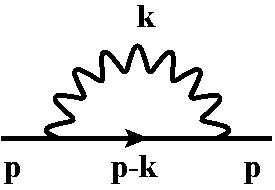 Figure 1
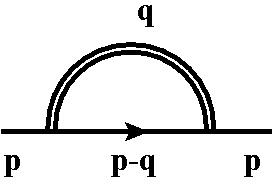 Figure 1
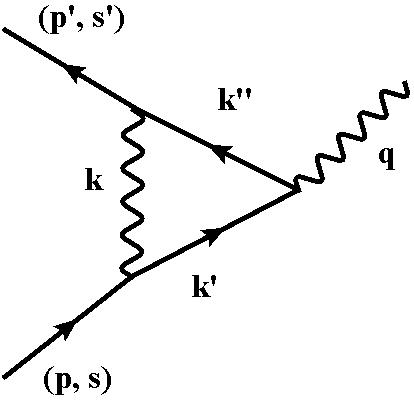 Figure 2
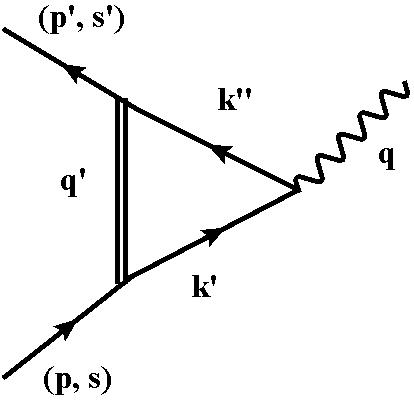 Figure 2
Peer Reviews
No public reviews on file for this paper yet. If you reviewed it on a platform where reviews are public (OpenReview, ICLR, NeurIPS, ICML), you can paste yours below so the community can read it here.
Videos
No videos yet. Explain this paper in a talk, walkthrough, or lecture? Add one.
Lightfront QED, Stueckelberg field and Infrared divergence
T. R. Govindarajan a,∗, Jai D. Moreb,† and P. Ramadevi
a Chennai Mathematical Institute, Kelambakkam Siruseri, Tamil Nadu 600113, India.
b Department of Physics, Indian Institute of Technology Bombay,
Powai, Mumbai 400076, India.
[email protected], [email protected], [email protected], [email protected]
Abstract
Stueckelberg mechanism introduces a scalar field, known as Stueckelberg field, so that gauge symmetry is preserved in the massive abelian gauge theory. In this work, we show that the role of the Stueckelberg field is similar to the Kulish and Faddeev coherent state approach to handle infrared (IR) divergences. We expect that the light-front quantum electrodynamics (LFQED) with Stueckelberg field must be IR finite in the massless limit of the gauge boson. We have explicitly shown the cancellation of IR divergences in the relevant diagrams contributing to self-energy and vertex correction at leading order.
I Introduction
It has been known for years, computation of the transition matrix element in gauge theories like QED or QCD inherits infrared divergences (IR) due to massless gauge boson Bloch37 ; Yennie61 ; Naka58 . There are different remedies to cure IR divergences. For example, one can treat these IR divergences by mass regularization where a small mass is introduced for the gauge particle. The other standard way is to perform dimensional regularization. Or traditionally one introduces a small energy cutoff for the in and out states, since the instruments come with natural limitations. We find the divergence gets canceled as we remove the cutoff Leibbrandt75 .
The standard Lehmann-Symanzik-Zimmermann (LSZ) formalism is based on the assumption that at large time ‘’ the coupling can be “switched off” or in other words the particles can be treated as free particles in the scattering process in the limit . Thus, in that case, the initial and the final state can be considered as Fock state to calculate the matrix element. However, in gauge theories with massless particles, in particular, gauge theory, the asymptotic states are not the free states . The charged particles are dressed by soft or long wavelength photons as pointed out by Kulish and Faddeev (KF) Kulish70 . Experimentally, these low energy photons cannot be detected by the detector and lead to soft divergences or IR divergences if one tries to do a theoretical computation. The cancellation of IR divergences at amplitude level was first summarized by Chung Chung65 , which says that IR divergences can be eliminated if one chooses the initial and final states to be charged particles with a suitable superposition of an infinite number of photons. KF demonstrated that the asymptotic interaction Hamiltonian in QED is non-vanishing. They obtained the appropriate initial and final state thereby modifying the Hilbert space, which is nothing but the new asymptotic states. They constructed the asymptotic state for QED by defining modified gauge invariant -matrix and showed that the IR divergences cancel at amplitude level using this new basis.
Bagan et al. Bagan:2001wj analogous to KF described that the coupling in QED does not asymptotically vanish hence the matter field is unphysical. Thus if one does not take into account carefully the asymptotic behavior then the IR divergences appear. They constructed a gauge invariant fermion wavefunction which handles the soft photon to obtain the IR finite result.
The KF method was later applied to obtain a set of asymptotic states in the asymptotic region of perturbative quantum chromodynamics (pQCD) by Nelson and Butler Nelson78 . It was shown that the asymptotic states constructed leads to cancellation of IR divergences in certain matrix elements in the lowest order in pQCD. KF approach was utilized by various authors Greco78 ; Dahmen81 to develop the coherent states in QED and QCD, in order to study the IR behavior of abelian as well as non-abelian gauge theories. The matrix elements using these coherent states were shown to be IR finite.
The canonical field theory methods reviewed so far can also be analyzed in light front (LF) formalism devised by Dirac Dirac49 . One of the advantages of LF quantization is that it provides the understanding of Feynman’s infinite momentum frame, in which all finite mass particles behave like massless particles. The smooth massless limit can be perceived in this context.
Harindranath and Vary Hari88 applied coherent state formalism to light front field theory (LFFT) for the first time and showed that a coherent state may be a valid vacuum in LFFT. A coherent state formalism was developed to deal with the true IR divergences in light front Misra94 and later applied by one of us to deal with true IR divergences in light-front QED (LFQED) to calculate fermion mass renormalization Jai12 ; Jai13 ; Jai15 . In the coherent state approach, the initial and final Fock state is replaced by superposition of an infinitely large number of soft photons in terms of new Hilbert space. It was shown that IR divergences cancel up to in LFQED using coherent state basis in light front gauge Jai12 and Feynman gauge Jai13 . Later, this method was generalized for cancellation of IR divergence in fermion mass renormalization to all orders in LFQED Jai15 .
It is known that IR divergences in gauge invariant QED is due to massless vector bosons. It will be interesting to look for alternate theories, which are free from IR divergences, giving physics of QED. For example, consider the case of Stueckelberg formalism wherein an additional scalar field led to massive gauge boson with a salient feature of gauge invariance Jac00 ; Ruegg04 . This was in contrast to massive vector Proca field which was just the extension of gauge theory with the additional mass term with a drawback of violation of abelian gauge symmetry. The additional triumph of Stucekelberg theory was that it is a renormalizable theory Ruegg04 . Not only the Stueckelberg mechanism, but there are other ways of generating vector boson mass like the well-known Higgs mechanism in field theories and terms as in BF topological theories .
Recently the infrared question and soft photon theorems have been linked to new asymptotic symmetries that emerge for massless particles in gauge theories Kapec17 ; Laddha18 . The Stueckelberg QED has an additional degree of freedom which exists for the massive gauge bosons. Preserving the degrees of freedom at null infinity, while taking the limit of gauge boson mass to zero, we can get additional global or asymptotic symmetry. In fact, one of us Govindarajan19 discussed modified soft photon theorems due to massive photons and analyzed the subtle procedure of taking massless limit.
The paper is organized as follows: In Sec. II we give the QED Lagrangian after the addition of Stueckelberg field and then obtain a generalized Stueckelberg Hamiltonian. In Sec. III, it is shown that IR divergences cancel when one takes the limit for the scalar field using light-front formalism up to leading order for self-energy correction. We also checked that IR divergences up to ) cancel in the massless limit of the scalar field is discussed in Sec. IV. We conclude with our remarks and future plans in Sec. V.
II Stueckelberg Lagrangian
We start by writing QED Lagrangian with Stueckelberg field Jac00 ; Ruegg04
[TABLE]
where
[TABLE]
, and describe the fermion field, gauge vector field and Stucekelberg scalar fields respectively. The field-strength tensor is given by: The term in Eq. 4 is the gauge fixing term to remove the redundancy. For simplification, we choose Feynman gauge which corresponds to . It should be noted that the Stueckelberg field decouples to conventional QED in the mass going to zero limit. In fact, to start with, electromagnetic potential has four components. The field equations led to the massless particle, the photon with two transverse physical degrees of freedom due to gauge invariance. However, the addition of mass term spoils the gauge invariance. But, by introducing an extra scalar field we have five fields now. This is Stucekelberg trick which gives Lorentz covariant and gauge invariant massive spin-1 theory.
The Lagrangian without the gauge fixing term is invariant under the gauge transformation:
[TABLE]
The complex gauge function satisfies the field equation congruent with and ;
[TABLE]
The Stueckelberg field is not coupled to the fermion, which is actually not a gauge invariant remark. We make the following gauge transformation using the Stueckelberg field itself as gauge parameter:
[TABLE]
After this transformation we have the fermion field coupled to the Stueckelberg field through derivative interaction. The Lagrangian in the new variables is:
[TABLE]
The fermion wavefunction can be decomposed into independent and dependent component of and respectively (for details cf. Ref Mus91 ).
[TABLE]
The components of four vector are chosen as
[TABLE]
This Hamiltonian can be obtained generalizing Jai12 for massive photon QED in light front as
[TABLE]
where
[TABLE]
is the free Hamiltonian,
[TABLE]
is the , standard 3point interaction vertex,
[TABLE]
is an non-local effective 4point vertex corresponding to instantaneous fermion exchange and
[TABLE]
is an non-local effective 4point vertex corresponding to an instantaneous photon exchange.
[TABLE]
is the 3point interaction term due to the Stueckelberg field after gauge transformation.
and have standard expansions in terms of creation and annihilation operators:
[TABLE]
and satisfy
[TABLE]
These commutation/anticommutation relations hold at equal light-front time .
III Self energy correction up to
We obtain the transition matrix element in light-front time ordered perturbation theory using perturbative expansion as follows
[TABLE]
The contribution to self-energy correction is obtained from
[TABLE]
In Eq. 21 on the right hand side, we obtain the contributions to fermion self-energy correction. The first term corresponds to the standard three-point vertices, the second term corresponds to three-point vertices due to the Stueckelberg field while the third term corresponds to four-point instantaneous vertex which arises in light front quantization. We will focus on the true IR divergences in the massless limit which shows up due to the vanishing energy denominator. The third term can be dropped as it is not contaminated by IR divergence. It is very important to understand here that in the second term the energy denominator gets IR divergence, when one takes limit. Then the second term contribute when longitudinal polarization is used, equal and opposite to the first term. In order to calculate the transition matrix element and contributing to fermion self-energy correction to , we insert a complete sets of states to account for the intermediate state. Details of the calculation follow:
[TABLE]
On substituting for and further simplification gives
[TABLE]
In going from Eq. 23 to Eq. 24 we have written the longitudinal polarization vector as Banks08
[TABLE]
Since we focus on IR divergence in the massless limit which come from the disappearance of the longitudinal mode we use corresponding polarization.
In the similar manner, we can calculate the diagram in Fig. 1(b)
[TABLE]
In the limit , and we observe that IR divergences in Eq. 24 and Eq. 26 cancel exactly each other.
It was shown that IR divergences cancel when we use coherent state basis instead of Fock state to calculate the same matrix element in Ref Jai12 . Now, we have calculated self-energy correction up to and shown that the IR divergences cancel when we use Stueckelberg field and take limit. This explains up to the contribution for the terms responsible for the cancellation for IR divergences in the coherent state basis are provided by the Stueckelberg field.
IV Vertex correction up to
In this section, we discuss the lowest order radiative correction for 3-point interaction in light front formalism. It was shown in Ref Misra94 the IR divergences cancel when one uses coherent state basis instead of Fock state to calculate the matrix element. Now we compute using the Stueckelberg field.
The correction terms due to the three-point vertex contributing to IR divergences are given by
[TABLE]
where corresponds to vertex correction contribution coming from three 3-point vertices . As we have an additional three-point vertex due to Stueckelberg field interaction with the fermion field which is represented by . The subscript corresponds to one particle state going to two particle states. There are also contributions for vertex correction coming from the vertex due to instantaneous fermion vertex and instantaneous boson vertex corresponding to and respectively. We consider only the diagrams shown in Fig. 2 and also we limit our calculation for the vertex correction hence the last term do not contribute due to the tensor structure.
The contribution to vertex correction up to is given by
[TABLE]
We use again longitudinal polarization from Eq. 25. We observe the addition of the Stueckelberg field leads to the cancellation of IR divergences in the limit at the amplitude level itself as in the self-energy computation. Coherent states led to the similar cancellation of IR divergence was shown earlier in Ref Misra94 . Again it is clear the role of soft photon in coherent states is played by Stueckelberg field. Using coherent states IR divergence cancellation was extended to all orders in Ref Jai15 . We do not anticipate difficulty in establishing similar cancellation using Stueckelberg field.
V Conclusion
In this work, we have shown that IR divergences get cancelled if one adds Stueckelberg field to QED lagrangian using light-front formalism. Massive Stueckelberg QED has been studied earlier and shown to be renormalizable. For very low mass it has also been shown to reproduce results of conventional QED as long as the interaction is through a conserved current. Our main goal was to study limit in Stueckelberg QED where IR divergences could make its appearance. Interestingly, we could reproduce the leading order results expected by KF approach. It appears that the arguments can be extended to establish the cancellation of IR divergences to all orders. We hope to pursue in future such a generalization where the tools discussed in Ref. Jai15 will be useful.
Applying the Stueckelberg mechanism to QCD has limitations due to self coupling amongst gauge bosons. In fact, the non-abelian Stueckelberg theory is non-renormalisable. Hence, the problem of achieving IR divergence cancellation in QCD needs a novel approach. The recent paper Glazek2018 attempts IR issues through Higgs mechanism in abelian theory. Comparing their methods with our approach may give us a tangible idea to handle IR problems in non-abelian theories.
Another interesting aspect to explore will be the interplay between IR divergences and supersymmetry in the context of supersymmetric formulation of Stueckelberg QED Kors05 . Also it is known that SUSY Stueckelberg QED is renormalizable.
We have confined to gauge theories in this work. It will be challenging to investigate Stueckelberg mechanism in gravity theories. For example, the linearised massless gravity theory studied by van Dam, Veltman, and Zakharov (vDVZ) has a discontinuity known as vDVZ discontinuityHinterbichler12 . The addition of new fields into the massive gravity theory could remove such discontinuities. These new fields, similar to the Stueckelberg field, are required so that the number of degrees of freedom are unchanged even after taking the massless limit. These additional Stueckelberg degrees of freedom can play non-trivial role due to its gravitational interaction. This will be presented elsewhere TRG .
Acknowledgements.
The authors would like to acknowledge Prof V. Ravindran for extremely useful discussions. J.D.M would like to thank Prof V. Ravindran and T.R.G for warm hospitality during her visit to IMSc. J.D.M wishes to thank P.R for financial support through the IRCC funded project by IIT Bombay no. 17 RPA001.
The reference list from the paper itself. Each links out to its DOI / PubMed record.
- 1(1) F. Bloch and A. Nordsieck, Phys. Rev. 52 (1937) 54.
- 2(2) D. R. Yennie, S. C. Frautschi and H. Suura, Annals Phys. 13 (1961) 379.
- 3(3) N. Nakanishi, Prog. Theor. Phys. 19 (1958) 159.
- 4(4) G. Leibbrandt, Rev. Mod. Phys. 47 (1975) 849.
- 5(5) P. P. Kulish and L. D. Faddeev, Theor. Math. Phys. 4 , 745 (1970).
- 6(6) V. Chung, Phys. Rev. 140 (1965) B 1110.
- 7(7) E. Bagan, M. Lavelle, D. Mc Mullan and S. Tanimura, Phys. Rev. D 65 (2002) 105004.
- 8(8) D. R. Butler and C. A. Nelson, Phys. Rev. D 18 , 1196 (1978).