Quasi-isotropic cycles and non-singular bounces in a Mixmaster cosmology
Chandrima Ganguly, Marco Bruni

TL;DR
This paper introduces mechanisms in a Mixmaster cosmology that produce non-singular, quasi-isotropic bounces, potentially allowing the universe to undergo endless cycles with some resembling standard cosmological models.
Contribution
It presents novel methods using non-linear equations of state and negative anisotropic stresses to achieve non-singular, quasi-isotropic bounces in a Mixmaster universe, reducing chaos.
Findings
Non-singular bounces achieved with a non-linear fluid equation of state.
Negative anisotropic stresses isotropize the universe and suppress chaos.
The universe can undergo infinite cycles with some being nearly isotropic.
Abstract
A Bianchi IX Mixmaster spacetime is the most general spatially homogeneous solution of Einstein's equations and it can represent the space-averaged Universe. We introduce two novel mechanisms resulting in a Mixmaster Universe with non-singular bounces which are quasi-isotropic. A fluid with a non-linear equation of state allows non-singular bounces. Using negative anisotropic stresses successfully isotropises this Universe and mitigates the well known Mixmaster chaotic behaviour. Thus the Universe can be an eternal Mixmaster, going through an infinite series of different cycles separated by bounces, with a sizable fraction of cycles isotropic enough to be well approximated by a standard Friedmann-Lema\^itre-Robertson-Walker model from the radiation era onward.
Click any figure to enlarge with its caption.
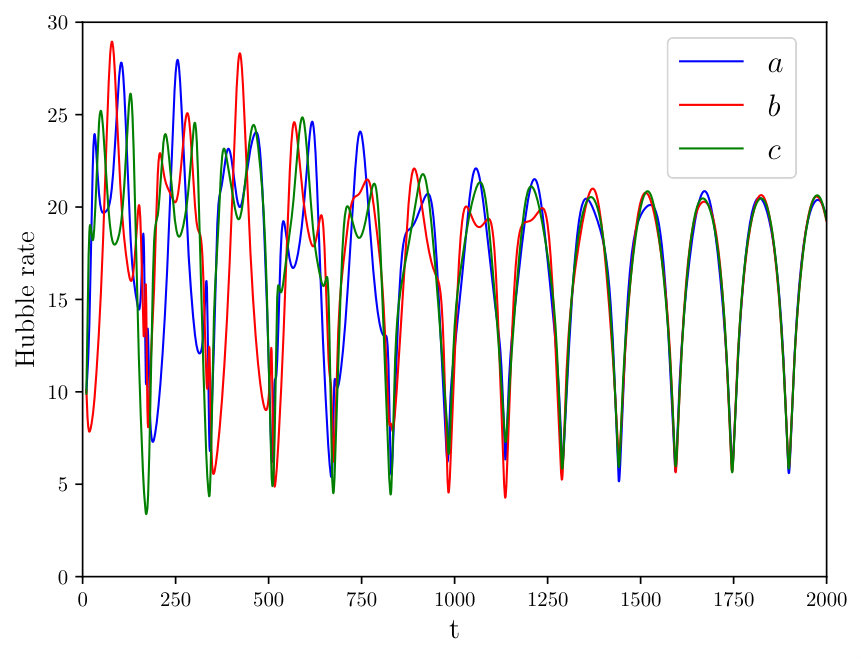 Figure 1
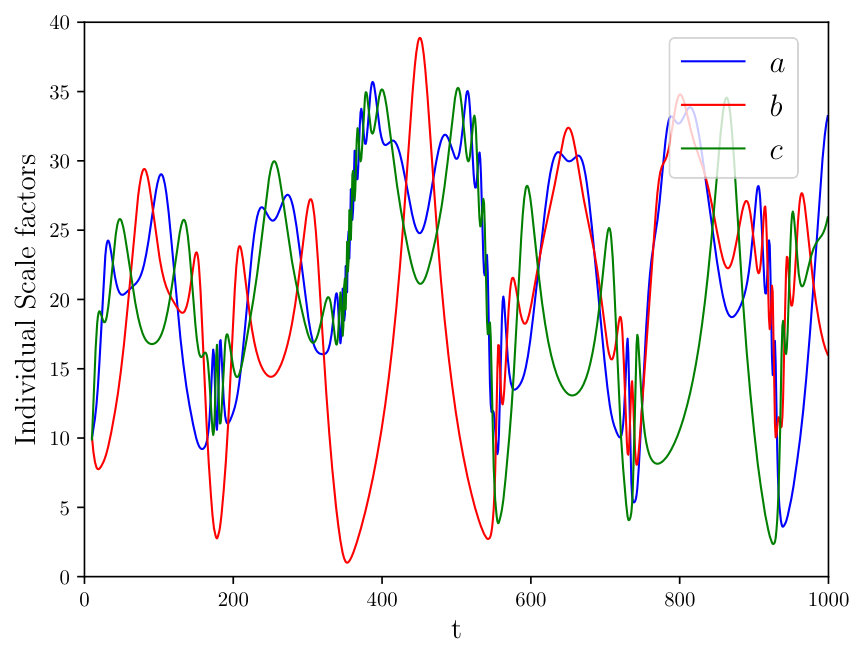 Figure 2
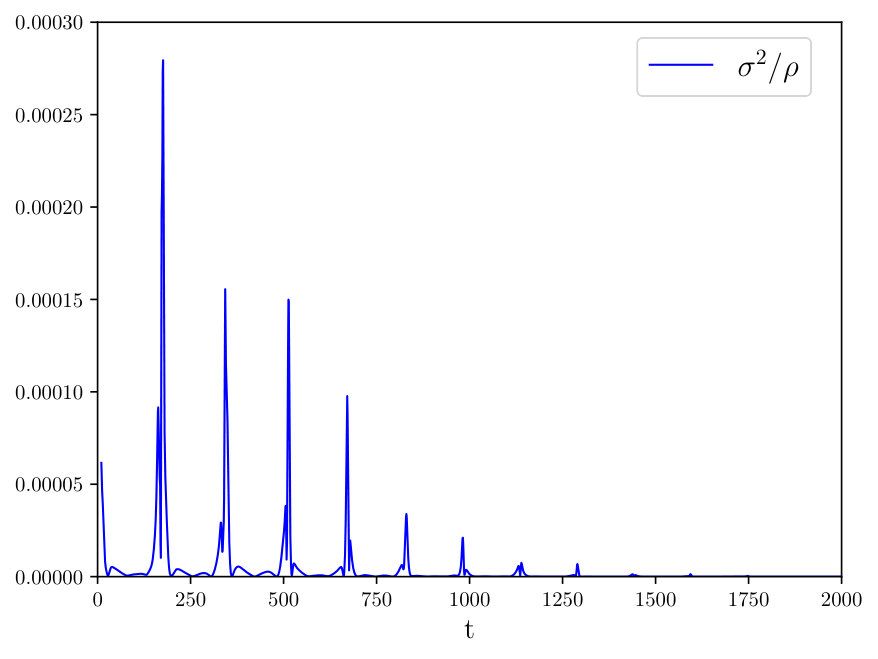 Figure 3
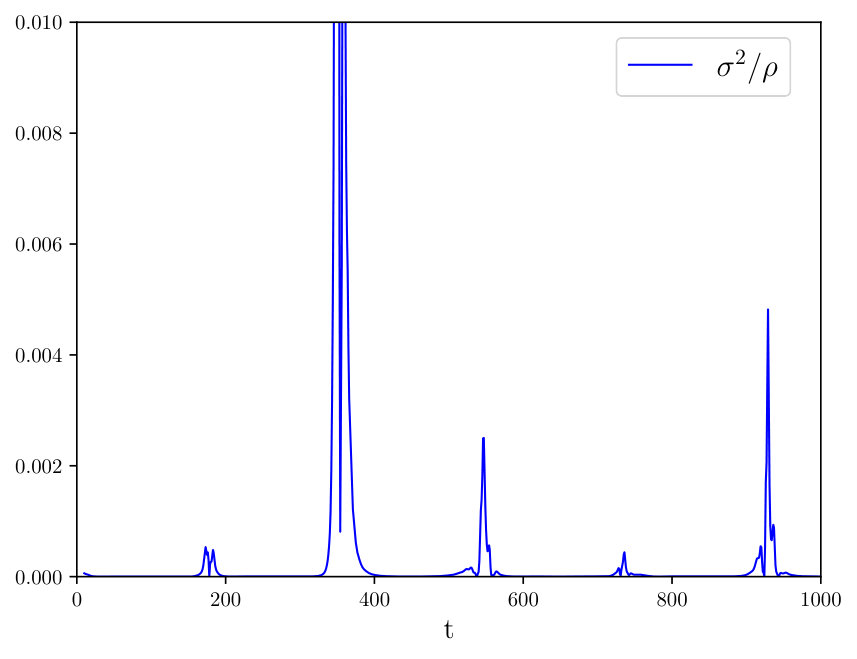 Figure 4
Peer Reviews
No public reviews on file for this paper yet. If you reviewed it on a platform where reviews are public (OpenReview, ICLR, NeurIPS, ICML), you can paste yours below so the community can read it here.
Videos
No videos yet. Explain this paper in a talk, walkthrough, or lecture? Add one.
Quasi-isotropic cycles and non-singular bounces in a Mixmaster cosmology
Chandrima Ganguly
Lindemann Fellow, Department of Physics and Astronomy,Wilder Laboratories, Dartmouth College, Hanover NH03755, USA
Marco Bruni
Institute of Cosmology and Gravitation, University of Portsmouth, Dennis Sciama Building, Burnaby Road, Portsmouth PO1 3FX, UK
Abstract
A Bianchi IX Mixmaster spacetime is the most general spatially homogeneous solution of Einstein’s equations and it can represent the space-averaged Universe. We introduce two novel mechanisms resulting in a Mixmaster Universe with non-singular bounces which are quasi-isotropic. Matter with a non-linear equation of state allows these bounces. Using a negative anisotropic stress successfully isotropises this Universe and mitigates the well known Mixmaster chaotic behaviour. The Universe can be an eternal Mixmaster, going through an infinite series of quasi-isotropic cycles separated by bounces.
Suggested keywords
††preprint: AIP/123-QED
Introduction
Cosmological parameter extraction from Planck Planck Collaboration, 2016a ; Planck Collaboration, 2016b ; Planck Collaboration, 2016c and other studies Saadeh et al., (2016) place tight constraints on the anisotropy of the current day Universe, , where represent the contribution of the (scalar part of) shear anisotropic expansion, and the isotropic expansion rate. A main problem of classical cosmology is that a Big Bang singularity is quite ubiquitous Hawking and Ellis, (2011); Hawking and Israel, (2010); Belinski and Henneaux, (2017). Inflation through exponential expansion is able to propose a mechanism of diluting out any initial anisotropy, homogeneity and curvature. Most importantly, the inflationary scenario is predictive, as it provides the setting to generate the observable fluctuations in the cosmic microwave background and in the matter distribution. However there remain shortcomings within this paradigm. For example many models can’t be extrapolated backwards, unable to escape a Big Bang. The energy scale of inflation can also be high enough for a complete theory of quantum gravity to be required Liddle, (1994). All cosmologically interesting fluctuation modes may have originated from a trans-Planckian zone of ignorance - the physics of which would significantly impact the predicted spectrum of cosmological perturbations Martin and Brandenberger, (2001).
The scenario proposed in this paper does away with this problem by producing an alternate ‘beginning’ story to the observable Universe - a successful bounce which solves the issue of the Big Bang singularity and the trans-Planckian problem Brandenberger and Peter, (2017), followed by a quasi-isotropic expansion.
We assume General Relativity (with units ) and a matter source with a non-linear equation of state (EoS) Ananda and Bruni, 2006b ; Ananda and Bruni, 2006a
[TABLE]
relating the pressure and the energy density . For the most general case of an anisotropic fluid conservation of energy is guaranteed by
[TABLE]
where is the anisotropic stress. Here is the characteristic energy scale at which the effect of the non-linearities in the EoS becomes relevant. can play the role of an effective cosmological constant Ananda and Bruni, 2006b ; in this paper we assume and . Then, for the perfect fluid case, this gives an effective cosmological constant
[TABLE]
i.e. a stationary point of (2), so that it must be , or otherwise one gets a “phantom behaviour”, i.e. during expansion () Ananda and Bruni, 2006b . In other words, in our scenario we have a high-energy cosmological constant for . Choosing to correspond to the radiation case at low energies, when the quadratic term is negligible, we have therefore a maximum value for . A closed (positively curved space) Friedmann-Lemaître-Robertson-Walker (FLRW) universe with this EoS can undergo cycles with non singular bounces, as shown in Ananda and Bruni, 2006b ; here we want to use this EoS in the context of a Bianchi IX cosmology, generalising Ananda and Bruni, 2006b ; Ananda and Bruni, 2006a . In this scenario as long as is below the Planck energy scale the universe undergoes a bounce at energies where one can use classical General Relativity. Other components such as standard matter can be introduced, but here we restrict the analysis to the bare-bones of the scenario, to make it simpler.
The next question addressed in this work is that of growing anisotropies in the contracting phase of a bouncing cosmology. We introduce a novel isotropisation mechanism using a negative anisotropic stress. This has been studied in expanding universes in Misner, (1968). A negative successfully mitigates the growth of expansion anisotropy, as well as the chaotic behaviour that is ubiquitous in spatially homogeneous spacetimes with anisotropic -curvature. This is an improvement from the use of the unphysical linear EoS that has been used in the literature so far Lidsey, (2006); Burd et al., (1990).
The Bianchi IX universe
To understand the behaviour of the most general kind of anisotropies - both in expansion as well as in the curvature - we turn to the Bianchi IX models. These are the most general anisotropic, spatially homogeneous spacetimes Landau, (1975). When one considers solutions of Einstein’s equations of this type, under standard assumption on the matter content Belinski and Henneaux, (2017), typically these models approach a singularity where matter becomes negligible, with the anisotropic -curvature driving the scale factors to undergo infinite chaotic oscillations over a finite time interval Belinsky et al., (1970); Landau, (1975); Deruelle and Langlois, (1995); Bruni and Sopuerta, (2003). This chaotic behaviour is actually an attractor, called the Mixmaster attractor Misner, (1969). An important reason why this class of cosmological models is interesting is because they contain the closed FLRW model as their isotropic sub-case. Universe models having positive spatial curvature have always been of particular interest as cycling solutions have been found in the isotropic case sourced by a linear EoS fluid Ananda and Bruni, 2006b ; Barrow and Tsagas, (2009) and by our present quadratic EoS Ananda and Bruni, 2006b . In the Bianchi IX models the sign of the -curvature is crucial: only when they are close enough to isotropy the -curvature is positive and re-expansion can occur. Sufficient isotropisation must therefore take place before the Universe can re-expand after collapse. Attempts at isotropising the Bianchi IX cosmology and mitigating the chaotic behaviour have mostly been focused on introducing stiff () Belinski and Khalatnikov, (1973) or super-stiff () Lidsey, (2006); Burd et al., (1990) matter. Adding a super-stiff fluid does not always seem to work as the existence of super-stiff anisotropic stress causes a faster growth of the energy density in the shear anisotropies Barrow and Ganguly, (2016). We study the effects of the non-linear EoS (1) and the negative anisotropic stress by numerically integrating the Einstein’s field equations and the conservation equation for the energy momentum tensor for these cosmological models.
In general, the metric for a homogeneous spacetime is given by
[TABLE]
Here are the one-forms for the triad basis in which the spacetime is defined. They are general functions of the spatial coordinates. The are the metric components in this triad and are functions of time only, as the spacetime is homogeneous. For our purposes, the metric in the triad frame is explicitly given by where , and will be taken to be the dimensionless scale factors of the universe in the three spatial directions. The isotropic FLRW subcase is given by .
We can write the equations of motion for this system in the triad basis in terms of and its time-derivative, the extrinsic curvature Landau, (1975). Thus, mathematically the problem is reduced to the study of a non-linear dynamical system of ordinary differential equations.
The Bianchi IX universe with matter has been found to undergo rotation of the triad frame axes themselves. The triad frame itself is part of the dynamics and the rotation can be parametrised in terms of the Euler angles , and . For our present purposes however, we are not interested in matter that exhibits non-comoving velocities or vorticities (see Ganguly and Barrow, (2017) and Refs. therein). Thus the stress-energy tensor is diagonal. Einstein equations then imply that the non-diagonal components of the Ricci tensor are zero. It has been shown Belinski and Henneaux, (2017) that this also implies that the Euler angles , and are constant and frame rotation can be disregarded in this case.
We also introduce the following variable
[TABLE]
These variable definitions are useful: gives the overall expansion of the volume of the universe and and are directly related to the shear (made of the logarithmic derivatives of , and ). They allow us to track the growth of anisotropy. We choose a fluid 4-velocity and consider a diagonal stress energy tensor given by , where is given by (1). Therefore, using Eq. (1) in (2), together with Eqs. (5) and three equations for , and , we have a dynamical system consisting of seven coupled first-order ordinary differential equations for seven variables.
Characteristic scale of the problem
The non-linear EoS (1) is characterised by the energy scale . We can then introduce new dimensionless variables
[TABLE]
which amounts to introduce a dimensionless time Ananda and Bruni, 2006b . Then, rewriting time derivatives in the equations of motion in terms of the dynamics can made completely dimensionless and independent from . Equivalently, for the purposes of our computations, we can use as our unit, setting in our equations. However is related to the initial conditions and needs to be re-introduced in order to get physical results. We will comment on the effect of this in a later section.
Results from introducing only the non-linear fluid
The results of the numerical integration in Fig. 1 reveal that the individual scale factors undergo several oscillations as expected and the volume scale factor undergoes bounces of similar height. This behaviour is reminiscent of the analysis done by Zardecki, (1983) for linear equations of state, while the negative quadratic term in Eq. (1) is similar to the effective term in Loop Quantum Cosmology Agullo and Singh, (2017). The shear and the -curvature shoot up at the minima but remain small when the universe is at its maximum size. The energy density in the anisotropies is diluted by expansion and is the smallest at the expansion maxima and show peaks near the minima. However we see from Fig. 2 that the evolution of the shear energy density has chaotic peaks. This implies that although the non-linear EoS (1) is successful in creating a non singular bounce, it is not as successful in isotropising the universe, in contrast with the flat Bianchi I case studied in Bozza and Bruni, (2009). This bouncing universe doesn’t seem capable of satisfying the stringent observational constraints on isotropy.
Introduction of negative anisotropic stress as a mechanism of isotropisation
The anisotropy energy density given by grows as . The solution proposed by ekpyrosis Khoury et al., (2002); Kallosh et al., (2008); Steinhardt and Turok, (2002) is to introduce a scalar field rolling down a steep negative exponential potential. The idea is that this field - also known as the ekpyrotic field- will have an effective EoS that is super-stiff i.e. . This effective super-stiff fluid will evolve much faster than in a universe with contracting volume and so will be able to dominate over the anisotropy, and inhomogeneity in the contracting phase of a bouncing universe. When anisotropic stress are included which are themselves super-stiff they act as a source for growing shear and hence any ekpyrotic field will always have to compete with these growing anisotropies. This has been studied in detail in Barrow and Ganguly, (2016). Furthermore, a universe that is highly anisotropic and has non zero spatial curvature - like the Bianchi IX universe - will not re-expand through a bounce after contraction as the anisotropies will dominate over the fields that drive the bounce Battefeld and Peter, (2015). In the specific case of the Bianchi IX universe this will signal the onset of chaotic behaviour. By the same reasoning, a negative anisotropic stress should cause the shear to decrease. This has been seen in the context of shear viscosity in expanding anisotropic universes in L. Parnovskii, (1977).
We investigate whether similar forms of negative anisotropic stress can be used as a novel isotropisation mechanism in the presence of both expansion as well as curvature anisotropies. We choose the form of the anisotropic stress to be
[TABLE]
is a dimensionless constant that we choose to be negative . This form of the anisotropic stress is also useful as the effect of these stresses only become significant at sufficiently high energies near the bounce. The negative proportionality constant should lead to the reduction of the shear without having to take recourse to introducing a super-stiff fluid. The stress energy tensor now becomes .
We now solve the Einstein field equations in the Bianchi IX universe with the inclusion of this anisotropic stress. We find that the bouncing behaviour is still sustained with the bounces becoming more isotropic, see Fig. 3. Furthermore we find, as shown in Fig. 4, that the peaks in the shear at the expansion minima of the model now decrease in height over time. This seems to point to isotropy being achieved. It now remains to be seen if the chaotic behaviour that is an attractor in the Bianchi IX universe is also suppressed.
Effect on Mixmaster chaos
The onset of chaotic behaviour in the Mixmaster system has been studied analytically, numerically and with invariant methods, e.g. see Chernoff and Barrow, (1983), Zardecki, (1983); Burd et al., (1990) and Cherubini et al., (2005) and references therein. By chaotic behaviour we mean that for a small change in initial conditions, the solution trajectories diverge exponentially from one another during the course of the evolution, eventually filling the phase space. The Principal Lyapunov exponent measures the rate at which the solution trajectories begin to diverge. A positive Principal Lyapunov index would signify the onset of chaos. Vice versa, a negative Principal Lyapunov index signals the suppression of chaos. We choose initial conditions containing some initial expansion as well as -curvature anisotropy, but with this being small enough to resemble the isotropic Friedmann universe very closely. We then evaluate the time evolution of the Principal Lyapunov index numerically to find that the Mixmaster chaos is completely mitigated, as the Principal Lyapunov index is negative and of the order of . It is interesting to note that this happens even without the inclusion of a stiff fluid as observed in Belinski and Khalatnikov, (1973) or a super-stiff field as shown in Burd et al., (1990). This is caused by the reduction in shear by the inclusion of the negative anisotropic stress as well as by the non-linear term in eq. (1): at energies close enough to this term dominates and acts like an effective super-stiff fluid.
Energy scale and size of the Universe at the bounce
In our scenario for the evolution of the Universe the non-linearity of the EoS (1) depends critically from . The effect of increasing its value is simply to increase the time period of the oscillations, and hence the amplification factor of the volume. Since our Bianchi IX model evolves toward the corresponding FLRW closed model Ananda and Bruni, 2006b , we can use this to estimate the size of the Universe at the bounce. Working now with a dimensionless scale factor normalised to today and restoring units, from Ananda and Bruni, 2006b its minimum value at the bounce is at least
[TABLE]
for bounded by (defined in Eq. (3)), where is the curvature of the Universe, and and are the today’s measured Hubble parameter and curvature density parameters, respectively. The ratio of the size of the Universe today and its minimum is simply and, if in turn we assume that is bounded by the Planck energy density, this ratio is of the order of
[TABLE]
This estimate would change with the inclusion of other matter components.
Conclusion
In this work, we have studied Bianchi IX universe models sourced by a non-linear equation of state fluid. We find that with a negative quadratic term in the EoS (1) we can produce a series of non-singular bounces. These bounces and the subsequent cycles are reminiscent of the Mixmaster oscillations which are known to be chaotic in cases when the universe is sourced by fields obeying the strong energy condition (SEC), see Ellis et al., (2016) for an example. In our scenario, the field obeys the SEC at low energies but at energies close enough to the non-linear term that drive the bounce become important and the SEC can be violated. Crucially, the null energy condition is not violated and during expansion, avoiding a phantom behavior Ananda and Bruni, 2006b . If the energy scale is sufficiently smaller than the Planck scale the evolution is purely classical and no quantum gravity corrections are needed.
We go a step further to propose a novel mechanism of isotropising the anisotropic closed Bianchi IX universe models by introducing a negative anisotropic stress. The effect is isotropisation as well as the mitigation or even suppression of the well-known Mixmaster chaos. This mechanism does not take recourse to the use of a super-stiff fluid reminiscent of the ekpyrosis scenario Khoury et al., (2002); Steinhardt and Turok, (2002).
The net result of introducing the non-linear EoS (1) together with a negative anisotropic stress (2) is that we obtain Bianchi IX cycling universe models that go through bounces followed by expansion and re-contraction, while remaining close to a FLRW model with positive spatial curvature during expansion epochs. Thus these models, the most general homogeneous solutions of Einstein equations, should satisfy observational constrains Planck Collaboration, 2016a ; Planck Collaboration, 2016b ; Planck Collaboration, 2016c , specifically those on anisotropy Saadeh et al., (2016), once all relevant matter components are included.
For simplicity, here we have used a single fluid representing radiation at low energies, to demonstrate the mechanism of the bounce and isotropisation. Our results generalise easily to the inclusion of more matter components, in particular a standard pressureless matter (giving a matter-dominate era) and dark energy, which are both subdominant to radiation and negligible once the evolution is close to a bounce. In future work, we will include such a standard matter component and we will investigate the effects of various dark energy scenarios on the type of cosmological models considered here.
Acknowledgements
CG would like to acknowledge Marcelo Gleiser and John D. Barrow for many useful discussions. She would like to thank Dartmouth College Department of Physics and Astronomy for hosting her. She would also like to thank the English Speaking Union’s Lindemann Trust for supporting this work. MB is supported by UK STFC Grant No. ST/N/.
The reference list from the paper itself. Each links out to its DOI / PubMed record.
- 1Agullo and Singh, (2017) Agullo, I. and Singh, P. (2017). Loop Quantum Cosmology. In Ashtekar, A. and Pullin, J., editors, Loop Quantum Gravity: The First 30 Years , pages 183–240. WSP.
- 2(2) Ananda, K. N. and Bruni, M. (2006 b). Cosmological dynamics and dark energy with a nonlinear equation of state: A quadratic model. Phys. Rev. D , 74:023523.
- 3(3) Ananda, K. N. and Bruni, M. (2006 a). Cosmo-dynamics and dark energy with a quadratic Eo S: Anisotropic models, large-scale perturbations and cosmological singularities. Phys. Rev. , D 74:023524.
- 4Barrow and Ganguly, (2016) Barrow, J. D. and Ganguly, C. (2016). Evolution of initially contracting Bianchi Class A models in the presence of an ultra-stiff anisotropic pressure fluid. Class. Quant. Grav. , 33(12):125004.
- 5Barrow and Tsagas, (2009) Barrow, J. D. and Tsagas, C. G. (2009). On the stability of static ghost cosmologies. Classical and Quantum Gravity , 26(19):195003.
- 6Battefeld and Peter, (2015) Battefeld, D. and Peter, P. (2015). A Critical Review of Classical Bouncing Cosmologies. Phys. Rept. , 571:1–66.
- 7Belinski and Henneaux, (2017) Belinski, V. and Henneaux, M. (2017). The Cosmological Singularity . Cambridge Monographs on Mathematical Physics. Cambridge University Press.
- 8Belinski and Khalatnikov, (1973) Belinski, V. A. and Khalatnikov, I. M. (1973). Effect of Scalar and Vector Fields on the Nature of the Cosmological Singularity. Sov. Phys. JETP , 36:591.