Failure of rational approximation on some Cantor type sets
Albert Mas

TL;DR
This paper provides a counterexample demonstrating the failure of rational approximation equality on certain Cantor-type sets, and establishes conditions under which the equality holds, advancing understanding of function algebras on complex sets.
Contribution
It constructs a counterexample to a question about algebra equality on specific compact sets and proves the equality under the condition that one set has no interior.
Findings
Counterexample shows $R(K) eq A(K)$ for certain Cantor-type sets.
Equality $R(K) = A(K)$ holds if $K_1$ has no interior.
Provides insight into rational approximation on complex fractal sets.
Abstract
Let be the algebra of continuous functions on a compact set which are analytic on the interior of , and the closure (with the uniform convergence on ) of the functions that are analytic on a neighborhood of . A counterexample of a question made by A. O'Farrell about the equality of the algebras and when , with and compact subsets of , is given. Also, the equality is proved with the assumption that has no interior.
Click any figure to enlarge with its caption.
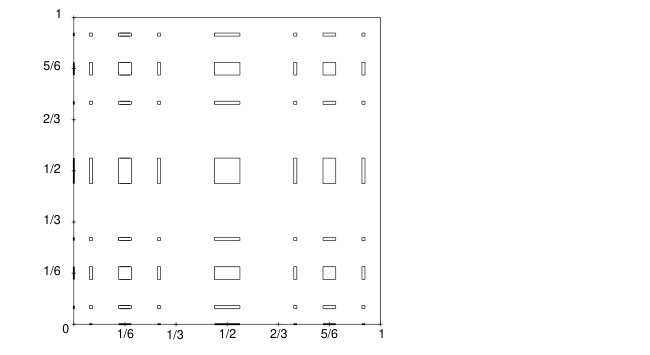 Figure 1
Peer Reviews
No public reviews on file for this paper yet. If you reviewed it on a platform where reviews are public (OpenReview, ICLR, NeurIPS, ICML), you can paste yours below so the community can read it here.
Videos
No videos yet. Explain this paper in a talk, walkthrough, or lecture? Add one.
Taxonomy
TopicsAdvanced Banach Space Theory · Approximation Theory and Sequence Spaces · Functional Equations Stability Results
Failure of rational approximation on some Cantor type sets
ALBERT MAS-BLESA
Departament de Matemàtiques, Universitat Autònoma de Barcelona, Spain
(Date: February 2008)
Abstract.
Let be the algebra of continuous functions on a compact set which are analytic on the interior of , and the closure (with the uniform convergence on ) of the functions that are analytic on a neighborhood of . A counterexample of a question made by A. O’Farrell about the equality of the algebras and when , with and compact subsets of , is given. Also, the equality is proved with the assumption that has no interior.
Key words and phrases:
Rational approximation, analytic capacity, Cantor sets
1991 Mathematics Subject Classification:
Primary 30C85; Secondary 31A15
Supported by grant AP2006-02416 (Programa FPU del MEC, España). Also, partially supported by grants 2005SGR-007749 (Generalitat de Catalunya) and MTM2007-62817 (MEC, España)
1. Introduction
Consider a compact set of the complex plane. Let be the algebra of continuous functions on which are analytic on the interior of , and the closure (with the uniform convergence on ) of the functions that are analytic on a neighborhood of . Obviously, .
In the 60’s, Vitushkin gave a description in analytic terms of the compact sets for which (see [Vi]), but there is still no characterization of those compact sets in a geometric way. Nevertheless, there have been important advances in this area recently, as can be seen in the articles of Xavier Tolsa [To1] and [To2] and the one of Guy David [Da]. In this direction, Anthony G. O’Farrell raised the following question (private communication):
Question 1.1**.**
Let and be two compact subsets of and define Is it true that ?
It is known that the identity holds if one of the compact sets or has no interior. For completeness, we include a proof of that fact at the end of the paper. However, it was not known whether the identity holds or not in general. In this paper we provide an example of a compact set which gives a negative answer to the question. The set is constructed as follows:
Let be the ternary Cantor set on the interval , i.e.,
[TABLE]
where and each is an interval of length obtained by dividing the intervals of length in three equal parts and excluding the central part. Call the center of . Consider a sequence such that and define , where is the center of . Let
[TABLE]
Finally, define and put .
With this construction of we will prove the main result of the paper:
Theorem 1.2**.**
For a suitable choice of the sequence ,
In the whole paper stands for the 1-dimensional Hausdorff content and denotes the continuous analytic capacity (see [Vi]). Remember that, given a compact set ,
[TABLE]
where the supremum is taken over all continuous functions which are analytic on , and uniformly bounded by on . If satisfies all these properties, we say that is admissible for and . By definition, .
2. Proof of the main result
In the two following lemmas, we shall obtain some estimates of the Hausdorff content of that will be useful to show that the algebras and are not equal for a suitable choice of the sequence .
Lemma 2.1**.**
Fix and such that . Define , and
[TABLE]
Then , where .
Proof.
Since is the union of the squares for and and each square has side length , we have
[TABLE]
The inequality is equivalent to . Then, using that , we can deduce that
[TABLE]
∎
As we will see in the proof of the following lemma, the important fact of the preceding one is that is bounded by something that tends to zero as decreases, rather than the exact value of the bound.
Lemma 2.2**.**
For every there exists a sequence such that
[TABLE]
Proof.
Put . Consider the crosses for defined in the following way (see Figure 1 to understand the construction):
[TABLE]
It is clear that . By construction, we also have for all . Therefore,
[TABLE]
Call the horitzontal strip of the cross and the vertical one. Because of the symmetry of the compact set and the subadditivity of ,
[TABLE]
Observe that is a countable union of rectangles, and on all those rectangles have the sides of length less or equal than . So, the set can be included by a translation in a set like the one of the preceding lemma, if we take and such that . Applying the lemma we obtain,
[TABLE]
with , and then,
[TABLE]
Given , it is easy to find a decreasing sequence that makes the last sum less than , because . ∎
Proof of theorem 1.2.
As Vitushkin proved in [Vi] (see also [Ga], theorem VIII.8.2), if and only if for every bounded open set .
If , we known that because , where denotes the Hausdorff dimension. Observe that and it does not depend on the chosen sequence . This implies that , so it is guarantied a minimum of continuous analytic capacity on the boundary of for any sequence .
Observe also that because is negligible (see [Ga], chapter VIII). Therefore,
[TABLE]
On the other hand, by the preceding lemma we can find a sequence such that If we take into account that , we can deduce that
[TABLE]
These inequalities show that the necessary condition for in Vitushkin’s theorem does not hold for . So, for that sequence we have . ∎
3. when has no interior
Now, as we said at the beginning of the paper, we proceed to give an affirmative answer to the question 1.1 with the assumption that has no interior. We need an auxiliary lemma that we guess is already known, so we only sketch the proof.
Lemma 3.1**.**
Fix and . Let be a rectangle with sides of length and and put , where squares of side length with pairwise disjoint interiors. Let and suppose there exists such that for all . Then, there exists a constant depending only on such that
[TABLE]
Hint of the proof.
Given admissible functions for and , one can find a function admissible for and such that using Vitushkin’s localization scheme with a modified triple zero lemma (see [Ve] or [Vi]), where one uses the fact that the sets are aligned. Then, one can prove the lemma by taking supremums. ∎
From now on, we shall denote by an absolute constant that may change its value at different occurrences.
Theorem 3.2**.**
Let be two compact sets and define . Suppose that has no interior. Then, .
Proof.
By Vitushkin’s theorem, it is known that if and only if there exists an absolute constant such that for all open squares .
Fix a square of side length . We can suppose that is not empty, so there exists a square . Let and be the projections onto the horitzontal and vertical coordinate axis respectively. Then, and we can find an interval of length for big enough.
On the other hand, if we split into intervals for with pairwise disjoint interiors and length , we can also find intervals for , because has no interior. Therefore, and .
Now we are ready to use the preceding lemma with the squares , the subsets and , and we obtain
[TABLE]
We can finally deduce that
[TABLE]
for every open square , so . ∎
We are grateful to Anthony O’Farrell for the communication of another proof of theorem 3.2 which uses annihilating measures instead of Vitushkin’s theorem.
Acknowledgment
The author gratefully acknowledges Mark Melnikov and Xavier Tolsa for the communication of the main question 1.1 and for useful discussions while preparing this paper.
The reference list from the paper itself. Each links out to its DOI / PubMed record.
- 1[Da] G. David, Unrectifiable 1-sets have vanishing analytic capacity. Rev. Mat. Iberoamericana 14, 1998, pp. 369-479.
- 2[Ga] T. Gamelin, Uniform Algebras. Prentice-Hall, Englewood Cliffs, N.J., 1969.
- 3[To 1] X. Tolsa, Painlevé’s problem and the semiadditivity of analytic capacity. Acta Math. 190, 2003, pp. 105-149.
- 4[To 2] X. Tolsa, The semiadditivity of continuous analytic capacity and the inner boundary conjecture. Amer. J. Math. 126, 2004, pp. 523-567.
- 5[Ve] J. Verdera, Removability, capacity and approximation. In “Complex Potential Theory”, (Montreal, PQ, 1993), NATO Adv. Sci. Int. Ser. C Math. Phys. Sci. 439, Kluwer Academic Publ., Dordrecht, 1994, pp. 419-473.
- 6[Vi] A. G. Vitushkin, The analytic capacity of sets in problems of approximation theory, Uspeikhi Mat. Nauk. 22(6), 1967, pp. 141-199 (Russian); in Russian Math. Surveys 22, 1967, pp. 139-200. (English).