Finite-size effects on sound damping in stable computer glasses
Corrado Rainone, Avraham Moriel, Geert Kapteijns, Eran Bouchbinder and, Edan Lerner

TL;DR
This paper discusses how finite-size effects influence sound damping in stable computer glasses, providing insights into the limitations and implications of recent simulation results.
Contribution
It offers a critical analysis of finite-size effects on sound damping, highlighting their impact on interpreting simulation data in stable glasses.
Findings
Finite-size effects significantly affect sound damping measurements.
Analysis clarifies limitations of previous simulation results.
Provides guidelines for future computational studies.
Abstract
In this brief note we comment on the recent results presented in arXiv:1812.08736v1
Click any figure to enlarge with its caption.
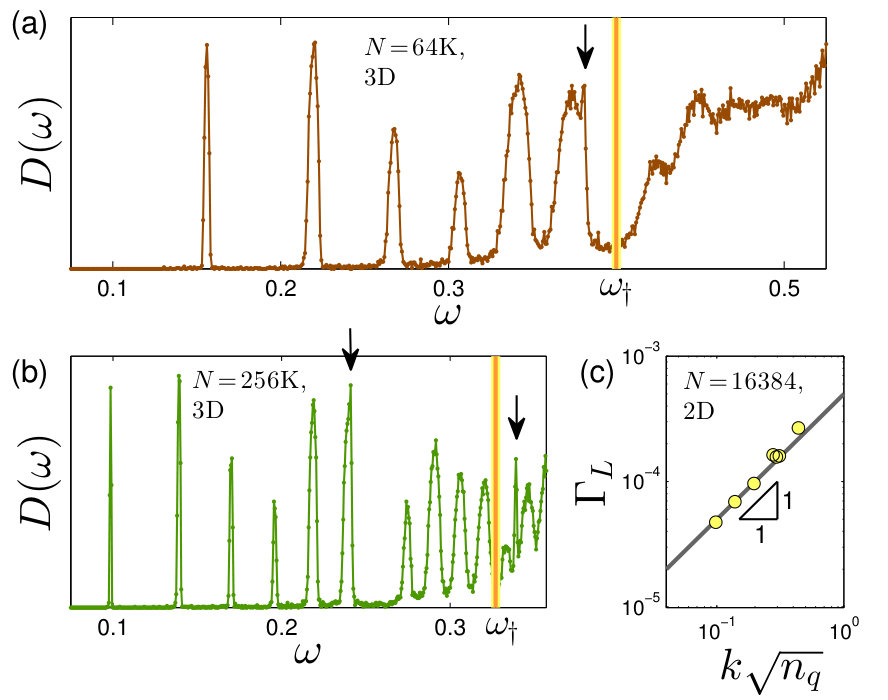 Figure 1
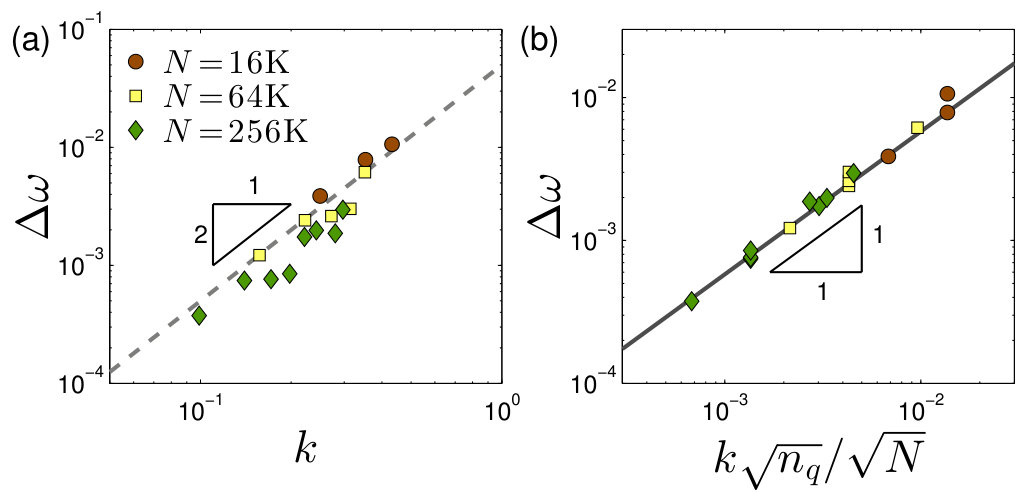 Figure 2
Peer Reviews
No public reviews on file for this paper yet. If you reviewed it on a platform where reviews are public (OpenReview, ICLR, NeurIPS, ICML), you can paste yours below so the community can read it here.
Videos
No videos yet. Explain this paper in a talk, walkthrough, or lecture? Add one.
Taxonomy
TopicsComputer Graphics and Visualization Techniques · 3D Shape Modeling and Analysis · Interactive and Immersive Displays
Finite-size effects on sound damping in stable computer glasses
Corrado Rainone1, Avraham Moriel2, Geert Kapteijns1, Eran Bouchbinder2, and Edan Lerner1
1Institute for Theoretical Physics, University of Amsterdam, Science Park 904, 1098 XH Amsterdam, The Netherlands
2Chemical and Biological Physics Department, Weizmann Institute of Science, Rehovot 7610001, Israel
It is well known that disorder gives rise to attenuation of low frequency elastic waves in amorphous solids, even if dynamics are strictly confined to the harmonic regime Buchenau et al. (1992); Ganter and Schirmacher (2010); Marruzzo et al. (2013); Gelin et al. (2016); Mizuno and Ikeda (2018). In a recent preprint Wang et al. (2018), Szamel and coworkers present results regarding sound attenuation rates measured within the harmonic regime in very stable three-dimensional (3D) computer glasses; the key result announced in Wang et al. (2018) is the discovery of a new scenario of sound damping in which the shear (transverse) wave attenuation rate follows in the low wavenumber regime. This scenario has been asserted to be experimentally relevant.
In this brief note we show that the key result of Wang et al. (2018) is in fact a finite-size effect, which has been recently discussed and fully explained theoretically in Bouchbinder and Lerner (2018). Consequently, the sound damping scenario reported on in Wang et al. (2018) is neither new nor experimentally relevant; it will disappear in the thermodynamic limit of macroscopic glasses. Central to understanding the observations of Wang et al. (2018) is the following theoretical prediction for and (the sound/longitudinal wave attenuation rate) presented in Bouchbinder and Lerner (2018)
[TABLE]
Here is a crossover frequency Bouchbinder and Lerner (2018), divided by the shear (transverse) wave-speed , below which phonons cluster into discrete bands of disorder-induced width and degeneracy 111 is the number of different solutions to the integer sum of squares problem , and in finite-size systems composed of particles, as demonstrated in Fig. 1. Finally, note that it has been shown that in dimensions Bouchbinder and Lerner (2018).
To support our main assertion that the low wavenumber regime reported on in Wang et al. (2018) is described by the finite-size theory prediction in Eq. (1), we present in Fig. 2a measurements of phonon band frequency widths , extracted (as described in Bouchbinder and Lerner (2018)) from the vibrational modes of between independent stable computer glasses footnote1 in , for , and plotted against the phonon band wavenumber . We find that the widths approximately follow (dashed line in Fig. 2a), which corresponds to the observations in Wang et al. (2018). This scaling, however, is an apparent one; the data in fact follow the finite-size theory prediction in Eq. (1), as shown next.
In Fig. 2b we plot the phonon band widths against the rescaled wavenumber . These data establish that the phonon band widths follow the finite-size scaling as given by Eq. (1), even for very stable glasses, and consequently that the scaling reported on in Wang et al. (2018) will not persist in the thermodynamic limit , for which . Note, though, that the crossover wavenumber depends very weakly on system size ( in , consistent with our estimations shown in Fig. 1); varying by a factor of , as done in Wang et al. (2018), changes by merely , hence explaining the apparent -independent crossover to the finite-size regime observed in Fig. 2b of Wang et al. (2018).
Finally, an approximate quartic scaling of the sound (longitudinal) wave attenuation rate is also reported on in Wang et al. (2018), exhibiting no finite-size effects as predicted in Eq. (1). We assert that for the system sizes employed in Wang et al. (2018), (all but the very lowest-) sound waves reside above (see Fig. 1a-b, where sound waves are marked with arrows), explaining why sound attenuation rates are devoid of finite-size effects in this case. In very stable 2D glasses several sound waves do reside below , and consequently attenuation rates also follow the predicted finite-size scaling Eq. (1), as demonstrated in Fig. 1c.
The reference list from the paper itself. Each links out to its DOI / PubMed record.
- 1Buchenau et al. (1992) U. Buchenau, Y. M. Galperin, V. L. Gurevich, D. A. Parshin, M. A. Ramos, and H. R. Schober, Phys. Rev. B 46 , 2798 (1992) . · doi ↗
- 2Ganter and Schirmacher (2010) C. Ganter and W. Schirmacher, Phys. Rev. B 82 , 094205 (2010) . · doi ↗
- 3Marruzzo et al. (2013) A. Marruzzo, W. Schirmacher, A. Fratalocchi, and G. Ruocco, Sci. Rep. 3 , 1407 (2013) . · doi ↗
- 4Gelin et al. (2016) S. Gelin, H. Tanaka, and A. Lemaître, Nat. Mater. 15 , 1177 (2016) . · doi ↗
- 5Mizuno and Ikeda (2018) H. Mizuno and A. Ikeda, Phys. Rev. E 98 , 062612 (2018) . · doi ↗
- 6Wang et al. (2018) L. Wang, L. Berthier, E. Flenner, P. Guan, and G. Szamel, ar Xiv preprint ar Xiv:1812.08736 v 1 (2018) .
- 7Bouchbinder and Lerner (2018) E. Bouchbinder and E. Lerner, New J. Phys. 20 , 073022 (2018) . · doi ↗
- 8Note (1) n q subscript 𝑛 𝑞 n_{q} is the number of different solutions to the integer sum of squares problem q \tmspace − .1667 e m = \tmspace − .1667 e m n x 2 \tmspace − .1667 e m + n y 2 \tmspace − .1667 e m + n z 2 𝑞 \tmspace .1667 𝑒 𝑚 \tmspace .1667 𝑒 𝑚 superscript subscript 𝑛 𝑥 2 \tmspace .1667 𝑒 𝑚 superscript subscript 𝑛 𝑦 2 \tmspace .1667 𝑒 𝑚 superscript subscript 𝑛 𝑧 2 q\tmspace-{.1667 em}=\tmspace-{.1667 em}n_{x}^{2}\tmspace-{.1667 em}+n_{y}^{2}\tmspace-{.1667 em