Quasiprobability distribution functions from fractional Fourier transforms
Jorge A. Anaya-Contreras, A. Z\'u\~niga-Segundo, and H\'ector M., Moya-Cessa

TL;DR
This paper introduces a new class of complex quasiprobability distribution functions derived from fractional Fourier transforms, linking them to Fresnel transforms and proposing a reconstruction method via atom-field interactions.
Contribution
It presents a formal framework for quasiprobability functions based on fractional Fourier transforms and connects them to physical reconstruction techniques.
Findings
New quasiprobability functions from fractional Fourier transforms
Connection to Fresnel transform of characteristic functions
Proposed method for distribution reconstruction via atom-field interactions
Abstract
We show, in a formal way, how a class of complex quasiprobability distribution functions may be introduced by using the fractional Fourier transform. This leads to the Fresnel transform of a characteristic function instead of the usual Fourier transform. We end the manuscript by showing a way in which the distribution we are introducing may be reconstructed by using atom-field interactions.
Click any figure to enlarge with its caption.
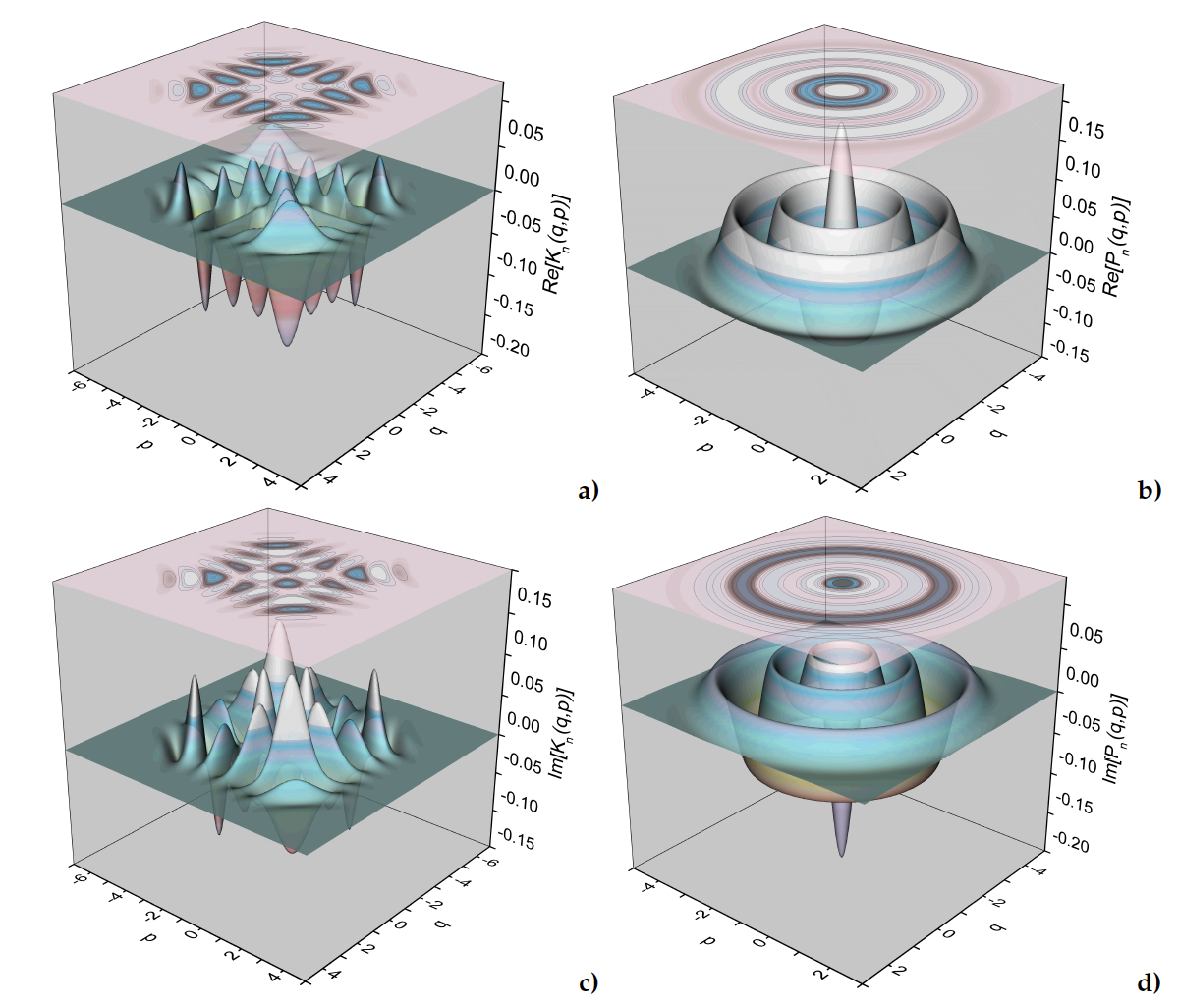 Figure 1
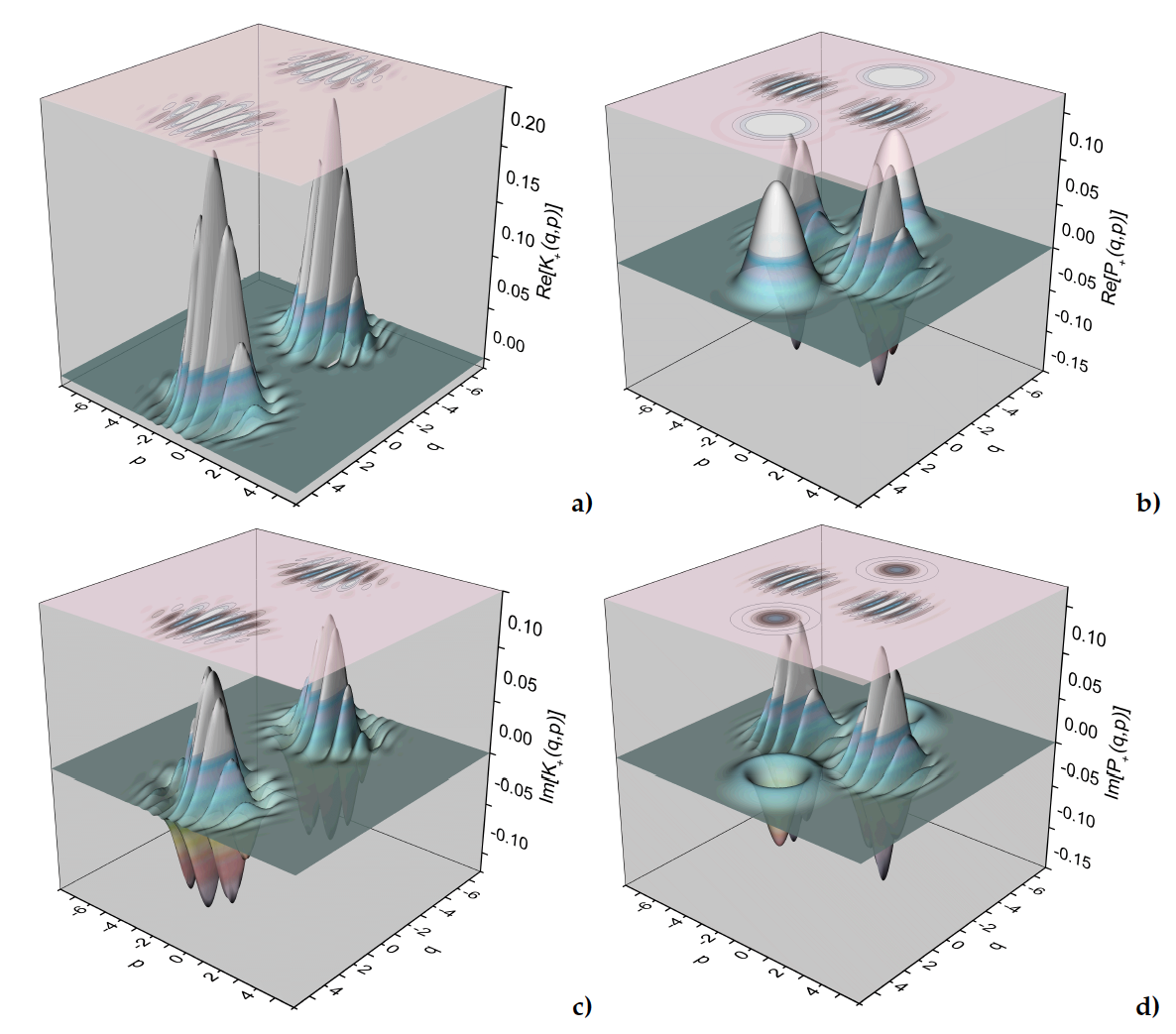 Figure 2
 Figure 3
 Figure 4
Peer Reviews
No public reviews on file for this paper yet. If you reviewed it on a platform where reviews are public (OpenReview, ICLR, NeurIPS, ICML), you can paste yours below so the community can read it here.
Videos
No videos yet. Explain this paper in a talk, walkthrough, or lecture? Add one.
Taxonomy
TopicsMathematical Analysis and Transform Methods · Statistical Mechanics and Entropy · Orbital Angular Momentum in Optics
*∗*Correspondence: [email protected]; Tel.: +52-222-266-3100
Quasiprobability distribution functions from fractional Fourier transforms
Jorge A. Anaya-Contreras 1,A. Zúñiga-Segundo1,and Héctor M. Moya-Cessa
1 Instituto Politécnico Nacional, ESFM, Departamento de Física. Edificio 9, Unidad Profesional “Adolfo López Mateos, CP 07738 Cd. de México, Mexico
2 Instituto Nacional de Astrofísica, Óptica y Electrónica, Calle Luis Enrique Erro 1, Santa María Tonantzintla, Pue., 72840 Mexico
Abstract
We show, in a formal way, how a class of complex quasiprobability distribution functions may be introduced by using the fractional Fourier transform. This leads to the Fresnel transform of a characteristic function instead of the usual Fourier transform. We end the manuscript by showing a way in which the distribution we are introducing may be reconstructed by using atom-field interactions.
Keywords: Quasiprobability distribution functions; Fractional Fourier transform; Reconstruction of the wave function.
1 Introduction
It has been already shown that quasiprobability distribution functions may be reconstructed by the measurement of atomic properties in ion-laser interactions [1] and two-level atoms interacting with quantized fields [2, 3]. Such measurements of the wave function are realized usually by measuring atomic observables, namely, the atomic inversion and polarization.
Although the first quasiprobability distribution functions were introduced in the quantum realm [4, 5, 6, 8, 7], they may be also used to analyze classical signals [9, 10].
Ideal interactions, i.e., without taking into account an environment, have shown to lead to the reconstruction of the Wigner function [3] by taking advantage of its expression in terms of the parity operator. However, the interaction of a system with its environment [11] leads to -prametrized quasiprobability distribution functions [12, 13, 14]
[TABLE]
where , with and the annihilation and creation operators of the harmonic oscillator, respectively, is the Glauber displacement operator [15]. The state is a so-called displaced number state [16]. Note that, in order to reconstruct a given quasiprobability function it is needed to do displace the system by an amplitude and then measure the diagonal elements of the displaced density matrix.
The parameter defines different orderings and therefore different quasiprobability distribution functions (QDF). The Glauber-Sudarshan -function [15, 17] is given for , and is used to obtain averages of functions of normal ordered creation and annihilation operators; gives the Husimi -function, used to obtain averages of functions of anti-normal ordered creation and annihilation operators, while is used for the symmetric ordering and gives the Wigner function.
Equation (1) may be rewritten as
[TABLE]
that, by using the commutation properties under the symbol of trace, and the system in a pure state , may be casted into
[TABLE]
Recent studies have openned the possibility of measuring, instead of observables, non-Hermitian operators [18]. It would be plausible then that such measurements could be related to complex quasiprobability distributions like the McCoy-Kirkwood-Rihaczek-Dirac distribution functions [5, 6, 8, 19].
In this contribution we would like to introduce other kind of complex quasiprobabilities that, although they could be introduced simply by taking as a complex number, we introduce them in a formal way by considering the fractional Fourier transform (FrFT) [20, 21, 22] of a signal. Then, by writing the Dirac-delta function in terms of its FrFT, we are able to write a general expression for complex quasiprobability distributions in terms of the Fresnel transform. Indeed, the representation of these complex quasiprobability distributions in terms of a Fresnel transform implies that they are solutions of a paraxial wave equation [3]. Finally, by using an effective Hamiltonian for the atom-field interaction, we show how this quasiprobability distribution function may be reconstructed.
2 Fractional Fourier Transform
Up to a phase, the fractional Fourier Transform of a signal can be written by the following expression [20, 21, 22]
[TABLE]
that may be expressed in terms of an integral transform as
[TABLE]
where
[TABLE]
Then, if we consider equation (6) as a propagator, Dirac’s delta distribution function takes the form
[TABLE]
Now, if we apply the fractional Fourier transform to the Dirac delta function we obtain
[TABLE]
Then, applying the inverse fractional Fourier transform to equation (8) we obtain an alternative representation of the Dirac delta distribution function
[TABLE]
From the above equation it may be seen that there is a phase multiplying the usual integral representation of the Dirac delta function, that although could be omitted by using properties of the delta function, we keep in order to obtain a quasiprobability distribution function as a fractional Fourier (Fresnel) transform of the characteristic function.
3 Probability distribution in the phase space
We define a probability distribution in the phase space as
[TABLE]
then, using equation (9), the distribution may be rewritten as
[TABLE]
and because
[TABLE]
equation (11) takes the form
[TABLE]
that by using the equivalence
[TABLE]
may be casted into the expression
[TABLE]
3.1 Case
The above quasiprobability distribution function is defined for a range of parameters and , however, for the sake of simplicity, we will consider the case .
We may relate the quasiprobability distribution function to the Wigner function, by noting that, for , equation (15) has the form
[TABLE]
According to trace representation of Wigner function [14]
[TABLE]
we write the distribution as the Fresnel transform of the Wigner function
[TABLE]
It is easy to show that the quasiprobability distribution (18) can be normalized
[TABLE]
Therefore, for normalization reasons, the quasiprobability distribution is finally given in the form
[TABLE]
that, by applying the change of variables takes the form
[TABLE]
with .
From the above expression it is direct to show that the Wigner function
[TABLE]
and the function may be easily related by the differential relation
[TABLE]
The above quasiprobability function may be written as a trace by noting that
[TABLE]
that leads to the trace representation of
[TABLE]
Last equation allows us to show that is correctly normalized, for this we do the double integration
[TABLE]
where we have defined
[TABLE]
and
[TABLE]
with
[TABLE]
By replacing equation (3.1) into equation (28) we obtain
[TABLE]
that shows that equation (26) is correctly normalized
[TABLE]
4 Kirkwood distribution and distribution
Being the QDF and Kirkwood distributions complex functions we show now some differences between them.
The Kirkwood distribution is defined as [8, 19, 23, 24]
[TABLE]
or an alternative way to write it as an expectation value [25] is
[TABLE]
4.1 Number state
The Kirkwood and distributions for number state , are represented by the following equations
[TABLE]
and
[TABLE]
where, and are Hermite and Laguerre polynomials, respectively.
4.2 Superposition of two coherent states
Now, we consider a superposition of two coherent states as:
[TABLE]
[TABLE]
where , such that the Kirkwood and the distributions for the superposition of two coherent states, , is given by
[TABLE]
and
[TABLE]
respectively.
We plot both distribution in Figures 1 and 2. In both figures a more uniform behaviour may be seen in the QDF than in the Kirkwood function. In fact, the real and imaginary parts of the distribution we have introduced here, look like Wigner function for number states (Fig. 1) and Scrhödinger cat states (Fig. 2).
5 Reconstruction of distribution
It is not difficult to show that the real part of QDF may be measured. This can be achieved by measuring the atomic polarization in the dispersive interaction between an atom and a quantized field [3], whose Hamiltonian reads
[TABLE]
with , the Pauli matrix corresponding to the atomic inversion operator, where and represent the ground and excited states of the two-level atom. The parameter is the dispersive coupling constant. The above Hamiltonian yields the evolution operator
[TABLE]
from where we can obtain the evolved wavefunction , that allows the calculation of averages of different observables.
The average of observable then can be obtained for an arbitrary initial field, which we conveniently write as and the atom is initially in a superposition of atomic states, . Then we write
[TABLE]
It is also easy to show that the imaginary part of the QDF may be associated to the observable
[TABLE]
If we set the interaction time , we obtain that
[TABLE]
Therefore, by measuring the polarizations and we are able to measure the QDF .
6 Conclusions
We have introduced a set of parametrized (in terms of and ) quasiprobability distribution functions, equation (15), by using the fractional Fourier transform. This has lead us to generalize QDF to Fresnel transforms of the characteristic function instead of their usual Fourier transforms. We have also shown how such QDF may be recosntructed in the dispersive atom-field interaction. We have also given a (differential) relation that allows the calculation of the newly introduced QDF from the Wigner function.
Acknowledgments: We thank CONACYT for support.
The reference list from the paper itself. Each links out to its DOI / PubMed record.
- 1[1] D. Leibfried, D. M. Meekhof, B. E. King, C. Monroe, W. M. Itano, and D. J. Wineland, Experimental Determination of the Motional Quantum State of a Trapped Atom, Phys. Rev. Lett. 77, 4281 (1996).
- 2[2] P. Bertet, A. Auffeves, P. Maioli, S. Osnaghi, T. Meunier, M. Brune, J. M. Raimond, and S. Haroche, Direct Measurement of the Wigner Function of a One-Photon Fock State in a Cavity, Phys. Rev. Lett. 89, 200402 (2002).
- 3[3] L.G. Lutterbach, and L. Davidovich, Phys. Rev. Lett. 78 , 2547 (1997), Method for Direct Measurement of the Wigner Function in Cavity QED and Ion Traps.
- 4[4] E.P. Wigner,. On the quantum correction for thermodynamic equilibrium. Phys. Rev. 1932 , 40, 749.
- 5[5] N. H. Mc Coy, On the Function in Quantum Mechanics Which Corresponds to a Given Function in Classical Mechanics. Proc. Natl. Acad. Sci. U.S.A. 18, 674 (1932).
- 6[6] P.A.M. Dirac, On the Analogy Between Classical and Quantum Mechanics. Rev. Mod. Phys. 17, 195 (1945).
- 7[7] K. Husimi, Some Formal Properties of the Density Matrix, Proc. Phys. Math. Soc. Jpn. 22, 264–314 (1940).
- 8[8] J.G. Kirkwood, Quantum Statistics of Almost Classical Assemblies. Phys. Rev. 44 , 31-37 (1933).