The SOPHIE search for northern extrasolar planets. XIV. A temperate ($T_\mathrm{eq}\sim 300$ K) super-earth around the nearby star Gliese 411
R. F. D\'iaz (1,2), X. Delfosse (3), M. J. Hobson (4), I. Boisse (4),, N. Astudillo-Defru (5), X. Bonfils (3), G. W. Henry (6), L. Arnold (7), F., Bouchy (8), V. Bourrier (8), B. Brugger (4), S. Dalal (9), M. Deleuil (4), O., Demangeon (10, 11), F. Dolon (7), X. Dumusque (8)

TL;DR
This paper reports the detection of a low-mass, temperate super-Earth orbiting the nearby star Gliese 411, using precise radial velocity measurements, and discusses its potential for atmospheric characterization.
Contribution
First detection of a super-Earth around Gliese 411 with the SOPHIE spectrograph, demonstrating the instrument's capability to identify low-amplitude planetary signals.
Findings
Detected a 12.95-day planetary signal with 1.6 m/s amplitude.
Estimated planet mass around three Earth masses.
Planet receives about 3.5 times Earth's insolation, outside habitable zone.
Abstract
Periodic radial velocity variations in the nearby M-dwarf star Gl411 are reported, based on measurements with the SOPHIE spectrograph. Current data do not allow us to distinguish between a 12.95-day period and its one-day alias at 1.08 days, but favour the former slightly. The velocity variation has an amplitude of 1.6 m/s, making this the lowest-amplitude signal detected with SOPHIE up to now. We have performed a detailed analysis of the significance of the signal and its origin, including extensive simulations with both uncorrelated and correlated noise, representing the signal induced by stellar activity. The signal is significantly detected, and the results from all tests point to its planetary origin. Additionally, the presence of an additional acceleration in the velocity time series is suggested by the current data. On the other hand, a previously reported signal with a period of…
Click any figure to enlarge with its caption.
 Figure 1
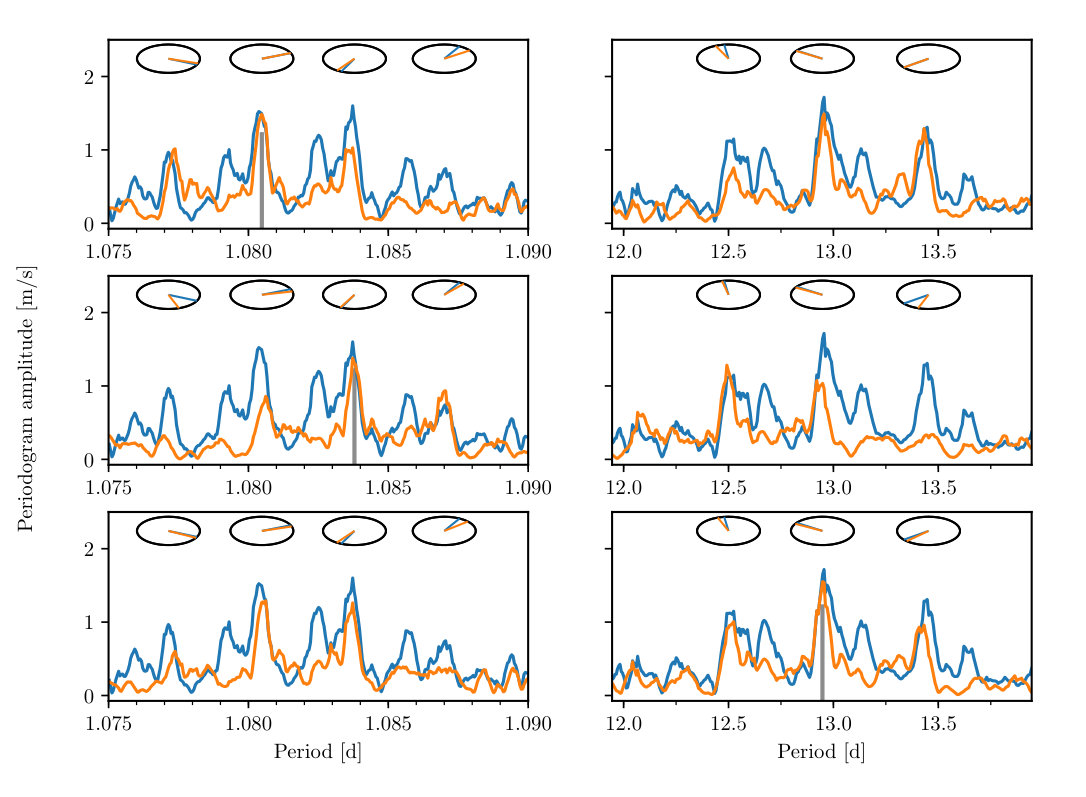 Figure 2
Peer Reviews
No public reviews on file for this paper yet. If you reviewed it on a platform where reviews are public (OpenReview, ICLR, NeurIPS, ICML), you can paste yours below so the community can read it here.
Videos
No videos yet. Explain this paper in a talk, walkthrough, or lecture? Add one.