Coset Cosmology
Luca Di Luzio, Michele Redi, Alessandro Strumia, Daniele Teresi

TL;DR
This paper explores how Nambu-Goldstone boson potentials with multiple minima influence cosmology, leading to phenomena like domain walls, primordial black holes, and high-temperature symmetry breaking.
Contribution
It reveals that trigonometric potentials in composite Higgs and Dark Matter models can produce multiple minima and novel cosmological effects, including symmetry non-restoration.
Findings
Multiple minima in Nambu-Goldstone boson potentials are common in composite models.
Degenerate minima can cause cosmological domain-wall problems.
Unusual cosmological phenomena such as primordial black holes and high-temperature symmetry breaking are predicted.
Abstract
We show that the potential of Nambu-Goldstone bosons can have two or more local minima e.g. at antipodal positions in the vacuum manifold. This happens in many models of composite Higgs and of composite Dark Matter. Trigonometric potentials lead to unusual features, such as symmetry non-restoration at high temperature. In some models, such as the minimal composite Higgs with fermions in the fundamental representation, the two minima are degenerate giving cosmological domain-wall problems. Otherwise, an unusual cosmology arises, that can lead to supermassive primordial black holes; to vacuum or thermal decays; to a high-temperature phase of broken , possibly interesting for baryogenesis.
Click any figure to enlarge with its caption.
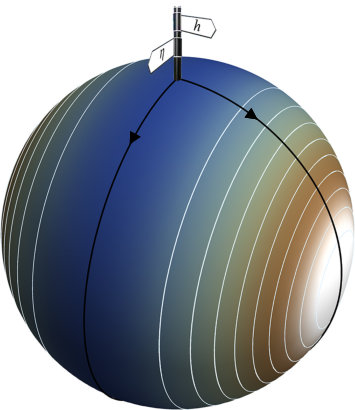 Figure 1
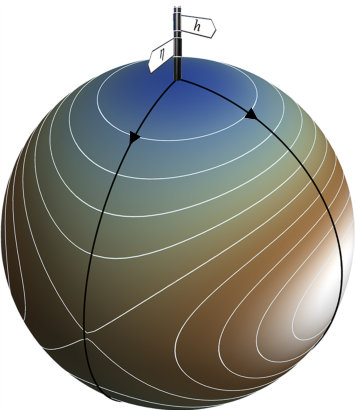 Figure 2
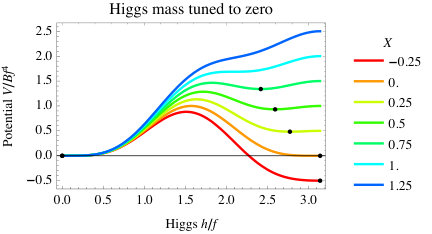 Figure 3
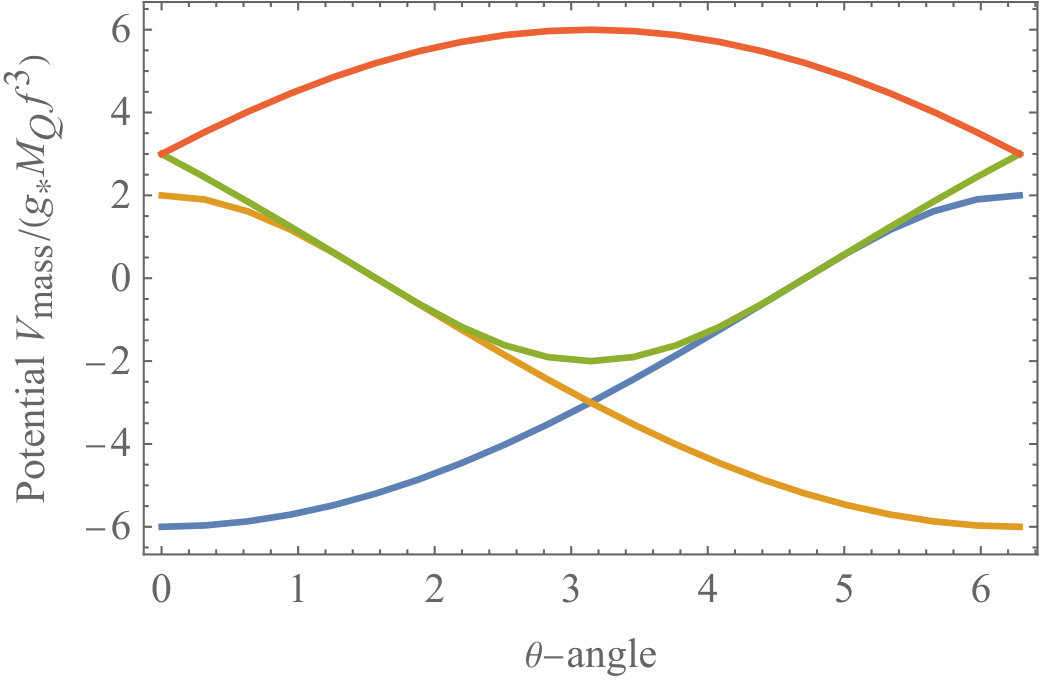 Figure 4
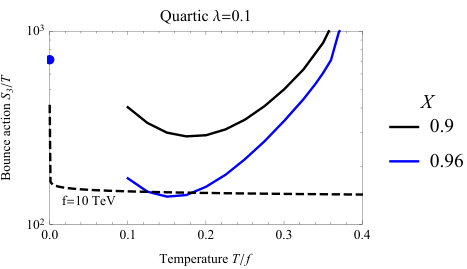 Figure 5
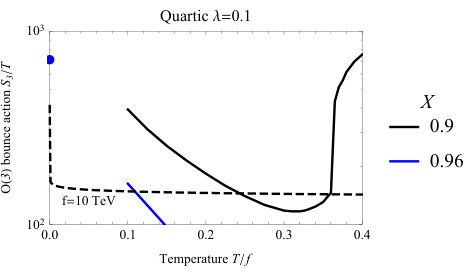 Figure 6
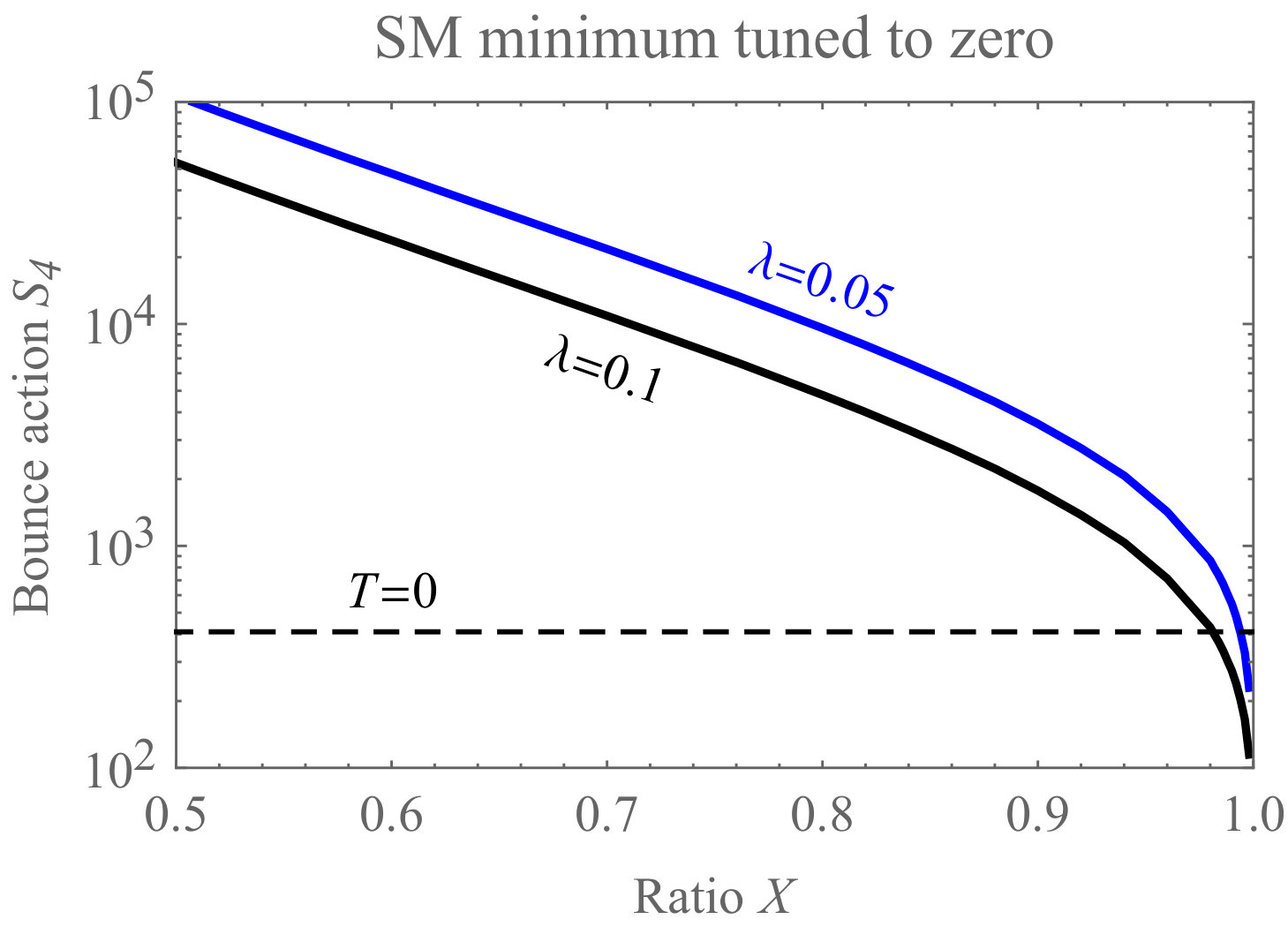 Figure 7
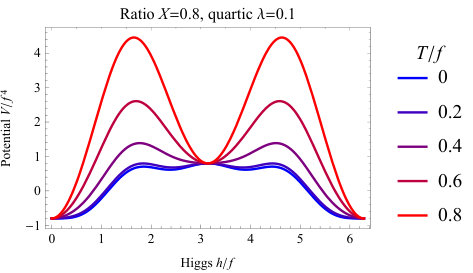 Figure 8
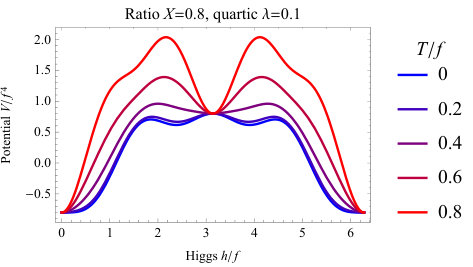 Figure 9
Peer Reviews
No public reviews on file for this paper yet. If you reviewed it on a platform where reviews are public (OpenReview, ICLR, NeurIPS, ICML), you can paste yours below so the community can read it here.
Videos
No videos yet. Explain this paper in a talk, walkthrough, or lecture? Add one.