Limits on $f(R,T)$ Gravity from Earth's Atmosphere
Taylor M. Ordines, Eric D. Carlson

TL;DR
None
Contribution
None
Abstract
We investigate changes in Earth's atmospheric models coming from the modified theory of gravity, in which the gravitational Lagrangian is given by an arbitrary function of the Ricci scalar and the trace of the stress-energy tensor. We obtain a generic form for the gravitational field equations and derive the hydrostatic equation for Earth's atmosphere for leading order terms Based on the apparent accuracy of the 1976 U.S. Standard Atmosphere model, which varies no more than from observations, we find limits of .
Click any figure to enlarge with its caption.
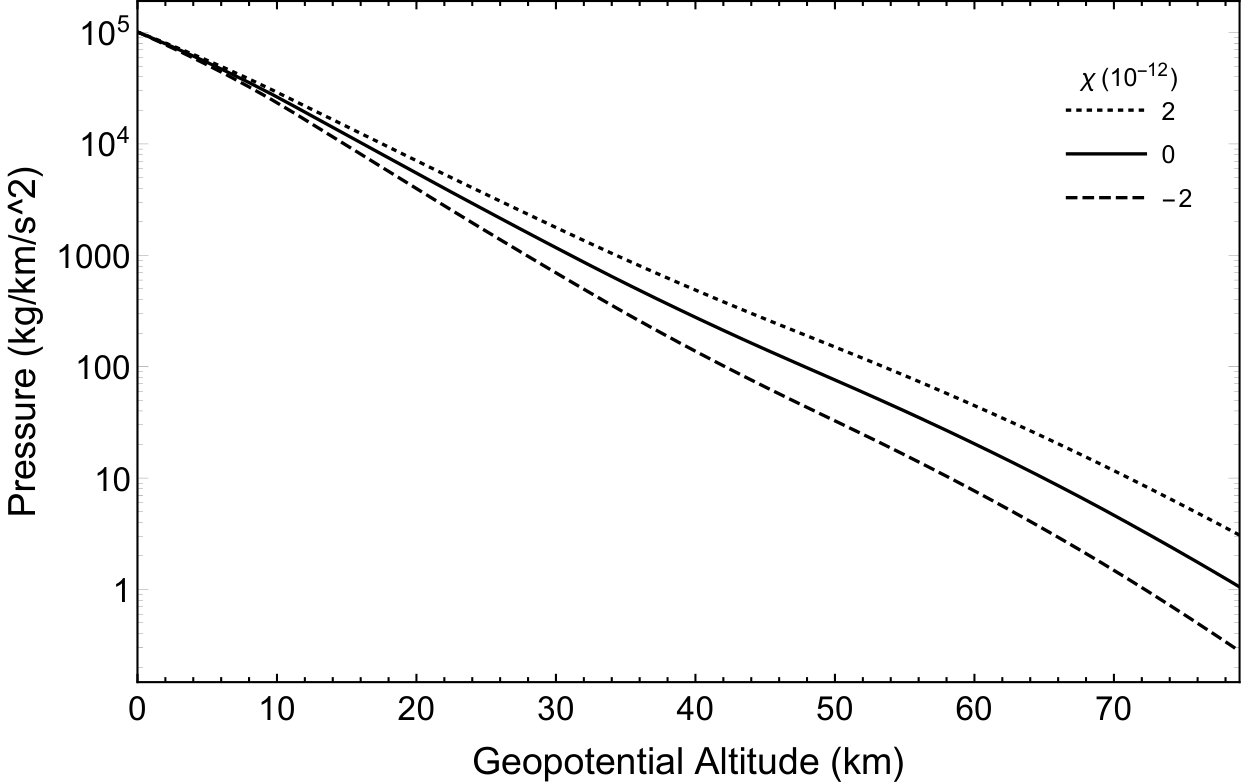 Figure 1
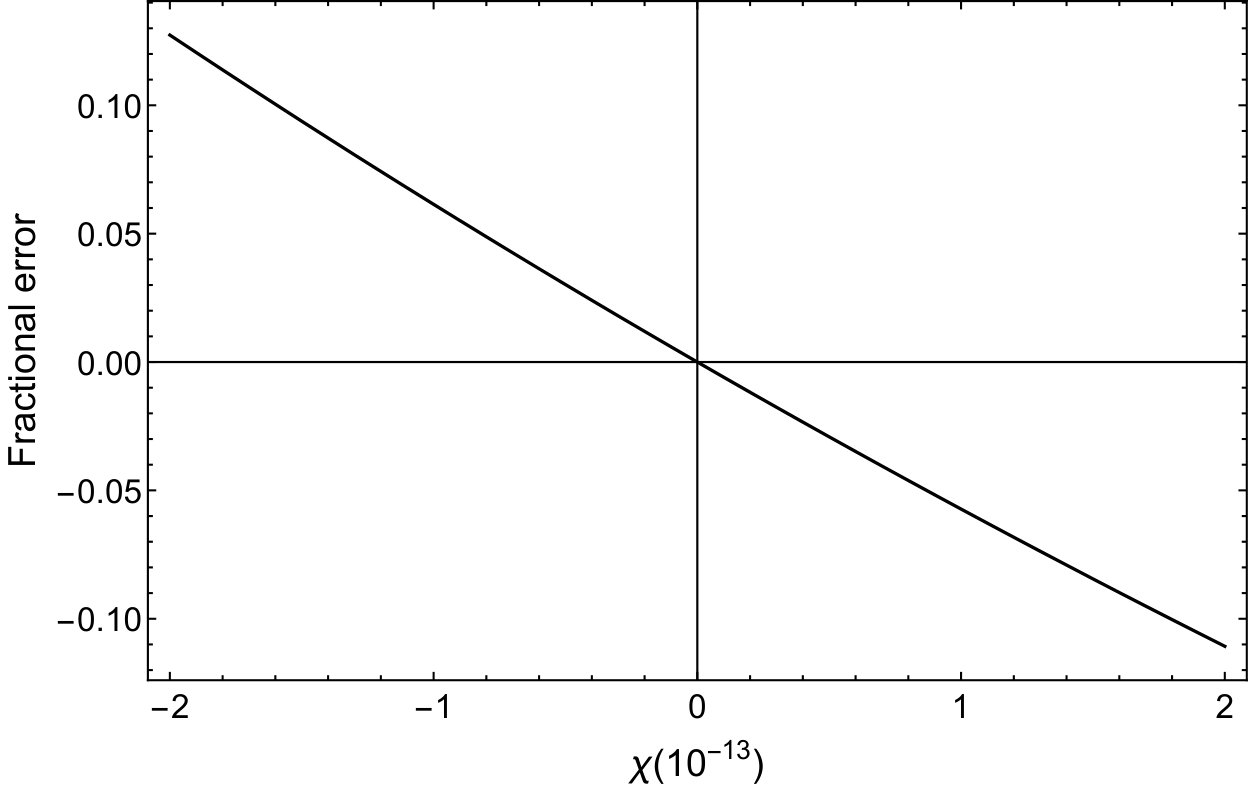 Figure 2
Peer Reviews
No public reviews on file for this paper yet. If you reviewed it on a platform where reviews are public (OpenReview, ICLR, NeurIPS, ICML), you can paste yours below so the community can read it here.
Videos
No videos yet. Explain this paper in a talk, walkthrough, or lecture? Add one.
Limits on gravity from Earth’s atmosphere
Taylor M. Ordines
Eric D. Carlson
Department of Physics, Wake Forest University, 1834 Wake Forest Road, Winston-Salem, North Carolina 27109, USA
Abstract
We investigate changes in Earth’s atmospheric models coming from the modified theory of gravity, in which the gravitational Lagrangian is given by an arbitrary function of the Ricci scalar and the trace of the stress-energy tensor. We obtain a generic form for the gravitational field equations and derive the hydrostatic equation for Earth’s atmosphere for leading order terms Based on the apparent accuracy of the 1976 U.S. Standard Atmosphere model, which varies no more than from observations, we find limits of .
I Introduction
Modern cosmological observation has revealed the accelerating expansion of the universe Riess et al. (1998); Perlmutter et al. (1998, 1999). The discovery has become one of the most important developments in modern cosmology due to its apparent inconsistency with the predictions of general relativity, which state that a universe filled with a mixture of ordinary matter and radiation should experience a slowing of the expansion. Novel theories and modifications to general relativity have been proposed to explain the acceleration. Two notions in particular have been heavily investigated: either the Universe contains a great amount of dark energy, or the theory of general relativity breaks down on the cosmological scale Frieman et al. (2008).
One theory that has gained much attention for its ability to explain the expansion is modified gravity Buchdahl (1970). The gravitational action, from which the Einstein equations are derived, is traditionally a linear function of the scalar curvature . The theory of gravity replaces in the gravitational action with an arbitrary function , with the traditional being the leading order contribution. Higher order gravity theories, such as the Starobinsky model Starobinsky (1980), are thus generally possible.
A generalization of gravity proposed in Bertolami et al. (2007) incorporates an explicit coupling between the matter Lagrangian and an arbitrary function of the scalar curvature, which leads to an extra force in the geodesic equation of a perfect fluid. It was later shown that this extra force may account for the accelerated expansion of the universe Bertolami et al. (2010). The inclusion of matter terms in the gravitational action was further explored in Harko et al. (2011) in gravity, in which the gravitational Lagrangian density is an arbitrary function of both and the trace of the stress-energy tensor . Part of the motivation of gravity is to produce models that can act similarly to a cosmological constant without explicitly including such a constant. The arbitrary dependence on encapsulates the possible contributions from both nonminimal coupling and explicit terms.
In general such modified theories can contain higher than first order derivatives in the Lagrangian and will thus suffer Ostrogradsky instability. One can in principle introduce an auxiliary field to the Lagrangian to remove the higher derivatives, resulting in ghosts De Felice and Tanaka (2010); Nojiri et al. (2017). A general discussion of such issues is beyond the scope of this paper. For the specific case we will be discussing, this will not be relevant.
Cosmological effects of theories have been explored by choosing several functional forms of . The separation has received much attention because one can explore the contributions from without specifying . For example, in such separable theories, a non-equilibrium picture of thermodynamics at the apparent horizon of the Friedmann-Lemaître-Robertson-Walker (FLRW) universe was studied in Sharif and Zubair (2012).
While higher powers of have been considered Zaregonbadi et al. (2016), at low densities the linear contributions will dominate, and linear is of interest and has been studied Harko et al. (2011); Carvalho et al. (2017); Velten and Caramês (2017); Deb et al. (2018).
Harko et al. Harko et al. (2011) noted that such a simple model could produce cosmological constant like effects, but it is easy to see from their formula (29) that an accelerating universe is not possible from this term alone. As we will demonstrate, strong limits on , which we use to parameterize linear contributions from , indicate that this term has no cosmological significance.
Even if is not separable, one would expect that in situations of low curvature and matter density, the linear terms of should dominate. We therefore focus on these terms, and assuming there is no constant term (cosmological constant) we may approximate
[TABLE]
where the coefficient of must be one to yield conventional gravity in low curvature environments, and is a single parameter describing the modification of gravity. Note there is no question of Ostrogradsky instability in this theory. Obtaining strong limits on could severely effect the possible contributions of this term in astrophysical situations.
One approach to studying the consequences of such gravitational modifications would be comparison with limits from the parameterized post-Newtonian (PPN) formalism Will (2014). Strong limits on several parameters from the Solar System and other astrophysical systems can be obtained. Such an approach is non-trivial in this case because the dynamics of this theory are not entirely described in terms of the metric. In particular, as will be shown below, the stress-energy tensor is not conserved, and hence pressureless dust will not generally follow geodesics. We do not pursue this approach here, primarily because we believe we can achieve stronger limits by using the Tolman-Oppenheimer-Volkoff (TOV) equations.
In Deb et al. (2018), modified TOV equations were obtained and used to obtain modifications to models of strange stars. It was found that substantial and potentially measurable changes to such stars occurred if . Observational data for white dwarfs were used in Carvalho et al. (2017) to obtain a lower limit of . This limit was obtained by modeling the interior of the white dwarf as a non-interacting zero temperature electron gas. Indeed, Carvalho et al. (2017) was unable to obtain self-consistent solutions for , because the vanishing of the sound velocity near the surface of the white dwarf did not allow the density to drop to zero at finite radius. However, the surface of the white dwarf is not at zero temperature, and the electron interactions are not negligible, so we believe that positive values are also allowed. We have not performed this calculation, because we believe we can obtain more stringent limits by considering the Earth’s atmosphere.
In this paper, we investigate Eq. (1) in the weak-field regime of Earth’s atmosphere to further limit the possible range of . By modeling the atmosphere as a perfect fluid ideal gas, we obtain modifications to the traditional hydrostatic equation
[TABLE]
where is isotropic pressure, is mass density, and is acceleration due to gravity. Solutions to the modified hydrostatic equation can then be compared to the atmospheric model given in NASA (1976) to obtain strong limits on .
Our paper is structured as follows. The general formalism for gravity is given in Section II. In Section III, we derive the modified hydrostatic equation in a spherically symmetric, static spacetime. The hydrostatic equation is then obtained for our model of Earth’s atmosphere and computational results and limits on are given in Section IV. Finally, our conclusions are given in Section V.
We use the sign conventions of Misner, Thorne, and Wheeler Misner et al. (1973) with metric signature and work in units where .
II formalism
The theory of gravity is motivated by the framework that replaces the standard Hilbert action with an arbitrary function of the Ricci scalar Nojiri and Odintsov (2011). Harko et al. Harko et al. (2011) first proposed gravity by introducing to the gravitational action an arbitrary dependence on the trace of the stress-energy tensor . The full action is
[TABLE]
where the matter Lagrangian describes any matter contributions. We will follow the derivation given by Harko et al. (2011).111 Ref. Harko et al. (2011) has an equation apparently identical to our Eq. (4); however, they should have the opposite sign because they are working with the opposite sign metric. This apparent sign error is canceled by another apparent sign error when they choose as the perfect fluid matter Lagrangian.
Beginning with Eq. (3), we define the stress-energy tensor as
[TABLE]
There is an implicit assumption that does not depend on derivatives of the metric. Variation of Eq. (3) with respect to yields the field equations
[TABLE]
where , , and
[TABLE]
The covariant derivative of Eq. (5) can then be written as
[TABLE]
Note that the stress-energy tensor in traditional and gravity is divergenceless. Applying our explicit form from Eq. (1), this simplifies to
[TABLE]
III Hydrostatic equation in spherically symmetric gravity
Static, spherically symmetric objects are described by the metric
[TABLE]
where and are metric potentials.
We will consider the stress-energy tensor of a perfect fluid, such that
[TABLE]
where and are the energy density and isotropic pressure of the fluid, and is the fluid four-velocity, satisfying and . Eq. (6) can now be written as
[TABLE]
The field equations in traditional general relativity have no direct dependence on , leading to non-unique choices such as or , as discussed in Brown (1993). In theories with non–minimal coupling of matter to curvature or an action with contributions from , explicitly appears in the field equations, and the choices for become non-equivalent Bertolami et al. (2008). Following the work of Harko et al. (2011) and Carvalho et al. (2017), we will use . Then the hydrostatic equation from the radial component of Eq. (8) is
[TABLE]
where is the gravitational acceleration,
[TABLE]
IV Earth’s atmosphere and results
In Earth’s weak field, the atmosphere can be described using a Schwarzschild metric, for which and thus . In the atmosphere, . We approximate and take Earth’s atmosphere to be an ideal gas with , where is atmospheric molar mass, is temperature, and is the ideal gas constant. After reinserting factors of and assuming constant , Eq. (12) is
[TABLE]
We now introduce geopotential altitude , as defined in the U.S. Standard Atmosphere 1976 NASA (1976) as , where is the standard surface gravity and corresponds to sea level. Hence, will not exactly correspond to physical altitude; for example, a geopotential altitude of corresponds to a physical altitude of about above sea level. Eq. (14) in terms of geopotential altitude becomes
[TABLE]
We use the U.S. Standard Atmosphere model for both temperature and atmospheric composition as a function of geopotential height. The U.S. Standard Atmosphere was an update to an existing international model first published in 1958 and updated in 1962, 1966, and 1976 that developed a mathematical model of the atmospheric profile NASA (1976). It proposed a pressure equation similar to Eq. (15) without terms. The model also developed geopotential profiles for mass density, temperature, and other atmospheric measurements. It separated Earth’s atmosphere into upper and lower regions, with the boundary at . We focus on the lower region as it is the best measured and understood. In this region, composition is approximately constant, with , and the temperature is a piecewise linear function of .
The final update to the U.S. Standard Atmosphere improved the model such that it differed from atmospheric measurements by at most NASA (1976). We assert that any changes to the predicted pressure profile due to terms can be no larger than the largest error of from the model. We numerically solved the differential equation in Eq. (15) for pressure given specific values of . Fig. 1 shows pressure profiles for select values as a function of , and Fig. 2 shows the fractional change to the pressure as a function of at , where the pressure profile difference due to is greatest. From the analysis, we obtain approximate limits on of
[TABLE]
V Conclusion
We have examined the gravity modified hydrostatic equation in Earth’s atmosphere to obtain limits on the leading order contributions from to the gravitational action. We found that the parameter describing the leading order modification to gravity is limited to the range by examining the atmospheric region below (approximately an altitude of ). These results follow from the assertion that modifications from should vary from observational data by at most , which is motivated by the U.S. Standard Atmosphere model having a maximum percent deviation of the same amount.
Within the limits we observe, leading order terms in the gravitational action would have tiny effects on strange stars (as studied in Deb et al. (2018)) and cosmological models. For example, Ref. Velten and Caramês (2017) found significant cosmological effects for . Our limits are also nine orders of magnitude stronger than limits from white dwarfs Carvalho et al. (2017).
Perhaps more promising would be to look at other terms whose contributions would be small in Earth’s atmosphere but could be larger in more extreme situations. The term , for instance, would yield an extra term in the covariant derivative of the stress-energy tensor, which in environments of large curvature, such as neutron stars, could produce significant changes to traditional models.
Acknowledgements.
We would like to thank P. Anderson for his helpful discussion.
The reference list from the paper itself. Each links out to its DOI / PubMed record.
- 1Riess et al. (1998) A. G. Riess, A. V. Filippenko, P. Challis, A. Clocchiattia, A. Diercks, P. M. Garnavich, R. L. Gilliland, C. J. Hogan, S. Jha, R. P. Kirshner, B. Leibundgut, M. M. Phillips, D. Reiss, B. P. Schmidt, R. A. Schommer, R. C. Smith, J. Spyromilio, C. Stubbs, N. B. Suntzeff, and J. Tonry, The Astronomical Journal 116 , 1009 (1998) , ar Xiv: astro-ph/9805201. · doi ↗
- 2Perlmutter et al. (1998) S. Perlmutter, G. Aldering, M. D. Valle, S. Deustua, R. S. Ellis, S. Fabbro, A. Fruchter, G. Goldhaber, D. E. Groom, I. M. Hook, A. G. Kim, M. Y. Kim, R. A. Knop, C. Lidman, R. G. Mc Mahon, P. Nugent, R. Pain, N. Panagia, C. R. Pennypacker, P. Ruiz-Lapuente, B. Schaefer, and N. Walton, Nature 391 , 51 (1998) . · doi ↗
- 3Perlmutter et al. (1999) S. Perlmutter, G. Aldering, G. Goldhaber, R. A. Knop, P. Nugent, P. G. Castro, S. Deustua, S. Fabbro, A. Goobar, D. E. Groom, I. M. Hook, A. G. Kim, M. Y. Kim, J. C. Lee, N. J. Nunes, R. Pain, C. R. Pennypacker, R. Quimby, C. Lidman, R. S. Ellis, M. Irwin, R. G. Mc Mahon, P. Ruiz-Lapuente, N. Walton, B. Schaefer, B. J. Boyle, A. V. Filippenko, T. Matheson, A. S. Fruchter, N. Panagia, H. J. M. Newberg, W. J. Couch, and T. S. C. Project, 517 , 565 (1999) . · doi ↗
- 4Frieman et al. (2008) J. A. Frieman, M. S. Turner, and D. Huterer, Annu. Rev. Astron. Astrophys. 46 , 385 (2008) . · doi ↗
- 5Buchdahl (1970) H. A. Buchdahl, Mon Not R Astron Soc 150 , 1 (1970) . · doi ↗
- 6Starobinsky (1980) A. A. Starobinsky, Physics Letters B 91 , 99 (1980) . · doi ↗
- 7Bertolami et al. (2007) O. Bertolami, C. G. Boehmer, T. Harko, and F. S. N. Lobo, Physical Review D 75 , 104016 (2007) , ar Xiv: 0704.1733. · doi ↗
- 8Bertolami et al. (2010) O. Bertolami, P. Frazao, and J. Páramos, Physical Review D 81 , 104046 (2010) , ar Xiv: 1003.0850. · doi ↗