Radiative $b$-baryon decays to measure the photon and $b$-baryon polarization
Luis Miguel Garc\'ia Mart\'in, Brij Jashal, Fernando Mart\'inez Vidal,, Arantza Oyanguren, Shibasis Roy, Ria Sain, Rahul Sinha

TL;DR
This paper proposes a method to measure photon and $b$-baryon polarization in radiative $b$-baryon decays, which can test the Standard Model and probe new physics with future LHC data.
Contribution
It provides a comprehensive angular analysis framework for $b$-baryon radiative decays to extract polarization observables, enhancing the potential for new physics searches.
Findings
Photon polarization asymmetry can be accurately measured.
Simultaneous measurement of initial $b$-baryon polarization is feasible.
Higher $b$-baryon yields improve sensitivity to new physics.
Abstract
The radiative decays of -baryons facilitate the direct measurement of photon helicity in transitions thus serving as an important test of physics beyond the Standard Model. In this paper we analyze the complete angular distribution of ground state -baryon ( and ) radiative decays to multibody final states assuming an initially polarized -baryon sample. Our sensitivity study suggests that the photon polarization asymmetry can be extracted to a good accuracy along with a simultaneous measurement of the initial -baryon polarization. With higher yields of -baryons, achievable in subsequent runs of the Large Hadron Collider (LHC), we find that the photon polarization measurement can play a pivotal role in constraining different new physics scenarios.
Click any figure to enlarge with its caption.
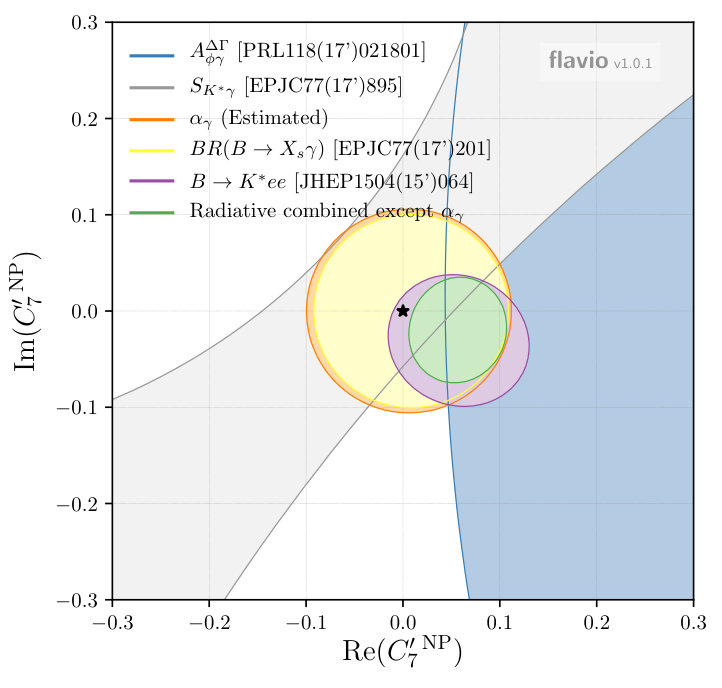 Figure 1
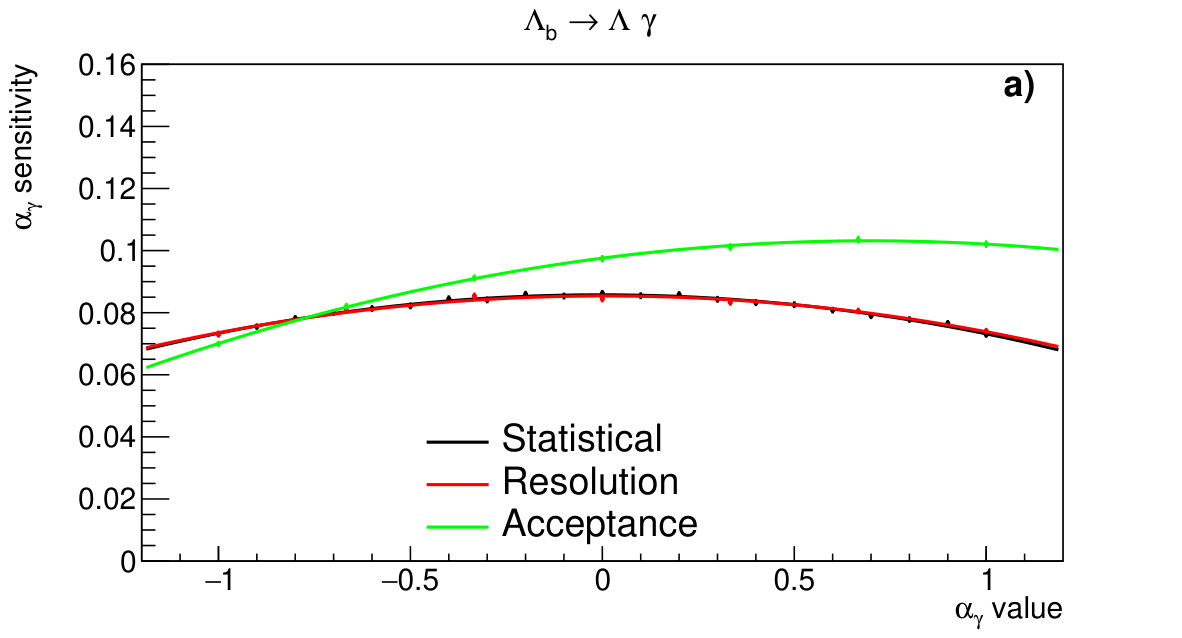 Figure 2
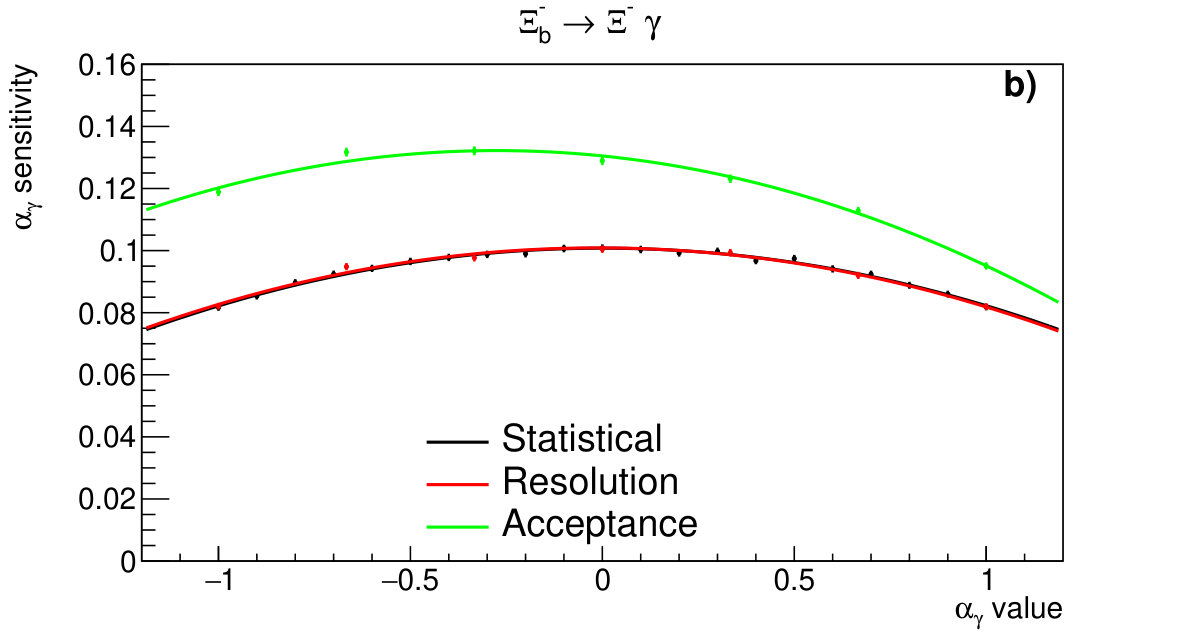 Figure 3
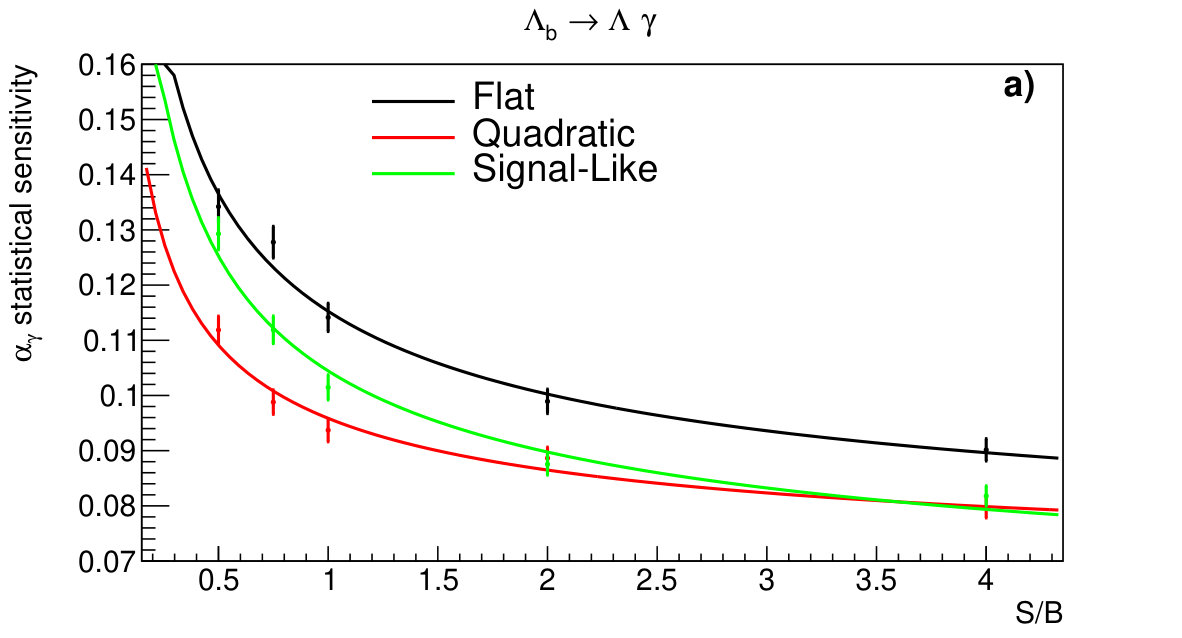 Figure 4
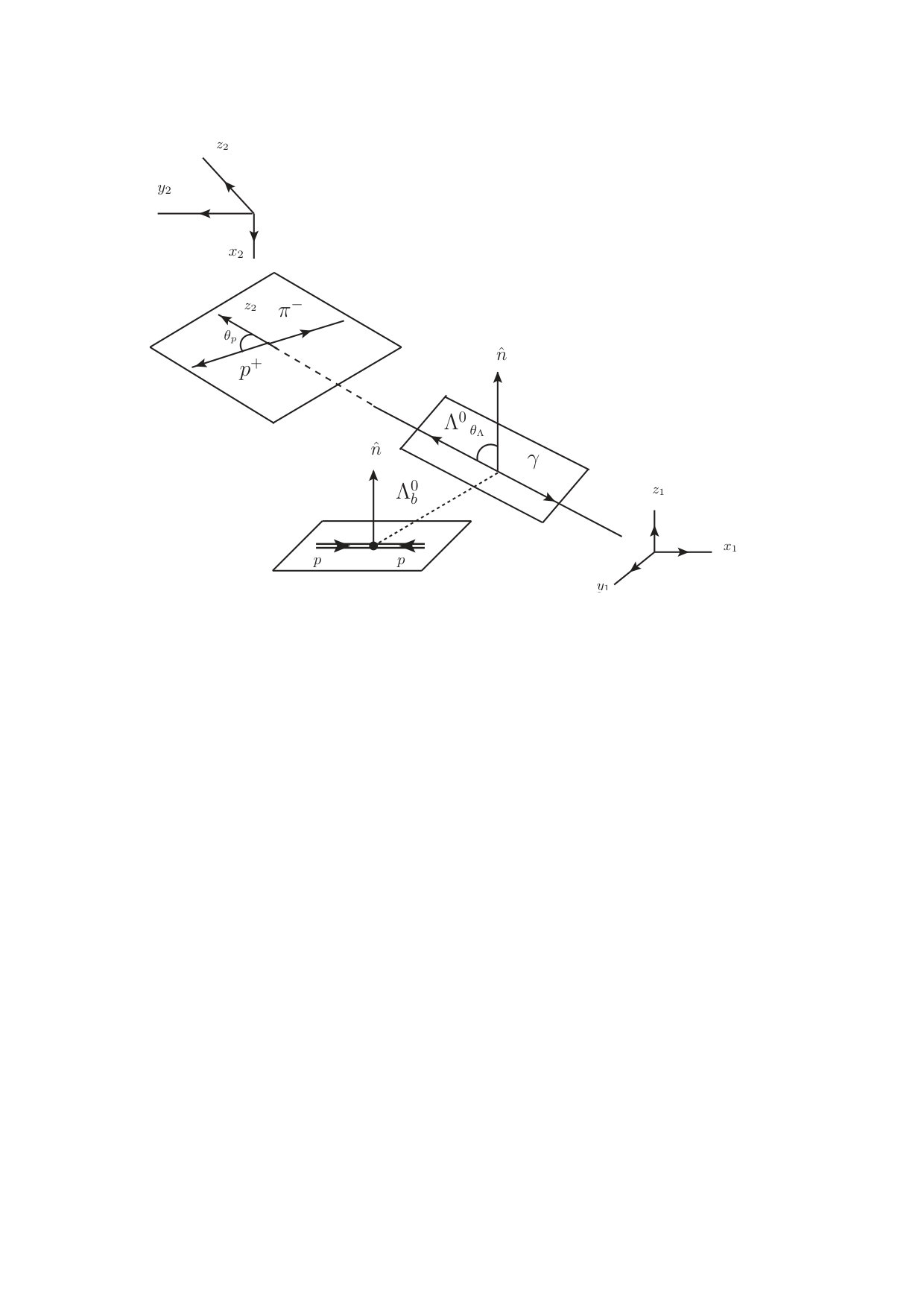 Figure 5
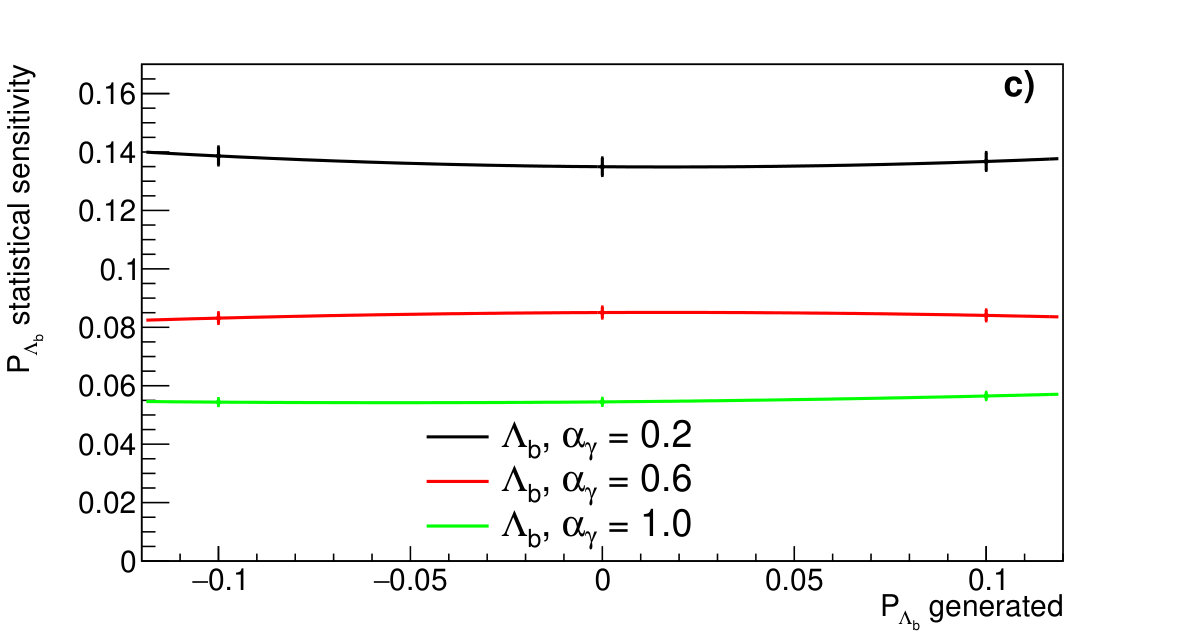 Figure 6
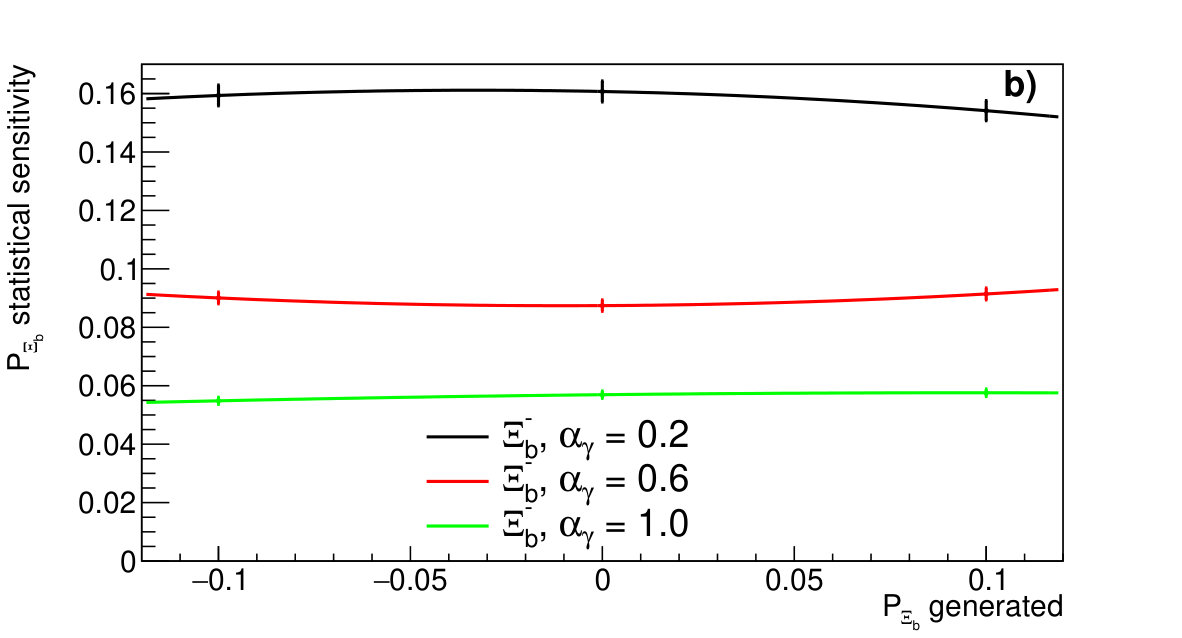 Figure 7
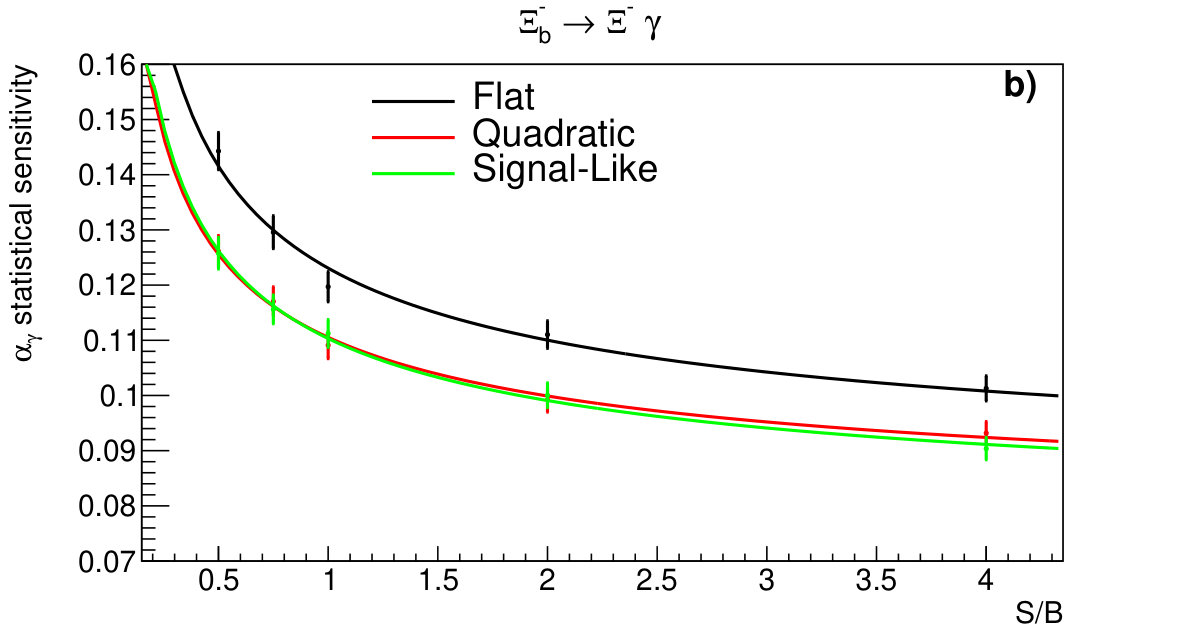 Figure 8
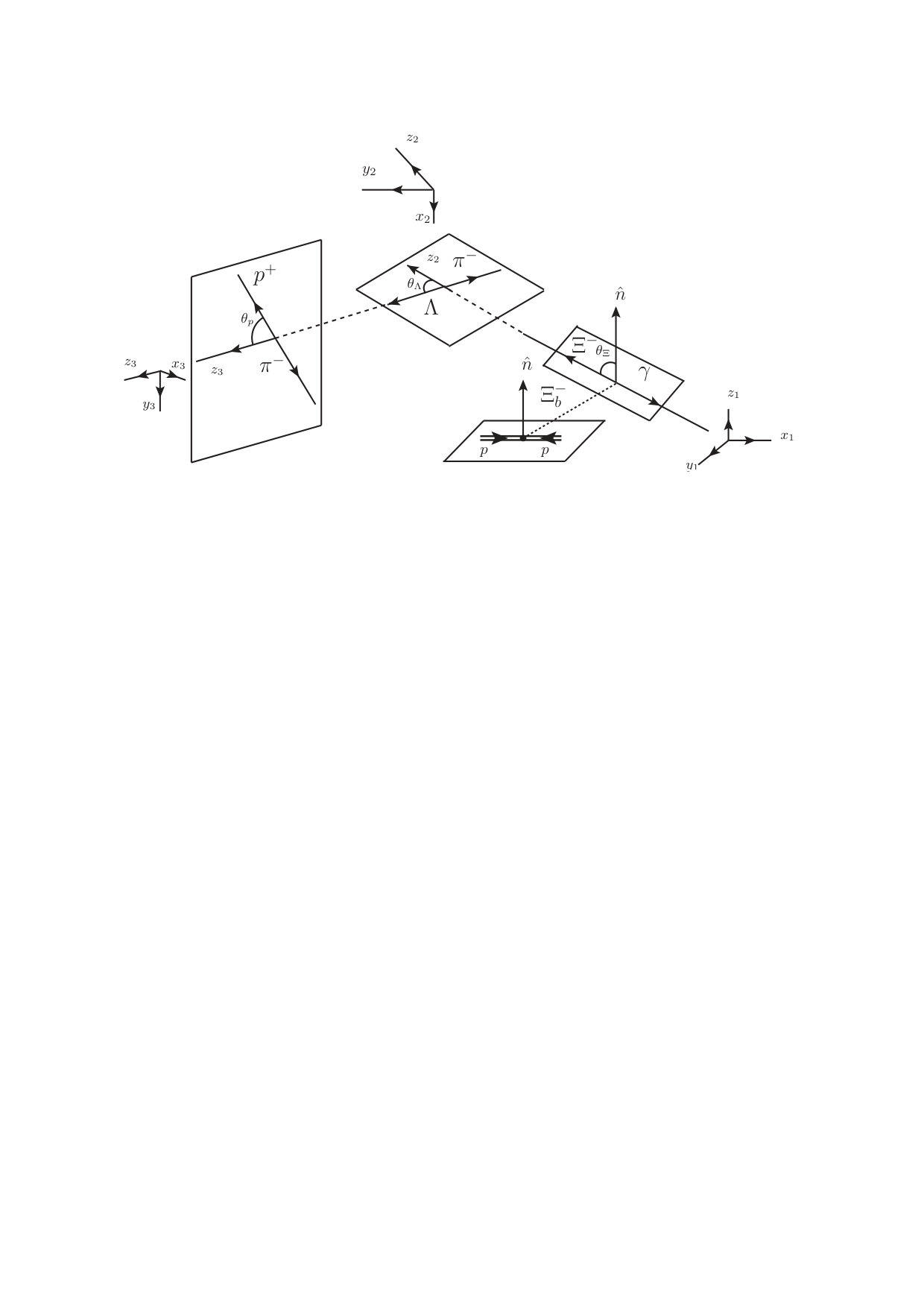 Figure 9
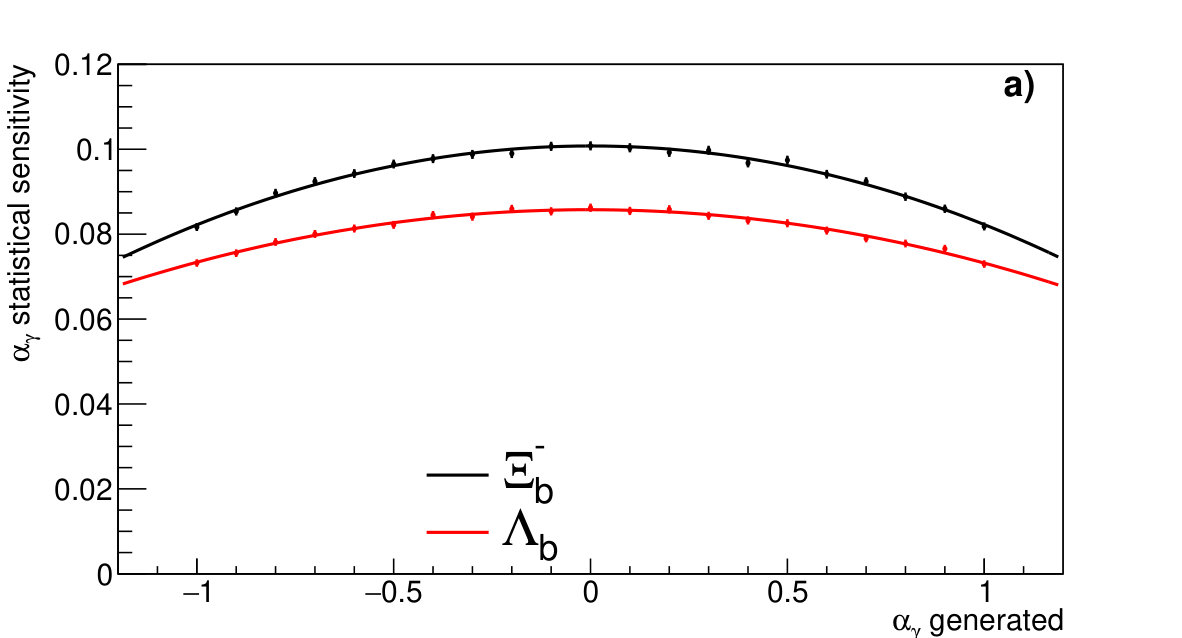 Figure 10
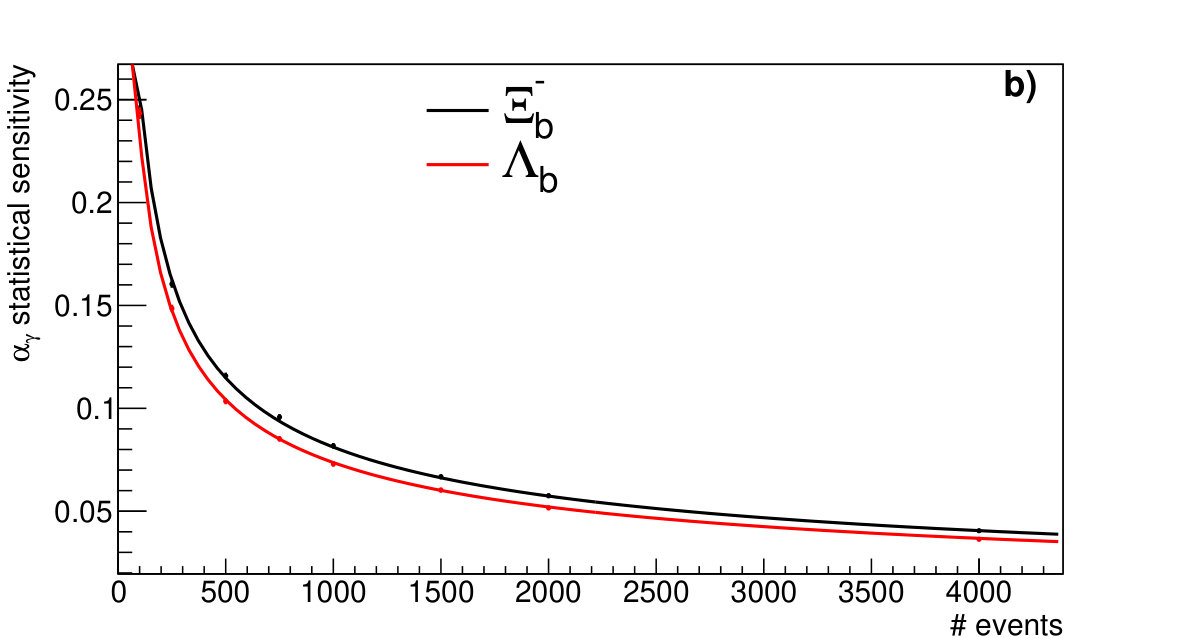 Figure 11
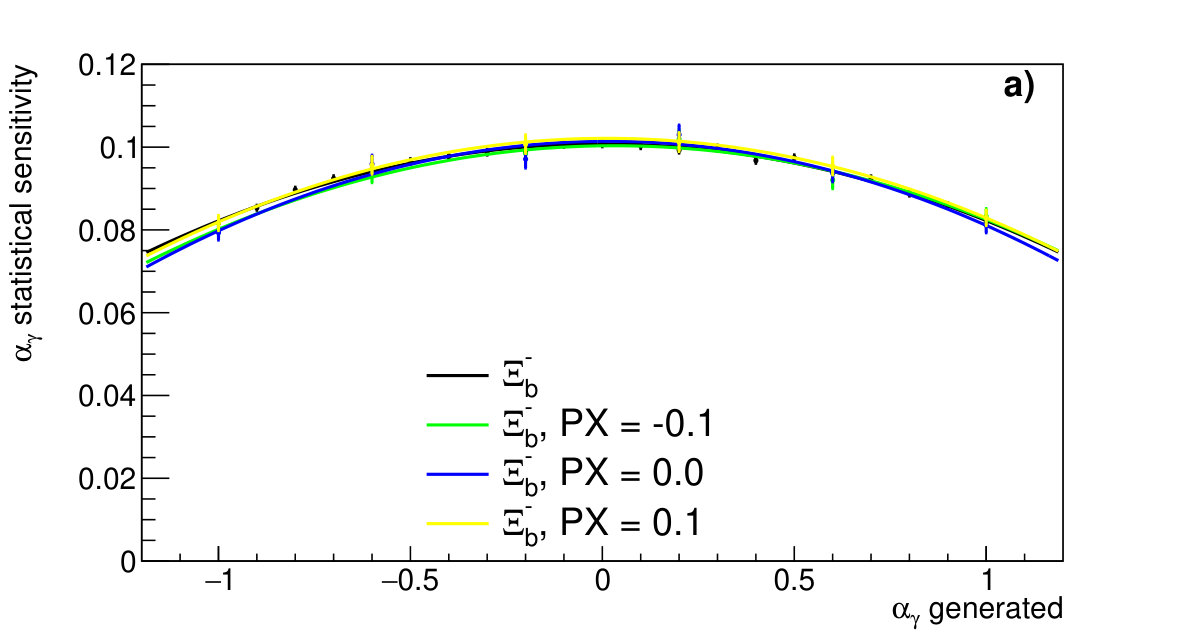 Figure 12
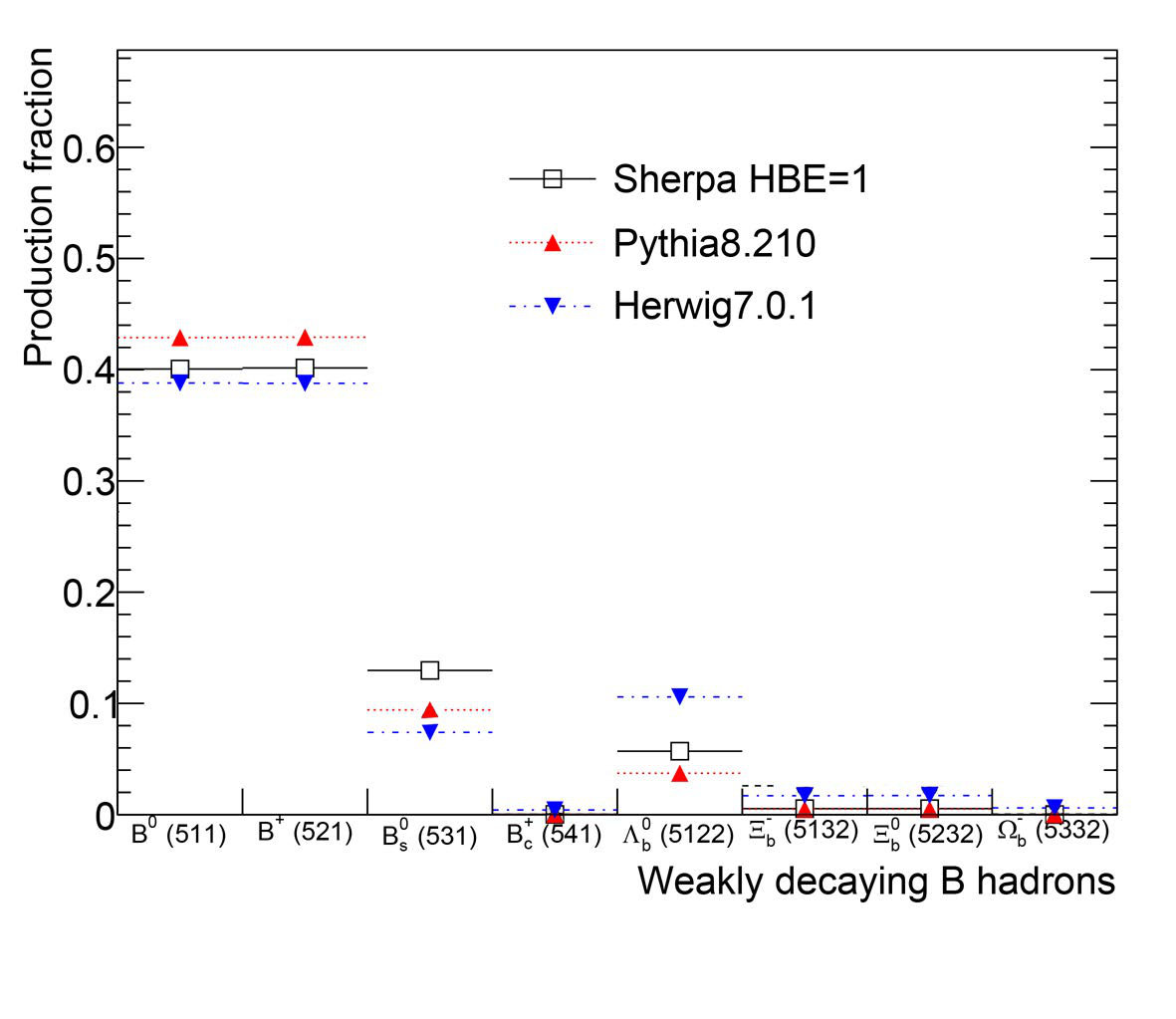 Figure 13
| - | ||
Peer Reviews
No public reviews on file for this paper yet. If you reviewed it on a platform where reviews are public (OpenReview, ICLR, NeurIPS, ICML), you can paste yours below so the community can read it here.
Videos
No videos yet. Explain this paper in a talk, walkthrough, or lecture? Add one.
11institutetext: IFIC, Universitat de Valncia-CSIC, Apt. Correus 22085, E-46071 Valncia, Spain 22institutetext: Tata Institute of Fundamental Research, Mumbai, India 33institutetext: The Institute of Mathematical Sciences, Taramani, Chennai 600113, India 44institutetext: Homi Bhabha National Institute Training School Complex, Anushakti Nagar, Mumbai 400085, India
Radiative -baryon decays to measure the photon and -baryon polarization
Luis Miguel García Martín [email protected]11
Brij Jashal *[email protected] *1122
Fernando Martínez Vidal *[email protected] *11
Arantza Oyanguren *[email protected] *11
Shibasis Roy Ria Sain and Rahul Sinha [email protected][email protected][email protected]334433443344
Abstract
The radiative decays of -baryons facilitate the direct measurement of photon helicity in transitions thus serving as an important test of physics beyond the Standard Model. In this paper we analyze the complete angular distribution of ground state -baryon ( and ) radiative decays to multibody final states assuming an initially polarized -baryon sample. Our sensitivity study suggests that the photon polarization asymmetry can be extracted to a good accuracy along with a simultaneous measurement of the initial -baryon polarization. With higher yields of -baryons, achievable in subsequent runs of the Large Hadron Collider (LHC), we find that the photon polarization measurement can play a pivotal role in constraining different new physics scenarios.
pacs:
IMSc/2019/02/02
1 Introduction
The flavour-changing neutral current decays are known to be excellent probes of physics beyond the Standard Model (SM) Misiak:1992bc ; Buras:1993xp ; Chetyrkin:1996vx ; Kruger:1999xa . Of particular interest are the loop level Glashow-Iliopoulos-Maiani (GIM) mechanism suppressed processes involving transitions that enable the photon polarization to be measured. The helicity flip required for the dipole transition in such decays is sensitive to new physics (NP). Unfortunately, the helicity structure of the quark level transition is hard to analyze using spinless mesons, as handedness of the quark is difficult to retrieve after hadronization Grossman:2000rk ; Gronau:2001ng ; Gronau:2002rz ; Hurth:2003vb ; Grinstein:2004uu ; Becirevic:2012dx ; Bishara:2015yta ; Kou:2010kn .
Recently the LHCb experiment performed several indirect measurements concerning the photon polarization in the and meson systems. Polarized photons in transitions were observed for the first time by analyzing the up-down asymmetry in decays Aaij:2014wgo . Angular observables in the channel for dielectron invariant masses of less than 1 GeV, sensitive to the polarization of the virtual photon, were measured in Aaij:2015dea . The first experimental study of the photon polarization in radiative decays was reported in Aaij:2016of by analyzing the time dependence of the decay rate.
A large number of -baryons are also being produced at LHCb allowing for several interesting measurements to be performed using the ground state spin- -baryons. The study of spin correlations in radiative decays of -baryons allows one to directly infer the chirality of the dipole transition involved. The observable of interest, namely, the photon polarization asymmetry , defined as the ratio of excess left-handed photons over right-handed photons, is well recognized in the context of -baryon radiative decays and has resulted in several studies Gremm:1995nx ; Mannel:1997xy ; Huang:1998ek ; Hiller:2001zj ; Aliev:2005np ; He:2006ud ; Leitner:2006nb ; Legger:2006cq ; Oliver:2010im ; Liu:2011ema ; Blake:2015tda . Despite the rich phenomenology, the photon polarization asymmetry in radiative -baryon decays is yet to be explored in experiments. In addition, it is worth mentioning that the initial -baryon can have non-zero transverse polarization Leader:1996hm ; Dharmaratna:1996xd depending on the various production mechanism of a -quark at the Large Hadron Collider (LHC). For finite quark masses (), a -quark produced in a QCD process can have transverse polarization of the order of 10% Dharmaratna:1996xd ; Galanti:2015pqa . During hadronization, the polarization of the -quark is retained to a large extent by the -baryon as the depolarization effects Dharmaratna:1996xd due to QCD interactions are suppressed by a factor of /, a feature common to all -baryons. A systematic study of -baryon polarization Aaij:2013oxa ; CMS:2016iaf , defined as the production asymmetry between its up and down spin components, is therefore important for our understanding of the production mechanism and hadronization process of heavy quarks.
In this paper we revisit the and the analogous decays. The and subsequently decay to multibody final states that provide powerful handles not only on the photon polarization but also the initial -baryon polarization. The complete angular distribution of the decay chains and , with the decaying into , is a function of the photon polarization, , the initial -baryon polarization, , and known decay asymmetry parameters of intermediate baryons. We explore the potential of simultaneous measurement of the photon and -baryon polarizations at LHCb through the study of the angular distribution of -baryon decays using Monte Carlo simulations. With the expected yield from the LHC Run II a sensitivity of about 0.15 is achievable for the photon polarization along with a measurement of polarization with a precision better than 10%. Despite of the challenges in due to scarcity of data, the decay mode remains a promising channel for Run II and beyond where a sensitivity of the order of 0.2 can be achieved in measurement along with a first time measurement of polarization.
The paper is laid out as follows: in Sec. 2 we have discussed the angular distribution of the radiative decays of and . Sec. 3 is devoted to the sensitivity analysis of these rare decays at the LHCb experiment. Finally, we provide constraints on new physics scenarios from the photon polarization asymmetry in Sec. 4 before concluding in Sec. 5.
2 Angular distribution of radiative -baryon decays
2.1 Case study of
Assuming an initially polarized sample of we study the complete angular distribution of where the subsequently decays to a proton () and pion (). The transverse polarization is defined Aaij:2013oxa ; CMS:2016iaf as the mean value of the spin along the unit vector
[TABLE]
normal to the production plane, where is the counterclockwise proton beam direction and the momentum. A schematic view of the decay is shown in Fig. 1. The primary decay of is described by two complex helicity amplitudes with , referring to the helicity values of the respective particles Gutsche:2013pp . To define the angles we consider two Cartesian coordinate systems attached to the rest frames of and . In the rest frame of , the -axis is chosen to be parallel to the polarization direction . The relevant kinematic variables are defined as follows:
- •
is the polar angle of the momentum relative to in rest frame, .
- •
are the polar and azimuthal angle of the proton momentum defined with respect to the axes and in rest frame.
The angular distribution is:
[TABLE]
Here, is the initial polarization and is the weak decay parameter, defined in Table 1.
2.2 Case study of
Assuming an initially polarized sample of we study the complete angular distribution of , considering the subsequent decay . The further decays to a proton and pion, resulting in a final state. The transverse polarization of is defined as the mean value of spin along the unit vector
[TABLE]
normal to the production plane, where is the counter-clockwise proton beam direction and the momentum. A schematic view of the decay is shown in Fig. 2. The primary decay is described by two complex helicity amplitudes with , referring to the helicity values of the respective particles. To define the angles we consider three Cartesian coordinate systems attached to the rest frames of , and . In the rest frame of , the -axis is chosen to be parallel to the polarization direction . Similar to the previous case, the relevant kinematic variables are defined as follows:
- •
is the polar angle of the momentum relative to in rest frame, .
- •
are the polar and azimuthal angle of the momentum defined with respect to the axes and in rest frame.
- •
are the polar and azimuthal angle of the proton momentum defined with respect to the axes and in rest frame.
The complete angular distribution reads,
[TABLE]
where , and the polarization matrix is defined as and , with the off-diagonal entries averaging out to zero in absence of correlation between production and decay mechanisms. Here is the initial polarization, and is the weak decay parameter. The complete expressions of decay parameters and their values are summarized in Table 1.
3 Experimental prospects at the LHCb experiment
The potential to measure the photon and -baryon polarization at LHCb through the angular distribution of -baryon decays can be studied using Monte Carlo simulations. The expected sensitivity as a function of the values of the , and parameters, and depending on the number of reconstructed events, is determined. Effects due to the angular acceptance and resolution, coming from the event reconstruction, are included in the simulations. The impact of the amount and shape of the possible background is also studied. Results are detailed along this section. Since the expected number of events depend on the -hadron production fractions in proton-proton collisions at the LHC energy, a summary of the present status is also discussed.
3.1 -baryon fragmentation fractions
There are various processes through which a quark can be produced in LHC. The quark can then combine with a light diquark to produce a -baryon. The probability of a -quark fragment into a baryon is given by the fragmentation fraction (). It is customary to express the fragmentation fraction Galanti:2015pqa ; Aaij:2014jyk ; Hsiao:2015txa ; Jiang:2018iqa for a specific -baryon as
[TABLE]
where are: for , for , for and . is experimentally measured Aaij:2011jp ; Amhis:2016xyh and along with the knowledge of one can estimate Aaij:2014jyk ; Aaij:2013qqa ; Aaij:2016avz . It is important to note that has a dependence on of the final state particles Aaij:2014jyk ; Aaij:2011jp ; Aaij:2015fea . Latest results from LHCb yields Aaij:2011jp
[TABLE]
Recently LHCb has measured the fragmentation fraction of a quark hadronizing into a () with respect to fragmentation fraction of a quark hadronizing into a (), using the and decay modes Aaij:2019ezy ; Voloshin:2015xxa .
Using the data samples collected at TeV to measure the ratio of production rates of to , with pseudorapidity and in the range , , the following values are observed:
[TABLE]
In these results the uncertainty is dominated by the departure from the SU(3) relation , coming from breaking of the order of 30% Aaij:2019ezy .
The fraction of -baryon species produced in proton proton collisions at =1.96 TeV is about PDG18 . Assuming that this proportion remains constant at = 13 TeV, and that the total cross section is Aaij:2016avz , we get the values and . In this estimation the contribution is taken to be about of the . These values are inside the range of the predictions by several Monte Carlo generators, as shown in Fig. 3.
3.2 Fit procedure
An unbinned maximum likelihood fit is used to determine the photon and -baryon polarization. The angular distribution for in Sec. 2.1 allows to extract the photon polarization fixing the polarization, or extracting both parameters at the same time. Thus, Eq. 2.1 is used for obtaining these two polarizations simultaneously. The dependence on the initial -baryon polarization can be eliminated by integrating out the in Eq. 2.1 obtaining:
[TABLE]
In the case of angular distribution of Sec. 2.2, it is possible to integrate out the azimuthal angle in Eq. 2.2. This removes the dependence on the unknown parameter:
[TABLE]
This expression is used in the fit to extract the photon and polarization simultaneously. Integrating out the angle in Eq. 3.2, the dependence with the -baryon polarization can also be removed:
[TABLE]
In order to validate the fit procedure, to check consistency between pseudo-experiments and to detect possible biases in the distribution of the fitted parameters, pull distributions, defined as the difference between the fitted and generated values, divided by the uncertainty from the fit, are determined. It is found that there is no bias in the fit and the pull distributions are correct.
3.3 Measurement of , and
To understand the correlation of the value of the parameter and its uncertainty, a large number of pseudo-experiments of 1000 events each are generated according to Eq. 2.1 and 2.2 for the and decay channels respectively. The generated value of is varied in this study between 1.0 and +1.0 and the angular distribution is fitted for each case. The results of the fits are shown in Fig. 4 a). A small dependence with the value of the photon polarization is observed for both channels, with maximum sensitivity at larger slopes, +1 and 1 values of the parameter. The sensitivity for the decay channel is found to be slightly better (about ) as compared to the channel. This is coming from the larger absolute value of the weak decay parameter, , compared to the parameter (see Eq. 8 and 10). Fig. 4 b) shows the expected sensitivity to the parameter as function of the reconstructed number of events for both channels. Pseudo-experiments with samples ranging between 100 and 4000 events are generated in this study with the Standard Model expectation of = 1. The results show that the photon polarization can be potentially measured with less than uncertainty with the reconstruction of about 1000 radiative -baryon events.
In Table 2 the expected number of events for the different run periods at LHCb are estimated. Numbers are obtained according to the production fractions of the different -baryon species (see Section 3.1) and assuming that the branching fraction for radiative -baryon decays is about Wang:2008sm . A reconstruction efficiency of order is considered. This estimation is obtained by scaling the reconstruction efficiency for radiative meson decays in Aaij:2016of a factor 1/100. This assumption takes into account that the trigger and reconstruction algorithms at LHCb are less efficient for long living particles PadLong . Besides, one expects the need of tighter selection criteria to suppress the large amount of combinatorial background expected from prompt ’s and random photons.
Since the angular distribution of radiative -baryon decays is also sensitive to the initial -baryon polarization (see Eq. 2.1 and 3.2), one can extract and values together with the photon polarization. Pseudo-experiments with 1000 events each are performed in this study using several values of the and polarization, fitting simultaneously and , for the decay channel, and and for the decay channel. Since the in hadron collisions is expected to be similar to the polarization of the , which has been measured in Sirunyan:2018bfd , a maximum polarization of for the initial -baryon polarization is considered in the generation for both channels. The results of the achieved sensitivity for the and or parameters as a function of its value is shown in Fig. 5.
As it can be seen in Fig. 5 b), the sensitivity to the parameter is not affected by the measurement of the polarization in the simultaneous fit, given enough statistics. This is also true for the same study with the polarization. In addition, the value of the and polarization parameters can be extracted with good accuracy independently of its value, with improved precision as the photon polarization approaches the SM value.
3.4 Event reconstruction and background effects
To include the effect of the signal event reconstruction and background sources the angular distribution in Eq. 8 and Eq. 10 is modified. The signal probability density distribution is affected by an angular acceptance, , and a resolution function, . Additionally, background sources with different angular shapes and signal to background rate () are also considered in the fitting procedure. The angular distributions of the and decay channels are modified:
[TABLE]
The LHCb detector has been described elsewhere Aaij:2014jba ; Alves:2008zz . The resolution of the proton and polar angles are expected to be worse if the particle decays after the first LHCb tracker, since the vertex and momentum resolutions degrade. If the information of the LHCb VELO detector is not included in the reconstruction of the proton and pion candidates, named downstream track category, the angular resolution can be as large as 90 mrad Aaij:2018gwm . Since particles have a long lifetime, most of the events are expected in this category. No bias in the mean of the angular resolution is expected. For tracks which are reconstructed including the information of the VELO detector, named long track category, the angular resolution is expected to be better. Monte Carlo simulations are performed using angular resolutions from 30 to 90 mrad. Since the angular distributions are quite smooth the resolution is expected to have a negligible effect. Figure 6 shows the effect of the resolution and angular acceptance for the and cases.
The angular acceptance is expected to be due to trigger and reconstruction selection criteria. The most biasing effects are expected to come from pion momentum requirements, affecting the proton and angles in an asymmetric way. Following the results obtained in Aaij:2013oxa for the proton angle, a third order polynomial function is implemented for the acceptance. Pseudo-experiments are generated using this function. Results of the fits, including the acceptance, are shown in Fig. 6. An important effect on the sensitivity to the photon polarization is observed, which will have to be controlled using data control samples. For the case of the small correlation between the proton and angles is expected.
One of the most important challenges when reconstructing radiative -baryon decays is expected to be the background suppression. Since strange -baryons have large lifetimes, and photons are involved in the decays, making a vertex fit from the -baryon decay products is not possible. A large amount of combinatorial background is then expected from random photons and prompt particles. In this study a background source is considered and a large number of pseudo-experiments is generated and fitted considering different signal (S) to background (B) rates, as well as different shapes for the angular distribution of the background. The signal samples are of 1000 events each, and the amount of events in the background sample are varied. A flat, signal-like and a second order polynomial are tested for the angular distribution of the background. The samples are generated with SM values of the photon polarization parameter, . Fig. 7 shows the results of the fit of the pseudo-experiments.
As it can be observed, the shape of the background is not so relevant as the background rejection capability. An important S/B rate is necessary in order to measure the photon polarization with an accuracy below . To achieve this, multivariate analysis techniques will be crucial, in particular for rejecting the large amount of the expected combinatorial background.
3.5 Discussion of results
Assuming that the LHCb detector can reconstruct about 900 events with the data of the Run II, and that systematic uncertainties can be controlled to the same order of the statistical uncertainty, a sensitivity of about 0.15 could be achieved for the photon polarization parameter . The polarization can also be measured with a precision better than , the sensitivity depending on the value of the photon polarization.
The measurement for the decay channel is more challenging and will need more data to reach the same sensitivity but it is a promising channel for Run III and beyond. It has the advantage of an additional track coming from the () and the possibility to reconstruct the charged baryon. If systematic uncertainties are controlled at the order of the statistical uncertainty, a sensitivity of around 0.2 could be achieved. This channel also offers the possibility to measure the polarization, which is unknown at present. The experimental angular resolution is found to have a negligible effect on the measurement of the photon polarization. In contrast, the effect of the angular acceptance due to the event reconstruction is found to be important needs to be controlled from data.
The crucial task in these analyses is expected to be the background suppression. A signal-to-background rate less than one is needed to obtain a good precision in the photon polarization.
Estimations in Tab. 2 for the LHCb Run III do not assume any improvement of the LHCb detector, which is far from reality. In the next LHC run, from 2020-2023, in addition to upgrade its tracking and vertexing systems, the LHCb experiment will exploit a novel trigger concept where all subdetectors are read out in real time and the first level trigger is fully software implemented. Track momenta resolution will improve by 10-20upgrades . For long living particles such as strange baryons, the efficiency is expected to increase at least by 10 using dedicated reconstruction algorithms PadLong , and could still be much larger with the improvement of the software trigger.
3.6 Normalization channel
A data-driven measurement of radiative b-baryon decays require the use of control and normalization decay modes. The and are chosen as the preferred modes of normalization for the and channels, respectively. The advantage of this choice is that most of the systematic uncertainties coming from the track reconstruction of -baryons cancel when the ratio of rates are considered. Also the fragmentation fractions, which have at present large uncertainties (see Sec. 3.1), cancel. The relative number of events of the radiative and di-muonic channels is then:
[TABLE]
assuming the same luminosity for both channels, and taking into account that , and cancel in this ratio. and are the remaining efficiencies which are different for both channels, coming mainly from photon and muon reconstruction. In a similar way:
[TABLE]
where again same luminosity for both channels is assumed, and , and cancel. and are the remaining efficiencies which are different for both channels. Note that no attempt is made to measure the angular distribution of di-muonic channels.
An alternative decay channel for normalization is the , which has larger efficiency but is also affected by larger amount of background. In this case the systematic uncertainty due to the photon reconstruction cancels.
4 New physics constraints
The process , at the leading order in , gets contribution from dimension six electromagnetic dipole operators:
[TABLE]
corresponding to the emission of a left (L) or right (R) handed photon respectively. The small -quark mass has been ignored in and are defined as . The Hamiltonian corresponding to the decay is given by
[TABLE]
where are the Wilson coefficients Mannel:1997xy describing the short distance contributions, and are the relevant Cabibbo-Kobayashi-Maskawa (CKM) matrix elements for the transition, and is the Fermi constant. The polarization asymmetry in Table 1 can be thus defined as
[TABLE]
Within SM the contribution to right-handed photons is suppressed by the ratio , resulting in
[TABLE]
However, various new physics (NP) scenarios as well as long distance effects within the SM can result in new contributions to the causing a departure from the SM value Paul:2016urs . Long distance contribution has been estimated to be small and of the order of 5% Mannel:1997xy . Thus, any significant deviation of the measured value of from unity could indicate the presence of NP contributions to the Wilson coefficient . In general can have both real and imaginary contributions. There are, however, already constraints on using other measurements like , the direct CP asymmetry, , the mixing-induced CP asymmetry and , the mass-eigenstate rate asymmetry from the decays of neutral and mesons to CP eigenstates, for example in or decays. In Fig. 8, the constraints in the plane from measurements of , the inclusive branching ratio , and angular asymmetries of are shown. The constraint for an estimate of is also plotted. With the expected sensitivity of it is clear that this measurement provides competitive constraints on new physics in comparison to the existing measurements using mesons.
5 Conclusions
The flavour-changing GIM suppressed processes involving transitions are known to be excellent probes of physics beyond the Standard Model. In that context, we analyze the decays and undergoing the same transition. By exploiting the spin correlations in radiative decays of -baryons we demonstrate that they offer a convenient method for direct measurement of the photon polarization asymmetry along with a measurement of the initial -baryon polarization. We presented expressions for the complete angular distribution of the decay chains and , with the decaying into , expressed as a function of , the photon polarization, , the initial -baryon polarization and known decay asymmetry parameters of intermediate baryons. We then explored the potential of joint measurement of the photon and -baryon polarization at LHCb through the angular distribution study of -baryon decays using Monte Carlo simulations. We find that with the expected yield from the LHC Run II a sensitivity of about 0.15 is achievable for the photon polarization along with a measurement of polarization with a precision better than 10%. Despite of the challenges in due to scarcity of data, even Run II allows a sensitivity of the order of 0.2 to be achieved for along with a first time measurement of . With higher yields, achievable in subsequent runs of the Large Hadron Collider, the photon polarization measurement using -baryons will play a pivotal role in constraining different new physics scenarios.
Acknowledgements
We thank L. Oliver for the interesting and motivating discussions at the beginning of this work. Part of this work is supported by the Spanish Ministerio of Economía, Industria and Competitividad.
The reference list from the paper itself. Each links out to its DOI / PubMed record.
- 1(1) M. Misiak, Nucl. Phys. B 393 , 23 (1993) Erratum: [Nucl. Phys. B 439 , 461 (1995)]. doi:10.1016/0550-3213(95)00029-R, 10.1016/0550-3213(93)90235-H
- 2(2) A. J. Buras, M. Misiak, M. Munz and S. Pokorski, Nucl. Phys. B 424 , 374 (1994) doi:10.1016/0550-3213(94)90299-2 [hep-ph/9311345].
- 3(3) K. G. Chetyrkin, M. Misiak and M. Munz, Phys. Lett. B 400 , 206 (1997) Erratum: [Phys. Lett. B 425 , 414 (1998)] doi:10.1016/S 0370-2693(97)00324-9 [hep-ph/9612313].
- 4(4) F. Kruger, L. M. Sehgal, N. Sinha and R. Sinha, Phys. Rev. D 61 , 114028 (2000) Erratum: [Phys. Rev. D 63 , 019901 (2001)] doi:10.1103/Phys Rev D.61.114028, 10.1103/Phys Rev D.63.019901 [hep-ph/9907386]
- 5(5) Y. Grossman and D. Pirjol, JHEP 0006 , 029 (2000) doi:10.1088/1126-6708/2000/06/029 [hep-ph/0005069].
- 6(6) M. Gronau, Y. Grossman, D. Pirjol and A. Ryd, Phys. Rev. Lett. 88 , 051802 (2002) doi:10.1103/Phys Rev Lett.88.051802 [hep-ph/0107254].
- 7(7) M. Gronau and D. Pirjol, Phys. Rev. D 66 , 054008 (2002) doi:10.1103/Phys Rev D.66.054008 [hep-ph/0205065].
- 8(8) T. Hurth, Rev. Mod. Phys. 75 , 1159 (2003) doi:10.1103/Rev Mod Phys.75.1159 [hep-ph/0212304].