Polaritonic frequency-comb generation and breather propagation in a negative-index metamaterial with a cold four-level atomic medium
Saeid Asgarnezhad-Zorgabad, Pierre Berini, Barry C. Sanders

TL;DR
This paper proposes a novel waveguide design that uses a lossless dielectric with four-level atoms above a negative-index metamaterial to generate polaritonic frequency combs and breathers, enabling high-speed modulation and compact photonic applications.
Contribution
It introduces a new waveguide scheme combining atomic media and metamaterials to control surface-polaritonic waves for frequency comb and breather generation.
Findings
Successful excitation of polaritonic Akhmediev breathers at the interface.
Generation of position-dependent polaritonic frequency combs.
Potential for high-speed, compact photonic devices.
Abstract
We develop a concept for a waveguide that exploits spatial control of nonlinear surface-polaritonic waves. Our scheme includes an optical cavity with four-level -type atoms in a lossless dielectric placed above a negative-index metamaterial layer. We propose exciting a polaritonic Akhmediev breather at a certain position of the interface between the atomic medium and the metamaterial by modifying laser-field intensities and detunings. Furthermore, we propose generating position-dependent polaritonic frequency combs by engineering widths of the electromagnetically induced transparency window commensurate with the surface-polaritonic modulation instability. Therefore, this waveguide acts as a high-speed polaritonic modulator and position-dependent frequency-comb generator, which can be applied to compact photonic chips.
Click any figure to enlarge with its caption.
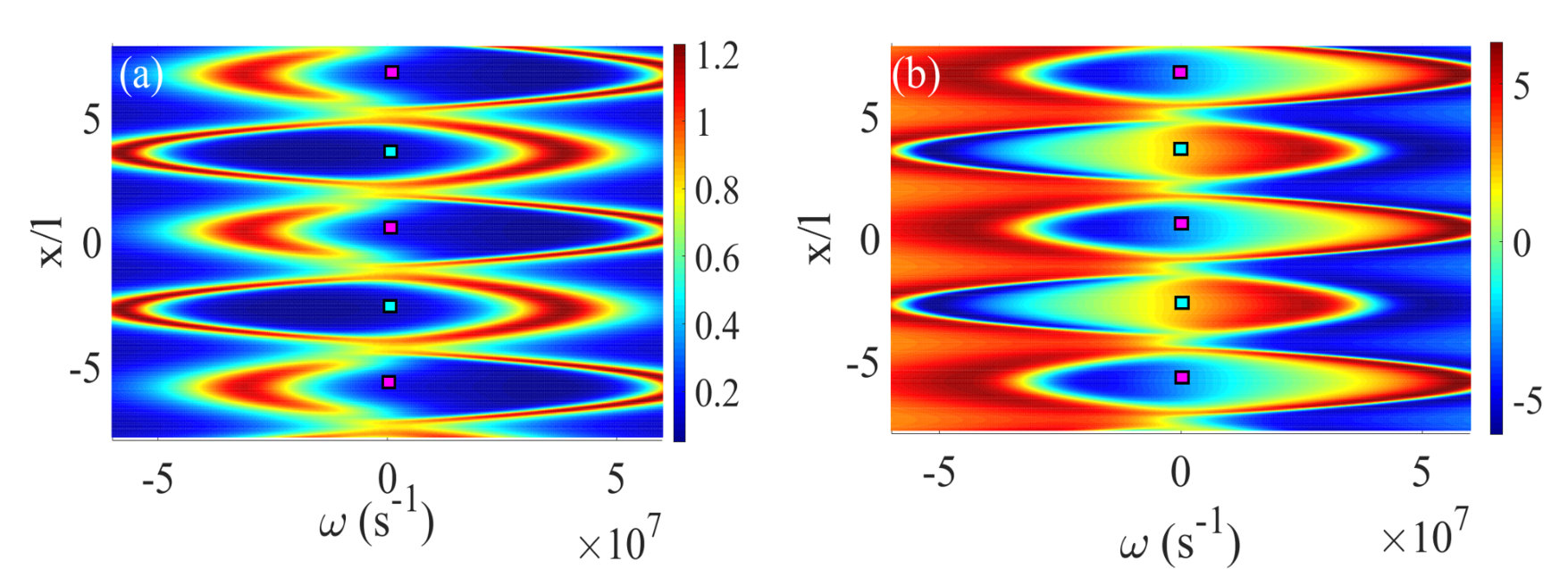 Figure 1
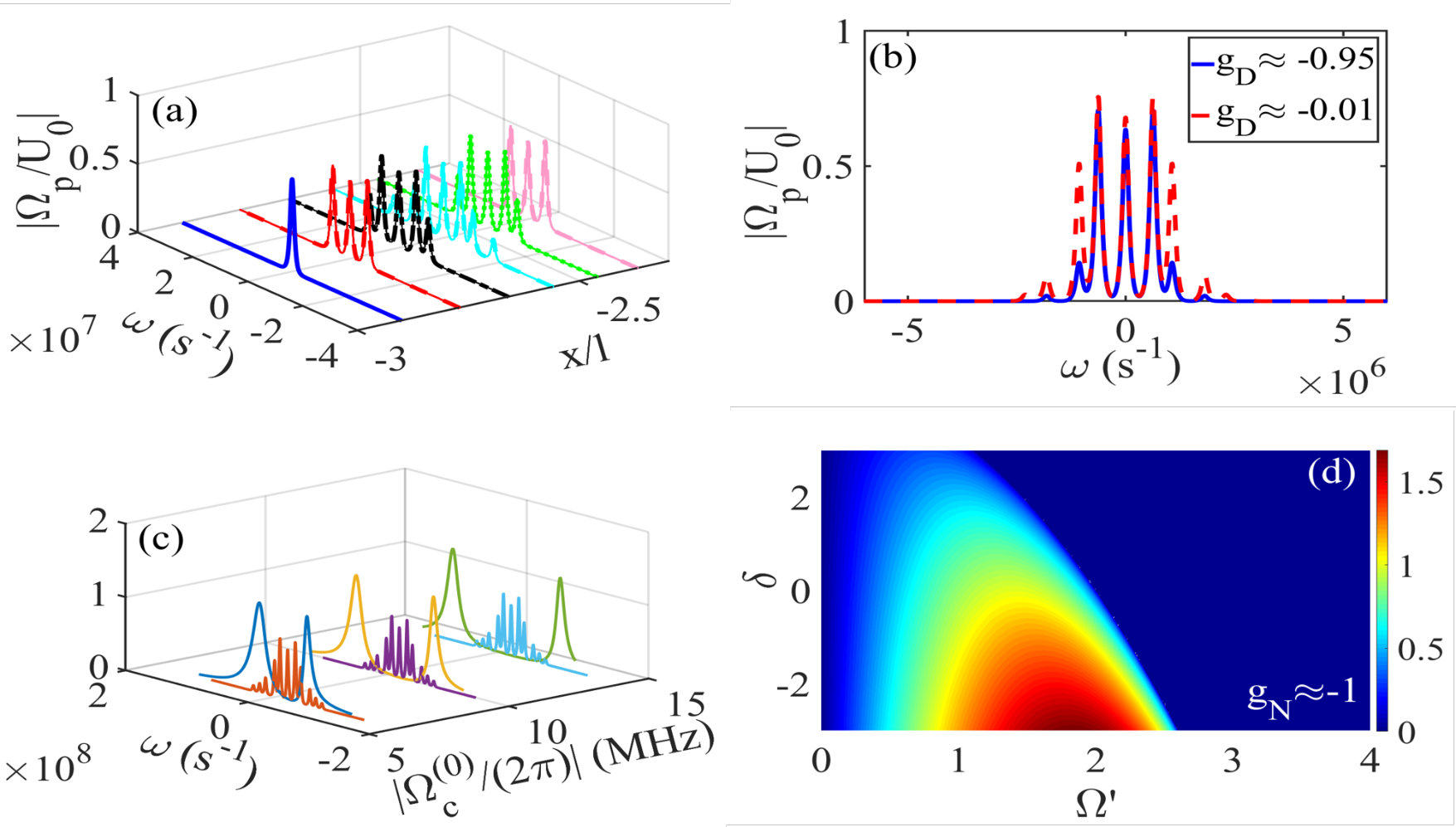 Figure 2
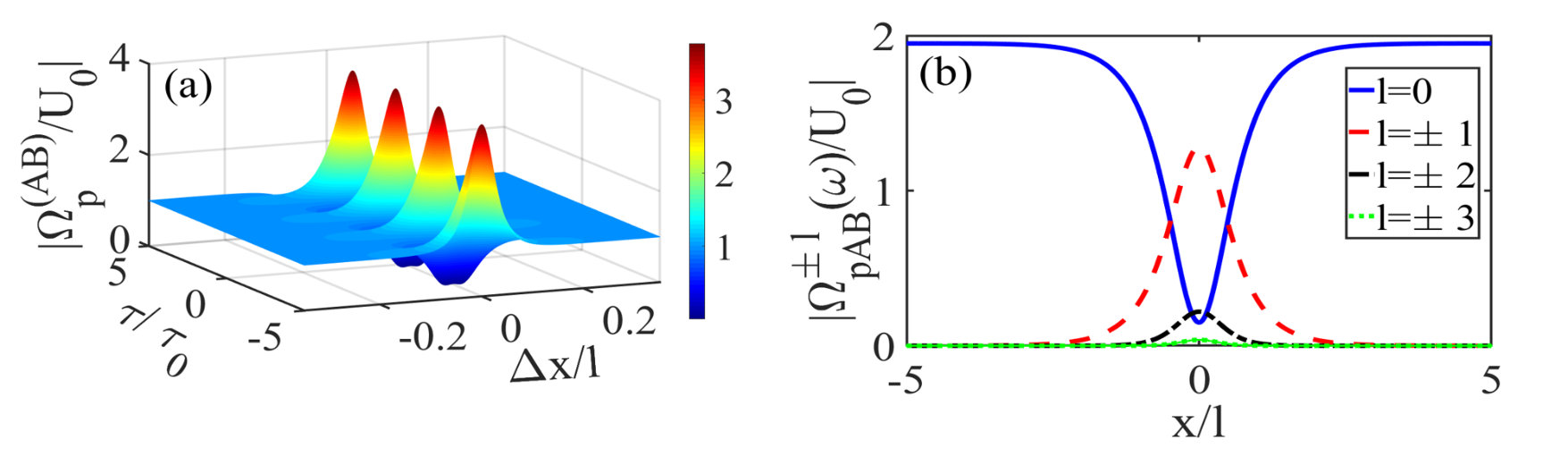 Figure 3
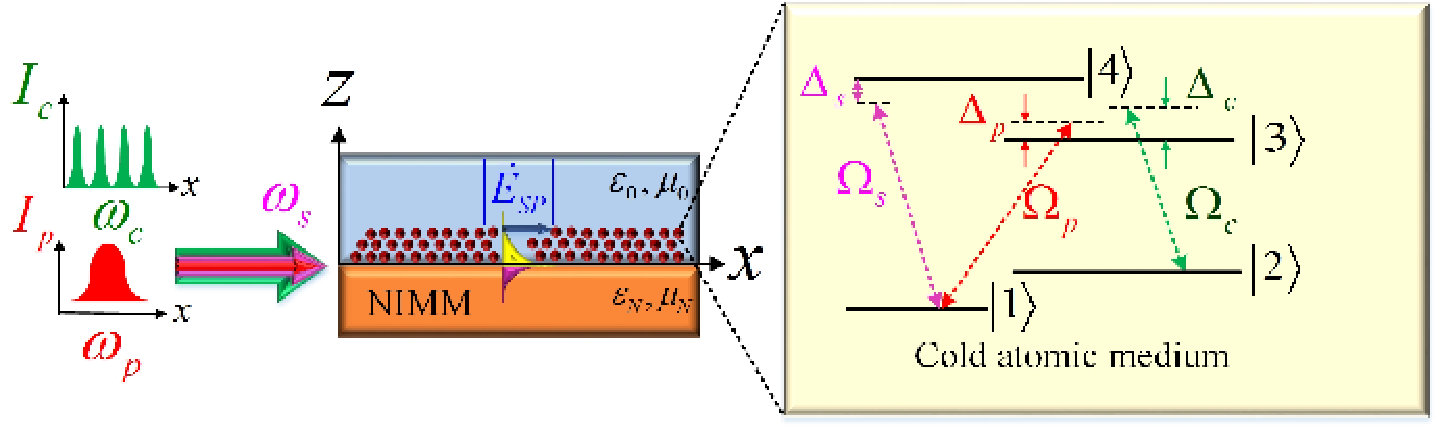 Figure 4
Peer Reviews
No public reviews on file for this paper yet. If you reviewed it on a platform where reviews are public (OpenReview, ICLR, NeurIPS, ICML), you can paste yours below so the community can read it here.
Videos
No videos yet. Explain this paper in a talk, walkthrough, or lecture? Add one.
Polaritonic frequency-comb generation and breather propagation in a negative-index metamaterial with a cold four-level atomic medium
Saeid Asgarnezhad-Zorgabad
Department of Physics, Sharif University of Technology, Tehran, 11365 11155, Iran
Institute for Quantum Science and Technology, University of Calgary, Calgary, Alberta T2N 1N4 Canada
Pierre Berini
Department of Physics, University of Ottawa, 150 Louis-Pasteur, Ottawa, Ontario K1N 6N5, Canada
Centre for Research in Photonics, University of Ottawa, 25 Templeton St., Ottawa, Ontario K1N 6N5, Canada
School of Electrical Engineering and Computer Science, 700 King Edward St., Ottawa, Ontario, K1N 6N5 Canada
Barry C. Sanders
Institute for Quantum Science and Technology, University of Calgary, Calgary, Alberta T2N 1N4 Canada
Program in Quantum Information Science, Canadian Institute for Advanced Research, Toronto, Ontario M5G 1M1 Canada http://iqst.ca/people/peoplepage.php?id=4 [email protected]
Abstract
We develop a concept for a waveguide that exploits spatial control of nonlinear surface-polaritonic waves. Our scheme includes an optical cavity with four-level N-type atoms in a lossless dielectric placed above a negative-index metamaterial layer. We propose exciting a polaritonic Akhmediev breather at a certain position of the interface between the atomic medium and the metamaterial by modifying laser-field intensities and detunings. Furthermore, we propose generating position-dependent polaritonic frequency combs by engineering widths of the electromagnetically induced transparency window commensurate with the surface-polaritonic modulation instability. Therefore, this waveguide acts as a high-speed polaritonic modulator and position-dependent frequency-comb generator, which can be applied to compact photonic chips.
pacs:
Valid PACS appear here
††preprint: APS/123-QED
Nonlinear plasmonics (and polaritonics) Kauranen and Zayats (2012) in waveguide geometries are of strong interest for schemes enabling strong cross-phase modulation Moiseev et al. (2010), amplification and lasing Berini and De Leon (2012), modulators Schuller et al. (2010) and detection Brongersma et al. (2015). Controlling and exciting nonlinear surface polaritons (SPs) is challenging as the strength of the nonlinear processes and their efficiency depend strongly on (metallic) nanostructure roughness Nahata et al. (2003); Feth et al. (2008) which is experimentally challenging to minimize. We circumvent this problem by formulating an approach that spatially controls nonlinear SP waves, and we explore its application for modulation Schuller et al. (2010) and frequency-comb generators Geng et al. (2016).
For spatial control of nonlinear surface-polaritonic waves, we suggest driving four-level N-type atoms (4NAs) Sheng et al. (2011a) on the surface of a negative-index metamaterial (NIMM) Xiao et al. (2010) as depicted in Fig. 1. These components are contained in a stable cavity
and serve as a nonlinear planar waveguide. The atoms are dopants in a transparent medium over a thickness of several dipole-transition wavelengths. These atoms are driven by three co-propagating fields a pump signal (s), a weak probe signal (p), and a standing wave coupling signal (c), all assumed injected from laser beams using the end-fire coupling technique Stegeman et al. (1983).
Various approaches can be used to describe the NIMM Shalaev (2007). We employ a macroscopic description involving macroscopic permittivity and permeability, which are inserted into the Drude-Lorentz model Kamli et al. (2008); Xiao et al. (2009)
The 4NA is appealing because of its giant Kerr nonlinearity and controllable dispersion Sheng et al. (2011b). We assume that the signal (s), probe (p) and couple (c) laser fields drive the , and atomic transitions, respectively. The 4NA medium in our waveguide is assumed as in with corresponding energy levels
[TABLE]
We assume inhomogeneous broadening of the atomic transitions to be in Lorentzian line shape Kuznetsova et al. (2002). The 4NA medium has atomic density , natural decay rates and dephasing rates between levels and Boyd (2003).
The signal (s), probe (p) and couple (c) laser fields interact with the 4NAs in the waveguide within an optical cavity of length . The signal detuning frequencies are , and the Rabi frequencies are with
[TABLE]
for constant Rabi-frequency coefficient and longitudinal coordinate, or position, . The fields are evanescently confined to the NIMM-4NA interface with decay functions . The decay functions are maximum at the interface, and we assume that Tan and Huang (2015).
We show that these laser driving fields would excite nonlinear SP waves including Akhmediev breathers, which is a solitary localized nonlinear wave with a periodically oscillating amplitude Akhmediev and Korneev (1986), and a frequency comb, as a nonlinear wave that appears briefly at specific positions. We propose generating these nonlinear waves by coupling the probe laser to the dipole moment of the 4NA transition, and stability is achieved by imposing an SP low-loss condition and modifying the nonlinearity and dispersion of SPs at the interface.
Our quantitative description of the system is obtained by solving Maxwell-Bloch equations Kraus et al. (2006) based on a perturbative, asymptotic, multi-scale position () and time () expansion Asgarnezhad-Zorgabad et al. (2018)
[TABLE]
for the perturbation scale coefficient. Our third-order truncated solution yields a nonlinear Schrödinger equation (NLSE). We solve and plot the Rabi frequency for the resultant surface-polaritonic Akhmediev breather and explore Rabi-frequency dependence as a function of various control parameters to identify conditions for efficient frequency-comb generation.
We use only and in our analysis by ignoring three effects, namely, (i) the second-order -derivative due to a slowly varying amplitude Davoyan et al. (2009), (ii) higher-order time scales and position , in deriving Eq. (6) by ignoring higher-order dispersion and (iii) group-velocity dispersion (GVD) in the NIMM layer, which is times the 4NA GVD.
We treat SPs as plane waves with GVD for the linear dispersion. The SP absorption coefficient is , and we neglect GVD and self-phase modulation (SPM) () variability at different orders of position scales: is constant for all for . Nonlinear SPs have large initial pulse width , group velocity and half-Rabi frequency
[TABLE]
and propagate up to several nonlinear units of length given by if the imaginary parts of the GVD and SPM are much smaller than the real parts.
We replace
[TABLE]
ignoring the atomic absorption due to EIT window. We normalized GVD and SPM according to . Dynamics of the normalized SP pulse envelope follows
[TABLE]
which is a dimensionless NLSE Conforti et al. (2018).
We propose employing the spatially modulated coupling laser for SP absorption-dispersion control during its propagation, which we illustrate by plotting SP absorption and dispersion in Figs. 2(a,b), respectively. Asymmetric absorption-dispersion profiles for the position-dependent SPs are evident, and we see the formation of multiple static EIT windows in the propagation direction by coupling laser modulation. We reduce atomic absorption by adjusting the spatially modulated control field and other laser field intensities for the wavelength corresponding to the atomic transition (i.e., for ). Therefore, points in the propagation direction correspond to for the multiple EIT windows seen in Figs. 2(a,b). These EIT windows are suitable for propagating nonlinear polaritonic waves including Akhmediev breathers and frequency combs.
We choose realistic parameters to analyze performance of this polaritonic waveguide Wang et al. (2008). Radiative decay is quantified by and non-radiative decay by . Atomic density is . We propose using a R6G ring dye laser as input sources with , , , , , and . Realistic parameters are also employed for the NIMM layer Kamli et al. (2011); Xiao et al. (2010).
We suggest two sets of positions corresponding to for stable propagation of nonlinear polaritonic waves including Akhmediev breathers and frequency combs. (i) At positions
[TABLE]
nonlinear SPs propagate with within , and
[TABLE]
respectively, are constant with . Therefore, at these specific positions SPs propagate as polaritonic Akhmediev breathers. (ii) For
[TABLE]
GVD and SPM are position-dependent within so
[TABLE]
At these points, SPs propagate with weak dispersion and strong nonlinearity as efficient polaritonic-frequency combs.
Exploiting the correspondence between energy levels of the Bogoliubov spectrum () of the uniform Bose gas with kinetic energy () Bogoliubov (1947) and energy transferrence between nonlinear polaritonic modes in EIT windows, we propose generating polaritonic side-bands with modulation frequency and growth rate and thereby realize Akhmediev breather excitation. Our analysis shows energy transfer from the zeroth order () polaritonic wave with propagation constant , , to the first-order side-bands () by setting and .
We thereby obtain the wave with amplification factor according to
[TABLE]
Energy transmittance to third-order polaritonic side-bands () is depicted in Fig. 3(b) and is in accordance with energy-conservation
[TABLE]
In our scheme, a stable polaritonic Akhmediev breather propagates for , and within within EIT windows such that as shown in Fig. 3(a).
Our waveguide serves as a fast-phase modulator Melikyan et al. (2014) according to stable polaritonic-breather propagation. To this aim, we rewrite the surface-polaritonic Akhmediev breather solution as . For our realistic parameters, which is the phase shift between initial and recovered plane SP waves after breather formation. The time duration for the breather excitation-recurrence cycle in our nonlinear waveguide is . Therefore, our waveguide modulates polaritonic frequencies up to a few GHz and can be applied as a fast surface-polaritonic phase modulator.
We propose efficient polaritonic-frequency combs by rewriting
[TABLE]
in terms of constant and position dependent parts. The frequency combs can be excited at specific positions , where nonlinear SPs exhibit low GVD () and strong nonlinearity (). Therefore, we neglect GVD and replace (6) and assume . The resultant expression admits an initial SP wave with input power of the form
[TABLE]
We claim that stable propagation of nonlinear SPs in the weak-dispersion limit depends on the EIT-window widths and the normalized nonlinear coefficient .
We propose efficient surface-polaritonic frequency combs by SP propagation along the interface shown in Fig. 3(a) with , . Then we numerically solve the NLSE together with initial condition (14) within . We obtain a modulated EIT window, strong nonlinearity and consequently efficient polaritonic frequency combs. Specifically, for with and , frequency combs up to with stability are excited. However, outside the EIT window, the generated polaritonic combs are highly unstable due to high atomic absorption.
This model allows us to develop a condition to generate efficient surface-polaritonic frequency combs via position-dependent GVD and SPM. To this aim, we consider as a small propagation length and add a perturbative term to Eq. (14) of the form
[TABLE]
We also expand the SP-wave perturbation frequency around the EIT-window centre () as a function of the relative polaritonic frequency comb mode number () in the presence of SPs dispersion
[TABLE]
with related to higher-order dispersion. Efficient frequency combs are generated by suppressing higher-order dispersion (16); i.e., . Specifically, at , , and , which yields efficient polaritonic-frequency combs as shown in Fig. 4(a).
We vary the coupling-laser intensity for experimental control of EIT-window widths, leading to efficient polaritonic frequency combs shown clearly for and with initial condition (15) solving the NLSE numerically around . The number of frequency combs increases by modulating coupling-laser intensity and by engineering the EIT-window widths shown in Fig. 4(c). Comparing our frequency combs to polaritonic Akhmediev breather reveals that nonlinear waves generated at our propose position are more efficient than frequency combs excited by Akhmediev breathers, as seen in Fig. 4(b)).
We describe the excitation of nonlinear surface-polaritonic waves including polaritonic Akhmediev breather and frequency combs by employing the concept of pass-band polaritonic modulation instability. We assume the initial SPs with dispersion length according to
[TABLE]
with
[TABLE]
Moreover, we assume as a modulation frequency, as the normalized perturbed frequencies and as a modulation parameter in the propagation direction. We have perturbed the SP waves in terms of as
[TABLE]
We also expand the SPs linear dispersion and the nonlinear coefficient as a power series of the normalized perturbation frequency
[TABLE]
and linearize the NLSE using Eq. (19) in the weak perturbation limit Chen et al. (2017). The perturbed-wave dispersion relation is
[TABLE]
with . The gain map for the perturbed-polaritonic waves, shown in Fig. 4(d), demonstrates that nonlinear-polaritonic waves are excited in EIT windows with and corresponding to pass-band polaritonic modulation instability.
In summary, we introduce a waveguide that exploits spatial control to excite nonlinear-polaritonic waves including Akhmediev breathers and frequency combs as specific cases. We propose a stable cavity comprising 4NAs in a lossless dielectric above the NIMM layer, on which SPs propagate. The 4NA medium is driven by three co-propagating signals, a pump signal (s), a weak probe signal (p), and a standing wave coupling signal (c), all assumed injected from laser beams using the end-fire coupling technique. We propose stable excitation of polaritonic Akhmediev breathers and energy transfer to other polaritonic side-bands at certain position of NIMM-4NA interface by modifying laser-field intensities and detunings through GVD-SPM modulation. Moreover, we demonstrate efficient polaritonic frequency-comb generation at a specified position of the waveguide by engineering EIT-window widths and decreasing GVD commensurate with the pass-band regime for polaritonic modulation instability. Our proposed waveguide has been analzyed for experimentally feasible conditions and should act as a high-speed polaritonic phase modulator and efficient frequency-comb generator.
The reference list from the paper itself. Each links out to its DOI / PubMed record.
- 1Kauranen and Zayats (2012) M. Kauranen and A. V. Zayats, Nat. Photon. 6 , 737 (2012).
- 2Moiseev et al. (2010) S. A. Moiseev, A. A. Kamli, and B. C. Sanders, Phys. Rev. A 81 , 033839 (2010) . · doi ↗
- 3Berini and De Leon (2012) P. Berini and I. De Leon, Nat. Photon. 6 , 16 (2012).
- 4Schuller et al. (2010) J. A. Schuller, E. S. Barnard, W. Cai, Y. C. Jun, J. S. White, and M. L. Brongersma, Nat. Mater. 9 , 193 (2010).
- 5Brongersma et al. (2015) M. L. Brongersma, N. J. Halas, and P. Nordlander, Nat. Nanotechnol. 10 , 25 (2015).
- 6Nahata et al. (2003) A. Nahata, R. A. Linke, T. Ishi, and K. Ohashi, Opt. Lett. 28 , 423 (2003).
- 7Feth et al. (2008) N. Feth, S. Linden, M. Klein, M. Decker, F. Niesler, Y. Zeng, W. Hoyer, J. Liu, S. Koch, J. Moloney, et al. , Opt. Lett. 33 , 1975 (2008).
- 8Geng et al. (2016) X. T. Geng, B. J. Chun, J. H. Seo, K. Seo, H. Yoon, D.-E. Kim, Y.-J. Kim, and S. Kim, Nat. Commun. 7 , 10685 (2016).