Area and perimeter foliations on spaces of polygons
Aziz El Kacimi Alaoui, Abdellatif Zeggar

TL;DR
This paper characterizes families of star-shaped polygons with fixed area and perimeter as leaves of a foliation in the space of polygons, and explores geometric properties of convex polygons related to these measures.
Contribution
It provides a complete description of polygon families with given area and perimeter, linking geometric properties to these measures.
Findings
Families of star-shaped polygons form a foliation with prescribed area and perimeter.
Convex polygons' inscriptibility and regularity relate to their perimeter and area.
The geometric properties of polygons are analyzed in the context of the foliation structure.
Abstract
We describe all families of star-shaped n-polygons in the Euclidean plane with prescribed perimeter and area ; they are leaves of a foliation F on the space of star-shaped n-polygons. By the way, we study some geometric properties of convex polygons, for instance their inscriptibility in a circle and their regularity in relation with the perimeter and the area.
Click any figure to enlarge with its caption.
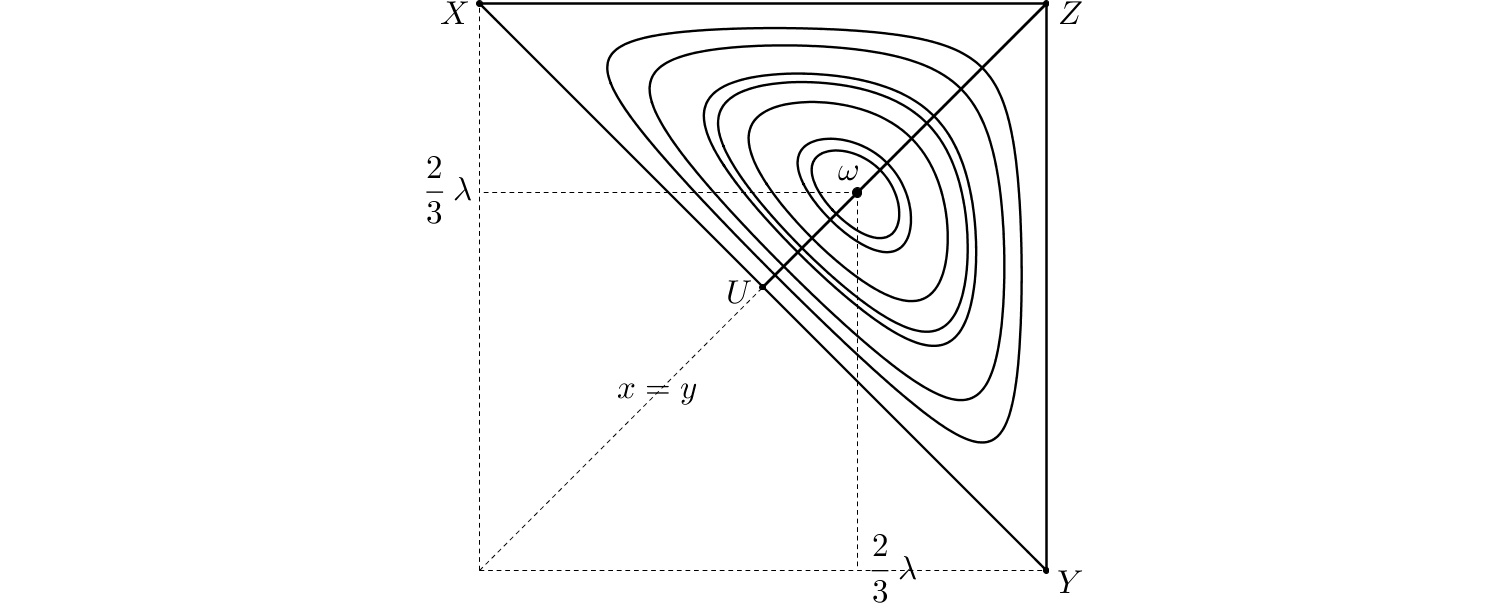 Figure 1
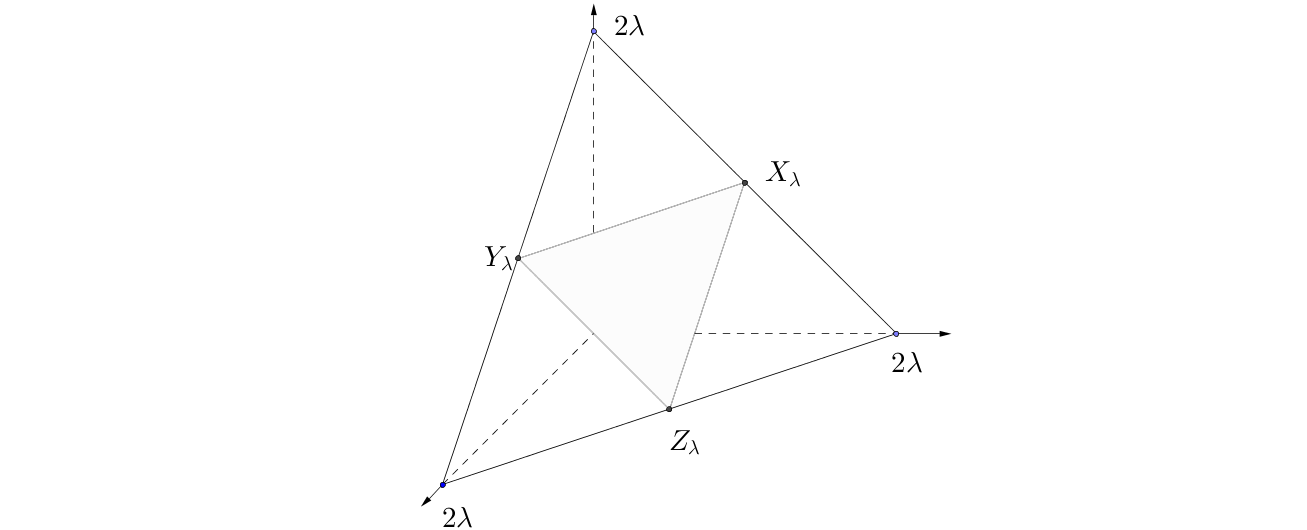 Figure 2
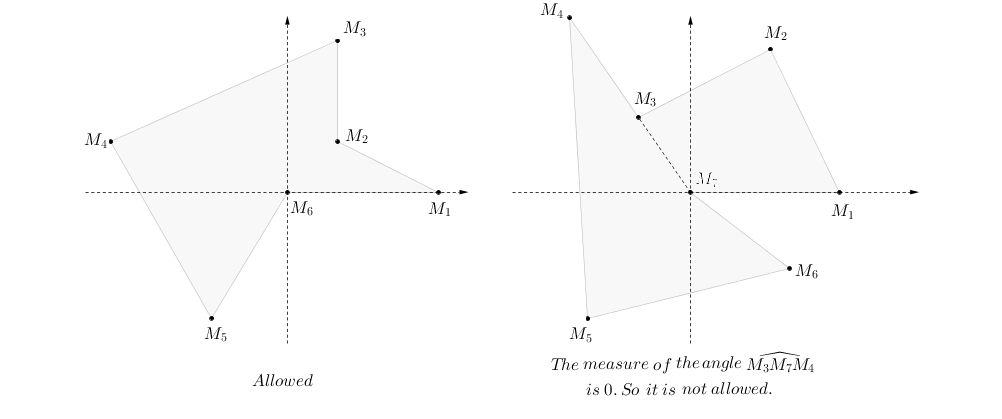 Figure 3
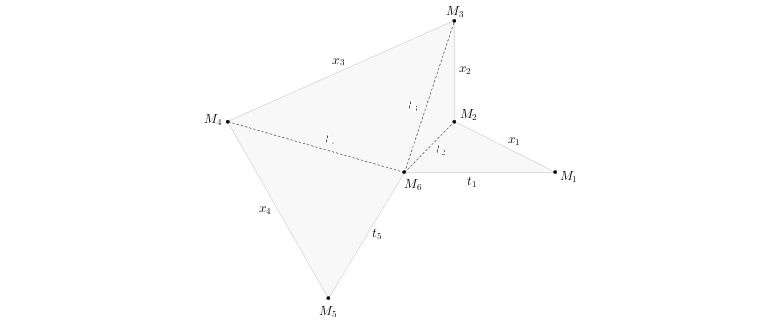 Figure 4
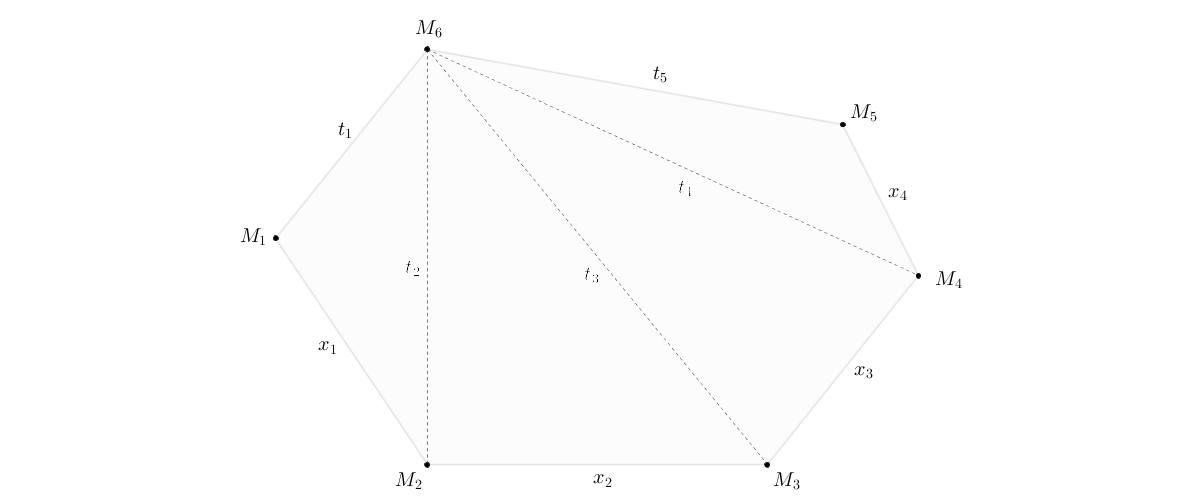 Figure 1
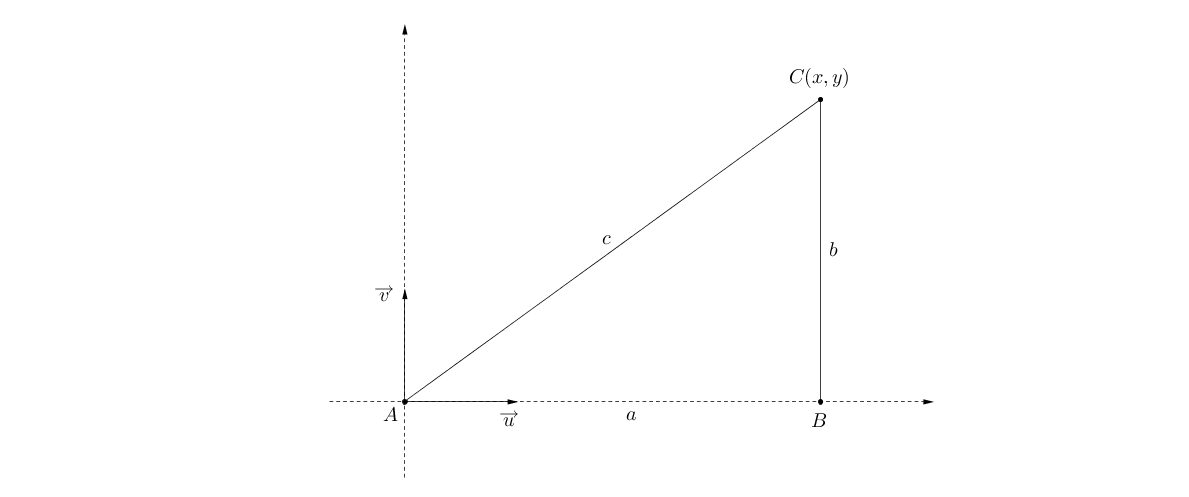 Figure 2
Peer Reviews
No public reviews on file for this paper yet. If you reviewed it on a platform where reviews are public (OpenReview, ICLR, NeurIPS, ICML), you can paste yours below so the community can read it here.
Videos
No videos yet. Explain this paper in a talk, walkthrough, or lecture? Add one.
Taxonomy
TopicsComputational Geometry and Mesh Generation
Area and perimeter foliations on spaces of polygons
by
Aziz EL KACIMI ALAOUI & Abdellatif ZEGGAR
(February 2019)
We describe all families of star-shaped -polygons in the Euclidean plane with prescribed perimeter and area; they are leaves of a foliation on the space of star-shaped polygons. By the way, we study some geometric properties of convex polygons, for instance their inscriptibility in a circle and their regularity in relation with the perimeter and the area.
We denote by 𝔼 an Euclidean vector plane equipped with its canonical affine structure and an orientation given by an orthonormal basis. The word ‘isometry’ means a transformation of 𝔼 which preserves the distance; necessarily it is an affine transformation of 𝔼. The origin of 𝔼 is denoted . For we denote the vector . Let be a natural integer.
0. Introduction
A figure of 𝔼 is just a part of it. But usually this name is given only to a one having a certain peculiarity: we see it all (it is bounded) or at least we understand how it is made to guess its behavior when it escapes our view, like a straight line… and its outline has a little regularity. A polygon is an example of such figure: it is bounded and bordered by a finite number of segments called sides or edges. To each polygon, one can associate invariants, among which are two real numbers that play an important role: the perimeter and the area.
The polygons of the plane are numerous and their shapes and sizes are varied. So the question of their equivalence therefore arises naturally. But in which sense?
From the set point of view, two polygons and are always equivalent: there is a bijection of 𝔼 which sends one on the other. But as we are in a Euclidean plane, we would like this bijection to preserve properties related to the affine Euclidean structure. There are several notions of equivalence; here are some of them (those that will interest us directly). We will say that and are:
isometric if there exists an isometry such that . We can superimpose them; and we can still do that without going out of the plan if and are directly isometric, that is preserves the orientation; 2. 2.
similar if there is a similarity such that . In a way, one of them is an enlargement of the other (as for the photos); 3. 3.
equivalent (shortly) if they have the same area. In this case, we can always go from one to another by cutting and geometric gluing; 4. 4.
isoperimetric if they have the same perimeter.
The isometric equivalence is the strongest and implies all the others. So it is too rigid to be ‘useful’: two isometric polygons differ only in the positions they occupy in the plane. It is rather the equivalences 3 and 4 that will occupy us here.
This paper takes its origin from the following question (): Are there two non-isometric triangles with same perimeter and same area? It led us first to the construction of a foliation on the space of triangles: each leaf consists of triangles having same perimeter and same area. Then we made a more general study for the space of star-shaped polygons; this space contains convex polygons for which some properties related to area and perimeter have also been studied. Some of them are certainly known, but little absent in the ‘geometric literature’, which motivated us to insert them in this text.
() It was asked by Geoffrey Letellier to his teacher Valerio Vassallo who put it in turn to the first author. The latter has built for this purpose the foliation on the space of the triangles. But just to the question asked, Geoffrey himself responded by constructing a one parameter family of isosceles triangles having the same perimeter and the same area (his example is given in subsection 4.6).
The integer we consider in all this paper will be greater than or equal to .
1. Preliminaries
1.1. Definition. A non degenerate polygon of 𝔼 is an element of such that:
(i) for the point is distinct from ;
(ii) for any , the oriented angle has its measure in .
By convention, we set and . The orientation of the angle is the same as the orientation of the trigonometric circle centered at the point .
The points and the segments are respectively the vertices and the sides of the polygon . If and are two non successive vertices, that is , we say that the segment is a diagonal of the polygon.
Recall that a polygon is said to be:
-
equilateral if all its sides have the same length;
-
inscribable if all its vertices are on a same circle;
-
regular if it is both inscribable and equilateral.
The set of all -polygons of the plane 𝔼 will be denoted . Let be an isometry of the Euclidean plane 𝔼. The image of a polygon is a polygon of 𝔼 such that:
[TABLE]
So we have a natural action:
[TABLE]
where is the group of the affine isometries of 𝔼. The quotient space of this action will be denoted:
[TABLE]
The elements of are called geometric polygons of 𝔼.
A geometric polygon of 𝔼 is said to be equilateral (resp. inscribable) if it admits a representative which is equilateral (resp. inscribable).
For an element of , we will use the following notations:
[TABLE]
The positive numbers are the lengths of the sides and are the lengths of the diagonals from the vertex (see the picture bellow for the case of the hexagon). We have lengths of type and lengths of type .
Since an isometry preserves the distance in the Euclidean plane 𝔼, does not depend on the choice of the representative of the geometric polygon .
[TABLE]
For any triangle with , the lengths satisfy the inequalities:
[TABLE]
that is, is an element of the open set of consisting of the triplets satisfying:
[TABLE]
Moreover, one can verify by induction that, for the lengths of the sides of a polygon, each length is strictly smaller than the sum of the others. For instance, we have the following nice:
1.2. Theorem [Pen]. For any natural integer and any -tuple of positive real numbers, there exists a unique inscribable geometric polygon such that for if and only if, for any , we have the inequality:
1.3. Definition. A -polygon of 𝔼 is convex if, for any , the oriented angle has its measure in . It is called star-shaped polygon with respect to the vertex if, for any vertex the open segment is contained in the interior of . Of course, any convex polygon is a star-shaped polygon with respect to any of its vertices.
Star-shaped polygons with respect to the vertex form a subspace of , invariant under the action of (on ).
One can easily see that any element of is isometric to a unique star-shaped polygon with respect to such that:
[TABLE]
will denote the space of the star-shaped polygons satisfying these conditions.
[TABLE]
In the following subsection we will recall some metric properties in a triangle which will be very useful for determining the space of polygons on which we will define area and perimeter foliations in section 3.
1.4. Let be a non degenerate triangle ; we set , , and . All the real numbers , , are positive and . For the triangle we denote the radius of its inscribed circle, its perimeter and its area. We have the following well known formulaes:
[TABLE]
and:
[TABLE]
For a given there are two numbers and such that . We take (which depends on ) and we define the function by:
[TABLE]
It is well defined and continuous.
Now consider the open set of given by:
[TABLE]
Let be the map where the real numbers are given by the formulaes (1.4).
From now on we will identify the geometric star-shaped polygons to the points of the open set by the map . This identification will enables one to study easily some properties of the space of geometric star-shaped polygons.
Let be any map. A nonempty subset of of the form will be called the level set (level line, level surface, level manifold…) of at level .
2. The geometric inscribable polygons for
First note that, following our definition 1.3, an inscribable polygon is always convex. It is therefore a star-shaped polygon with respect to any of its vertices. We can therefore represent it by an element of . In this way, the set of inscribable polygons of 𝔼 can be viewed as a subset of the open set . (Recall that any regular geometric polygon is inscribable.)
2.1. Remark. The fact that a polygon is inscribable is equivalent to the fact that each one of the quadrilaterals: is inscribable.
2.2. Lemma. A convex quadrilateral is inscribable if and only if the distances and satisfy the relation:
[TABLE]
Proof. Let and denote the measures respectively of the angles and . Then (by the cosine’s law of Al-Kashi):
[TABLE]
We deduce:
[TABLE]
On the other hand, the quadrilateral is inscribable if and only if or, equivalently, if . Hence:
[TABLE]
which is also equivalent to
Remark 2.1 and Lemma 2.2 make possible to realize as a level set of a differentiable map. More precisely, consider the maps , and defined by:
[TABLE]
[TABLE]
and:
[TABLE]
2.3. Proposition. The set of geometric inscribable polygons is given by . Moreover, this set is a differentiable submanifold of dimension of the Euclidean space .
Proof. Let be an element of represented by a polygon (in ). Then we have the following equivalences:
\omega\in\Gamma_{n}\Longleftrightarrow\hbox{(M_{n},M_{k},M_{k+1},M_{k+2})}\hbox{ is inscribable for 1\leq k\leq n-3}
\Longleftrightarrow\Theta(t_{k},x_{k},t_{k+1},x_{k+1},t_{k+2})=0\;\;\hbox{for 1\leq k\leq n-3}
\Longleftrightarrow\gamma_{k}(\omega)=0\;\;\hbox{for 1\leq k\leq n-3}
Now we will prove, by induction on , that the map has maximal rank at each point of .
** The case .** We have and the map:
[TABLE]
has maximal rank at each point . Indeed, . So is a codimension submanifold of the open set and then a submanifold of dimension of .
Heredity. Suppose that, for a fixed integer , the map has maximal rank at each point of . If to each element we associate:
[TABLE]
then we can write and Note that here we are using the same notation for three different maps. The Jacobian matrix of the map at each point is given by:
[TABLE]
where :
[TABLE]
which is the Jacobian matrix of the map at the point ,
[TABLE]
By the induction hypothesis, the matrix has rank . On the other hand, the two partial derivatives:
[TABLE]
do not vanish simultaneously since otherwise we will have:
[TABLE]
which implies . Taking into account this equality in the relation we obtain :
[TABLE]
and then . This contradicts the inequality since these are the lengths of the sides of the non degenerate triangle .
The Jacobian matrix of the map is then of rank . The proof by induction is then over.
We deduce that, for any , the map has maximal rank and then the nonempty set is a codimension submanifold of the open set of . This implies that is a submanifold of dimension of .
3. The area and perimeter foliations
In all this section the space of star-shaped polygons will be identified (as we have proceed until now) to the open set .
3.1. We define the maps , and by:
[TABLE]
[TABLE]
For any , we have:
[TABLE]
with:
[TABLE]
Setting , we obtain for any :
[TABLE]
On the other hand, the maps and are clearly differentiable with gradient vectors and given by:
[TABLE]
where the logarithmic derivative is given at each point by:
[TABLE]
We then deduce:
[TABLE]
This gives the partial derivatives of :
[TABLE]
and for :
[TABLE]
3.2. Theorem. We have the following assertions.
(1) The perimeter function and the area function are submersions on . Then the level sets of (resp. of ) are leaves of a codimension foliation (resp. ) on .
(2) For , the differential is of rank if is not a regular polygon and of rank if is a regular polygon. Then the map defines a codimension foliation on the open set of which consists of non regular polygons of .
Proof. Let be an element of and one of its representatives as a satr-shaped polygon.
Point (1)
For any , since . Then is a submersion on .
For any , or . Indeed we have the implications:
[TABLE]
But the equality can not be satisfied. Then . This proves that is a submersion on .
Point (2)
If the sides of the polygon are not all equal, there exist two successive sides having as common point and different lengths. One can suppose that . In these conditions, the lengths and are different. This implies since we have the implication The Jacobian matrix of the map at the point is:
[TABLE]
and then it is of rank since the -matrix of consisting of the two first columns is invertible.
Suppose the polygon is equilateral. We consider two cases:
The condition below is satisfied.
[TABLE]
The matrix has rank since it admits a matrix of order which is reversible.
The condition is not satisfied. In this case the following condition non(C) is satisfied:
[TABLE]
and we have:
[TABLE]
This implies that is of rank . We shall prove that, in this case, is regular polygon.
For , we have which implies:
[TABLE]
Thus, taking into account the fact that the sides are all equal in this case, we obtain by factorization :
[TABLE]
where:
[TABLE]
Thus
If , taking into account the relation , we obtain:
[TABLE]
This implies that the two triangles and are rectangular respectively at and . Consequently the quadrilateral is inscribable ().
If , the convex quadrilateral has the following properties:
[TABLE]
The triangle is then isosceles at the and . This implies, like in the preceding case, that the quadrilateral is inscribable.
If , then the convex quadrilateral is still inscribable since it satisfies the relation . Indeed, we have:
[TABLE]
We have proved that, in all cases, the quadrilateral is inscribable for any . Then the polygon is inscribable. Since the latter is equilateral, it is necessarily regular.
Finally the singular points of the map are the regular polygons and this map induces a submersion on whose level sets are leaves of a foliation .
4. The example of triangles
It is the situation where we see things more concretely and where the drawings are more visible. The way to treat the topic in this section will be slightly different from the others.
4.1. The space of non degenerate triangles
To give oneself a non degenerate triangle (in any Euclidean finite dimensional space) is to give oneself three real numbers , and such that:
[TABLE]
which represent the lengths of the sides. Exceptionally in this section, we shall denote a triangle by instead of where the points , and are the vertices. Indeed it is well known that is isometric to if , and . (For the moment we will make the difference between a triangle and another obtained by permutation of the three numbers representing it even if, geometrically, they are the same!) From now on, will be the half perimeter .
The set of non degenerate triangles is thus the open set given by (1.7). We will describe it explicitly. To inequalities (4.1) are associated three equations defining respectively three planes:
[TABLE]
In the slice of , , and are the sides of an equilateral triangle in whose vertices are , and (see the picture bellow); the interior of the convex hull of these three points represents the space of triangles whose perimeter is .
When varies to , we obtain another , image of by the homothety centered at the origin and with ratio . Thus, the space is foliated by these ; is in fact the open cone with vertex the origin and basis anyone of these plaques , for instance :
[TABLE]
[TABLE]
For a particular situation which will appear thereafter, we recall the following result which we have already established in the general case of polygons.
For a given family of triangles with prescribed perimeter, the maximum of the area is realized by the equilateral triangle.
4.2. The perimeter foliation
Each (where ) is the level set where is the perimeter function . We have also seen that the level surface is the interior of the convex hull of the triangle .
Thus we have a foliation on whose leaves are the surfaces (). Of course, is trivial since isomorphic to the product .
4.3. The area foliation
The function which associates to a triangle its area is given by Héron formula:
[TABLE]
The foliation by which we will be interested is the foliation whose leaves are the level surfaces of this function.
The surface at level of the function on the open set is exactly the surface at level of the function . The benefit of working with instead of is that there is no more square root, which simplifies the calculations, among others that of the differential which plays a fundamental role. We consider then the function:
[TABLE]
The differential of has the form:
[TABLE]
where the functions , and are given as follows:
[TABLE]
An easy but long computation shows that these three functions , et are zero simultaneously only if , which can not happen since is not in .
If we fix the perimeter , the area function is maximal, and so is the function , when ; at this point is equal to . These are the values taken by the function on the open half line whose equation is .
Now let be the open set . At , the differential has rank ; then the set level of passing through this point is a regular surface , in fact an algebraic surface of degree . Its equation is:
[TABLE]
Let be the subgroup of Isom (the full group of isometries of the Euclidean space ) generated by the rotation whose axis is and angle and the reflection with respect to the plane of equation . (The restrictions of these elements to the plane of equation is the group of isometries of the equilateral triangle .) It leaves the space invariant and also its boundary , the half line and the open sets and . Then it acts on and fixes each leaf of ; the same applies to the foliation .
4.4. Let be the function :
[TABLE]
Up to a multiplicative factor, the matrix of its differential at is :
[TABLE]
where , and are the functions given by (5.6). It can be shown that these functions are equal only if ; then, for , has rank . Thus, the level sets of are regular curves, leaves of a foliation on .
4.5. On we have a singular foliation . Its leaves of dimension [math] are the points of the open half line . The other leaves are of dimension ; each one has equation in the open set . These curves define (by restriction) a foliation on each plaque (leaf of ). To see what it is, this plaque is projected orthogonally on the plane ; we obtain the foliation drawn on the picture below. We will explain what all this means.
[TABLE]
The interior of the triangle is the projection (which we denote by ) on the plane of the set of triangles with perimeter . Note that the boundary of is an equilateral triangle while is an isosceles and rectangle triangle. The foliation on is isomorphic to the foliation on the picture via the diffeomorphism defined by with inverse .
The point with coordinates corresponds to the equilateral triangle with maximal area. As we easily imagine, an equilateral triangle may never be deformed to an other one having the same perimeter and the same area.
The curves at the interior of are leaves of a foliation of , each leaf corresponds to the set of triangles having the same area. It has as equation where is a constant varying in the interval \big{]}0,{{8\lambda^{4}}\over{27}}\big{[}.
The piece of diagonal corresponds to isosceles triangles (for which ). In each leaf, there is exactly the projections of two isosceles triangles and .
4.6. Geoffrey Letellier constructed two lines of isosceles triangles : and where with , and , . They are such that, for any :
[TABLE]
For instance, the two isosceles triangles , and , have the same perimeter equal to and the same area equal to .
Finally one can see on the picture that all the situation is invariant by the reflection (symmetry with respect to the diagonal ) while that on the triangle is invariant by the full group .
5. Some results related to the perimeter and the area
The following well known classical results are among the most beautiful theorems that we can cite in Euclidean elementary geometry of the plane.
5.1. Theorem (Isoperimetric inequality). Among all the convex polygons with prescribed perimeter, the regular polygon is the one whose area is maximum.
For a sketch of proof, see for instance [Han]. In the same order of ideas, we also have the following theorem. Its proof is not difficult but it is a bit long and not immediate. (And the reader can even attempt to reproduce it himself!)
5.2. Theorem. Among all convex polygons whose sides have given lengths, the inscribable polygon is the one whose area is maximum.
Using the analytic expression of the function “area" , we prove the following result related to the two theorems above. (It was also partially established, by a different method, in [Khi].)
5.3. Theorem. We have the following results.
(1) For any real number , the differentiable manifold consisting of all polygons with perimeter , is diffeomorphic to a convex open set of and the restriction of to admits a critical point at the unique regular polygon of perimeter .
(2) The convex polygons whose sides have given lengths form a differentiable manifold diffeomorphic to an open convex set of and the restriction of the function to this open set admits a critical point at its unique inscribable polygon.
Proof. Recall that, for any , we have:
[TABLE]
[TABLE]
with:
[TABLE]
Setting for , we obtain:
[TABLE]
for any .
Point (1)
Let . For any , we have:
[TABLE]
Then, by considering the affine map given by:
[TABLE]
where , we see that is naturally identified to the convex open set of .
For any , we have:
[TABLE]
Set and for . The partial derivatives for any are:
[TABLE]
[TABLE]
and for :
[TABLE]
If the sides of the polygon are not all equal, there are two consecutive ones with a common vertex and different lengths.
By changing the numbering of the vertices, one can assume . In these conditions, the lengths and are different and this implies and that is not a critical point of .
If the lengths of all the sides are equal, then and a necessary condition for this polygon to be a critical point of , is for any , or:
[TABLE]
This implies:
[TABLE]
The development of this relationship leads to next equality:
[TABLE]
where:
[TABLE]
Thus The proof ends as that of the Theorem 3.2. We thus obtain the inscriptibility of all the quadrilaterals for and then the inscriptibility of the polygon . But since the latter has all its sides of the same length, it is necessarily regular.
Finally the singular points of the map are the regular polygons of , that is, the unique regular polygon of perimeter .
Point (2)
Let and let be the set of convex polygons whose sides are , ,,, . This is a convex open set is of .
On the other hand, the area function is given, for , by:
[TABLE]
Setting:
[TABLE]
one can express the partial derivatives of as follows:
[TABLE]
A critical point of the area function must satisfy:
[TABLE]
Setting and , we obtain where:
[TABLE]
and or:
[TABLE]
This implies:
[TABLE]
or:
[TABLE]
Then we deduce:
[TABLE]
which implies that the quadrilateral is inscribable for any index . Hence the polygon is inscribable.
Conversely, if is inscribable then, one can prove easily that is a critical point of the area function.
References
[Han] Hansen, V.L. Shadows of the Circle. World Scientific (1998).
[Khi] Khimshiashvili, G. Cyclic polygons as critical points. Proc. of I. Vekua Institute of Applied Mathematics Vol. 58, (2008), 74-83.
[Pen] Penner, R.C. The Decorated Teichmüller Space of Punctured Surfaces. Commun. Math. Phys. 113, (1987), 299-339.
[Per] Perrin, D. Mathématiques d’école. Nombres, mesures et géométrie. Cassini, Paris, (2005).
[Ram] Ramon, P. Introduction à la géométrie différentielle discrète. Editions Ellipses, (2013).
Université Polytechnique Hauts-de-France
LAMAV, FR CNRS 2956,
ISTV2, Le Mont Houy
59313 Valenciennes Cedex 9
FRANCE