Periodic Traveling-wave solutions for regularized dispersive equations: Sufficient conditions for orbital stability with applications
Fabr\'icio Crist\'ofani, F\'abio Natali, Ademir Pastor

TL;DR
This paper introduces a new criterion for the orbital stability of periodic waves in regularized dispersive equations, applicable to fifth-order models and based on minimization of a functional, without requiring Hessian positivity.
Contribution
It provides a novel stability criterion that does not depend on Hessian positivity and applies it to establish stability in fifth-order dispersive models.
Findings
Established a new stability criterion for periodic waves.
Proved orbital stability for a fifth-order dispersive model.
Demonstrated stability via functional minimization.
Abstract
In this paper, we establish a new criterion for the orbital stability of periodic waves related to a general class of regularized dispersive equations. More specifically, we present sufficient conditions for the stability without knowing the positiveness of the associated hessian matrix. As application of our method, we show the orbital stability for the fifth-order model. The orbital stability of periodic waves resulting from a minimization of a convenient functional is also proved.
Click any figure to enlarge with its caption.
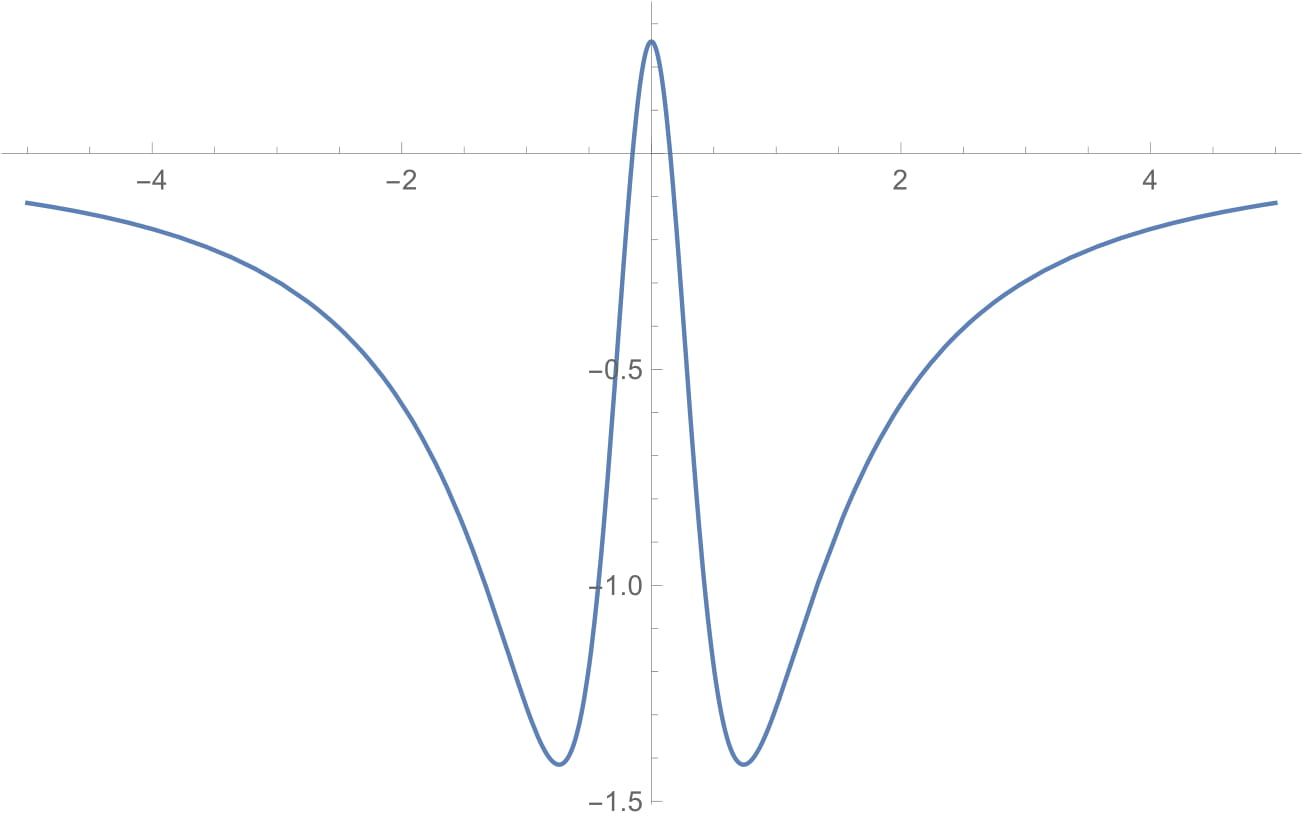 Figure 1
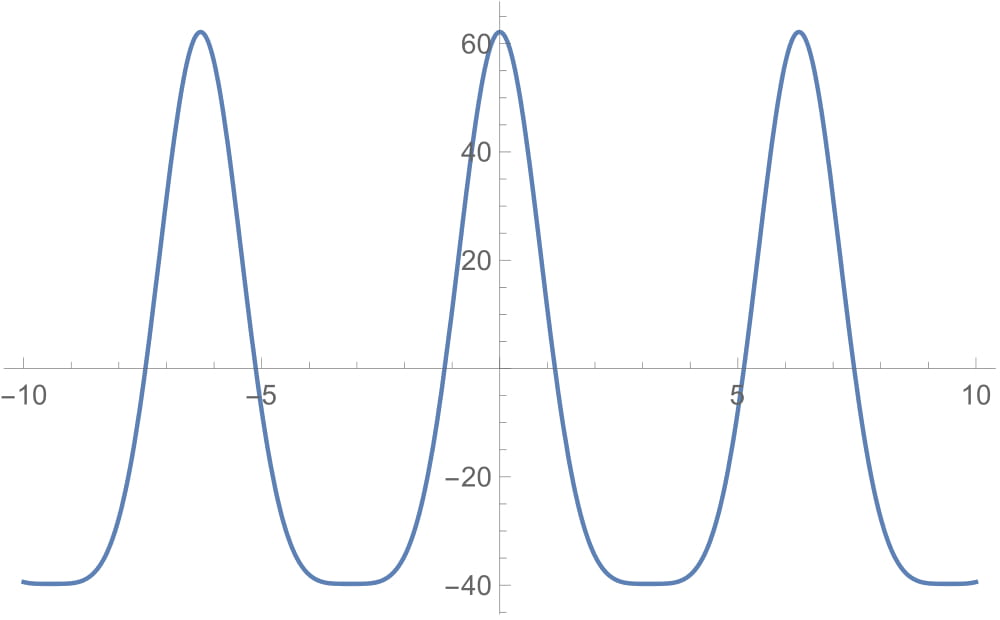 Figure 2
Peer Reviews
No public reviews on file for this paper yet. If you reviewed it on a platform where reviews are public (OpenReview, ICLR, NeurIPS, ICML), you can paste yours below so the community can read it here.
Videos
No videos yet. Explain this paper in a talk, walkthrough, or lecture? Add one.
Periodic Traveling-wave solutions for regularized dispersive equations: Sufficient conditions for orbital stability with applications
Abstract.
In this paper, we establish a new criterion for the orbital stability of periodic waves related to a general class of regularized dispersive equations. More specifically, we present sufficient conditions for the stability without knowing the positiveness of the associated hessian matrix. As application of our method, we show the orbital stability for the fifth-order model. The orbital stability of periodic waves resulting from a minimization of a convenient functional is also proved.
Key words and phrases:
Orbital stability, regularized dispersive equation, periodic waves
2000 Mathematics Subject Classification:
76B25, 35Q51, 35Q53.
**Fabrício Cristófani **
IMECC-UNICAMP
Rua Sérgio Buarque de Holanda, 651, CEP 13083-859, Campinas, SP, Brazil.
Fábio Natali
Departamento de Matemática - Universidade Estadual de Maringá
Avenida Colombo, 5790, CEP 87020-900, Maringá, PR, Brazil.
Ademir Pastor
IMECC-UNICAMP
Rua Sérgio Buarque de Holanda, 651, CEP 13083-859, Campinas, SP, Brazil.
1. Introduction
We present sufficient conditions for the orbital stability of periodic traveling-wave solutions associated to the regularized dispersive model
[TABLE]
where is a real spatially -periodic function. Here is a differential or pseudo-differential operator in the periodic setting and it is defined as a Fourier multiplier by
[TABLE]
The symbol is assumed to be even and continuous on satisfying
[TABLE]
for all and for some , .
Regularized equations appear as alternative models to describe the propagation of nonlinear waves in several physical contexts. Indeed, if , equation reduces to the so called BBM equation,
[TABLE]
which was originally derived by Benjamin-Bona-Mahony [8] as an alternative model to the well known Korteweg-dr Vries equation for small-amplitude, long wavelength surface water waves. Also, if , equation reduces to the regularized Benjamin-Ono equation
[TABLE]
where indicates the Hilbert transform defined via its Fourier transform as
[TABLE]
Equation (1.4) models the evolution of long-crested waves at the interface between two immiscible fluids. It also appears in the two-layer system created by the inflow of fresh water from a river into the sea (see [18] and references therein). For the orbital stability of periodic traveling waves for (1.4) we refer the reader to [5].
Formally, equation admits the conserved quantities
[TABLE]
[TABLE]
and
[TABLE]
A traveling wave solution for (1.1) is a solution of the form , where is a real constant representing the wave speed and is a periodic function. Substituting this form into (1.1), we obtain
[TABLE]
where is a constant of integration.
In view of the conserved quantities (1.5)-(1.7) we may define the augmented Lyapunov functional,
[TABLE]
and the linearized operator around the wave ,
[TABLE]
Note in particular that . Thus, it is expected that the functional defined in (1.9) plays a crucial role in order to guarantee the orbital stability.
Let us connect our work with the current literature. First of all, since the operator satisfies the general relation (1.2), we are able to address in a unified way a large number of dispersive models. However, our main motivation come from the results for the generalized BBM equation. Indeed, based on the work [17], the author in [16] established sufficient conditions for the modulational/orbital stability of periodic waves related to the generalized BBM equation
[TABLE]
where is an integer. In particular, if , it was showed that the periodic waves in the solitary wave limit are stable (modulationally and nonlinearly). On the other hand, if , the instability was established provided the corresponding wave speed is greater than a critical speed . To this end, the author has constructed smooth periodic waves , where the period depends smoothly on the triple . Here is the integration constant which appears in the quadrature form associated with the second order differential equation with . So, by assuming that the signal of the Jacobian matrices , and are positive at the point , one has the orbital stability of the waves . Here,
[TABLE]
In the case , the reader will also find some results in [5], [6], where the authors studied the orbital stability of some explicit solutions.
If is the fractional derivative operator , , in Fourier sense (the cases and are included in that approach), in [14], the authors established the existence of minimizers for the energy functional. In addition, it has been proved that the local minimizers are orbitally stable provided that the determinant is assumed to be non-zero.
Our main goal in this paper is to establish a new criterion for the orbital stability where it is not necessary to know the positiveness of the associated Hessian matrix neither the Jacobians as determined in [7], [14] and [16]. To do so, instead of considering as a Lyapunov function, based on the works [2], [26] and [29], we consider the new functional given by
[TABLE]
where is a positive constant to be determined later and with real constants also to be determined properly. This new functional removes the assumption of the mentioned positiveness in the stability theorem.
Next, we present a brief outline of our work. We will assume the following assumption:
- (H)
Assume . Let be fixed. Suppose that is an even periodic solution of (1.8) in the sense of distributions with fixed period . Moreover, assume the self-adjoint operator
[TABLE]
has only one negative eigenvalue which is simple and zero is a simple eigenvalue whose eigenfunction is .
Here and throughout the paper, stands for the periodic Sobolev space of order . When , indicates the subspace of constituted by the even periodic functions.
The spectral properties of operator in assumption are crucial to obtain our results. In general, such properties are not easily obtained and one needs to work with the structure of the equation in hand to obtain them. However, there are some theories in the literature where we may get . Indeed, in many situations when is a second order differential operator and is given in terms of the Jacobian elliptic functions, turns out to be a Hill’s operator with a Lamé type potential (see [23]). In particular, studying the spectrum of is equivalent to studying the eigenvalue problem
[TABLE]
where is a real parameter and is a non-negative integer. Depending on , the first eigenvalues of (1.12) are well known (see e.g., [15]). Many applications using this approach have appeared in the literature (see e.g., [3] and references therein). Another approach to obtain was given in [27]. Assume that is a second order differential operator. Recall from Floquet’s theorem (see e.g., [23] page 4) that if is any solution of , linearly independent of , then there exists a constant satisfying
[TABLE]
In particular, if satisfies the initial condition then by taking the derivative with respect to in both sides of (1.13) and evaluating the result at , we see that
[TABLE]
Under these conditions Theorem 3.1 in [27] (see also [25]) states that the second eigenvalue of is simple if and only if ; in addition, it is zero if and only if . Finally, let us recall the approach given in [4], which is based on the total positivity theory (see [20]) and can be applied to local or nonlocal operators. To give the precise statement of the result, we recall that a sequence of real numbers is said to be in the class discrete if
- (i)
, for all ;
- (ii)
, for and .
Theorem 4.1 in [4] states if is positive, even, and and belong to the class discrete, then satisfies (see also Section 4 below). Here stands for the Fourier transform of .
With hypothesis in hand, we are enabled to construct a smooth surface
[TABLE]
of periodic solutions for , with a fixed period . This means that for any in the open neighborhood of , is a solution of (1.8) with period . In addition, assumption is also suitable to obtain the non-positive spectrum of the linearized operator in , since one has the convergence in the sense of Kato (see detailed arguments in [21]). As a consequence, we may prove the orbital stability of periodic waves without knowing the behavior of the Hessian matrix associated to the function , as required in [4], [5], [13], [14], [16], [25], and related references. Instead, assuming that assumption occurs and , our orbital stability criterion is based in proving that the quantity defined as
[TABLE]
is strictly positive. In fact, we have the following result
Theorem 1.1**.**
Assume that assumption holds and let be defined as in 1.15. If and , then the periodic wave is orbitally stable in .
In order to prove Theorem 1.1, we employ the recent developments in [11] and [26], which are extensions of the approaches in [9], [13], and [17] adapted to the periodic case.
Our paper is organized as follows. In next section we present the existence of periodic waves related to equation , the behaviour of the non-positive spectrum of , and the orbital stability theory of periodic waves. The sufficient condition for the orbital stability of periodic waves is presented in Section 3. Finally, Section 4 is devoted to some applications of our theory.
2. Orbital Stability of Periodic Waves
In this section, we present our stability result. The main result of the section is Theorem 2.3 which gives a criterion for the orbital stability. Before stating the result itself, we need some preliminary tools. For functions and in we let be the “distance” between and defined by
[TABLE]
Roughly speaking the distance between and is measured through the distance between and the orbit of , generated by translations.
Throughout this section we let be the periodic wave given in . Our precise definition of orbital stability is given below.
Definition 2.1**.**
We say that an -periodic solution is orbitally stable in , by the periodic flow of (1.1), if for any there exists such that for any satisfying , the solution of (1.1) with initial data exists globally and satisfies
[TABLE]
for all .
Remark 2.2**.**
The notion of orbital stability prescribes the existence of global solutions. Since questions of (local and) global well-posedness is out of the scope of this paper, we will assume the periodic Cauchy problem associated with (1.1), namely,
[TABLE]
is globally well-posed in .
For a given , we define the -neighborhood of the orbit as
[TABLE]
In what follows, we set
[TABLE]
where denotes the scalar product in . Note that is nothing but the tangent space to at . With these notations, our main theorem reads as follows.
Theorem 2.3**.**
Suppose that assumption (H) holds. Moreover, for defined in (1.11), assume the existence of such that , for all , and , then is orbitally stable in by the periodic flow of .
In order to prove Theorem 2.3 we follow the strategy put forward in [11], [26], and [29]. Let us start by showing that is strictly positive when restricted to the space .
Lemma 2.4**.**
Under assumptions of Theorem 2.3, there exists a constant such that
[TABLE]
for all , where .
Proof.
See Proposition 4.12 in [11]. ∎
Lemma 2.4 is useful to establish the following result.
Lemma 2.5**.**
Under assumptions of Theorem 2.3, there exist and such that
[TABLE]
for all .
Proof.
Given , define
[TABLE]
where and . Because , it is easily seen that . Thus, Lemma 2.4 implies
[TABLE]
Using Cauchy-Schwartz and Young’s inequalities, we have
[TABLE]
Furthermore, we may choose such that
[TABLE]
We point out that depends only on . Therefore, using (2.1), (2.2) and (2.3), we conclude
[TABLE]
The proof is thus completed. ∎
Let be the constant obtained in the previous lemma. We define the functional as
[TABLE]
where is the augmented functional defined in (1.9) with . It is easy to see from and that and .
Lemma 2.6**.**
There exist and such that
[TABLE]
for all .
Proof.
First, note that from the definition of it follows that
[TABLE]
for all . In particular,
[TABLE]
Consequently, from Lemma 2.5 we get
[TABLE]
for all .
On the other hand, a Taylor expansion of around reveals that
[TABLE]
where . Thus, we can choose such that
[TABLE]
where .
Since and , we have from (2.5), (2.6) and that
[TABLE]
for all such that
Now, let us define the smooth map given by . Since and , we guarantee, from the implicit function theorem, the existence of , and a unique map such that and , for all . Consequently, , for all .
To complete the proof, let with arbitrarily fixed. Thus, there exists such that , where . Hence,
[TABLE]
On other hand, using the fact that is continuous and , one has that there exists such that
[TABLE]
Let us consider . Therefore, we conclude, by and ,
[TABLE]
and . Since , we obtain, by , the existence of such that . ∎
The above lemma is the key point to prove our main result. Roughly speaking, it says that is a suitable Lyapunov function to handle with our problem. Finally, we present the proof our stability result.
Proof of Theorem 2.3.
Let be the constant such that Lemma 2.6 holds. Since is continuous at , for a given , there exists such that if one has
[TABLE]
where is the constant in Lemma 2.6.
The continuity in time of the function allows to choose such that
[TABLE]
Thus, one obtains , for all . Combining Lemma 2.6 and the fact that for all , we have
[TABLE]
Next, we prove that , for all , from which one concludes the orbital stability. Indeed, let be the supremum of the values of for which holds. To obtain a contradiction, suppose that . By choosing we obtain, from ,
[TABLE]
Since is continuous, there is such that , for , contradicting the maximality of . Therefore, and the theorem is established. ∎
3. Sufficient condition for orbital stability
In this section we will give a sufficient condition for the existence of the element as assumed in Theorem 2.3. In particular, the main result of the section states that under assumption , the periodic wave is orbitally stable provided that the quantity , defined in Corollary 3.5, is positive. We point out that such a quantity does not depend on any derivative with respect to parameters.
3.1. Regularity
Let us start by proving that any solution of (1.8) is in fact smooth. This result will be used below and is the content of the next statement.
Proposition 3.1**.**
Let . If is a solution of in the sense of distributions, then , for all .
Proof.
In view of the embedding , , it suffices to assume . First, we will prove that . Indeed, applying the Fourier transform in (1.8) yields
[TABLE]
where . Since , it follows that and , for all . Hence, by Hausdorff-Young inequality, we have for all .
On other hand, by (1.2), for all Let be a small number such that . Thus
[TABLE]
where and . Now, we consider the smallest such that the first term on the right side is finite. That is, . Thus . In order to obtain that the second term on the right side is finite we need the condition which gives the inequality . Note that can always be chosen such that this holds since . Therefore, we get which implies that there exists such that (see [30, page 190]). Hence, using [30, Corollary 1.51] we obtain and so for and for . By iterating the procedure a finite number of times, we obtain
[TABLE]
and thus .
Finally, Plancherel’s theorem leads to
[TABLE]
which implies . Furthermore, from (3.1), we have
[TABLE]
where is a constant depending only on . After iterations, we conclude that , for all . ∎
3.2. Existence of a smooth surface of periodic waves
As an intermediate step to obtain our main result, we will prove that is sufficient to show the existence of a smooth surface of periodic waves. This will be a consequence of the Implicit Function Theorem.
Theorem 3.2**.**
Suppose that assumption (H) holds. Then, there exist an open neighborhood containing and a smooth surface
[TABLE]
of even -periodic solutions of (1.8).
In particular, , as , in .
Proof.
We first define by
[TABLE]
where indicates the periodic Sobolev space constituted by even -periodic functions. The case can be determine using similar arguments. Since is an even function we have that is also even, for any function in . In addition, since the Sobolev embedding implies . This means that (3.2) makes sense in .
From assumption (H) one has . Moreover, note that is smooth and its Fréchet derivative with respect to evaluated at is
[TABLE]
From (1.8) it is easily seem that is an eigenfunction of the operator (defined on with domain ) whose eigenvalue is Since does not belong to (because it is odd), we conclude that is one-to-one.
Next, let us prove that is also surjective. Indeed, is clearly a self-adjoint operator. Thus, the spectrum of , denoted by is such that , where and stand, respectively, for the discrete and essential spectra. Being compactly embedded in , the operator has compact resolvent. Consequently, and consists of isolated eigenvalues with finite algebraic multiplicities (see also Proposition 3.1 in [4]). Finally, since is one-to-one, it follows that [math] is not an eigenvalue of , and so it does not belong to . Therefore, , where denotes the resolvent set of , and consequently, by definition, is surjective.
The arguments above imply that exists and is a bounded linear operator. Thus, since and its derivative with respect to are smooth maps on their domains, from the Implicit Function Theorem (see, for instance, Theorem 15.1 in [12]) and Proposition 3.1 we establish the desired results. ∎
Next result shows that the spectral property in is preserved by small perturbations of the parameter in an open subset containing .
Proposition 3.3**.**
Suppose that assumption (H) holds and let be the periodic traveling wave solution obtained in Theorem 3.2. Then, for all , operator has only one negative eigenvalue which is simple and zero is a simple eigenvalue whose eigenfunction is
Proof.
Assume and define
[TABLE]
It is clear that such an operator defined on with domain is also self-adjoint. Thus, since and , it suffices to prove that the statements in the proposition holds for .
Let us first show that converges to , as , in the metric gap (see Sections 2 and 3 of Chapter IV in [21]). Indeed, since the multiplication operator defined by is bounded with norm , Theorem 2.17 in [21, Chapter IV] implies that
[TABLE]
Now, by using the multiplication operator
[TABLE]
is also bounded in with norm below
[TABLE]
an application of Theorem 2.14 in [21, Chapter IV] yields
[TABLE]
By recalling that , as , in , a combination of (3.3) and (3.4) finally establish that , as .
Consequently, by taking into account that zero is an eigenvalue of with eigenfunction , from Theorem 3.16 in [21, Chapter IV], we conclude that for in a neighborhood of , has the same spectral properties of , which is to say that it has only one negative eigenvalue which is simple and zero is a simple eigenvalue. At this point, it should be clear that if necessary we can take a neighborhood smaller than . However, for convenience we assume that such a set is the whole . ∎
Since we have obtained a smooth surface of periodic solutions with a fixed period , we can define
[TABLE]
Next we set
[TABLE]
[TABLE]
and
[TABLE]
These quantities will be very useful in what follows.
Proposition 3.4**.**
Let be the function defined as
[TABLE]
Assume the existence of such that . Then, there exists such that , for all , and
[TABLE]
Proof.
It suffices to define . Indeed, since and , it is clear that , for all , and
[TABLE]
The proof is thus completed. ∎
Next result gives a sufficient condition to obtain satisfying . Consequently, we are in conditions to prove Theorem 1.1.
Corollary 3.5**.**
Suppose that assumption (H) holds. If and defined in is positive, there exists such that .
Proof.
First, in order to simplify the notation we define as the solution obtained in Theorem 3.2. Deriving equation (1.8) with respect to and , we obtain, respectively
[TABLE]
and
[TABLE]
Next, if we integrate equations (3.5) and (3.6) over one has
[TABLE]
and
[TABLE]
where we used, in view of (1.2), that
[TABLE]
On the other hand, multiplying (3.5) by and (1.8) by , adding the results and using (3.7), we get
[TABLE]
Similarly, multiplying (3.6) by and (1.8) by , adding the results and using (3.8), we conclude
[TABLE]
Now, multiplying (3.5) by , integrating over and using (1.8) one has
[TABLE]
Similarly, multiplying (3.6) by , integrating over and using (1.8), we get
[TABLE]
Thus, deriving (3.11) with respect to , (3.12) with respect to and adding the results, we obtain the equality
[TABLE]
So, comparing the results in (3.11), (3.12) and (3.13) with (3.9) and (3.10), we conclude that
[TABLE]
and
[TABLE]
Finally, collecting the results in (3.14) and (3.15), considering and evaluating the results at , we have
[TABLE]
By choosing , and using the fact
[TABLE]
we get
[TABLE]
The proof is thus completed. ∎
4. Applications
In this section, we apply the arguments developed in Section 2 in order to obtain the orbital stability of periodic waves for some regularized dispersive models.
4.1. Orbital stability for a fifth-order model.
Here, as an application of Corollary 1.1, we present the orbital stability of a periodic traveling-wave solution related to the following fifth-order model
[TABLE]
Equation can be seen as the regularized version of
[TABLE]
which models wave propagation on a nonlinear transmission line (see [19]).
To simplify the exposition, throughout this subsection we assume . Note that (4.1) is of the form with . In particular, and the energy space is .
By looking for periodic traveling wave solutions having the form , we get from (after integration) that solves the nonlinear ordinary differential equation
[TABLE]
Equation admits an explicit -periodic solution given by the ansatz (see [28])
[TABLE]
where
[TABLE]
and
[TABLE]
Also, represents the Jacobi elliptic function of dnoidal type, is the complete elliptic integral of the first kind, is the complete elliptic integral of the second kind and both of them depend on the elliptic modulus (see [10] for additional details). It is to be pointed out that is a free parameter and we shall assume that for the sake of completeness. Moreover, constant is a smooth function depending given by
[TABLE]
Next, we will obtain the spectral properties related to the operator as required in . To do so, we will utilize the following result of [4]:
Theorem 4.1**.**
Suppose that is a positive even solution of (4.2) such that and , , where is a real function such that , . Then the operator has only one negative eigenvalue which is simple and zero is a simple eigenvalue whose eigenfunction is .
Proof.
See Theorem 4.1 and Lemma 4.1 in [4]. See also [1] for the continuous case. ∎
The application of Theorem 4.1 is not immediate. First of all note that is not positive (see Figure 4.1 (Left)). The idea to overcome this is to use an auxiliary function defined by , where is a fixed arbitrary number such that . Note that is a solution of the equation
[TABLE]
where . Moreover, we can rewrite as
[TABLE]
Now, we are going to determine the nonpositive spectrum of according with equality above
In fact, by [22] the solution in (4.3) has the Fourier expansion
[TABLE]
where is defined by
[TABLE]
and we have used that . Therefore, the Fourier coefficients of are given by
[TABLE]
By considering , and choosing large enough such that and , it is possible we redefine function by a differentiable function such that and in with for (see [4, page 1145]). So, using Theorem 4.1, we obtain that has only one negative eigenvalue which is simple and zero is a simple eigenvalue whose eigenfunction is . Therefore, we have that assumptions in (H) hold.
Finally, by using we obtain after some straightforward but tedious calculations, that
[TABLE]
from which we conclude that for all . It is also clear, from (4.4), that for all , where is the unique positive root of . Therefore, from Theorem 1.1, we conclude that is orbitally stable in by the periodic flow of (4.1).
4.2. Minimizers and orbital stability of periodic waves
In this subsection, we present a simple way to prove the orbital stability of periodic waves for equation provided they minimize a convenient smooth functional with a constraint. In other words, we show that, in this case, the hypothesis and the fact can be replaced by the simple assumption that is even and .
Let be fixed. For define the set
[TABLE]
Our first goal is to find a minimizer of the constrained minimization problem
[TABLE]
where, for fixed,
[TABLE]
Lemma 4.2**.**
For any , the minimization problem (4.5) has at least one solution, that is, there exists satisfying
[TABLE]
Proof.
First of all note that, from , is an equivalent norm in , yielding . Let be a minimizing sequence for (4.5), that is, a sequence in satisfying
[TABLE]
It is easy to check that
[TABLE]
implying that is bounded in . Consequently, there exists such that, up to a subsequence,
[TABLE]
On other hand, using we get the energy space is compactly embedded in . Thus,
[TABLE]
Besides that, using the fact
[TABLE]
we can say that .
Moreover, thanks to the weak lower semi-continuity of , we have
[TABLE]
Therefore, satisfies (4.5). ∎
From Lemma (4.2) and Lagrange’s Multiplier Theorem, there exists of such that
[TABLE]
We note that is nontrivial since . Furthermore, a simple scaling argument, gives us that can be chosen as . Indeed, for ,
[TABLE]
Then, satisfies the equation
[TABLE]
In addition, we obtain that is smooth (by Proposition 3.1) and satisfies equation with .
As before, let . Here, instead of assuming all assumption in , we suppose the following:
- (H1)
is even and .
We note that, in view of (4.5), we have
[TABLE]
where . So we have.
Proposition 4.3**.**
Let be the local minimizer satisfying (4.5). Then , where stands for the number of negative eigenvalues of acting on .
Proof.
Since
[TABLE]
It follows that acting on must have at least one negative eigenvalue. Moreover, using (4.6) we have, by Courant’s mini-max principle, that has at most one negative eigenvalues. Therefore, . ∎
Since is odd and the kernel of is simple by , we can apply Theorem 3.2 to obtain the existence of an open set , , and a smooth surface of periodic waves , , which solves equation . Proposition 3.3 can be used to conclude that the kernel of the linearized operator is simple, generated by and , for all pair .
The next step is to calculate , where , . In fact, one has
[TABLE]
We shall give a convenient expression for . In fact, from with , we get
[TABLE]
On the other hand, multiplying equation by and integrating the result, one has
[TABLE]
Thus, from , and the fact that , we obtain
[TABLE]
Now, substituting the value of in into , we deduce, after some calculations
[TABLE]
To estimate the middle term on the right-hand side of (4.11), observe, from (4.9), that
[TABLE]
from which we deduce
[TABLE]
By replacing (4.12) into (4.11) we then infer
[TABLE]
Hence, as an application of Theorem 1.1 we just have proved the following.
Theorem 4.4**.**
Let and be fixed. Choose such that
[TABLE]
Let be a minimizer of problem (4.5) according to Lemma 4.2 and assume that holds. Then is orbitally stable in by the periodic flow of (1.1).
Remark 4.1**.**
The arguments above, assumption , Corollary 3.5 and the smoothness of the involved functions are sufficient to deduce the orbital stability of the smooth surface of periodic waves , , obtained from .
As an application of the approach presented in this subsection, we are going to use Theorem 4.4 to get the orbital stability of periodic waves of the model in . Our intention is to give a considerable simplification of the arguments in [5]. In fact, to get assumption , the authors have used the expansion in Fourier series of the explicit periodic wave which solves the equation when and . Moreover, it has been required in [5] an explicit calculation of the derivative in terms of of the inner product to conclude the orbital stability.
To simplify the notation, let us consider . The minimizer obtained in Lemma 4.2 solves the equation
[TABLE]
Let be fixed. Using similar arguments as those in [7], we get an explicit solution as
[TABLE]
where .
On the other hand, since is arbitrary, we deduce from that can be seen as a curve depending smoothly on and this fact is a cornestone to conclude assumption . In fact, clearly in is even. Let us consider , thus
[TABLE]
Now, since and \widetilde{\mathcal{L}_{0}}\left(\frac{\partial\phi}{\partial\omega}\Big{|}_{\omega=\omega_{0}}\right)=-\frac{1}{\omega_{0}^{2}}\phi-\frac{1}{2\omega_{0}^{2}}\phi^{2}, we have from that . Proposition 3.2 in [14] gives us that as required in .
The Poincaré-Wirtinger inequality applied to combined with the equation give us
[TABLE]
Last term in can be handled employing Hölder inequality to get, again from equation in this particular case, that
[TABLE]
Since , we obtain by
[TABLE]
Finally, it is easy to see that implies
[TABLE]
and, according with Theorem 4.4 one has the orbital stability of .
Remark 4.2**.**
In the general fractional case, that is, , and , assumption holds (see [14]) since it is assumed the existence of a smooth surface of periodic waves, , , which solves equation having fixed period . The existence of such smooth surface prevents the existence of ”fold points”, that is, values of such that , for some . In fact, the existence of a smooth surface of periodic waves solving equation enables us to deduce the existence of such that , and thus, after a straightforward calculation one has . This property can be combined with Proposition 3.2 in [14] to get the non-degeneracy of (see [24] for details). By taking a small enough and , one sees that is orbitally stable in and, therefore, we can conclude that equation , in the fractional case, always admits stable periodic waves. However, our approach diverges, in some sense the arguments in [14], because, in this case, it was not necessary to calculate the signal of the Hessian matrix associated to the conserved quantities and in and .
Acknowledgements
F. C. is supported by FAPESP/Brazil grant 2017/20760-0. F. N. is partially supported by CNPq/Brazil and Fundação Araucária/Brazil grants 304240/2018-4 and 002/2017. A. P. is partially supported by CNPq/Brazil grants 402849/2016-7 and 303098/2016-3. The second author would like to express his gratitude to McMaster University for its hospitality and Dmitry E. Pelinovsky for fruitful comments regarding this work.
The reference list from the paper itself. Each links out to its DOI / PubMed record.
- 1[1] J.P. Albert, Positivity properties and stability of solitary-wave solutions of model eqautions for long waves , Comm. Partial Differential Equations, 17 (1992), 1-22.
- 2[2] G. Alves, F. Natali and A. Pastor, Sufficient conditions for orbital stability of periodic traveling waves , ar Xiv:1611.04771.
- 3[3] J. Angulo, Nonlinear dispersive equations: Existence and stability of solitary and periodic travelling wave solutions, Math. Surveys Monogr. 156, American Mathematical Society, 2009.
- 4[4] J. Angulo and F. Natali, Positivity properties of the Fourier transform and the stability of periodic travelling-wave solutions , SIAM J. Math. Anal., 40 (2008), 1123-1151.
- 5[5] J. Angulo, M. Scialom and C. Banquet, The regularized Benjamin-Ono and BBM equations: Well-posedness and nonlinear stability , J. Differential Equations, 250 (2011), 4011-4036.
- 6[6] J. Angulo, M. Scialom and C. Banquet, Stability for the modified and fourth-order Benjamin-Bona-Mahony equations , Discrete Contin. Dyn. Syst., 30 (2011), 851-871.
- 7[7] J. Angulo, J. L. Bona and M. Scialom, Stability of cnoidal waves , Adv. Differential Equations, 11 (2006), 1321-1374.
- 8[8] T.B. Benjamin, J.L. Bona and J.J. Mahony, Model equations for long waves in nonlinear dispersive systems , Phil. Trans. Royal Soc. London, Ser. A 272 (1972), 47-78.