Multi-Component Dark Matter in a Non-Abelian Dark Sector
Fatemeh Elahi, Sara Khatibi

TL;DR
This paper investigates a complex dark sector model with multiple dark matter candidates arising from a gauged $SU(2)_R$ symmetry, analyzing its phenomenology, experimental constraints, and potential to explain DAMPE observations.
Contribution
It introduces a multi-component dark matter framework with a non-Abelian gauge symmetry and explores its phenomenological viability and implications for recent cosmic-ray observations.
Findings
Multiple dark matter candidates identified: Dirac fermion, gauge boson, scalar.
Parameter space consistent with experimental constraints.
Potential explanation for DAMPE electron-positron spectrum feature.
Abstract
In this paper, we explore a dark sector scenario with a gauged and a global , where the continuous symmetries are spontaneously broken to a global . We show that in various regions of the parameter space we can have two, or three dark matter candidates, where these dark matter particles are either a Dirac fermion, a dark gauge boson, or a complex scalar. The phenomenological implications of this scenario are vast and interesting. We identify the parameter space that is still viable after taking into account the constraints from various experiments. We, also, discuss how this scenario can explain the recent observation by DAMPE in the electron-positron spectrum. Furthermore, we comment on the neutrino mass generation through non-renormalizable interactions between the standard model and the dark sector.
Click any figure to enlarge with its caption.
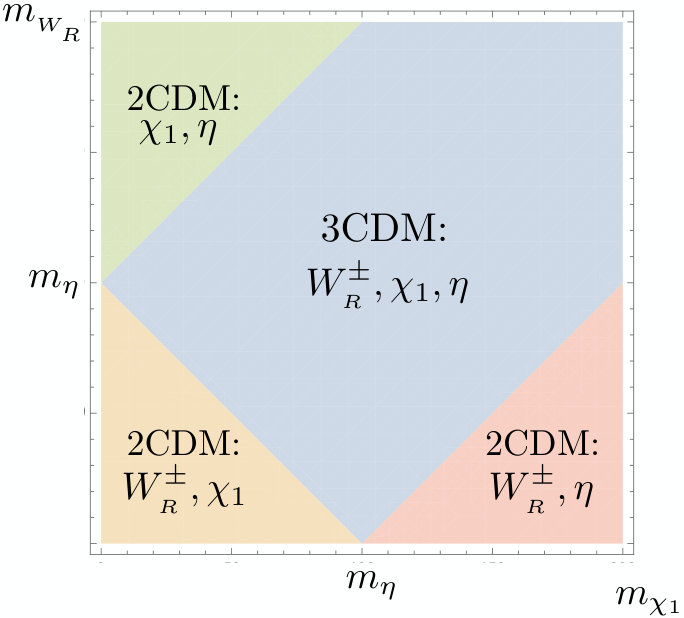 Figure 1
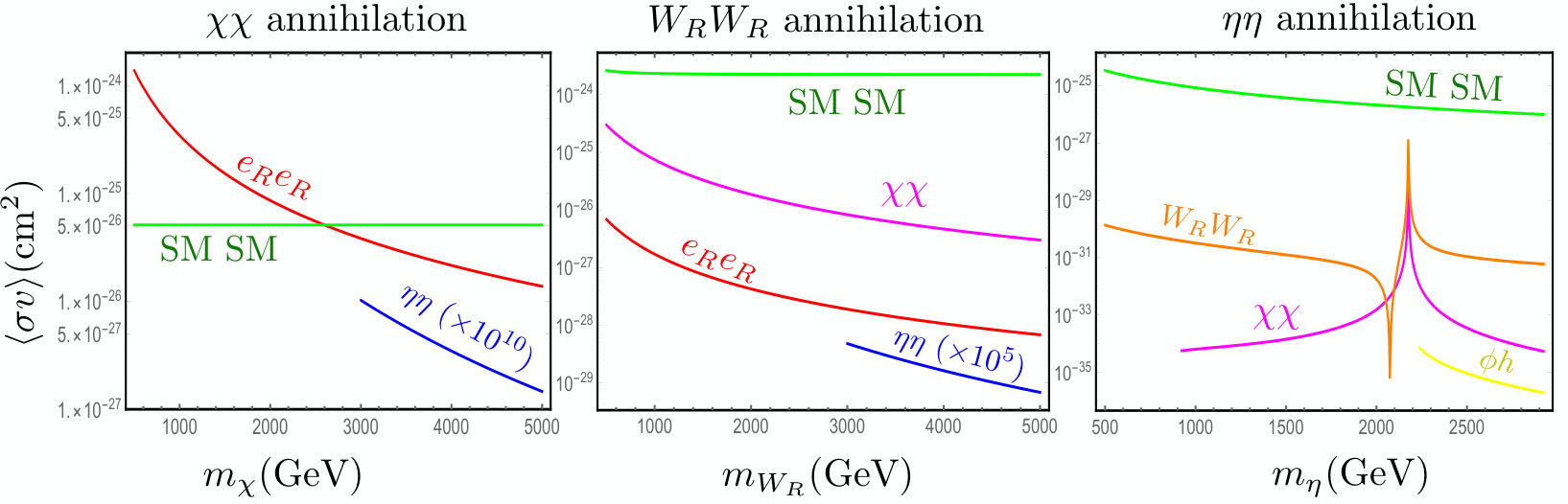 Figure 2
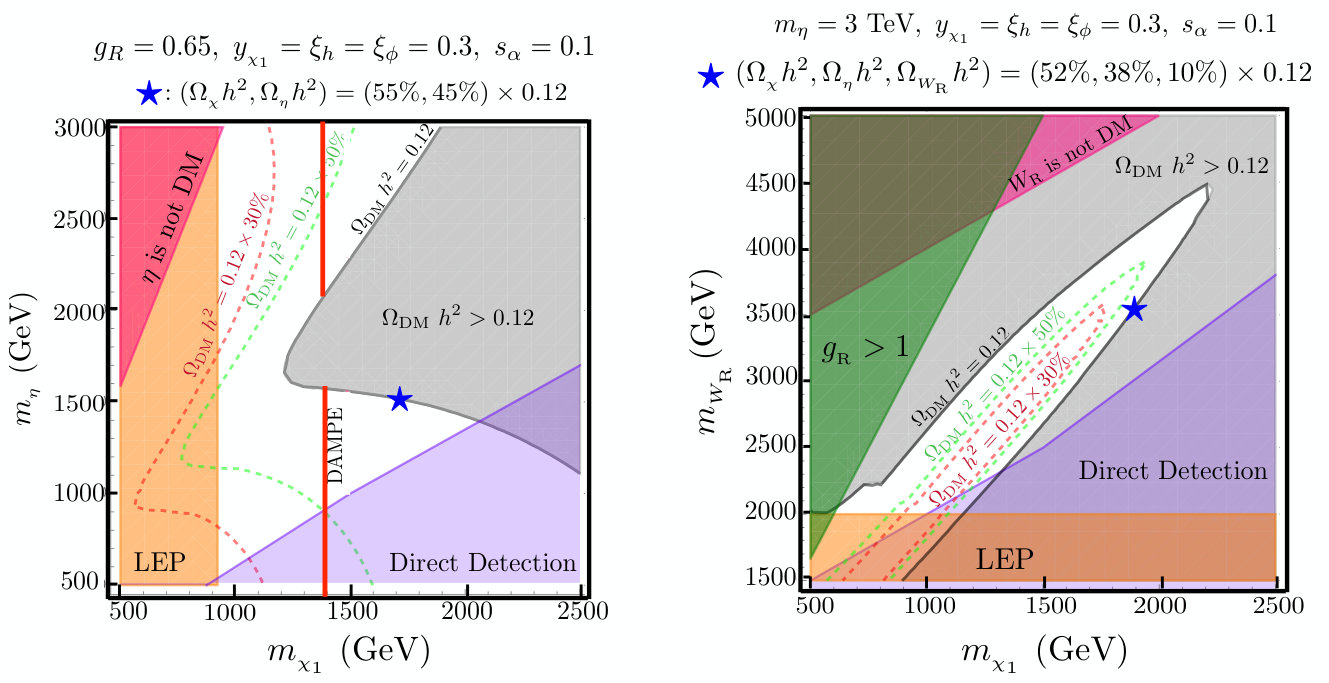 Figure 3
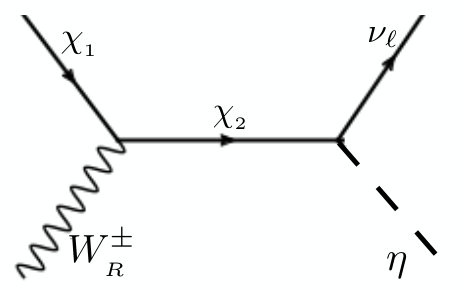 Figure 4
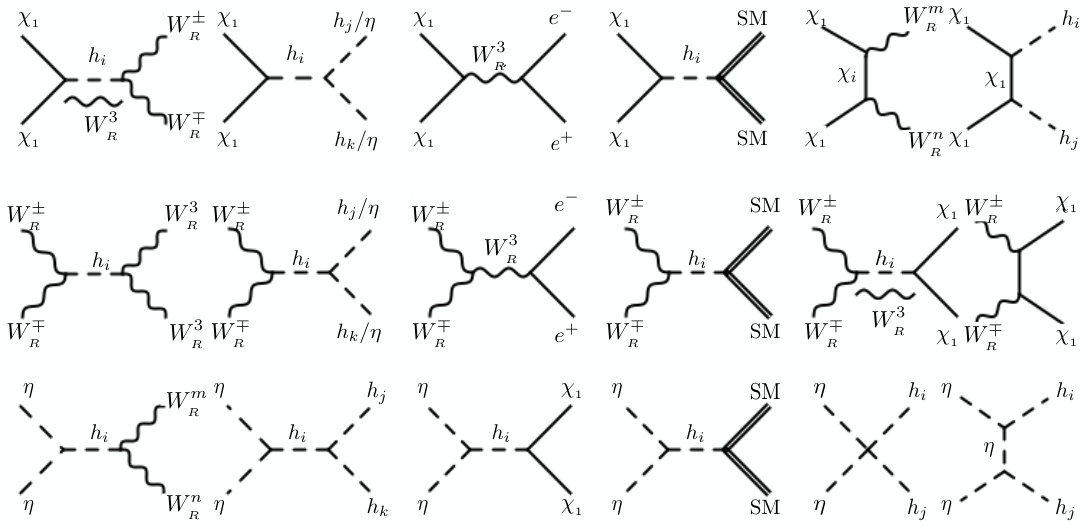 Figure 5
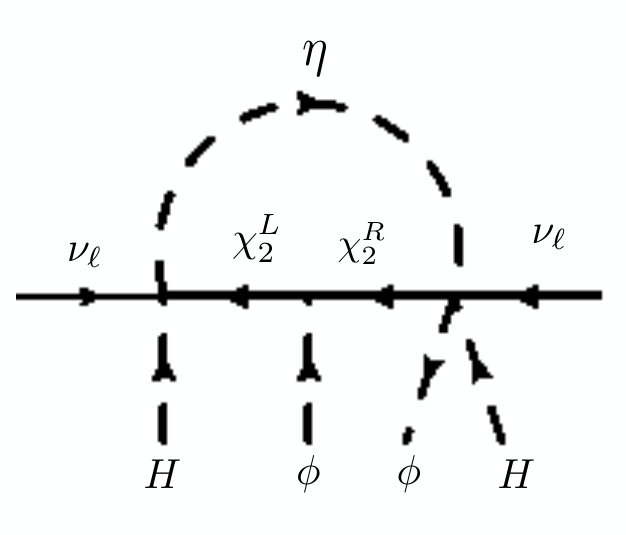 Figure 6
| Particles | ||||||||
|---|---|---|---|---|---|---|---|---|
| 3 | + | (1 , 1 , 0) | ||||||
| 2 | 1/2 | + | (1 , 1 , 0) | |||||
| 1 | 2 | – | (1 , 1 , 0) | |||||
| 1 | 1 | – | (1 , 1 , 0) | |||||
| 1 | 2 | – | (1 , 1 , 0) | |||||
| 2 | 3/2 | – | (1 , 1 , 0) | |||||
| 2 | 1/2 | + |
| – | 2 | ||||||
| – | 1 | ||||||
| + | 1 | ||||||
| + | |||||||
| + | 0 | ||||||
| – | 2 |
| Particles | ||||||
|---|---|---|---|---|---|---|
| 2 | -1 | 1/2 | ||||
| 2 | +1 | |||||
| 1 | -1 | |||||
| 1 | -1 | |||||
| 1 | 1 | |||||
| 1 | 1 | |||||
| 2 | -1 |
Peer Reviews
No public reviews on file for this paper yet. If you reviewed it on a platform where reviews are public (OpenReview, ICLR, NeurIPS, ICML), you can paste yours below so the community can read it here.
Videos
No videos yet. Explain this paper in a talk, walkthrough, or lecture? Add one.
Multi-Component Dark Matter in a Non-Abelian Dark Sector
Fatemeh [email protected]
School of Particles and Accelerators, Institute for Research in Fundamental Sciences (IPM) P.O. Box 19395-5531, Tehran, Iran
Sara [email protected]
Department of Physics, University of Tehran, North Karegar Ave. Tehran 14395-547, Iran
School of Particles and Accelerators, Institute for Research in Fundamental Sciences (IPM) P.O. Box 19395-5531, Tehran, Iran
Abstract
In this paper, we explore a dark sector scenario with a gauged and a global , where the continuous symmetries are spontaneously broken to a global . We show that in various regions of the parameter space we can have two, or three dark matter candidates, where these dark matter particles are either a Dirac fermion, a dark gauge boson, or a complex scalar. The phenomenological implications of this scenario are vast and interesting. We identify the parameter space that is still viable after taking into account the constraints from various experiments. We, also, discuss how this scenario can explain the recent observation by DAMPE in the electron-positron spectrum. Furthermore, we comment on the neutrino mass generation through non-renormalizable interactions between the standard model and the dark sector.
I Introduction
Despite the numerous successes of the Standard Model (SM) in describing the observed phenomena, there are still intriguing questions that wait to be answered. Arguably, the most important one among them is the nature and origin of dark matter (DM). For some decades, the leading theory was a single component thermal relic with weak size couplings and mass, commonly known as Weakly Interacting Massive Particle. With the advancement of experiments, however, most of the parameter space of a single-component thermal relic has been excluded. Therefore, we are compelled to examine more complex structures of dark sectors. Among the proposed scenarios, multi-component dark matter (MCDM) has attracted a lot of attentions Dienes:2011ja ; Dienes:2011sa ; Bian:2013wna ; Duda:2001ae ; Duda:2002hf ; Profumo:2009tb ; Gao:2010pg ; Feldman:2010wy ; Baer:2011hx ; Aoki:2012ub ; Chialva:2012rq ; Bhattacharya:2013hva ; Esch:2014jpa ; Bian:2014cja ; YaserAyazi:2018lrv ; Ahmed:2017dbb ; DuttaBanik:2016jzv ; DiFranzo:2016uzc ; Dienes:2013xff ; Biswas:2015sva ; Herrero-Garcia:2018qnz ; Karam:2016rsz ; Bhattacharya:2018cgx ; Bhattacharya:2016ysw ; Dev:2016qeb ; Khlopov:1995pa ; Bhattacharya:2017fid ; Huang:2015wts . In these scenarios, the total relic abundance of dark matter is due to the existence of multiple dark matter species. Given the rather complex structure of the SM, it should not be surprising if the dark sector has multiple species as well, but to further motivate MCDM scenarios, the extra degrees of freedom in the dark sector are usually employed to explain some other shortcomings of the SM.
The most common approach in MCDM models is assuming one or multiple symmetries in the dark sector. MCDM models with a gauged extension or a conserved non-abelian gauge symmetries have already received some attention Ahmed:2017dbb ; DuttaBanik:2016jzv ; Karam:2016rsz ; Bhattacharya:2018cgx ; Bhattacharya:2016ysw ; Davoudiasl:2013jma ; Barman:2018esi ; Gross:2015cwa ; Yamanaka:2015tba ; Dev:2016xcp . In this paper, we focus on a gauged times a global that are spontaneously broken to a global , once a scalar – a doublet of with a non-zero charge under – acquires a vacuum expectation value (vev). Due to this breaking, we have three massive gauge bosons (). We further assume that dark sector respects a symmetry that stays conserved after the spontaneous symmetry breaking. This symmetry becomes crucial in making sure we have multiple DM species in various regions of the parameter space. To extend the dynamics of the dark sector, we assume there exists another scalar (), and two Dirac Fermions ( and ), some of which have the potential to be a dark matter candidate.
The communication of dark sector with the SM content can occur through various means (e.g., kinetic mixing, scalar portal, etc). The kinetic mixing of non-abelian symmetries with any of the SM gauge symmetries is usually non-renormalizable, leading to small interaction between the particles in the two sectors. Therefore, we mainly focus on the scalar portal induced by and the SM Higgs acquiring vevs. This is in many ways similar to a simple Higgs portal model; however, it has some extra advantages that are listed below:
- •
Large self-interactions between some of the DM candidates: Even though collision-less cold dark matter is successful in describing large scale structures Blumenthal:1984bp , it faces some difficulty describing small scale structures. N-body simulations have shown that Self-Interacting DM can alleviate the small scale structure problems Tulin:2017ara ; Balducci:2018dms . On the other hand, from direct detection experiments, we are led to believe that DM has negligible interactions with nucleons Messina:2018fmz . Therefore, the dark sector could have a non-trivial structure, where it can allow strong self-interaction, while the portal between the dark sector and SM is rather weak. This is easily achieved in our model.
- •
The extra bosonic degrees of freedom can be used to alleviate the Higgs Hierarchy problem Bian:2013wna ; Chakraborty:2012rb ; Grzadkowski:2009mj ; Karahan:2014ola ; Antipin:2013exa ; Craig:2013xia ; Farina:2013ssa , rescue the vacuum instability Bian:2013wna ; Gonderinger:2009jp ; Drozd:2011aa ; Baek:2012se ; Gabrielli:2013hma ; Hambye:2013sna allow strong first order phase transition, which is needed to prevent baryonic asymmetry from washing out after its generation Noble:2007kk ; Damgaard:2013kva ; Profumo:2014opa .
- •
Recently, the DArk Matter Particle Explorer (DAMPE) collaboration released their new measurement of the electron-positron flux in the energy range 25 GeV to 4.6 TeV Ambrosi:2017wek . The results show a sharp peak above the background around 1.4 . The sharpness of the peak suggests that DM from a nearby source is annihilating to Yuan:2017ysv ; Fan:2017sor ; Duan:2017pkq ; Gu:2017gle ; Cao:2017ydw ; Liu:2017rgs ; Tang:2017lfb ; Chao:2017yjg ; Gu:2017bdw ; Duan:2017qwj ; Jin:2017qcv ; Niu:2017hqe ; Li:2017tmd ; Gu:2017lir ; Nomura:2017ohi ; Ghorbani:2017cey ; Yang:2017cjm ; Ding:2017jdr ; Liu:2017rgs ; Okada:2017pgr ; Yao:2018ewe ; Beck:2018hau ; Wang:2018pcc ; Balducci:2018dms ; Cao:2017sju ; Cao:2017rjr ; Huang:2015wts . Assuming that the excess is indeed due to the interaction of DM with electrons, to achieve the height of the resonance, the annihilation cross section needs to be much larger than that of the canonical single component thermal relic. To enhance the cross section of dark matter candidates with electrons, we also charge right-handed electron under . Even though the main motivation for distinguishing right-handed electron is the results of the DAMPE experiment, the annihilation of dark matter candidates to a pair of electron-positron plays a crucial role in setting the relic abundance.
- •
Neutrino mass generation: Another important observation that cannot be justified within the context of the SM is the mass of neutrinos. In the most minimalistic scenario, we can use the Weinberg operator: Weinberg:1979sa , where refers to the mass of a heavy Majorana Fermion. A simple calculation reveals that has to be bigger than Mohapatra:1979ia , which is larger than the Landau pole, and in the regime where we cannot trust the SM framework. With a more complex dark sector, we can connect the mass of neutrinos to some of the degrees of freedom in the dark sector. We still use non-renormalizable operators to get a neutrino mass; however, we find a smaller value for the cut-off scale.
In the following section, we explain the model in greater details and introduce the dark matter candidates. In section III, we find the relic abundance of each DM particles and identify the constraints coming from DM detection experiments. Some comments about neutrino mass generation are given in section III.4. Finally, the concluding remarks are presented in Section IV.
II Model
We study a new physics scenario where the standard model gauge symmetries are augmented by a gauged and a global . We supplement the scalar content by two SM singlet scalars: which is a doublet of :
[TABLE]
with being the goldstone bosons, and which is a singlet of ; both and have non-zero charges under . We also extend the Fermionic fields by a doublet , and two singlets ( of . These fields are complete singlets of the SM gauge symmetries, but they have a non-zero charges to avoid mixing with left-handed neutrinos.
Motivated by the DAMPE excess, we also assume right-handed electron is charged under . For the notation, we use , where is the familiar SM electron, and is a particle with exactly the same quantum numbers as the right-handed electron. The list of the new particles and their charges is presented in Table 1.
In the interaction basis, the Lagrangian of the relevant fields has the following form:
[TABLE]
where,
[TABLE]
In the kinetic Lagrangian, , with being the coupling of the , and is the hypercharge value. The field tensor is shown by . In this Lagrangian, are the Yukawa coupling between and , and . The last term in the Yukawa Lagrangian is the electron Yukawa interaction which due to the charge of under becomes non-renormalizable333As we will discuss later, acquires a vacuum expectation value and generates a mass for the electrons. The empirical value of electron masses gives a lower bound on : , which means if .. Another higher dimensional operator that becomes important in figuring out the dynamics of the dark sector is shown in . The cut-off scale appearing in does not have to be the same as the one appearing in the electron Yukawa (e.g, ), and so we distinguish between them.
To write the scalar potential, , we first need to comment on whether the new symmetries stay conserved or are broken. To ensure massive gauge bosons and fermions in the dark sector, we assume acquires a vacuum expectation value (vev) and thus breaks the at the scale . Consequently, the scalar potential becomes444As it is clear from the form of potential, does not acquire a vev, because its mass terms is positive ().
[TABLE]
Note that since is even under the symmetry, the symmetry stays conserved after the spontaneous symmetry breaking (SSB). Before moving on to the phenomenological effects of the and the Electroweak SSB, we note that the stability of the vacuum puts some constraints on the couplings of the scalar potential Kannike:2012pe
[TABLE]
From minimizing the potential, we can find the values of the vevs:
[TABLE]
One of the most important consequences of the and Electroweak SSB is the inducement of the scalar portal. That is the mixing 555Since does not acquire a vev, there is no mixing between the CP-even component of with the other scalars. between the neutral CP-even component of the Higgs field and that of the field. As a result of this mixing, we have two scalars in the mass basis that interact with both the SM sector and dark sector as a function of the mixing angle . That is
[TABLE]
where and are the CP-even component of the Higgs and doublet, respectively, and and are the physical fields in the mass basis. We have used and , with being
[TABLE]
The masses of the scalars are, therefore,
[TABLE]
Similarly, we can find the masses of the dark gauge bosons and the fermions:
[TABLE]
One important difference between this symmetry breaking and the EW symmetry breaking is that is global, and thus does not effect the covariant derivative. Hence, the masses of all of the three gauge bosons associated with () are the same.
In this article, we are interested in the phenomenology of the dark matter candidates, and thus it is important to figure out which dark sector particles are cosmologically stable. Given that is broken, we need to revisit the conserved symmetries at low scales. Studying the Lagrangian after the SSB, we can convince ourselves that there is a residual symmetry along with the original symmetry, which leads to the stability of at least two particles in the dark sector. The charges of various particles under the symmetry is shown in Table 2, where the charges are simply , with being their charges under .
As has electromagnetic charge, it is not a good dark matter candidate. Therefore, we must assume666A mechanism for mass generation is provided in the following subsection II.1. . Among the other particles listed in Table 2, is also not a DM candidate because it is not charged under either of the symmetries. More specifically, as long as (which as we will show later, the collider constraints require this condition to be true), we can always have the decay of . The rest of the particles mentioned in Table 2 are connected through the Feynman diagram shown in Fig. 1. Depending on the masses of the dark sector particles, they can decay to each other. For simplicity, we will assume is considerably larger than the rest of them, so the true players in the DM phenomenology are , and .
Collecting the relevant free prameters of our model, we can categorize them into
[TABLE]
Particles in the dark sector can interact with SM particles via the scalar portal as well as the direct coupling of the right-handed electrons to dark gauge bosons. In the following section, we first identify the dark matter candidates in each region of the parameter space and then find their relic abundance. We also explain the constraints various experiments impose on the parameter space. However, before diving into the phenomenology, we first address the issue of gauge anomaly that is present in the model.
II.1 Anomaly
The gauged symmetry we have introduced is anomalous. Since gauge anomalies777 The anomaly in the global , is not dangerous, because the anomalies in global symmetries only lead to the appearance of new vertices. are dangerous, we need to extend the model to cancel the anomalies.
-
- Among the triangle diagrams, is also anomaly free, due to the traceless-ness of the symmetries.
-
- The triangle diagram with would be anomaly-free if and only if the sum of the chiral fermion hypercharges going through the loop is 0 (e.g., ).
-
- Another triangle diagram that leads to gauge anomaly is , which requires the sum of the cube of hypercharges to vanish (e.g., ).
From the points listed above, it is clear that only leads to gauge anomalies, because it is charged under both and . The minimal way to cancel the anomalies mentioned in and is to introduce another a doublet of that has hypercharge , which we call , and which is a singlet of with .
We will have to assume that the mass of are large enough that it would not interfere with our phenomenology, but not too large that it would decouple from the theory and leave the model anomalous. To achieve this goal, we will assume there are some vector-like fermions, , that can mix with s after acquires a vev, and thus give s some mass. Specifically, we will extend our model to include the fermions mentioned in Table 3.
The Lagrangian terms that lead to a mass for and are:
[TABLE]
where in the last Lagrangian term. We take to be on the order of so that can acquire a mass at or below . However, we will assume that these masses are near and thus larger than all of our dark matter candidates. Furthermore, taking , we can also be sure that the existence of these particles does not violate the current search on exotic particles with electromagnetism charge Schael:2013ita . It is also noteworthy to mention that we assume there are no vector-like fermions with quantum numbers to avoid new contribution to the electron mass.
Having gone over the issue of gauge anomaly, we can now be confident that our theory is consistent. Hence, we can study the phenomenology of DM candidates in the subsequent section.
III Dark Matter Candidates
For having a reliable DM model, the DM particles must be long-lived and produce the correct relic density and satisfy the limits of direct and indirect searches. In this section, we examine each of these steps, starting with identify the stable dark sector particles in various regions of the parameter space.
Stability of the DM candidates:
The simplest way to ensure the stability of DM candidates is using the symmetries of the model. There is a symmetry that stays conserved after the SSB. Therefore, the lightest particles charged under these symmetries are DM candidate. Taking and to be heavier than , and , we have the following DM candidates:
- •
: and ;
- •
: and ;
- •
: and ;
- •
: , , and ,
where in the last line we have three DM candidates due to the kinematics. The schematic figures of these conditions are shown in Fig. 2. In the following subsection, we calculate the relic abundance for each of these DM candidates.
III.1 Relic Abundance
In thermal Multi-Component Dark Matter (MCDM) scenarios, each dark matter particle starts out in thermal equilibrium with SM particles, and once the temperature falls below the DM mass, DM particles will only annihilate until they freeze-out. The most recent experimental value for relic density is reported by Planck collaboration Ade:2015xua . To calculate the DM relic abundance in our model, the coupled Boltzmann equation is applied to study the evolution of the DM particles Springel:2005nw . Assuming thermal relic, we can write:
[TABLE]
where and are denoted the number of density and equilibrium density of the DM particles respectively and is the Hubbel parameter, and the thermal average annihilation cross section is shown by . The annihilation Feynman diagrams for all of the DM components are depicted in Fig 3, where SM denotes bosons and the top quark.
For Eq. 9 to be valid, we need to make sure . In other words, we want to decay long before the DM particle become non-relativistic. Therefore,
[TABLE]
where is the reduced Planck mass and represents the relativistic degrees of freedom at temperature . This constraint puts a mild bound on . For example, if we care about DM particles with mass, and so we take and , we get . Furthermore, we need to assume any of the or that is not DM decay quickly enough that they do not interfere with the relic abundance of DM particles once DM becomes non-relativistic. Hence, if we show the decaying particle by , we roughly get
[TABLE]
where represent the couplings and the other couplings involved. Taking , and using the same benchmarks as before, we arrive at a slightly more stringent bound on . As long as this condition is satisfied, we can be confident that the decays of heavier dark sector particles do not play a role in the relic abundance of DM candidates.
The only diagram that leads to semi-annihilation between DM candidates is the one shown in Fig. 1, which is roughly
[TABLE]
where and , and we have assumed all of them have roughly the same mass, . Using the usual benchmark values: and taking888In section III.4, where we discuss neutrino mass generation, we find that should preferably be bigger than . , the semi-annihilation cross section is approximately , and thus is extremely small. Therefore, we ignore the semi-annihilation diagrams. Consequently, the calculation of relic abundance is greatly simplified and the only important ingredient we need is the annihilation cross sections of each of the DM candidates. The analytical expressions of the annihilation diagrams can be found in Appendix A Berlin:2014tja ; Ko:2014gha .
To get a better understanding of the relative sizes of these annihilation process with respect to each other, Fig. 4 shows the cross section of various diagrams where we have fixed: , and . We have also fixed and . The left panel of Fig. 4, shows the annihilation to various final states. The red line is though , and as we can see it has a very significant rate. , where is shown in green. The blue line is the cross section of times a factor of , where we have taken . This channel opens up for and the rate is very small . With the parameters chosen, is smaller than and (Eq. 7), and thus the annihilation of does not happen. The middle panel of Fig. 4 shows the annihilation of to various final states, where we have again taken . The annihilation of is p-wave and thus it is comparatively smaller than . The annihilation of s to SM particles and , however, benefit from a higher coupling () and thus it is relatively bigger. Furthermore, the annihilation of to a pair of s is also kinematically possible and has a fairly large rate999In the region where both and are DM candidates, the Boltzmann equation becomes coupled due to the annihilation of , and needs a more careful treatment. However, due to the much smaller rate of this channel compared with , and the mass difference between and , we noticed that annihilation of to does not play a significant role.. Finally, the right panel of Fig. 4 illustrates annihilation, where we have fixed . The resonance at around is due to becoming on-shell in s-channel annihilations of . The yellow line is the annihilation of which opens us for . Other than , the rest of the channels suffer from low rate.
Having determined the important processes that set the relic abundance of DM, we move to current constraints on the model parameters. In the following two sub-sections, we study the direct detection, indirect detections as well as the collider constraints. We show that if we insist on using couplings, the allowed parameter space can be probed with the next generation of experiments.
III.2 Direct Detection
Since, in MCDM, each DM particle shares some portion of the total relic abundance, we expect their annihilation rate to be larger than what would be single component DM :
[TABLE]
Naively, there is a concern that with such large interaction rates of DM with SM particles, it must have been detected at DM experiments, by now. One of the most important constraints on DM models comes from Direct Detection (DD). In our model, DM can scatter with nucleus through Higgs or exchange, leading to potential constraints from DD. Since Higgs portal interactions care about the mass of particles, the interaction of DM with the nucleon is suppressed. In other words, Higgs portal scenarios are efficient in producing the right relic abundance through the annihilation of DM to heavy SM particles, but have a suppressed scattering cross section in DD experiments. This particular reason is common to all Higgs portal DM, and it is one of the benefits of the Higgs portal over generic models.
Furthermore, in calculating the relic abundance of and DM, their annihilation to a pair of electrons through mediator is dominant, especially for large values of . However, this process contributes to DD only at loop level and thus is negligible. This is the second reason that we can have efficient annihilation of and DM while being safe from DD bounds.
Since the mediator is a CP-even scalar, the bounds on our model comes from spin-independent DD. Higgs portal DD constraints have been studied in multiple studies, and it is well-known that if DM is a Dirac fermion, , then its scattering cross section with the SM is Barger:2007im
[TABLE]
where is the coupling of the DM particle with the scalar mediator, and is the effective coupling of Higgs with proton Djouadi:2012zc :
[TABLE]
In the case the dark matter is a gauge boson, its scattering cross section with nucleons goes as the following101010As shown in Eq. 10, and Eq. 12, there is a destructive interference between the two scalar mediation in DD bounds for the case of Dirac fermion and gauge boson DM which is another reason that DD cannot bound Higgs portal DM models very well. Baek:2012se :
[TABLE]
and finally for a stable scalar it is Casas:2017jjg
[TABLE]
To recast the DD bounds on our model, it is important to realize that each component of DM constitute only a percentage of DM. Assuming their ratio in early universe is the same as the one in the vicinity of earth, we get
[TABLE]
In Fig. 5, the DD constraints as well as some other constraints are shown. The purple region is excluded from the DD experiments Messina:2018fmz . The LEP experiment puts a stringent constraint on any particle that interacts with electrons Schael:2013ita . Since right-handed electrons are charged under , the dark gauge bosons can directly interact with them. The strongest constraint of LEP comes from the Drell-Yan Production of a pair of electrons through an exchange of , which excludes . This is shown in orange in Fig. 5. The red shaded region is when the indicated particle is no longer a DM candidate because it is not stable. The green region is when , which threatens perturbativity. Finally, the gray region is when the relic abundance of all DM candidates combined is too large and they over-close the universe. The green and red dotted lines indicate that the DM introduced in this paper are respectively and of the total DM. The star in the left plot of Fig. 5 is a benchmark, where of the DM is due to the relic abundance of and is from . Similarly, the star in the right plot of Fig. 5, indicates a sample point, where , and are respectively , and of the total DM. Due to the large cross-section of to electrons and , its relic abundance is usually low.
III.3 Indirect Detection
Another way to constrain our parameter space is by using indirect detection (ID) results. The main annihilation channels of our DM candidates are the production of a pair of electrons or heavy particles. Heavy particles eventually decay to stable particles, which some of them can be detected here on earth. Furthermore, any particle in this process that is electromagnetically charged will radiate photon which can also be detected through various experiments (e.g, Fermi-LAT Ackermann:2013yva ). However, due to the large uncertainty of the background, ID bounds are usually mild. Even considering the strongest bounds of Fermi-LAT, which is branching ratio to , ID can constrain DM only up to a few hundreds of GeV, which is smaller than the benchmarks we are considering.
Recently, the DArk Matter Particle Explorer (DAMPE) experiment Ambrosi:2017wek , which is a satellite-borne, high energy particles and gamma-ray detector, published their measurement of the electron plus positron spectrum. Their result indicates a tentative narrow peak around . The local significance of this excess is about assuming a broken power-law background Fowlie:2017fya ; Huang:2017egk , and its global significance has been measured to about Huang:2017egk ; Niu:2017lts ; Ge:2017tkd ; Chao:2017emq ; Nomura:2018jkd ; Yao:2018ewe . Such a narrow peak could be a result of a DM with mass to a pair of right-handed electrons. The interaction of DM with left-handed electrons should be suppressed, due to the results published by IceCube, which reported no excess in the neutrino experiment Zhao:2017nrt . This is the reason we considered only the right-handed electrons being charged under the .
According to the DAMPE experiment, the annihilation rate to electron-positron is estimated to be much more than the annihilation rate for a single component DM, which further motivates our set up for multi-component DM. However, it is important to make sure the annihilation to electron pair is s-wave.
Among the DM candidates in our set-up, and interact with right-handed electrons strongly. The annihilation of to , however, is p-wave:
[TABLE]
Even though this process could play a significant role in setting the abundance of in the early universe, its rate right now should be negligible. That is because the ambient velocity of DM is estimated to be . The annihilation of , on the other hand, is s-wave and thus can have a significant contribution to ID at the current time:
[TABLE]
Therefore, in the region where is a DM particle, its annihilation to a pair of electrons could justify the observation of the narrow peak in the DAMPE experiment. The red line in the left panel of Fig. 5, shows the benchmark that could explain the DAMPE observation. It is worth mentioning that even though the main motivation behind charging the right-handed electrons under was explaining the DAMPE observation, the annihilation of DM particles to a pair of electrons contributes significantly in setting the relic abundance of DM candidates. In the scenario where right-handed electrons did not interact directly with the dark sector, DM particles had to be about a factor of 5 lighter to not over-close the universe. However, that region of the parameter space is strongly constrained by DD experiments.
III.4 Neutrino Mass
An added bonus of non-minimal structure in the dark sector is that we can attack some other problem of the SM. In this part, we comment on how the neutrino mass can be radiatively generated using the particles in the dar sector. To do so, we will employ the following terms:
[TABLE]
We can think of s to be vector-like fermions, one with charge and another with charge . To avoid the contribution of Weinberg operator in giving neutrinos a mass, we will assume there are no Majorana or triplet of in the UV theory111111Even though the Weinberg operator respects the symmetries of the model, since it violates lepton number, it requires a new degree of freedom in the UV to generate the term. In other words, we cannot generate the Weinberg operator with the degrees of freedom present at low scales. Thereby, we can ignore the effect of Weinberg operator by requiring there to be no degrees of freedom in the UV that can generate such term. It is noteworthy to mention that we cannot impose the lepton number, , as a symmetry of the model, because one of the higher dimensional operators we used to generate the neutrino mass term violates .. The diagram leading to neutrino mass is shown in Fig. 6.
Given that neutrino mass is expected to be smaller than a few 0.1 eV Giusarma:2016phn ; Giusarma:2018jei we can roughly estimate the value of assuming and are :
[TABLE]
Assuming a benchmark value of , , and we get . This constraint combined with the bound we need to satisfy to make sure the decaying particles decay before DM candidates become non-relativisitc requires to be roughly in the range of TeV.
IV Conclusions
In this work, we studied a scenario of the dark sector that contains two or three dark matter (DM) candidates. We proposed extending the SM symmetries by a gauge and a global , which the continuous symmetries are spontaneously broken to a global . We considered a case where dark sector contained some Dirac fermions and complex scalars to investigate a dynamic dark sector. To see how our proposed scenario could explain the recent observation by DArk Matter Particle Explorer (DAMPE), we also charged right-handed electrons under . We assumed couplings, to consider a more natural scenario. Other than the Higgs portal, which connects the dark sector to the SM, the annihilation of and to a pair of electrons happen to play a significant role in the relic abundance of DM particles.
The phenomenology of DM candidates was studied, and the region of the parameter space where they can produce the right relic abundance while being safe from various DM detection experiment was identified. We noticed that only a small region of parameter space survives the constraint and this region could be probed with the next generations of experiments. Additionally, we commented on how neutrinos can gain a mass through non-renormalizable interactions with the dark sector. An important advantage of our scenario over Weinberg operator is that our cut-off scale is , and much lower than the cut-off scale suggested by the Weinberg operator.
In conclusion, we emphasize that in the era where single DM thermal relics are highly constrained, it is important to consider multi-species DM. In the most simplistic paradigm, where DM particles are thermal relics, multi-component DM suggests strong couplings between DM particles and SM. As a result, Leptophilic DM or when there is a Higgs portal models are preferred.
Acknowledgments
We would like to especially thank Adam Martin for his invaluable comments on the draft. We are also grateful to Carlos Alvarado, Hoda Hesari, Mojtaba Mohammadi, and Sedigheh Tizchang for insightful discussions. We thank the CERN theory group for their hospitality.
Appendix A The cross section of DM candidates
In this appendix, we show the analytical expressions that we have calculated using FeynCalc Shtabovenko:2016sxi . The first subsection is the potential annihilation cross sections of , the second one belongs to and the last one shows the annihilation cross sections of . These processes set the relic abundance of DM if they are 1) kinematically allowed, 2) the indicated initial state is indeed a DM candidate.
A.1 DM
[TABLE]
[TABLE]
A.2 DM
[TABLE]
[TABLE]
A.3 DM
[TABLE]
The reference list from the paper itself. Each links out to its DOI / PubMed record.
- 1(1) K. R. Dienes and B. Thomas, Dynamical Dark Matter: I. Theoretical Overview , Phys. Rev. D 85 (2012) 083523, [ 1106.4546 ].
- 2(2) K. R. Dienes and B. Thomas, Dynamical Dark Matter: II. An Explicit Model , Phys. Rev. D 85 (2012) 083524, [ 1107.0721 ].
- 3(3) L. Bian, R. Ding, and B. Zhu, Two Component Higgs-Portal Dark Matter , Phys. Lett. B 728 (2014) 105–113, [ 1308.3851 ].
- 4(4) G. Duda, G. Gelmini, and P. Gondolo, Detection of a subdominant density component of cold dark matter , Phys. Lett. B 529 (2002) 187–192, [ hep-ph/0102200 ].
- 5(5) G. Duda, G. Gelmini, P. Gondolo, J. Edsjo, and J. Silk, Indirect detection of a subdominant density component of cold dark matter , Phys. Rev. D 67 (2003) 023505, [ hep-ph/0209266 ].
- 6(6) S. Profumo, K. Sigurdson, and L. Ubaldi, Can we discover multi-component WIMP dark matter? , JCAP 0912 (2009) 016, [ 0907.4374 ].
- 7(7) X. Gao, Z. Kang, and T. Li, The Supersymmetric Standard Models with Decay and Stable Dark Matters , Eur. Phys. J. C 69 (2010) 467–480, [ 1001.3278 ].
- 8(8) D. Feldman, Z. Liu, P. Nath, and G. Peim, Multicomponent Dark Matter in Supersymmetric Hidden Sector Extensions , Phys. Rev. D 81 (2010) 095017, [ 1004.0649 ].