TL;DR
This paper introduces a novel neural network architecture for simulating many-body quantum systems that allows for efficient, exact sampling, overcoming the limitations of traditional Markov Chain Monte Carlo methods.
Contribution
The authors propose a specialized autoregressive neural network model enabling efficient and exact sampling of quantum states, enhancing scalability and accuracy.
Findings
Achieved accurate results on larger 2D spin models
Overcame sampling limitations of traditional neural-network states
Demonstrated improved scalability in quantum simulations
Abstract
Artificial Neural Networks were recently shown to be an efficient representation of highly-entangled many-body quantum states. In practical applications, neural-network states inherit numerical schemes used in Variational Monte Carlo, most notably the use of Markov-Chain Monte-Carlo (MCMC) sampling to estimate quantum expectations. The local stochastic sampling in MCMC caps the potential advantages of neural networks in two ways: (i) Its intrinsic computational cost sets stringent practical limits on the width and depth of the networks, and therefore limits their expressive capacity; (ii) Its difficulty in generating precise and uncorrelated samples can result in estimations of observables that are very far from their true value. Inspired by the state-of-the-art generative models used in machine learning, we propose a specialized Neural Network architecture that supports efficient and…
Click any figure to enlarge with its caption.
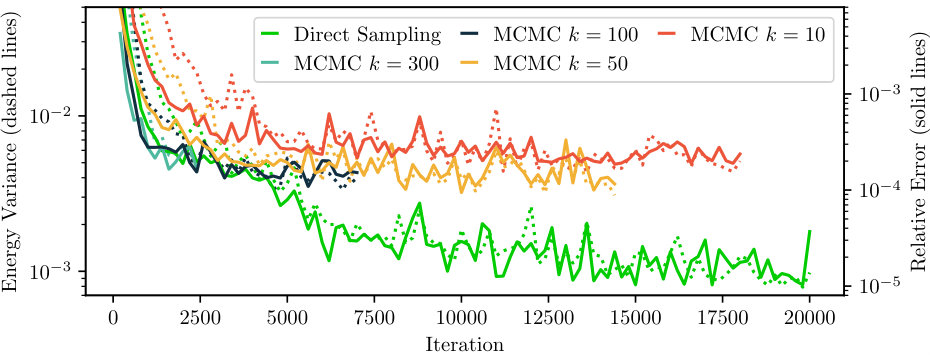 Figure 1
 Figure 1
 Figure 3
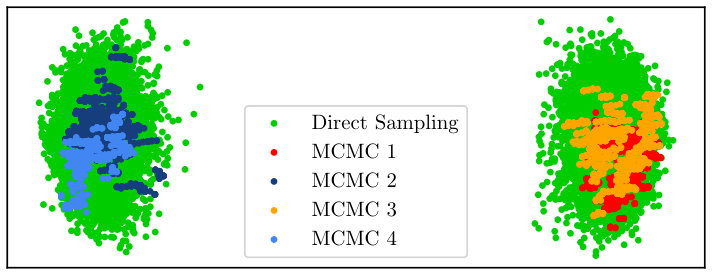 Figure 4
Peer Reviews
No public reviews on file for this paper yet. If you reviewed it on a platform where reviews are public (OpenReview, ICLR, NeurIPS, ICML), you can paste yours below so the community can read it here.
Code & Models
Videos
No videos yet. Explain this paper in a talk, walkthrough, or lecture? Add one.
