All those EPPA classes (Strengthenings of the Herwig-Lascar theorem)
Jan Hubi\v{c}ka, Mat\v{e}j Kone\v{c}n\'y, Jaroslav Ne\v{s}et\v{r}il

TL;DR
This paper proves a comprehensive and elementary extension property for partial automorphisms (EPPA) for classes of structures with relations, unary functions, and permutation groups, unifying and strengthening several key theorems.
Contribution
It provides a unified, combinatorial proof of EPPA for diverse classes, extending previous theorems and establishing a common framework for EPPA and Ramsey properties.
Findings
Unified proof of EPPA for classes with relations and unary functions
Extension of EPPA results to classes with forbidden homomorphisms
Application to a problem from Hrushovski's construction
Abstract
In this paper we prove a general theorem showing the extension property for partial automorphisms (EPPA, also called the Hrushovski property) for classes of structures containing relations and unary functions, optionally equipped with a permutation group of the language. The proof is elementary, combinatorial and fully self-contained. Our result is a common strengthening of the Herwig-Lascar theorem on EPPA for relational classes with forbidden homomorphisms, the Hodkinson-Otto theorem on EPPA for relational free amalgamation classes, its strengthening for unary functions by Evans, Hubi\v{c}ka and Ne\v{s}et\v{r}il and their coherent variants by Siniora and Solecki. We also prove an EPPA analogue of the main results of J. Hubi\v{c}ka and J. Ne\v{s}et\v{r}il: All those Ramsey classes (Ramsey classes with closures and forbidden homomorphisms), thereby establishing a common framework for…
Click any figure to enlarge with its caption.
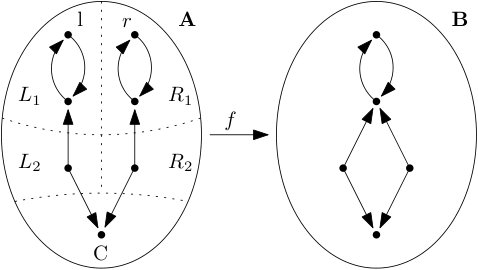 Figure 1
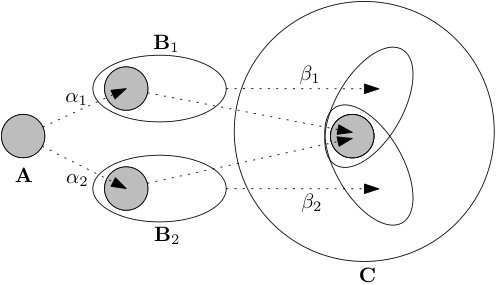 Figure 2
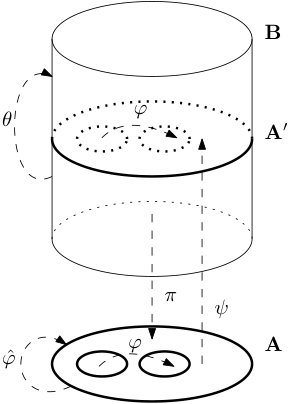 Figure 3
Peer Reviews
No public reviews on file for this paper yet. If you reviewed it on a platform where reviews are public (OpenReview, ICLR, NeurIPS, ICML), you can paste yours below so the community can read it here.
Videos
No videos yet. Explain this paper in a talk, walkthrough, or lecture? Add one.
All those EPPA classes
(Strengthenings of the Herwig–Lascar theorem)
Abstract.
Let be a finite structure. We say that a finite structure is an EPPA-witness for if it contains as a substructure and every isomorphism of substructures of extends to an automorphism of . Class of finite structures has the extension property for partial automorphisms (EPPA, also called the Hrushovski property) if it contains an EPPA-witness for every structure in .
We develop a systematic framework for combinatorial constructions of EPPA-witnesses satisfying additional local properties and thus for proving EPPA for a given class . Our constructions are elementary, self-contained and lead to a common strengthening of the Herwig–Lascar theorem on EPPA for relational classes defined by forbidden homomorphisms, the Hodkinson–Otto theorem on EPPA for relational free amalgamation classes, its strengthening for unary functions by Evans, Hubička and Nešetřil and their coherent variants by Siniora and Solecki. We also prove an EPPA analogue of the main results of J. Hubička and J. Nešetřil: All those Ramsey classes (Ramsey classes with closures and forbidden homomorphisms), thereby establishing a common framework for proving EPPA and the Ramsey property.
There are numerous applications of our results, we include a solution of a problem related to a class constructed by the Hrushovski predimension construction. We also characterize free amalgamation classes of finite -structures with relations and unary functions which have EPPA.
Contents
-
10 A generalisation of the Herwig–Lascar theorem: Proof of Theorem 1.5
-
11 Connections to the structural Ramsey theory: Proof of Theorem 1.6
1. Introduction
Let and be finite structures (e.g. graphs, hypergraphs or metric spaces) such that is a substructure of . We say that is an EPPA-witness for if every isomorphism of substructures of (a partial automorphism of ) extends to an automorphism of . We say that a class of finite structures has the extension property for partial automorphisms (EPPA, also called the Hrushovski property) if for every there is which is an EPPA-witness for .
In 1992, Hrushovski [Hru92] established that the class of all finite graphs has EPPA. This result was used by Hodges, Hodkinson, Lascar, and Shelah to show the small index property for the random graph [HHLS93]. After this, the quest of identifying new classes of structures with EPPA continued with a series of papers including [Her95, Her98, HL00, HO03, Sol05, Ver08, Con19, Ott17, ABWH*+*17c, HKN19, Kon19, HKN18, EHKN20].
In particular, Herwig and Lascar [HL00] proved EPPA for certain relational classes with forbidden homomorphisms. Solecki [Sol05] used this result to prove EPPA for the class of all finite metric spaces. This was independently obtained by Vershik [Ver08], see also [Pes08, Ros11b, Ros11a, Sab17, HKN19] for other proofs. Some of these proofs are combinatorial [HKN19], others are using the profinite topology on free groups and the Ribes–Zalesskii [RZ93] and Marshall Hall [Hal49] theorems. Solecki’s argument was refined by Conant [Con19] for certain classes of generalised metric spaces and metric spaces with (some) forbidden subspaces. In [ABWH*+*17c], these techniques were carried further and a layer was added on top of the Herwig–Lascar theorem to show EPPA for many classes of metrically homogeneous graphs from Cherlin’s catalogue [Che17] (see also exposition in [Kon18]).
There are known EPPA classes for which the Herwig–Lascar theorem is not well suited. In particular, EPPA for free amalgamation classes of relational structures was shown by Siniora and Solecki [SS19] using results of Hodkinson and Otto [HO03]. It was noticed by Ivanov [Iva15] that a lemma on permomorphisms from Herwig’s paper [Her98, Lemma 1] can be used to show EPPA for structures with definable equivalences on -tuples with infinitely many equivalence classes. Evans, Hubička, and Nešetřil [EHN17] strengthened the aforementioned construction of Hodkinson and Otto and established EPPA for free amalgamation classes in languages with relations and unary functions (e.g. the class of -orientations arising from a Hrushovski construction [EHN19] or the class of all finite bowtie-free graphs [EHN19]).
We give a combinatorial, elementary, and fully self-contained proof of a strengthening of all the aforementioned results [Her98, HL00, HO03, EHN17] and their coherent variants by Siniora and Solecki [SS19, Sin17]. This has a number of applications which we list in Section 1.3. In particular, in Section 12.5 we present a solution of a problem related to a class constructed by the Hrushovski predimension construction.
1.1. -structures
Before presenting the summary of our results, let us introduce the structures we are dealing with. With applications in mind, we generalise the standard notion of model-theoretic -structures in two directions. We consider functions which go to subsets of the vertex set and we also equip the languages with a permutation group . Our morphisms will consist of a map between vertices together with a permutation of the language: The standard notions of homomorphism, embedding etc. are generalised naturally, see Section 2 for formal definitions. If consists of the identity only and the ranges of all functions consist of singletons, one gets back the standard model-theoretic -structures together with the standard mappings, the standard definition of EPPA etc.
1.2. The main results
We now state the principal results of this paper together with a short discussion.
A structure is irreducible if it is not a free amalgamation of its proper substructures. If is an EPPA-witness for , we say that it is irreducible structure faithful if whenever is an irreducible substructure of , then there is an automorphism such that . A class has irreducible structure faithful EPPA if it has EPPA and all EPPA-witnesses can be chosen to be irreducible structure faithful. (This is a natural generalization of the clique faithful EPPA introduced by Hodkinson and Otto [HO03] to structures with functions.) Coherent EPPA is a “functorial” strengthening of EPPA introduced by Siniora and Solecki [SS19, Sin17] and is defined in Section 2.6.
In this paper we prove two main theorems. The “base” unrestricted theorem, formulated as Theorem 1.1, gives irreducible structure faithful coherent EPPA for the class of all finite -structures, strengthening results of Herwig [Her98, Lemma 1], Hodkinson and Otto [HO03], its coherent variant of Siniora and Solecki [SS19], and Evans, Hubička, and Nešetřil [EHN17].
Theorem 1.1** (Construction of an unrestricted EPPA-witness).**
Let be a language consisting of relations and unary functions equipped with a permutation group and let be a finite -structure. If lies in a finite orbit of the action of by relabelling, then there is a finite -structure , which is an irreducible structure faithful coherent EPPA-witness for .
Consequently, the class of all finite -structures has irreducible structure faithful coherent EPPA if every finite -structure lies in a finite orbit of the action of by relabelling.
Here, the action of by relabelling is defined such that sends a -structure to a -structure on the same vertex set where the relations and functions are relabelled according to (see Definition 2.1). Note that in particular if is finite (e.g. or is finite), then every -structure lies in a finite orbit of the action of by relabelling.
After that, we provide a theorem which, given a finite irreducible structure faithful (coherent) EPPA-witness for , produces a finite irreducible structure faithful (coherent) EPPA-witness for while providing extra control over the local structure of :
Theorem 1.2** (Construction of a restricted EPPA-witness).**
Let be a language consisting of relations and unary functions equipped with a permutation group , let be a finite irreducible -structure, let be a finite EPPA-witness for and let be an integer. There is a finite -structure satisfying the following.
- (1)
* is an irreducible structure faithful EPPA-witness for .* 2. (2)
There is a homomorphism-embedding . 3. (3)
For every substructure of on at most vertices there is a tree amalgamation of copies of and a homomorphism-embedding . 4. (4)
If is coherent then so is .
Here, a tree amalgamation of copies of is any structure which can be created by a series of free amalgamations of copies of over its substructures (see Definition 9.1).
Theorem 1.1 contains the condition that needs to lie in a finite orbit of the action of by relabelling. We prove that this is in fact necessary:
Theorem 1.3**.**
Let be a language equipped with a permutation group and let be a finite -structure. If lies in an infinite orbit of the action of by relabelling then there is no finite -structure which is an EPPA-witness for .
We can combine Theorems 1.1 and 1.3 with an easy observation used earlier [HO03, EHN17, Sin17] and characterize free amalgamation classes of finite -structures which have (irreducible structure faithful coherent) EPPA, provided that all functions in the language are unary. The following theorem strengthens results of Hodkinson and Otto [HO03], Evans, Hubička, and Nešetřil [EHN17], and Siniora [Sin17], and in particular implies irreducible structure faithful coherent EPPA for the class of all graphs, -free graphs or -regular hypergraphs.
Corollary 1.4**.**
Let be a language consisting of relations and unary functions equipped with a permutation group and let be a free amalgamation class of finite -structures. Then has EPPA if and only if every lies in a finite orbit of the action of on -structures by relabelling. Moreover, if has EPPA, then it has irreducible structure faithful coherent EPPA.
We also provide two corollaries of Theorem 1.2, which might be easier to apply in some cases. The first corollary is a direct strengthening of the Herwig–Lascar theorem [HL00, Theorem 3.2] and its coherent variant of Solecki and Siniora [SS19, Theorem 1.10]. For a set of -structures, we denote by the set of all finite and countable structures such that there is no with a homomorphism-embedding .
Theorem 1.5**.**
Let be a language consisting of relations and unary functions equipped with a permutation group . Let be a finite family of finite -structures and let be a finite -structure which lies in a finite orbit of the action of by relabelling. If there exists a (not necessarily finite) structure containing as a substructure such that each partial automorphism of extends to an automorphism of , then there exists a finite structure which is an irreducible structure faithful coherent EPPA-witness for .
Hubička and Nešetřil [HN19] gave a structural condition for a class to be Ramsey. It turns out that, in papers studying Ramsey expansions of various classes using their theorem, EPPA is sometimes an easy corollary of one of the intermediate steps, see e.g. [ABWH*+*17c, ABWH*+*17a, ABWH*+*17b, Kon19]. In this paper, we make this link explicit by proving a theorem on EPPA whose statement is very similar to [HN19, Theorem 2.18]. For the definition of a locally finite automorphism-preserving subclass, see Section 11.
Theorem 1.6**.**
Let be a language consisting of relations and unary functions equipped with a permutation group and let be a class of finite -structures which has EPPA. Let be a hereditary locally finite automorphism-preserving subclass of with the strong amalgamation property which consists of irreducible structures. Then has EPPA.
Moreover, if EPPA-witnesses in can be chosen to be coherent then EPPA-witnesses in can be chosen to be coherent, too.
1.3. Applications of our results
When proving EPPA for (some of) the antipodal classes of metrically homogeneous graphs in [ABWH*+*17c], an additional ad hoc layer was added on top of an application of the Herwig–Lascar theorem to ensure that edges of length form a matching [ABWH*+*17c, Theorem 7.7]. Another ad hoc layer was needed in the same paper for the bipartite classes [ABWH*+*17c, Theorem 6.13]. These ad hoc constructions can be avoided using the main theorem of this paper, adding unary functions to represent edges of length for the antipodal classes, or adding two unary predicates which can be swapped by to describe the partition for the bipartite classes.
When proving EPPA for the antipodal classes of odd diameter and the bipartite antipodal classes of even diameter of metrically homogeneous graphs in [Kon20], the full strength of Theorem 1.6 (from an early draft of this paper) was used: One needed unary functions to represent that edges of length form a matching, control over substructures to ensure that no non-metric cycles are created, and language permutations to generalise a construction from [EHKN20].
Section 12 of this paper is devoted to applications. In particular, we outline how to further strengthen our results to languages with constants or certain non-unary functions (see Theorems 12.6 and 12.7), and we prove that a class connected to Hrushovski’s predimension construction has EPPA (see Theorem 12.12). The two latter proofs use a general method for dealing with higher-arity functions by chaining several applications of Theorem 1.2 on top of each other using language permutations.
We are confident that there are many more applications of the main theorems of this paper to be discovered.
1.4. EPPA and Ramsey
The results and techniques of this paper are motivated by recent developments of the structural Ramsey theory, particularly the efforts to characterise Ramsey classes of finite structures. As this paper demonstrates, many techniques and proof strategies from structural Ramsey theory may serve as a motivation for results about EPPA classes. We were inspired by the scheme of proofs of corresponding Ramsey results in [HN19], by the construction of clique faithful EPPA-witnesses for relational structures given by Hodkinson and Otto [HO03], by the treatment of unary function in [EHN17], and by the recent proofs of EPPA for metric spaces [HKN19] and for two-graphs [EHKN20].
In each section, we fix a -structure and give an explicit construction of a -structure and an embedding . Then, given a partial automorphism of , we show how to construct an automorphism of extending it, that is, we prove that is an EPPA-witness for . Finally, we prove that has the given special properties (e.g. irreducible structure faithfulness, or control over small substructures) and that the extension is coherent. Usually, the constructions are the interesting part and the proofs are just verification that a function is an automorphism and that it composes correctly.
While all this may be surprising on the first glance and it is one of the novelties of this paper, we want to stress at this point some of the main differences between EPPA and Ramsey. (Further open problems will be in Section 13.)
Both EPPA and the Ramsey property imply the amalgamation property (see Observation 2.6 and [Neš05]) and have strong consequences for the Fraïssé limits. Nonetheless, not every amalgamation class has EPPA or the Ramsey property. While there is a meaningful conjecture motivating the classification program of Ramsey classes (see [HN19, BPT11]), for the classification of EPPA classes this is not yet the case.
The classification programme for EPPA classes was initiated in [EHN19, EHN17] by giving examples of classes with a non-trivial EPPA expansion. (See also the survey by the first author [Hub20].) There exist many classes which have a non-trivial Ramsey expansion but fail to have a non-trivial EPPA expansion. Examples include the class of all finite linear orders or the class of all finite finite partially ordered sets. On the other hand, to the author’s best knowledge, whenever a Ramsey expansion of an EPPA class is known, the expansion only adds a “small amount of information” (compared to what is promised for -categorical structures by [Kec12, Theorem 4.5]).
The correspondence between the structural conditions for EPPA and Ramsey classes then motivates the following conjecture.
Conjecture 1.7**.**
Every strong amalgamation class with EPPA has a precompact Ramsey expansion.
(See Section 2.3 for a definition of strong amalgamation and for example [NVT15] for a definition of a precompact expansion.) Note that this conjecture implies every -categorical structure with EPPA having a precompact Ramsey expansion. Classes known to have EPPA where it is not known if they have a precompact Ramsey expansion include the class of all finite groups [Sin17, PS18] and the class of all finite skew-symmetric bilinear forms111David M. Evans, personal communication. See also [CH03].. More open problems are listed in Section 13.
It is worth to mention a result of Jahel and Tsankov [JT20] who prove that for a large number of classes, EPPA implies the ordering property (which is closely related to the Ramsey property, see [KPT05]). In particular, this implies that while for Ramsey classes, there exists an ordering of Fraïssé limit which is compatible with the group of automorphisms, for EPPA classes satisfying the conditions of [JT20] such a global ordering cannot be definable. This in fact may be one of the main dividing lines.
Based on all this information and an analogous scheme in the Ramsey context [HN19], this may be schematically depicted as follows.
Ramsey
classes
amalgamation classes
EPPA
classes
more
special structures
ultrahomogeneous
structures
special
structures
This paper is organised as follows: In Section 2, we give all the necessary notions and definitions. In Section 3, which is supposed to serve as a warm-up, we give a new proof of (a coherent strengthening of) Hrushovski’s theorem [Hru92]. Then, in Sections 4 and 5, we show that this new construction generalises naturally to relational -structures. In Section 6, we add a new layer which allows the language to also contain unary functions. In Section 7, we combine this with techniques introduced earlier [HO03, EHN17] to obtain irreducible structure faithfulness, and in Section 8, we once again use a similar construction to deal with forbidden homomorphic images, which allows us to prove the main theorems of this paper in Sections 9, 10 and 11. Finally, in Section 12, we apply our results and prove EPPA for the class of -orientations with -closures, thereby confirming the first part of [EHN19, Conjecture 7.5]. We also prove Corollary 1.4, illustrate the usage of Theorems 1.1 and 1.6 on the example of integer-valued metric spaces with no large subspaces, where all vertices are in distance 1 from each other and prove EPPA for languages with constants or certain classes with non-unary functions.
2. Background and notation
We find it convenient to work with model-theoretic structures generalised in two ways: We equip the language with a permutation group (giving a more systematic treatment to the concept of permomorphisms introduced by Herwig [Her98]) and consider functions to the powerset (a further generalisation of [EHN17]). This is motivated by applications, see Section 12.5.
Let be a language consisting of relation symbols and function symbols each having its arity denoted by for relations and for functions.
Let be a permutation group on which preserves types and arities of all symbols. We say that is a language equipped with a permutation group . Observe that when is trivial and the ranges of all functions consist of singletons, one obtains the usual notion of model-theoretic language (and structures). All results and constructions in this paper presented on -structures thus hold also for standard -structures. By this we mean that given a class of standard -structures, one can treat them as -structures with trivial, use the results of this paper and then, perhaps after some straightforward adjustments, obtain the same results for the original class (see Observations 2.2 and 2.7).
Denote by the set of all subsets of . A -structure is a structure with vertex set , functions for every and relations for every . Notice that the domain of a function is a tuple while the range is a set, the reason for this is that it allows to explicitly represent algebraic closures by functions. If the set is finite, we call a finite structure. We consider only structures with finitely or countably infinitely many vertices. If , we call a relational language and say that a -structure is a relational -structure. A function such that is a unary function.
In this paper, the language and its permutation group are often fixed and understood from the context (and they are in most cases denoted by and respectively), we also only consider unary functions.
2.1. Maps between -structures
A homomorphism is a pair where and is a mapping such that for every and we have:
- (a)
, and 2. (b)
.
If and are homomorphisms, we denote by the homomorphism obtained by their composition. (It is straightforward to check that the composition is indeed a homomorphism .)
If is injective then is called a monomorphism. A monomorphism is an embedding if for every and :
- (a)
, and 2. (b)
.
If is an embedding where is one-to-one then is an isomorphism. An isomorphism from a structure to itself is called an automorphism. If is an inclusion and is the identity then is a substructure of and we may write to denote this fact.
Given a -structure and , the closure of in , denoted by , is the smallest substructure of containing . For , we will also write for and for a tuple we will write for .
Let , , and be -structures such that and . If is an isomorphism, we may also call it a partial isomorphism between and (note that also includes a permutation ).
Let be a homomorphism. For brevity, we may write for in the context where , and for where . By and we will always mean and respectively. If then by we mean the tuple , and if then we put .
Note that is the image of a set of tuples, while is the realisation of the relation in . These sets need not be equal in general (they will, however, be equal whenever is an embedding).
If and is a function from to some set , we denote by the homomorphic image of structure , that is, the -structure with vertex set such that for every and we have:
- (a)
, and 2. (b)
for every it holds that
[TABLE]
Note that is a homomorphism and moreover all relations and functions of are minimal possible for to be a homomorphism. Also observe that if is injective, then is an isomorphism .
Definition 2.1**.**
Let be a language equipped with a permutation group . We define the action of on -structures by relabelling, such that for a -structure and , we define as .
Observation 2.2**.**
Let be a language equipped with a permutation group . If is finite or then every finite -structure lies in a finite orbit of the action of by relabelling.
Proof.
If is finite, then there are only finitely many -structures on any given finite set and the action of by relabelling preserves the vertex set. If , then the action is trivial and every orbit is a singleton. ∎
2.2. -structures as standard model-theoretic structures
Whenever there exists a structure such that (e.g. when is finite or more generally when is a closed subgroup of ), there is a functorial correspondence between -structures and structures in a bigger language with no permutation group. This makes it possible to extend many theorems about classical structures to (certain) -structures without having to re-prove them.
Definition 2.3**.**
Let be a language equipped with a permutation group . Let be the set of all symbols of which are not fixed by and assume that there is a language disjoint from and an -structure such that is precisely the action of on . Let be the language defined as follows:
- (1)
For every symbol from , we put the same symbol with the same arity into . 2. (2)
For every symbol from , we put the same symbol with the same arity into . 3. (3)
For every such that contains a relation symbol of arity , we put an -ary relation symbol into (without loss of generality ). 4. (4)
For every such that contains a function symbol of arity , we put an -ary function symbol into (without loss of generality ). 5. (5)
There is a constant symbol (without loss of generality ).
Given a -structure , we define an -structure as follows:
- (1)
The vertex set of is the disjoint union (without loss of generality we can assume that ). 2. (2)
. 3. (3)
The substructure of induced on is isomorphic to (in particular, there are no relations or functions from ). 4. (4)
For every symbol we have that . 5. (5)
For every -ary relation symbol and every tuple it holds that if and only if . 6. (6)
For every -ary function symbol and every tuple it holds that if and only if , and in that case .
Fact 2.4**.**
In the setting of Definition 2.3, is an embedding of -structures if and only if is an embedding of structures .
This implies that the map is an isomorphism of categories. Note that whenever is finite, we have that is finite if and only if is. This construction still gives structures where the images of functions need not consist of singletons. In order to deal with this, one can replace functions by relations and consider only algebraically closed substructures as is standard in the area, see for example [Eva].
2.3. Amalgamation classes
Let , , and be -structures, and let , be embeddings. A structure with embeddings and such that (remember that this must also hold for the language part of ’s and ’s) is called an amalgamation of and over with respect to and , see Figure 1. We will often call simply an amalgamation of and over (in most cases and can be chosen to be inclusion embeddings).
We say that the amalgamation is strong if it holds that if and only if and . Strong amalgamation is free if , and whenever a tuple of vertices of contains vertices of both and , then is in no relation of and also for every function with it holds that .
Definition 2.5**.**
An amalgamation class is a class of finite -structures which is closed for isomorphisms and satisfies the following three conditions:
- (1)
Hereditary property: For every and every structure with an embedding we have ; 2. (2)
Joint embedding property: For every there exists with an embeddings and ; 3. (3)
Amalgamation property: For and embeddings , , there is which is an amalgamation of and over with respect to and .
If the in the amalgamation property can always be chosen to be a strong amalgamation then is a strong amalgamation class, if it can always be chosen to be the free amalgamation then is a free amalgamation class.
By the Fraïssé theorem [Fra53], relational amalgamation classes in a countable language with trivial containing only countably many members up to isomorphism correspond to countable homogeneous structures. By Section 2.2, one can extend this to various languages equipped with a permutation group using a variant of the Fraïssé theorem for languages with functions or for strong substructures, see for example [Eva].
Generalising the notion of a graph clique, we say that a structure is irreducible if it is not a free amalgamation of its proper substructures. A homomorphism is a homomorphism-embedding if the restriction is an embedding whenever is an irreducible substructure of . Given a family of -structures, we denote by the class of all finite or countably infinite -structures such that there is no with a homomorphism-embedding .
2.4. EPPA for -structures
A partial automorphism of a -structure is a partial isomorphism between and . Let and be finite -structures. We say that is an EPPA-witness for if there is an embedding and every partial automorphism of extends to an automorphism of , that is, for every partial automorphism of there is an automorphism such that .
We say that a class of finite -structures has the extension property for partial automorphisms (shortly EPPA, sometimes called the Hrushovski property) if for every there is which is an EPPA-witness for . Such a structure is irreducible structure faithful (with respect to ) if it has the property that for every irreducible substructure of there exists an automorphism of such that .
Note that the classes which we are interested in are closed under taking isomorphisms, and hence if there is an EPPA-witness for in , then there is also an EPPA-witness such that is just the inclusion . To simplify the arguments, we will often ignore this subtle technicality.
Homomorphism-embeddings were introduced in [HN19] and irreducible structure faithfulness was introduced in [EHN17] as a generalisation of clique faithfulness of Hodkinson and Otto [HO03]. The following observation provides a link to the study of homogeneous structures.
Observation 2.6** ([Her98]).**
Every hereditary isomorphism-closed class of finite -structures which has EPPA and the joint embedding property (see Definition 2.5) is an amalgamation class.
Proof.
Let be such a class and let , , be as in Definition 2.5. Let be the joint embedding of and (that is, we have embeddings and ) and let be an EPPA-witness for . Without loss of generality, we can assume that .
Let be a partial automorphism of sending to and let be its extension to an automorphism of . Finally, put and . It is easy to check that and certify that is an amalgamation of and over with respect to and . ∎
We believe that the results of this paper may often be used in a more specialised setting such as for standard model-theoretic -structures etc. In order to facilitate that, we state the following simple observation which allows translating the main theorems into this more specialised setting.
Observation 2.7**.**
Let and be finite -structures such that is an irreducible structure faithful EPPA-witness for . If, in , the range of every function consists of singletons then this also holds in .
Proof.
Suppose for a contradiction that there is a function and a tuple such that and . Since is irreducible, by irreducible structure faithfulness there is an automorphism sending to . In particular, and . As is an automorphism, we know that implying that which is a contradiction. ∎
2.5. EPPA and automorphism groups
As was mentioned in the introduction, the significance of EPPA comes from the fact that, while being a property of a class of finite structures, it is closely connected with topological properties of the automorphism group of an infinite structure, namely the Fraïssé limit of the class. We do not aim for this section to be self-contained nor complete (and refer the reader for example to [Sin17]), we only outline some of these connections and discuss how they extend to -structures. In contrast to the rest of this paper, in this section we are mostly going to be interested in (countably) infinite structures. For simplicity, we will assume that is finite (so that Section 2.2 can be fully applied), the case of infinite can be more complicated and deserves a study on its own.
Let be a countably infinite -structure. Assume without loss of generality that the vertex set of are the natural numbers and put . Remember that members of are pairs with . This means that can be understood as a subgroup of and as such inherits the topology of this product, where is equipped with the pointwise-convergence topology and , being finite, is equipped with the discrete topology. Note that this precisely corresponds to what one gets by using Section 2.2 and recalling the standard definitions.
Let be a homogeneous -structure. We say that is locally finite if for every finite it holds that is also finite. By we denote the class of all finite -structures which embed into . The following theorem has been proved by Kechris and Rosendal [KR07] for classical structures and by Section 2.2 extends naturally to -structures:
Theorem 2.8** ([KR07]).**
Let be a language equipped with a finite permutation group and let be a countable locally finite homogeneous -structure. Then has EPPA if and only if can be written as the closure of a chain of compact subgroups. Moreover, if has EPPA, then is amenable.
Definition 2.9** ([HHLS93, KR07]).**
Let be a language equipped with a finite permutation group , let be a countable locally finite homogeneous -structure and let be an integer. We say that has -generic automorphisms if has a comeagre orbit on in its action by diagonal conjugation. We say that has ample generics if it has -generic automorphisms for every .
Here, the action by diagonal conjugation is defined by
[TABLE]
The existence of ample generics has many consequences for the automorphism group such as the small index property. From the point of view of this paper, ample generics are relevant, because EPPA is very often a key ingredient in proving them. We will outline this connection in the rest of this section.
Definition 2.10**.**
Let be a language equipped with a permutation group , let be a class of finite -structures and let be an integer. An -system over is a tuple , where and are partial automorphisms of . We denote by the class of all -systems over .
If and are both -systems over and is an embedding of -structures, we say that is an embedding of -systems if for every it holds that (in particular, and ).
Definition 2.11**.**
Let be a language equipped with a permutation group , let be a class of finite -structures and let be an integer. We say that has the joint embedding property if for every there exists with embeddings of -systems and . We say that has the weak amalgamation property if for every there exists and an embedding of -systems such that for every pair of -systems and embeddings of -systems and there exists with embeddings on -systems and such that .
We only state the following theorem for , as does not have the joint embedding property for any if is a class of finite -structures with (see Example 2.16).
Theorem 2.12** ([KR07]).**
Let be a language, let be a countable locally finite homogeneous -structure, put and fix . Then has -generic automorphisms if and only if has the joint embedding property and the weak amalgamation property.
In order to explain the connection between EPPA and ample generics, we need one more definition
Definition 2.13**.**
Let be a language equipped with a permutation group and let be a class of finite -structures. We say that has the amalgamation property with automorphisms (abbreviated as APA) if for every and embeddings , there exists with embeddings and such that (i.e. is an amalgamation of and over with respect to and ) and moreover whenever we have and such that , and for every it holds that (that is, and agree on the copy of we are amalgamating over), then there is which extends . We call such with embeddings and an APA-witness for and over with respect to and
Proposition 2.14** ([KR07]).**
Let be a language equipped with a permutation group and let be a class of finite -structures. If has EPPA and APA then has the weak amalgamation property for every .
Proof.
Fix . If is an -system, we denote by the -system where is an EPPA-witness for (with respect to the inclusion embedding) and for every it holds that is an automorphism of extending .
We now prove that has the weak amalgamation property. Towards that, fix some . Let be arbitrary -systems with embeddings and .
Use APA for to get and embeddings and such that with and form an APA-witness for and over with respect to and . Let be some -system such that for every we have that extends . It is straightforward to verify that is the desired -system witnessing the weak amalgamation property for , and . ∎
Example 2.15**.**
Consider the class of all finite graphs. By a theorem of Hrushovski [Hru92] (or by Section 3) we know that has EPPA. APA for is an easy exercise (in general, APA for free amalgamation classes is always true). Hence, by Proposition 2.14, has the weak amalgamation property for every . To prove ample generics for the countable random graph it thus remains to prove the joint embedding property for . However, it is again an easy exercise (simply take the disjoint union of the graphs and the partial automorphisms).
Example 2.16**.**
Let be a language consisting of two unary relations and , put and let be the class of all finite -structures where every vertex is in precisely one of the two unary relations. Clearly, can equivalently be seen as the class of all finite structures with one equivalence relation with two equivalence classes. Since is a free amalgamation class, Corollary 1.4 gives us EPPA for , APA for is straightforward. Hence, by Proposition 2.14, has the weak amalgamation property for every .
However, fails to have the joint embedding property for any and this is already visible on -systems with the empty structure. Let be the -structure with no vertices and assume that is enumerated as where is the identity and is the transposition . Put and . Clearly, there is no 1-system which embeds both and .
However, this kind of obstacle is the only reason why does not have the joint embedding property (in general for free amalgamation classes): One can define an equivalence relation on for every and for every pair of -systems and by putting if and only if there is such that for every we have that . Then have a joint embedding if and only if . In fact, it is then possible to prove a relativised version of Theorem 2.12 and obtain generic automorphisms for every equivalence class of . For example, if is the class from this example, and the language part is the identity, then the generic automorphism is just a pair of permutations of vertices of each unary such that both of them have no infinite cycles and infinitely many -cycles for every finite .
2.6. Coherence of EPPA-witnesses
Siniora and Solecki [Sol09, SS19] strengthened the notion of EPPA in order to get a dense locally finite subgroup of the automorphism group of the corresponding Fraïssé limit. In order to state their definitions, we need to define how partial maps compose. Let be a language equipped with a permutation group , let , and be -structures, let be a partial isomorphism between and and let be a partial isomorphism between and such that . We define their composition (also denoted by ) to be the partial isomorphism between and such that , is defined if and only if and , and in this case we put .
Definition 2.17** (Coherent maps).**
Let be a language equipped with a permutation group , let be a -structure and let be a family of partial automorphisms of . A triple is called a coherent triple if and . A pair is called a coherent pair if there is such that is a coherent triple.
Let and be -structures, and let and be families of partial automorphisms of and , respectively. A function is said to be a coherent map if for each coherent triple from , its image () in is also coherent.
Definition 2.18** (Coherent EPPA).**
A class of finite -structures is said to have coherent EPPA if has EPPA and moreover the extension of partial automorphisms is coherent. That is, for every , there exists and an embedding such that every partial automorphism of extends to some with the property that the map from partial automorphisms of to is coherent. We say that is a coherent EPPA-witness for .
The following easy proposition will be used several times. We include its proof to make this paper self-contained.
Proposition 2.19** (Lemma 2.1 in [SS19]).**
Every finite set is a coherent EPPA-witness for itself. Consequently, the class of all finite sets has coherent EPPA.
Explicitly, for every finite set there is a map assigning to every partial injective function a permutation of such that and moreover for every coherent pair it holds that .
Proof.
Fix a set . Without loss of generality we can assume that . Let be a partial automorphism of , in other words, a partial injective function . We construct a permutation extending in the following way:
Put and and enumerate and such that and . Define by
[TABLE]
It is obvious that is a permutation of which extends . Thus it only remains to prove coherence.
Consider . If , then we have and hence . Put , () and and again enumerate them in an ascending order. If , we have , and , therefore indeed . ∎
When using this result, we will often simply say that we extend a partial permutation in an order-preserving way or coherently.
3. Warm-up: new proof of EPPA for graphs
We start with a simple proof of the theorem of Hrushovski [Hru92]. (Our proof is different from another simple proof given by Herwig and Lascar [HL00, Section 4.1].) This is the simplest case where the construction of coherent EPPA-witnesses is non-trivial and we encourage the reader to spend enough time on this section, as it can provide a very useful intuition for the subsequent sections. We consider graphs to be (relational) structures in a language with a single binary relation which is symmetric and irreflexive.
Fix a graph with vertex set .
Witness construction
We give a construction of a coherent EPPA-witness . It will be constructed as follows:
- (1)
The vertices of are all pairs where and is a function from to (called a valuation function for ). 2. (2)
Vertices and form an edge of if and only if and .
We now introduce a generic copy of in using an embedding defined by , where if and and otherwise (remember that we enumerated ). We put to be the graph induced by on . It follows directly that is indeed an embedding of into .
Remark 3.1*.*
Note that the functions from the definition of are in fact the rows of an asymmetric variant of the adjacency matrix of .
Let be the projection mapping . Note that for every . This means that is transversal, that is, is injective on .
Constructing the extension
The construction from the following paragraphs is schematically depicted in Figure 2.
Let be a partial automorphism of . Using we get a partial permutation of (the set) and we denote by its order-preserving extension to a permutation of (cf. Proposition 2.19).
We now construct a set of flipped pairs by putting if , and , where . Note that if we also have that , then if and only if , where . This follows from the fact that is a partial automorphism.
For every we define a function on valuation functions for putting
[TABLE]
Finally, we define a function by putting . This function will be the coherent extension of .
Proofs
Both proofs in this section are only an explicit verification that our constructions work as expected.
Lemma 3.2**.**
* is an automorphism of extending . In other words, is an EPPA-witness for .*
Proof.
Clearly, has an inverse . Observe also that the function defined as
[TABLE]
is an inverse of . It follows that is a bijection .
Let and be vertices of . If , then by the definition of neither of and form an edge. If , then we have if and only if (by the definition of and ), hence preserves both edges and non-edges, that is, it is an automorphism of .
Let with . We have for every that if and only if . By the definition of , it follows that if and only if , therefore . This means that indeed extends . ∎
Lemma 3.3**.**
Let , and be partial automorphisms of such that and , and their corresponding extensions as above. Then .
Proof.
Denote by , and the corresponding permutations of constructed above, and by , and the corresponding sets of flipped pairs.
By Proposition 2.19 we get that . To see that is a composition of and it remains to verify that pairs flipped by are precisely those pairs that are flipped by the composition of and .
This follows from the construction of . Only pairs with at least one vertex in the domain of are put into sets and and again only pairs with at least one vertex in the domain of (which is the same as the value range of ) are put into .
Consider . This means that at least one of them (without loss of generality ) is in . Furthermore we know that . Because , we get that either , or (and precisely one of these happens). And this means that both and flip .
On the other hand, if , then either is in both and or in neither of them and then, again, neither nor flip . This implies that indeed . ∎
The previous lemmas immediately imply the following proposition.
Proposition 3.4**.**
The graph is a coherent EPPA-witness for .
Remark 3.5*.*
Note that only depends on the number of vertices of and, as such, is a coherent EPPA-witness for all graphs with at most vertices.
Remark 3.6*.*
There is a simple generalisation of the ideas of this section which gives coherent EPPA for (not only) -uniform hypergraphs directly, producing EPPA-witnesses on fewer vertices than Corollary 1.4 (see the next paragraph). For example, when , vertices of are pairs , where is a function from (the set of all (unordered) pairs of vertices of different from ) to and we say that form a hyperedge of if and only if , and are distinct and is odd. The rest of the construction is generalised in the same way, see also Section 4
Corollary 1.4 also implies coherent EPPA for the class of all -uniform hypergraphs and other such classes. However, its proof takes a detour by first constructing EPPA-witnesses where the -ary relation is not symmetric and contains tuples with repeated occurrences of the same vertices (a generalisation of loops), and then relying on a construction of irreducible structure faithful EPPA-witnesses to get a -uniform hypergraph.
Remark 3.7*.*
A minor change to the construction makes it possible to prove the extension property for partial switching automorphisms (which is a strengthening of standard EPPA), and hence also EPPA for two-graphs and antipodal metric spaces. This was done by Evans and the authors in [EHKN20].
Remark 3.8*.*
Hrushovski’s construction gives EPPA-witnesses on at most vertices (where ) and he asks if this can be improved [Hru92, Section 3].222We would like to thank H. Andréka and I. Németi for bringing this question to our attention. The combinatorial construction of Herwig and Lascar [HL00] provides EPPA-witnesses on roughly vertices, where and is the maximum degree of a vertex of . Our construction gives EPPA-witnesses on vertices, thereby providing the best uniform bound over all graphs on vertices. The same construction was found independently by Andréka and Németi [AN19].
Hrushovski also proves a lower bound for . It remains open to improve either of the bounds. Some partial progress on obtaining EPPA-witnesses of small size for some special classes of graphs has been made by Bradley-Williams and Cameron [BWC20]. We believe that studying bounds on the number of vertices of EPPA-witnesses is an interesting and meaningful project which can deepen our understanding of symmetries of graphs.
What now follows is a series of strengthenings of the main ideas from this section. Each of the constructions will proceed in several steps:
- (1)
Define a structure using a suitable variant of valuations. 2. (2)
Give a construction of a generic copy of in . 3. (3)
For a partial automorphism of , give a construction of its coherent extension . 4. (4)
Prove that is indeed a coherent extension of and that and have the extra properties required in the respective section.
We believe that the constructions are what is interesting. However, the proofs often contain some steps which are conceptually straightforward but slightly technical due to the nature of the constructions. We decided to state these technicalities as Claims and prove them at the very end of each section. We believe that this helps separate the key parts of the arguments from technical verifications.
4. Coherent EPPA for relational structures
In this section we generalise the construction from the previous section to prove the following proposition:
Proposition 4.1**.**
Let be a finite relational language equipped with a permutation group and let be a finite -structure. There exists a finite -structure which is a coherent EPPA-witness for .
Fix a finite relational language equipped with a permutation group and a finite -structure with . We will construct a -structure and give an embedding such that is a coherent EPPA-witness for (with respect to ). Proposition 4.1 then immediately follows.
Witness construction
Given a vertex and an integer , we denote by the set of all -tuples (i.e. -element sequences) of elements of containing . Note that also includes -tuples with repeated occurrences of vertices.
Given a relation of arity and a vertex , we say that a function is an -valuation function for . An -valuation function for a vertex is a function assigning to every an -valuation function for .
Now we are ready to give the definition of :
- (1)
The vertices of are all pairs , where and is an -valuation function for . 2. (2)
For every relation symbol of arity we put
[TABLE]
if and only if for every such that it also holds that and furthermore
[TABLE]
(summing over ensures that possible multiple occurrences of are only counted once).
Next we give an embedding by putting to be the identity, and
[TABLE]
where is an -valuation function for such that for every we have
[TABLE]
The following claim follows from the construction:
Claim 4.2**.**
is an embedding .
Proof.
Fix an -ary relation . Recall that for , we have with if and only if and . In particular, if , then , as for every we have that .
Suppose now that . For every we have if and only if . Hence
[TABLE]
so it is odd and thus . ∎
Put . This is the copy whose partial automorphisms we will later extend. Let defined as be the projection.
Constructing the extension
As in Section 3, we fix a partial automorphism and extend the projection of to a permutation of in an order-preserving way. Note that already contains a permutation of the language, therefore we will focus on extending the structural part.
For every relation symbol of arity , we construct a function . These functions will play a similar role as the set in Section 3 (i.e., they will control the flips) and are constructed as follows:
For an -tuple and , we put if and only if one of the following two cases is true:
- (1)
and , where . 2. (2)
is odd and , where is the smallest index such that (note that might not exist, but then all entries are covered by case 1).
All the other entries of are equal to 0. Note that case 2 ensures that the there is an even number of distinct vertices of whose corresponding entry in is equal to 1.
For every we define a function on -valuation functions for , putting
[TABLE]
Finally, we define by putting and .
Proofs
In the rest we proceed analogously to Section 3.
Lemma 4.3**.**
* is an automorphism of extending .*
Proof.
In the same way as in Lemma 3.2 one can see that is a bijection. Observe that by the construction we get that for every of arity and every -tuple we have that whenever and that
[TABLE]
(where taking the size of the set means that each distinct vertex is counted only once even if it has repeated occurrences in ): Indeed, if contains vertices from , this follows directly. Otherwise all vertices of are from , but then (as is a partial automorphism), we get that
[TABLE]
and using the definition of relations in we see that an even number of distinct vertices from changed how they valuate with respect to and with respect to respectively.
Pick and put . Recall that if and only if for every such that it also holds that and furthermore
[TABLE]
Note that if then if and only if . To get that is an automorphism, it remains to show that
[TABLE]
if and only if
[TABLE]
By the construction of , we have for every that
[TABLE]
if and only if . This means that
[TABLE]
is equal to , which is an even number. This concludes the proof that is an automorphism of .
To see that extends , pick a tuple , an index such that , and an arbitrary . Recall that if and only if , where . Since if and only if , we get that and hence . ∎
Lemma 4.4**.**
Let , and be partial automorphisms of such that and let , and be their corresponding extensions as above. Then .
Proof.
Let , and be the permutations of constructed in the previous section for , and respectively, similarly define , and for every . Since , and were chosen in an order-preserving way, by Proposition 2.19 we get that .
Hence, by an argument analogous to the proof of Lemma 3.3, we can see that it suffices to show that for every , for every and for every , it holds that .
Fix such , and . Put and . First suppose that and denote and . By the construction, we have the following:
[TABLE]
It immediately follows that if and only if exactly one of and is equal to one and we are done.
Otherwise . Let , and be the indices from case 2 of the definition of for , for , and for , respectively. Since is a coherent triple, we get that .
If is not in , it follows that . Now we will assume that . Define
[TABLE]
Observe that by the previous paragraphs we have that is the symmetric difference of and , so in particular
[TABLE]
Also note that if and only if . It follows that
[TABLE]
where is the number of distinct vertices of such that their corresponding entry in is equal to one. Looking at this equation modulo 2, we get that is odd if and only if precisely one of and is odd.
This implies (comparing with case 2 of the definitions of , and ) that even for , we have that , which finishes the proof. ∎
This finishes the proof of Proposition 4.1.
Remark 4.5*.*
The EPPA-witness constructed in this section has at most
[TABLE]
vertices, where is the largest arity of a relation in . Consequently, the size of a coherent EPPA-witness for only depends on the language and on the number of vertices of .
5. Infinite languages
When a non-trivial permutation group is present it is not true that for every finite structure there is a finite EPPA-witness. Consider, for example, the language consisting of infinitely many unary relations, where is the symmetric group. Let be a structure with a single vertex which is in exactly one relation. Then every EPPA-witness for needs to, in particular, extend all partial automorphisms of of type , where and is the empty map. This implies that every EPPA-witness for must contain a vertex in precisely one unary relation for every , hence infinitely many vertices.
First, we generalise this argument and prove Theorem 1.3:
Proof of Theorem 1.3.
being in an infinite orbit means that there is an infinite sequence such that the sequence consists of pairwise distinct structures. For a contradiction, assume that there is a (finite) EPPA-witness for .
In particular, needs to extend all partial automorphisms , , which means that for every , there is an embedding of into . In other words, for every we get a tuple , and by the assumption, all these tuples are pairwise distinct. This implies that the set is infinite, and since is finite, it follows that is infinite, a contradiction. ∎
On the positive side, we prove the following proposition, thereby characterising relational languages equipped with a permutation group for which the class of all finite -structures has EPPA.
Proposition 5.1**.**
Let be a relational language equipped with a permutation group and let be a finite -structure such that lies in a finite orbit of the action of by relabelling. There is a finite -structure which is a coherent EPPA-witness for .
In order to prove Proposition 5.1, we will need the following lemma.
Lemma 5.2**.**
Let be a relational language equipped with a permutation group and let be a class of finite -structures. Suppose that there is a set such that for every and every , it holds that and for every we have (i.e. fixes setwise). Put
[TABLE]
where for a permutation , is its restriction to .
Then is a permutation group on and has coherent EPPA if and only if does, where is the class consisting of the same structures as , but understood as -structures.
Proof.
Since every fixes setwise, we immediately get that is a permutation group on . If has coherent EPPA, then clearly does, too, because for each , we can simply pick an arbitrary such that and use coherent EPPA for . It thus remains to prove the other direction.
In the following, for , we denote by its corresponding -structure from .
Fix . By the assumption that has coherent EPPA, we get such that is a coherent EPPA-witness for . Let be a partial automorphism of . Then is a partial automorphism of and it extends to an automorphism of . It is straightforward to check that is an automorphism of extending (it clearly extends , and it is an automorphism of , because contains no relations from and ). Coherence follows by coherence in . ∎
5.1. Proof of Proposition 5.1
First we will define some auxiliary notions. Given an -tuple and a function , we define an -tuple
[TABLE]
For a -structure and an -tuple containing no repeated vertices (i.e. if , then ), we define to be the set of all pairs , where is an -ary relation and is a surjective function, such that .
Next, we define sets , such that consists of all pairs , where is an -ary relation and is a surjection . For every and for every we assume that does not contain the symbol and we let be an -ary relation. We define a language to consist of all these relations .
We put (remember that by our assumption). For every , we define a permutation on such that
[TABLE]
where .
Finally, we put . It is easy to verify that the map is a group isomorphism (this is the only place in the proof where we use that ).
Given a -structure , we define a -structure such that the vertex set of is and for every containing no repeated vertices, we put . There are no other tuples in any relations of .
In the other direction, given a -structure such that for every , we define a -structure such that the vertex set of is , and whenever , we put for every . There are no other tuples in any relations of . It is easy to verify that and are mutually inverse, that is for every -structure , and for every -structure such that for every .
In fact, these maps are functorial in the sense of the following lemma.
Lemma 5.3**.**
Let be -structures. Let be an embedding (, ). Then is an embedding .
Let be -structures such that for every . Let be an embedding (, ). Then is an embedding .
Proof.
We only need to verify the definition of an embedding. For the first part, we know that for every , every -tuple containing no repeated vertices and for every surjection , we have if and only if , which implies that
[TABLE]
from which the claim follows. The second part can be proved in a complete analogy. ∎
Continuing with the proof of Proposition 5.1 we define to be the subset of consisting of all , where and is a tuple of vertices of containing no repeated ones (remember that is the -structure fixed in the statement of Proposition 5.1).
We claim that is finite: Whenever , then there is and such that , however, this is equivalent to saying that . In other words, every -ary relation corresponds to at least one pair , where is an -tuple of vertices of with no repeated occurrences and . Since lies in a finite orbit of the action of by relabelling, it follows that there are only finitely many different choices for . By definition, all relations in have arity at most , hence there are finitely many choices for and thus is indeed finite. Observe also that for every we have .
Let be the class consisting of all -structures such that whenever , then . Observe that and is defined for every .
We have verified that satisfies the conditions of Lemma 5.2. Hence, we get a permutation group on and a class , which in this case is simply the class of all finite -structures and hence has coherent EPPA by Proposition 4.1. By Lemma 5.2 we then get that also has coherent EPPA.
In particular, we get which is a coherent EPPA-witness for . Putting , we have a -structure such that is a coherent EPPA-witness for . In the last paragraph, we shall prove that is a coherent EPPA-witness for .
Let be a partial automorphism of . From the construction it follows that is a partial automorphism of (equivalently, it follows from Lemma 5.3 and the observation that a partial automorphism of can be understood as a pair of embeddings of the same structure into ), which extends to an automorphism of (that is, ). By Lemma 5.3 again, we get that is an automorphism of , and since , it extends . Coherence follows from coherence of , because . This finishes the proof of Proposition 5.1.
6. EPPA for structures with unary functions
We are now ready to introduce unary functions into the language. In order to do so, we will use valuation structures instead of valuation functions, which was first done in [EHN17]. Otherwise we follow the general scheme as above and prove the following proposition.
Proposition 6.1**.**
Let be a language consisting of relation and unary function symbols equipped with a permutation group and let be a finite -structure which lies in a finite orbit of the action of by relabelling. Then there is a coherent EPPA-witness for .
Fix a language consisting of relation and unary function symbols equipped with a permutation group , and a finite -structure which lies in a finite orbit of the action of by relabelling.
Denote by the language consisting of all relation symbols of and let be the group obtained by restricting permutations from to . For a -structure , we will denote by the -reduct of (that is, the -structure on the same vertex set as with for every )
Witness construction
Let be a finite -structure which is a coherent EPPA-witness for ( exists by Proposition 5.1). We furthermore, for convenience, assume that . Let be a vertex of and let be a -structure. We say that is a valuation structure for if the following hold:
- (1)
, 2. (2)
there exists and an isomorphism satisfying (note that can permute the language), 3. (3)
is a substructure of .
Note that if contains no functions, then there is exactly one valuation structure for every , namely the substructure of induced on . In this case, the rest of this construction simply describes the identity.
We construct as follows:
- (1)
The vertices of are all pairs where and is a valuation structure for , 2. (2)
for every relation symbol of arity , we put if and only if , 3. (3)
for every (unary) function symbol we put
[TABLE]
Since is a valuation structure for , it follows that is a valuation structure for .
Next we define an embedding , putting and . Note that (a substructure of ) is indeed a valuation structure for being the identity, because we assumed that . We put to be the copy of in whose partial automorphisms we will extend.
Claim 6.2**.**
is an embedding .
Proof.
It follows directly from the construction that is injective and that for every relation we have if and only if . It remains to verify that for every and for every function we have .
By the construction of we have
[TABLE]
Since and , we have
[TABLE]
which is exactly . ∎
Observe that the vertex set of is finite: Assume for a contradiction that it is infinite. Since there are finitely many vertices in , this implies that there is for which there are infinitely many valuation structures. Moreover, by the definition of a valuation structure, this implies that in fact there is a vertex , a structure , an injection , a sequence of permutations and a sequence of structures , such that the following hold:
- (1)
for every (so, in particular, they have the same vertex set), 2. (2)
the structures are pairwise distinct, and 3. (3)
is an embedding for every .
Taking the inverse, we get that there is a substructure such that the structures , are pairwise distinct, which gives a contradiction with lying in a finite orbit of the action of by relabelling.
Constructing the extension
Let , defined by , be the projection. Note that . Fix a partial automorphism of . It induces (by and restriction to ) a partial automorphism of . Denote by the extension of to an automorphism of . Put and
[TABLE]
Proofs
We again proceed analogously to Section 3.
Lemma 6.3**.**
* is an automorphism of extending .*
Proof.
Since is a bijection , it follows that for every the function is a bijection of valuation structures for . Hence is a bijection . The relations on only depend on the projection, and since is an automorphism, we get that respects the relations. It remains to prove that for every and every we have that . To make the notation more readable, define function mapping every valuation structure to .
By the definition of we know that
[TABLE]
hence
[TABLE]
Denote . By the definition of , we have
[TABLE]
Since is a bijection , we can write
[TABLE]
Note that , hence if and only if , and so we can write
[TABLE]
Finally, , hence indeed
[TABLE]
∎
Lemma 6.4**.**
Assume that is a coherent EPPA-witness for and thus can be chosen to be coherent. Let , and be partial automorphisms of such that , and let , and be their corresponding extensions as above. Then .
Proof.
Pick an arbitrary . We know that
[TABLE]
Similarly,
[TABLE]
(as by the assumption, the language parts of and compose to and moreover the language permutation commutes with applying on the vertex set of ). By coherence of we know that , and so
[TABLE]
hence indeed . ∎
This proves Proposition 6.1.
Observation 6.5**.**
The number of vertices of the EPPA-witness constructed in this section can be bounded from above by a function which depends only on the number of vertices of , the number of vertices of and the size of the orbit of the action of by relabelling in which lies.
Proof.
We know that the vertex set of consists of pairs , where and is a valuation structure for . Thus, it is enough to bound the number of valuation structures for any vertex of . The vertex set of any valuation structure is a subset of , hence there are at most different vertex sets of valuation structures. Hence it remains to bound the number of different valuation structures on a given subset .
Let be an enumeration of the orbit of the action of by relabeling in which lies and let such that . Note that for every -structure and every embedding , there is such that . Indeed, by the way embeddings compose, we have that . Composing with on the left, we get that is an embedding . This means that there is such that and hence indeed .
Fix . For every valuation structure on this vertex set, there is an isomorphism , where . Since is in particular an embedding , by the previous paragraph we get such that . Hence there are at most as many different structures as there are pairs . Since there are at most choices for and at most choices for , the claim is proved. ∎
From now on, our structures may contain unary functions. To some extent, the unary functions do not interfere too much with the properties which we are going to ensure and thus it is possible to treat them “separately”. Namely, we will always first introduce a notion of a valuation function (in order to get the desired property) and then wrap the valuation functions in a variant of the valuation structures.
7. Irreducible structure faithful EPPA
In this section we prove the following proposition, which is a strengthening of [EHN17, Theorem 1.7], which in turn extends [HO03, Theorem 9].
Proposition 7.1**.**
Let be a language consisting of relation and unary function symbols equipped with a permutation group and let be a finite -structure. Let be a finite -structure which is an EPPA-witness for . Then there is a finite -structure which is an irreducible structure faithful EPPA-witness for , and a homomorphism-embedding .
Moreover, if is coherent then is coherent, too.
Remark 7.2*.*
Note that up to this point, the permutation group was not very relevant. In Section 4, the constructed EPPA-witnesses worked for being the symmetric group, and in Section 6, it didn’t play an important role either.
However, in this section plays a central role because it restricts which irreducible substructures can be sent to by an automorphism. For example, let be the language consisting of unary relation and let be an -structure consisting of one vertex which is in and in no other relations.
For this , Section 4 will produce an EPPA-witness , where such that if and only if . Fix now a permutation group on the language and consider as a -structure. An irreducible structure faithful EPPA-witness for will contain only vertices, which are in precisely one unary relation such that moreover and are in the same orbit of . In particular, if , then is an irreducible structure faithful EPPA-witness for itself. If , then a possible irreducible structure faithful EPPA-witness for has vertices such that has precisely one unary mark .
Fix a language consisting of relation symbols and unary function symbols equipped with a permutation group . Fix also a finite -structure and its EPPA-witness . Without loss of generality, assume that . We now present a construction of an irreducible structure faithful EPPA-witness with a homomorphism-embedding (projection) to , such that every extension of a partial automorphism in is induced by the extension of its projection to .
Witness construction
Let be an irreducible substructure of . We say that is bad if there is no automorphism such that . Given a vertex , we denote by the set of all bad irreducible substructures of containing .
For a vertex , we say that a function assigning to every a value from is a valuation function for . Given vertices and their valuation functions and respectively, we say that the pairs and are generic, if either , or and for every it holds that . We say that a set is generic if it consists of pairs where and is a valuation function for , and every pair is generic. In particular, the projection to the first coordinate is injective on every generic set.
A valuation structure for a vertex is a -structure such that:
- (1)
The vertex set of is a generic set of pairs with and being a valuation function for , and 2. (2)
the pair , where , is an isomorphism of and .
For a pair , where and is a valuation structure for , we denote by the (unique) valuation function for such that and we put ( is again the projection from to ). We say that a set of pairs , such that and is a valuation structure for , is generic, if the union is generic. Note that this implies that in particular is generic and thus is injective on every generic set.
Observe that if contains no functions then every valuation structure for contains exactly one vertex , and conversely, for every valuation function for there is exactly one valuation structure for such that .
Now we construct a -structure :
- (1)
The vertices of are all pairs , where and is a valuation structure for . 2. (2)
For every relation symbol , we put
[TABLE]
if and only if , and is generic. 3. (3)
For every (unary) function symbol , we put
[TABLE]
Note that in the definition of it holds that is isomorphic to , so it is indeed a valuation structure for . Also observe that is finite, because is finite, is finite for every (hence there are only finitely many candidate vertex sets for valuations structures), and there is at most one valuation structure on any candidate vertex set.
The following claim (whose proof is quite technical and will be given at the end of this section) justifies our definition of genericity and the construction of .
Claim 7.3**.**
Let be irreducible. Then is generic.
We also have this complementary fact to Claim 7.3, which will be useful several times in this section.
Claim 7.4**.**
Let be such that is a generic set. Then the restriction of to is an embedding .
Next we define an embedding with . For every bad irreducible , we fix an arbitrary injective function . Such a function exists, because is a proper subset of (otherwise would not be bad). For every we define a valuation function for such that .
Given , we also define a valuation structure for such that , and the structure on is chosen such that the pair is an isomorphism . We put .
Claim 7.5**.**
is an embedding and is generic.
Constructing the extension
At some point, we will also need to prove irreducible structure faithfulness. And in that proof, we are going to need to construct some automorphisms of based on some automorphisms of and partial automorphisms of . Because of it, we will prove a more general statement
Lemma 7.6**.**
Let be a partial automorphism of satisfying the following conditions:
- (1)
Both the domain and the range of are generic, and 2. (2)
there is an automorphism of which extends the projection of via .
Then there is an automorphism of extending .
Note that if is a partial automorphism of , then it satisfies both conditions (as is generic) and therefore it can be extended to an automorphism of . Note also that in condition 2, the projection of via is a partial automorphism of by Claim 7.4.
Proof of Lemma 7.6.
Put
[TABLE]
and
[TABLE]
Because both and are generic, we get that , so in particular no appears in or with more than one valuation structure. Therefore, defines a bijection .
For a bad irreducible substructure , we can define a partial permutation of , such that for every with and for , we put
[TABLE]
This is indeed a partial permutation of , because both and are generic. Let be the order-preserving extension of .
Put
[TABLE]
Having for every bad , we can define as
[TABLE]
where . Since is an automorphism of and each is a permutation of , it follows that is a permutation of . It is easy to check that extends .
Finally, we define by putting and
[TABLE]
The proof of the following claim, which will be given at the end of this section, is simply a mechanical verification that our constructions are well-defined.
Claim 7.7**.**
is an automorphism of extending .
∎
Proofs
We again proceed analogously to Section 3.
Lemma 7.8**.**
* is an EPPA-witness for . Moreover, if is coherent then so is . If is a coherent EPPA-witness for , then is a coherent EPPA-witness for .*
Proof.
Lemma 7.6 implies that is indeed an EPPA-witness for , because is generic. We thus focus on proving coherence. Let , and be a coherent triple of partial automorphisms of and let , , be automorphisms of which are the coherent extensions of the projections of , and by .
Denote by , , and , and for every the corresponding functions from proof of Lemma 7.6. Coherence on the first coordinate follows from coherence of , , , to get coherence on the second coordinate, we need to prove that . To see that, one only needs to prove that , which is true as all of them are extended in an order-preserving way. ∎
Proof of Proposition 7.1.
First we prove that is a homomorphism-embedding from to . From the construction it directly follows that it is a homomorphism which preserves functions. Let be an irreducible substructure of . By Claim 7.3 we get that is generic and hence by Claim 7.4 we get that is an embedding on .
It only remains to prove irreducible structure faithfulness of . Let be an irreducible substructure of . By Claim 7.3 we get that is generic and hence is not a bad substructure of . It is, however, irreducible, because is a homomorphism-embedding, and thus there is such that . Define by and . This is a partial automorphism of with generic domain and range, whose projection extends to . Lemma 7.6 then gives an automorphism of sending to , which is what we wanted. ∎
We are now ready to prove Theorem 1.1.
Proof of Theorem 1.1.
Section 6 gives a finite coherent EPPA-witness for , Proposition 7.1 ensures irreducible structure faithfulness and preserves coherence. The “consequently” part is immediate. ∎
Remark 7.9*.*
Note that Theorem 1.1 can be used to prove EPPA for classes where the relations are, for example, symmetric (because a non-symmetric relation is witnessed on a tuple which is irreducible), and similarly it implies EPPA for classes with unary functions whose range has a given size (for example, size 1, which means that we can prove EPPA for the standard model-theoretic unary functions).
Remark 7.10*.*
Note that our partial automorphism extension actually has some functorial properties. Taking isomorphic copies, we can assume that and (then in particular ). Given a partial automorphism of let be its (coherent) extension to an automorphism of and let be the constructed extension to an automorphism of using . Let be an equivalence relation on given by . Then is a congruence with respect to and the natural actions of and on the equivalence classes of coincide.
Observation 7.11**.**
The number of vertices of the EPPA-witness constructed in this section can be bounded from above by a function which depends only on the number of vertices of and the number of vertices of .
Proof.
Put and . There are at most bad substructures of and hence at most valuation functions for a given (this is a very rough estimate). Let be the set of all pairs , where and is a valuation function for . We get that .
The vertices of are pairs , where and is a valuation structure for . The vertex set of every valuation structure is a subset of (and hence there are at most of them) and the structure on is determined by an embedding . There are at most such embeddings. This finishes the proof. ∎
Proof of Claim 7.3.
For a contradiction, suppose that it is not the case, that is, there are which form a non-generic pair. This implies that there are such that and (they cannot both lie in the same valuation structure, because the vertex sets of valuation structures are generic), and hence the set is non-generic. Put and similarly define . Since closures are unary, these are substructures of . Note that as closures in are generic, we also know that and . This means that are both non-empty and neither is a substructure of the other.
We first prove . Suppose for a contradiction that there is with . Then (by the construction of ) we have , which is a contradiction with forming a non-generic pair.
Fix and . Because we know that and , we get that , is not a generic pair and therefore no relation of contains both and . Thus is a free amalgam of and over their intersection, which is a contradiction with its irreducibility. Therefore is indeed generic. ∎
Proof of Claim 7.4.
We have already observed that is injective. The fact that preserves relations and non-relations follows directly from the construction of . Let be a function and fix . We need to prove that is equal to .
By definition,
[TABLE]
Moreover, we know that the pair , where , is an isomorphism of and . Hence if then and conversely, whenever then there is such that (and since is generic, such is uniquely determined). So
[TABLE]
This concludes the proof. ∎
Proof of Claim 7.5.
First we will prove that is a generic set. By definition this happens if is a generic set. Note that . Let be arbitrary and pick . By the construction we have , hence and form a generic pair which implies that is indeed a generic set. From this it follows that in particular every is a generic set and hence is a function .
Next fix a relation and a tuple . We will prove that if and only if . By the definition of the “only if” part is immediate, to prove the other implication, we need to prove that (understood as a set) is generic, but clearly is a subset of a generic set , which concludes the proof.
Finally we prove that for every (unary) function and every vertex we have (remember that ). Clearly
[TABLE]
Put . By the construction we have
[TABLE]
Note that and that if , then . Hence, in particular, is injective on . So we can write
[TABLE]
Since is an isomorphism , we get that if and only if . For the same reason, is isomorphic to by projecting to the first coordinate and hence in fact . Putting this together, we get that
[TABLE]
∎
Proof of Claim 7.7.
It is easy to see that is a bijection which maps generic sets to generic sets. Fix a relation and a tuple . Note that
[TABLE]
because is an automorphism of . Together with the fact that maps generic sets to generic sets it follows that if and only if .
It remains to prove that for every function and every we have . To simplify the notation we put for every valuation structure . Fix an arbitrary and put . By the definition of we know that
[TABLE]
Denote . By the definition of , we have
[TABLE]
Since is a bijection which agrees with on the first coordinate, we can write
[TABLE]
Note that
[TABLE]
hence if and only if , and so we have
[TABLE]
Finally, , hence indeed
[TABLE]
∎
8. Unwinding induced cycles
In this section we give a key ingredient for proving Theorem 1.2:
Lemma 8.1**.**
Let be a language consisting of relations and unary functions equipped with a permutation group . Let be a finite irreducible -structure and let be its (finite) irreducible structure faithful EPPA-witness. Assume that contains a binary relation which is fixed by every permutation in and assume that is a complete graph. (Note that by irreducible structure faithfulness is an undirected graph without loops.)
There is a finite -structure which is an irreducible structure faithful EPPA-witness for satisfying the following:
- (1)
There is a homomorphism-embedding . 2. (2)
Let be a subset of . Then at least one of the following holds:
- (a)
* contains no (induced) cycle of length ,* 2. (b)
, or 3. (c)
.
Moreover, if is a coherent EPPA-witness for , then is also coherent.
Note that since is a homomorphism-embedding, we get that if , then and induces an injective mapping from to .
In the rest of the section, we will prove Lemma 8.1. The construction is inspired by a similar construction for EPPA for metric spaces by the authors [HKN19].
For the rest of the section, fix , , and as in the statement of Lemma 8.1. Assume without loss of generality that .
Valuations
A sequence of distinct vertices of is a bad cycle sequence if and the structure induced by on is a graph cycle containing precisely the edges connecting and for every (where we identify ).
Given a vertex , we denote by the set of all bad cycle sequences containing . We call functions valuation functions for . Given vertices and their valuation functions and , we say that the pairs and are generic, if either , or and for every bad cycle sequence , one of the following holds:
- (1)
There is such that and , or 2. (2)
and .
A set of pairs is generic if every pair is generic.
Let be a vertex of . A valuation structure for is a -structure such that:
- (1)
The vertex set is a generic set of pairs where and is a valuation function for . 2. (2)
The pair is an isomorphism of and .
Let be a valuation structure for . We denote by the valuation function for such that . Similarly as in Section 7, if contains no functions then every valuation structure for contains exactly one vertex and conversely, for every valuation function for there is exactly one valuation structure for such that .
A set of pairs , where is a valuation structure for , is generic, if the union is generic.
Witness construction
Now we construct a -structure :
- (1)
The vertices of are all pairs where and is a valuation structure for . 2. (2)
For every relation symbol , we put
[TABLE]
if and only if , and is generic. 3. (3)
for every (unary) function symbol and every vertex , we put
[TABLE]
Claim 8.2**.**
If is an irreducible substructure of , then is generic.
Define and . We then have the following:
Claim 8.3**.**
is a finite -structure and is a homomorphism-embedding from to which is an embedding on every generic .
Observe that since every pair of distinct vertices is in , it follows that every bad cycle sequence contains at most two vertices of , and if it contains precisely two, then they are adjacent in . For every bad cycle sequence containing at least one vertex of , we define a function as follows.
[TABLE]
Next we give an embedding . Given a vertex , we define a valuation function for , putting for every , and we define a valuation structure for with such that restricted to is an isomorphism (which is a substructure of ). We put and .
Claim 8.4**.**
is an embedding and is generic.
Constructing the extension
Similarly as in the last section, we will need to prove irreducible structure faithfulness and the following slightly more general extension lemma will be useful in proving that.
Lemma 8.5**.**
Let be a partial automorphism of satisfying the following conditions:
- (1)
Both the domain and the range of are generic, and 2. (2)
there is an automorphism of which extends the projection of via .
Then there is an automorphism of extending .
Note that by Claim 8.3, is an embedding on generic sets, hence the projection of via is a partial automorphism of .
Proof.
Let be the set consisting of all bad cycle sequences for which there is a vertex such that that .
We define a function such that if is a valuation function for then is a valuation for satisfying
[TABLE]
Put . Next we define a function putting
[TABLE]
and using it we construct the extension such that and .
The proof of the following claim, which will be given at the end of this section, is simply a mechanical verification that our constructions are well-defined.
Claim 8.6**.**
is an automorphism of extending .
∎
Proofs
Lemma 8.7**.**
The following statements about are true:
- (1)
* is irreducible structure faithful.* 2. (2)
If is a coherent EPPA-witness for , then is a coherent EPPA-witness for .
Proof.
To prove irreducible structure faithfulness, let be an irreducible substructure of . By Claim 8.2, is generic and hence is an embedding on (Claim 8.3). This means that is an irreducible substructure of and thus there is an automorphism of sending to . Put to be the partial automorphism of sending to with . This is a partial automorphism of with generic domain and range (using Claim 8.4) and extends . By Lemma 8.5 we get an automorphism of extending , that is, . Therefore is indeed irreducible structure faithful.
To prove coherence, let , and be a coherent triple of partial automorphisms of and let , , be automorphisms of which are the coherent extensions of their projections by .
Denote by , , and , and the corresponding functions and sets from proof of Lemma 7.6. Coherence on the first coordinate follows from coherence of , , . To get coherence on the second coordinate, we need to prove that is the symmetric difference of and . This follows by the same argument as in the proof of Lemma 4.4: Since and , we have that
[TABLE]
if and only if exactly one of
[TABLE]
and
[TABLE]
happens. ∎
To finish the proof of Lemma 8.1, we now prove that for every such that is a cycle of length , it holds that is not an embedding (of the reducts to relation ). This would imply that whenever contains an induced graph cycle of length , one of (2b) and (2c) holds.
Fix a set such that is an induced graph cycle of length and, for a contradiction, assume that its projection is again an induced graph cycle of the same length in the relation . This means that we can enumerate as such that is bad cycle sequence. For every , we have (identifying ), so in particular the set is generic. By definition, this implies that for every , we have
[TABLE]
but
[TABLE]
which is a contradiction.
Remark 8.8*.*
Exactly as in the previous section, our partial automorphism extension has some functorial properties. Taking isomorphic copies, we can assume that and (then in particular ). Given a partial automorphism of let be its (coherent) extension to an automorphism of and let be the constructed extension to an automorphism of using . Let be an equivalence relation on given by . Then is a congruence with respect to and the natural actions of and on the equivalence classes of coincide.
Observation 8.9**.**
The number of vertices of the EPPA-witness constructed in this section can be bounded from above by a function which depends only on the number of vertices of .
Proof.
Let be the number of vertices of . There are at most (rough estimate) bad cycle sequences and hence at most valuation functions for any given vertex . This means that there are at most different pairs , where and is a valuation function for , and thus at most different generic sets. Given a generic set and a vertex , there is at most one valuation structure for with vertex set . Since the vertex set of consists of all pairs , where and is a valuation structure for , the claim then follows. ∎
Proof of Claim 8.2.
This is a word-to-word copy of the proof of Claim 7.3.
For a contradiction, suppose that it is not the case, that is, there are which form a non-generic pair. This implies that there are such that and (they cannot both lie in the same valuation structure, because the vertex sets of valuation structures are generic), and hence the set is non-generic. Put and similarly define . Since closures are unary, these are substructures of . Note that as closures in are generic, we also know that and . This means that are both non-empty and neither is a substructure of the other.
We first prove . Suppose for a contradiction that there is with . Then (by the construction of ) we have , which is a contradiction with forming a non-generic pair.
Fix and . Because we know that and , we get that , is not a generic pair and therefore no relation of contains both and . Thus is a free amalgam of and over their intersection, which is a contradiction with its irreducibility. Therefore is indeed generic.
∎
Proof of Claim 8.3.
Finiteness of follows from Observation 8.9. Given , we have that (since is a valuation structure). By definition of ,
[TABLE]
As is generic, we have that for every there is at most one such that . Moreover, since is an isomorphism , we can write
[TABLE]
and because , we indeed have
[TABLE]
that is, preserves functions.
Let be a relation and let be a tuple of vertices of . Clearly, if then , hence is a homomorphism. If is generic, the definition of gives us that if and only if , hence is an embedding on every generic set.
The fact that is a homomorphism-embedding now follows from Claim 8.2. ∎
Proof of Claim 8.4.
First we will prove that is a generic set. By definition this happens if is a generic set. Note that . Let be arbitrary and pick . Remember that since is a complete graph, there are at most two vertices of in every bad cycle sequence, and if there are two, then they are connected by an edge of the cycle. Hence we have and . By the choice of we get that and form a generic pair which implies that is indeed a generic set. From this it follows that in particular every is a generic set and hence is a function . What follows is a word-to-word copy of the proof of Claim 7.5.
Next fix a relation and a tuple . We will prove that if and only if . By the definition of the “only if” part is immediate, to prove the other implication, we need to prove that (understood as a set) is generic, but clearly is a subset of a generic set , which concludes the proof.
Finally we prove that for every (unary) function and every vertex we have (remember that ). Clearly
[TABLE]
Put . By the construction we have
[TABLE]
Note that and that if , then . Hence, in particular, is injective on . So we can write
[TABLE]
Since is an isomorphism , we get that if and only if . For the same reason, is isomorphic to by projecting to the first coordinate and hence in fact . Putting this together, we get that
[TABLE]
∎
Proof of Claim 8.6.
It is easy to see that is a bijection which maps generic sets to generic sets. Since the domain of is generic, it follows that for every bad cycle sequence there are at most two vertices from in , and if there are two of them, they are connected by an edge of the cycle. The same holds for .
Fix a bad cycle sequence of length and suppose that there are distinct vertices and valuation structures , such that and denote and . We know that there is such that (without loss of generality) and (with ). By genericity of we know that if and only if . Because is a bijection we have that and . And as is also generic, we get that if and only if . Hence
[TABLE]
Moreover, this happens if and only if , and thus extends . In the remaining paragraphs we prove that is an automorphism of . The proof is in fact a word-to-word copy of the analogous argument from Claim 7.7.
Fix a relation and a tuple . Note that
[TABLE]
because is an automorphism of . Together with the fact that maps generic sets to generic sets it follows that if and only if .
It remains to prove that for every function and every we have . To simplify the notation we put for every valuation structure . Fix an arbitrary and put . By the definition of we know that
[TABLE]
Denote . By the definition of , we have
[TABLE]
Since is a bijection which agrees with on the first coordinate, we can write
[TABLE]
Note that
[TABLE]
hence if and only if , and so we have
[TABLE]
Finally, , hence indeed
[TABLE]
∎
9. Locally tree-like EPPA-witnesses: Proof of Theorem 1.2
The goal of this section is to prove Theorem 1.2 using Lemma 8.1.
Definition 9.1**.**
Let be a language equipped with a permutation group and let be a finite -structure. We recursively define what a tree amalgamation of copies of is.
- (1)
If is isomorphic to then is a tree amalgamation of copies of . 2. (2)
If and are tree amalgamations of copies of , is a -structure and , and are embeddings then the free amalgamation of and over with respect to and is also a tree amalgamation of copies of .
The following proposition gives an alternative way of viewing tree amalgamations.
Proposition 9.2**.**
Let be a language equipped with a permutation group , let be a finite -structure and let be a finite -structure. The following statements are equivalent:
- (1)
* is a tree amalgamation of copies of .* 2. (2)
There exists a sequence of finite -structures such that for every there is a -structure , embeddings and an embedding such that is a free amalgamation of and with respect to and .
Note that if is irreducible (which will always be the case in this paper), the process in point 2 can be understood as having a graph tree whose vertices precisely correspond to copies of in and each edge determines, how the neighbouring copies of overlap.
Proof of Proposition 9.2.
The direction (2)(1) is trivial, as (2) is just a special case of the recursive definition of tree amalgamation of copies of .
To obtain the other direction, we will use induction on the recursive construction of to prove an even stronger statement, namely that for every copy of , we can pick to correspond to the given copy. Clearly, this holds if is isomorphic to . Suppose now that is the free amalgamation of and with respect to and as in Definition 9.1 and without loss of generality assume that the chosen copy of lies in .
By the induction hypothesis, we get such that corresponds to the chosen copy. Also by the induction hypothesis, we get such that corresponds to the copy of given by . It is easy to see that if, for , we put to be the free amalgamation of and with respect to and , then witnesses that satisfies point 2. ∎
Note that in both equivalent definitions, we require that we only amalgamate over copies of which lie in a copy of . The reason for it is that when is irreducible, it allows us to prove the following two observations about tree amalgamations of copies of .
Observation 9.3**.**
Let be a finite irreducible -structure, let be a tree amalgamation of copies of witnessed by the sequence of -structures and let be an irreducible structure. Then either , or there is such that and lies fully in the copy of which together with forms . Consequently, every embedding of an irreducible structure to extends to an embedding of to
Proof.
This follows from the fact that if is a free amalgamation of and (without loss of generality we can assume that all the embeddings are inclusions and ) and is an irreducible substructure of , then or . The “consequently” part is immediate. ∎
Note that this in particular implies that the only copies of in are those which we added in some step of the construction of .
Observation 9.4**.**
Let be a hereditary amalgamation class of finite -structures and let be an irreducible structure. Suppose that is a tree amalgamation of copies of . Then there is and a homomorphism-embedding .
Proof.
We will proceed by induction on the recursive definition of . If is isomorphic to , then the statement clearly holds with being the identity. Otherwise we get , , , , , and as in Definition 9.1. By the induction hypothesis, we get and homomorphism-embeddings and . Since is irreducible, we get that is an embedding for , hence in particular the structure induced by on is isomorphic to for . Therefore, we can put to be the amalgamation of and with respect to and . ∎
Note that the fact that we are only amalgamating over structures which lie in a copy of was crucial, because “being irreducible” is not a hereditary property (for example, if is a language containing one ternary relation and is an -structure such that and , then is irreducible, but the substructure of induced on is not irreducible).
We will make use of the following lemma which has a graph-theoretic proof:
Lemma 9.5**.**
Let be a language equipped with a permutation group , assume that contains a binary symmetric relation , and let be a finite irreducible -structure such that is a complete graph. Let be a -structure satisfying the following:
- (1)
Every irreducible substructure of is isomorphic to a substructure of , and 2. (2)
* contains no induced graph cycles (of length ) in the relation .*
Then is a substructure of a tree amalgamation of copies of .
Proof.
We proceed by induction on . If is irreducible then the statement follows trivially, hence we can assume that is reducible.
Note that condition 1 implies that if is an irreducible substructure of , then is a clique. And conversely, whenever induces a clique on then is irreducible: Indeed, suppose for a contradiction that is the free amalgamation of some and over such that . If , then we would get that (because is a substructure of ) which is a contradiction, similarly for . Hence there are such that and . But this implies that , which is a contradiction.
For the following paragraphs, we will mainly consider the graph relation and we will treat subsets of as (induced) subgraphs of the graph . We will use the standard terminology of graph theory.
Let be an inclusion minimal substructure of such that forms a vertex cut of (i.e. is not connected in ) and let be an inclusion minimal vertex cut of . Such a exists, because is reducible. Note that from the minimality of it follows that .
First observe that from the minimality of it follows that for every pair of distinct vertices there are be two distinct nonempty connected components such that both contain a vertex adjacent to as well as a vertex adjacent to . Now observe that is a clique: If there was a pair of vertices such that , we could construct an induced cycle of length using and and vertices of , from the previous paragraph. This implies that is irreducible, because it is the closure of a clique.
From the condition on we get that is not connected, that is, it can be split into two non-empty disjoint parts such that there are no edges between and (and therefore no relations or functions at all thanks to condition 1). This means that is the free amalgamation of (its substructures induced on) and over .
Using the induction hypothesis, we get -structures and which are tree amalgamations of copies of such that the substructures induced by on are substructures of for . Since is irreducible, it follows that there are embeddings , and (by Observation 9.3) and hence we can put to be the free amalgamation of and over with respect to and . Clearly (up to an isomorphism) and is a tree amalgamation of copies of . ∎
Now we are ready to prove Theorem 1.2.
Proof of Theorem 1.2.
We intend to use Lemma 8.1 as the main ingredient to this proof. However, Lemma 8.1 expects that there is a graph edge relation in the language and that is a complete graph, which is not guaranteed by the assumptions of Theorem 1.2. For this reason, we extend the language to , adding a binary symmetric relation fixed by every permutation of the language (assuming without loss of generality that ), put to be the -structure obtained from by putting to be the complete graph on , and put to be the -structure obtained from by putting to be the complete graph on .
Observe that partial automorphisms of are precisely the partial automorphisms of (barring the new relation fixed by every permutation of the language) and . Therefore, is an EPPA-witness for and it is coherent if is.
Put . Use Proposition 7.1 on and to get , an irreducible structure faithful (coherent) EPPA-witness for with a homomorphism-embedding . Next, by applying Lemma 8.1 iteratively times, we construct a sequence of -structures and a sequence of maps , such that for every it holds that is an irreducible structure faithful EPPA-witness for , is a homomorphism-embedding , and if is coherent then so is .
Put and put to be the -reduct of forgetting the relation . Since every automorphism of is also an automorphism of , we get that is an EPPA-witness for , and if was coherent, then so is . To see that is irreducible structure faithful, note that an irreducible substructure of is also an irreducible substructure of .
Let be a substructure of on at most vertices and let be a substructure of on the same vertices as . Denote by the structures such that for every it holds that .
Since we used Lemma 8.1 times, let us count how many times one of (2b) and (2c) from Lemma 8.1 has happened. Clearly, possibility (2b) could have happened at most times, because and . And for every fixed , possibility (2c) could have happened at most times. Therefore, (2b) or (2c) have together happened at most times, which means that there is such that possibility (2a) happened in the -th step. This then means that contains no induced cycles of length .
Because is an irreducible structure faithful EPPA-witness for , we get that every irreducible substructure of is isomorphic to a substructure of , so in particular, this holds for irreducible substructures of . Hence, we can apply Lemma 9.5 on to obtain a tree amalgamation of copies of and a homomorphism-embedding (obtained by composing the output of Lemma 9.5 with some of the ’s).
Let be the -reduct obtained from by forgetting the relation . It is easy to check that is a homomorphism-embedding and that is a tree amalgamation of copies of , which concludes the proof. ∎
Observation 9.6**.**
The number of vertices of the EPPA-witness provided by Theorem 1.2 can be bounded from above by a function which depends only on the number of vertices of and on .
Proof.
was obtained from by iteratively applying Lemma 8.1 times. We know that in each step, the number of vertices of the constructed structure can be bounded by a function of the number of vertices of the original structure (by Observation 8.9). The claim then follows. ∎
10. A generalisation of the Herwig–Lascar theorem: Proof of Theorem 1.5
Next, we show how Theorem 1.2 implies Theorem 1.5. Note that unlike Theorem 1.5, Theorem 1.2 assumes that is irreducible, because otherwise one can not define what tree amalgamation is. In order to deal with it, we extend the language to , adding a binary symmetric relation fixed by every permutation of the language (assuming without loss of generality that ), and consider the class consisting of finite -structures where is a complete graph. Moreover, for such , we will denote by its -reduct forgetting the relation .
We will need the following technical lemma.
Lemma 10.1**.**
Let be a language consisting of relations and unary functions equipped with a permutation group and fix a finite -structure such that is a complete graph. Assume that there is a (not necessary finite) -structure containing as a substructure such that every partial automorphism of extends to an automorphism of . Then, for every tree amalgamation of copies of , there is a homomorphism-embedding . Moreover, for every embedding there is an automorphism of such that .
Proof.
We proceed by induction on the tree construction of (cf. Definition 9.1). The claim clearly holds if is isomorphic to . Suppose now that and are tree amalgamations of copies of and is a substructure of with embeddings , and such that is the free amalgamation of and over with respect to and .
By the induction hypothesis, we have homomorphism-embeddings and and automorphisms of such that for . Let be a partial automorphism of sending and let be its extension to a partial automorphism of . It is easy to check that the function defined by
[TABLE]
is a homomorphism embedding . The moreover part follows straightforwardly as is irreducible and therefore every copy of in is either in or in . ∎
Now we are ready to prove Theorem 1.5.
Proof of Theorem 1.5.
Let be the -expansion of adding a clique in the relation . Clearly, is in a finite orbit of the action of by relabelling, hence we can use Theorem 1.1 to get a -structure which is an irreducible structure faithful coherent EPPA-witness for . Let be the number of vertices of the largest structure in and let be given by Theorem 1.2. We will show that satisfies the statement. Clearly, it is a coherent EPPA-witness for . Since every irreducible substructure of is all the more so an irreducible substructure of , we get that is irreducible structure faithful. To finish the proof, it remains to show that .
For a contradiction, suppose that there is with a homomorphism-embedding . We have that . Let be the substructure of induced on . From Theorem 1.2, we get a tree amalgamation of copies of and a homomorphism-embedding . Composing , we get that has a homomorphism-embedding to . However, Lemma 10.1 gives a homomorphism-embedding , hence we get a homomorphism-embedding , which is a contradiction with . ∎
11. Connections to the structural Ramsey theory: Proof of Theorem 1.6
Most of the applications of the Herwig–Lascar theorem proceed similarly to applications of a theorem developed independently in the context of the structural Ramsey theory [HN19]. Both EPPA and the Ramsey property imply the amalgamation property (cf. Observation 2.6 and [Neš05]), however, the amalgamation property is not enough to imply either of them. This motivates the following strengthening of (strong) amalgamation introduced in [HN19]:
Definition 11.1**.**
Let be a structure. An irreducible structure is a completion of if there is a homomorphism-embedding . It is a strong completion if the homomorphism-embedding is injective. A completion is automorphism-preserving if it is strong and for every there is such that and moreover the map is a group homomorphism .
To see that completion is a strengthening of amalgamation, let be a class of irreducible structures. The amalgamation property for can be equivalently formulated as follows: For , , embeddings and , there is which is a completion of the free amalgamation of and over with respect to and (which itself need not be in ). In the same way, strong completion strengthens strong amalgamation and automorphism-preserving completion strengthens the so-called amalgamation property with automorphisms.
Definition 11.2**.**
Let be a language equipped with a permutation group . Let be a class of finite -structures and let be a subclass of consisting of irreducible structures. We say that is a locally finite subclass of if for every and every there is a finite integer such that every -structure has a completion , provided that it satisfies the following:
- (1)
Every irreducible substructure of has an embedding to , 2. (2)
there is a homomorphism-embedding from to , and 3. (3)
every substructure of on at most vertices has a completion in .
We say that is a locally finite automorphism-preserving subclass of if can always be chosen to be automorphism-preserving.
Note that if is hereditary, point 1 implies that every irreducible substructure of is in . Note also that we are only promised that every substructure on at most vertices has a completion in , even though we are asking for an automorphism-preserving (hence, in particular, strong) completion.
Luckily, for languages where all functions are unary, one can prove that if a structure has a completion in a strong amalgamation class then it has in fact a strong completion, which makes verifying local finiteness much easier. This was first proved in [HN19] as Proposition 2.6, we include a proof for completeness.
Proposition 11.3**.**
Let be a language equipped with a permutation group such that all function symbols of are unary and let be a hereditary class of finite irreducible -structures with the strong amalgamation property. For every finite -structure , it holds that it has a completion in if and only if it has a strong completion in .
Proof.
One implication is trivial. To prove the other, assume to the contrary that there is a -structure with no strong completion in , a -structure and a homomorphism-embedding (that is, is a completion of ). Among all such examples, choose one with minimal. Note that this implies that whenever there is a -structure and homomorphism-embeddings and such that and is surjective, we have that either is injective, or is injective (as otherwise contradicts the minimality).
We decompose the vertex set of into five parts denoted by , , , , and as depicted in Figure 3 by the following procedure.
Because is not a strong completion in , we know that there is a pair of vertices such that . Now observe that, by the non-existence of , for every other pair of vertices satisfying it holds that one vertex is in and the other is in : Indeed, otherwise we could first identify only vertices from with vertices from , yielding such a structure .
Because vertex closures are irreducible substructures, we know that identifies two irreducible substructures and of to one and is injective otherwise.
Put and . Observe that because and can be chosen arbitrarily, if a substructure of contains a vertex of then it contains all vertices of (otherwise we would again get a contradiction with the non-existence of ). By symmetry, the same holds for . Denote by the set of all vertices such that . Analogously denote by the set of all vertices such that . and are disjoint, because is an embedding on irreducible substructures, and thus no vertex closure (which is an irreducible substructure) can contain both and (as ). By a similar irreducibility argument, we get that there is no tuple , , containing both a vertex from and a vertex from .
Let be the set of all vertices whose vertex closure does not contain nor , that is, . Because all functions are unary, induces a substructure on . Similarly, denote by the substructure induced by on , and by the substructure induced by on .
Because is hereditary and is injective on , we know that is a strong completion of all of , and . Applying the strong amalgamation property of , there is which is a strong amalgamation of and over , hence a strong completion of , which is a contradiction. ∎
Note that in [HN19] it is also observed that the unarity assumption of Proposition 11.3 cannot be omitted. We now prove Theorem 1.6.
Proof of Theorem 1.6.
Given , use the fact that has (coherent) EPPA to obtain a (coherent) EPPA-witness . Let be as in the definition of a locally finite subclass and let and a homomorphism-embedding be given by Theorem 1.2 for , and .
Because is irreducible structure faithful, it follows that every irreducible structure of can be sent by an automorphism to . We also get that every substructure on at most vertices has a homomorphism-embedding to a tree amalgamation of copies of . Using Observation 9.4, we obtain and a homomorphism-embedding , by composing these two homomorphism-embedding, we get that every substructure of on at most vertices has a (not necessarily strong) completion in , and Proposition 11.3 gives us that it has a strong completion in .
Now we can use the fact that is a locally finite automorphism-preserving subclass of to get an automorphism-preserving completion of . Finally, if was coherent, then and consequently are coherent, too, thanks to the moreover part of Definition 11.1. ∎
12. Applications
In this section we present three applications of our general results.
12.1. Free amalgamation classes
We characterize free amalgamation classes of finite -structures with relations and unary functions which have EPPA. We start with an easy observation.
Observation 12.1** ([HO03, EHN17, Sin17]).**
Let be a free amalgamation class, let be a finite structure and let be an irreducible structure faithful EPPA-witness for . Then .
Proof.
Assume for a contradiction that . Let be an inclusion minimal substructure of such that . Because is a free amalgamation class it follows that is irreducible. However, this is a contradiction with the existence of an automorphism of such that . ∎
Now we can prove Corollary 1.4 which characterises free amalgamation classes with EPPA.
Proof.
If there is which lies in an infinite orbit of the action of by relabelling then by Theorem 1.3 there is no finite EPPA-witness for , hence does not have EPPA.
If lies in a finite orbit of the action of by relabelling then by Theorem 1.1 there is a finite irreducible structure faithful coherent EPPA-witness for . By Observation 12.1 lies in . ∎
12.2. Metric spaces without large cliques
We continue with an example of an application of Theorem 1.6, which was first proved by Conant [Con19, Theorem 3.9] (see also [ABWH*+*17c]).
Proposition 12.2**.**
Let denote the metric space on vertices where all distances are 1. The class of all finite integer-valued metric spaces which do not contain a copy of has coherent EPPA for every .
Proof.
We will consider integer-valued metric spaces to be relational structures in the language (with trivial ), where if and only if . We do not explicitly represent . Let be the class of all -structures such that is symmetric and irreflexive for every , for every pair of vertices it holds that is in at most one of and .
Clearly, is a free amalgamation class, and since is trivial, we get that every orbit of the action of by relabelling has size 1. Therefore, by Corollary 1.4, has irreducible structure faithful coherent EPPA. is a hereditary subclass of and consists of irreducible substructures. We need to verify that is a locally finite automorphism-preserving subclass of and that it has the strong amalgamation property in order to use Theorem 1.6 and thus finish the proof.
Note that if we have and a finite -structure with a homomorphism-embedding , the following holds for :
- (1)
, 2. (2)
the relation is symmetric and irreflexive for every , 3. (3)
every pair of vertices is in at most one relation, and 4. (4)
there is a finite set such that for every we have (i.e. uses only distances from ).
Note also that whenever we have a structure satisfying conditions 1–4, we can equivalently view it as an -edge-labelled graph, that is, a triple such that if and only if there is such that and is such that if and only if (note that we write instead of ).
Let be an -edge-labelled cycle (that is, is a graph cycle) and enumerate the vertices as such that and are adjacent for every (we identify with ) and is maximal. We say that is a non-metric cycle if
[TABLE]
The following claim is standard and was used many times (e.g. [Sol05, Neš07, Con19, HN19]). For a proof, see for example Observation 2.1 of [HKN19].
Claim 12.3**.**
Let be a finite set of distances and let be a finite -edge-labelled graph. There is a metric space on the same vertex set such that the identity is a homomorphism-embedding if and only if there is no non-metric cycle with a homomorphism-embedding . Moreover, , and if , then .
In other words, we have a characterization of edge-labelled graphs with a completion to a metric space. Let’s first see how this claim implies both strong amalgamation and local finiteness. For strong amalgamation, it is enough to observe that free amalgamations of metric spaces contain no non-metric cycles (indeed, if there was one, then we could find one in or , which would be a contradiction). For local finiteness observe that there are only finitely many non-metric cycles with distances from a finite set , hence there is an upper bound on the number of their vertices (which only depends on ) and we are done.
To conclude, we give a sketch of proof of the claim. Put and define function as
[TABLE]
where by we mean the sum of distances of . It is easy to check that is a metric space, that it preserves automorphisms and that if and only if contains no (homomorphism-embedding of a) non-metric cycle. We remark that is called the shortest path completion of in [HN19]. ∎
Remark 12.4*.*
The fact that we used as the base class in the proof of Proposition 12.2 was a matter of choice. We could also, for example, start with the class of all -structures; the condition that every small enough substructure of has a completion in would also ensure that are symmetric and irreflexive, that every pair of vertices is in at most one relation and that does not contain .
12.3. Structures with constants
We show how languages equipped with a permutation group can help us reduce EPPA for languages with constants (nulary functions) to languages without constants. Since the goal of this section is to illustrate applications of our main theorems, we will only construct EPPA-witnesses for structures where the constants behave in a special way.
To simplify the notation, if is a -structure and is a constant symbol of , we will write instead of . Moreover, if the image of is a singleton (recall that, in general, functions go to the powerset of ), we will write instead of .
We first give a definition.
Definition 12.5**.**
Let be a language equipped with a permutation group and let be a -structure. We define the constant trace of , denoted by , as
[TABLE]
In particular, is a (possibly empty) -structure.
For example, if contains no constants, then the constant traces of all -structures are empty. If contains, say, two constants and and a binary relation and is a structure such that and are singletons, , and moreover , then is the two-vertex -structure with the corresponding relation .
If contains one constant symbol and one unary function symbol and is a -structure containing a vertex such that is a singleton, and , then also contains .
Theorem 12.6**.**
Let be a language equipped with a permutation group where the arity of every function is at most 1 and let be a finite -structure. Let be the set of all constant symbols of . Assume the following:
- (1)
For every and every it holds that . 2. (2)
* is finite.* 3. (3)
For every it holds that is a singleton. 4. (4)
For every it holds that . 5. (5)
For every and for every unary function it holds that . 6. (6)
* lies in a finite orbit of the action of by relabelling.*
Then there is a finite -structure which is an irreducible structure faithful coherent EPPA-witness for .
We again remark that our goal here was to keep the proof as simple as possible, a similar theorem can be proved with much weaker assumptions. In fact, one can obtain a category theory-like theorem which then makes it possible to lift the main theorems of this paper to work for languages with constants. These results will appear elsewhere.
The structure of the proof will be similar to that of Proposition 5.1. That is, we will define a new language without constants and we will reduce the question to the question of EPPA in that language.
Proof of Theorem 12.6.
Without loss of generality we will assume that does not contain the symbol . Given a function , we put . Observe that from assumptions 3 and 5 it follows that the vertex set of is precisely .
Now, we define a language without constant symbols. Let be an -ary relation symbol. For every function such that , we put an -ary relation symbol in . Let be a unary function symbol. For every , we put a unary relation symbol in . We also put all unary function symbols of into .
Given , we define as
[TABLE]
We put . Observe that is a permutation group on (). We claim that is a group isomorphism: Clearly it is a surjective homomorphism, injectivity follows from the fact that contains all unary function symbols of , for every relation symbol we have (where by we mean the constant function), and every fixes pointwise.
Given an -tuple and a function such that , we define to be the -tuple , where
[TABLE]
Put (that is, the members of are precisely the non-constant vertices of ). We claim that for every -tuple , there is precisely one triple , where , and is a function with , such that . Indeed, put
[TABLE]
and , where is chosen such that and
Let be a -structure such that is disjoint from . We define a -structure as follows:
- (1)
The vertex set of is . 2. (2)
The identity on is an isomorphism between and the structure induced by on (in particular, the constants are defined on in in the same way as in ). 3. (3)
For every unary function and every , we put
[TABLE] 4. (4)
For every relation and every , we put .
Note that is an embedding of -structures , if and only if is an embedding . This follows directly from the construction. It also implies that lies in a finite orbit of the action of by relabelling if and only if lies in a finite orbit of the action of by relabelling.
Next, we define a -structure such that . We put the vertex set of to be , the relations and functions are defined as follows:
- (1)
For every unary function and every vertex , we put . 2. (2)
For every unary function , every vertex and every constant , we put if and only if . 3. (3)
For every -ary relation and every such that , where , and , we put .
It is straightforward to verify that indeed .
Since is a language where all functions are unary, by Theorem 1.1 we get an irreducible structure faithful coherent EPPA-witness for . Without loss of generality we can assume that is disjoint from . We claim that is an irreducible structure faithful coherent EPPA-witness for .
Let be a partial automorphism of . This implies that is a partial automorphism of , which by the assumption extends to an automorphism of . This implies that is an automorphism of extending . Since the extensions in can be chosen to be coherent, by the construction we get coherence also for .
To get irreducible structure faithfulness of , observe that if is the free amalgamation of and over , then is the free amalgamation of and over . This follows from the fact that functions in a -structure are subsets of the corresponding functions in and if, for , an -tuple is in a relation in , then is is a sub-tuple of a tuple in a relation of .
Taking the contrapositive, this means that if is an irreducible substructure of , then induces an irreducible substructure on . Hence, there is an automorphism sending to and thus is an automorphism of such that . ∎
12.4. EPPA for special non-unary functions
One of our motivations for introducing languages equipped with a permutation group was that it gives a nice formalism to stack several EPPA constructions on top of each other, thereby allowing to prove coherent EPPA for certain classes with non-unary functions. We conclude this paper with two examples of this. This section can be seen as an introduction to Section 12.5.
The following theorem is a variant of Ivanov’s observation that permomorphisms of Herwig [Her98, Lemma 1] can be used to prove EPPA of equivalence relations on -tuples [Iva15]:
Theorem 12.7**.**
Let be a finite language consisting of two unary relations , and functions , each of arity at least 1. Let be the class of all finite -structures satisfying the following:
- (1)
* and ,* 2. (2)
for every it holds that and .
(Equivalently, structures in can be viewed as 2-sorted structures where all the functions go from the first sort to the other.) Then has irreducible structure faithful coherent EPPA.
Proof.
Fix . We will construct such that is the desired EPPA-witness. Towards that, we define a language consisting of an -ary relation for every and every . Let be the permutation group obtained by the natural action of on . Next we define an -structure such that the vertex set of is precisely and for every tuple of vertices of and every relation we put if and only if . Let be an irreducible structure faithful coherent EPPA-witness for (obtained for example using Theorem 1.1). Without loss of generality we can assume that .
Next we reconstruct an -structure using as a template as follows:
- (1)
The vertex set of is the disjoint union . 2. (2)
and . 3. (3)
For every , every and every tuple from we put if and only if .
Clearly, . Since , we get that . To see that is in fact a substructure of , observe that , and whenever is a tuple of vertices from , and , then if and only if (by the construction of ), which happens if and only if (since ) and this is true if and only if (by the construction of ). Hence indeed .
Now we show how to construct an automorphism of from an automorphism of and a permutation of . Let be a permutation of and let be an automorphism of such that is induced by . Put . We claim that is an automorphism of . Clearly, is a bijection which preserves the unary relations. Given an arbitrary , an arbitrary tuple of vertices from and an arbitrary , we know that if and only if (by the construction of ), which happens if and only if (as is an automorphism and is induced by ), and by the construction of it is equivalent to . Hence is an automorphism of .
To see that is irreducible structure faithful, it is enough to observe that if is irreducible, then either consists of a single vertex of , or and for every pair there is a tuple of vertices of containing both and , and such that . Consequently, induces an irreducible substructure on . By irreducible structure faithfulness there is an automorphism of such that . Let be an arbitrary permutation of inducing and let be the automorphism of constructed from and in the previous paragraph. Clearly, , and therefore . This finishes the proof of irreducible structure faithfulness.
Next we prove that is an EPPA-witness for . Let be a partial automorphism of . Remember that preserves the unary relations. Let be the coherent extension of to a permutation of obtained using Proposition 2.19. Let be induced by and put . Observe that is a partial automorphism of and extend it to an automorphism of (in a coherent way). Put . By the previous paragraphs, is an automorphism of . Moreover, since and , we get that extends .
To finish the proof, note that since both and were chosen to be coherent, is coherent as well. ∎
Remark 12.8*.*
This construction can be carried out more generally for infinitely many functions, more than 2 unary marks (as long as all functions go in one direction) and more complicated structures living on each unary mark (as long as the whole multi-sorted structure still lies in a finite orbit of the relabelling action). This will appear elsewhere. In the next section, we adapt this construction for a class which does not a priori look multi-sorted.
12.5. EPPA for -orientations with -closures
In this section we extend the construction from Section 12.4 and prove EPPA for the class of all -orientations with -closures, thereby confirming a conjecture from [EHN19]. We only define the relevant classes and prove EPPA for them here, to get more context (for example the connection with Hrushovski’s predimension constructions and the importance for the structural Ramsey theory), see [EHN19].
Let be an oriented graph (that is, if there is an edge from vertex to vertex then there is no edge from to ). We say that it is a -orientation if the out-degree of every vertex is at most . We say that a vertex is a root if its out-degree is strictly smaller than . Let be the class of all finite -orientations. While is not an amalgamation class, there are two natural expansions which do have the free amalgamation property:
Definition 12.9**.**
Let be the graph language with a single binary relation and let be its expansion by a unary function symbol .
Let be a -orientation. By we denote the -expansion of putting
[TABLE]
Here, an oriented path from to is a sequence with such that for every it holds that . Put .
Recall that denotes the smallest substructure of containing and is called the closure of in . For and , we denote by the set of all roots of which are in . Define to be the subclass of such that if and only if for every it holds that .
Definition 12.10**.**
Let be an expansion of adding an -ary function symbol for every .
Given , we denote by the -expansion of putting if is not a tuple of distinct roots and
[TABLE]
if is a tuple of distinct roots. Put .
Note that in the definition of we are only considering members of . The reason is that if there was a vertex with , it would be in the closure of the empty set, i.e. we would need to add constants. It is possible to do so, but it would make the construction a bit complicated and for the applications we have in mind it does not make any difference.
It is easy to see that is a free amalgamation class. Combining with Corollary 1.4, we get the following theorem proved by Evans, Hubička and Nešetřil [EHN19, EHN17].
Theorem 12.11**.**
* has irreducible structure faithful coherent EPPA for every .*
It is again straightforward to verify (and it was done in [EHN19]) that is a free amalgamation class. Since it contains non-unary functions, the results of this paper cannot be applied directly to prove that has irreducible structure faithful coherent EPPA. However, we can use the fact that the non-unary functions go from root vertices to non-root vertices and show the following theorem, which was conjectured to hold in [EHN19, Conjecture 7.5].
Theorem 12.12**.**
* has irreducible structure faithful coherent EPPA for every .*
In the rest of this section, we will prove this theorem. The proof is based on the following observation: Let be a set consisting of root vertices only, let be the -closure of (i.e. we ignore the functions) and let be the -closure of (i.e. we also consider the functions). Then the root vertices in are precisely the root vertices in . Consequently, if one is interested in root vertices only, all closures are unary, even in the presence of higher-arity functions. Thus, we can view structures from as two-sorted structures (one sort being the roots and the other being the non-roots) in which all non-unary functions go from one sort to the other, which allows us to use a similar structure of arguments as in Section 12.4.
Fix and denote by its -reduct (so ). Let be an irreducible structure faithful coherent EPPA-witness for given by Theorem 12.11.
Let be the set of all pairs such that is a non-root vertex of , is a tuple of distinct root vertices of and . Note that we have such a pair for each possible permutation of . Given , we define to be the projection and put .
Denote by the expansion of adding a -ary relation symbol for every and a -ary relation symbol for every . Let be the permutation group on consisting of all permutations of the and symbols induced by the natural action of on . In particular, and are fixed by .
Denote by the -structure created from by removing all non-root vertices, keeping the edges between root vertices, putting , adding if and only if is a non-root vertex of and , and adding if and only if , is a root vertex of and . Let be an irreducible structure faithful coherent EPPA-witness for given by Theorem 1.1.
We will now reconstruct an -structure from such that will be an irreducible structure faithful coherent EPPA-witness for . The general idea is to put back the non-root vertices according to the and relations using as a template.
Let be the set consisting of all pairs such that , is a tuple of vertices of and . We say that if and and are different permutations of the same set. Let consist of exactly one (arbitrary) member of each equivalence class of on .
Put . For , we put if and only if one of the following holds:
- C1
and , 2. C2
, and , 3. C3
, , there is such that and , or 4. C4
, , and .
For every we put
[TABLE]
Finally, we put if is not a tuple of distinct vertices of and if is a tuple of distinct vertices of . Here, is defined as follows:
- (1)
If , we put . 2. (2)
Otherwise and thus for some choice of and . In this case we put (where by we mean the smallest substructure of containing all vertices from ).
Depending on the context, we may consider to be a substructure of or just a subset of .
Lemma 12.13**.**
Let . There is automorphism of such that . If there is also such that then can be chosen so that also .
Moreover, whenever is an automorphism of such that and is an automorphism of such that is induced by then the following hold:
- (1)
, 2. (2)
for every it holds that , and 3. (3)
, 4. (4)
.
If there is also such that , then if and only if .
Proof.
The first part is straightforward: Since (or respectively) is in a relation of , we get that (or respectively) is an irreducible substructure of , and so there is an automorphism of with the desired properties by irreducible structure faithfulness of .
Suppose now that we have such automorphisms and . The first statement is just rephrasing that is an automorphism with induced by . From the construction of it follows that whenever , then for every , which implies the second point. The third point is a direct consequence of the second point and the construction of . To see the fourth point, note that is a substructure of , hence .
If there is also such that , then directly from the definition of the relations on it follows that if and only if . ∎
Observation 12.14**.**
If then .
Proof.
From the definition of , we know that . So, by Lemma 12.13, we get automorphisms and such that for every and are the only roots reachable from in . Consequently, they are all the more so the only roots reachable from in and hence . Sending it back by then gives
[TABLE]
∎
The following observation follows directly from the construction of .
Observation 12.15**.**
Whenever , we have that .
Proof.
We have to distinguish four cases:
- (1)
If , by C1 we know that . This implies that , so and hence . 2. (2)
If , , by C2 we know that . By definition, and . Using Lemma 12.13 we get automorphisms and such that and . So
[TABLE]
Consequently, , and hence
[TABLE] 3. (3)
If and , by C3 we have such that . Then
[TABLE] 4. (4)
If and , by C4 we get immediately that .
∎
Our next goal is to show that . Towards that direction we define the following procedure to map portions of to substructures of . Given a vertex and an automorphism of such that is a substructure of we define -correspondence as follows:
- (1)
If , we put . 2. (2)
Otherwise . Then (for some choice of and ) and we put . (Here, by we mean the such that .)
Claim 12.16** (on correspondence).**
Let be an automorphism of and such that both and are substructures of . Then
- P1
. 2. P2
if and only if .
Proof.
Let be an automorphism of inducing . If then we know that and P1 follows. If precisely one of , is in then it follows that precisely one of is a root of and P1 follows as well.
So and . We will show that , which would imply that , hence P1 holds. For a contradiction, suppose that . By the construction we have that and and Lemma 12.13 then implies that (where we consider and as sets), hence and are different permutations of the same set. This is, however, in a contradiction with the definition of and the fact that , which finishes the proof of P1.
If , P2 immediately follows from C1. If and , we know by C2 that if and only if . By Lemma 12.13 we know that this happens if and only if .
Now suppose that and . If there is such that , we know that if and only if by C3. Lemma 12.13 tells us that , and since is an automorphism of , we get that if and only if . So for any . In that case by C3. But, again using Lemma 12.13, we know that , and as is a root of , we know that , so in particular .
Finally, suppose that and . If , then we know that (as sets)
[TABLE]
so (as sets) and hence by C4. So . But then, as is an automorphism, we get that and thus by C4. ∎
Corollary 12.17**.**
Let be a sequence of vertices of such that for every and let be an automorphism of such that . Then for every and for every . Moreover, such an automorphism always exists.
Proof.
Put . First note that is an irreducible substructure of (it is either the closure of a vertex, or a tuple in a relation), so irreducible structure faithfulness of gives the moreover part. By Observation 12.15 we know that for every . Hence is defined for every and an application of Claim 12.16 finishes the proof. ∎
Claim 12.18**.**
Let and let be an automorphism of with . Then restricts to a bijection between the out-neighbours of in and the out-neighbours of in .
Proof.
Pick an arbitrary such that . By Corollary 12.17 we get that and moreover if is a different out-neighbour of then by Claim 12.16 we know that . So restricts to an injective function from the out-neighbours of in to the out-neighbours of in .
To prove that it is surjective, pick an arbitrary such that . We will find such that and . If , we know that and hence is a root of . If is also a root of , it follows that and so by C1, hence we can put . If is a non-root of then, by the construction of , there is a tuple of vertices of such that and (without loss of generality the enumeration of is chosen so that ). Let be an automorphism of which induces . Putting and picking such that , we can see that indeed and (by C2).
So suppose . Let be an automorphism of which induces . We know that and that is a non-root of . If is a root of , we get that , and hence, by the construction of , there is such that . By Lemma 12.13 we know that , hence . If we put , we get that and, by C3, .
The last case is that is a non-root of . Since , we get that
[TABLE]
Let be an enumeration of . By the construction of we get that and so . Put and assume that enumeration of was chosen so that . Then and, by C4, , which concludes the proof. ∎
Corollary 12.19**.**
* is a -orientation and the roots of are precisely members of .*
Proof.
Pick an arbitrary . Since is an irreducible substructure of , there is an automorphism of sending to . Hence, by Claim 12.18, the out-degree of in is the same as the out-degree of in . Consequently, the out-degree of in is at most (hence is a -orientation) and it is less than if and only if is a root of which happens if and only if , i.e. if . ∎
Corollary 12.20**.**
Given , an automorphism sending into and a sequence of vertices of such that for every , there is a sequence of vertices of such that for every and for every .
Proof.
We will prove this by induction on . For the statement is trivial. For the induction step, suppose that the statement is true for . By the induction hypothesis we have a sequence of vertices of such that for every and for every . By Observation 12.15 we know that for every , hence Claim 12.18 for tells us that is a bijection between the out-neighbours of and . Therefore in particular, there is some such that and which concludes the proof. ∎
Claim 12.21**.**
For every it holds that .
Proof.
First we prove that . Pick an arbitrary . This means that (by Corollary 12.19) and that there is a sequence of vertices of such that for every . By Corollary 12.17 we get an automorphism of such that for every and for every . Consequently, and so, by the construction of and , .
To see that , pick an arbitrary and let be an automorphism of sending to . By the definition of and this means that that , so in particular and there is a sequence of vertices of such that for every . Using Corollary 12.20 we get a sequence of vertices of such that for every and for every . In particular, and , hence (by Corollary 12.19). ∎
Claim 12.22**.**
Let be a substructure of and an automorphism of such that is a substructure of . Put
[TABLE]
Then induces a substructure on and is an isomorphism from to a substructure induced by on .
Proof.
Since is a substructure of , it follows that . Let and be vertices such that . From Observation 12.15 if follows that and so . This means that there are no outgoing edges from in and thus is closed on the function . By Claim 12.21, is also closed on all functions , hence indeed induces a substructure on .
Next we will prove that is a bijection . Clearly, . Fix . If then . Conversely, all roots in are from , because .
So suppose with . Let be an automorphism of which induces . By Lemma 12.13 we get that for every and . Since , it follows that , hence indeed . Conversely, let be a non-root vertex of and let be an arbitrary enumeration. We know that and by the construction we also get that . Hence we can reconstruct and with such that . So indeed . From P1 of Claim 12.16 we get that is a bijection .
Finally, from P2 of Claim 12.16 it follows that for every we have if and only if . Since all functions in and are defined from the graph structure, it follows that indeed is an isomorphism . ∎
Lemma 12.23**.**
Let be irreducible. Then induces an irreducible substructure on .
Proof.
First note that if is a substructure of , then induces a substructure on . Indeed, by Corollary 12.19 we know that are precisely the root vertices of . If there is then by Corollary 12.19 it is a root vertex of . This means that there is such that (by Claim 12.21). But this implies that , hence , a contradiction.
Put and let be the substructure induced by on . We know that are precisely the root vertices of . From the definition of and Claim 12.21 it follows that
[TABLE]
We will now prove that if is reducible then is also reducible. Taking the contrapositive then proves the statement of this claim. Suppose that there are substructures such that is the free amalgamation of and over (in particular, and ). Put
[TABLE]
and let , and be the substructures of induced on , and respectively. Clearly, , and . We will prove that is the free amalgamation of and over .
Since both and are substructures of , they are in particular closed on functions and . If there were vertices , such that , then , which is a contradiction. Hence there are no edges spanning vertices of both and at the same time.
If then, as is a substructure, it follows that , similarly for and . It follows that whenever contains vertices from both and then . Consequently, is the free amalgamation of and over . ∎
Corollary 12.24**.**
.
Proof.
Let be an irreducible substructure of . Since is a free amalgamation class, it suffices to prove that . By Lemma 12.23 we know that induces an irreducible substructure on and by Claim 12.21 this substructure is non-empty. Now we can use irreducible structure faithfulness of and Claim 12.22 to get an embedding . As , we get that , hence indeed . ∎
Lemma 12.25**.**
Let be an automorphism of and let be an automorphism of which induces . Let be the map on given by and let bet the map induced by on (it is easy to see that is a congruence with respect to ). Define . Then is an automorphism of .
Proof.
Since is an automorphism of , it follows that is a bijection . Consequently, is a bijection . As is a bijection and is the disjoint union of and , it follows that is a bijection . By Corollary 12.24 we know that the functions and are defined in from the graph structure. To see that is an automorphism of , it remains to prove that for every we have if and only if . We will distinguish four cases.
- (1)
First suppose that . By C1 we know that if and only if . Since is an automorphism of , we know that if and only if , so indeed if and only if . 2. (2)
If and , we know by C2 that if and only if . Again, since is an automorphism of , we get that
[TABLE]
if and only if
[TABLE]
As and , we get from C2 that this happens if and only if . 3. (3)
If and , we know by C3 that if and only if there is such that and . This is equivalent to and which is in turn once again equivalent to . 4. (4)
Finally, if , then (by C4) if and only if (as sets) and . This is equivalent to (as sets) and , or in other words, .
∎
Note that . Therefore, Claim 12.22 for and the identity automorphism gives us an isomorphism . Put and denote . This will be the copy of in whose automorphisms we are going to extend. Note that for every we have that and for every we have that . It follows that and
[TABLE]
Proposition 12.26**.**
* is an irreducible structure faithful coherent EPPA-witness for .*
Proof.
First we refine the proof of Corollary 12.24 to prove that is irreducible structure faithful. Let be an irreducible substructure of . By Lemma 12.23 we know that induces an irreducible substructure on . Now we can use irreducible structure faithfulness of to get an automorphism of such that . Let be an automorphism of inducing .
Use Lemma 12.25 to construct an automorphism of . Clearly, . Hence it remains to prove that (where are precisely the non-root vertices of ). Pick an arbitrary . We know that . By definition of we also know that , and so and thus indeed .
To see that is an EPPA-witness for , let be a partial automorphism of . Consider as a partial automorphism of (note that for every ) and extend it to an automorphism of . Let be the permutation of given by and put . Note that is a bijection , because preserves whether a vertex is a root or not. Put . It is easy to verify that is a partial automorphism of : It preserves the relations and functions, because does. Suppose that and , then this means that, in , there is a vertex such that . This implies that and hence . Consequently, and so indeed .
Let be the extension of and use Lemma 12.25 for (as ) and (as ) to get an automorphism of (called in the statement of Lemma 12.25). By the construction, we know that . In order to prove that extends it thus remains to argue that for every .
Pick an arbitrary . Since , we know that , hence , and consequently (as tuples). By the construction we know that (up to applying the same permutation on and to pick the correct member of the -equivalence class),
[TABLE]
which is equal to
[TABLE]
In particular, . By the construction we know that and consequently . By the definition of we know that , so in particular . So indeed, .
We know that (as sets), hence . Since is a partial automorphism, . But (by Claim 12.21) and we know that . It follows that and hence indeed extends , which concludes the argument.
Since both and can be chosen coherently, it follows that is also coherent and hence is a coherent EPPA-witness for . ∎
Proof of Theorem 12.12.
In this section we constructed, for an arbitrary a structure . By Corollary 12.24, and by Proposition 12.26 is an irreducible structure faithful coherent EPPA-witness for an isomorphic copy of . Hence indeed has irreducible structure faithful coherent EPPA. ∎
13. Conclusion
Comparing known EPPA classes and known Ramsey classes one can easily identify two main weaknesses of the state-of-the-art EPPA constructions.
- (1)
The need for automorphism-preserving completion procedure is not necessary in the Ramsey context. The example of two-graphs [EHKN20] shows that there are classes with EPPA which do not admit automorphism-preserving completions (see [Kon20] for a more systematic treatment of certain classes of this kind). Understanding the situation better might lead to solutions of some of the long standing open problems in this area including the question whether the class of all finite tournaments has EPPA (see [HPSW18], [HJKS19a] and [HJKS19b] for recent progress on this problem). 2. (2)
There is a lack of general EPPA constructions for classes with non-unary function symbols. Again, there are known classes with non-unary function symbols that have EPPA (e.g. finite groups or classes from Section 12.4). It is however not known whether, for example, the class of all finite partial Steiner systems or the class of all finite equivalences on unordered pairs with two equivalence classes have EPPA.
On the other hand, in this paper we consider -structures which, in the finite language case, reduce to the usual model-theoretic structures in the Ramsey context, because the action of must be trivial in order for the class to be rigid. This has some additional applications including:
- (1)
Elimination of imaginaries for classes having definable equivalence classes (see [Iva15, HN19]), 2. (2)
representation of special non-unary functions which map vertices of one type to vertices of different type (see Section 12.4 or Theorem 12.12), or 3. (3)
representation of antipodal structures and switching classes ([EHKN20, Kon20]).
We refer the reader to [HN19, ABWH*+*17c, Kon18, Kon19, HKN18] for various examples of (automorphism-preserving) locally finite subclasses.
One of the main weaknesses of Theorems 1.1, 1.5 and 1.6 is that they only allow unary functions. It would be interesting to know whether they hold without this restriction.
Question 13.1**.**
Do Theorems 1.1, 1.5 and 1.6 hold for languages with non-unary functions?
A positive answer to Question 13.1 would have some applications which are interesting on their own and have been asked before. We present two of them as separate questions.
Question 13.2**.**
Let be the language consisting of a single binary function and let be the class of all finite -structures (say, such that the image of every pair of vertices has cardinality at most one). Does have EPPA?
Question 13.3**.**
Does the class of all finite partial Steiner triple systems have EPPA, where one only wants to extend partial automorphism between closed substructures? (A sub-hypergraph of a Steiner triple system is closed if whenever is a triple of and , then .)
Acknowledgment
We would like to thank Andy Zucker, the anonymous referee, and David M. Evans for their helpful comments which significantly improved the quality of this paper.
The reference list from the paper itself. Each links out to its DOI / PubMed record.
- 1[ABWH + 17a] Andres Aranda, David Bradley-Williams, Eng Keat Hng, Jan Hubička, Miltiadis Karamanlis, Michael Kompatscher, Matěj Konečný, and Micheal Pawliuk. Completing graphs to metric spaces. Electronic Notes in Discrete Mathematics , 61:53–60, 2017. The European Conference on Combinatorics, Graph Theory and Applications (EUROCOMB’17).
- 2[ABWH + 17b] Andres Aranda, David Bradley-Williams, Eng Keat Hng, Jan Hubička, Miltiadis Karamanlis, Michael Kompatscher, Matěj Konečný, and Micheal Pawliuk. Completing graphs to metric spaces. ar Xiv:1706.00295, accepted to Contributions to Discrete Mathematics, 2017.
- 3[ABWH + 17c] Andres Aranda, David Bradley-Williams, Jan Hubička, Miltiadis Karamanlis, Michael Kompatscher, Matěj Konečný, and Micheal Pawliuk. Ramsey expansions of metrically homogeneous graphs. Submitted, ar Xiv:1707.02612, 2017.
- 4[AN 19] H. Andréka and I. Németi. Extending partial isomorphisms, a small construction. private communication, 2019.
- 5[BPT 11] Manuel Bodirsky, Michael Pinsker, and Todor Tsankov. Decidability of definability. In Proceedings of the 2011 IEEE 26th Annual Symposium on Logic in Computer Science , LICS ’11, pages 321–328, Washington, DC, USA, 2011. IEEE Computer Society.
- 6[BWC 20] David Bradley-Williams and Peter J. Cameron. Notes on eppa witnesses. In preparation, 2020.
- 7[CH 03] Gregory Cherlin and Ehud Hrushovski. Finite Structures with Few Types . Princeton University Press, 2003.
- 8[Che 17] Gregory Cherlin. Homogeneous ordered graphs and metrically homogeneous graphs. Submitted, December 2017.