From fractals in external DLA to internal DLA on fractals
Ecaterina Sava-Huss

TL;DR
This paper compares external and internal DLA growth models on graphs, highlighting their contrasting behaviors and exploring their dynamics on fractal structures like Sierpinski gaskets and carpets.
Contribution
It introduces a unified framework for analyzing external and internal DLA models on infinite and fractal graphs, revealing their distinct growth patterns.
Findings
External DLA forms fractal, irregular structures.
Internal DLA produces regular, filled clusters.
Results on DLA behavior on Sierpinski fractals.
Abstract
We present an unified approach on the behavior of two random growth models (external DLA and internal DLA) on infinite graphs, the second one being an internal counterpart of the first one. Even though the two models look pretty similar, their behavior is completely different: while external DLA tends to build irregularities and fractal-like structures, internal DLA tends to fill up gaps and to produce regular clusters. We will also consider the aforementioned models on fractal graphs like Sierpinski gasket and carpet, and present some recent results and possible questions to investigate.
Click any figure to enlarge with its caption.
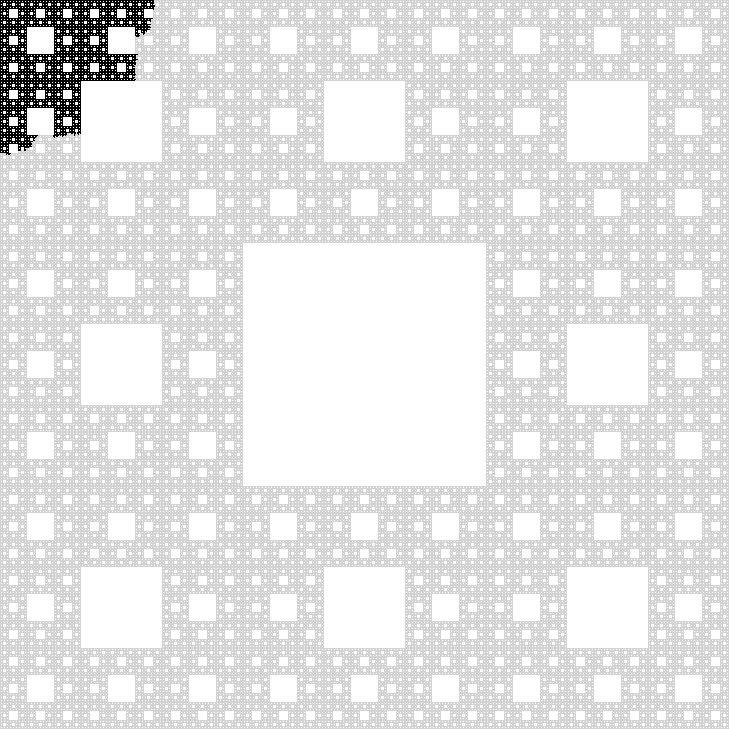 Figure 1
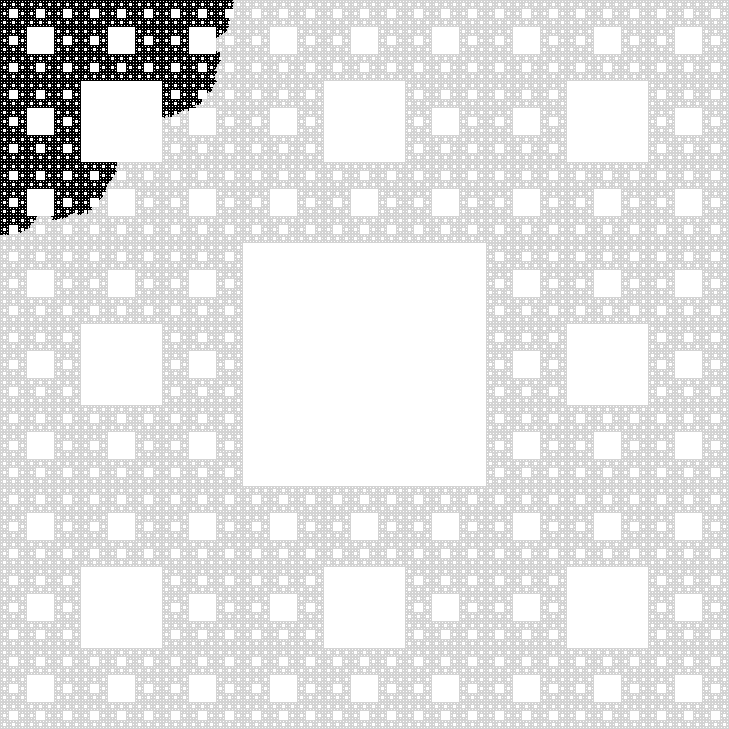 Figure 2
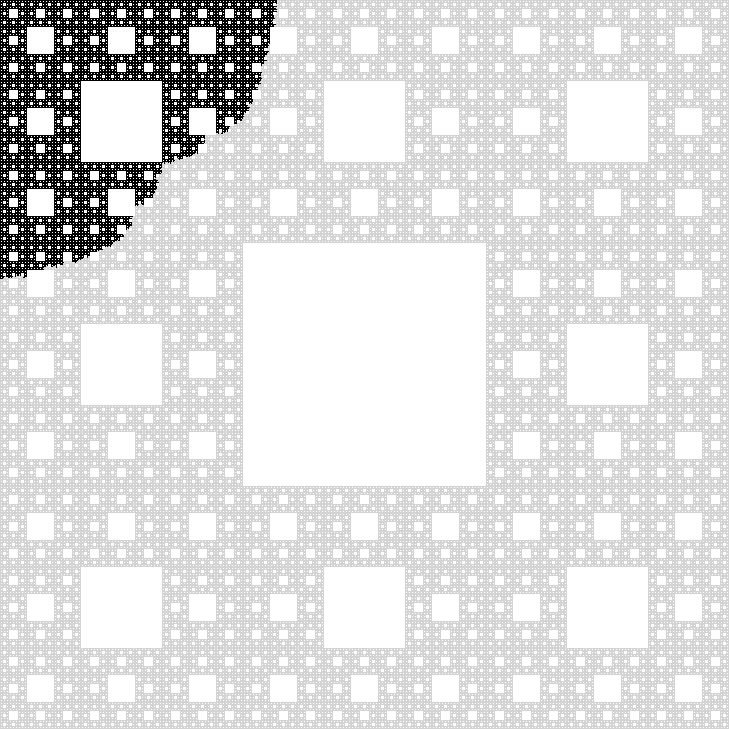 Figure 3
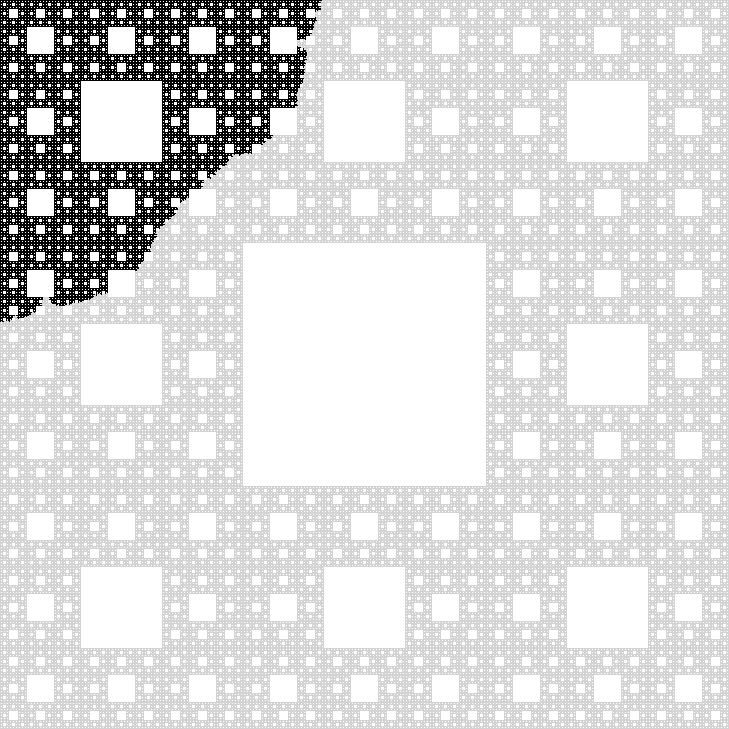 Figure 4
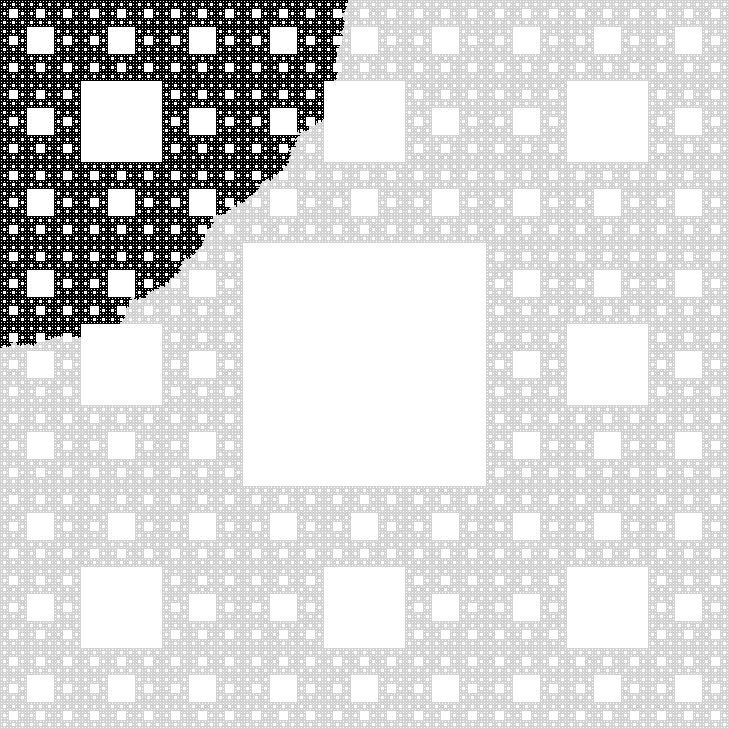 Figure 5
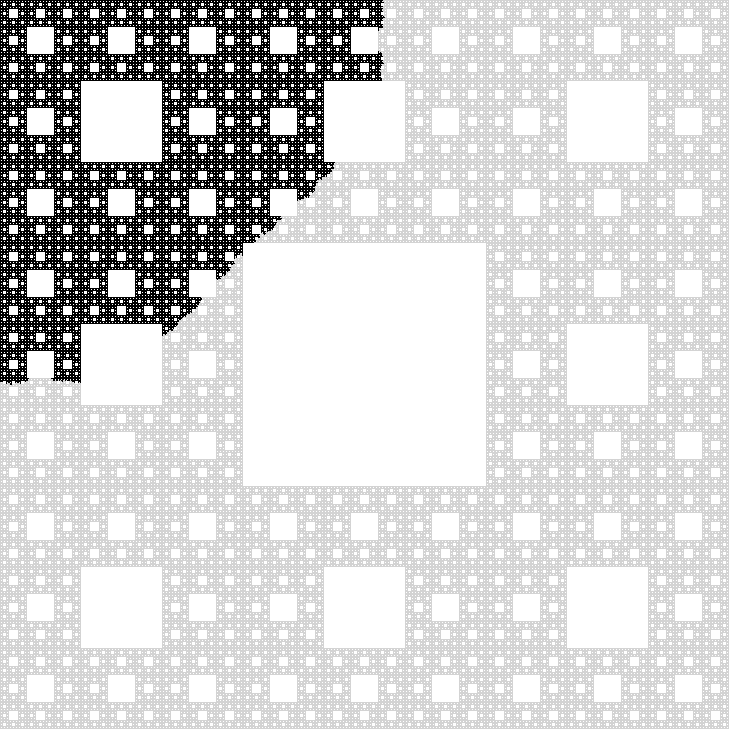 Figure 6
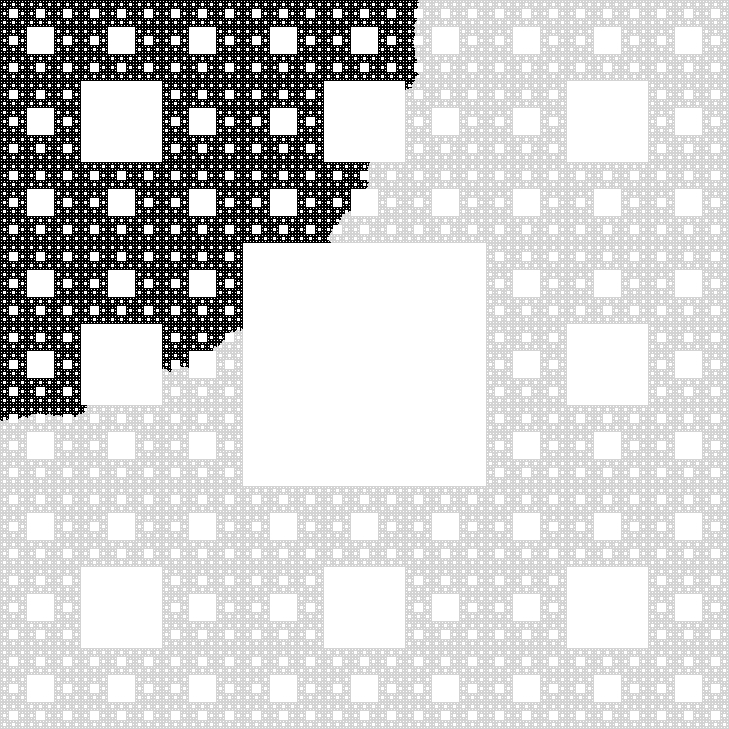 Figure 7
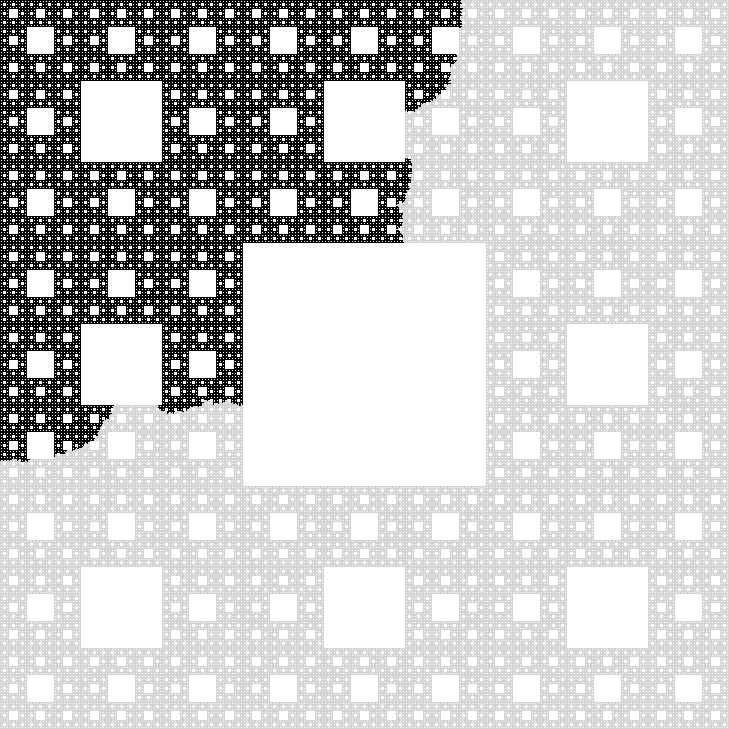 Figure 8
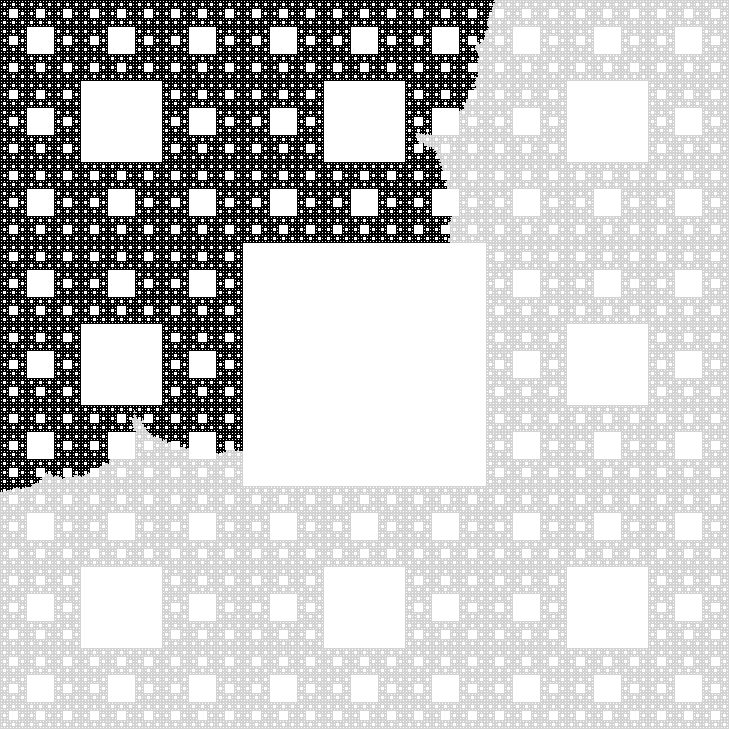 Figure 9
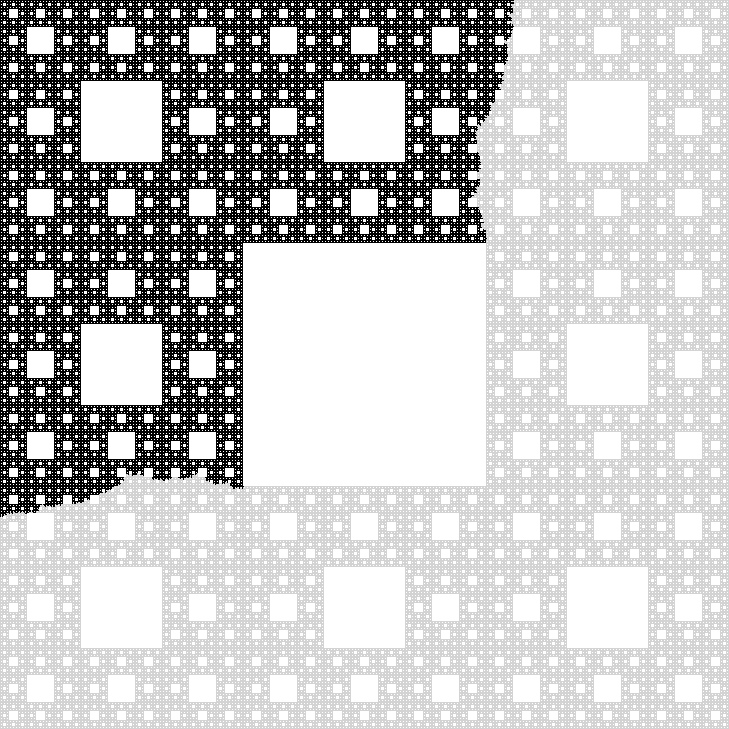 Figure 10
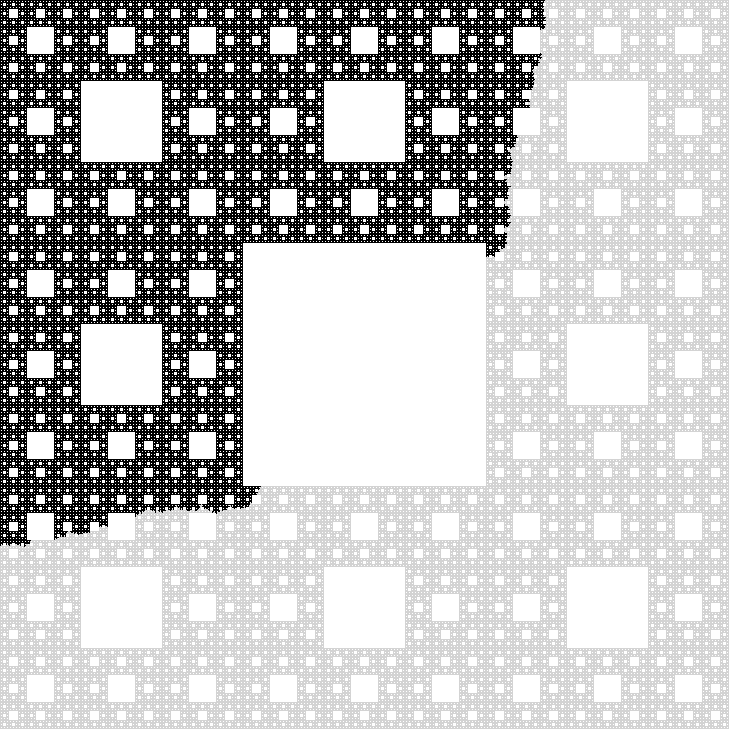 Figure 11
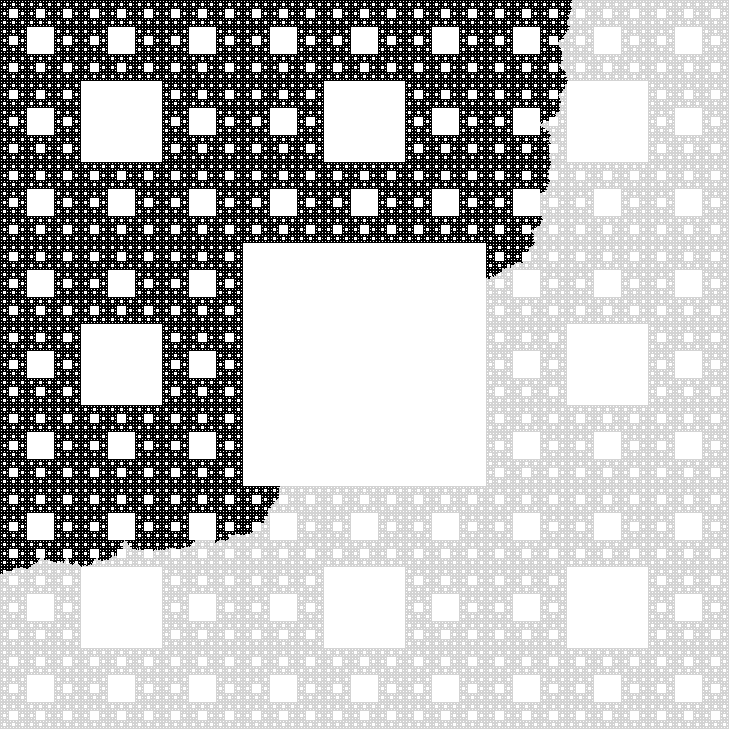 Figure 12
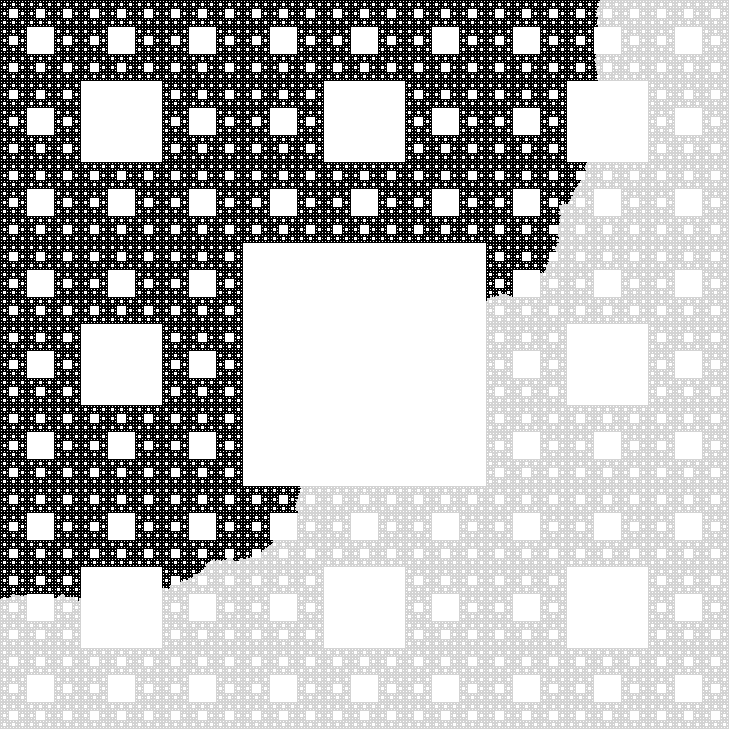 Figure 13
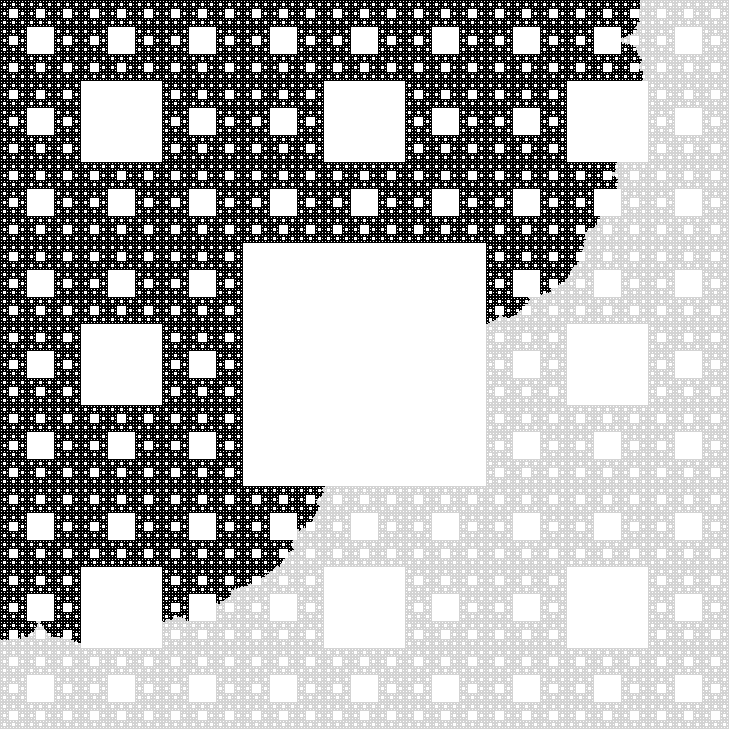 Figure 14
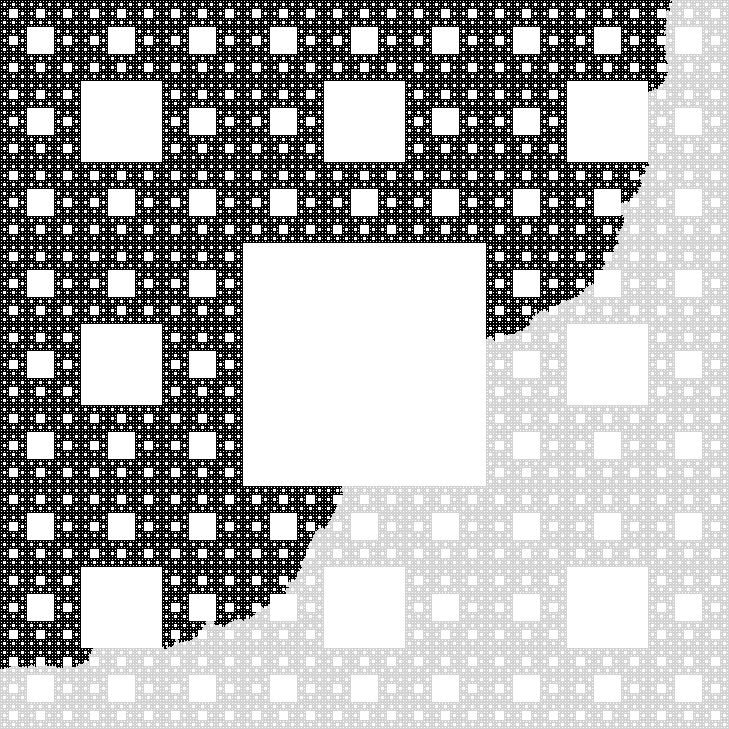 Figure 15
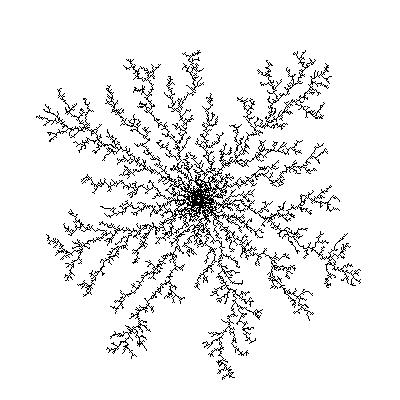 Figure 16
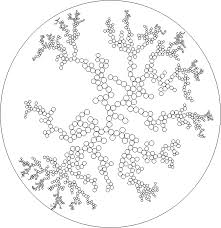 Figure 17
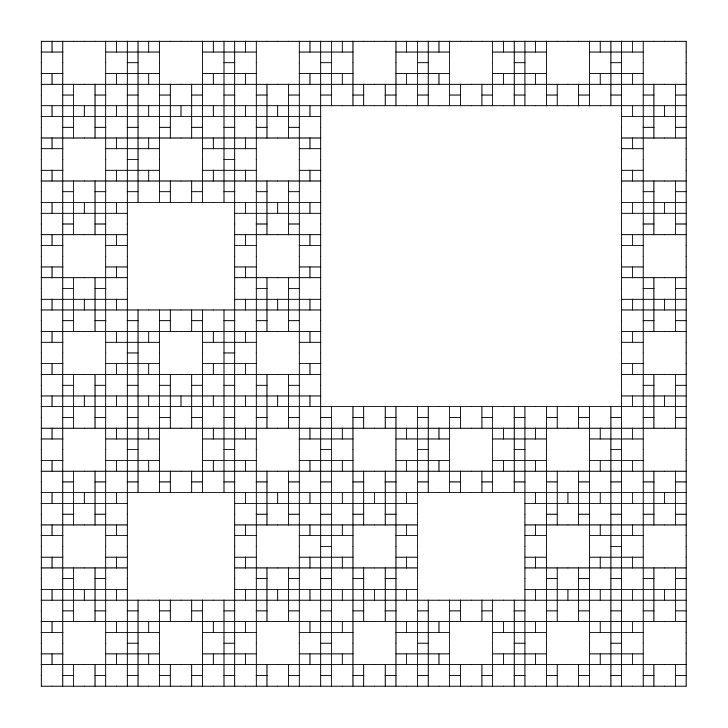 Figure 18
Peer Reviews
No public reviews on file for this paper yet. If you reviewed it on a platform where reviews are public (OpenReview, ICLR, NeurIPS, ICML), you can paste yours below so the community can read it here.
Videos
No videos yet. Explain this paper in a talk, walkthrough, or lecture? Add one.
Taxonomy
TopicsMathematical Dynamics and Fractals · Theoretical and Computational Physics · Stochastic processes and statistical mechanics
From fractals in external DLA to internal DLA on fractals
Ecaterina Sava-Huss 111Institute of Discrete Mathematics, Graz University of Technology, Austria. [email protected]; http://www.math.tugraz.at/ sava
Abstract
We present an unified approach on the behavior of two random growth models (external DLA and internal DLA) on infinite graphs, the second one being an internal counterpart of the first one. Even though the two models look pretty similar, their behavior is completely different: while external DLA tends to build irregularities and fractal-like structures, internal DLA tends to fill up gaps and to produce regular clusters. We will also consider the aforementioned models on fractal graphs like Sierpinski gasket and carpet, and present some recent results and possible questions to investigate.
Contents
1 Introduction
We consider two aggregation models initially introduced in physics in [WS83] and [MD86], and rigorously studied in mathematics over the last three decades, models for which we present a survey on the existing results and state several open problems. The models under consideration are external diffusion limited aggregation (shortly external DLA) and internal diffusion limited aggregation (shortly internal DLA). In the mathematical community, these two models started to gain interest only a couple of years after being introduced, with the first results on external DLA in [Kes87a, Kes90], and on internal DLA in [LBG92]. Only recently, these models became interesting in the fractals community: few recent results concerning external DLA on the -dimensional pre-Sierpinski carpet as defined in [Osa90], for are available. For the internal DLA on the Sierpinski gasket graph, there are also some limit shape results, but other than these two examples, there is not much known about the two growth models on other fractal graphs, where according to simulations which we present towards to end of the paper, interesting behavior may be observed. With the current overview, we would like to draw the attention on the beauty of these models.
For the rest of the paper, will be an infinite and locally finite graph, the reference state space, which will be replaced with concrete examples of graphs as needed. We denote by a fixed vertex, the origin of the graph .
External DLA was initially introduced in physics by Witten and Sander [WS83] as an example to create ordering out of chaos due to a simple rule. Mathematically, this ordering is far away from being understood, and new methods and ideas are needed in order to move forward in this direction. External DLA is a model of random fractal growth which exhibits self-organized criticality and complex-pattern formation, and which produces scale-invariant objects whose Hausdorff dimension is independent of short-range details. Moreover external DLA has no upper critical dimension as shown in [WS83]; it is a model which builds a sequence of random growing sets , starting with one particle at the origin of . At each time step, a new particle starts a simple random walk from ”infinity” (far away) and walks until it hits the outer boundary of the existing cluster, where it stops and settles. In this way, one builds a family of growing clusters; the set consists of exactly particles and it is called external DLA cluster. In spite of these very simple growth rules, only a few rigorous mathematical results about external DLA are available, results which will be surveyed below. A typical structure produced on a two-dimensional lattice is shown in Figure 1. External DLA was found to well represent growth processes in nature such as growth of bacterial colonies, electrodeposition, or crystal growth.
Internal DLA is an attempt of a model which eliminates irregularities and fills gaps, as opposed to external DLA. It was proposed by Meakin and Deutch [MD86] as a model of industrial chemical processes such as electropolishing, corrosion and etching. Diaconis and Fulton in [DF91] identified internal DLA as a special case of a “smash sum” operation on subsets of . Internal DLA is a random growth model which builds a sequence of random growing clusters based on particles performing random walks, where all the particles start from the same fixed point . Typically, one starts with , and for each , we let be plus the first point where a random walk started at exits . There are several modifications in this model, where one can start the random walks uniformly at random in the already existing cluster, or one can start with an initial configuration of particles on the state space . Results in this directions will be surveyed in the following. As in external DLA, understanding the shape of the limiting cluster , the internal DLA cluster with particles, is the main question in this model. Also, of fundamental significance as mentioned in the initial paper [MD86], is to know how smooth a surface formed by internal DLA (processes) may be. These problems are well understood mathematically on many state spaces, and there are very precise results. On the one hand, the limiting object formed from internal DLA does not show any fractal structure. On the other hand, when running internal DLA on a fractal graph, we have partial results that indicate the absence of fractal structure, though there remain many more fractal state spaces to be explored.
The crucial difference between the above two models is that the dynamics of the external model roughens the cluster, whereas the dynamics of the internal model makes the cluster smoother.
Structure of the paper. After fixing the notation and the basic notions in Section 2, we focus on the external DLA model in Section 3, in which we survey the available results on the growth of arms in this model, number of holes, and variations of the standard model. The results will not be stated in the chronological order of publication, but according to the state space they evolve on. Finally, in Section 4 we survey the results for the limit shapes of the internal DLA cluster, and we include several questions through the whole paper.
2 Preliminaries
Graphs.
Let be an infinite, locally finite graph (i.e. every vertex has finite degree denoted by ). The neighborhood relation will be denoted by , and by we mean that is an edge in . Let be a fixed distinguished vertex, which will be called the origin or the root. For , the distance represents the minimal number of edges on the path connecting with . For a subgraph of , we denote by the outer boundary of :
[TABLE]
For and , we write for the ball of radius and center in . If the center of the ball is , we write only .
Random Walks.
Let be a random walk on , and denote by the probability measure of the random walk started at . We do not fix yet the transition probabilities for the random walk, since those will change from case to case, and we will mention them as needed. For a subset , let be the hitting time of , defined as
[TABLE]
For a set with a single vertex, we write instead of . The heat kernel of the random walk is defined to be
[TABLE]
and the Green function is defined as
[TABLE]
which is well defined and finite precisely when the random walk is transient. For a subset , the killed or the stopped Green function is defined as
[TABLE]
The hitting distribution is then
[TABLE]
and is the hitting position of . If the random walk starts at , we write
[TABLE]
for the probability of the random walk starting at to first hit in , that is is the harmonic measure (from ) of the set , and .
3 External DLA
We define here formally the external DLA model, by first explaining what it means to release a particle at infinity. Several variants of external DLA have been considered, but we refer here to the original, simplest model, which can be defined on any space where the notion of random walk or diffusion exists. If the Poisson boundary consists of one point and the random walk is recurrent (for instance the case of simple random walks on and ), external DLA can be defined so that the law of the location of a new particle is the harmonic measure of the existing aggregate with pole at infinity. If the random walk is transient (such as the case of simple random walks on , with , or on regular trees of degree , -dimensional Sierpinski carpet graph, for ), one can consider the harmonic measure with a pole far away from the aggregate, let the pole go to infinity and take limits (i.e., conditioning the random walk coming from infinity to hit the cluster). That is, in defining rigorously external DLA, we have to distinguish the cases when the random walk on the infinite graph is recurrent or transient; the Poisson boundary of the random walk also plays a role in this case. We recall that the Poisson boundary of a random walk is measure space that describes the stochastically significant behavior of the walk at infinity. It provides an integral representation of the bounded harmonic functions of the random walk.
During the whole paper, when we speak about the -dimensional Sierpinski carpet graph, we shall also use the notion pre-Sierpinski carpet, and we have in mind the construction introduced in [Osa90].
We shall write for the harmonic measure from infinity, that is, for the probability to start a random walk at infinity and to hit the finite subset at the point . Depending on whether the graph is transient or recurrent, this measure can take different forms, and we cannot define it globally on any general graph here. This will be made precise in the concrete cases below.
Definition 3.1**.**
Let be an infinite graph, and a random walk on it. External DLA on is a Markov chain on finite subsets of , which evolves in the following way. Start with a single vertex , that is . Given the process at time , let be a random vertex in chosen according to the harmonic measure (from infinity) of . That is,
[TABLE]
and we set
Definition 3.2**.**
The cluster at infinity for the external DLA process on is defined as
[TABLE]
It is immediate that the external DLA cluster at time contains exactly particles. This model is hard to study. The difficulty comes from the fact that the dynamics is neither monotone nor local (meaning that if big tentacles surround a vertex , than will never be added to the cluster). By non-monotonicity we mean that there is no coupling between the external DLA starting from a cluster and another from a cluster such that, at each step, the inclusion of the clusters remains valid almost surely. Understanding the shape of as and the fractal nature of this object, are problems one would be typically interested in. While mathematically this is out of reach for the time being, there are other partial results concerning the growth of arms and the number of holes in external DLA.
3.1 Integer lattices
In this subsection the state space for the external DLA process is , . Even for , there are no results that prove the fractal nature of the limiting object, or results that prove the zero density in the long run. The first rigorous results go back to Kesten [Kes87a, Kes90], who gives estimates on the growth of arms in external DLA. Since for , the behavior of standard external DLA is trivial, we consider , and let be a simple random walk on .
For , for any finite nonempty subset , we have with probability one, and we define the harmonic measure (from infinity) of
[TABLE]
where denotes the Euclidean norm of . The limit corresponds to ”releasing the particle at infinity”. In this case, is recurrent, so that by [Spi76, Theorem 14.1] the limit in (2) exists and .
For , since the random walk is transient, the limit in (2) is identically zero (cf [Spi76, Proposition 25.3]). So in order to obtain a nontrivial limit similar to the one in (2), we have to condition on being finite. This conditioning gives the factor of the capacity of the set in the denominator. In the case , we define the harmonic measure (from infinity) of a finite subset as
[TABLE]
which is proportional to the so-called equilibrium measure associated to the set . The limit in (3) exists again by [Spi76, Proposition 26.2] for (the same proof works also for ) and satisfies . Therefore, we have a valid definition for external DLA, and we let to be the radius of , defined as
[TABLE]
Theorem 3.3**.**
[Kes87b*, Theorem]** and [Kes87a, Corollary]
There exist constants such that with probability *
[TABLE]
The proof uses classical estimates for the harmonic measure (from infinity) as defined in (2) and (3) and for the hitting probabilities. Simulations actually indicate that for , but as far as the lower bound is concerned, nothing has been proven beyond in the 35 years since the model has been introduced. It would be very interesting to prove even a logarithmic correction, i.e. to prove that . On , a lower bound on the number of vertices in which are occupied by the cluster is known.
Theorem 3.4**.**
[Kes90, Theorem 2]** There exist constants such that with probability
[TABLE]
Another non-trivial result on concerns the number of holes in the external DLA cluster . A hole of is a finite connected component of .
Theorem 3.5**.**
[EW99]** For any finite connected subset of we have
[TABLE]
Theorem 3.3 has been improved in [BY17], where upper bounds on the growth rate of arms in external DLA cluster are given on a big class of transient graphs such as: transitive graphs of polynomial growth of degree ; transitive graphs of exponential growth; ; non-amenable graphs; -dimensional pre-Sierpinski gasket graphs () as introduced in [Osa90]. In particular, on the factor from Theorem 3.3 has been improved to On the class of transient graphs considered in [BY17], the harmonic measure (from infinity) of a set is defined as in (3).
A directed version of external DLA has been recently introduced on in [Mar17]. In a series of three papers [AABK16, AAK17, Ami17], a one-dimensional external DLA model based on random walks with long jumps (that depend on a parameter ) is proposed, which tries to capture the fractal nature of the standard DLA. Depending on the values of , the random walk with long jumps on may be recurrent or transient, and for the precise definition of harmonic measure from infinity we refer to those three papers. The main results of [AABK16, AAK17] can be summarized into the following theorem.
Theorem 3.6**.**
Let be a symmetric random walk on that satisfies . Let be the diameter of the external DLA cluster . Then almost surely:
- (a)
If , then , where depends only on . 2. (b)
If , then , where . 3. (c)
If , then . 4. (d)
If , then , where and . 5. (e)
If , then , where .
The last one [Ami17] from the series of three papers mentioned above deals with the cluster at infinity , and it is shown that for random walks whose step size has finite third moment, has a renewal structure and positive density. In contrast, for random walks whose step size has finite variance, the renewal structure no longer exists and has zero density.
Theorem 3.7**.**
[Ami17, Theorem 1]** Assume that the step distribution of the random walk on satisfies for any and some . There exists some such that a.s. has density . Further, is the limit density of :
[TABLE]
Theorem 3.8**.**
[Ami17, Theorem 2]** Assume that there exist and constants so that satisfies for all then a.s.
[TABLE]
In particular, has zero density in the sense that .
The results mentioned above are the only ones available for external DLA on , and the limit shape and the density problem for still resist a mathematical proof. There are many open problems and questions in this direction; see [BY17] for more details.
Conjecture 3.9**.**
On , the rate of growth of the radius of the external DLA cluster started at is of order :
[TABLE]
Question 3.10**.**
What is the distribution of the number of ends of the cluster at infinity on ?
Concerning recent progress on external DLA in a wedge of , we refer to [PRZ18]. Furthermore, the reach of Kesten’s idea is extended to non-transitive graphs in [PZ19], where the (horizontally) translation invariant stationary harmonic measure on the upper half plane with absorbing boundary condition is defined and it is shown that the growth of such stationary harmonic measure in a connected subset intersecting x-axis is sub-linear with respect to the height; see also [PZ18, PYZ19] where the stationary harmonic measure as a natural growth measure for external DLA model in the upper planar lattice is investigated.
3.2 Trees
One reason that makes the lattice case hard to investigate is that there is no simple way to describe the harmonic measure (from infinity) for the boundary of an external DLA cluster on . On other state spaces, such as trees, which have no loops, the model is more tractable and the harmonic measure (from infinity) can be understood. In [BPP97], an adjusted version of external DLA on -regular trees , where the fingering phenomenon occurs, was introduced. The dynamics of their model is as follows: the initial cluster contains only the root. Vertices are then added one by one from among those neighboring the current subtree. The choice of which vertices to add is random, with vertices in generation (i.e. distance from the root) chosen with probabilities proportional to where is a fixed parameter. Then is the subtree at step and let denote the maximum height of a vertex in , which is similar to the radius in (4). For this model, for a finite subtree with boundary , its harmonic measure (from infinity) on , with parameter can be computed as
[TABLE]
see Definition on page 4 in [BPP97]. In the latter paper, the case is studied. The external DLA cluster is the position at time of the Markov chain defined in Definition 3.1, where is obtained from by adding a new vertex according to the harmonic measure defined in the previous equation. For it is easy to see that is almost surely the entire tree. For , one has the uniform measure on (this corresponds to the Eden model). From the external DLA perspective, the case is the interesting one, where one obtains the so-called fingering phenomenon. For this external DLA model, [BPP97] obtained a strong law and a central limit theorem for the height of the DLA cluster.
Theorem 3.11**.**
Let be a d-regular tree and . There exist constants and such that
- (a)
* a.s.* 2. (b)
* as .*
The model considered here can be also interpreted as a model of first passage percolation on .
3.3 Hyperbolic plane
In [Eld15], external DLA on the hyperbolic plane is considered, and it is shown that the cluster at infinity almost surely admits a positive upper density. For completeness, we recall the definition of the upper density of a set, as used in [Eld15]. In a metric measure space whose diameter is infinite, we say that a locally finite set has an upper density greater or equal to if there exist a point and a sequence such that as , such that
[TABLE]
where is a metric ball centered at with radius and is the measure defined on . On the hyperbolic plane, one can use this definition with the standard hyperbolic distance as a metric and the standard Riemannian volume of a set as a measure.
In the hyperbolic setting the behavior of the aggregate is simpler to analyze than the Euclidean one; the rate of decay of the hyperbolic potential plays an important role in understanding the external DLA.
See Figure 2 for a picture of external DLA model with 1000 particles, viewed on the Poincaré disc model.
In his construction, particles are metric balls of radius , , where is a fixed point in , and recursively , where is added to the aggregate according to a (harmonic) measure with pole at infinity that has to be carefully constructed on , such that external DLA makes sense in this setting. For details on this construction, we refer to [Eld15]; the main result of his paper reads as following.
Theorem 3.12**.**
[Eld15, Theorem 1.1]** The external DLA cluster at infinity almost surely has an upper density greater than , where is an universal constant.
We would like to point out the fact that the behavior of external DLA on the hyperbolic plane and on the regular tree as considered in [BPP97] is completely different, even though the hyperbolic plane has a tree-like structure.
3.4 Cylinder graphs
Other results on external DLA that are worth mentioning have been proven in [BY08] on cylinder graphs . Let us first fix the notation for the graphs we consider below. Let be a finite, connected graph. The cylinder graph with base , denoted by , is defined as: the vertex set of is , where represents the vertex set of . The edge set is defined by the following relations: for all and all , , that is between vertices and there is an edge in , if and only if and in , or and . Equivalently, the cylinder with base is obtained by just placing infinitely many copies of one over the other, and connecting each vertex in a copy to its corresponding vertices in the adjacent copies.
On , particles perform simple random walks from infinity. Since is finite, such random walks are recurrent on , and the harmonic measure from infinity can be defined similar to the one on , as in (2). That is, vertices are added to the existing cluster according to the measure in (2). Denote by the induced subgraph on the vertices of , for all , and call the -th level of the cylinder graph . One of the results proven in [BY08] is that external DLA on grows arms if the base graph mixes fast. Recall that the mixing time of the simple random walk on is the time it takes for the random walk to come close in total-variation distance to the stationary distribution.
Theorem 3.13**.**
[BY08, Theorem 2.1]** Let . There exists , such that the following holds for all : let be a -regular graph of size , and mixing time . Let be the external DLA process on with , and for , let be the first time the DLA cluster reaches . Then, for all , .
This phenomenon is often referred to as the aggregate grows arms, i.e. grows faster than order particles per layer. As mentioned in [BY08], the result above is believed not to be optimal, and a stronger result is conjectured.
Conjecture 3.14**.**
[BY08, Conjecture 2.2]** Let be a family of -regular graphs such that . There exists and such that for all the following holds: consider the cylinder graph with base and let be the external DLA process on with being the zero layer of the cylinder graph, and be the first time the external DLA cluster reaches level on the cylinder graph . Then, for all , .
Concerning the density of the limit cluster at infinity , for cylinder graphs with base , in the same paper there are two results. To state them, let us define the empirical density of particles in the finite cylinder as
[TABLE]
and the density at infinity as . Using standard arguments from ergodic theory one can show that the above limit exists, and is constant almost surely. The next result relates the density at infinity to the average growth rate.
Theorem 3.15**.**
[BY08, Theorem 4.2]** For the external DLA process on , where is a -regular graph of size , we have
[TABLE]
In [BY08, Theorem 4.6] the previous result has been improved to for the case when the base graph is a vertex transitive graph. Finally, for a family of base graphs with small mixing time, the following holds.
Theorem 3.16**.**
[BY08, Theorem 4.8]** Let be a family of -regular graphs () such that , and for all ,
[TABLE]
Let be the density at infinity of the external DLA process on . Then .
We refer to the last section of [BY08] for several open questions and problems concerning external DLA on cylinder graphs. Many of the bounds from the previous three results can be improved, with some careful technicalities and assumptions on the base graph .
3.5 Fractal graphs
The appearance of fractal-like structures in DLA models (both internal and external) and their behavior on fractal graphs is the main theme of this paper, and we would like at this point to introduce two fractal graphs: the Sierpinski gasket graph and the Sierpinski carpet graph (called also pre-Sierpinki carpet).
Sierpinski gasket graph is a pre-fractal associated with the Sierpinski gasket, defined as follows. We consider in the sets and
[TABLE]
Now recursively define by
[TABLE]
and
[TABLE]
where . Let , , and . Then the doubly infinite Sierpinski gasket graph is the graph with vertex set and edge set . See Figure 3 for a graphical representation of . Set the origin . External DLA on seems to be an approachable problem, due to the fact that is a post-critically finite fractal, and the existence of cut points simplifies the understanding of the harmonic measure from infinity, which can be defined again as in (2), since the random walk on is recurrent. We refer the reader to [Bar98] and [Kig01] for more details on analysis and diffusion on fractals.
Sierpinski carpet graph , called also -dimensional pre-Sierpinski carpet, is an infinite graph derived from the Sierpinski carpet. is constructed from the unit square in by dividing it into equal squares and deleting the one in the center. The same procedure is then repeated recursively to the remaining squares. As mentioned in the introduction, we use the construction of the pre-Sierpinski carpet as in [Osa90]. Recall that in this construction, the length scale factor is and the mass scale factor is . For random walks on such graphs see [BB99] and the references therein. See Figure 4 for a finite piece of Sierpinski carpet graph in dimension .
For , simple random walk on is transient, and the harmonic measure from infinity for a finite subset is defined by using the capacity of and the equilibrium measure of , similar to (3). More details on the construction can be found in [BY17], where upper bounds for the arms of external DLA on a large class of transient graphs, including , , are proved. Their proofs are based on good control of heat-kernel estimates. The bounds for read as following.
Theorem 3.17**.**
[BY17, Theorem 5.5]** Let be the -dimensional Sierpinski carpet graph, and the external DLA process on started at ( is some fixed origin). Then almost surely,
[TABLE]
where
[TABLE]
When , we have almost surely,
[TABLE]
where
We would like to conclude the section on external DLA with a couple of problems/questions.
Question 3.18**.**
Can one find an upper bound for the growth of arms in external DLA on and on (the random walk is strongly recurrent on these two graphs)? Can one extend the method Kesten used to upper bound the growth of arms in external DLA on ?
Question 3.19**.**
Do we have zero density at infinity of the cluster on the Sierpinski gasket graph ?
Question 3.20**.**
Does the external DLA cluster on the Sierpinski gasket graph and on the Sierpinski carpet graph have infinitely many holes, with probability one, as in the case of as proven in [EW99]?
Other than and there is a variety of other fractal graphs one can look at, and investigate the behavior of external DLA, which can be easier than .
Question 3.21**.**
Assuming that the Poisson boundary of the random walk on the graph is non trivial, is there a characterization of the Poisson boundary in terms of the number of ends of the external DLA cluster at infinity on ?
4 Internal DLA
Internal DLA can be defined on any infinite graph ; fix as above a vertex of and call it the origin. The internal DLA cluster is built up one site at a time, by letting the -th particle perform a random walk until it exits the set of sites already occupied by the previous particles, the walk of the -th particle being independent of the past. Similarly to external DLA, internal DLA is also a Markov chain on finite subsets of .
Definition 4.1**.**
Let be an infinite graph, and a simple random walk on starting at . Internal DLA on is a Markov chain on finite connected subsets of , which evolves in the following way. Start with a single vertex and set . Given the process at time , let be a random vertex in chosen according to the harmonic measure (from ) of , as defined in (1). That is, is the first exist location from of the simple random walk starting from , independent of the past:
[TABLE]
and we set
The set is called the internal DLA cluster at time , and it contains particles. As , we are interested in the asymptotic shape of internal DLA cluster , and the fluctuations of the cluster around the limiting shape. Due to the fact that the harmonic measure for ”nice subsets” (for example balls) of , when is an Euclidean lattice, or a regular tree, is easier to understand than the harmonic measure from infinity as in the external DLA case, for the internal DLA model we have very precise estimates on many state spaces. Moreover, several variations of the classical internal DLA have been introduced.
4.1 Integer lattices
The first result concerning the internal DLA goes back to [LBG92], where it is shown that the limit shape of internal DLA cluster is a ball, in the following sense. Let be the volume of the -dimensional Euclidean ball of radius 1, and be the -dimensional ”lattice ball” of radius , that is, , where denotes the Euclidean norm of .
Theorem 4.2**.**
[LBG92, Theorem 1]** At time , internal DLA cluster occupies a set of sites close to a -dimensional ball of radius . More precisely, for any , with probability
[TABLE]
In this first paper, a basic open question on fluctuations (deviation of from the Euclidean ball) was asked: are the fluctuations of order , of order for some , or even smaller? Lawler [Law95] proved that for , the fluctuations are subdiffusive and they are of order at most . While it was conjectured that the fluctuations are at most logarithmic in the radius, this resisted a mathematical proof for about 20 years. Two independent groups Jerison, Levine, and Sheffield [JLS12, JLS13, JLS14a] and Asselah and Gaudillière [AG14, AG13a, AG13b], and by different methods have shown that indeed, for there are fluctuations, and for , there are fluctuations in the radius. A summary of their results reads as following.
Theorem 4.3**.**
If , there is an absolute constant , such that with probability ,
[TABLE]
If , there is an absolute constant , such that with probability ,
[TABLE]
A generalization of the classical internal DLA on was treated in [LP10], where instead of running all particles from the origin, the authors run the process from an arbitrary starting configuration of particles (initial density of particles) on finer and finer lattices, all particles still performing simple random walks. They then show that, as the lattice spacing tends to zero, the internal DLA has a deterministic scaling limit which can be described as the solution to a certain PDE free boundary problem in . We do not state here the rigorous result, which requires more notation and definition, but refer to the lengthy and complex paper [LP10]. In order to study this general model, a new model called divisible sandpile was introduced in [LP09], which uses a continuous amount of mass instead of discrete particles.
The divisible sandpile model can be briefly described as following: start with an initial mass at the origin . A vertex is called full if it has mass at least . Any full site can topple by keeping mass for itself and distributing the excess mass equally among its neighbors. At each time step, one chooses a full site and topples it. As time goes to infinity, provided each full site is eventually toppled, the mass approaches a limiting distribution in which each site has mass ; this is proved in [LP09]. Individual topplings do not commute, but the divisible sandpile is abelian in the sense that any sequence of topplings produces the same limiting mass distribution; this is proved in [LP10, Lemma 3.1]. The set of sites with limit mass distribution equal to is denoted by and is called the divisible sandpile cluster. The asymptotic shape of the divisible sandpile cluster is proven to be the same as the one of the internal DLA cluster on in [LP09], on regular trees in [Lev09], on comb lattices in [HS12], and on Sierpinski gasket graphs in [HSH19].
Random walks with drift on .
If one lets the particles which build up the internal DLA cluster perform drifted random walk instead of simple random walk as in the classical model, one can again ask about the shape of the limit cluster on any state space. On , this was open for several years, and the cluster was believed to be represented by the level sets of the Green function for the drifted random walk. This fact has been disproved, and with the help of the divisible sandpile model, in [Luc14] it was proven that the internal DLA cluster is a true heat ball, because it gives rise to a mean-value property for caloric functions. The author introduced there the unfair divisible sandpile, where the mass is not distributed equally to the neighbors, but according to the one-step probabilities of the drifted random walk; the limit shape for the unfair divisible sandpile on was also described there. The main result for the limit shape for drifted internal DLA can be found in [Luc14, Theorem 1.1], and for the limit shape of the unfair divisible sandpile cluster in [Luc14, Theorem 3.3].
Uniform starting points.
To my knowledge, the most recent result for internal DLA on , concerns the limit shape for the cluster when the particles do not all start from the same vertex . Instead the starting position is chosen uniformly at random in the existing cluster. Formally, one can define the internal DLA as in Definition 4.1, starting with , and given the process at time , let be the first exit location from of the simple random walk starting at , where is a point chosen uniformly on , independent of the past. Set . It turns out, as shown in [BDCKL19], that this additional source of randomness arising from the choice of the initial position of the random walk, does not change the limit shape of the process, as the result below shows. Let .
Theorem 4.4**.**
[BDCKL19, Theorem 1.1]** Let . There exist constants and depending only on the dimension such that, almost surely, the internal DLA cluster with uniform starting points satisfies
[TABLE]
Question 4.5**.**
What can we say about the fluctuations of the internal DLA cluster with uniform starting points around the limit shape? Are they bigger (smaller) that the fluctuations for internal DLA when all particles start their random walk from the same vertex ?
Supercritical percolation cluster on : In [She10], the underlying state space for the internal DLA model is the supercritical bond percolation cluster on , with the origin conditioned to be in the infinite cluster. It is shown in [She10, Theorem 1.1] that an inner bound for the internal DLA cluster is a ball in the graph metric. The picture for the outer bound was completed in [DCLYY13, Theorem 1.1], where the authors show that also in this case the limit shape is a ball. The results in their paper hold in a more general setting: given the existence of a ”good” inner bound for internal DLA, one can also prove a matching outer bound by using their methods. An interesting problem in the context of internal DLA model on a random graph is to understand the fluctuations.
4.2 Comb lattices
The 2-dimensional comb lattice is the spanning tree of obtained by removing all horizontal edges, except the ones on the -axis. While is a simple graph, see Figure 5, it has some remarkable properties in what concerns the behavior of random walks: no form of the so-called Einstein relation for exponents associated with random walks hold on , see [Ber06]. Peres and Krishnapur [KP04] showed that on two independent simple random walks meet only finitely often. The comb is an example where the limit shape of internal DLA is not a ball in the graph metric or in another standard metric. Indeed, the diameter of the internal DLA cluster with particles grows like in the -direction, and like in the -direction. See Figure 6 for a picture of the internal DLA cluster with 100, 500, and 1000 particles, respectively.
Let
[TABLE]
where the constants and are given by
[TABLE]
The inner bound for the limit shape of internal DLA cluster on was proven in [HS12, Theorem 4.2], while the outer bound together together with the fluctuations was proven in [AR16].
Theorem 4.6**.**
[AR16, Theorem 1.2]** There is a positive constant such that with probability , and large enough
[TABLE]
Remark that this result does not mean that the fluctuations are sub-logarithmic, but rather gaussian; see [AR16, Theorem 1.2] and the comments afterwards. In [HS12, Theorem 3.5] we also prove that the limit shape for the divisible sandpile cluster on is given by the set .
4.3 Trees
Internal DLA on discrete groups with exponential growth has been studied in [BB07]. The homogeneous tree is a particular case (as a Cayley graph of a free group) of these state spaces, for which the authors have proven that the limit shape of internal DLA cluster is a ball in the graph metric, and they give lower bounds for the inner and outer error. The more general result is the following.
Theorem 4.7**.**
[BB07, Theorem 3.1]** Let be a finitely generated group of exponential growth, and consider the internal DLA model on , built up with symmetric random walks with finitely supported increments, starting at the identity of . Then, for any constants and ,
[TABLE]
where is a constant that ensures that the ball contains the boundary , and is the ball of radius centered at the identity in the word metric on .
An extension of this result to non-amenable graphs for a wide class of Markov chains was considered in [Hus08]. On discrete groups with polynomial growth, internal DLA has been considered in [Bla04].
4.4 Cylinder graphs
Like in Section 3.4, we consider here cylinder graphs , and we let to be the cycle graph on vertices. Internal DLA on cylinder graphs was investigated in [JLS14b], for the following initial setting. For , the set is called the -th level of the cylinder, and the *rectangle of height * . Let , and given the cluster at time , let be the first exit location from of a random walk that starts uniformly at random on level zero of the cylinder, independent on the past, that is, the starting location is chosen with equal probability among the sites , for . We then set . It has been proven in [JLS14b, Theorem 2] that the limit shape of internal DLA clusters on is logarithmically close to rectangles, result that we do not state in complete form here, but instead we state a more recent result due to Levine and Silvestri [LS18, Theorem 1.1] which generalizes the previous one [JLS14b] (here the fluctuations are described in terms of the Gaussian Free Field exactly). Remark that in the cylinder setting, there are two parameters, the size of the cycle base graph, and the time .
Theorem 4.8**.**
[LS18, Theorem 1.1]** Let be the internal DLA process on starting from . For any , there exist a constant such that
[TABLE]
For other results concerning the fluctuations and the behavior of internal DLA clusters on , we refer to [LS18].
4.5 Fractal graphs
We would like to conclude the section about internal DLA with the behavior of the model on Sierpinski gasket graphs . Recall the definition of the Sierpinski gasket graph and of the Sierpinski carpet graph , as given in Section 3.5. Due to the symmetry of , it is clear that the limit shape of the internal DLA cluster on is a ball in the graph metric, a result proved in [CHSHT19].
Theorem 4.9**.**
[CHSHT19, Theorem 1.1]** On , the internal DLA cluster of particles occupies a set of sites close to a ball of radius . That is, for all , we have
[TABLE]
with probability 1.
A limit shape for the divisible sandpile on was described in [HSH19]. Concerning the fluctuations for internal DLA, it is conjectured that they are sub-logarithmic.
Conjecture 4.10**.**
[CKF19, Conjecture 4.1]** There exists such that
[TABLE]
Many other questions concerning internal DLA on fractal graphs can be found in the final section of [CKF19].
Question 4.11**.**
Is the limit shape for the internal DLA model with uniform starting points on , again a ball in the graph metric? What about the fluctuations in this case?
A reason why is easier to work with is because 1) it is a finitely ramified fractal graph, and 2) we have a precise characterization of the divisible sandpile model on , thanks to the finite ramification and the symmetries it possesses. In contrast, is infinitely ramified, and characterizing the harmonic measure thereon is a challenging open question in the study of analysis on fractals. So at the moment it is very difficult to analyze growth models on . See Figure 7 for the behavior of internal DLA on .
Question 4.12**.**
Does the internal DLA cluster on the 2-dimensional Sierpinski carpet graph have a (unique) scaling limit? What can one say about the boundary of the limit shape, which according to simulations appears to be of fractal nature?
Question 4.13**.**
What is the limit shape of internal DLA on fractal graphs, other that (which is understood) and (which seems hard to investigate)?
Since in most cases, the limit shape for internal DLA is a ball (in the graph metric, or Euclidean metric, or word metric), a more general question to ask is about the state space for the process.
Question 4.14**.**
What properties should the state space and the random walk on it have, in order for the internal DLA cluster on to have a ball as limit shape?
We would like to conclude this survey with the remark that fractals provide a class of state spaces with intriguing properties, both for the behavior of the external and internal DLA model, respectively. This behavior is definitely not fully understood on such graphs, and we hope to attract more people from the fractal community into the beauty of these topics.
Acknowledgements.
I am very grateful to the anonymous referee for a very careful reading of the manuscript and for several useful comments that improved the paper substantially.
The reference list from the paper itself. Each links out to its DOI / PubMed record.
- 1[AABK 16] Gideon Amir, Omer Angel, Itai Benjamini, and Gady Kozma. One-dimensional long-range diffusion-limited aggregation I. Ann. Probab. , 44(5):3546–3579, 2016.
- 2[AAK 17] Gideon Amir, Omer Angel, and Gady Kozma. One-dimensional long-range diffusion limited aggregation II: The transient case. Ann. Appl. Probab. , 27(3):1886–1922, 2017.
- 3[AG 13a] Amine Asselah and Alexandre Gaudillière. From logarithmic to subdiffusive polynomial fluctuations for internal DLA and related growth models. Ann. Probab. , 41(3A):1115–1159, 2013.
- 4[AG 13b] Amine Asselah and Alexandre Gaudillière. Sublogarithmic fluctuations for internal DLA. Ann. Probab. , 41(3A):1160–1179, 2013.
- 5[AG 14] Amine Asselah and Alexandre Gaudillière. Lower bounds on fluctuations for internal DLA. Probab. Theory Related Fields , 158(1-2):39–53, 2014.
- 6[Ami 17] Gideon Amir. One-dimensional long-range diffusion-limited aggregation III—The limit aggregate. Ann. Inst. Henri Poincaré Probab. Stat. , 53(4):1513–1527, 2017.
- 7[AR 16] Amine Asselah and Houda Rahmani. Fluctuations for internal DLA on the comb. Ann. Inst. Henri Poincaré Probab. Stat. , 52(1):58–83, 2016.
- 8[Bar 98] Martin T. Barlow. Diffusions on fractals. In Lectures on probability theory and statistics (Saint-Flour, 1995) , volume 1690 of Lecture Notes in Math. , pages 1–121. Springer, Berlin, 1998.