Longitudinal spin asymmetries in polarized deuteron DIS with spectator tagging
W. Cosyn, C. Weiss

TL;DR
This paper explores how polarized electron-deuteron deep-inelastic scattering with spectator proton tagging can precisely measure neutron spin structure functions, accounting for nuclear effects using light-front nuclear structure methods, and proposes feasible experimental setups at future colliders.
Contribution
It introduces a novel approach to extract neutron spin structure functions using spectator tagging and analyzes the associated nuclear structure factors with light-front methods.
Findings
Two-state deuteron spin asymmetry allows accurate extraction of $g_{1n}$.
Measurement feasibility at future electron-ion colliders is demonstrated.
Nuclear effects can be controlled with spectator proton tagging.
Abstract
Polarized electron-deuteron DIS with spectator proton tagging offers a way of measuring the neutron spin structure functions with maximal theoretical control of nuclear effects. We calculate the nuclear structure factors in the longitudinal double-spin asymmetries using methods of light-front nuclear structure. A unique feature of the spin-1 system is that spin asymmetries can be formed either relative to the cross section in all three spin states () or in the two maximum-spin states only (, involving tensor polarization). We find that the two-state deuteron spin asymmetry at small spectator proton momenta permits accurate extraction of the neutron structure function . Such measurements could be performed at a future electron-ion collider (EIC) with polarized deuteron beams and suitable forward detectors.
Click any figure to enlarge with its caption.
 Figure 1
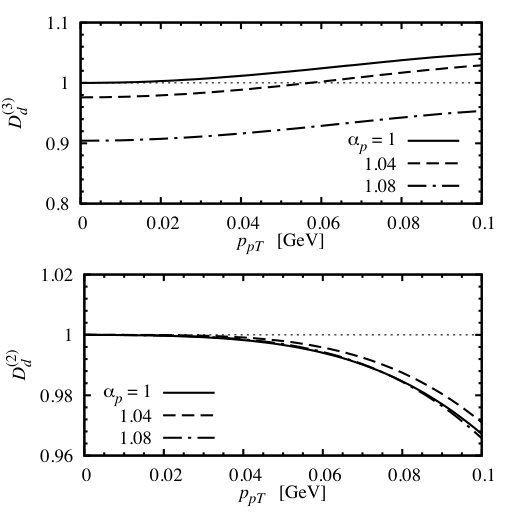 Figure 2
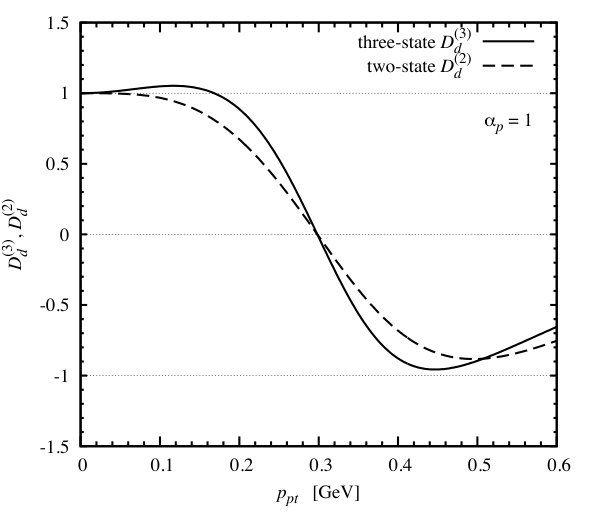 Figure 3
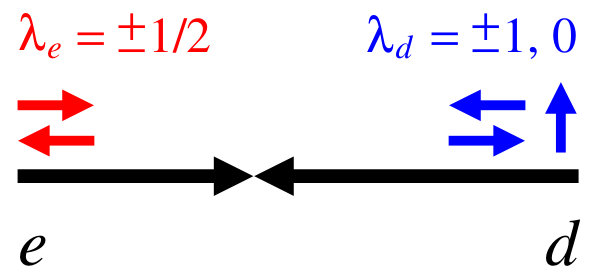 Figure 4
Peer Reviews
No public reviews on file for this paper yet. If you reviewed it on a platform where reviews are public (OpenReview, ICLR, NeurIPS, ICML), you can paste yours below so the community can read it here.
Videos
No videos yet. Explain this paper in a talk, walkthrough, or lecture? Add one.
Taxonomy
TopicsNuclear physics research studies · Quantum Chromodynamics and Particle Interactions · Rare-earth and actinide compounds
Longitudinal spin asymmetries in polarized deuteron DIS with spectator tagging
Department of physics and Astronomy, Ghent University, Proeftuinstraat 86, B9000 Ghent, Belgium
C. Weiss
Theory Center, Jefferson Lab, Newport News, VA 23606, USA
Abstract:
Polarized electron-deuteron DIS with spectator proton tagging offers a way of measuring the neutron spin structure functions with maximal theoretical control of nuclear effects. We calculate the nuclear structure factors in the longitudinal double-spin asymmetries using methods of light-front nuclear structure. A unique feature of the spin-1 system is that spin asymmetries can be formed either relative to the cross section in all three spin states () or in the two maximum-spin states only (, involving tensor polarization). We find that the two-state deuteron spin asymmetry at small spectator proton momenta permits accurate extraction of the neutron structure function . Such measurements could be performed at a future electron-ion collider (EIC) with polarized deuteron beams and suitable forward detectors.
1 Introduction
Deep-inelastic electron scattering on the deuteron with detection of a proton in the nuclear fragmentation region (“spectator tagging”), , represents an essential tool for studies of nucleon structure and its nuclear modifications. The measurement of the proton recoil momentum ( 100 MeV in the deuteron rest frame) controls the nuclear configuration during the high-energy process and permits a differential theoretical treatment of nuclear effects. On-shell extrapolation in the recoil momentum allows one to extract the free neutron structure functions, eliminating nuclear initial-state modifications and final-state interactions [1]. Spectator tagging in polarized electron-deuteron DIS could be used for precise measurements of the neutron spin structure functions, which are needed for the flavor separation of the polarized quark densities and the singlet-nonsinglet separation in QCD evolution. Such measurements would become possible at a future electron-ion collider with polarized deuteron beams and forward proton detectors [2]. It is therefore necessary to develop the theoretical description of polarized tagged DIS in collider kinematics and study its experimental feasibility [3, 4, 5].
In these proceedings we report a theoretical calculation of the nuclear structure effects in the longitudinal double spin asymmetries in tagged DIS in collider kinematics and discuss their implications for neutron spin structure extraction; see Ref. [6] for an earlier study. The nuclear effects are expressed in the form of a “depolarization factor” depending on the proton recoil momentum, describing the effective neutron polarization in the given nuclear configuration. We consider the spin asymmetries formed with all three deuteron spin states () and the two maximum-spin states only () and compare their dependence on the proton recoil momentum. We find that the two-state asymmetry permits a straightforward extraction of the neutron structure function . Details will be provided in a forthcoming article [7].
2 Spin asymmetries in tagged DIS
Polarized tagged electron-deuteron DIS is described by the invariant differential cross section
[TABLE]
where and are the usual DIS variables, “recoil” denotes the variables describing the proton recoil momentum (to be specified below), and is the invariant phase space element in the recoil momentum. The variables and describe the electron and deuteron polarization in the initial state. In the following we consider a colliding-beam setup with collinear beams (zero crossing angle), in which and describe the spin projections on the beam axis (see Fig. 1); generalization to other situations is straightforward. Experiments typically measure differences and sums of cross sections in different electron and deuteron polarization states and their ratios (spin asymmetries). The “polarized” cross section is defined as the double-spin difference between the deuteron spin states,111In fully inclusive DIS the spin dependence of the cross section is entirely through double-spin dependent terms , and it is sufficient to take the difference in the electron or deuteron spin states alone, with the other spin remaining fixed. In tagged DIS the cross section can have also single-spin dependent terms , and it is necessary to take the double difference in the electron and deuteron spins in order to isolate the double-spin dependent terms.
[TABLE]
It can be compared to two different “unpolarized” cross sections: (i) to the sum of all three deuteron spin states (); (ii) to the sum of the two maximum-spin states only (), which enter in the polarized cross section Eq. (2),
[TABLE]
the latter combination implies a nonzero tensor polarization of the deuteron ensemble. Correspondingly, one can define the “three-state” and “two-state” spin asymmetries as
[TABLE]
Both asymmetries can be used for neutron spin structure extraction from tagged DIS. They differ in the theoretical nuclear structure effects (S and D wave contributions, recoil momentum dependence) and the experimental requirements (preparation of spin state, systematics).
3 Deuteron structure effects
A theoretical calculation of the tagged DIS cross section has been performed using methods of light-front (LF) quantization, which permit the separation of nuclear and nucleonic structure in high-energy processes [6]. The description is implemented in a frame where the deuteron 4-momentum and the momentum transfer are collinear (along the -axis), and the proton recoil momentum is described by its LF momentum variables
[TABLE]
The deuteron’s structure is described by a LF wave function in nucleon degrees of freedom (proton and neutron), which incorporates the relativistic spin structure (Melosh rotations connecting LF helicity with canonical spin) and can be constructed approximately using the non-relativistic deuteron wave function in the rest frame (S and D waves). In the impulse approximation, the tagged spin asymmetries are obtained as (for cross sections integrated over the azimuthal angle of the recoil momentum) [7]
[TABLE]
Here is the neutron spin structure function, is the effective scaling variable for the DIS process on the neutron, is the L/T ratio for the neutron, is the virtual photon polarization parameter, and
[TABLE]
is the kinematic depolarization factor (the scaling variable is the same for DIS on the deuteron and the free neutron up to small corrections). Eq. (6) applies in the DIS limit , fixed; we neglect the power-suppressed contributions of the structure function. The deuteron structure effects are contained in the factor , which depends on the proton recoil momentum; it plays the role of a “dynamical” depolarization factor specific to the deuteron configuration selected by the proton recoil momentum. For the three-state asymmetry Eq. (4) the deuteron structure factor is obtained as
[TABLE]
where and are the helicity-dependent and -independent LF momentum distributions of neutrons in the deuteron, which are defined as certain densities of the deuteron LF wave function. Their explicit expressions are [7]
[TABLE]
Here are the deuteron’s radial wave functions in the S- and D-wave, and
[TABLE]
are factors representing the relativistic spin effects; both depend on the effective center-of-mass momentum of the proton-neutron system, , which is related to the LF momentum variables by
[TABLE]
and enables a rotationally symmetric representation of the two-body wave function [8, 9, 10].
For the two-state asymmetry Eq. (4) the deuteron structure factor is obtained as
[TABLE]
where the additional contribution in the denominator is a tensor-polarized structure function. It arises because the sum of spin states only (without the 0 state) corresponds to a spin ensemble with an effective tensor polarization. Its explicit expression is [7]
[TABLE]
with
[TABLE]
One can show that the two-state factor satisfies the bounds
[TABLE]
because of the presence of the tensor-polarized term in the denominator; no such bound is found for the three-state factor , which can attain absolute values larger than unity.
A numerical study of the deuteron structure factors has been performed using the AV18 nonrelativistic wave function [11] to construct the deuteron LF wave function and densities [7]. Figure 2 shows the two structure factors as a function of and different values of .
One observes:
Both and are unity at at and , where and only the S-wave is present. 2. 2.
and remain close to unity for 150 MeV, where the S-wave dominates. The D-wave contributions raise above unity but lowers , in accordance with the bound Eq. (16), showing the effect of the tensor polarized structure in . 3. 3.
Both and decrease significantly at 150 MeV and pass through zero at 300 MeV, where the combination vanishes. They become negative at larger momenta, where the D-wave dominates. 4. 4.
Because the factors and become unity at , at and arbitrary . In contrast, for and arbitrary . Only if , does become unity at .
At small recoil momenta the values of are much closer to unity than those of . This difference can also be seen in the expressions when one substitutes the factors and by their approximate forms for small CM momenta . In this approximation
[TABLE]
The D-wave corrections affect at only quadratic order at low momenta, but already at linear order.
4 Neutron spin structure extraction
In both the three-state and the two-state spin asymmetries the nuclear structure factors approach unity at small proton recoil momenta (in the deuteron rest frame). The two-state asymmetry has the advantage that the structure factor is identically equal to unity for and any , resulting in a flat behavior of the spin asymmetry in the region where on-shell extrapolation will be performed. This feature should be convenient for collider experiments, where longitudinal and transverse recoil momenta are measured with different coverage and resolution (as determined by the beam optics and forward detector design). The two-state asymmetry also has the advantage that only preparation of the deuteron spin states is required, reducing the systematic uncertainty. The two-state asymmetry therefore appears to be the most promising method for extracting neutron spin structure from polarized tagged DIS experiments. It is interesting that the asymmetry that is theoretically more complex (because of the presence of tensor polarization) is practically more convenient for neutron structure extraction.
A full assessment of the prospects for neutron spin structure extraction also requires an estimate of final-state interactions (FSI) between the tagged proton and the DIS products. A detailed study has shown that FSI effects in unpolarized tagged DIS in EIC kinematics are moderate, and that the on-shell extrapolation is still feasible [12]. The formalism presented there can be extended to the polarized case without essential changes.
5 Applications and extensions
The theoretical methods for high-energy scatering on the polarized deuteron with spectator tagging described here can be applied and extended to several other types of measurements of interest [7]. This includes tagged DIS with transverse deuteron polarization; azimuthal asymmetries and tensor-polarized tagged structure functions; tagged measurements of hard exclusive processes on the neutron such as deeply-virtual Compton scattering; and the use of tagging for studies of nuclear modifications of partonic structure.
This material is based upon work supported by the U.S. Department of Energy, Office of Science, Office of Nuclear Physics under contract DE-AC05-06OR23177.
The reference list from the paper itself. Each links out to its DOI / PubMed record.
- 1[1] M. Sargsian and M. Strikman, Model independent method for determination of the DIS structure of free neutron , Phys. Lett. B 639 (2006) 223–231 , [ hep-ph/0511054 ]. · doi ↗
- 2[2] D. Boer et al., Gluons and the quark sea at high energies: Distributions, polarization, tomography , 1108.1713 .
- 3[3] V. Guzey, D. Higinbotham, C. Hyde, P. Nadel-Turonski, K. Park, M. Sargsian et al., Polarized light ions and spectator nucleon tagging at EIC , Po S DIS 2014 (2014) 234, [ 1407.3236 ].
- 4[4] C. Weiss et al., Physics potential of polarized light ions with EIC@J Lab , Jefferson Lab 2014/15 Laboratory–directed R&D Project , [ https://www.jlab.org/theory/tag/ ].
- 5[5] W. Cosyn, V. Guzey, M. Sargsian, M. Strikman and C. Weiss, Electron–deuteron DIS with spectator tagging at EIC: Development of theoretical framework , EPJ Web Conf. 112 (2016) 01022 , [ 1601.06665 ]. · doi ↗
- 6[6] L. L. Frankfurt and M. I. Strikman, High momentum transfer processes with polarized deuterons , Nucl. Phys. A 405 (1983) 557–580 . · doi ↗
- 7[7] W. Cosyn, C. Weiss, in preparation.
- 8[8] L. L. Frankfurt and M. I. Strikman, High-Energy Phenomena, Short Range Nuclear Structure and QCD , Phys. Rept. 76 (1981) 215–347 . · doi ↗