Klein-Gordon representation of acoustic waves and topological origin of surface acoustic modes
Konstantin Y. Bliokh, Franco Nori

TL;DR
This paper demonstrates that surface acoustic waves at media interfaces have a topological origin linked to the Klein-Gordon representation of acoustic fields, revealing a new topological perspective for classical sound waves.
Contribution
It introduces a topological explanation for surface acoustic waves based on the non-Hermitian four-momentum operator in the Klein-Gordon framework, extending topological concepts beyond electromagnetic waves.
Findings
Surface acoustic waves are explained by topological features.
Topological properties originate from the non-Hermitian four-momentum operator.
Surface waves occur at media with opposite-sign densities.
Abstract
Recently, it was shown that surface electromagnetic waves at interfaces between continuous homogeneous media (e.g., surface plasmon-polaritons at metal-dielectric interfaces) have a topological origin [K. Y. Bliokh et al., Nat. Commun. 10, 580 (2019)]. This is explained by the nontrivial topology of the non-Hermitian photon helicity operator in the Weyl-like representation of Maxwell equations. Here we analyze another type of classical waves: longitudinal acoustic waves corresponding to spinless phonons. We show that surface acoustic waves, which appear at interfaces between media with opposite-sign densities, can be explained by similar topological features and the bulk-boundary correspondence. However, in contrast to photons, the topological properties of sound waves originate from the non-Hermitian four-momentum operator in the Klein-Gordon representation of acoustic fields.
Click any figure to enlarge with its caption.
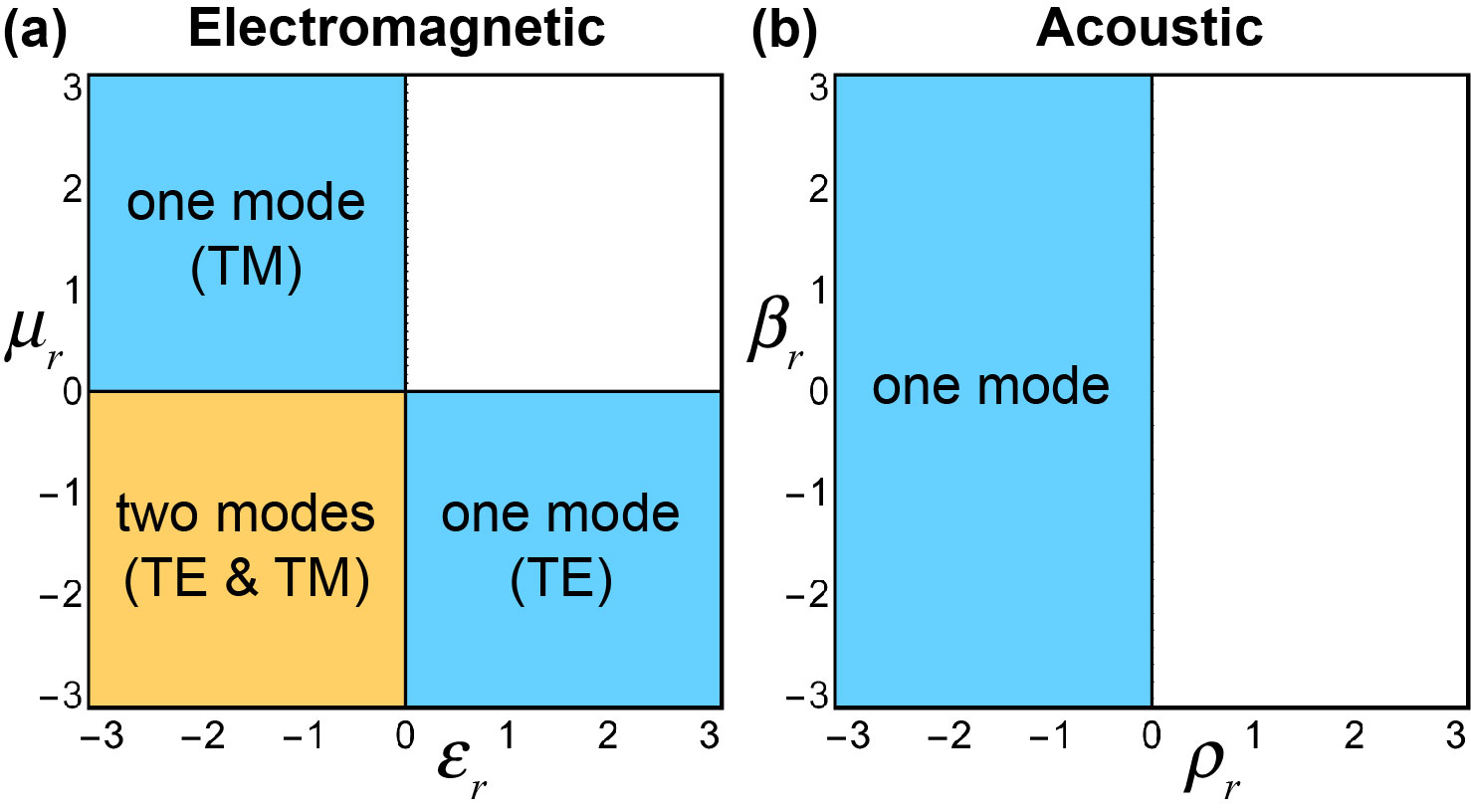 Figure 1
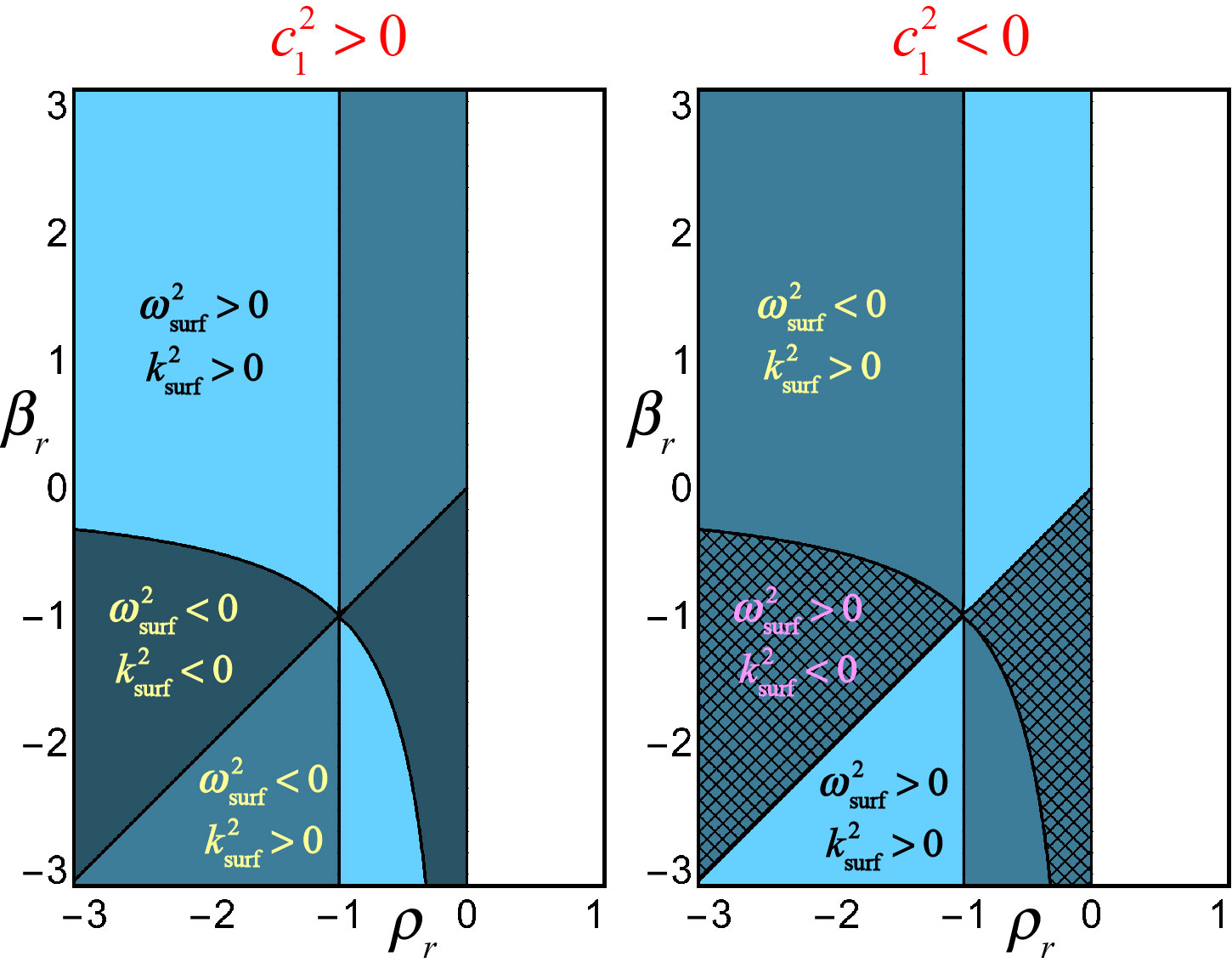 Figure 2
 Figure 3
 Figure 4
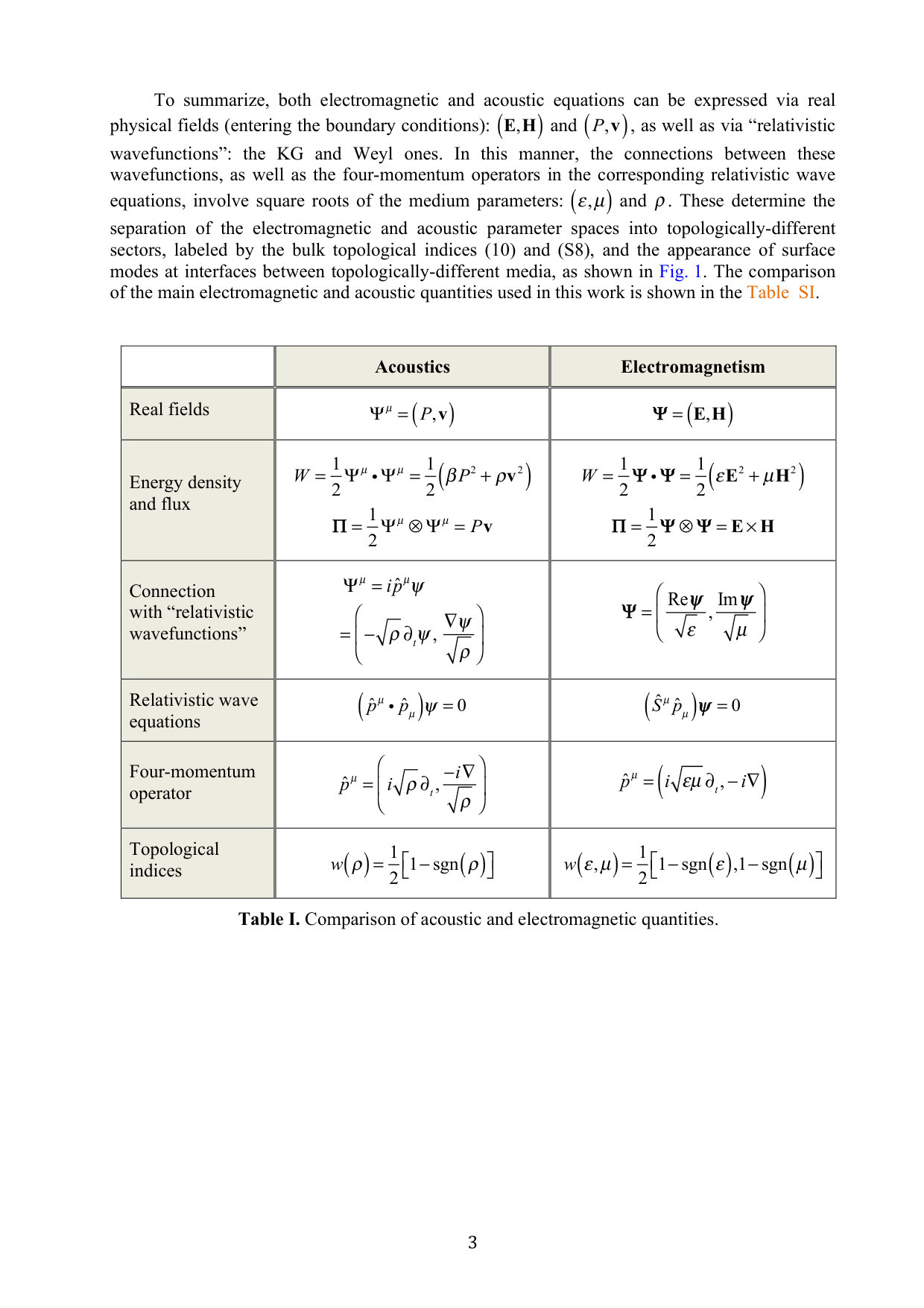 Figure 5
Peer Reviews
No public reviews on file for this paper yet. If you reviewed it on a platform where reviews are public (OpenReview, ICLR, NeurIPS, ICML), you can paste yours below so the community can read it here.
Videos
No videos yet. Explain this paper in a talk, walkthrough, or lecture? Add one.