Pseudorapidity distributions of charged hadrons in xenon-xenon collisions at $\sqrt{s_\mathrm{NN}} =$ 5.44 TeV
CMS Collaboration

TL;DR
This paper reports measurements of charged hadron pseudorapidity distributions in xenon-xenon collisions at 5.44 TeV, revealing details about particle production and collision geometry effects at the LHC.
Contribution
It provides the first detailed pseudorapidity distribution measurements for xenon-xenon collisions at this energy, highlighting differences from lead-lead collisions and challenging existing models.
Findings
Charged-hadron pseudorapidity density at midrapidity is 1187 ± 36 for central collisions.
Rapidity distribution is flat around y=0, independent of rapidity within the measured range.
Existing Monte Carlo models fail to describe both the pseudorapidity and rapidity distributions simultaneously.
Abstract
Measurements of the pseudorapidity distributions of charged hadrons produced in xenon-xenon collisions at a nucleon-nucleon centre-of-mass energy of 5.44 TeV are presented. The measurements are based on data collected by the CMS experiment at the LHC. The yield of primary charged hadrons produced in xenon-xenon collisions in the pseudorapidity range 3.2 is determined using the silicon pixel detector in the CMS tracking system. For the 5% most central collisions, the charged-hadron pseudorapidity density in the midrapidity region 0.5 is found to be 1187 36 (syst), with a negligible statistical uncertainty. The rapidity distribution of charged hadrons is also presented in the range 3.2 and is found to be independent of rapidity around 0. Existing Monte-Carlo event generators are unable to simultaneously describe both…
Click any figure to enlarge with its caption.
 Figure 1
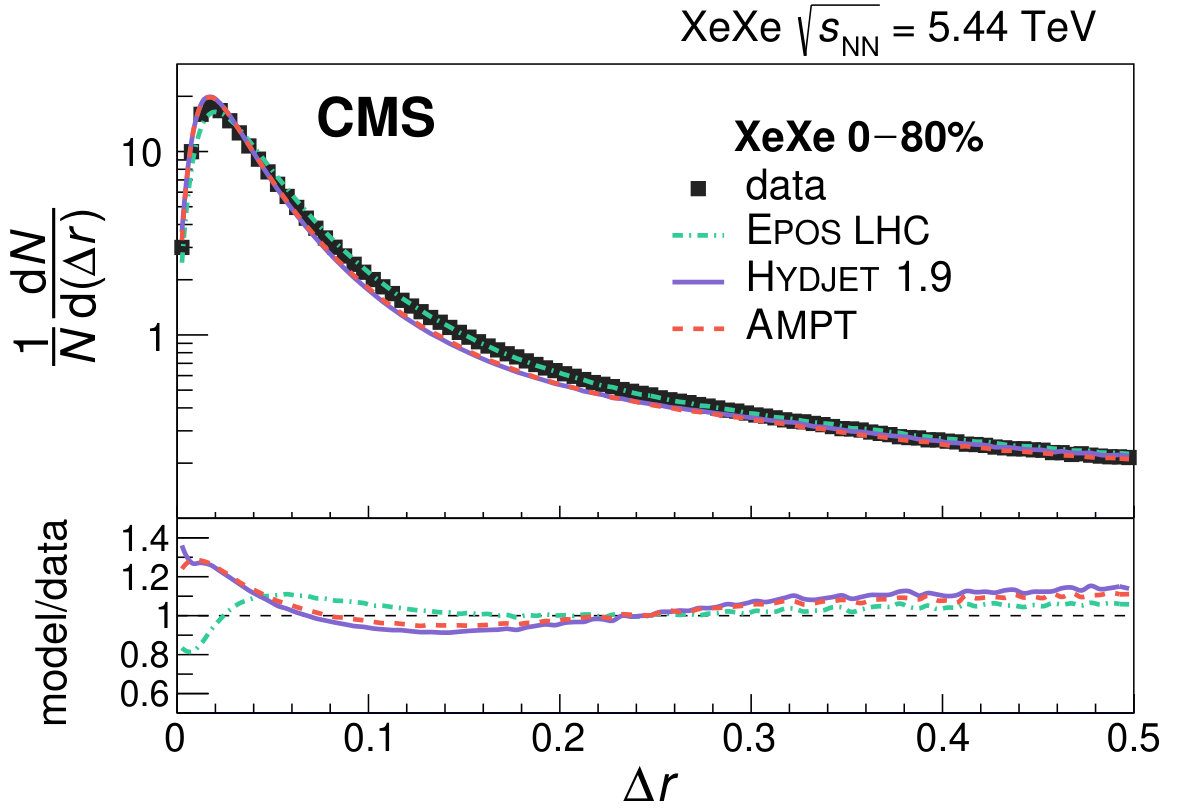 Figure 1
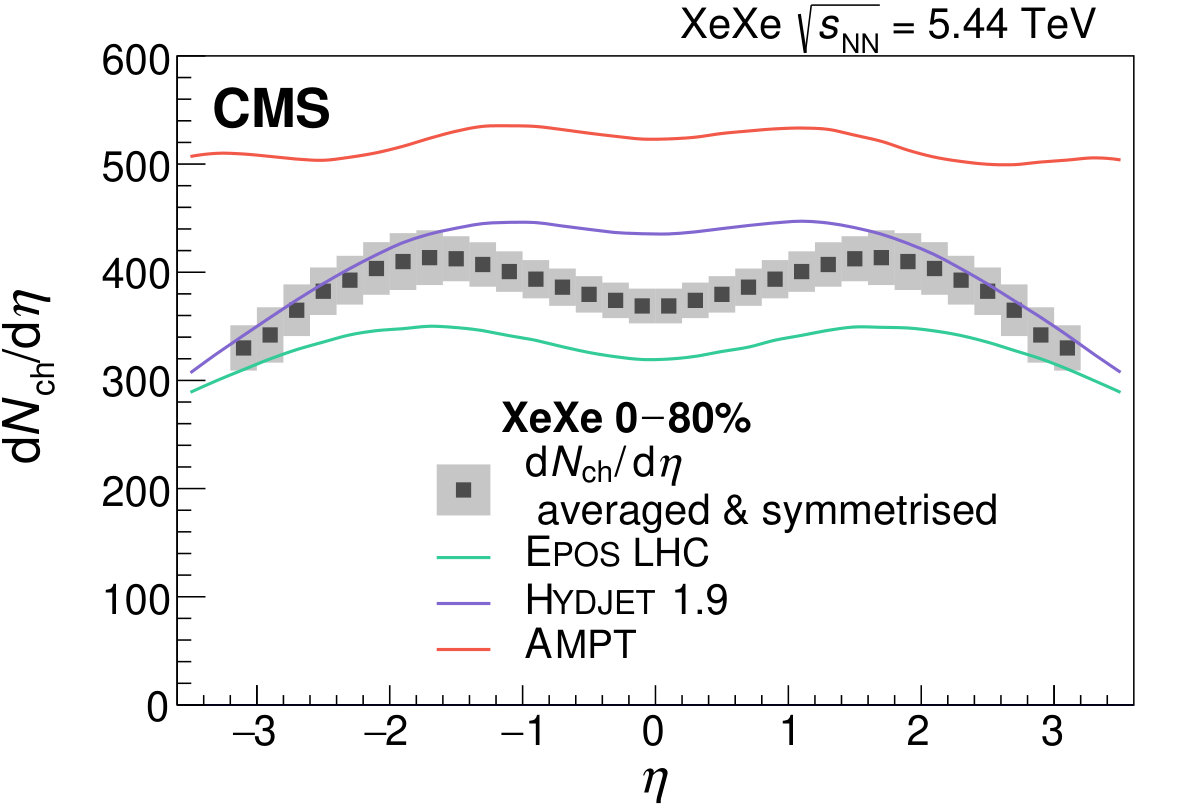 Figure 2
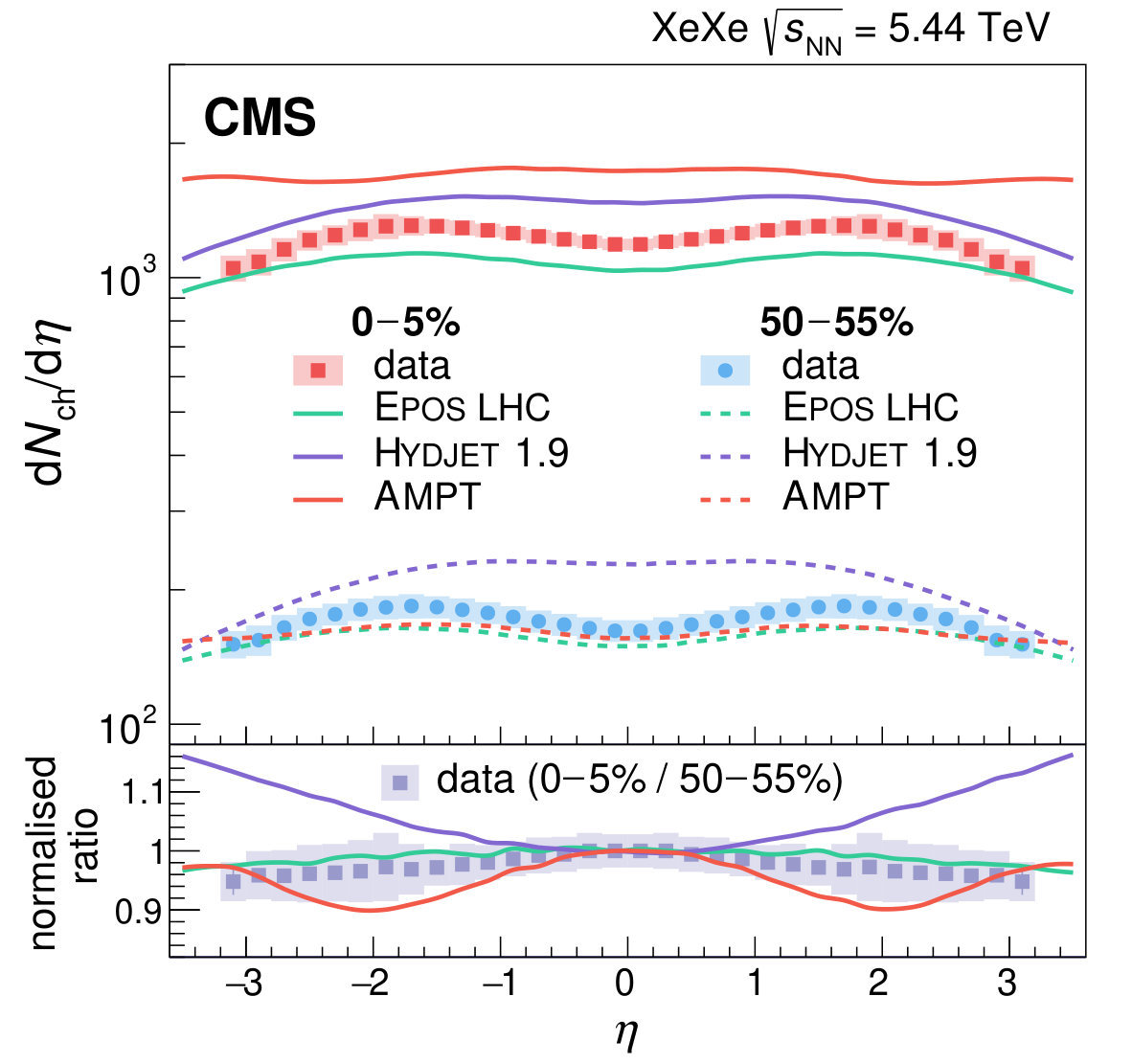 Figure 2
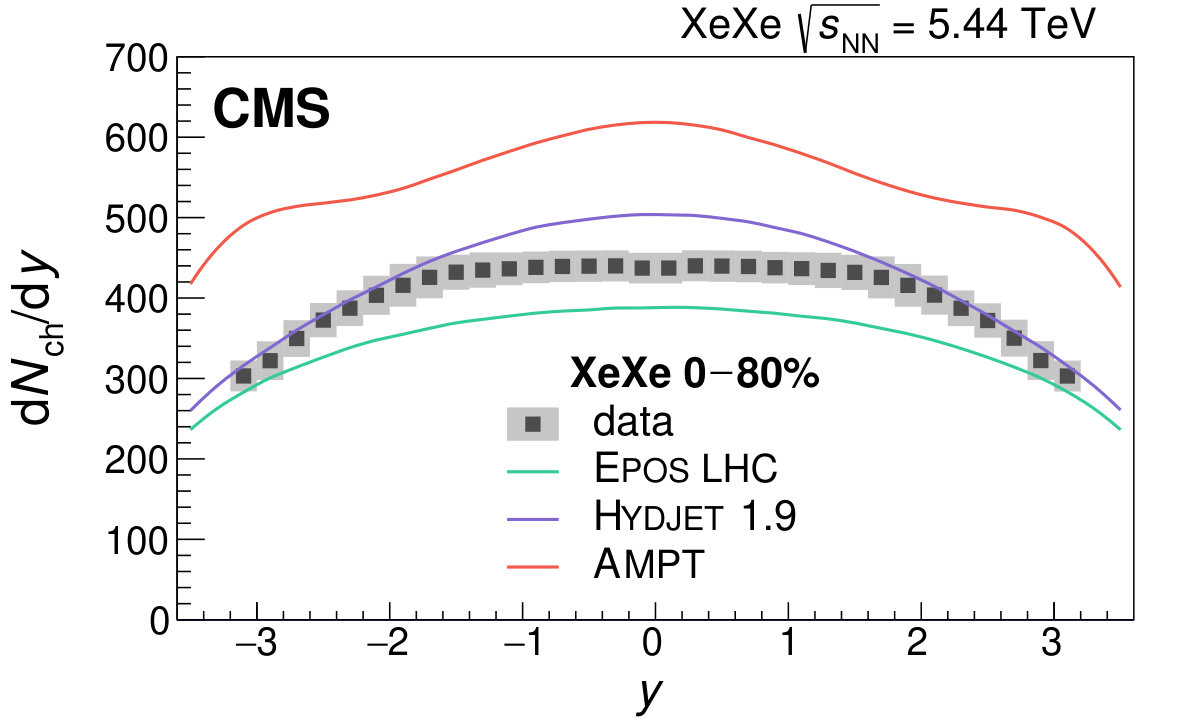 Figure 3
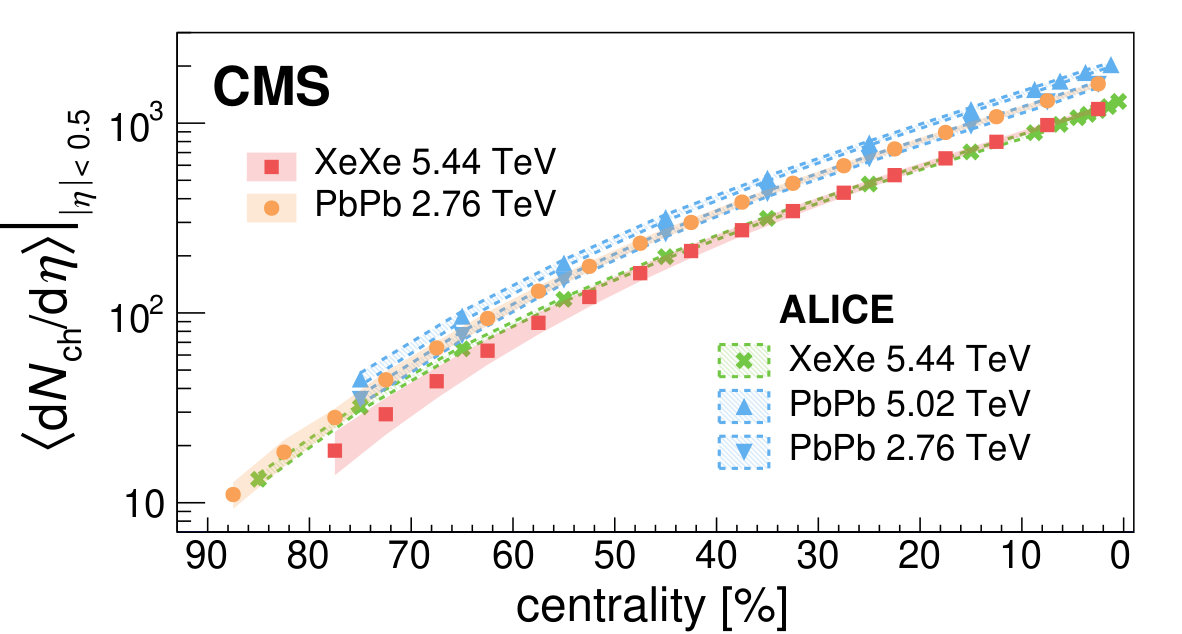 Figure 4
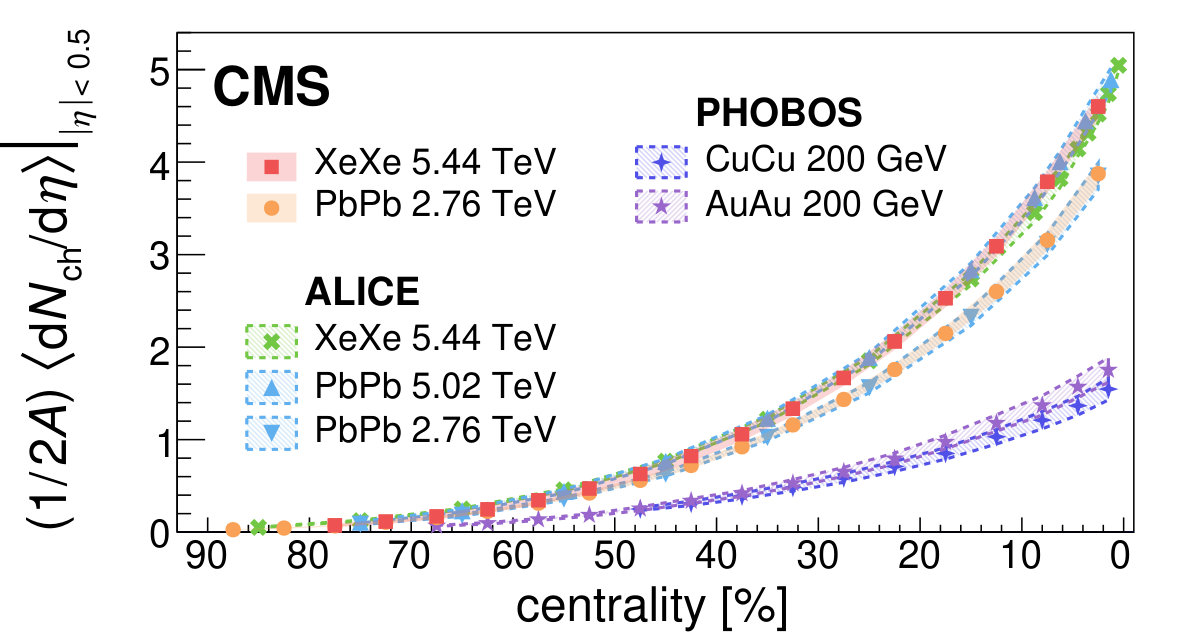 Figure 4
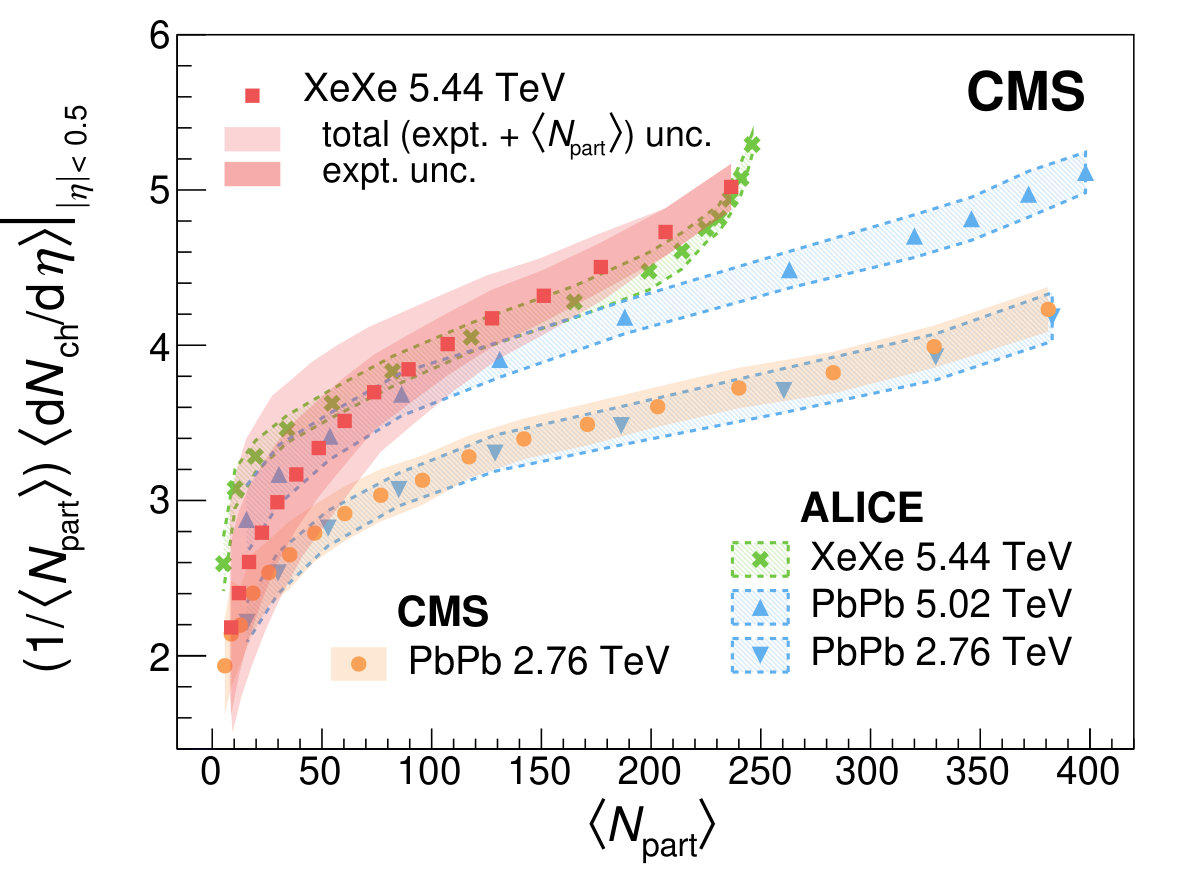 Figure 5
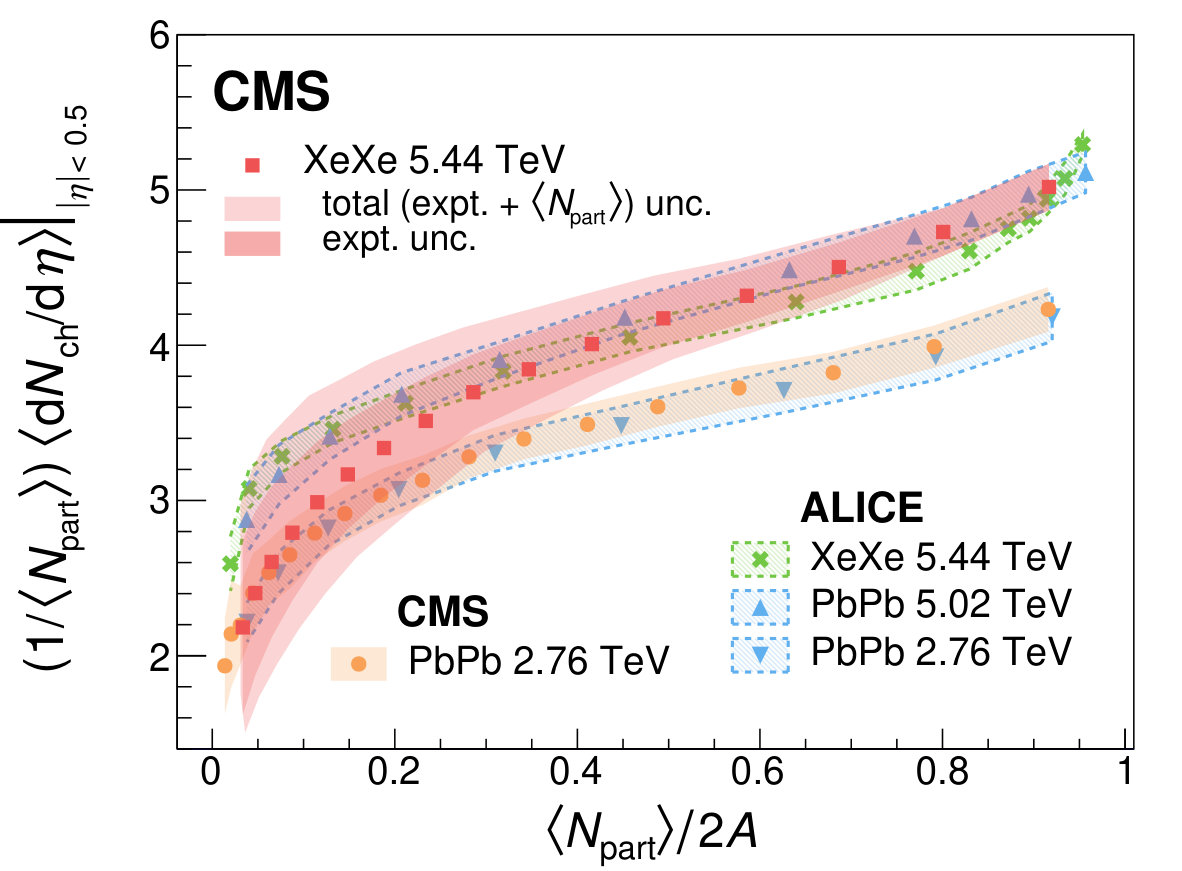 Figure 5
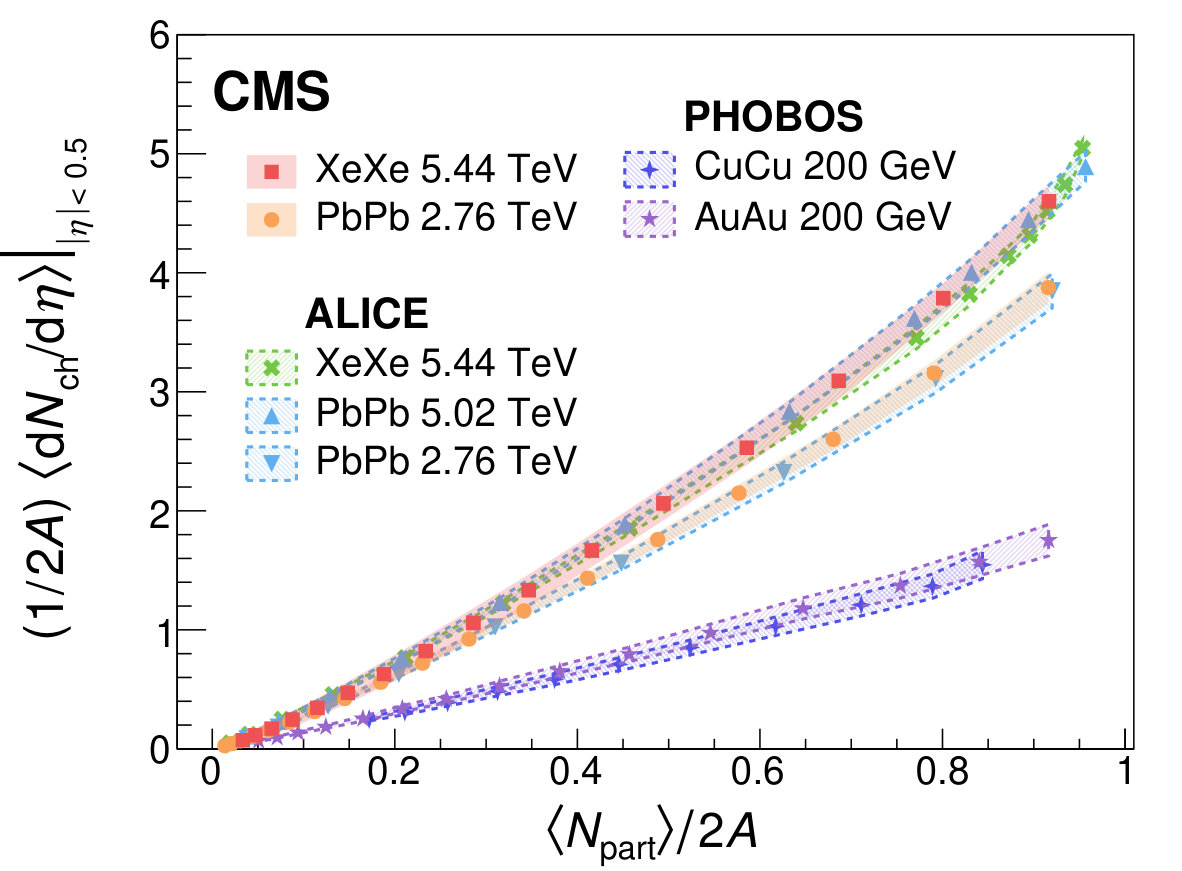 Figure 6
 Figure 11
 Figure 12
Peer Reviews
No public reviews on file for this paper yet. If you reviewed it on a platform where reviews are public (OpenReview, ICLR, NeurIPS, ICML), you can paste yours below so the community can read it here.
Videos
No videos yet. Explain this paper in a talk, walkthrough, or lecture? Add one.
\cmsNoteHeader
HIN-17-006
\RCS
\RCS
\cmsNoteHeader
HIN-17-006
Pseudorapidity distributions of charged hadrons in xenon-xenon collisions at
Abstract
Measurements of the pseudorapidity distributions of charged hadrons produced in xenon-xenon collisions at a nucleon-nucleon centre-of-mass energy of are presented. The measurements are based on data collected by the CMS experiment at the LHC. The yield of primary charged hadrons produced in xenon-xenon collisions in the pseudorapidity range is determined using the silicon pixel detector in the CMS tracking system. For the 5% most central collisions, the charged-hadron pseudorapidity density in the midrapidity region is found to be , with a negligible statistical uncertainty. The rapidity distribution of charged hadrons is also presented in the range and is found to be independent of rapidity around . Existing Monte-Carlo event generators are unable to simultaneously describe both results. Comparisons of charged-hadron multiplicities between xenon-xenon and lead-lead collisions at similar collision energies show that particle production at midrapidity is strongly dependent on the collision geometry in addition to the system size and collision energy.
0.1 Introduction
Collisions between ultra-relativistic heavy ions are the only known way of experimentally studying quantum chromodynamics (QCD) matter at high temperatures and energy densities. The current understanding is that in such collisions, a state of matter known as the quark-gluon plasma (QGP) is formed shortly after the initial impact between the nuclei [1].
The multiplicity and pseudorapidity distributions of the produced charged particles are key observables that characterise the initial condition and subsequent hydrodynamic evolution of the QGP [2]. The dependence of the charged-particle multiplicity on the colliding system, centre-of-mass energy, and collision geometry can provide information about nuclear shadowing and gluon saturation effects [3], as well as the relative contributions to particle production from hard scattering and soft processes [4]. These observables also provide input for models of the particle production process [5], from which information about the formation and properties of the QGP can be extracted.
In October 2017, the CERN LHC collided xenon () ions at a nucleon-nucleon centre-of-mass energy of , marking the first time ions other than protons and lead () have been circulated in the LHC. This new collision system provides a unique opportunity to study the dependence of the charged-particle multiplicity on the size of the matter produced at LHC energies. Previous measurements of charged-particle multiplicities in copper-copper (CuCu) and gold-gold (AuAu) collisions at RHIC have been observed to be sensitive to the collision geometry [6]. The XeXe collision data are thus important for determining if this feature is also present at higher energies. Comparisons of the data to predictions of models tuned to describe PbPb collision data [7, 8, 9] can also be used to test the extent to which these models are able to describe other collision systems.
In this Letter, measurements of the pseudorapidity density of primary charged hadrons, , in the range are reported for XeXe collisions delivered by the LHC. Following earlier analyses in proton-proton collisions at 0.9–13\TeV [10, 11, 12, 13, 14], proton-lead collisions at 5.02 and 8.16\TeV [15], and PbPb collisions at 2.76\TeV [16], “primary” charged hadrons are defined as prompt charged hadrons and decay products of all particles with proper decay length \unitcm, where is the speed of light in vacuum and is the proper lifetime of the particle. Contributions from prompt leptons, decay products of longer-lived particles, and secondary interactions are excluded.
The results are compared to a measurement by the ALICE Collaboration [17] and to predictions from the Epos LHC v3400 [18, 8], Hydjet 1.9 [9], and Ampt 1.26t5 [19] event generators. The Epos generator is based on Gribov–Regge theory [20, 21] and includes the effect of collective hadronisation in hadron-hadron scattering. The Hydjet generator treats a heavy ion collision as a superposition of a hydrodynamically parametrised soft component and a hard component resulting from multi-parton fragmentation. The Ampt generator combines the Hijing event generator [22] with Zhang’s parton cascade procedure [23] and the ART model [24] for the last stage of parton hadronisation.
0.2 The CMS detector
The central feature of the CMS apparatus is a superconducting solenoid of 6\unitm internal diameter, providing a magnetic field of 3.8\unitT. Within the solenoid volume are a silicon pixel and strip tracker covering the range , a lead tungstate crystal electromagnetic calorimeter, and a brass and scintillator hadron calorimeter, each composed of a barrel and two endcap sections. Forward calorimeters (HF), made of steel and quartz-fibres and located on either side of the interaction point, extend the pseudorapidity coverage provided by the barrel and endcap detectors to . Muons are detected in gas-ionisation chambers embedded in the steel flux-return yoke outside the solenoid. The beam pickup timing for experiments (BPTX) devices are located around the beam pipe at a distance of 175\unitm from the interaction point on either side and provide precise information on the timing of the incoming beams. A more detailed description of the CMS detector, together with a definition of the coordinate system used and the relevant kinematic variables, can be found in Ref. [25].
Charged hadrons are reconstructed using the silicon pixel detectors installed during the Phase 1 upgrade [26], which consist of four concentric cylindrical shells (layers) in the barrel region (BPIX) and three disks on both sides of the interaction point in the forward region (FPIX). The BPIX and FPIX consist of a total of 1184 and 672 modules, respectively, and provide excellent position resolution with their pixels. In this Letter, the layers of the BPIX are denoted in increasing order of their radial distance from the beam axis, \iethe layer closest to the beam axis is referred to as layer 1, the next closest layer is referred to as layer 2, and so on, while the disks of the FPIX are referred to in increasing order of their longitudinal distance from the nominal interaction point.
0.3 Event selection
This analysis is based on approximately 1.36 million events. The average interaction probability per bunch crossing was 1.8%. Events are selected in two stages: (i) online, a coincidence of signals from both BPTX devices and at least one energy deposit above 3\GeVon either side of the HF are required; (ii) offline, three energy deposits above 3\GeVon each side of the HF and at least one reconstructed vertex, according to the tracklet-based vertex reconstruction method described in Ref. [16], are required. A study of noncolliding ion bunches shows that the above requirements are sufficient to reject all backgrounds not originating from interactions between xenon ions. Consequently, the contribution of background events from beam, beam-halo, and cosmic ray sources to the observed yields is negligible.
Contamination from electromagnetic (EM) interactions between xenon ions is studied using simulated events generated by STARlight 2.2 [27] interfaced with Dpmjet-III 3.0-5 [28], and is estimated to be around 1%. The event selection efficiency is estimated by fitting the distribution of the total transverse energy in the HF calorimeter using a template extracted from simulated Epos LHC events [16]. Variations in the fit parameters, as well as other observables correlated with event activity, are used to determine the uncertainty in this method. In combination with the contamination rate, an overall value of is quoted for the event selection efficiency.
Nuclei are extensive objects, and their collisions can be characterised by the centrality, which is related to the impact parameter of the collision. The centrality can be estimated from the sum of the transverse energy in the HF calorimeter [29, 16]. The distribution of the total transverse energy, after correcting for the event selection efficiency, is divided into equal partitions and used to classify events into centralities. The centrality represents a percentile of the total nuclear interaction cross section [16]; the most central collisions, \iethe collisions with the smallest impact parameter, are denoted by lower percentiles. To minimise the amount of EM contamination, which is concentrated in the 20% most peripheral events, the analysis is restricted to events with centrality in the 0–80% range, where the event selection is fully efficient.
The event centrality is also related to the number of participating nucleons , which is determined from a Glauber model calculation [30, 31]. For this calculation, the nucleon-nucleon inelastic cross section is taken to be [31], while the nuclear radius, skin depth, and deformation parameter of the xenon nucleus are set to , [32], and [17], respectively. Simulated Epos LHC events are used to account for the energy resolution of the HF calorimeters and fluctuations in event activity, which smear the centrality distributions. The resulting values and associated uncertainties for are listed in Appendix .8.
0.4 Analysis
The measurement of is performed using tracklets, which are pairs of pixel clusters from two different layers (disks) of the silicon pixel detector. Pairs of pixel clusters that are produced by the same charged particle have small differences in and azimuthal angle with respect to the primary vertex. These correlations are exploited in the analysis to reconstruct tracklets that reflect the original distribution of primary charged hadrons. The vertex and tracklet reconstruction algorithms are described in Ref. [16].
Six possible types of tracklets can be formed from distinct combinations of the four layers of the BPIX. In addition, three types of tracklets can be formed from unique combinations of the three disks of the FPIX. The individual measurements from all nine combinations are averaged and symmetrised about to obtain the final results. The different combinations are also useful for layer-by-layer systematic checks, as they have different sensitivities to the particle momentum spectrum. Particles with \ptabove 40\MeVcan be reconstructed using the two BPIX layers closest to the beam pipe.
The angular distance between the two clusters that make up a tracklet is defined as
[TABLE]
where is the pseudorapidity of the pixel cluster position in the th layer or disk, calculated with respect to the primary vertex position, and is defined similarly for the azimuthal angle. The distribution for tracklets reconstructed from layers 1 and 2 of the BPIX is shown in Fig. 1. The spectrum is compared to fully simulated events generated by Epos LHC, Hydjet, and Ampt.
Tracklets with are selected for analysis. This selection criterion suppresses the combinatorial background from uncorrelated background clusters and low transverse momentum (\pt) particles that loop around in the high magnetic field and leave multiple charge deposits per layer of the pixel detector. The reconstructed tracklet spectrum is then corrected to the hadron-level event definition by applying a number of correction factors accounting for the geometric acceptance, reconstruction efficiency, and event selection efficiency. These correction factors are derived from MC simulations generated with the aforementioned event generators. The detector response is simulated with \GEANTfour [33] and processed through the same event reconstruction chain as the collision data. All simulations are produced with the same vertex distribution along the interaction region as is observed in data.
Simulations generated with Epos LHC are used as the primary reference for the derivation of these correction factors because the spectrum obtained from these simulated events most closely resembles the corresponding spectrum in data at large , where the combinatorial background is dominant. The other event generators are used in the study of systematic uncertainties. The correction factors are calculated as functions of the primary vertex position, pseudorapidity, and tracklet multiplicity. Typical values of these correction factors at (1.6) range from 1.12 (0.95) at low multiplicities to 1.01 (0.85) at high multiplicities.
The Jacobian transformation from to rapidity, , can also be derived from simulations by relating the rapidity density of charged hadrons to the corresponding pseudorapidity density in each interval [34, 35]. The particle composition in data is assumed to fall within the range of particle compositions predicted by the various event generators. The final transformation factors applied are the mean values of the factors derived from each event generator.
The sum of transverse energy in the HF, on which the event selection is based, is correlated with the charged-hadron multiplicity in the region around where the measurement is made. Hence, the event selection criteria are susceptible to multiplicity fluctuations and may lead to a nonnegligible bias in the results [36]. The magnitude of this bias is studied using various MC event generators by comparing the average at midrapidity, defined as , for two sets of generated events: (i) events selected based on the transverse energy sum in the HF, and (ii) events selected based on , weighted to have the same distribution of as the former selection. This provides a comparison of results with and without the selection bias while also accounting for detector effects that smear the distribution of selected events. The bias caused by the event selection criteria is found to be negligible in the centrality interval used in this analysis.
0.5 Systematic uncertainties
The uncertainties resulting from various systematic effects affecting the measurement are evaluated. The sources of these systematic uncertainties include differences between data and simulation for effects such as the probability of pixel cluster splitting, pixel cluster reconstruction efficiency, and the fraction of uncorrelated pixel clusters, as well as the uncertainties in the alignment of pixel detector modules, tracklet selection criteria, parametrisation of correction factors, consistency between different tracklet combinations, and model dependence of the correction factors. Additionally, the uncertainty in the event selection is taken into account as an independent, fully correlated uncertainty. The individual contributions are then summed in quadrature to give the total systematic uncertainty.
Pixel cluster splitting refers to when the charge deposit from a single charged particle is reconstructed as two pixel clusters in close proximity. The difference in the relative fraction of split clusters between data and simulation can be estimated by artificially splitting the pixel clusters in simulation and comparing the resulting modified distribution of cluster pairs in simulation to that in data. This difference is found to be no more than 2%, which results in a variation of 1.8–2.0% in the results. The pixel cluster reconstruction efficiency can be estimated by studying the fraction of tracklets reconstructed from pixel clusters from the first and third layers that have a matching pixel cluster in the second layer. The ratio of this efficiency in data and simulation shows a relative difference of 0.5%, which has an effect of 0.5% when propagated to the final results. The pixel cluster positions are smeared by the uncertainty in the alignment of the pixel detector modules, and the effect on the final results is found to be . The difference in the number of uncorrelated pixel clusters in data and simulation is estimated by comparing the tracklet distributions in the region , where tracklets reconstructed from two uncorrelated clusters are dominant. Additional pixel clusters (on the order of 1–4%) were randomly added to the simulated events such that the tracklet distributions at large match those in data. A difference of 0.5% in the final results is observed at , which increases monotonically with to 2.4% at .
The tracklet selection criteria affect the minimum \ptand signal-to-background ratio of reconstructed tracklets. The sensitivity of the correction factors to these effects is checked by varying the nominal selection criterion on by . The effect of such variations on the final results is found to be about 0.2%. The multiplicity variable used in the parametrisation of the correction factors can be changed to be the number of pixel clusters, which is independent of the tracklet reconstruction efficiency. The effects of such a change are negligible. In any given range, measurements can be made using multiple tracklet combinations. The maximum deviation of the measurements obtained using each tracklet combination from the final averaged and symmetrised result, which ranges from 1.0 to 2.1% within and up to 5.0% at larger values of , is quoted as a systematic uncertainty. The model dependence of the correction factors is studied by using different sets of correction factors derived from Hydjet and Ampt, which have different descriptions of the particle production mechanisms. The predicted particle spectra and composition can differ significantly among the event generators, which affect the correction for leptons and the extrapolation of the measured tracklet spectra to . The maximum deviation from the nominal results is quoted as an uncertainty, and ranges from 2.0–2.2% within to a maximum of 5.0% around . The model dependence of the Jacobian transformation from to rapidity is also evaluated in a similar manner, and the maximum deviation, which ranges from 0.5% around to 2.1% (2.5%) around (3.2), is quoted as an additional uncertainty for the results.
The determination of event centrality depends on the hadronic event selection efficiency, as well as the amount of contamination from EM processes. Since the inefficiency is limited to the most peripheral collisions, the effect of the uncertainty in the event selection efficiency is to shift the events into other centrality intervals. Hence, to evaluate the uncertainty in the final results, different sets of centrality calibrations, derived after varying the event selection efficiency by its uncertainty, are used to categorise the data. This leads to a difference of 0.4–25.7% in the final results, largest in the 75–80% centrality interval and decreasing towards more central collisions, which is fully correlated across different centrality intervals and values. The uncertainties in the values are determined by propagating the uncertainties in the parameters of the Glauber model, which are listed in Section 0.3, and which range from 0.7 to 8.9%.
A summary of the systematic uncertainties is given in Table 0.5. With the exception of the uncertainties in the event selection efficiency and the values, the systematic uncertainties are largely independent of centrality and highly correlated point-to-point in the region , where only combinations of BPIX layers contribute to the result.
0.6 Results
The pseudorapidity distributions of charged hadrons for are shown in Fig. 2 (left) for events in the 0–80% centrality interval, and in Fig. 2 (right) for events in the 0–5% and 50–55% centrality intervals. The bottom panel in Fig. 2 (right) shows the ratios of the distributions for events in the 0–5% centrality interval to those in the 50–55% centrality interval, normalised to unity at midrapidity. There is a hint of a centrality dependence in the shape of the distribution, in that the distribution in peripheral collisions is flatter than that in central collisions.
None of the event generators are able to fully describe the distributions in the three centrality intervals shown, in particular the at midrapidity. However, the shapes of the distributions, where the overall normalisations are factored out, are consistent with those predicted by the Epos LHC event generator within the total systematic uncertainties. The centrality dependence of the shape of the distributions is described well by Epos LHC but not by the other event generators, as shown in the bottom panel of Fig. 2 (right).
The rapidity distribution of charged hadrons in XeXe collisions with 0–80% centrality is shown in Fig. 3. The distribution in data is observed to be consistent with a rapidity plateau in the region . The distributions obtained from the Epos LHC, Hydjet, and Ampt event generators are also shown for comparison. None of the event generators describe the plateau around .
Figure 4 (left) shows the charged-hadron at midrapidity as a function of centrality. For events in the 0–5% centrality interval, is found to be at midrapidity. This is nearly a factor of two greater than the interpolated in proton-proton collisions at the same energy [11] after scaling by , the atomic number of the nuclei. The results are compared to a measurement at the same energy for charged particles by the ALICE Collaboration [17], which includes leptons in the analysis. Within the total uncertainties, the measurements are consistent in the 0–60% centrality interval, although the ALICE Collaboration reports a slightly higher for more peripheral collisions.
The results are also compared to previous measurements in PbPb collisions at and 5.02\TeVby the CMS [16] and ALICE [37, 38] Collaborations. As one would expect, for the same centrality, increases with energy and system size. It is interesting to note that for different colliding nuclei at the same energy, is proportional to . This is evident from Fig. 4 (right), where is shown as functions of centrality for a variety of colliding nuclei and energies. These results show that the feature observed at lower energies, that the geometry of the colliding systems plays an important role in determining the production of particles [6], is also present at the much higher LHC energies.
To study the relevance for particle production of the number of participating nucleons, is shown as a function of in Fig. 5 (left). The results are compared to a measurement at the same energy by the ALICE Collaboration and to previous measurements in PbPb collisions at and 5.02\TeV. As can be seen, the per-participant multiplicity for XeXe and PbPb collisions with similar , but corresponding to different centrality classes in the two collision systems, are inconsistent. This is most apparent when nearly completely overlapping XeXe collisions (0–5% centrality or ) are compared to PbPb collisions with similar , for which the corresponding centrality is approximately 15–20%. However, as shown in Fig. 5 (right), where is used as a proxy for centrality (the correspondence between centrality and is tabulated in Appendix .8), the per-participant charged-hadron multiplicity for different colliding nuclei are equal within uncertainties when the geometry (centrality) and energy of the compared systems are the same.
An equivalent representation of Fig. 5 (right) is shown in Fig. 6, where is shown as a function of . In this form, it is clear that multiparticle production scales as times a function of , indicating a dependence on both the system size (given by ) and the geometry of the colliding system (represented by ). Considering that multiparticle production processes in heavy ion collisions are highly complex—starting with the initial impact of the two nuclei, through the creation and evolution of a relativistic fluid, and followed by a hadronisation and scattering phase—it is not surprising that the result depends on both the colliding system and energy, in a nontrivial way.
0.7 Summary
The pseudorapidity distributions of charged hadrons in xenon-xenon collisions at a centre-of-mass energy of 5.44\TeVper nucleon pair are reported. Using data taken with the upgraded 4-layer silicon pixel detectors, the charged-hadron pseudorapidity densities, , are measured to an extended range of . For events in the 0–5% centrality interval, the at midrapidity is measured to be , with a negligible statistical uncertainty. The results are found to be consistent with the ALICE Collaboration’s measurement. The charged-hadron rapidity density is also presented, and is found to be consistent with a rapidity plateau in the region . The results are compared to predictions from the Epos LHC v3400, Hydjet 1.9, and Ampt 1.26t5 event generators. None of the event generators are able to fully describe the measurements in terms of the magnitude, pseudorapidity dependence, and centrality dependence of the distributions, although Epos LHC describes the shape well. The per-participant at midrapidity in XeXe collisions is observed to rise faster with than in PbPb collisions. However, when comparing events with similar fractional overlap, the per-participant is consistent between the two collision systems. The results also show that the at midrapidity is a function of the collision geometry after normalising by , where , is the atomic number of the nuclei. This is observed for a variety of collision systems and energies, both at RHIC and the LHC, demonstrating that final-state charged-hadron multiplicities are strongly dependent on the collision geometry. These results provide important constraints on models and generators which describe multiparticle production in heavy ion collisions at high energies. They may also help in the characterisation of the initial conditions of the quark gluon plasma, which is needed for the understanding of its subsequent hydrodynamic evolution, as well as the properties of this fluid.
Acknowledgements.
We congratulate our colleagues in the CERN accelerator departments for the excellent performance of the LHC and thank the technical and administrative staffs at CERN and at other CMS institutes for their contributions to the success of the CMS effort. In addition, we gratefully acknowledge the computing centers and personnel of the Worldwide LHC Computing Grid for delivering so effectively the computing infrastructure essential to our analyses. Finally, we acknowledge the enduring support for the construction and operation of the LHC and the CMS detector provided by the following funding agencies: BMBWF and FWF (Austria); FNRS and FWO (Belgium); CNPq, CAPES, FAPERJ, FAPERGS, and FAPESP (Brazil); MES (Bulgaria); CERN; CAS, MoST, and NSFC (China); COLCIENCIAS (Colombia); MSES and CSF (Croatia); RPF (Cyprus); SENESCYT (Ecuador); MoER, ERC IUT, and ERDF (Estonia); Academy of Finland, MEC, and HIP (Finland); CEA and CNRS/IN2P3 (France); BMBF, DFG, and HGF (Germany); GSRT (Greece); NKFIA (Hungary); DAE and DST (India); IPM (Iran); SFI (Ireland); INFN (Italy); MSIP and NRF (Republic of Korea); MES (Latvia); LAS (Lithuania); MOE and UM (Malaysia); BUAP, CINVESTAV, CONACYT, LNS, SEP, and UASLP-FAI (Mexico); MOS (Montenegro); MBIE (New Zealand); PAEC (Pakistan); MSHE and NSC (Poland); FCT (Portugal); JINR (Dubna); MON, RosAtom, RAS, RFBR, and NRC KI (Russia); MESTD (Serbia); SEIDI, CPAN, PCTI, and FEDER (Spain); MOSTR (Sri Lanka); Swiss Funding Agencies (Switzerland); MST (Taipei); ThEPCenter, IPST, STAR, and NSTDA (Thailand); TUBITAK and TAEK (Turkey); NASU and SFFR (Ukraine); STFC (United Kingdom); DOE and NSF (USA). Individuals have received support from the Marie-Curie program and the European Research Council and Horizon 2020 Grant, contract Nos. 675440 and 765710 (European Union); the Leventis Foundation; the A.P. Sloan Foundation; the Alexander von Humboldt Foundation; the Belgian Federal Science Policy Office; the Fonds pour la Formation à la Recherche dans l’Industrie et dans l’Agriculture (FRIA-Belgium); the Agentschap voor Innovatie door Wetenschap en Technologie (IWT-Belgium); the F.R.S.-FNRS and FWO (Belgium) under the “Excellence of Science – EOS” – be.h project n. 30820817; the Beijing Municipal Science & Technology Commission, No. Z181100004218003; the Ministry of Education, Youth and Sports (MEYS) of the Czech Republic; the Lendület (“Momentum”) Program and the János Bolyai Research Scholarship of the Hungarian Academy of Sciences, the New National Excellence Program ÚNKP, the NKFIA research grants 123842, 123959, 124845, 124850, 125105, 128713, 128786, and 129058 (Hungary); the Council of Science and Industrial Research, India; the HOMING PLUS program of the Foundation for Polish Science, cofinanced from European Union, Regional Development Fund, the Mobility Plus program of the Ministry of Science and Higher Education, the National Science Center (Poland), contracts Harmonia 2014/14/M/ST2/00428, Opus 2014/13/B/ST2/02543, 2014/15/B/ST2/03998, and 2015/19/B/ST2/02861, Sonata-bis 2012/07/E/ST2/01406; the National Priorities Research Program by Qatar National Research Fund; the Programa Estatal de Fomento de la Investigación Científica y Técnica de Excelencia María de Maeztu, grant MDM-2015-0509 and the Programa Severo Ochoa del Principado de Asturias; the Thalis and Aristeia programs cofinanced by EU-ESF and the Greek NSRF; the Rachadapisek Sompot Fund for Postdoctoral Fellowship, Chulalongkorn University and the Chulalongkorn Academic into Its 2nd Century Project Advancement Project (Thailand); the Welch Foundation, contract C-1845; and the Weston Havens Foundation (USA).
.8
Supplementary material: Centrality intervals and corresponding values
.9 The CMS Collaboration
\cmsinstskip
**Yerevan Physics Institute, Yerevan, Armenia
** A.M. Sirunyan, A. Tumasyan \cmsinstskip**Institut für Hochenergiephysik, Wien, Austria
** W. Adam, F. Ambrogi, E. Asilar, T. Bergauer, J. Brandstetter, M. Dragicevic, J. Erö, A. Escalante Del Valle, M. Flechl, R. Frühwirth\cmsAuthorMark1, V.M. Ghete, J. Hrubec, M. Jeitler\cmsAuthorMark1, N. Krammer, I. Krätschmer, D. Liko, T. Madlener, I. Mikulec, N. Rad, H. Rohringer, J. Schieck\cmsAuthorMark1, R. Schöfbeck, M. Spanring, D. Spitzbart, A. Taurok, W. Waltenberger, J. Wittmann, C.-E. Wulz\cmsAuthorMark1, M. Zarucki \cmsinstskip**Institute for Nuclear Problems, Minsk, Belarus
** V. Chekhovsky, V. Mossolov, J. Suarez Gonzalez \cmsinstskip**Universiteit Antwerpen, Antwerpen, Belgium
** E.A. De Wolf, D. Di Croce, X. Janssen, J. Lauwers, M. Pieters, H. Van Haevermaet, P. Van Mechelen, N. Van Remortel \cmsinstskip**Vrije Universiteit Brussel, Brussel, Belgium
** S. Abu Zeid, F. Blekman, J. D’Hondt, I. De Bruyn, J. De Clercq, K. Deroover, G. Flouris, D. Lontkovskyi, S. Lowette, I. Marchesini, S. Moortgat, L. Moreels, Q. Python, K. Skovpen, S. Tavernier, W. Van Doninck, P. Van Mulders, I. Van Parijs \cmsinstskip**Université Libre de Bruxelles, Bruxelles, Belgium
** D. Beghin, B. Bilin, H. Brun, B. Clerbaux, G. De Lentdecker, H. Delannoy, B. Dorney, G. Fasanella, L. Favart, R. Goldouzian, A. Grebenyuk, A.K. Kalsi, T. Lenzi, J. Luetic, N. Postiau, E. Starling, L. Thomas, C. Vander Velde, P. Vanlaer, D. Vannerom, Q. Wang \cmsinstskip**Ghent University, Ghent, Belgium
** T. Cornelis, D. Dobur, A. Fagot, M. Gul, I. Khvastunov\cmsAuthorMark2, D. Poyraz, C. Roskas, D. Trocino, M. Tytgat, W. Verbeke, B. Vermassen, M. Vit, N. Zaganidis \cmsinstskip**Université Catholique de Louvain, Louvain-la-Neuve, Belgium
** H. Bakhshiansohi, O. Bondu, S. Brochet, G. Bruno, C. Caputo, P. David, C. Delaere, M. Delcourt, B. Francois, A. Giammanco, G. Krintiras, V. Lemaitre, A. Magitteri, A. Mertens, M. Musich, K. Piotrzkowski, A. Saggio, M. Vidal Marono, S. Wertz, J. Zobec \cmsinstskip**Centro Brasileiro de Pesquisas Fisicas, Rio de Janeiro, Brazil
** F.L. Alves, G.A. Alves, M. Correa Martins Junior, G. Correia Silva, C. Hensel, A. Moraes, M.E. Pol, P. Rebello Teles \cmsinstskip**Universidade do Estado do Rio de Janeiro, Rio de Janeiro, Brazil
** E. Belchior Batista Das Chagas, W. Carvalho, J. Chinellato\cmsAuthorMark3, E. Coelho, E.M. Da Costa, G.G. Da Silveira\cmsAuthorMark4, D. De Jesus Damiao, C. De Oliveira Martins, S. Fonseca De Souza, H. Malbouisson, D. Matos Figueiredo, M. Melo De Almeida, C. Mora Herrera, L. Mundim, H. Nogima, W.L. Prado Da Silva, L.J. Sanchez Rosas, A. Santoro, A. Sznajder, M. Thiel, E.J. Tonelli Manganote\cmsAuthorMark3, F. Torres Da Silva De Araujo, A. Vilela Pereira \cmsinstskip**Universidade Estadual Paulista a, Universidade Federal do ABC b, São Paulo, Brazil
** S. Ahujaa, C.A. Bernardesa, L. Calligarisa, T.R. Fernandez Perez Tomeia, E.M. Gregoresb, P.G. Mercadanteb, S.F. Novaesa, SandraS. Padulaa \cmsinstskip**Institute for Nuclear Research and Nuclear Energy, Bulgarian Academy of Sciences, Sofia, Bulgaria
** A. Aleksandrov, R. Hadjiiska, P. Iaydjiev, A. Marinov, M. Misheva, M. Rodozov, M. Shopova, G. Sultanov \cmsinstskip**University of Sofia, Sofia, Bulgaria
** A. Dimitrov, L. Litov, B. Pavlov, P. Petkov \cmsinstskip**Beihang University, Beijing, China
** W. Fang\cmsAuthorMark5, X. Gao\cmsAuthorMark5, L. Yuan \cmsinstskip**Institute of High Energy Physics, Beijing, China
** M. Ahmad, J.G. Bian, G.M. Chen, H.S. Chen, M. Chen, Y. Chen, C.H. Jiang, D. Leggat, H. Liao, Z. Liu, F. Romeo, S.M. Shaheen\cmsAuthorMark6, A. Spiezia, J. Tao, Z. Wang, E. Yazgan, H. Zhang, S. Zhang\cmsAuthorMark6, J. Zhao \cmsinstskip**State Key Laboratory of Nuclear Physics and Technology, Peking University, Beijing, China
** Y. Ban, G. Chen, A. Levin, J. Li, L. Li, Q. Li, Y. Mao, S.J. Qian, D. Wang, Z. Xu \cmsinstskip**Tsinghua University, Beijing, China
** Y. Wang \cmsinstskip**Universidad de Los Andes, Bogota, Colombia
** C. Avila, A. Cabrera, C.A. Carrillo Montoya, L.F. Chaparro Sierra, C. Florez, C.F. González Hernández, M.A. Segura Delgado \cmsinstskip**University of Split, Faculty of Electrical Engineering, Mechanical Engineering and Naval Architecture, Split, Croatia
** B. Courbon, N. Godinovic, D. Lelas, I. Puljak, T. Sculac \cmsinstskip**University of Split, Faculty of Science, Split, Croatia
** Z. Antunovic, M. Kovac \cmsinstskip**Institute Rudjer Boskovic, Zagreb, Croatia
** V. Brigljevic, D. Ferencek, K. Kadija, B. Mesic, A. Starodumov\cmsAuthorMark7, T. Susa \cmsinstskip**University of Cyprus, Nicosia, Cyprus
** M.W. Ather, A. Attikis, M. Kolosova, G. Mavromanolakis, J. Mousa, C. Nicolaou, F. Ptochos, P.A. Razis, H. Rykaczewski \cmsinstskip**Charles University, Prague, Czech Republic
** M. Finger\cmsAuthorMark8, M. Finger Jr.\cmsAuthorMark8 \cmsinstskip**Escuela Politecnica Nacional, Quito, Ecuador
** E. Ayala \cmsinstskip**Universidad San Francisco de Quito, Quito, Ecuador
** E. Carrera Jarrin \cmsinstskip**Academy of Scientific Research and Technology of the Arab Republic of Egypt, Egyptian Network of High Energy Physics, Cairo, Egypt
** A. Ellithi Kamel\cmsAuthorMark9, M.A. Mahmoud\cmsAuthorMark10*,*\cmsAuthorMark11, Y. Mohammed\cmsAuthorMark10 \cmsinstskip**National Institute of Chemical Physics and Biophysics, Tallinn, Estonia
** S. Bhowmik, A. Carvalho Antunes De Oliveira, R.K. Dewanjee, K. Ehataht, M. Kadastik, M. Raidal, C. Veelken \cmsinstskip**Department of Physics, University of Helsinki, Helsinki, Finland
** P. Eerola, H. Kirschenmann, J. Pekkanen, M. Voutilainen \cmsinstskip**Helsinki Institute of Physics, Helsinki, Finland
** J. Havukainen, J.K. Heikkilä, T. Järvinen, V. Karimäki, R. Kinnunen, T. Lampén, K. Lassila-Perini, S. Laurila, S. Lehti, T. Lindén, P. Luukka, T. Mäenpää, H. Siikonen, E. Tuominen, J. Tuominiemi \cmsinstskip**Lappeenranta University of Technology, Lappeenranta, Finland
** T. Tuuva \cmsinstskip**IRFU, CEA, Université Paris-Saclay, Gif-sur-Yvette, France
** M. Besancon, F. Couderc, M. Dejardin, D. Denegri, J.L. Faure, F. Ferri, S. Ganjour, A. Givernaud, P. Gras, G. Hamel de Monchenault, P. Jarry, C. Leloup, E. Locci, J. Malcles, G. Negro, J. Rander, A. Rosowsky, M.Ö. Sahin, M. Titov \cmsinstskip**Laboratoire Leprince-Ringuet, Ecole polytechnique, CNRS/IN2P3, Université Paris-Saclay, Palaiseau, France
** A. Abdulsalam\cmsAuthorMark12, C. Amendola, I. Antropov, F. Beaudette, P. Busson, C. Charlot, R. Granier de Cassagnac, I. Kucher, A. Lobanov, J. Martin Blanco, C. Martin Perez, M. Nguyen, C. Ochando, G. Ortona, P. Paganini, P. Pigard, J. Rembser, R. Salerno, J.B. Sauvan, Y. Sirois, A.G. Stahl Leiton, A. Zabi, A. Zghiche \cmsinstskip**Université de Strasbourg, CNRS, IPHC UMR 7178, Strasbourg, France
** J.-L. Agram\cmsAuthorMark13, J. Andrea, D. Bloch, J.-M. Brom, E.C. Chabert, V. Cherepanov, C. Collard, E. Conte\cmsAuthorMark13, J.-C. Fontaine\cmsAuthorMark13, D. Gelé, U. Goerlach, M. Jansová, A.-C. Le Bihan, N. Tonon, P. Van Hove \cmsinstskip**Centre de Calcul de l’Institut National de Physique Nucleaire et de Physique des Particules, CNRS/IN2P3, Villeurbanne, France
** S. Gadrat \cmsinstskip**Université de Lyon, Université Claude Bernard Lyon 1, CNRS-IN2P3, Institut de Physique Nucléaire de Lyon, Villeurbanne, France
** S. Beauceron, C. Bernet, G. Boudoul, N. Chanon, R. Chierici, D. Contardo, P. Depasse, H. El Mamouni, J. Fay, L. Finco, S. Gascon, M. Gouzevitch, G. Grenier, B. Ille, F. Lagarde, I.B. Laktineh, H. Lattaud, M. Lethuillier, L. Mirabito, S. Perries, A. Popov\cmsAuthorMark14, V. Sordini, G. Touquet, M. Vander Donckt, S. Viret \cmsinstskip**Georgian Technical University, Tbilisi, Georgia
** A. Khvedelidze\cmsAuthorMark8 \cmsinstskip**Tbilisi State University, Tbilisi, Georgia
** D. Lomidze \cmsinstskip**RWTH Aachen University, I. Physikalisches Institut, Aachen, Germany
** C. Autermann, L. Feld, M.K. Kiesel, K. Klein, M. Lipinski, M. Preuten, M.P. Rauch, C. Schomakers, J. Schulz, M. Teroerde, B. Wittmer, V. Zhukov\cmsAuthorMark14 \cmsinstskip**RWTH Aachen University, III. Physikalisches Institut A, Aachen, Germany
** A. Albert, D. Duchardt, M. Erdmann, S. Erdweg, T. Esch, R. Fischer, S. Ghosh, A. Güth, T. Hebbeker, C. Heidemann, K. Hoepfner, H. Keller, L. Mastrolorenzo, M. Merschmeyer, A. Meyer, P. Millet, S. Mukherjee, T. Pook, M. Radziej, H. Reithler, M. Rieger, A. Schmidt, D. Teyssier, S. Thüer \cmsinstskip**RWTH Aachen University, III. Physikalisches Institut B, Aachen, Germany
** G. Flügge, O. Hlushchenko, T. Kress, A. Künsken, T. Müller, A. Nehrkorn, A. Nowack, C. Pistone, O. Pooth, D. Roy, H. Sert, A. Stahl\cmsAuthorMark15 \cmsinstskip**Deutsches Elektronen-Synchrotron, Hamburg, Germany
** M. Aldaya Martin, T. Arndt, C. Asawatangtrakuldee, I. Babounikau, K. Beernaert, O. Behnke, U. Behrens, A. Bermúdez Martínez, D. Bertsche, A.A. Bin Anuar, K. Borras\cmsAuthorMark16, V. Botta, A. Campbell, P. Connor, C. Contreras-Campana, V. Danilov, A. De Wit, M.M. Defranchis, C. Diez Pardos, D. Domínguez Damiani, G. Eckerlin, T. Eichhorn, A. Elwood, E. Eren, E. Gallo\cmsAuthorMark17, A. Geiser, A. Grohsjean, M. Guthoff, M. Haranko, A. Harb, J. Hauk, H. Jung, M. Kasemann, J. Keaveney, C. Kleinwort, J. Knolle, D. Krücker, W. Lange, A. Lelek, T. Lenz, J. Leonard, K. Lipka, W. Lohmann\cmsAuthorMark18, R. Mankel, I.-A. Melzer-Pellmann, A.B. Meyer, M. Meyer, M. Missiroli, G. Mittag, J. Mnich, V. Myronenko, S.K. Pflitsch, D. Pitzl, A. Raspereza, M. Savitskyi, P. Saxena, P. Schütze, C. Schwanenberger, R. Shevchenko, A. Singh, H. Tholen, O. Turkot, A. Vagnerini, G.P. Van Onsem, R. Walsh, Y. Wen, K. Wichmann, C. Wissing, O. Zenaiev \cmsinstskip**University of Hamburg, Hamburg, Germany
** R. Aggleton, S. Bein, L. Benato, A. Benecke, V. Blobel, T. Dreyer, E. Garutti, D. Gonzalez, P. Gunnellini, J. Haller, A. Hinzmann, A. Karavdina, G. Kasieczka, R. Klanner, R. Kogler, N. Kovalchuk, S. Kurz, V. Kutzner, J. Lange, D. Marconi, J. Multhaup, M. Niedziela, C.E.N. Niemeyer, D. Nowatschin, A. Perieanu, A. Reimers, O. Rieger, C. Scharf, P. Schleper, S. Schumann, J. Schwandt, J. Sonneveld, H. Stadie, G. Steinbrück, F.M. Stober, M. Stöver, A. Vanhoefer, B. Vormwald, I. Zoi \cmsinstskip**Karlsruher Institut fuer Technologie, Karlsruhe, Germany
** M. Akbiyik, C. Barth, M. Baselga, S. Baur, E. Butz, R. Caspart, T. Chwalek, F. Colombo, W. De Boer, A. Dierlamm, K. El Morabit, N. Faltermann, B. Freund, M. Giffels, M.A. Harrendorf, F. Hartmann\cmsAuthorMark15, S.M. Heindl, U. Husemann, F. Kassel\cmsAuthorMark15, I. Katkov\cmsAuthorMark14, S. Kudella, H. Mildner, S. Mitra, M.U. Mozer, Th. Müller, M. Plagge, G. Quast, K. Rabbertz, M. Schröder, I. Shvetsov, G. Sieber, H.J. Simonis, R. Ulrich, S. Wayand, M. Weber, T. Weiler, S. Williamson, C. Wöhrmann, R. Wolf \cmsinstskip**Institute of Nuclear and Particle Physics (INPP), NCSR Demokritos, Aghia Paraskevi, Greece
** G. Anagnostou, G. Daskalakis, T. Geralis, A. Kyriakis, D. Loukas, G. Paspalaki, I. Topsis-Giotis \cmsinstskip**National and Kapodistrian University of Athens, Athens, Greece
** G. Karathanasis, S. Kesisoglou, P. Kontaxakis, A. Panagiotou, I. Papavergou, N. Saoulidou, E. Tziaferi, K. Vellidis \cmsinstskip**National Technical University of Athens, Athens, Greece
** K. Kousouris, I. Papakrivopoulos, G. Tsipolitis \cmsinstskip**University of Ioánnina, Ioánnina, Greece
** I. Evangelou, C. Foudas, P. Gianneios, P. Katsoulis, P. Kokkas, S. Mallios, N. Manthos, I. Papadopoulos, E. Paradas, J. Strologas, F.A. Triantis, D. Tsitsonis \cmsinstskip**MTA-ELTE Lendület CMS Particle and Nuclear Physics Group, Eötvös Loránd University, Budapest, Hungary
** M. Bartók\cmsAuthorMark19, M. Csanad, N. Filipovic, P. Major, M.I. Nagy, G. Pasztor, O. Surányi, G.I. Veres \cmsinstskip**Wigner Research Centre for Physics, Budapest, Hungary
** G. Bencze, C. Hajdu, D. Horvath\cmsAuthorMark20, Á. Hunyadi, F. Sikler, T.Á. Vámi, V. Veszpremi, G. Vesztergombi \cmsinstskip**Institute of Nuclear Research ATOMKI, Debrecen, Hungary
** N. Beni, S. Czellar, J. Karancsi\cmsAuthorMark21, A. Makovec, J. Molnar, Z. Szillasi \cmsinstskip**Institute of Physics, University of Debrecen, Debrecen, Hungary
** P. Raics, Z.L. Trocsanyi, B. Ujvari \cmsinstskip**Indian Institute of Science (IISc), Bangalore, India
** S. Choudhury, J.R. Komaragiri, P.C. Tiwari \cmsinstskip**National Institute of Science Education and Research, HBNI, Bhubaneswar, India
** S. Bahinipati\cmsAuthorMark22, C. Kar, P. Mal, K. Mandal, A. Nayak\cmsAuthorMark23, D.K. Sahoo\cmsAuthorMark22, S.K. Swain \cmsinstskip**Panjab University, Chandigarh, India
** S. Bansal, S.B. Beri, V. Bhatnagar, S. Chauhan, R. Chawla, N. Dhingra, R. Gupta, A. Kaur, M. Kaur, S. Kaur, R. Kumar, P. Kumari, M. Lohan, A. Mehta, K. Sandeep, S. Sharma, J.B. Singh, A.K. Virdi, G. Walia \cmsinstskip**University of Delhi, Delhi, India
** A. Bhardwaj, B.C. Choudhary, R.B. Garg, M. Gola, S. Keshri, Ashok Kumar, S. Malhotra, M. Naimuddin, P. Priyanka, K. Ranjan, Aashaq Shah, R. Sharma \cmsinstskip**Saha Institute of Nuclear Physics, HBNI, Kolkata, India
** R. Bhardwaj\cmsAuthorMark24, M. Bharti\cmsAuthorMark24, R. Bhattacharya, S. Bhattacharya, U. Bhawandeep\cmsAuthorMark24, D. Bhowmik, S. Dey, S. Dutt\cmsAuthorMark24, S. Dutta, S. Ghosh, K. Mondal, S. Nandan, A. Purohit, P.K. Rout, A. Roy, S. Roy Chowdhury, G. Saha, S. Sarkar, M. Sharan, B. Singh\cmsAuthorMark24, S. Thakur\cmsAuthorMark24 \cmsinstskip**Indian Institute of Technology Madras, Madras, India
** P.K. Behera \cmsinstskip**Bhabha Atomic Research Centre, Mumbai, India
** R. Chudasama, D. Dutta, V. Jha, V. Kumar, P.K. Netrakanti, L.M. Pant, P. Shukla \cmsinstskip**Tata Institute of Fundamental Research-A, Mumbai, India
** T. Aziz, M.A. Bhat, S. Dugad, G.B. Mohanty, N. Sur, B. Sutar, RavindraKumar Verma \cmsinstskip**Tata Institute of Fundamental Research-B, Mumbai, India
** S. Banerjee, S. Bhattacharya, S. Chatterjee, P. Das, M. Guchait, Sa. Jain, S. Karmakar, S. Kumar, M. Maity\cmsAuthorMark25, G. Majumder, K. Mazumdar, N. Sahoo, T. Sarkar\cmsAuthorMark25 \cmsinstskip**Indian Institute of Science Education and Research (IISER), Pune, India
** S. Chauhan, S. Dube, V. Hegde, A. Kapoor, K. Kothekar, S. Pandey, A. Rane, S. Sharma \cmsinstskip**Institute for Research in Fundamental Sciences (IPM), Tehran, Iran
** S. Chenarani\cmsAuthorMark26, E. Eskandari Tadavani, S.M. Etesami\cmsAuthorMark26, M. Khakzad, M. Mohammadi Najafabadi, M. Naseri, F. Rezaei Hosseinabadi, B. Safarzadeh\cmsAuthorMark27, M. Zeinali \cmsinstskip**University College Dublin, Dublin, Ireland
** M. Felcini, M. Grunewald \cmsinstskip**INFN Sezione di Bari a, Università di Bari b, Politecnico di Bari c, Bari, Italy
** M. Abbresciaa**,b, C. Calabriaa**,b, A. Colaleoa, D. Creanzaa**,c, L. Cristellaa**,b, N. De Filippisa**,c, M. De Palmaa**,b, A. Di Florioa**,b, F. Erricoa**,b, L. Fiorea, A. Gelmia**,b, G. Iasellia**,c, M. Incea**,b, S. Lezkia**,b, G. Maggia**,c, M. Maggia, G. Minielloa**,b, S. Mya**,b, S. Nuzzoa**,b, A. Pompilia**,b, G. Pugliesea**,c, R. Radognaa, A. Ranieria, G. Selvaggia**,b, A. Sharmaa, L. Silvestrisa, R. Vendittia, P. Verwilligena, G. Zitoa \cmsinstskip**INFN Sezione di Bologna a, Università di Bologna b, Bologna, Italy
** G. Abbiendia, C. Battilanaa**,b, D. Bonacorsia**,b, L. Borgonovia**,b, S. Braibant-Giacomellia**,b, R. Campaninia**,b, P. Capiluppia**,b, A. Castroa**,b, F.R. Cavalloa, S.S. Chhibraa**,b, C. Cioccaa, G. Codispotia**,b, M. Cuffiania**,b, G.M. Dallavallea, F. Fabbria, A. Fanfania**,b, E. Fontanesi, P. Giacomellia, C. Grandia, L. Guiduccia**,b, S. Lo Meoa, S. Marcellinia, G. Masettia, A. Montanaria, F.L. Navarriaa**,b, A. Perrottaa, F. Primaveraa**,b,\cmsAuthorMark15, A.M. Rossia**,b, T. Rovellia**,b, G.P. Sirolia**,b, N. Tosia \cmsinstskip**INFN Sezione di Catania a, Università di Catania b, Catania, Italy
** S. Albergoa**,b, A. Di Mattiaa, R. Potenza*a**,b, A. Tricomia**,b, C. Tuvea**,*b \cmsinstskip**INFN Sezione di Firenze a, Università di Firenze b, Firenze, Italy
** G. Barbaglia, K. Chatterjeea**,b, V. Ciullia**,b, C. Civininia, R. D’Alessandroa**,b, E. Focardia**,b, G. Latino, P. Lenzia**,b, M. Meschinia, S. Paolettia, L. Russoa**,\cmsAuthorMark28, G. Sguazzonia, D. Stroma, L. Viliania \cmsinstskip**INFN Laboratori Nazionali di Frascati, Frascati, Italy
** L. Benussi, S. Bianco, F. Fabbri, D. Piccolo \cmsinstskip**INFN Sezione di Genova a, Università di Genova b, Genova, Italy
** F. Ferroa, F. Raveraa**,b, E. Robuttia, S. Tosi*a**,*b \cmsinstskip**INFN Sezione di Milano-Bicocca a, Università di Milano-Bicocca b, Milano, Italy
** A. Benagliaa, A. Beschib, L. Brianzaa**,b, F. Brivioa**,b, V. Cirioloa**,b,\cmsAuthorMark15, S. Di Guidaa**,d,\cmsAuthorMark15, M.E. Dinardoa**,b, S. Fiorendia**,b, S. Gennaia, A. Ghezzia**,b, P. Govonia**,b, M. Malbertia**,b, S. Malvezzia, A. Massironia**,b, D. Menascea, F. Monti, L. Moronia, M. Paganonia**,b, D. Pedrinia, S. Ragazzi*a**,b, T. Tabarelli de Fatisa**,b, D. Zuoloa**,*b \cmsinstskip**INFN Sezione di Napoli a, Università di Napoli ’Federico II’ b, Napoli, Italy, Università della Basilicata c, Potenza, Italy, Università G. Marconi d, Roma, Italy
** S. Buontempoa, N. Cavalloa**,c, A. De Iorioa**,b, A. Di Crescenzoa**,b, F. Fabozzia**,c, F. Fiengaa, G. Galatia, A.O.M. Iorioa**,b, W.A. Khana, L. Listaa, S. Meolaa**,d,\cmsAuthorMark15, P. Paoluccia**,\cmsAuthorMark15, C. Sciacca*a**,b, E. Voevodinaa**,*b \cmsinstskip**INFN Sezione di Padova a, Università di Padova b, Padova, Italy, Università di Trento c, Trento, Italy
** P. Azzia, N. Bacchettaa, D. Biselloa**,b, A. Bolettia**,b, A. Bragagnolo, R. Carlina**,b, P. Checchiaa, M. Dall’Ossoa**,b, P. De Castro Manzanoa, T. Dorigoa, U. Dossellia, F. Gasparinia**,b, U. Gasparinia**,b, A. Gozzelinoa, S.Y. Hoh, S. Lacapraraa, P. Lujan, M. Margonia**,b, A.T. Meneguzzoa**,b, J. Pazzinia**,b, P. Ronchesea**,b, R. Rossina**,b, F. Simonettoa**,b, A. Tiko, E. Torassaa, M. Zanetti*a**,b, P. Zottoa**,b, G. Zumerlea**,*b \cmsinstskip**INFN Sezione di Pavia a, Università di Pavia b, Pavia, Italy
** A. Braghieria, A. Magnania, P. Montagnaa**,b, S.P. Rattia**,b, V. Rea, M. Ressegottia**,b, C. Riccardia**,b, P. Salvinia, I. Vai*a**,b, P. Vituloa**,*b \cmsinstskip**INFN Sezione di Perugia a, Università di Perugia b, Perugia, Italy
** M. Biasinia**,b, G.M. Bileia, C. Cecchia**,b, D. Ciangottinia**,b, L. Fanòa**,b, P. Laricciaa**,b, R. Leonardia**,b, E. Manonia, G. Mantovania**,b, V. Mariania**,b, M. Menichellia, A. Rossia**,b, A. Santocchiaa**,b, D. Spigaa \cmsinstskip**INFN Sezione di Pisa a, Università di Pisa b, Scuola Normale Superiore di Pisa c, Pisa, Italy
** K. Androsova, P. Azzurria, G. Bagliesia, L. Bianchinia, T. Boccalia, L. Borrello, R. Castaldia, M.A. Cioccia**,b, R. Dell’Orsoa, G. Fedia, F. Fioria**,c, L. Gianninia**,c, A. Giassia, M.T. Grippoa, F. Ligabuea**,c, E. Mancaa**,c, G. Mandorlia**,c, A. Messineoa**,b, F. Pallaa, A. Rizzia**,b, P. Spagnoloa, R. Tenchinia, G. Tonellia**,b, A. Venturia, P.G. Verdinia \cmsinstskip**INFN Sezione di Roma a, Sapienza Università di Roma b, Rome, Italy
** L. Baronea**,b, F. Cavallaria, M. Cipriania**,b, D. Del Rea**,b, E. Di Marcoa**,b, M. Diemoza, S. Gellia**,b, E. Longoa**,b, B. Marzocchia**,b, P. Meridiania, G. Organtinia**,b, F. Pandolfia, R. Paramattia**,b, F. Preiatoa**,b, S. Rahatloua**,b, C. Rovellia, F. Santanastasio*a**,*b \cmsinstskip**INFN Sezione di Torino a, Università di Torino b, Torino, Italy, Università del Piemonte Orientale c, Novara, Italy
** N. Amapanea**,b, R. Arcidiaconoa**,c, S. Argiroa**,b, M. Arneodoa**,c, N. Bartosika, R. Bellana**,b, C. Biinoa, N. Cartigliaa, F. Cennaa**,b, S. Comettia, M. Costaa**,b, R. Covarellia**,b, N. Demariaa, B. Kiania**,b, C. Mariottia, S. Masellia, E. Migliorea**,b, V. Monacoa**,b, E. Monteila**,b, M. Montenoa, M.M. Obertinoa**,b, L. Pachera**,b, N. Pastronea, M. Pelliccionia, G.L. Pinna Angionia**,b, A. Romeroa**,b, M. Ruspaa**,c, R. Sacchia**,b, K. Shchelinaa**,b, V. Solaa, A. Solanoa**,b, D. Soldia**,b, A. Staianoa \cmsinstskip**INFN Sezione di Trieste a, Università di Trieste b, Trieste, Italy
** S. Belfortea, V. Candelisea**,b, M. Casarsaa, F. Cossuttia, A. Da Rolda**,b, G. Della Riccaa**,b, F. Vazzolera**,b, A. Zanettia \cmsinstskip**Kyungpook National University, Daegu, Korea
** D.H. Kim, G.N. Kim, M.S. Kim, J. Lee, S. Lee, S.W. Lee, C.S. Moon, Y.D. Oh, S.I. Pak, S. Sekmen, D.C. Son, Y.C. Yang \cmsinstskip**Chonnam National University, Institute for Universe and Elementary Particles, Kwangju, Korea
** H. Kim, D.H. Moon, G. Oh \cmsinstskip**Hanyang University, Seoul, Korea
** J. Goh\cmsAuthorMark29, T.J. Kim \cmsinstskip**Korea University, Seoul, Korea
** S. Cho, S. Choi, Y. Go, D. Gyun, S. Ha, B. Hong, Y. Jo, K. Lee, K.S. Lee, S. Lee, J. Lim, S.K. Park, Y. Roh \cmsinstskip**Sejong University, Seoul, Korea
** H.S. Kim \cmsinstskip**Seoul National University, Seoul, Korea
** J. Almond, J. Kim, J.S. Kim, H. Lee, K. Lee, K. Nam, S.B. Oh, B.C. Radburn-Smith, S.h. Seo, U.K. Yang, H.D. Yoo, G.B. Yu \cmsinstskip**University of Seoul, Seoul, Korea
** D. Jeon, H. Kim, J.H. Kim, J.S.H. Lee, I.C. Park \cmsinstskip**Sungkyunkwan University, Suwon, Korea
** Y. Choi, C. Hwang, J. Lee, I. Yu \cmsinstskip**Vilnius University, Vilnius, Lithuania
** V. Dudenas, A. Juodagalvis, J. Vaitkus \cmsinstskip**National Centre for Particle Physics, Universiti Malaya, Kuala Lumpur, Malaysia
** I. Ahmed, Z.A. Ibrahim, M.A.B. Md Ali\cmsAuthorMark30, F. Mohamad Idris\cmsAuthorMark31, W.A.T. Wan Abdullah, M.N. Yusli, Z. Zolkapli \cmsinstskip**Universidad de Sonora (UNISON), Hermosillo, Mexico
** J.F. Benitez, A. Castaneda Hernandez, J.A. Murillo Quijada \cmsinstskip**Centro de Investigacion y de Estudios Avanzados del IPN, Mexico City, Mexico
** H. Castilla-Valdez, E. De La Cruz-Burelo, M.C. Duran-Osuna, I. Heredia-De La Cruz\cmsAuthorMark32, R. Lopez-Fernandez, J. Mejia Guisao, R.I. Rabadan-Trejo, M. Ramirez-Garcia, G. Ramirez-Sanchez, R Reyes-Almanza, A. Sanchez-Hernandez \cmsinstskip**Universidad Iberoamericana, Mexico City, Mexico
** S. Carrillo Moreno, C. Oropeza Barrera, F. Vazquez Valencia \cmsinstskip**Benemerita Universidad Autonoma de Puebla, Puebla, Mexico
** J. Eysermans, I. Pedraza, H.A. Salazar Ibarguen, C. Uribe Estrada \cmsinstskip**Universidad Autónoma de San Luis Potosí, San Luis Potosí, Mexico
** A. Morelos Pineda \cmsinstskip**University of Auckland, Auckland, New Zealand
** D. Krofcheck \cmsinstskip**University of Canterbury, Christchurch, New Zealand
** S. Bheesette, P.H. Butler \cmsinstskip**National Centre for Physics, Quaid-I-Azam University, Islamabad, Pakistan
** A. Ahmad, M. Ahmad, M.I. Asghar, Q. Hassan, H.R. Hoorani, A. Saddique, M.A. Shah, M. Shoaib, M. Waqas \cmsinstskip**National Centre for Nuclear Research, Swierk, Poland
** H. Bialkowska, M. Bluj, B. Boimska, T. Frueboes, M. Górski, M. Kazana, M. Szleper, P. Traczyk, P. Zalewski \cmsinstskip**Institute of Experimental Physics, Faculty of Physics, University of Warsaw, Warsaw, Poland
** K. Bunkowski, A. Byszuk\cmsAuthorMark33, K. Doroba, A. Kalinowski, M. Konecki, J. Krolikowski, M. Misiura, M. Olszewski, A. Pyskir, M. Walczak \cmsinstskip**Laboratório de Instrumentação e Física Experimental de Partículas, Lisboa, Portugal
** M. Araujo, P. Bargassa, C. Beirão Da Cruz E Silva, A. Di Francesco, P. Faccioli, B. Galinhas, M. Gallinaro, J. Hollar, N. Leonardo, M.V. Nemallapudi, J. Seixas, G. Strong, O. Toldaiev, D. Vadruccio, J. Varela \cmsinstskip**Joint Institute for Nuclear Research, Dubna, Russia
** S. Afanasiev, P. Bunin, M. Gavrilenko, I. Golutvin, I. Gorbunov, A. Kamenev, V. Karjavine, A. Lanev, A. Malakhov, V. Matveev\cmsAuthorMark34*,*\cmsAuthorMark35, P. Moisenz, V. Palichik, V. Perelygin, S. Shmatov, S. Shulha, N. Skatchkov, V. Smirnov, N. Voytishin, A. Zarubin \cmsinstskip**Petersburg Nuclear Physics Institute, Gatchina (St. Petersburg), Russia
** V. Golovtsov, Y. Ivanov, V. Kim\cmsAuthorMark36, E. Kuznetsova\cmsAuthorMark37, P. Levchenko, V. Murzin, V. Oreshkin, I. Smirnov, D. Sosnov, V. Sulimov, L. Uvarov, S. Vavilov, A. Vorobyev \cmsinstskip**Institute for Nuclear Research, Moscow, Russia
** Yu. Andreev, A. Dermenev, S. Gninenko, N. Golubev, A. Karneyeu, M. Kirsanov, N. Krasnikov, A. Pashenkov, D. Tlisov, A. Toropin \cmsinstskip**Institute for Theoretical and Experimental Physics, Moscow, Russia
** V. Epshteyn, V. Gavrilov, N. Lychkovskaya, V. Popov, I. Pozdnyakov, G. Safronov, A. Spiridonov, A. Stepennov, V. Stolin, M. Toms, E. Vlasov, A. Zhokin \cmsinstskip**Moscow Institute of Physics and Technology, Moscow, Russia
** T. Aushev \cmsinstskip**National Research Nuclear University ’Moscow Engineering Physics Institute’ (MEPhI), Moscow, Russia
** M. Chadeeva\cmsAuthorMark38, P. Parygin, D. Philippov, S. Polikarpov\cmsAuthorMark38, E. Popova, V. Rusinov \cmsinstskip**P.N. Lebedev Physical Institute, Moscow, Russia
** V. Andreev, M. Azarkin, I. Dremin\cmsAuthorMark35, M. Kirakosyan, S.V. Rusakov, A. Terkulov \cmsinstskip**Skobeltsyn Institute of Nuclear Physics, Lomonosov Moscow State University, Moscow, Russia
** A. Baskakov, A. Belyaev, E. Boos, A. Ershov, A. Gribushin, A. Kaminskiy\cmsAuthorMark39, O. Kodolova, V. Korotkikh, I. Lokhtin, I. Miagkov, S. Obraztsov, S. Petrushanko, V. Savrin, A. Snigirev, I. Vardanyan \cmsinstskip**Novosibirsk State University (NSU), Novosibirsk, Russia
** A. Barnyakov\cmsAuthorMark40, V. Blinov\cmsAuthorMark40, T. Dimova\cmsAuthorMark40, L. Kardapoltsev\cmsAuthorMark40, Y. Skovpen\cmsAuthorMark40 \cmsinstskip**Institute for High Energy Physics of National Research Centre ’Kurchatov Institute’, Protvino, Russia
** I. Azhgirey, I. Bayshev, S. Bitioukov, D. Elumakhov, A. Godizov, V. Kachanov, A. Kalinin, D. Konstantinov, P. Mandrik, V. Petrov, R. Ryutin, S. Slabospitskii, A. Sobol, S. Troshin, N. Tyurin, A. Uzunian, A. Volkov \cmsinstskip**National Research Tomsk Polytechnic University, Tomsk, Russia
** A. Babaev, S. Baidali, V. Okhotnikov \cmsinstskip**University of Belgrade, Faculty of Physics and Vinca Institute of Nuclear Sciences, Belgrade, Serbia
** P. Adzic\cmsAuthorMark41, P. Cirkovic, D. Devetak, M. Dordevic, J. Milosevic \cmsinstskip**Centro de Investigaciones Energéticas Medioambientales y Tecnológicas (CIEMAT), Madrid, Spain
** J. Alcaraz Maestre, A. Álvarez Fernández, I. Bachiller, M. Barrio Luna, J.A. Brochero Cifuentes, M. Cerrada, N. Colino, B. De La Cruz, A. Delgado Peris, C. Fernandez Bedoya, J.P. Fernández Ramos, J. Flix, M.C. Fouz, O. Gonzalez Lopez, S. Goy Lopez, J.M. Hernandez, M.I. Josa, D. Moran, A. Pérez-Calero Yzquierdo, J. Puerta Pelayo, I. Redondo, L. Romero, M.S. Soares, A. Triossi \cmsinstskip**Universidad Autónoma de Madrid, Madrid, Spain
** C. Albajar, J.F. de Trocóniz \cmsinstskip**Universidad de Oviedo, Oviedo, Spain
** J. Cuevas, C. Erice, J. Fernandez Menendez, S. Folgueras, I. Gonzalez Caballero, J.R. González Fernández, E. Palencia Cortezon, V. Rodríguez Bouza, S. Sanchez Cruz, P. Vischia, J.M. Vizan Garcia \cmsinstskip**Instituto de Física de Cantabria (IFCA), CSIC-Universidad de Cantabria, Santander, Spain
** I.J. Cabrillo, A. Calderon, B. Chazin Quero, J. Duarte Campderros, M. Fernandez, P.J. Fernández Manteca, A. García Alonso, J. Garcia-Ferrero, G. Gomez, A. Lopez Virto, J. Marco, C. Martinez Rivero, P. Martinez Ruiz del Arbol, F. Matorras, J. Piedra Gomez, C. Prieels, T. Rodrigo, A. Ruiz-Jimeno, L. Scodellaro, N. Trevisani, I. Vila, R. Vilar Cortabitarte \cmsinstskip**University of Ruhuna, Department of Physics, Matara, Sri Lanka
** N. Wickramage \cmsinstskip**CERN, European Organization for Nuclear Research, Geneva, Switzerland
** D. Abbaneo, B. Akgun, E. Auffray, G. Auzinger, P. Baillon, A.H. Ball, D. Barney, J. Bendavid, M. Bianco, A. Bocci, C. Botta, E. Brondolin, T. Camporesi, M. Cepeda, G. Cerminara, E. Chapon, Y. Chen, G. Cucciati, D. d’Enterria, A. Dabrowski, N. Daci, V. Daponte, A. David, A. De Roeck, N. Deelen, M. Dobson, M. Dünser, N. Dupont, A. Elliott-Peisert, P. Everaerts, F. Fallavollita\cmsAuthorMark42, D. Fasanella, G. Franzoni, J. Fulcher, W. Funk, D. Gigi, A. Gilbert, K. Gill, F. Glege, M. Guilbaud, D. Gulhan, J. Hegeman, C. Heidegger, V. Innocente, A. Jafari, P. Janot, O. Karacheban\cmsAuthorMark18, J. Kieseler, A. Kornmayer, M. Krammer\cmsAuthorMark1, C. Lange, P. Lecoq, C. Lourenço, L. Malgeri, M. Mannelli, F. Meijers, J.A. Merlin, S. Mersi, E. Meschi, P. Milenovic\cmsAuthorMark43, F. Moortgat, M. Mulders, J. Ngadiuba, S. Nourbakhsh, S. Orfanelli, L. Orsini, F. Pantaleo\cmsAuthorMark15, L. Pape, E. Perez, M. Peruzzi, A. Petrilli, G. Petrucciani, A. Pfeiffer, M. Pierini, F.M. Pitters, D. Rabady, A. Racz, T. Reis, G. Rolandi\cmsAuthorMark44, M. Rovere, H. Sakulin, C. Schäfer, C. Schwick, M. Seidel, M. Selvaggi, A. Sharma, P. Silva, P. Sphicas\cmsAuthorMark45, A. Stakia, J. Steggemann, M. Tosi, D. Treille, A. Tsirou, V. Veckalns\cmsAuthorMark46, M. Verzetti, W.D. Zeuner \cmsinstskip**Paul Scherrer Institut, Villigen, Switzerland
** L. Caminada\cmsAuthorMark47, K. Deiters, W. Erdmann, R. Horisberger, Q. Ingram, H.C. Kaestli, D. Kotlinski, U. Langenegger, T. Rohe, S.A. Wiederkehr \cmsinstskip**ETH Zurich - Institute for Particle Physics and Astrophysics (IPA), Zurich, Switzerland
** M. Backhaus, L. Bäni, P. Berger, N. Chernyavskaya, G. Dissertori, M. Dittmar, M. Donegà, C. Dorfer, T.A. Gómez Espinosa, C. Grab, D. Hits, T. Klijnsma, W. Lustermann, R.A. Manzoni, M. Marionneau, M.T. Meinhard, F. Micheli, P. Musella, F. Nessi-Tedaldi, J. Pata, F. Pauss, G. Perrin, L. Perrozzi, S. Pigazzini, M. Quittnat, C. Reissel, D. Ruini, D.A. Sanz Becerra, M. Schönenberger, L. Shchutska, V.R. Tavolaro, K. Theofilatos, M.L. Vesterbacka Olsson, R. Wallny, D.H. Zhu \cmsinstskip**Universität Zürich, Zurich, Switzerland
** T.K. Aarrestad, C. Amsler\cmsAuthorMark48, D. Brzhechko, M.F. Canelli, A. De Cosa, R. Del Burgo, S. Donato, C. Galloni, T. Hreus, B. Kilminster, S. Leontsinis, I. Neutelings, G. Rauco, P. Robmann, D. Salerno, K. Schweiger, C. Seitz, Y. Takahashi, A. Zucchetta \cmsinstskip**National Central University, Chung-Li, Taiwan
** Y.H. Chang, K.y. Cheng, T.H. Doan, R. Khurana, C.M. Kuo, W. Lin, A. Pozdnyakov, S.S. Yu \cmsinstskip**National Taiwan University (NTU), Taipei, Taiwan
** P. Chang, Y. Chao, K.F. Chen, P.H. Chen, W.-S. Hou, Arun Kumar, Y.F. Liu, R.-S. Lu, E. Paganis, A. Psallidas, A. Steen \cmsinstskip**Chulalongkorn University, Faculty of Science, Department of Physics, Bangkok, Thailand
** B. Asavapibhop, N. Srimanobhas, N. Suwonjandee \cmsinstskip**Çukurova University, Physics Department, Science and Art Faculty, Adana, Turkey
** A. Bat, F. Boran, S. Cerci\cmsAuthorMark49, S. Damarseckin, Z.S. Demiroglu, F. Dolek, C. Dozen, I. Dumanoglu, S. Girgis, G. Gokbulut, Y. Guler, E. Gurpinar, I. Hos\cmsAuthorMark50, C. Isik, E.E. Kangal\cmsAuthorMark51, O. Kara, A. Kayis Topaksu, U. Kiminsu, M. Oglakci, G. Onengut, K. Ozdemir\cmsAuthorMark52, S. Ozturk\cmsAuthorMark53, D. Sunar Cerci\cmsAuthorMark49, B. Tali\cmsAuthorMark49, U.G. Tok, S. Turkcapar, I.S. Zorbakir, C. Zorbilmez \cmsinstskip**Middle East Technical University, Physics Department, Ankara, Turkey
** B. Isildak\cmsAuthorMark54, G. Karapinar\cmsAuthorMark55, M. Yalvac, M. Zeyrek \cmsinstskip**Bogazici University, Istanbul, Turkey
** I.O. Atakisi, E. Gülmez, M. Kaya\cmsAuthorMark56, O. Kaya\cmsAuthorMark57, S. Ozkorucuklu\cmsAuthorMark58, S. Tekten, E.A. Yetkin\cmsAuthorMark59 \cmsinstskip**Istanbul Technical University, Istanbul, Turkey
** M.N. Agaras, A. Cakir, K. Cankocak, Y. Komurcu, S. Sen\cmsAuthorMark60 \cmsinstskip**Institute for Scintillation Materials of National Academy of Science of Ukraine, Kharkov, Ukraine
** B. Grynyov \cmsinstskip**National Scientific Center, Kharkov Institute of Physics and Technology, Kharkov, Ukraine
** L. Levchuk \cmsinstskip**University of Bristol, Bristol, United Kingdom
** F. Ball, L. Beck, J.J. Brooke, D. Burns, E. Clement, D. Cussans, O. Davignon, H. Flacher, J. Goldstein, G.P. Heath, H.F. Heath, L. Kreczko, D.M. Newbold\cmsAuthorMark61, S. Paramesvaran, B. Penning, T. Sakuma, D. Smith, V.J. Smith, J. Taylor, A. Titterton \cmsinstskip**Rutherford Appleton Laboratory, Didcot, United Kingdom
** A. Belyaev\cmsAuthorMark62, C. Brew, R.M. Brown, D. Cieri, D.J.A. Cockerill, J.A. Coughlan, K. Harder, S. Harper, J. Linacre, E. Olaiya, D. Petyt, C.H. Shepherd-Themistocleous, A. Thea, I.R. Tomalin, T. Williams, W.J. Womersley \cmsinstskip**Imperial College, London, United Kingdom
** R. Bainbridge, P. Bloch, J. Borg, S. Breeze, O. Buchmuller, A. Bundock, D. Colling, P. Dauncey, G. Davies, M. Della Negra, R. Di Maria, Y. Haddad, G. Hall, G. Iles, T. James, M. Komm, C. Laner, L. Lyons, A.-M. Magnan, S. Malik, A. Martelli, J. Nash\cmsAuthorMark63, A. Nikitenko\cmsAuthorMark7, V. Palladino, M. Pesaresi, D.M. Raymond, A. Richards, A. Rose, E. Scott, C. Seez, A. Shtipliyski, G. Singh, M. Stoye, T. Strebler, S. Summers, A. Tapper, K. Uchida, T. Virdee\cmsAuthorMark15, N. Wardle, D. Winterbottom, J. Wright, S.C. Zenz \cmsinstskip**Brunel University, Uxbridge, United Kingdom
** J.E. Cole, P.R. Hobson, A. Khan, P. Kyberd, C.K. Mackay, A. Morton, I.D. Reid, L. Teodorescu, S. Zahid \cmsinstskip**Baylor University, Waco, USA
** K. Call, J. Dittmann, K. Hatakeyama, H. Liu, C. Madrid, B. Mcmaster, N. Pastika, C. Smith \cmsinstskip**Catholic University of America, Washington, DC, USA
** R. Bartek, A. Dominguez \cmsinstskip**The University of Alabama, Tuscaloosa, USA
** A. Buccilli, S.I. Cooper, C. Henderson, P. Rumerio, C. West \cmsinstskip**Boston University, Boston, USA
** D. Arcaro, T. Bose, D. Gastler, D. Pinna, D. Rankin, C. Richardson, J. Rohlf, L. Sulak, D. Zou \cmsinstskip**Brown University, Providence, USA
** G. Benelli, X. Coubez, D. Cutts, M. Hadley, J. Hakala, U. Heintz, J.M. Hogan\cmsAuthorMark64, K.H.M. Kwok, E. Laird, G. Landsberg, J. Lee, Z. Mao, M. Narain, S. Sagir\cmsAuthorMark65, R. Syarif, E. Usai, D. Yu \cmsinstskip**University of California, Davis, Davis, USA
** R. Band, C. Brainerd, R. Breedon, D. Burns, M. Calderon De La Barca Sanchez, M. Chertok, J. Conway, R. Conway, P.T. Cox, R. Erbacher, C. Flores, G. Funk, W. Ko, O. Kukral, R. Lander, M. Mulhearn, D. Pellett, J. Pilot, S. Shalhout, M. Shi, D. Stolp, D. Taylor, K. Tos, M. Tripathi, Z. Wang, F. Zhang \cmsinstskip**University of California, Los Angeles, USA
** M. Bachtis, C. Bravo, R. Cousins, A. Dasgupta, A. Florent, J. Hauser, M. Ignatenko, N. Mccoll, S. Regnard, D. Saltzberg, C. Schnaible, V. Valuev \cmsinstskip**University of California, Riverside, Riverside, USA
** E. Bouvier, K. Burt, R. Clare, J.W. Gary, S.M.A. Ghiasi Shirazi, G. Hanson, G. Karapostoli, E. Kennedy, F. Lacroix, O.R. Long, M. Olmedo Negrete, M.I. Paneva, W. Si, L. Wang, H. Wei, S. Wimpenny, B.R. Yates \cmsinstskip**University of California, San Diego, La Jolla, USA
** J.G. Branson, P. Chang, S. Cittolin, M. Derdzinski, R. Gerosa, D. Gilbert, B. Hashemi, A. Holzner, D. Klein, G. Kole, V. Krutelyov, J. Letts, M. Masciovecchio, D. Olivito, S. Padhi, M. Pieri, M. Sani, V. Sharma, S. Simon, M. Tadel, A. Vartak, S. Wasserbaech\cmsAuthorMark66, J. Wood, F. Würthwein, A. Yagil, G. Zevi Della Porta \cmsinstskip**University of California, Santa Barbara - Department of Physics, Santa Barbara, USA
** N. Amin, R. Bhandari, J. Bradmiller-Feld, C. Campagnari, M. Citron, A. Dishaw, V. Dutta, M. Franco Sevilla, L. Gouskos, R. Heller, J. Incandela, A. Ovcharova, H. Qu, J. Richman, D. Stuart, I. Suarez, S. Wang, J. Yoo \cmsinstskip**California Institute of Technology, Pasadena, USA
** D. Anderson, A. Bornheim, J.M. Lawhorn, H.B. Newman, T.Q. Nguyen, M. Spiropulu, J.R. Vlimant, R. Wilkinson, S. Xie, Z. Zhang, R.Y. Zhu \cmsinstskip**Carnegie Mellon University, Pittsburgh, USA
** M.B. Andrews, T. Ferguson, T. Mudholkar, M. Paulini, M. Sun, I. Vorobiev, M. Weinberg \cmsinstskip**University of Colorado Boulder, Boulder, USA
** J.P. Cumalat, W.T. Ford, F. Jensen, A. Johnson, M. Krohn, E. MacDonald, T. Mulholland, R. Patel, A. Perloff, K. Stenson, K.A. Ulmer, S.R. Wagner \cmsinstskip**Cornell University, Ithaca, USA
** J. Alexander, J. Chaves, Y. Cheng, J. Chu, A. Datta, K. Mcdermott, N. Mirman, J.R. Patterson, D. Quach, A. Rinkevicius, A. Ryd, L. Skinnari, L. Soffi, S.M. Tan, Z. Tao, J. Thom, J. Tucker, P. Wittich, M. Zientek \cmsinstskip**Fermi National Accelerator Laboratory, Batavia, USA
** S. Abdullin, M. Albrow, M. Alyari, G. Apollinari, A. Apresyan, A. Apyan, S. Banerjee, L.A.T. Bauerdick, A. Beretvas, J. Berryhill, P.C. Bhat, K. Burkett, J.N. Butler, A. Canepa, G.B. Cerati, H.W.K. Cheung, F. Chlebana, M. Cremonesi, J. Duarte, V.D. Elvira, J. Freeman, Z. Gecse, E. Gottschalk, L. Gray, D. Green, S. Grünendahl, O. Gutsche, J. Hanlon, R.M. Harris, S. Hasegawa, J. Hirschauer, Z. Hu, B. Jayatilaka, S. Jindariani, M. Johnson, U. Joshi, B. Klima, M.J. Kortelainen, B. Kreis, S. Lammel, D. Lincoln, R. Lipton, M. Liu, T. Liu, J. Lykken, K. Maeshima, J.M. Marraffino, D. Mason, P. McBride, P. Merkel, S. Mrenna, S. Nahn, V. O’Dell, K. Pedro, C. Pena, O. Prokofyev, G. Rakness, L. Ristori, A. Savoy-Navarro\cmsAuthorMark67, B. Schneider, E. Sexton-Kennedy, A. Soha, W.J. Spalding, L. Spiegel, S. Stoynev, J. Strait, N. Strobbe, L. Taylor, S. Tkaczyk, N.V. Tran, L. Uplegger, E.W. Vaandering, C. Vernieri, M. Verzocchi, R. Vidal, M. Wang, H.A. Weber, A. Whitbeck \cmsinstskip**University of Florida, Gainesville, USA
** D. Acosta, P. Avery, P. Bortignon, D. Bourilkov, A. Brinkerhoff, L. Cadamuro, A. Carnes, M. Carver, D. Curry, R.D. Field, S.V. Gleyzer, B.M. Joshi, J. Konigsberg, A. Korytov, K.H. Lo, P. Ma, K. Matchev, H. Mei, G. Mitselmakher, D. Rosenzweig, K. Shi, D. Sperka, J. Wang, S. Wang, X. Zuo \cmsinstskip**Florida International University, Miami, USA
** Y.R. Joshi, S. Linn \cmsinstskip**Florida State University, Tallahassee, USA
** A. Ackert, T. Adams, A. Askew, S. Hagopian, V. Hagopian, K.F. Johnson, T. Kolberg, G. Martinez, T. Perry, H. Prosper, A. Saha, C. Schiber, R. Yohay \cmsinstskip**Florida Institute of Technology, Melbourne, USA
** M.M. Baarmand, V. Bhopatkar, S. Colafranceschi, M. Hohlmann, D. Noonan, M. Rahmani, T. Roy, F. Yumiceva \cmsinstskip**University of Illinois at Chicago (UIC), Chicago, USA
** M.R. Adams, L. Apanasevich, D. Berry, R.R. Betts, R. Cavanaugh, X. Chen, S. Dittmer, O. Evdokimov, C.E. Gerber, D.A. Hangal, D.J. Hofman, K. Jung, J. Kamin, C. Mills, I.D. Sandoval Gonzalez, M.B. Tonjes, H. Trauger, N. Varelas, H. Wang, X. Wang, Z. Wu, J. Zhang \cmsinstskip**The University of Iowa, Iowa City, USA
** M. Alhusseini, B. Bilki\cmsAuthorMark68, W. Clarida, K. Dilsiz\cmsAuthorMark69, S. Durgut, R.P. Gandrajula, M. Haytmyradov, V. Khristenko, J.-P. Merlo, A. Mestvirishvili, A. Moeller, J. Nachtman, H. Ogul\cmsAuthorMark70, Y. Onel, F. Ozok\cmsAuthorMark71, A. Penzo, C. Snyder, E. Tiras, J. Wetzel \cmsinstskip**Johns Hopkins University, Baltimore, USA
** B. Blumenfeld, A. Cocoros, N. Eminizer, D. Fehling, L. Feng, A.V. Gritsan, W.T. Hung, P. Maksimovic, J. Roskes, U. Sarica, M. Swartz, M. Xiao, C. You \cmsinstskip**The University of Kansas, Lawrence, USA
** A. Al-bataineh, P. Baringer, A. Bean, S. Boren, J. Bowen, A. Bylinkin, J. Castle, S. Khalil, A. Kropivnitskaya, D. Majumder, W. Mcbrayer, M. Murray, C. Rogan, S. Sanders, E. Schmitz, J.D. Tapia Takaki, Q. Wang \cmsinstskip**Kansas State University, Manhattan, USA
** S. Duric, A. Ivanov, K. Kaadze, D. Kim, Y. Maravin, D.R. Mendis, T. Mitchell, A. Modak, A. Mohammadi, L.K. Saini, N. Skhirtladze \cmsinstskip**Lawrence Livermore National Laboratory, Livermore, USA
** F. Rebassoo, D. Wright \cmsinstskip**University of Maryland, College Park, USA
** A. Baden, O. Baron, A. Belloni, S.C. Eno, Y. Feng, C. Ferraioli, N.J. Hadley, S. Jabeen, G.Y. Jeng, R.G. Kellogg, J. Kunkle, A.C. Mignerey, S. Nabili, F. Ricci-Tam, Y.H. Shin, A. Skuja, S.C. Tonwar, K. Wong \cmsinstskip**Massachusetts Institute of Technology, Cambridge, USA
** D. Abercrombie, B. Allen, V. Azzolini, A. Baty, G. Bauer, R. Bi, S. Brandt, W. Busza, I.A. Cali, M. D’Alfonso, Z. Demiragli, G. Gomez Ceballos, M. Goncharov, P. Harris, D. Hsu, M. Hu, Y. Iiyama, G.M. Innocenti, M. Klute, D. Kovalskyi, Y.-J. Lee, P.D. Luckey, B. Maier, A.C. Marini, C. Mcginn, C. Mironov, S. Narayanan, X. Niu, C. Paus, C. Roland, G. Roland, G.S.F. Stephans, K. Sumorok, K. Tatar, D. Velicanu, J. Wang, T.W. Wang, B. Wyslouch, S. Zhaozhong \cmsinstskip**University of Minnesota, Minneapolis, USA
** A.C. Benvenuti, R.M. Chatterjee, A. Evans, P. Hansen, Sh. Jain, S. Kalafut, Y. Kubota, Z. Lesko, J. Mans, N. Ruckstuhl, R. Rusack, J. Turkewitz, M.A. Wadud \cmsinstskip**University of Mississippi, Oxford, USA
** J.G. Acosta, S. Oliveros \cmsinstskip**University of Nebraska-Lincoln, Lincoln, USA
** E. Avdeeva, K. Bloom, D.R. Claes, C. Fangmeier, F. Golf, R. Gonzalez Suarez, R. Kamalieddin, I. Kravchenko, J. Monroy, J.E. Siado, G.R. Snow, B. Stieger \cmsinstskip**State University of New York at Buffalo, Buffalo, USA
** A. Godshalk, C. Harrington, I. Iashvili, A. Kharchilava, C. Mclean, D. Nguyen, A. Parker, S. Rappoccio, B. Roozbahani \cmsinstskip**Northeastern University, Boston, USA
** G. Alverson, E. Barberis, C. Freer, A. Hortiangtham, D.M. Morse, T. Orimoto, R. Teixeira De Lima, T. Wamorkar, B. Wang, A. Wisecarver, D. Wood \cmsinstskip**Northwestern University, Evanston, USA
** S. Bhattacharya, O. Charaf, K.A. Hahn, N. Mucia, N. Odell, M.H. Schmitt, K. Sung, M. Trovato, M. Velasco \cmsinstskip**University of Notre Dame, Notre Dame, USA
** R. Bucci, N. Dev, M. Hildreth, K. Hurtado Anampa, C. Jessop, D.J. Karmgard, N. Kellams, K. Lannon, W. Li, N. Loukas, N. Marinelli, F. Meng, C. Mueller, Y. Musienko\cmsAuthorMark34, M. Planer, A. Reinsvold, R. Ruchti, P. Siddireddy, G. Smith, S. Taroni, M. Wayne, A. Wightman, M. Wolf, A. Woodard \cmsinstskip**The Ohio State University, Columbus, USA
** J. Alimena, L. Antonelli, B. Bylsma, L.S. Durkin, S. Flowers, B. Francis, A. Hart, C. Hill, W. Ji, T.Y. Ling, W. Luo, B.L. Winer \cmsinstskip**Princeton University, Princeton, USA
** S. Cooperstein, P. Elmer, J. Hardenbrook, S. Higginbotham, A. Kalogeropoulos, D. Lange, M.T. Lucchini, J. Luo, D. Marlow, K. Mei, I. Ojalvo, J. Olsen, C. Palmer, P. Piroué, J. Salfeld-Nebgen, D. Stickland, C. Tully \cmsinstskip**University of Puerto Rico, Mayaguez, USA
** S. Malik, S. Norberg \cmsinstskip**Purdue University, West Lafayette, USA
** A. Barker, V.E. Barnes, S. Das, L. Gutay, M. Jones, A.W. Jung, A. Khatiwada, B. Mahakud, D.H. Miller, N. Neumeister, C.C. Peng, S. Piperov, H. Qiu, J.F. Schulte, J. Sun, F. Wang, R. Xiao, W. Xie \cmsinstskip**Purdue University Northwest, Hammond, USA
** T. Cheng, J. Dolen, N. Parashar \cmsinstskip**Rice University, Houston, USA
** Z. Chen, K.M. Ecklund, S. Freed, F.J.M. Geurts, M. Kilpatrick, W. Li, B.P. Padley, R. Redjimi, J. Roberts, J. Rorie, W. Shi, Z. Tu, J. Zabel, A. Zhang \cmsinstskip**University of Rochester, Rochester, USA
** A. Bodek, P. de Barbaro, R. Demina, Y.t. Duh, J.L. Dulemba, C. Fallon, T. Ferbel, M. Galanti, A. Garcia-Bellido, J. Han, O. Hindrichs, A. Khukhunaishvili, P. Tan, R. Taus \cmsinstskip**Rutgers, The State University of New Jersey, Piscataway, USA
** A. Agapitos, J.P. Chou, Y. Gershtein, E. Halkiadakis, M. Heindl, E. Hughes, S. Kaplan, R. Kunnawalkam Elayavalli, S. Kyriacou, A. Lath, R. Montalvo, K. Nash, M. Osherson, H. Saka, S. Salur, S. Schnetzer, D. Sheffield, S. Somalwar, R. Stone, S. Thomas, P. Thomassen, M. Walker \cmsinstskip**University of Tennessee, Knoxville, USA
** A.G. Delannoy, J. Heideman, G. Riley, S. Spanier \cmsinstskip**Texas A&M University, College Station, USA
** O. Bouhali\cmsAuthorMark72, A. Celik, M. Dalchenko, M. De Mattia, A. Delgado, S. Dildick, R. Eusebi, J. Gilmore, T. Huang, T. Kamon\cmsAuthorMark73, S. Luo, R. Mueller, D. Overton, L. Perniè, D. Rathjens, A. Safonov \cmsinstskip**Texas Tech University, Lubbock, USA
** N. Akchurin, J. Damgov, F. De Guio, P.R. Dudero, S. Kunori, K. Lamichhane, S.W. Lee, T. Mengke, S. Muthumuni, T. Peltola, S. Undleeb, I. Volobouev, Z. Wang \cmsinstskip**Vanderbilt University, Nashville, USA
** S. Greene, A. Gurrola, R. Janjam, W. Johns, C. Maguire, A. Melo, H. Ni, K. Padeken, J.D. Ruiz Alvarez, P. Sheldon, S. Tuo, J. Velkovska, M. Verweij, Q. Xu \cmsinstskip**University of Virginia, Charlottesville, USA
** M.W. Arenton, P. Barria, B. Cox, R. Hirosky, M. Joyce, A. Ledovskoy, H. Li, C. Neu, T. Sinthuprasith, Y. Wang, E. Wolfe, F. Xia \cmsinstskip**Wayne State University, Detroit, USA
** R. Harr, P.E. Karchin, N. Poudyal, J. Sturdy, P. Thapa, S. Zaleski \cmsinstskip**University of Wisconsin - Madison, Madison, WI, USA
** M. Brodski, J. Buchanan, C. Caillol, D. Carlsmith, S. Dasu, L. Dodd, B. Gomber, M. Grothe, M. Herndon, A. Hervé, U. Hussain, P. Klabbers, A. Lanaro, K. Long, R. Loveless, T. Ruggles, A. Savin, V. Sharma, N. Smith, W.H. Smith, N. Woods \cmsinstskip†: Deceased
1: Also at Vienna University of Technology, Vienna, Austria
2: Also at IRFU, CEA, Université Paris-Saclay, Gif-sur-Yvette, France
3: Also at Universidade Estadual de Campinas, Campinas, Brazil
4: Also at Federal University of Rio Grande do Sul, Porto Alegre, Brazil
5: Also at Université Libre de Bruxelles, Bruxelles, Belgium
6: Also at University of Chinese Academy of Sciences, Beijing, China
7: Also at Institute for Theoretical and Experimental Physics, Moscow, Russia
8: Also at Joint Institute for Nuclear Research, Dubna, Russia
9: Now at Cairo University, Cairo, Egypt
10: Also at Fayoum University, El-Fayoum, Egypt
11: Now at British University in Egypt, Cairo, Egypt
12: Also at Department of Physics, King Abdulaziz University, Jeddah, Saudi Arabia
13: Also at Université de Haute Alsace, Mulhouse, France
14: Also at Skobeltsyn Institute of Nuclear Physics, Lomonosov Moscow State University, Moscow, Russia
15: Also at CERN, European Organization for Nuclear Research, Geneva, Switzerland
16: Also at RWTH Aachen University, III. Physikalisches Institut A, Aachen, Germany
17: Also at University of Hamburg, Hamburg, Germany
18: Also at Brandenburg University of Technology, Cottbus, Germany
19: Also at MTA-ELTE Lendület CMS Particle and Nuclear Physics Group, Eötvös Loránd University, Budapest, Hungary
20: Also at Institute of Nuclear Research ATOMKI, Debrecen, Hungary
21: Also at Institute of Physics, University of Debrecen, Debrecen, Hungary
22: Also at Indian Institute of Technology Bhubaneswar, Bhubaneswar, India
23: Also at Institute of Physics, Bhubaneswar, India
24: Also at Shoolini University, Solan, India
25: Also at University of Visva-Bharati, Santiniketan, India
26: Also at Isfahan University of Technology, Isfahan, Iran
27: Also at Plasma Physics Research Center, Science and Research Branch, Islamic Azad University, Tehran, Iran
28: Also at Università degli Studi di Siena, Siena, Italy
29: Also at Kyung Hee University, Department of Physics, Seoul, Korea
30: Also at International Islamic University of Malaysia, Kuala Lumpur, Malaysia
31: Also at Malaysian Nuclear Agency, MOSTI, Kajang, Malaysia
32: Also at Consejo Nacional de Ciencia y Tecnología, Mexico City, Mexico
33: Also at Warsaw University of Technology, Institute of Electronic Systems, Warsaw, Poland
34: Also at Institute for Nuclear Research, Moscow, Russia
35: Now at National Research Nuclear University ’Moscow Engineering Physics Institute’ (MEPhI), Moscow, Russia
36: Also at St. Petersburg State Polytechnical University, St. Petersburg, Russia
37: Also at University of Florida, Gainesville, USA
38: Also at P.N. Lebedev Physical Institute, Moscow, Russia
39: Also at INFN Sezione di Padova a, Università di Padova b, Università di Trento (Trento) c, Padova, Italy
40: Also at Budker Institute of Nuclear Physics, Novosibirsk, Russia
41: Also at Faculty of Physics, University of Belgrade, Belgrade, Serbia
42: Also at INFN Sezione di Pavia a, Università di Pavia b, Pavia, Italy
43: Also at University of Belgrade, Faculty of Physics and Vinca Institute of Nuclear Sciences, Belgrade, Serbia
44: Also at Scuola Normale e Sezione dell’INFN, Pisa, Italy
45: Also at National and Kapodistrian University of Athens, Athens, Greece
46: Also at Riga Technical University, Riga, Latvia
47: Also at Universität Zürich, Zurich, Switzerland
48: Also at Stefan Meyer Institute for Subatomic Physics (SMI), Vienna, Austria
49: Also at Adiyaman University, Adiyaman, Turkey
50: Also at Istanbul Aydin University, Istanbul, Turkey
51: Also at Mersin University, Mersin, Turkey
52: Also at Piri Reis University, Istanbul, Turkey
53: Also at Gaziosmanpasa University, Tokat, Turkey
54: Also at Ozyegin University, Istanbul, Turkey
55: Also at Izmir Institute of Technology, Izmir, Turkey
56: Also at Marmara University, Istanbul, Turkey
57: Also at Kafkas University, Kars, Turkey
58: Also at Istanbul University, Faculty of Science, Istanbul, Turkey
59: Also at Istanbul Bilgi University, Istanbul, Turkey
60: Also at Hacettepe University, Ankara, Turkey
61: Also at Rutherford Appleton Laboratory, Didcot, United Kingdom
62: Also at School of Physics and Astronomy, University of Southampton, Southampton, United Kingdom
63: Also at Monash University, Faculty of Science, Clayton, Australia
64: Also at Bethel University, St. Paul, USA
65: Also at Karamanoğlu Mehmetbey University, Karaman, Turkey
66: Also at Utah Valley University, Orem, USA
67: Also at Purdue University, West Lafayette, USA
68: Also at Beykent University, Istanbul, Turkey
69: Also at Bingol University, Bingol, Turkey
70: Also at Sinop University, Sinop, Turkey
71: Also at Mimar Sinan University, Istanbul, Istanbul, Turkey
72: Also at Texas A&M University at Qatar, Doha, Qatar
73: Also at Kyungpook National University, Daegu, Korea
The reference list from the paper itself. Each links out to its DOI / PubMed record.
- 1[1] W. Busza, K. Rajagopal, and W. van der Schee, “Heavy ion collisions: The big picture, and the big questions”, Annual Review of Nuclear and Particle Science 68 (2018) 339, 10.1146/annurev-nucl-101917-020852 , ar Xiv:1802.04801 . · doi ↗
- 2[2] P. Romatschke and U. Romatschke, “Relativistic fluid dynamics in and out of equilibrium – ten years of progress in theory and numerical simulations of nuclear collisions”, (2017). ar Xiv:1712.05815 .
- 3[3] J. L. Albacete and C. Marquet, “Gluon saturation and initial conditions for relativistic heavy ion collisions”, Prog. Part. Nucl. Phys. 76 (2014) 1, 10.1016/j.ppnp.2014.01.004 , ar Xiv:1401.4866 . · doi ↗
- 4[4] D. Kharzeev and M. Nardi, “Hadron production in nuclear collisions at RHIC and high density QCD”, Phys. Lett. B 507 (2001) 121, 10.1016/S 0370-2693(01)00457-9 , ar Xiv:nucl-th/0012025 . · doi ↗
- 5[5] D. d’Enterria et al., “Constraints from the first LHC data on hadronic event generators for ultra-high energy cosmic-ray physics”, Astropart. Phys. 35 (2011) 98, 10.1016/j.astropartphys.2011.05.002 , ar Xiv:1101.5596 . · doi ↗
- 6[6] PHOBOS Collaboration, “System size, energy and centrality dependence of pseudorapidity distributions of charged particles in relativistic heavy ion collisions”, Phys. Rev. Lett. 102 (2009) 142301, 10.1103/Phys Rev Lett.102.142301 , ar Xiv:0709.4008 . · doi ↗
- 7[7] W.-T. Deng, X.-N. Wang, and R. Xu, “Gluon shadowing and hadron production in heavy-ion collisions at LHC”, Phys. Lett. B 701 (2011) 133, 10.1016/j.physletb.2011.05.040 , ar Xiv:1011.5907 . · doi ↗
- 8[8] T. Pierog et al., “EPOS LHC: Test of collective hadronization with data measured at the CERN Large Hadron Collider”, Phys. Rev. C 92 (2015) 034906, 10.1103/Phys Rev C.92.034906 , ar Xiv:1306.0121 . · doi ↗