Isotropic-Nematic Transition and Demixing Behaviour in Binary Mixtures of Hard Spheres and Hard Spherocylinders Confined in a Disordered Porous Medium: Scaled Particle Theory
M. Hvozd, T. Patsahan, M. Holovko

TL;DR
This paper develops a scaled particle theory to analyze the thermodynamics and phase behavior of a binary mixture of hard spheres and spherocylinders confined in a porous medium, predicting phase transitions and demixing phenomena.
Contribution
The study introduces an improved scaled particle theory with corrections to describe isotropic-nematic transitions and demixing in confined binary mixtures of HS and HSC.
Findings
Accurate phase diagrams for isotropic-nematic transition.
Thermodynamic approach predicts demixing in phases.
Porous medium influences phase transition behavior.
Abstract
We develop the scaled particle theory to describe the thermodynamic properties and orientation ordering of a binary mixture of hard spheres (HS) and hard spherocylinders (HSC) confined in a disordered porous medium. Using this theory the analytical expressions of the free energy, the pressure and the chemical potentials of HS and HSC have been derived. The improvement of obtained results is considered by introducing the Carnahan-Starling-like and Parsons-Lee-like corrections. Phase diagrams for the isotropic-nematic transition are calculated from the bifurcation analysis of the integral equation for the orientation singlet distribution function and from the conditions of thermodynamic equilibrium. Both the approaches correctly predict the isotropic-nematic transition at low concentrations of hard spheres. However, the thermodynamic approach provides more accurate results and is able to…
Click any figure to enlarge with its caption.
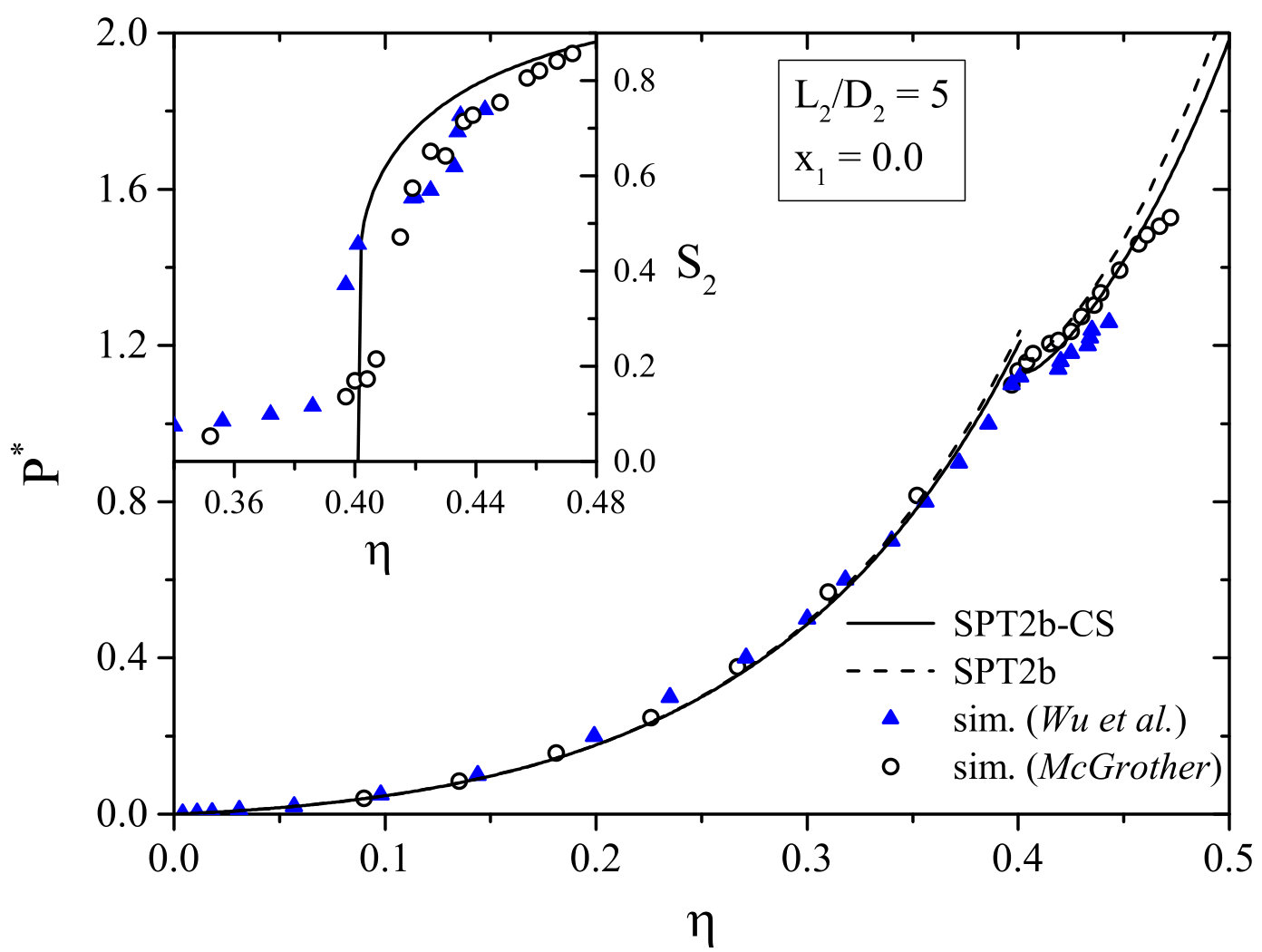 Figure 1
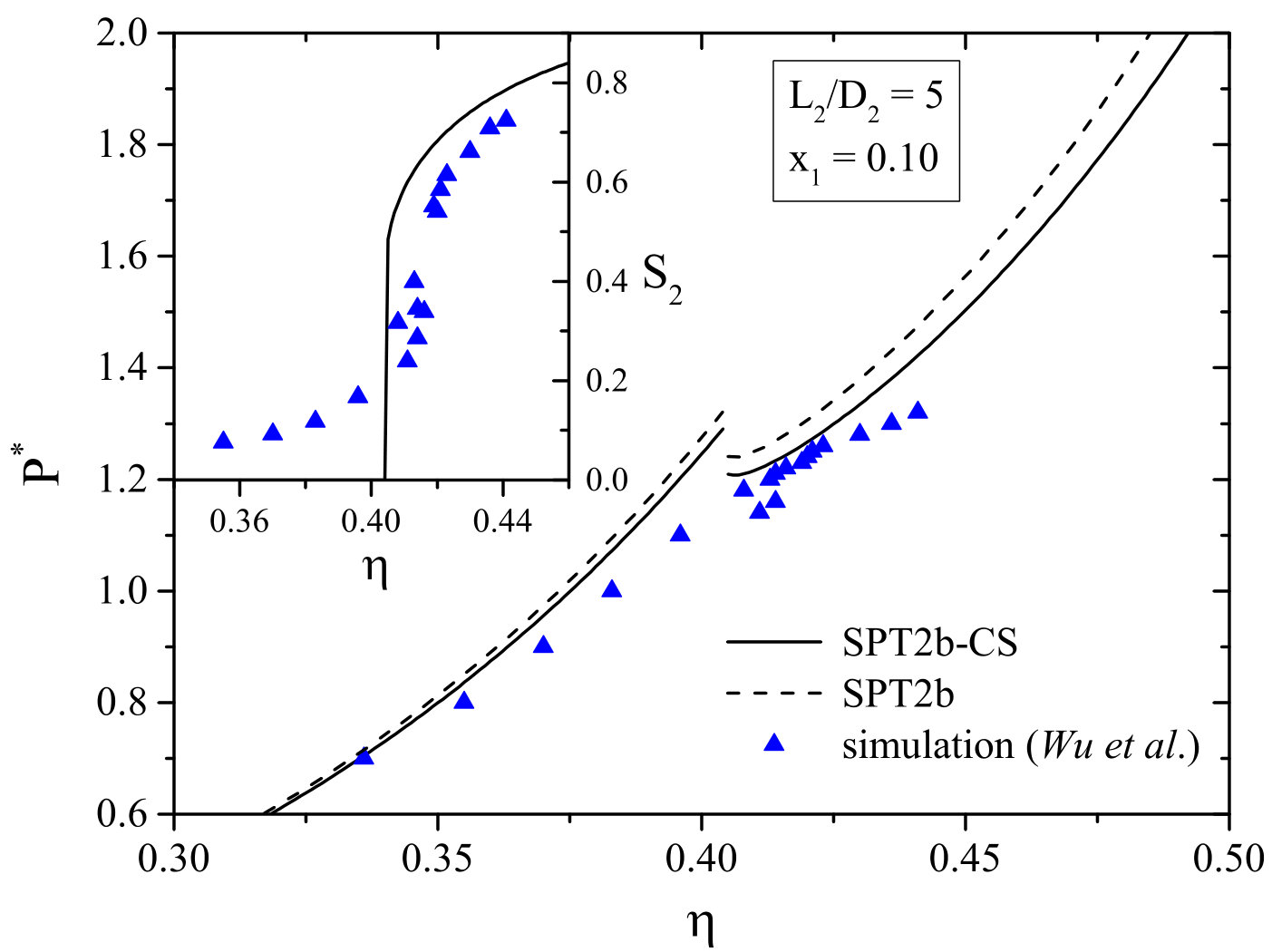 Figure 2
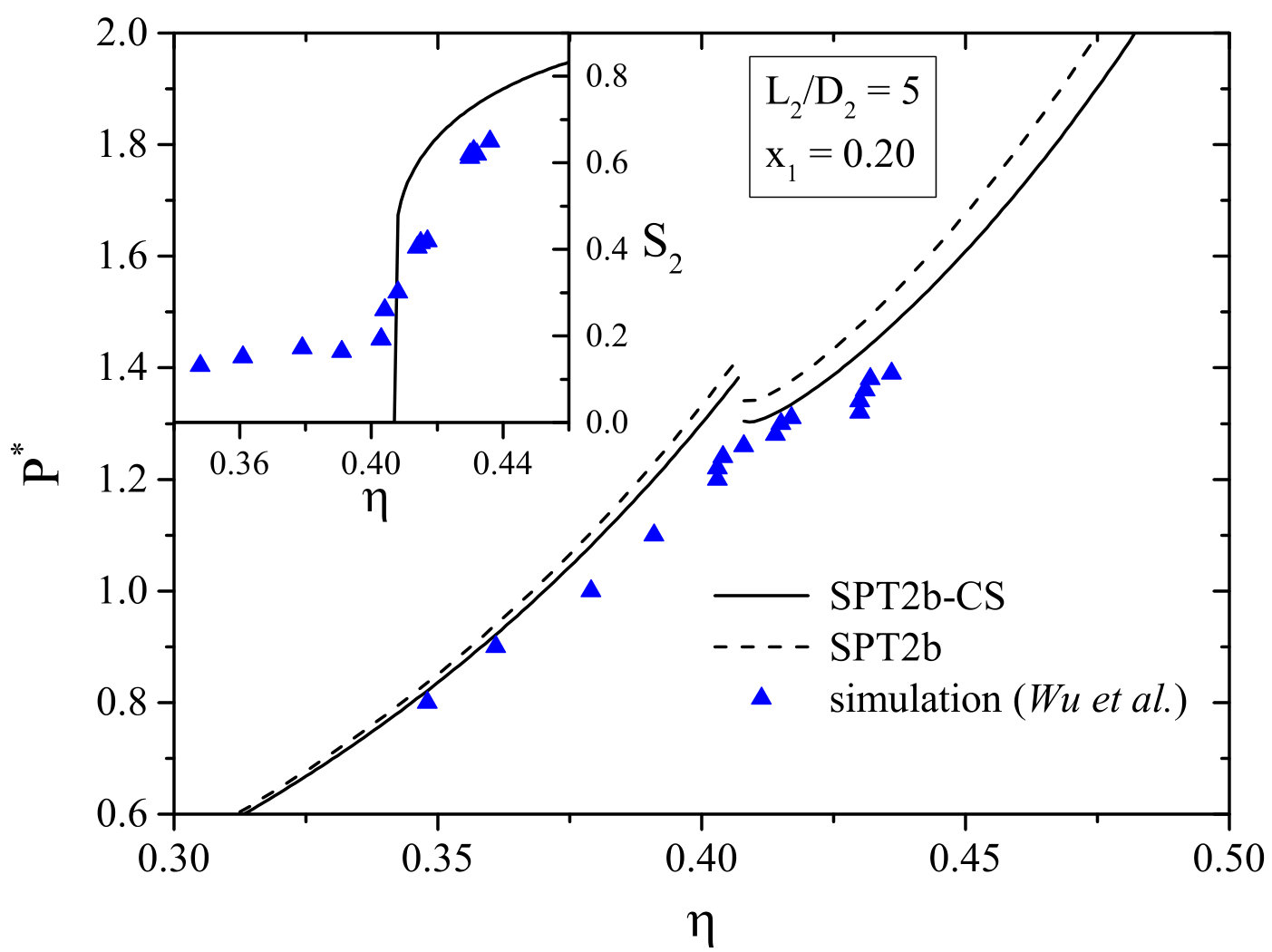 Figure 3
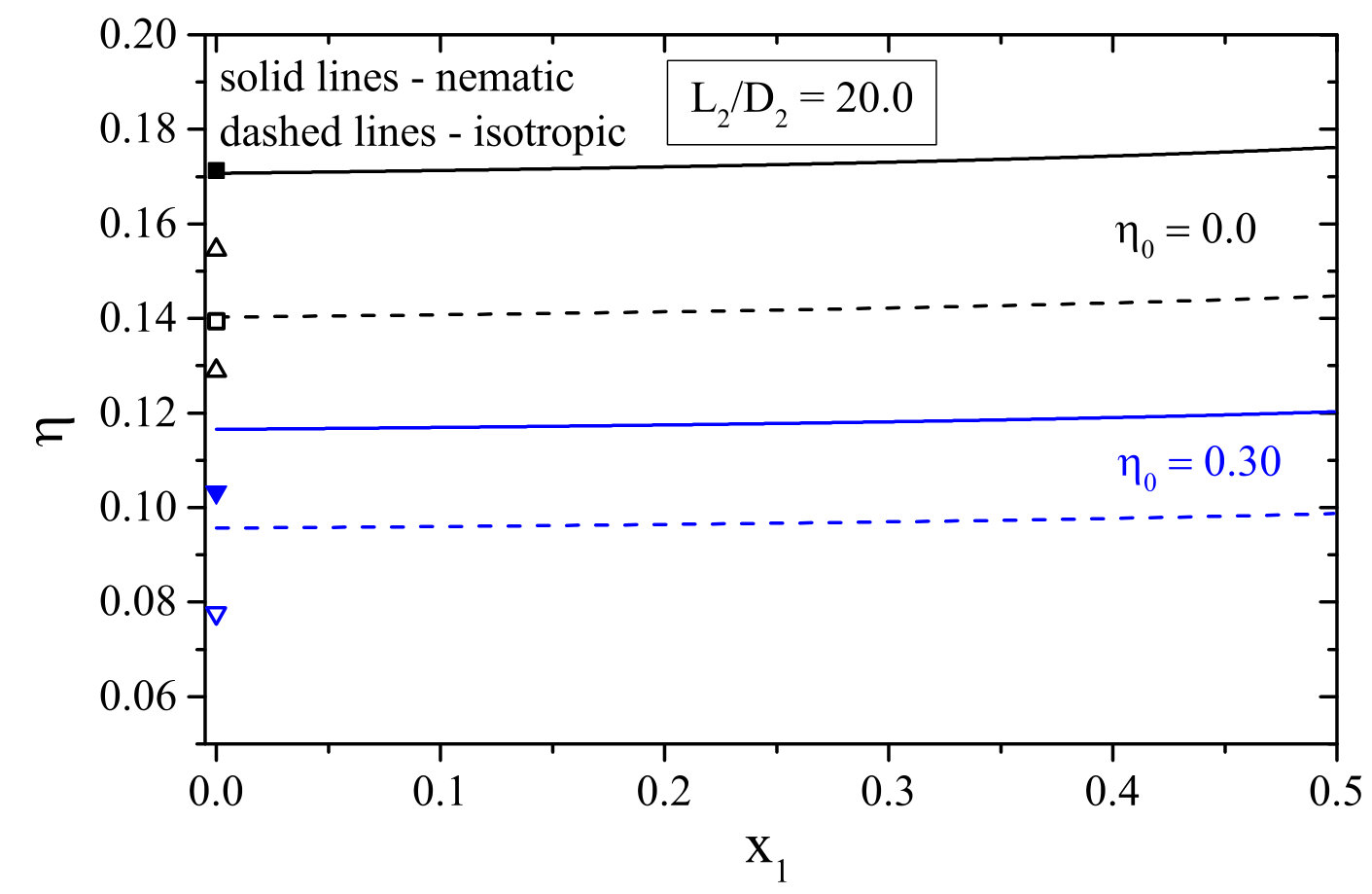 Figure 4
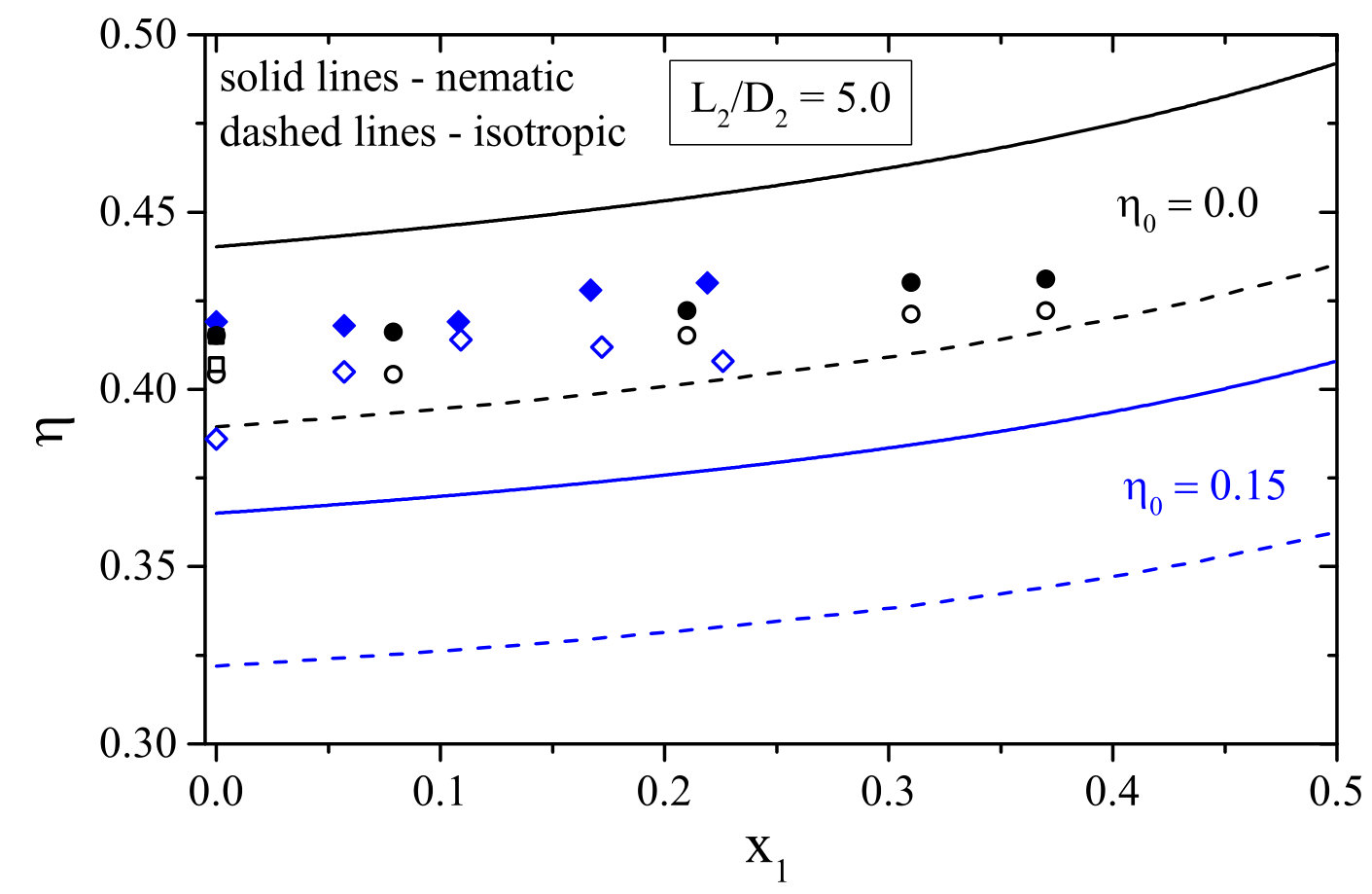 Figure 5
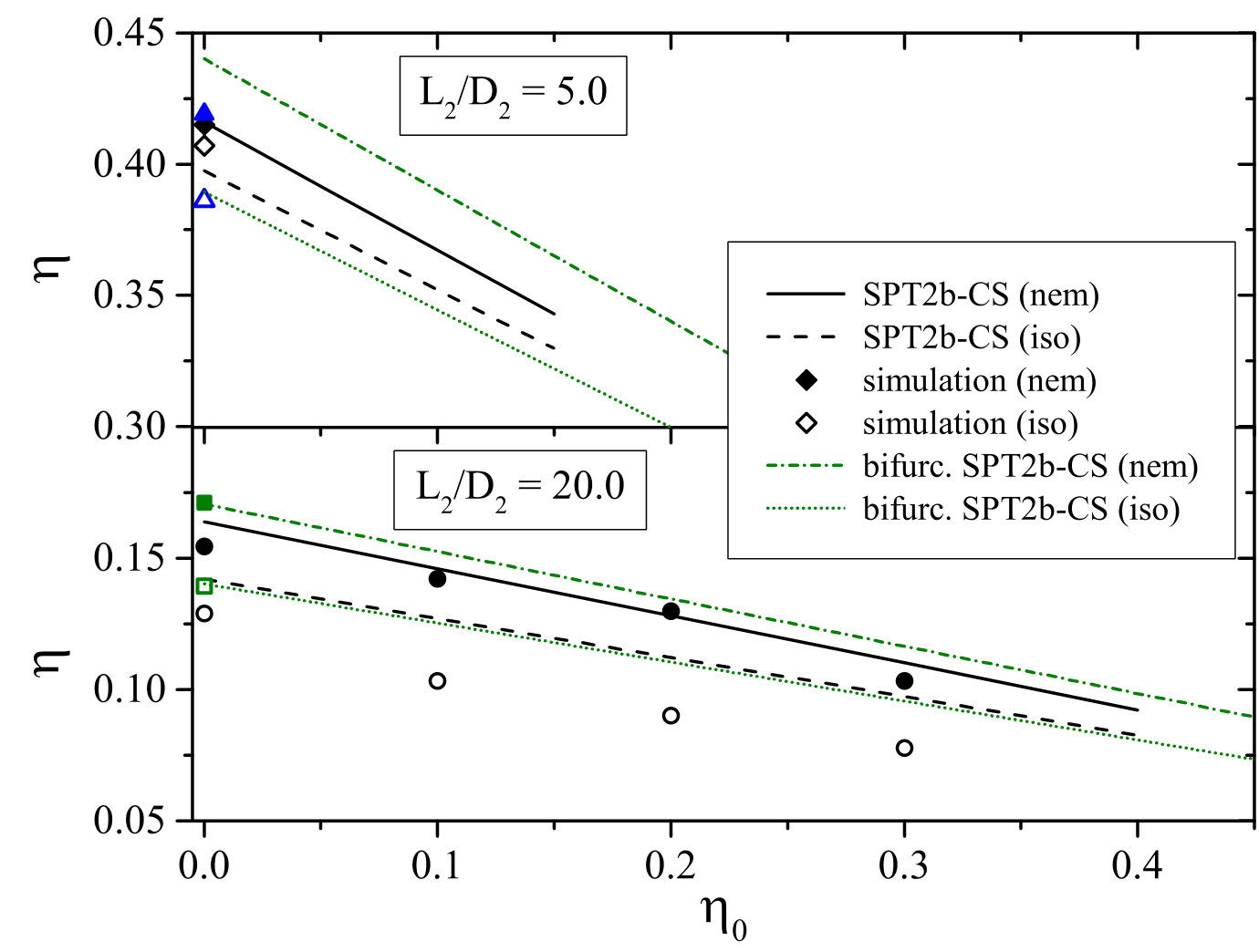 Figure 6
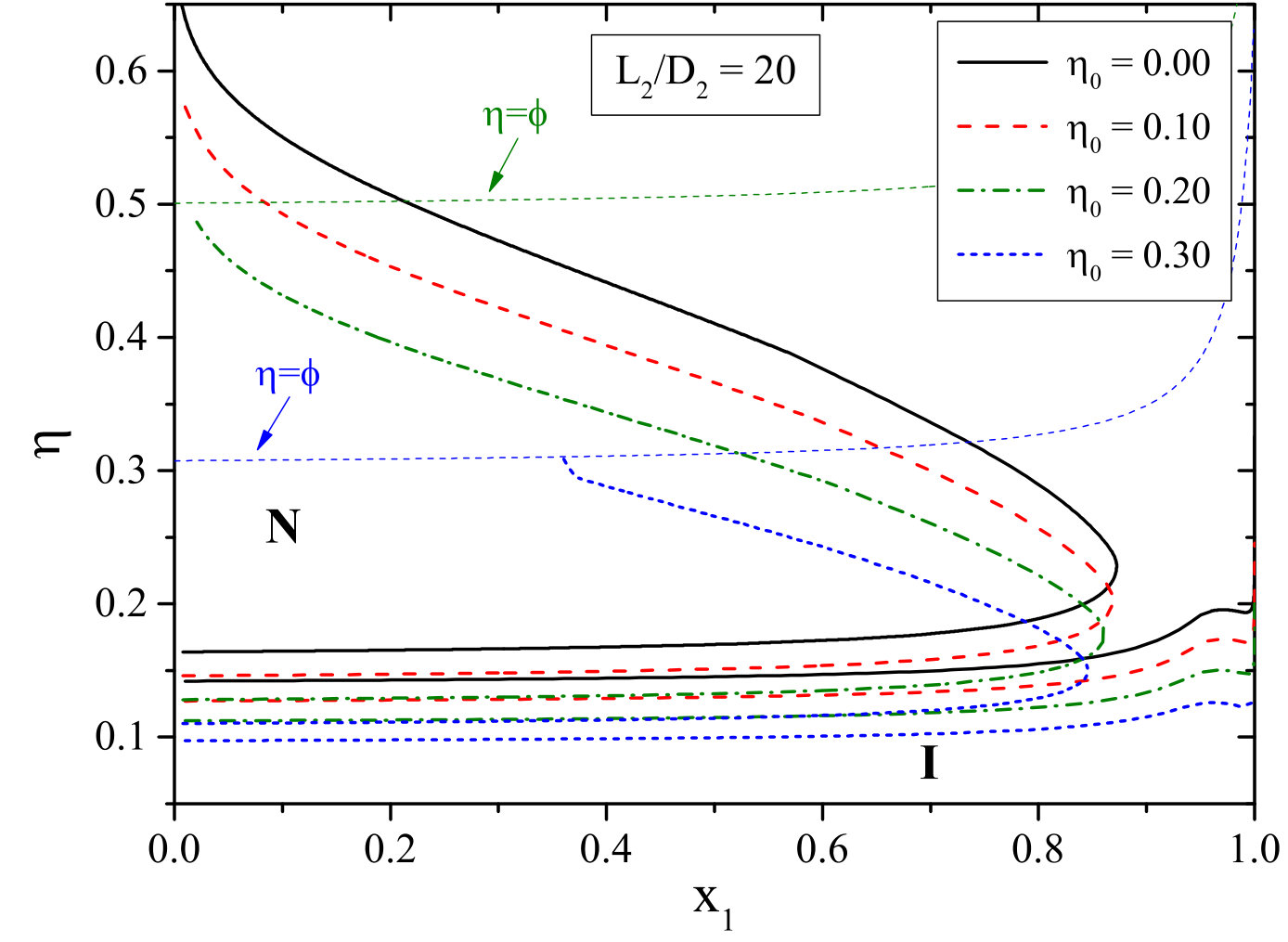 Figure 7
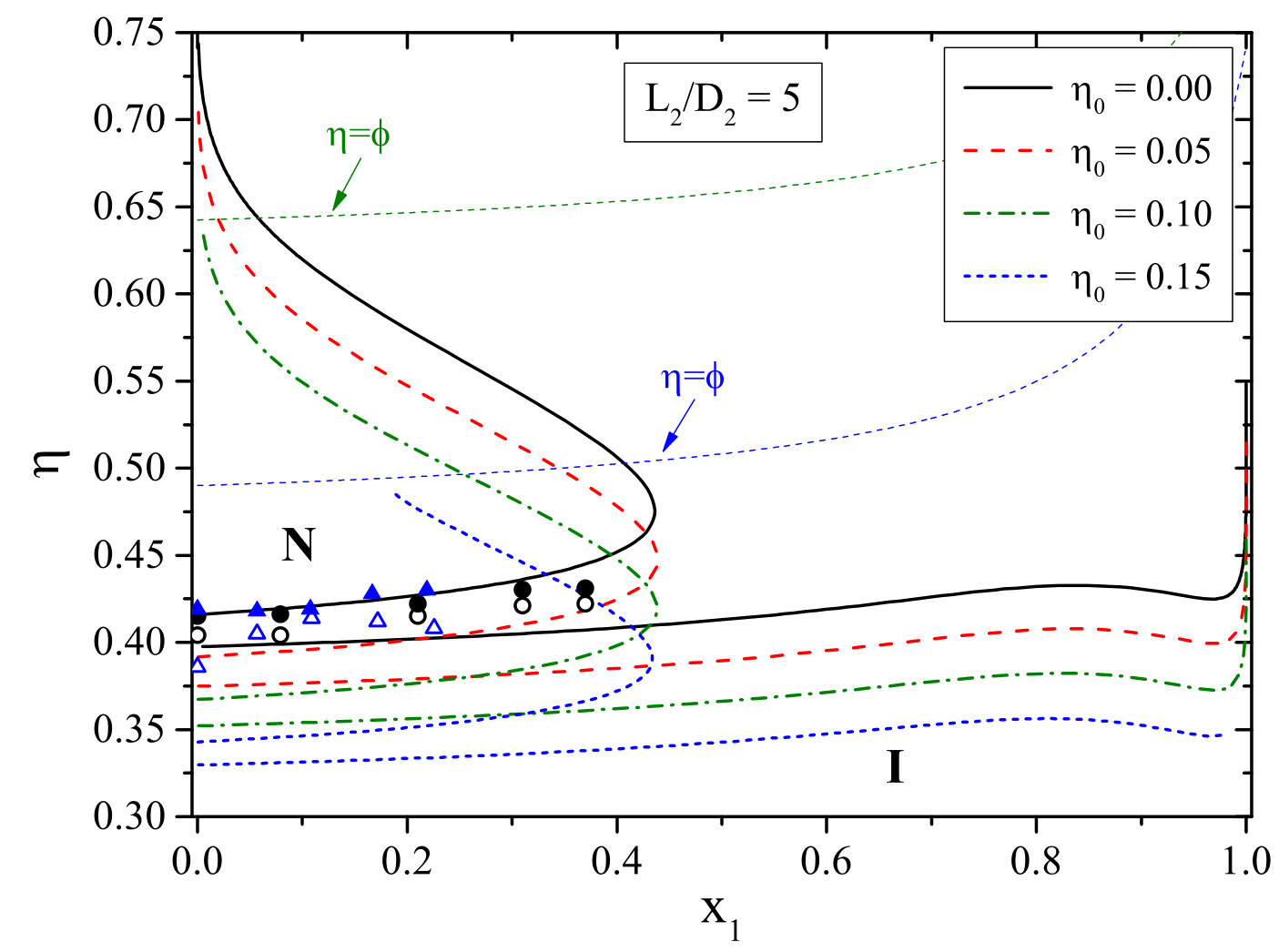 Figure 8
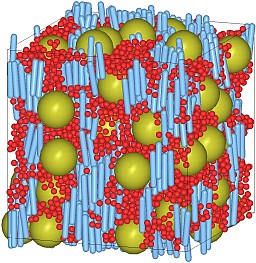 Figure 9
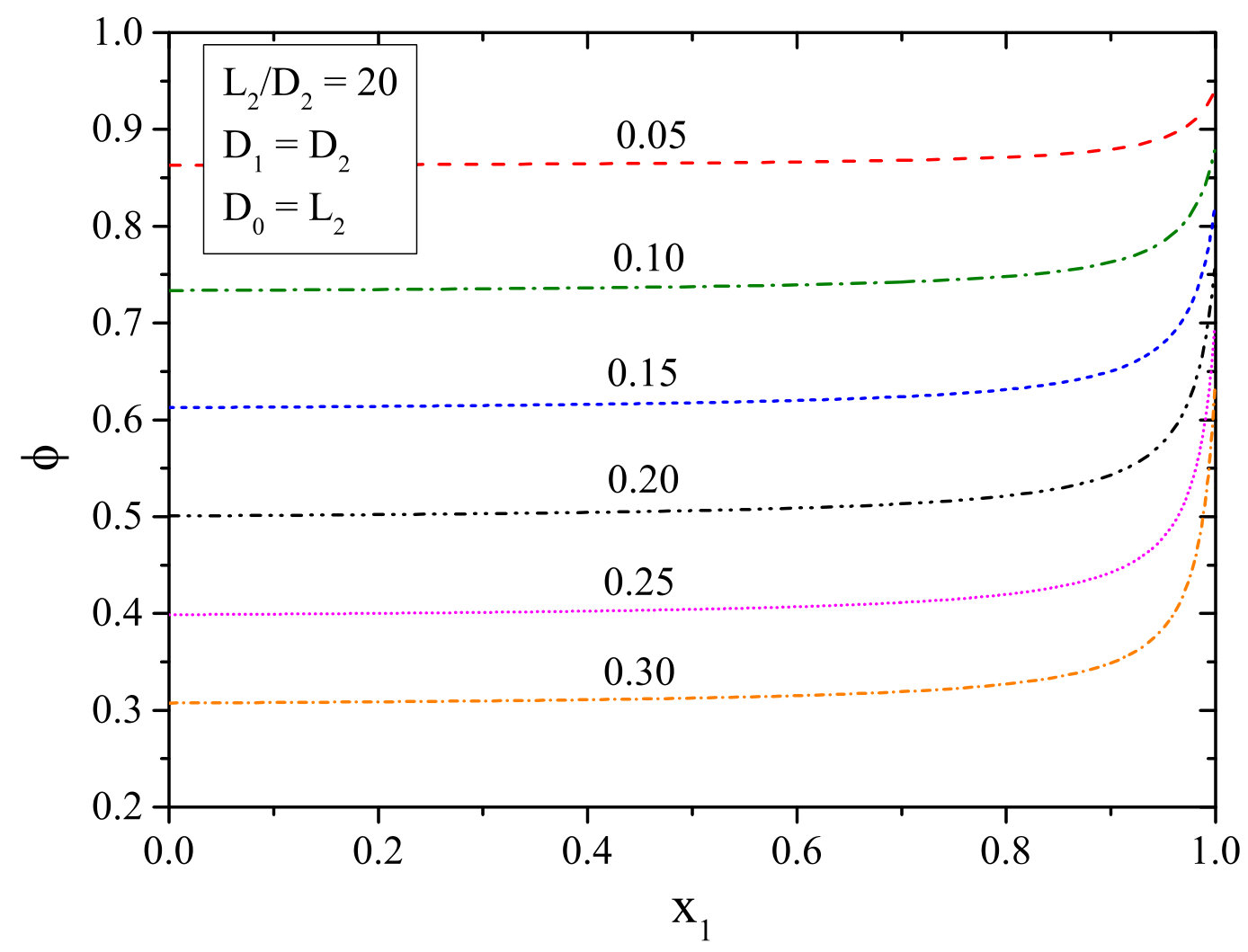 Figure 10
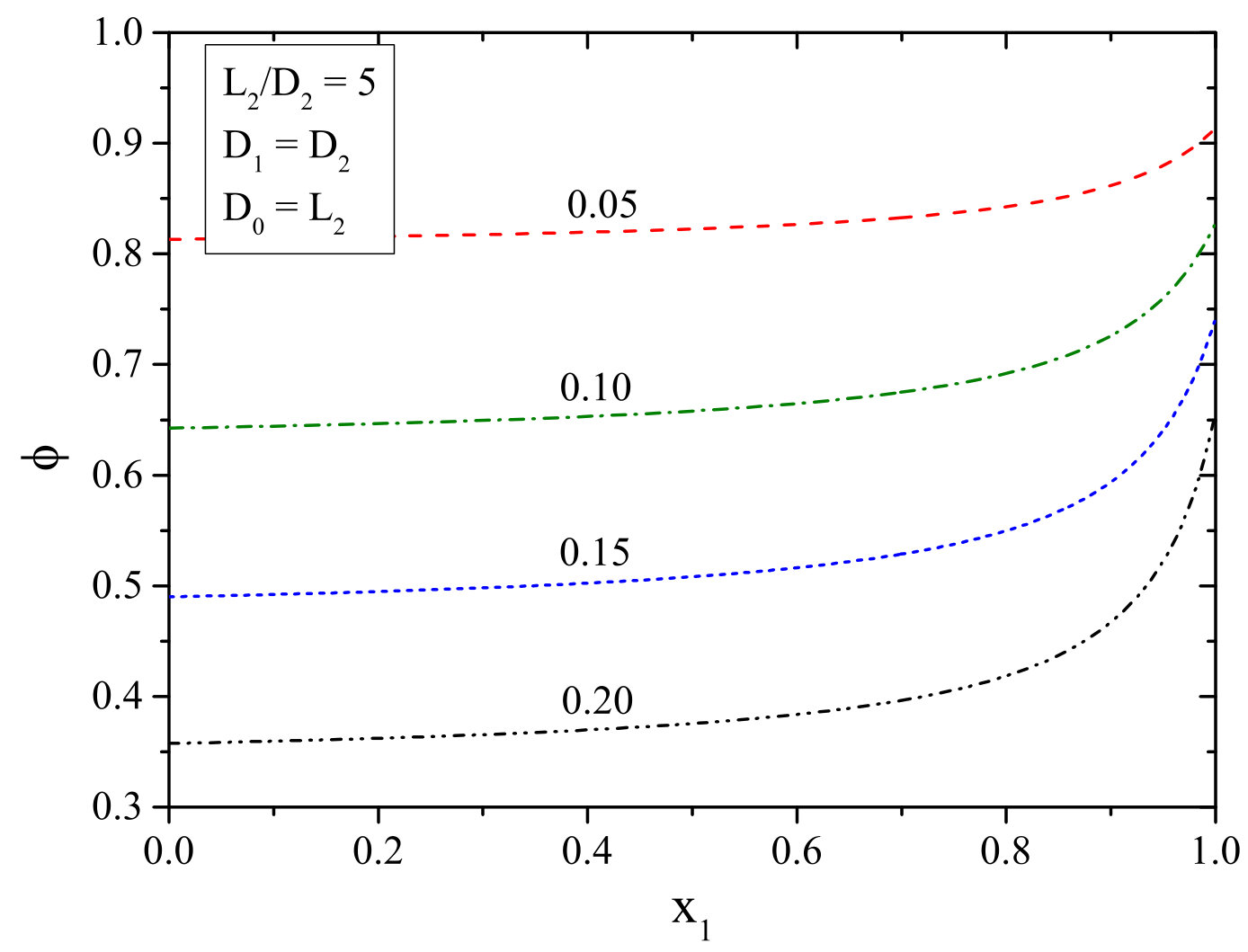 Figure 11
Peer Reviews
No public reviews on file for this paper yet. If you reviewed it on a platform where reviews are public (OpenReview, ICLR, NeurIPS, ICML), you can paste yours below so the community can read it here.
Videos
No videos yet. Explain this paper in a talk, walkthrough, or lecture? Add one.
Isotropic-Nematic Transition and Demixing Behaviour in Binary Mixtures of Hard Spheres and Hard Spherocylinders Confined in a Disordered Porous Medium: Scaled Particle Theory
M. Hvozd
T. Patsahan
M. Holovko
[
Abstract
We develop the scaled particle theory to describe the thermodynamic properties and orientation ordering of a binary mixture of hard spheres (HS) and hard spherocylinders (HSC) confined in a disordered porous medium. Using this theory the analytical expressions of the free energy, the pressure and the chemical potentials of HS and HSC have been derived. The improvement of obtained results is considered by introducing the Carnahan-Starling-like and Parsons-Lee-like corrections. Phase diagrams for the isotropic-nematic transition are calculated from the bifurcation analysis of the integral equation for the orientation singlet distribution function and from the conditions of thermodynamic equilibrium. Both the approaches correctly predict the isotropic-nematic transition at low concentrations of hard spheres. However, the thermodynamic approach provides more accurate results and is able to describe the demixing phenomena in the isotropic and nematic phases. The effects of porous medium on the isotropic-nematic phase transition and demixing behaviour in a binary HS/HSC mixture are discussed.
keywords:
nematics, porous medium, phase transition, hard spheres, hard spherocylinders, binary mixture, scaled particle theory, demixing, chemical potentials
Institute for Condensed Matter Physics] Institute for Condensed Matter Physics of the National Academy of Sciences of Ukraine, 1 Svientsitskii St., 79011 Lviv, Ukraine
1 Introduction
A study of the effects of disordered porous media on the isotropic-nematic transition in a fluid of rod-like particles or elongated rigid molecules is a topic of active research during the last decades due to the importance of such systems in numerous technological applications and because of special interest from the fundamental point of view 1. For nematic fluids a porous medium can play a double role. A porous medium does not only confines a nematic fluid geometrically, but also induces a randomly oriented field, which constrains the orientation of fluid particles near a pore surface. The effect of such random field depends directly on the anchoring strength between fluid particles and a pore surface, and indirectly on the porosity 2. Usually the starting point for the discussion of effect of this orientation field on ordering nematic phases is connected with so-called the Imry-Ma argument 3, according to which even a low amount of static disorder leads to suppressing the nematic long-range order in continuous symmetry systems. However, it was found that an existence of the quasi-long-range order can be observed in nematics confined in disordered porous media. Probably for the first time such a possibility was discussed in 4 and it was also predicted by numerical simulations 5 as well as by a renormalization group approach 6.
In many investigations of the isotropic-nematic transition of nematogenic fluids in porous media is given at the phenomenological or semiphenomenological levels. One of the simplest model for the description of nematic ordering in unconfined lyotropic systems is the model of hard spherocylinders (cylinders capped on both sides by hemispheres) 7, 8. The first treatment of isotropic-nematic transition within this model was done by L. Onsager near seventy years ago 9. The Onsager theory is based on the low-density expansion of the free energy functional truncated at the level of the second virial coefficient. This result is exact for the very specific case when the length of spherocylinder and the diameter of spherocylinder are taken in such a way that the reduced density of fluid is fixed, where , is the number of spherocylinders, is the volume of system.
The application of the scaled particle theory 10, 11, 12 provides the efficient approximate way to incorporate the higher-order density contributions neglected in the Onsager theory. The alternative way of improvement of the Onsager theory is the Parsons-Lee (PL) approach 13, 14, which is based on the mapping of the properties of a spherocylinder fluid to those of the hard sphere model. During the last decades the approaches developed for a hard spherocylinder fluid in the bulk case has been generalized for the description of mixtures of different hard anisotropic particles. In such systems the new phases were observed and their properties were richer and more complicated than those for the one-component case depending on thermodynamic conditions, shapes and sizes of the components. The simplest example of such multi-component systems of hard anisotropic particles is a binary mixture of hard spheres (HS) and hard spherocylinders (HSC) for the description of which the corresponding approaches have been proposed. Among them there are the Onsager theory 15, 16, Parsons-Lee approach 17, 18, 19, scaled particle theory 20 and computer simulations 21, 17, 18, 19, 22. The hard sphere-hard spherocylinder (HS/HSC) mixture is a simple model of a binary mixture of spherical colloids and macromolecular rod-like nematogens. It was noticed 22 that the properties of a HS/HSC mixture resulted from the balance between the entropic contributions of different nature. At low densities both the components are mixed in isotropic phase. At higher densities a HSC component forms the nematic phase, and due to a subtle balance between entropic contributions from the different components the demixing phenomena can take place, where the HSC and HS start to redistribute between nematic and isotropic phases 21, 22.
In order to study fluids in a disordered matrix many different theoretical approaches 23, 24, 25, 26 have been developed within the model proposed by Madden and Glandt 27. According to this model the porous medium is presented as a quenched disordered matrix of hard spheres. Despite an intensive study of fluids confined in disordered matrices the developed approaches were numerical in their basis. The first attempt to obtain analytical results was done in 28, 29, where the expressions for the chemical potential and pressure of a HS fluid confined in a hard sphere matrix were derived by extending the scaled particle theory (SPT)30, 30, 31. From a subsequent improvement of the scale particle theory for a HS fluid in a hard sphere (HS) matrix the SPT2 approach was formulated in 32, 33. Later on, the SPT2 approach for a HS fluid in a HS matrix was generalized for one- and two-dimensional cases 34, for a fluid of hard convex body particles 35, for a multi-component mixture of hard spheres in disordered matrices 36 and more recently for a hard spherocylinder fluid in disordered porous media 37. The original SPT2 approach includes two parameters, which characterize the porosity of matrix. The first one defines a bare geometry of matrix. It is so-called the geometrical porosity , which is equal to the ratio between the free volume not occupied by matrix particles and the total volume. The second parameter is so-called a probe-particle porosity, , and is determined by the chemical potential of a fluid in the limit of infinite dilution. This kind of porosity characterizes the adsorption of a fluid particle in a matrix, when other fluid particles are absent. The porosity is less than , since it takes into account a size of fluid particle. A number of approximation were proposed within the SPT2 approach32. Among them the SPT2b approximation is considered as one of the most successful. It was shown that the results of SPT2b agree well with computer simulation data in a wide range of fluid densities 32.
Also it is worth mentioning that some time before we started our development of different schemes of the SPT2 theory for the description of HS fluids in disordered matrices, M. Schmidt 38 had proposed his approach by combining the replica trick 23 with the density functional theory 39, hence he had developed the replica density functional theory for the description of the thermodynamic properties of HS fluids in disordered matrices. In particular, in 40, 41 the Onsager theory was generalized for the description of a HSC fluid in a hard sphere matrix. In order to control the quality of the developed theories the corresponding Monte-Carlo computer simulations were performed in those studies.
Recently, the SPT2 theory was also extended for the description of a HSC fluid in disordered porous media 35, 37. It was shown that the isotropic-nematic transition remains of the first order and a decrease of matrix porosity leads to the lowering of the density of HSC particles in the coexisting phases. The obtained theoretical results are in a good agreement with computer simulation data.
Despite more or less satisfactory knowledge about the phase behaviour of HS/HSC mixturse in the bulk, our understanding of the phase behaviour of this binary mixture is practically absent when it is confined in a disordered porous medium. This paper to the best of our knowledge is the first theoretical investigation of the effect of disordered matrix on the phase behaviour of a HS/HSC mixture. On the basis of our recent development proposed for a hard HSC fluid in a disordered matrix 35, 37, we generalize the SPT2 theory 36 to describe thermodynamic properties and orientation ordering of a HS/HSC mixture.
The paper is arranged as follows. The theoretical part is presented in Section 2. The discussion of obtained results is given in Section 3. And finally we draw some conclusions in the last section.
2 Theory
We consider a binary mixture of hard spheres (HS) and hard spherocylinders (HSC), which is confined in a disordered porous medium represented by the matrix of hard spheres. In order to characterize particles of the considered mixture we use three geometrical parameters: the volume of a particle, its surface area and the mean curvature taken with a factor 37. For the HS particles with the radius these parameters are
[TABLE]
for the HSC particles with the radius and the length
[TABLE]
And for the HS matrix particles with the radius we have
[TABLE]
2.1 SPT2 approach
The main essence of the scaled particle theory (SPT) is a calculation of the work needed to insert an additional scaled particle into a considered fluid system. A size of scaled particle is variable and in the case of HS particle it is defined by the scaling parameter . Thus, the volume , the surface area and the mean curvature of a scale particle equal to
[TABLE]
When we insert a scaled HSC particle with the scaling radius and the scaling length , in addition to the scaling parameter , we introduce the scaling parameter in such a way that and are defined as 10, 11, 12
[TABLE]
and consequently
[TABLE]
Hereafter we use the conventional notations 27, 23, 37, where indexes “1” and “2” are used to denote HS and HSC fluid components, respectively. The index “0” denotes matrix particles. For HS and HSC scaled particles we use indexes “1s” and “2s”, respectively.
By inserting a scaled particle into a system we produce a cavity, which is free of fluid particles. In the SPT theory we calculate the excess chemical potential of a scaled particle , which in turn corresponds to the work needed to produce the corresponding cavity 30, 42, 31.
In the case of matrix presence we generalize the previous results for HS fluid 28, 29, 32, 33, 36, 43 and for fluid HSC 35, 37 to derive the expressions for the excess chemical potentials of a small scaled particles in a HS/HSC mixture in the following way:
[TABLE]
[TABLE]
Here , is the Boltzmann constant, is the temperature, is the packing fraction of HS fluid, is the density of HS fluid, is the HS volume; is the packing fraction of HSC fluid, is the density of HSC fluid, is the HSC volume; , are the HS and HSC fluid thermal wavelengths, respectively; is the rotational partition function of a single HSC molecule 44. We note that the expressions (2.1)-(2.1) are written for isotropic case.
The terms and are defined by
[TABLE]
[TABLE]
where is the matrix packing fraction and is the density of matrix particles.
Substituting Eqs. (1)-(6) into Eqs. (2.1)-(10) and using the generalization of Eq. (2.1) for the anisotropic case the chemical potentials of the HS and HSC scaled particles in a HS matrix can be presented as following
[TABLE]
[TABLE]
where and are equal to
[TABLE]
In Eq.(2.1) and are given by
[TABLE]
[TABLE]
where denotes the orientation of HSC particles and it is defined by the angles and , is the normalized angle element, is an angle between orientation vectors of two molecules, is the singlet orientation distribution function normalized in such a way that
[TABLE]
The term in Eq. (2.1) is determined by the excess chemical potential, , of the HS scaled particle confined in an empty matrix. It has the same meaning as the probability to find a cavity inside of a matrix, which is large enough to insert this HS scaled particle. Similarly, the term in Eq. (2.1) refers to the HSC scaled particle. For and we have the following expressions:
[TABLE]
where and
[TABLE]
where , .
In the case of a large scaled particle we can write the excess chemical potential in the form of expression, which follows from the thermodynamic treatment for the work needed to produce a macroscopic cavity inside of a fluid confined in a porous medium. For the large HS scaled particle is related to the pressure of a HS/HSC mixture as
[TABLE]
where is the volume of the HS scaled particle. For the large HSC scaled particle with the volume we have
[TABLE]
The multipliers and mean that we are dealing with excluded volumes occupied by the matrix particles. They can be considered as the probabilities of finding a cavity produced by, respectively, HS scaled particle and HSC scaled particle in the matrix when the fluid particles are absent. There are two different types of the porosities, which are related directly to these probabilities. The first type corresponds to the case of and denotes the geometrical porosity
[TABLE]
for the scaled HS particle and
[TABLE]
for the HSC scaled particle. The geometrical porosity is related to the volume of a void existing between matrix particles and depends only on a structure of matrix. It is important to note that at the geometrical porosity , thus
[TABLE]
The second type of porosity called as the probe-particle porosity is determined by the excess chemical potential of fluid particles in the limit of infinite dilution . Consequently, the probe particle porosity depends on the nature of fluid under consideration. Using the SPT theory 45 for the bulk HS/HSC mixture in infinite dilution of corresponding component the probabilities to find HS particle or HSC particle in an empty matrix are respectively
[TABLE]
According to the ansatz of the SPT theory 37, 28, 29, 32, 33, 36, 43, and can be presented in the form of the following expansions
[TABLE]
The coefficients of these expansions can be obtained from the continuities of and , and they correspond to derivatives , at for a scaled HS particle; , , , at for a scaled HSC particle. Thus, for a HS scaled particle we have:
[TABLE]
Here ; and at . For a HSC scaled particle we obtain
[TABLE]
where , , , at .
Using Eqs. (19)–(20) at we derive the relations between the excess chemical potentials and and the pressure of a HS/HSC mixture in a matrix
[TABLE]
[TABLE]
The coefficients , , , define the porous medium structure and can be found from the following expressions:
[TABLE]
and
[TABLE]
The total chemical potentials for HS and HSC components are respectively
[TABLE]
and
[TABLE]
A substitution of Eqs. (30)-(31) in Eqs. (34)-(35) gives us two equations, and each of them contains two unknowns: the chemical potential and the pressure. In the case of one-component fluid we can eliminate one of unknowns, () or , from Eq. (34) or Eq. (35) using the Gibbs-Duhem equation. In our particular case the Gibbs-Duhem equation has the following form:
[TABLE]
Next we follow 36 and generalize the results for a binary HS/HS mixture to the case of binary HS/HSC mixture. In order to use Eq.(36) and to obtain one equation containing only one unknown instead of Eqs.(34)-(35), we take the derivatives with respect to the total fluid density on the both sides of Eqs.(34)-(35) by keeping the fluid composition unchanged: , . Hence, we can write the following
[TABLE]
Using Eq. (36) we can not find an expression for the chemical potential of one species from Eqs. (2.1) and (2.1), but the combination of Eqs. (36) and (2.1)-(2.1) leads to an expression for the fluid compressibility. Taking into account that , we obtain
[TABLE]
where
[TABLE]
[TABLE]
[TABLE]
Similarly as it was done for a HS mixture in 36 we integrate Eq.(2.1) over the total density at the fixed concentration to find the pressure:
[TABLE]
The expression (2.1) is the SPT2 result for the pressure of considered mixture and it has the same form as for the one-component case 32, 33, 37, 43. The free energy can be obtained by integrating the pressure over the mixture density, and the chemical potentials we derive dy differentiating the free energy with respect to the densities of HS and HSC.
As it was noted in 37 the obtained expression has two divergences appearing in and . Since the first divergence in occurs at lower densities than the second one. From geometrical point of view such a divergence should appear at densities corresponding to the maximum value of fluid packing fraction , which is available for a fluid in a given matrix and should be higher than , i.e. . Therefore, for essentially high fluid densities the different corrections and improvements of SPT2 are proposed 37, 32, 33, 36, 43. In the current study we restrict our consideration to the SPT2b approximation, since for mixtures in a matrix it is the best approximation, in which the SPT2 theory is formulated for this moment 36.
2.2 SPT2b approximation for HS/HSC mixture
We follow the scheme proposed in 36 for a HS multi-component mixture in a matrix to derive the pressure and chemical potentials for a binary HS/HSC mixture using the SPT2b approximation. However, according to 36 first we need to obtain the corresponding expressions in the SPT2a approximation 32. As it was shown in 36, 36 the SPT2a approximation can be derived by replacing with in all terms of the right hand side of Eq. (2.1). We take the limit and in order to remove the singularity we expand as the Taylor series around . Thus, we obtain
[TABLE]
From the pressure one can calculate the Helmholtz free energy using the following expression
[TABLE]
We carry out the integration of this expression at constant concentrations (, ). Therefore, the final expression for the free energy is
[TABLE]
where is the Helmholtz free energy of a bulk ideal gas mixture,
[TABLE]
Here is the entropic term and it is defined by
[TABLE]
From the Helmholtz free energy one can calculate the total chemical potentials for each of mixture components. Using the relation
[TABLE]
for a HS component we obtain
[TABLE]
where
[TABLE]
and
[TABLE]
For a HSC component we have the following expression
[TABLE]
where
[TABLE]
and
[TABLE]
Now, we take the limit in all terms of Eq. (2.1) except the first term, and as a result, the pressure in the SPT2b approximation is obtained:
[TABLE]
Consequently, for the free energy we have
[TABLE]
The total chemical potentials for the both of components of a HS/HSC mixture are derived in the SPT2b approximation as well:
[TABLE]
In order to obtain the singlet orientation distribution function a minimization of the free energy with respect to variations of should be applied. After taking the corresponding functional derivation we come to the non-linear integral equation:
[TABLE]
where
[TABLE]
[TABLE]
[TABLE]
2.3 Carnahan-Starling and Parsons-Lee corrections
In our previous paper 20 the SPT2 approach was applied for the description of a bulk HS/HSC mixture. We found from a comparison of the results obtained from the theory with computer simulations that the accuracy of the description of isotropic-nematic transition in a HS/HSC mixture becomes poor if the length of spherocylinders is not large enough. Since due to decreasing the length the region of isotropic-nematic phase transition shifts towards higher densities it is reasonable to assume that the problem of the SPT2 approach with relatively small values of is related to the accuracy of the SPT theory for higher densities.
As it is known 46 in the SPT for a HS fluid the thermodynamic properties coincide with the results obtained from the analytical solution of the Percus-Yevick integral equation, which is far from perfect at high fluid densities. Therefore, it is necessary to introduce an efficient correction in our formalism. Such a simple correction is the Carnahan-Starling improvement 47.
We propose the Carnahan-Starling correction for the case of a fluid in a matrix and present the equation of state in the following way:
[TABLE]
where is given by Eq.(56), is the Carnahan-Starling correction which can be defined as 46
[TABLE]
Carrying out a similar procedure described in the previous section we obtain the following expression for the free energy
[TABLE]
where the first term is given by Eq.(57) and the second one is the following:
[TABLE]
Consequently, for the chemical potentials we have
[TABLE]
where the first term is given by Eq.(2.2) and the second one is
[TABLE]
Another point for improvement of the SPT2b theory is related to the expression (2.2) for the parameter in the nonlinear equation (59) for the singlet distribution function . The expression (2.2) for the parameter has two terms. First of them appearing due to the coefficient and the second one comes from the coefficient in the expression (57) for the free energy. We propose the analogues for these two terms in the corresponding integral equation for the singlet distribution function from the consideration of the HSC fluid using the Parsons-Lee (PL) approach 13, 14. It was shown that the first term, which appears from the coefficient in the SPT2b approximation and in the PL approach are the same. But there is some difference in the second term. It is easy to show that when we introduce parameter as a factor before the term with in the coefficient it is possible to have practically the same results for the description of isotropic-nematic transition from both the SPT2 and PL approaches. After the generalization of this result for the case of HS/HSC mixture in a HS matrix, we can rewrite the expression for in the following form:
[TABLE]
Using the Parsons-Lee theory within the framework of Onsager’s investigation for sufficiently long HSC particles we derive 14. As a result, we obtain a new expression for :
[TABLE]
3 Results and discussions
The approach presented in the previous section allows us to describe thermodynamic properties of binary HS/HSC mixtures confined in a disordered porous medium of a HS matrix. It is important to ascertain that this theory can provide correct results for the thermodynamic quantities of considered systems and that it is able to predict accurately the position of I-N transition occurring in a HSC component. Therefore, using the SPT2 approach we have calculated the pressure of HS/HSC mixture as a function of its packing fraction . In Figs. 1 we compare the obtained results for bulk HS/HSC mixtures at different HS concentrations with the computer simulation data taken from the literature48, 19. We consider the approximation SPT2b and its modification SPT2b-CS. As it was expected the SPT2b-CS coincides much better with the simulations than the SPT2b. Especially, it is seen for the case of mixtures ( and ). While for the pure HSC fluid () the difference between these two approximations is negligible. In this case the theoretical results perfectly fit the simulation data from 48. However, the worse coincidence with the simulations taken from 19 is noticed, where the values of pressure obtained from the simulations become lower than theoretical ones at the packing fractions close to the I-N transition. This tendency also remains for the HS/HSC mixtures (Figs. 1) for the concentrations and . Since for all considered concentrations the SPT2b-CS fits the simulation results for the pressure better than those obtained in the SPT2b, hereafter we use the SPT2b-CS approximation as the best one. It should be noted that since the SPT2b-CS is based on the conceptions similar to the Parsons-Lee14 (PL) and many-fluid Parsons17 (MFP) approaches, the results obtained for a bulk mixture are close to that presented in 19, where the PL theory and MFP approach was used and compared. Also the order parameter behavior looks very similar to that predicted in 19, and one can observe that the I-N phase transition occurs at the correct packing fraction .
We apply the theory presented above to study the isotropic-nematic phase transition in a binary HS/HSC mixture confined in a matrix formed by a disordered HS particles. For this purpose we consider the coexistence between isotropic and nematic phases of a HSC component depending on the concentration of HS particles and the packing fraction of matrix particles .
A basic description of the isotropic-nematic phase behaviour of HSC can be obtained from the bifurcation analysis of the integral equation (59) for the singlet distribution function . This equation has the same form as the corresponding equation obtained by L. Onsager 9 for a pure HSC fluid in the limit of and , when the reduced density of fluid is fixed. Using the bifurcation analysis of the integral equation (59) it was found that this equation has two characteristic points and 47, which define the range of stability of considered mixture. The first point corresponds to the highest possible density of HSC in the stable isotropic state. The second point corresponds to the lowest density of the stable nematic state. For the Onsager model the minimization of free energy with respect to the singlet distribution function leads to the coexisting equations, the numerical solution of which provides the densities of coexisting isotropic and nematic phases of HSC fluid 49, 50, 51:
[TABLE]
For a HS/HSC mixture confined in the presence of porous medium we can use the Onsager limit and derive the expression for from (2.3) in the following form:
[TABLE]
It is immediately seen from the equation (72) that the I-N transition of HSC particles confined in a matrix shifts towards lower densities of if the packing fraction of matrix increases. Similarly the HSC density is affected by increasing the packing fraction of HS particles . In the general case when the parameters and are finite we can set
[TABLE]
where and are determined from Eq. (2.3). This approach allows us to estimate the packing fractions of HS/HSC mixture at which the isotropic and nematic phases of HSC component coexist. Using the conditions (73) we solve Eq. (2.3) with respect to , where can be defined through as
[TABLE]
and is the concentration of HS particles in a HS/HSC mixture and is the total packing fraction of this mixture. Hence, the packing fractions of isotropic phase and nematic phase are calculated for a HS/HSC mixture in the bulk () and in a matrix. In Fig. 2 we present results of the bifurcation analysis for the I-N coexistence curves of a HS/HSC mixture in the plane. We consider two sizes of HSC particles (Fig. 2, left panel) and (Fig. 2, right panel). The sizes of HS particles are the same in the both cases and are equal to the diameter of HSC particles (). On the other hand the size of matrix particles is set equal to the length of HSC particles (). The values of the parameters for the considered model are taken according to that used in the simulation studies of 22, 19, 40. Therefore, we can compare our theoretical predictions with the simulation data. It is seen for the case of that the bifurcation analysis describes correctly the region of I-N phase transition for a bulk HS/HSC mixture. However, the difference between coexistence densities and are much larger than that obtained from the computer simulations. On the other hand, for the long HSC particles () the and are very close to the simulation results obtained for the bulk HSC fluid in 52. This witnesses that the accuracy of the bifurcation analysis improves with increasing the length of HSC particles. Simultaneously, one can observe a rather poor coincidence of our results with the simulation data of Schmidt published in 40 for a pure HSC fluid in the bulk and in a matrix. Surprisingly, both for the bulk HSC fluid and for the confined HSC fluid the simulations of Schmidt 40 provide somewhat lower results than the theory does. However, it can be related to the statistical error of simulations.
From the qualitative comparison of the coexistence curves shown in Fig. 2 for the bulk and confined HS/HSC mixtures one can notice that the packing fractions of isotropic and nematic phases decrease with increasing the packing fraction of matrix, while the increase of HS concentration leads to increasing of . This trend is observed from both the bifurcation analysis and simulations. Also the coexistence region is slightly narrower in the case of confined mixture than in the bulk case.
Although the bifurcation analysis gives us a rather good description of the isotropic-nematic transition in a certain range of parameters, it remains rather limited, since it is not able to provide the whole phase diagram for a HS/HSC mixture correctly even on a qualitative level. It was shown in 21 that at some concentrations of HS particles the demixing processes occur in the coexisting phases leading to the nematic phase rich in HSC particles and the isotropic phase rich in HS particles. It follows from the conditions of thermodynamic equilibrium, according to which the pressure of HS/HSC mixture as well as the chemical potentials and of the both HS and HSC components in the isotropic phase should be the same as in the nematic phase:
[TABLE]
where and are the concentrations of HS particles in the isotropic and nematic phases, respectively. This set of equations can be solved with respect to , and at the fixed . Alternatively, we can fix and use as a variable. In any case, the calculated packing fractions and concentrations give us the dependencies of on in each of the phases, thus the coexistence curves can be plotted in the plane.
Using the expressions for the pressure and the chemical potentials and derived by us in this study within the SPT2b-CS approximation (63) and (67) we have solved the equations (75) numerically in combination with (59), where the definition for used according to the expression (2.3). For this purpose the Newton-Raphson algorithm have been applied. The packing fractions of HS/HSC mixture and HS concentrations in the coexisting isotropic and nematic phases have been calculated with the computational error less than .
We present isotropic-nematic coexistence diagrams for confined HS/HSC mixtures with in Fig. 3 and with in Fig. 4. Similarly as it was done above in the bifurcation analysis we set the size of HS particles equal to and the size of matrix particles is taken equal to . As it is seen the general shape of the coexistence curves of isotropic and nematic branches does not depend on the matrix porosity. At low concentrations of HS the packing fraction increases monotonously with both in the isotropic and nematic phases. It should be noted that the concentration of in the nematic phase is always less than in the coexisting isotropic phase, and however this difference is not essential at lower packing fractions of nematic phase, it permanently increases with . Such a behaviour is observed till some certain point at which the system enters into the demixing regime, and the difference in HS concentrations between two phases starts to increase much faster. This point corresponds to the concentrations for and for . It is also observed that at higher values of the nematic phase does not exist. Therefore, a further increase of in the isotropic phase leads to decreasing of in the nematic phase. In this case the packing fraction of nematic phase increases permanently. On the other hand, in the isotropic phase the dependency of on is not monotonous, i.e. at high concentrations slightly decreases (at for and for ), and then it sharply rises when approaches unity. Simultaneously, in the nematic phase quickly decreases with increasing and it tends to zero when the maximum packing fraction of HSC particles is reached. This behaviour was described first in 21 for a bulk HS/HSC mixture by use of the Parsons-Lee approach. And now we can see that for confined HS/HSC mixtures the phase diagrams qualitatively repeat the bulk case, although the I-N phase transition in the case of matrix presence occurs at lower packing fractions . Nevertheless, we have also found some peculiarities in the phase behaviour of considered systems, which are related directly to confinement effects. Except shifting of the I-N coexistence region towards lower , it have been noticed in Fig. 4 for that this region becomes narrower when the packing fraction of matrix increases. The same trend one can observe also for in Fig. 3, however it is not well pronounced. Another effect appears at the point from which the system enters into the demixing regime. For the demixing starts at the same HS concentrations. On the contrary, for (Fig. 4) this concentration varies depending on and it shifts towards lower values of with increasing .
We should point out one more important effect, which is very specific to systems of particles confined in disordered matrices. Especially, it concerns particles of strongly elongated shape, which cannot be packed efficiently in a disordered medium of matrix. In our case such particles are spherocylinders and the maximum packing fraction of pure HSC particles is limited by the probe-particle porosity of the confining matrix (2.1). For pure spheres the probe-particle porosity is given by (2.1), which should be larger than . For the HS/HSC mixture we have introduced the quantity (42), which is a combination of and , and now we rewrite the expression (42) in terms of and as follows
[TABLE]
Using the obtained expression (76) and taking into account the condition for the packing fraction of HS/HSC mixture in a matrix, , we can predict a boundary line which cannot be crossed towards higher or lower . In Figs. 5 we show some examples for the dependencies of on the concentration of HS particles . As it was expected the maximum packing fraction for HSC particles is less than for HS particles (). The dependencies are monotonous, thus for mixtures of HS/HSC the maximum packing fraction gets intermediate values. These results explain a reason why some of coexistence curves stop at a certain point in Figs. 3 and 4 and cannot reach in the nematic phase at higher packing fractions. For instance, this situation appears for HS/HSC mixtures in matrices of packing fractions and in the case of , and for and in the case of .
Finally, we consider the I-N coexistence curves for the same system parameters as we used above ( and ), but this time the results are shown in the plane. We should note that to the best of our knowledge no simulation data for HS/HSC mixtures in disordered matrices are published for this moment. However, one can find simulations for a pure HSC fluid confined in a matrix presented in 40. Therefore, in Fig. 6 we make an additional test of our theory by comparing our results with simulations in the case of . As it is seen for the approach proposed in our study describes well the nematic branch, while it leads to some overestimation for the isotropic curve. Similar tendency have also been observed for a bulk HS/HSC mixture in Fig. 3, where we compare the I-N coexistence curves with the simulation results of 22, 19.
4 Conclusions
The scaled particle theory previously generalized for the description of thermodynamical properties of a hard sphere fluid in a disordered porous matrix is extended to the case of a binary mixture of hard spherical colloids and spherocylinder particles. The analytical expressions for the pressure of the mixture and the chemical potentials of hard spheres and hard spherocylinders are obtained. For the correct description of thermodynamic properties the Carnahan-Starling-like and Parsons-Lee-like corrections are introduced. The nonlinear integral equation for the orientation singlet distribution function is obtained from the minimization of the free energy of considered system. From the bifurcation analysis of this equation the isotropic-nematic phase transition in this binary mixture is investigated. Other investigation of phase transition is done on the basis of conditions of thermodynamic equilibrium. It is shown that the both approaches correctly reproduce the general trends of isotropic-nematic transition at small concentrations of hard spheres. However, the thermodynamic approach predicts the demixing transition at high concentrations of hard spheres, what is not available in the bifurcation analysis. The effect of disordered matrix on the isotropic-nematic and demixing transitions are discussed in terms of the total packing fraction of mixture and the concentration of hard spheres for each of the coexisting phases.
It is shown that the increase of the packing fraction of matrix particles (decrease of porosity) shifts the region of isotropic-nematic coexistence towards lower packing fraction of a mixture. Simultaneously, this region gets narrower. For the case of long spherocylinders we have observed that the system enters the demixing regime at lower hard sphere concentrations if the packing fraction of matrix higher. We found the existence of boundary at which the mixture reaches their maximum of packing fraction in corresponding matrices. For the binary mixture without matrix it was shown that the phase behaviour predicted from the theory is in a good agreement with existing computer simulations data.
{acknowledgement}
This project has received funding from the European Unions Horizon 2020 research and innovation programme under the Marie Skłodowska-Curie grant agreement No 734276, and from the State Fund For Fundamental Research (project N F73/26-2017). Authors are also grateful to V. Shmotolokha for helpful discussions and valuable comments.
The reference list from the paper itself. Each links out to its DOI / PubMed record.
- 1Crawford and Zumer 1996 Crawford, G. P., Zumer, S., Eds. Liquid Crystals in Complex Geometries Formed by Polymer and Porous Networks ; Taylor & Francis: London, 1996
- 2Khasanov 2005 Khasanov, B. M. Isotropic Phase of Nematics in Porous Media. J. Exp. Theor. Phys. 2005 , 81 , 24–29
- 3Imry and Ma 1975 Imry, Y.; Ma, S.-K. Random-Field Instability of the Ordered State of Continuous Symmetry. Phys. Rev. Lett. 1975 , 35 , 1399–1401
- 4Radzihovsky and Toner 1997 Radzihovsky, L.; Toner, J. Nematic–to–Smectic-A Transition in Aerogel. Phys. Rev. Lett. 1997 , 79 , 4214–4217
- 5Chakrabarti 1998 Chakrabarti, J. Simulation Evidence of Critical Behaviour of Isotropic-Nematic Phase Transition in a Porous Medium. Phys. Rev. Lett. 1998 , 81 , 385–388
- 6Feldman 2000 Feldman, D. E. Quasi-Long-Range Order in Nematics Confined in Random Porous Media. Phys. Rev. Lett. 2000 , 84 , 4886–4889
- 7Vroege and Lekkerkerker 1992 Vroege, G. J.; Lekkerkerker, H. N. W. Phase Transitions in Lyotropic Colloidal and Polymer Liquid Crystals. Rep. Prog. Phys. 1992 , 55 , 1241–1309
- 8Franco-Melgar et al. 2008 Franco-Melgar, M.; Haslam, A. J.; Jackson, G. A Generalisation of the Onsager Trial-Function Approach: Describing Nematic Liquid Crystals with an Algebraic Equation of State. Mol. Phys. 2008 , 106 , 649–678