Train tracks and measured laminations on infinite surfaces
Dragomir \v{S}ari\'c

TL;DR
This paper studies geodesic laminations and train tracks on infinite hyperbolic surfaces, establishing parametrizations, topological properties, and homeomorphisms for bounded measured laminations within the Teichmüller space.
Contribution
It introduces a parametrization of measured laminations on infinite surfaces via train tracks and edge weight systems, and characterizes the topology of bounded measured laminations.
Findings
Any geodesic lamination on the surface is nowhere dense.
Measured laminations carried by train tracks correspond to edge weight systems with specific topologies.
The homeomorphism between bounded measured laminations and edge weight systems is established under the uniform weak* topology.
Abstract
Let be an infinite Riemann surface equipped with its conformal hyperbolic metric such that the action of the covering group on is of the first kind-i.e., the surface is equal to its convex core. We first prove that any geodesic lamination on is nowhere dense. Given a fixed geodesic pants decomposition of we define a family of train tracks on such that any geodesic lamination of is weakly carried by at least one train track. Then we parametrize all measured laminations on carried by a train track by the corresponding edge weight systems on the train track. Furthermore, we show that the weak* topology on the measured laminations weakly carried by a train track corresponds to a pointwise (weak) convergence of the edge weight systems. When one considers the Teichm\"uller space of the Riemann surface , it is natural to restrict…
Click any figure to enlarge with its caption.
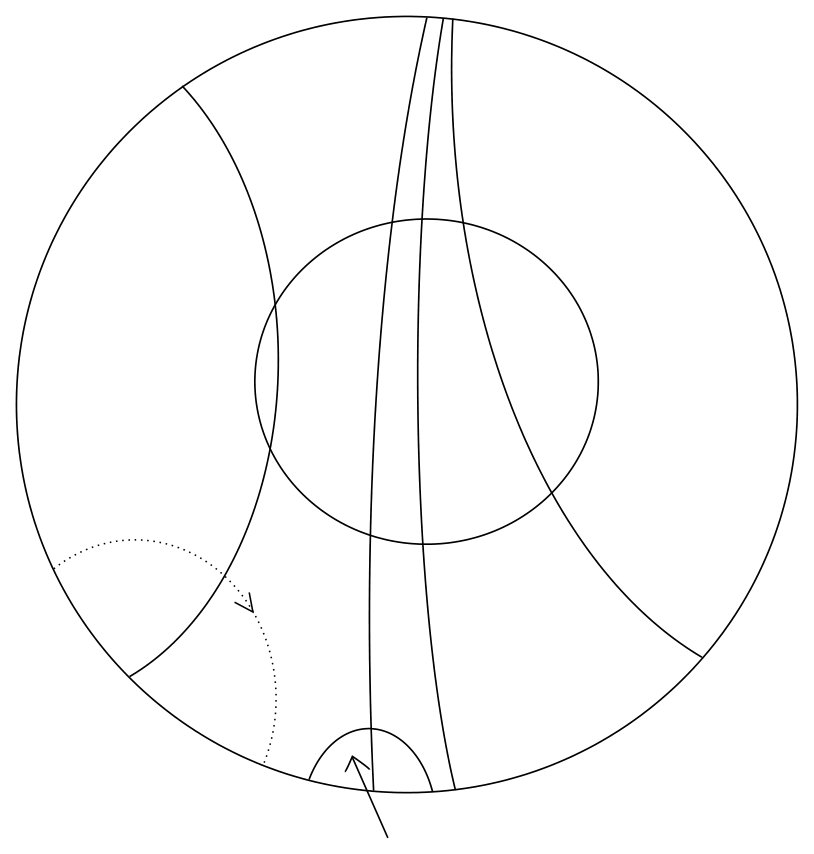 Figure 1
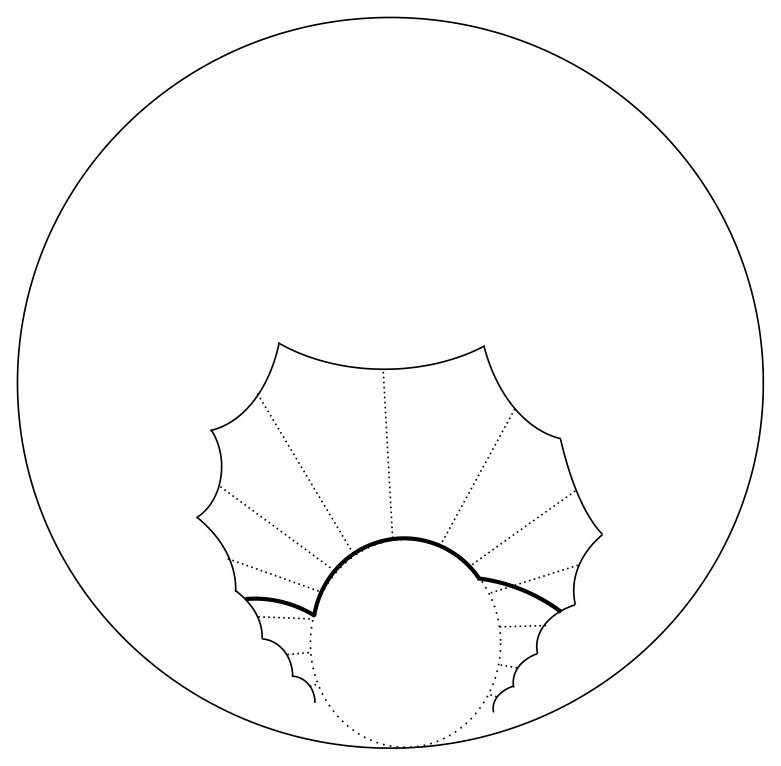 Figure 10
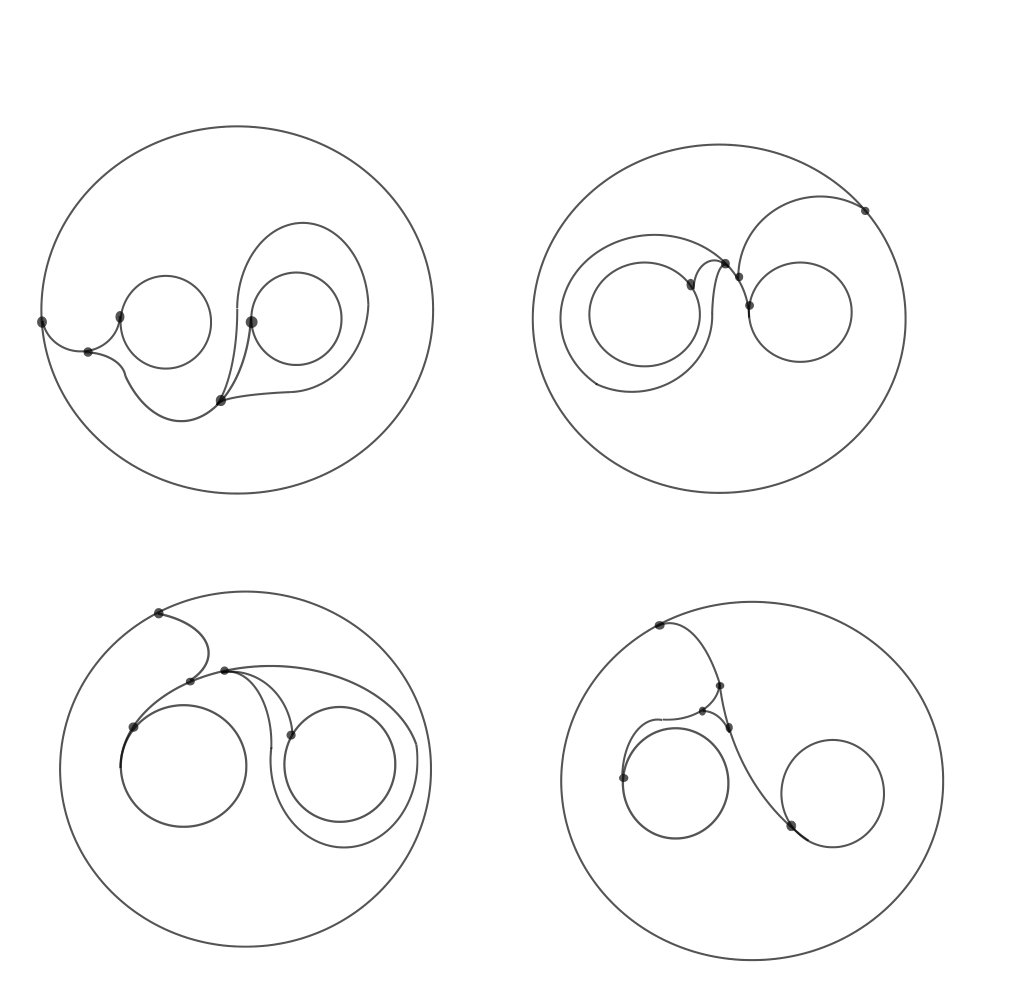 Figure 2
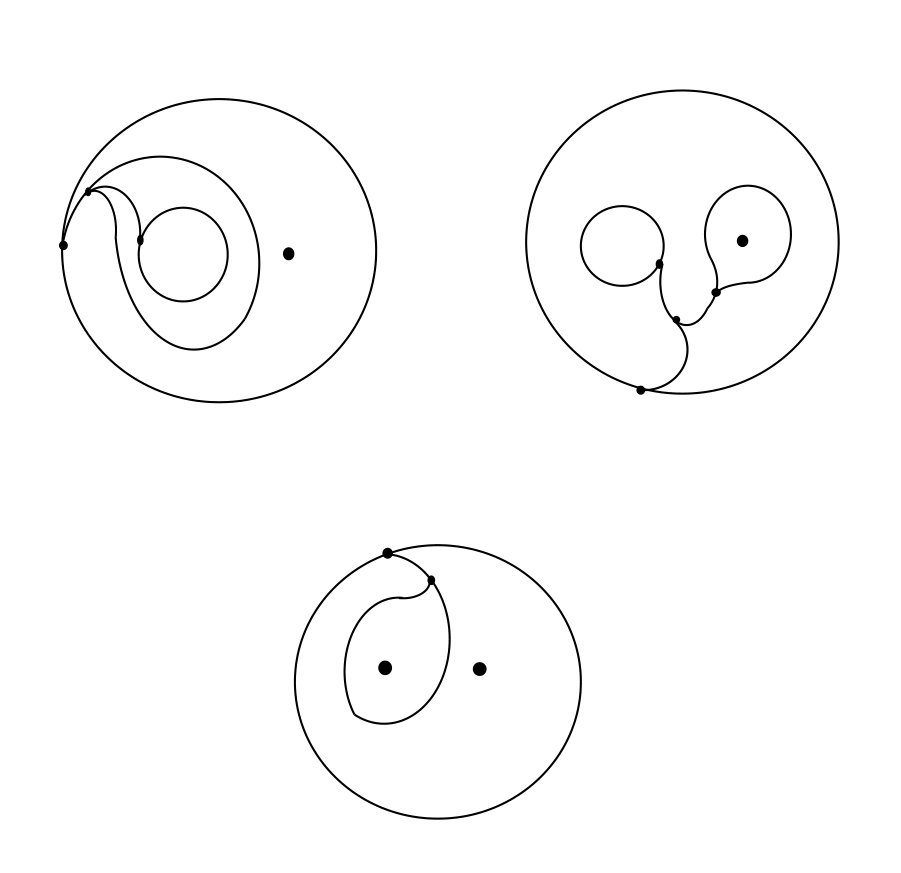 Figure 3
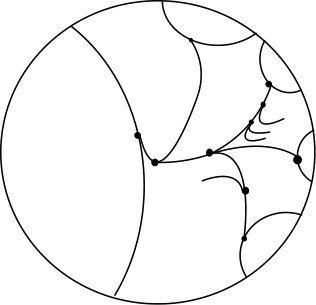 Figure 4
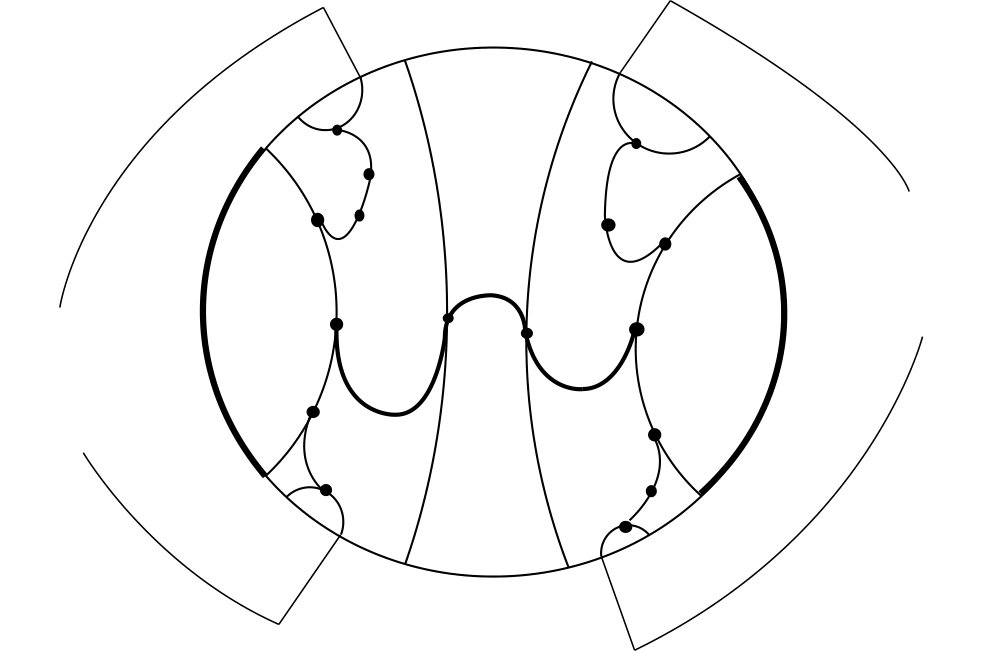 Figure 5
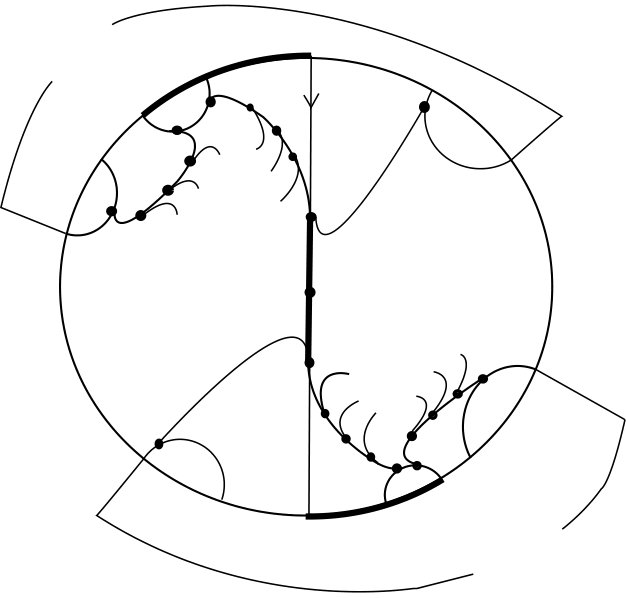 Figure 6
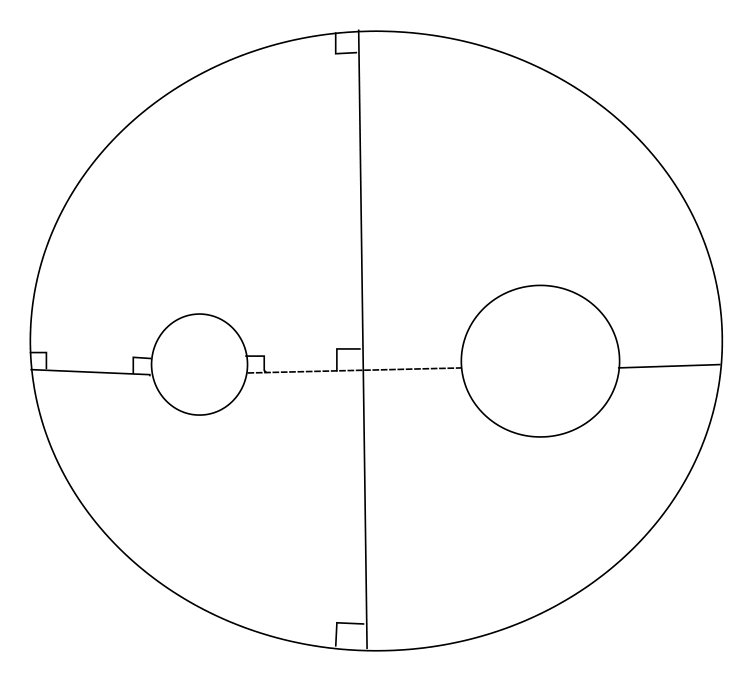 Figure 7
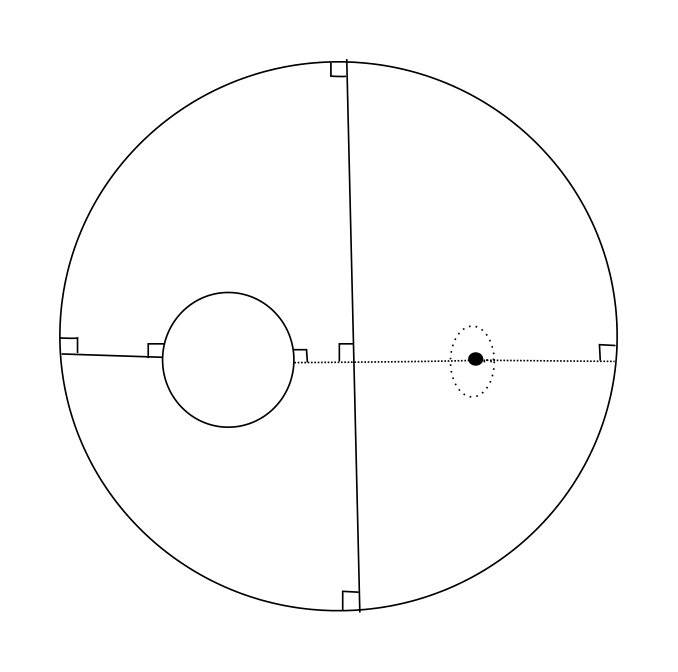 Figure 8
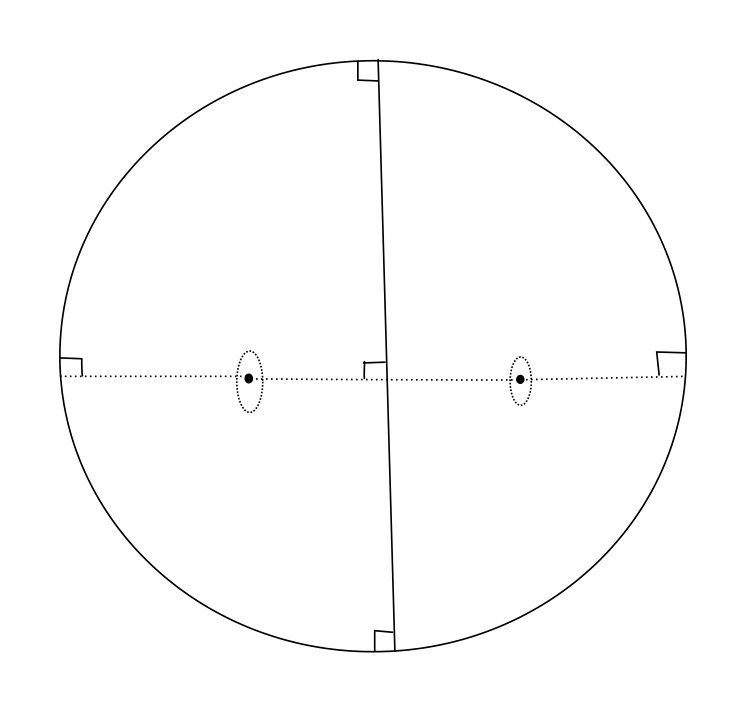 Figure 9
Peer Reviews
No public reviews on file for this paper yet. If you reviewed it on a platform where reviews are public (OpenReview, ICLR, NeurIPS, ICML), you can paste yours below so the community can read it here.
Videos
No videos yet. Explain this paper in a talk, walkthrough, or lecture? Add one.
Train tracks and measured laminations on infinite surfaces
Dragomir Šarić
Department of Mathematics, Queens College of CUNY, 65-30 Kissena Blvd., Flushing, NY 11367
Mathematics PhD. Program, The CUNY Graduate Center, 365 Fifth Avenue, New York, NY 10016-4309
Abstract.
Let be an infinite Riemann surface equipped with its conformal hyperbolic metric such that the action of the fundamental group on the universal covering is of the first kind. We first prove that any geodesic lamination on is nowhere dense. Given a fixed geodesic pants decomposition of we define a family of train tracks on such that any geodesic lamination on is weakly carried by at least one train track. The set of measured laminations on carried by a train track is in a one to one correspondence with the set of edge weight systems on the train track. Furthermore, the above correspondence is a homeomorphism when we equipped the measured laminations (weakly carried by a train track) with the weak* topology and the edge weight systems with the topology of pointwise (weak) convergence.
The space of bounded measured laminations appears prominently when studying the Teichmüller space of . If has a bounded pants decomposition, a measured lamination on weakly carried by a train track is bounded if and only if the corresponding edge weight system has a finite supremum norm. The space is equipped with the uniform weak* topology. The correspondence between bounded measured laminations weakly carried by a train track and their edge weight systems is a homeomorphism for the uniform weak* topology on and the topology induced by supremum norm on the edge weight system.
1. Introduction
A Riemann surface is said to be infinite if the fundamental group of is infinitely generated. An infinite Riemann surface has a unique conformal hyperbolic metric and all geometric notions in the paper are with respect to this metric. Let be the universal covering equipped with the hyperbolic metric such that the covering map is a local isometry. The universal covering is isometric to the hyperbolic plane and the ideal boundary is homeomorphic to the unit circle . The fundamental group is identified with a subgroup of isometries of such that . We introduce a family of train tracks on starting from a fixed geodesic pants decomposition in order to give local coordinates to the space of measured laminations on in terms of their edge weight systems on the train tracks. We prove that basic properties of these local coordinates are the same as for closed surfaces (see Thurston [39], Bonahon [11], Penner-Harer [30]). In addition, we also give local coordinates to a subspace of bounded measured laminations which naturally relates to the quasiconformal deformations of the Riemann surface and its Teichmüller space.
Recently, there is a considerable interest in studying infinite hyperbolic surfaces, their Teichmüller spaces and quasiconformal Teichmüller mapping class groups and the big mapping class groups (for example, see [2], [26], [17], [41], [4], [8], [29], [24], [16], etc). The topology of an infinite surface is determined by its genus and the space of ends (see B. Kérékjárto [23] and I. Richards [31]). The geometric structure of an infinite Riemann surface equipped with a conformal hyperbolic metric is described by Alvarez-Rodriguez [3] (see also [7] and Section 2).
An arbitrary infinite hyperbolic surface can be obtained by isometrically gluing countably many geodesic pairs of pants along their cuffs and by adding an at most countably many hyperbolic funnels and an at most countably many closed half-planes (see [3], [7] and Section 2). A geodesic lamination on is a closed subset of equipped with a foliation by complete geodesics. Unlike for closed surfaces, could possibly foliate a subset with non-empty interior. This happens when has an end that is a hyperbolic funnel or a half-plane. We first prove that the existence of such ends is the only reason for this phenomenon (see Proposition 3.4).
Indeed, let be the limit set of on the boundary and let be the convex core of in . Then is the convex core of . Note that is of the first kind if and only if . We prove
Theorem 1.1**.**
Let be an infinite Riemann surface equipped with its conformal hyperbolic metric and let be a geodesic lamination contained in the convex core of . Then is nowhere dense in .
In particular, if then any geodesic lamination in is nowhere dense.
The set of (unoriented) geodesics of is identified with , where is the diagonal (see Bonahon [11]). The topology on is given by the product topology. A geodesic lamination on lifts to a -invariant geodesic lamination of . Conversely, a -invariant geodesic lamination of projects to a geodesic lamination of (see [11]).
A homeomorphism of two compact surfaces and with genus induces a natural homeomorphism of the spaces of geodesics of their universal coverings that is - and -equivariant (for example, see [11]). For infinite hyperbolic surfaces a homeomorphism between two surfaces does not necessarily induce a (natural) homeomorphism between the spaces of geodesics of their universal covers. In fact, one surface can have a funnel end or a closed half-plane end while the other surface might not. Then the two spaces of geodesics of the universal coverings are not naturally homeomorphic. However, we show that this is the only reason why a homeomorphism of two surfaces might not induce a homeomorphism of spaces of geodesics of their universal coverings (see Theorem 3.6).
Theorem 1.2**.**
Let and be two infinite Riemann surfaces equipped with their conformal hyperbolic metrics such that and . Let be the space of geodesics of the universal covering of , for . A homeomorphism
[TABLE]
induces a - and -equivariant homeomorphism
[TABLE]
In the case of a closed surface of genus greater than , train tracks on were used to give local coordinates to the space of measured (geodesic) laminations (see [39], [30], [11]). Our main result is an extension of the idea of a train track to infinite surfaces in order to better understand the space of measured laminations on these surfaces.
From now on we assume that is an infinite hyperbolic surface with which is equivalent to being of the first kind. In this case does not contain funnels or closed half-planes. (For completeness, we note here that a surface with funnels is homeomorphic to a surface where each funnel is replaced by a cusp. Each half-plane can be “eliminated” from a hyperbolic surface by choosing appropriate twists on the cuffs of the fixed pants decomposition, see [7]. Thus any hyperbolic surface is homeomorphic to a surface without funnels and half-plane ends, i.e. .)
Let be a fixed geodesic pants decomposition of . We choose a standard Dehn-Thurston train track in each which meets cuffs at fixed basepoints. The complementary regions of the standard train tracks in the pairs of pants are triangles and punctured monogons. A pants train track on is obtained by taking choices of the standard train tracks in each pair of pants with cuffs being additional edges of the train track . Different choices of standard train tracks in and different choices of smoothing at the basepoints on the cuffs give rise to a whole family of train tracks starting from a fixed pants decomposition . A bi-infinite edge path in a pants train track determines a unique simple geodesic of . We will say that is weakly carried by (see Section 4). Let be the lift of to the universal covering .
Given an edge of , denote by the set of geodesics in whose corresponding bi-infinite edge paths contain the edge . Let be a measured lamination on and its lift to . Let be the set of edges of and the set of edges of . We define an edge weight system
[TABLE]
by
[TABLE]
The set is a pre-compact subset of the space of geodesics of and thus (see Section 5). At each vertex of the edge weight system satisfies the switch relation as for closed surfaces (see [11], [30] and Section 5). The edge weight system is -invariant and it projects to an edge weight system .
We prove that (see Theorems 5.3 and 6.5).
Theorem 1.3**.**
Let be an infinite hyperbolic surface such that . Let be a pants train track. Then the space of all measured laminations (equipped with the weak topology) that are weakly carried by is homeomorphic to the space of all edge weight systems on , when is given the topology of pointwise convergence.*
The train tracks are used to give local coordinates for measured laminations on infinite surfaces. We also establish that each measured lamination is weakly carried by at least one pants train track constructed from a fixed geodesic pants decomposition of (see Proposition 4.12).
Thurston [40] proved that any homeomorphic deformation of a hyperbolic surface can be obtained by an earthquake map along a measured lamination. The Teichmüller space of a Riemann surface is the space of quasiconformal deformations of modulo post-compositions by conformal maps and homotopy relative ideal endpoints. It is known that an earthquake map induces a quasiconformal deformation of a hyperbolic surface if and only if it is performed along a bounded measured lamination on (see [32], [33], [22], [40]). Moreover, the bijective correspondence between the space of bounded measured laminations and the Teichmüller space given by earthquake maps is a homeomorphism for the uniform weak* topology on and the topology introduced by the Teichmüller distance on (see [27]). For the definition of the uniform weak* topology see [27], [13], [35] and Section 5. In view of the action of the mapping class group it is perhaps even more important to mention that the Thurston boundary of is identified with the space of projective bounded measured laminations on (see [13] and [35]).
It is therefore of interest to understand the space of bounded measured lamination on the hyperbolic surface . We restrict our attention to surfaces with bounded pants decompositions (for the definition see [38], [2], [37] and Section 7) where the question is more tractable. We prove (see Theorems 7.4, 8.6 and 9.4)
Theorem 1.4**.**
Let be an infinite Riemann surface with a bounded pants decomposition such that and a pants train track constructed from the pants decomposition. The space of all bounded edge weight systems is parametrizing the space of all bounded measured laminations on that are weakly carried by , where if and .
In addition, the bijective correspondence
[TABLE]
is a homeomorphism when is endowed with the uniform weak topology and with the topology induced by the supremum norm.*
Acknowledgements. I am greatly indebted to Francis Bonahon for our illuminating conversations. I am also grateful to an anonymous referee for various suggestions and questions, and for giving us a short proof of Lemma 8.3 which significantly improved the paper.
2. Pants decompositions of infinite conformally hyperbolic surfaces
A topological pair of pants is a bordered surface homeomorphic to a sphere minus three open disks. A geodesic pair of pants is a topological pair of pants equipped with a metric of constant curvature such that the boundary consist of 3 closed geodesics (called cuffs) with possibly 1 or 2 geodesics degenerated to have length [math]–i.e., a cusp.
A topological surface is said to be *infinite * if its fundamental group is infinitely generated. A Riemann surface is *conformally hyperbolic * if it supports a unique metric of constant curvature in its conformal class called the hyperbolic metric. By the Uniformization Theorem every infinite Riemann surface is conformally hyperbolic.
Given an infinite Riemann surface we endow it with the unique hyperbolic metric in its conformal class which makes a complete Riemannian two manifold without boundary. The universal covering of is conformally equivalent to the unit disk and the hyperbolic metric on induces a hyperbolic metric on ; in this metric is isometric to the hyperbolic plane. The boundary at infinity of the universal covering is identified with the unit circle. The fundamental group acts by isometries on and is isometrically identified with . Denote by the limit set on of the action of . The convex core of is the smallest convex subset of that has as its ideal boundary. The convex core of is the smallest convex subset of that has the same homotopy type–equivalently, (see Maskit [25]).
Alvarez and Rodriguez [3] (see also [7]) proved that each infinite conformally hyperbolic surface can be constructed by isometrically gluing a countable set of geodesic pairs of pants along their cuffs (boundary geodesics) and by attaching to this union an at most countable set of hyperbolic funnels and an at most countable set of closed hyperbolic half-planes . The hyperbolic funnels are attached to the boundary geodesics of that end up not being glued to any other boundary geodesics. The half-planes are attached to the open geodesics that are accumulated by the cuffs . Note that the open geodesics are not in the union of the pairs of pants but rather in the closure of the union.
A first example of completing a countable union of geodesic pairs of pants by attaching a hyperbolic half-plane was given by Basmajian [5]. To better understand the situation, we fix a point and consider the set of all geodesic rays in starting at . This set of geodesic rays is naturally identified with the unit circle since each tangent vector at defines a unique geodesic ray tangent to it. If a geodesic ray starting at has a finite length then there is an open interval of geodesic rays containing that have finite length (see [7]). The geodesic rays corresponding to the endpoints of the open interval of finite length geodesic rays have infinite length. To each such open interval a closed hyperbolic half-plane is added and the two boundary geodesic rays of are asymptotic to the boundary geodesic of (see [7]). Each closed half-plane in lifts to countably many closed half-planes in the universal covering and the ideal boundary of each half-plane in is an open interval on . Since is homeomorphic to the unit circle it follows that can contain at most countably many disjoint open subintervals. We conclude that an at most countably many closed hyperbolic half-planes are added to .
A locally finite topological pants decomposition of an infinite Riemann surface is a decomposition of into topological pairs of pants such that any two pairs of pants are either disjoint or meet along a common boundary component and each compact subset of meets at most finitely many pairs of pants. A theorem of Kérékjárto [23] and Richards [31] implies that any infinite surface has a locally finite topological pants decomposition. By replacing each boundary curve of a locally finite topological pants decomposition with the simple closed geodesic in its homotopy class we obtain a locally finite geodesic pants decomposition of the convex core minus the set of open geodesics on its boundary (see [7]). The hyperbolic surface is obtained from its convex core by attaching hyperbolic funnels to the closed geodesics of the boundary and by attaching half-planes to the infinite (open) geodesics of the boundary of its convex core (see [7]).
A conformal structure of an infinite Riemann surface can be changed by twisting along the boundary geodesics of a locally finite geodesic pants decomposition (for example, see Alessandrini-Liu-Papadopoulos-Su [2]). In fact, there is a choice of real twists along such that the new conformally hyperbolic Riemann surface is equal to its convex core union of an at most countably many hyperbolic funnels and no half-planes (see [7]). Since is obtained from by twisting along it follows that is homeomorphic to . However, is not quasiconformal to . Indeed, a quasiconformal mapping between and lifts to a quasiconformal mapping of their universal covers and it extends to a homeomorphism of the limit sets of the covering groups. The limit set of is homeomorphic to the unit circle while the limit set of is not connected which is a contradiction.
For the most part we will be interested in infinite Riemann surfaces whose hyperbolic metrics are such that they are equal to their convex cores. In this case we do not have funnels and half-planes, and any locally finite topological pants decomposition straightens to a locally finite geodesic pants decomposition of the whole surface. The geodesic pairs of pants can have at most two cusps since the cusps are not glued to other pairs of pants. In the terminology of [7] such conformally hyperbolic Riemann surfaces are said to have no visible ends. The discussion above shows that any infinite Riemann surface is homeomorphic to a Riemann surface with no visible ends by performing twists along a geodesic pants decomposition and by replacing funnels with cusps (see [7]).
3. Geodesic laminations on infinite Riemann surfaces
Let be a conformally hyperbolic Riemann surface equipped with its unique hyperbolic metric. Let be the universal covering of with the hyperbolic metric induced by the hyperbolic metric on . Each oriented geodesic of is uniquely determined by the pair of its endpoints , where is the diagonal of , is the initial point of and is the end point of . The space of oriented geodesics of is identified with and the topology is given by the product topology.
The space of (unoriented) geodesics on the universal covering is identified with , where the action of permutes the components. The topology (and, in particular, the convergence) on is the quotient topology of the product topology on . Note that is not compact; a sequence of pairs of points that approaches the diagonal has no accumulation points (see Bonahon [11] and [13]).
Remark 3.1**.**
All constructions in the paper are for the unoriented geodesics. We will use subsets of as local coordinates for the space of unoriented geodesics.
We define a geodesic lamination on a conformally hyperbolic surface .
Definition 3.2**.**
Let be a conformally hyperbolic surface. A geodesic lamination on consists of a closed subset of together with its foliation by simple, pairwise disjoint complete geodesics of . By a foliation of a closed subset of by geodesics we mean a decomposition of into a pairwise disjoint simple complete geodesics such that each point has a neighborhood homeomorphic to where is homeomorphic to a closed subset of a compact geodesic arc and is an open interval corresponding to open arcs on geodesics.
Remark 3.3**.**
The lift of to the universal covering is a -invariant closed subset of that is foliated by pairwise disjoint complete geodesics. Note that being closed as a subset of is equivalent to it being closed as a subset of .
Unlike for compact hyperbolic surfaces, a geodesic lamination of a conformally hyperbolic infinite Riemann surface can foliate a subset of with non-empty interior. Indeed, since hyperbolic half-planes can be foliated by geodesic laminations a Riemann surface that contains a hyperbolic half-plane has this property. The same is true for Riemann surfaces with funnels because a funnel contains a hyperbolic half-plane.
On the other hand, we show that no subset of with non-empty interior can be foliated by a geodesic lamination if is equal to its convex core . This follows by proving a result for the convex core of .
Proposition 3.4**.**
Let be an infinite Riemann surface equipped with its conformal hyperbolic metric. Any geodesic lamination of the convex core is nowhere dense.
Remark 3.5**.**
If then any geodesic lamination of is nowhere dense in . If then there are geodesic laminations of whose supports can have non-empty interiors.
Proof.
Let be the lift of . By our assumption, is a subset of the convex core of the limit set . We assume on the contrary that there exists a closed hyperbolic disk which is covered by the geodesics of and seek a contradiction. Let be a single component of the lift of to . Then is a closed hyperbolic disk in that is covered by .
A closed hyperbolic disk in the hyperbolic plane is said to be regular if for any three disjoint complete geodesics intersecting it one geodesic separates the other two. It is an elementary fact that there exists such that any closed disk of radius at most is regular. By decreasing if necessary, we can assume that it is regular.
Note that has a natural orientation induced by the orientation of . By definition is the set of all such that , and are in the order of this orientation, and .
Let and be two geodesics of that intersect . Without loss of generality we can assume that they are in the relative position as in Figure 1. Since is regular then any geodesic of between and separates them. In other words, it has one endpoint in and other endpoint in .
Let be the union of all endpoints of the geodesics of that intersect . Since is a closed set and is a compact set it follows that is a closed subset of . Therefore each component of either or is an open arc if either of the two sets is non-empty.
Assume that is a component of . Let and be geodesics of with endpoints and such that their other two endpoints in are the closest to each other even possibly equal to each other. (We require this since either or could be endpoints of more than one geodesic of .) Then the part of between and does not contain geodesics of and yet covers . This is a contradiction with being regular. Therefore the set covers and an analogous argument shows that it covers as well.
Since it follows that
[TABLE]
It is possible that either or is a single point. However not both intervals can be points since is covered by .
Assume first that is not a point. The set of endpoints of the lifts of closed geodesics of is dense in the limit set (for example, see Maskit [25]). Let be a hyperbolic translation with the attracting fixed point and the repelling point . (A hyperbolic element with these properties exist since is not cyclic.) Let be a geodesic of in such that both its endpoints are different from and . A high enough iterate of will attract both endpoint of into the interval (see Figure 1). Then transversely intersects a geodesic of which is in . However since is a geodesic lamination that is invariant under we get a contradiction. Thus cannot cover a subset of with non-empty interior and cannot cover a subset of with non-empty interior. The argument is analogous when is not a point. ∎
A homeomorphism between two closed hyperbolic surfaces induces a natural homeomorphism between the spaces of geodesics of their universal coverings that is equivariant under the covering groups (see Bonahon [11], [12]). In general, a homeomorphism between two infinite Riemann surfaces does not induce an equivariant homeomorphism between the spaces of geodesics of their universal coverings. This is easily seen by considering a homeomorphism which sends a cusp onto a funnel. However, we prove that when the hyperbolic metrics are such that the surfaces are equal to their convex cores then a homeomorphism of surfaces induces an equivariant homeomorphism of the spaces of geodesics of their universal coverings.
Theorem 3.6**.**
Let and be two infinite Riemann surfaces which are equal to their convex cores. A homeomorphisms induces a natural homeomorphism which projects to a well-defined map . Furthermore, simple closed geodesics of are mapped onto simple closed geodesics of in the homotopy classes of their image curves under .
Proof.
A lift of the homeomorphism conjugates the action of onto the action of . Since the sets of fixed points of hyperbolic elements of and are dense in and it follows that extends to an order preserving injective map from a dense subset of onto a dense subset of .
The universal covers and are given by the exponential maps. We lift the map to an increasing map from a dense subset of onto a dense subset of . We claim that can be extended to a homeomorphism of . Indeed, let be a point where is not defined. Then there exists an increasing sequence that converges to such that is defined on . Let and be the points of on which is defined such that . We can assume that . Since is an increasing map we have . Thus is a bounded increasing sequence in and therefore it has a limit . If is another increasing sequence that converges to on whose elements is defined then converges to some . For every there exists such that which implies . By letting we obtain and by changing the roles of and we obtain . Thus and we have a well-defined extension.
Therefore we extended to a map of into which can easily be seen to be an increasing map. It remains to be proved that is onto. Let . Since is dense in there exists an increasing sequence that converges to . Since is increasing it follows that the sequence is increasing and let be its limit. Then by the definition of and we established that is onto. Therefore is a continuous bijection. Finally is invariant under the covering transformations on a dense subset of and therefore it is invariant under covering transformations on all of . Therefore projects to a continuous bijection between and which is a homeomorphism by the invariance of domains theorem.
Finally a homeomorphism of boundaries and extends to a homeomorphism which is invariant under the actions of and . Thus induces a natural bijection between and . Since simple closed geodesics on are mapped by to simple closed homotopically non-trivial curves on the last statement of the theorem follows. ∎
4. Train tracks from the pants decompositions
The theory of train tracks on closed surfaces was started by Thurston [39] and further developed by various authors: Penner-Harer [30], Bonahon [12] to name a few. In this section we introduce train tracks for infinite hyperbolic surfaces (that are equal to their convex cores) and in doing so we use the ideas which are developed for closed surfaces. Unlike for closed surfaces, the Milnor-Švarc lemma does not hold for infinite surfaces. Our results rely upon a fact that edge paths of the constructed train track when lifted to the universal covering converge to well-defined ideal boundary points of the universal covering. This fact needs to hold for an arbitrary surface without a priori control of the geometry. For this reason we adopt standard Dehn-Thurston train tracks on closed surfaces to infinite hyperbolic surfaces starting from a fixed geodesic pants decomposition. When developing basic facts for these train tracks we mostly use the approach and terminology of Bonahon’s book (see [12]) and Penner-Harer’s book (see [30]).
Throughout this section we assume that is an infinite Riemann surface equipped with its conformal hyperbolic metric such that . Therefore the Riemann surface has no funnels and no half-plane ends. We fix a locally finite geodesic pants decomposition of . Denote by the collection of cuffs of the pants decomposition . Any simple geodesic of either intersects a cuff, or it is a cuff, or it belongs to a single pair of pants and accumulates at the cuffs at both of its ends. We introduce an uncountable family of train tracks on starting from the fixed geodesics pants decomposition by connecting the boundary geodesics (cuffs) with “standard train tracks” inside the pairs of pants as follows.
On each cuff we choose a base point . The base points will belong to the set of vertices of the train track on that we will construct below. There will be additional vertices in each pair of pants but no additional vertices on . Each cuff is an edge of the train track that has both ends equal to called a cuff edge. If a pair of pants has cuffs , and , then we have a choice of four standard train tracks inside that meet cuffs at , and as in Figure 2 (see also [30]). In addition, at each vertex we have two possible choices of smoothing and Figure 2 represents one such choice. This gives a total of choices on a single pair of pants with cuffs.
If a pair of pants has cuffs and , then there are two possible configurations of the “standard train tracks” in illustrated in the first two cases of Figure 3. In addition, at each vertex we have two possible choices of smoothing which gives a total of choices. Finally if a pair of pants has cuff , then there is one possible configurations of the “standard train track” in illustrated in the last case of Figure 3 and we have two possible choices of smoothing at which gives a total of choices.
We form a train track on as follows. In the interior of each pair of pants we choose a standard train track as in Figures 2 and 3. The two standard train tracks can meet only at a base point of a cuffs on the boundary of the two pairs of pants. The edges of the standard train tracks in the interior of are called connector edges and each cuff gives exactly one edge called a cuff edge. The vertices of are formed by all the basepoints on the cuffs and up to three vertices from the standard train tracks in the interior of each pair of pants (see Figures 2 and 3).
Let be a connector edge with one vertex at a cuff . We orient such that is the end point for the orientation. We further orient such that the unit tangent vectors to and at the vertex agree. Then we will say that the connector edge is left tangent to if is on the left of the oriented cuff . Otherwise the connector edge is right tangent to . Note that the notions of left and right tangent to a cuff are independent of any a priori orientation of the cuff and depends only on the orientation of the surface.
For each cuff , we introduce a requirement that the two connector edges (on opposite sides and) meeting are either both left or both right tangent to . By the definition of standard train tracks in geodesic pairs of pants, each complementary region of is either a Jordan domain with piecewise smooth boundary and exactly three non-smooth points (called a triangle) or a Jordan domain minus a point with smooth boundary except at one point (called a punctured monogon).
A train track on obtained by making consistent choices of smoothing at each vertex on a cuff is called a pants train track. In fact, there are uncountably many pants train tracks on defined using a fixed pants decomposition of .
We fix one pants train track on and denote by the lift to . The set of edges of is denoted by and the set of edges of is denoted by . An edge path in is a finite or infinite or bi-infinite sequence of edges of such that the consecutive edges meet smoothly at each vertex.
We will need the following lemma.
Lemma 4.1**.**
Let be a single lift of a cuff and a lift of the base point . Then the number of lifts of cuffs on one side and connected to by finite edge paths starting at which are not crossing lifts of cuffs is at most four.
Proof.
Note that the finite edge paths that we consider are obtained by lifting of the standard train tracks in the pair of pants adjacent to corresponding to the given side of . We note that some standard train tracks have closed loops and a single lift of a closed loop can connect to infinitely many lifts of cuffs. By considering how different smoothing effectively restrict closed curves in the standard train tracks to correspond to more than two edge paths in the lift, we conclude that the total number is at most four (see Figure 4). ∎
Remark 4.2**.**
By our choice connector edges of that meet a cuff are either all left tangent or all right tangent to the cuff and the same is true for the lifted train track and lifts of cuffs. Let be an edge path of . We orient edges such that the end point of is the initial point of . Assume that the connector edge starts on a lift of a cuff and let be the next connector edge of that intersects a lift of a cuff . The lifts of cuffs and are on the boundary of a single component of the lift of a pair of pants from the fixed pants decomposition of . Then either all other edges of after remain on or, an at most finitely many edges of remain on and the edge leaves . This follows because an edge path in cannot come in at a lift of a cuff and leave it on the same side of the lift of a cuff since connector edges meeting are either all left tangent or all right tangent to . In other words, an edge path cannot “bounce off” from one boundary of back inside to meet another boundary component.
Let be an infinite edge path of the train track . We will say that crosses a lift of a cuff of the fixed pants decomposition if has edges in both complementary half-planes of in . We prove the following technical lemma for the later use.
Lemma 4.3**.**
Let be an infinite edge path on the train track such that no tail of lies on a single lift of a cuff . Then crosses infinitely many lifts of cuffs and if crosses it cannot return to it later.
Proof.
We first prove the second claim. Orient each edge of such that its end point coincide with the initial point of . Let be a connector edge with the initial point on a lift of a cuff (necessarily ) and assume on the contrary that meets in an another connector edge for some . Consider the sequence of lifts of cuffs that have points in common with the edge path . By Remark 4.2 each separates and and thus the edge path cannot return to which proves the second claim.
We prove the first claim next. The edge path does not cross infinitely many lifts of cuffs if and only if its tail remains in the closure of a single component of the lift of a pair of pants . If the tail stays on a lift of the same cuff then the assumptions in the lemma are violated. Therefore we can assume that the tail has edges on the infinitely many lifts of cuffs which are on the boundary of . Thus the tail contains a finite path of connector edges connecting a lift of a cuff to the lift of a cuff. By Remark 4.2 the tail either stays forever on or it leaves through which is a contradiction. Thus the first claim follows. ∎
The above proof gives more detailed information on the nested sequence of lifts of cuffs that are crossed by an infinite edge path of which we state as a separate lemma.
Lemma 4.4**.**
Let be an infinite edge path in and let be the nested sequence of lifts of cuffs that are crossed by in the given order. Each consecutive pair of lifts of cuffs is on the boundary of a single component of a lift of a pair of pants. Moreover is connected to by a unique finite edge path of which consists of only connector edges that are lifts of a standard train track in a single pair of pants.
We prove that two lifts of cuffs in (which need not be adjacent) are connected by an at most one edge path of . We will say that a sequence of lifts is nested if for each a half-plane with on its boundary contains for all .
Lemma 4.5**.**
Let be the lift to the universal cover of the above constructed pants train track . Then for any two different lifts and of cuffs there is an at most one finite edge path of that connects them.
Proof.
Any two lifts of cuffs on a single component of a lift of a pair of pants are connected by an at most one path of connector edges. Indeed, if they are connected by two paths of connector edges then these two paths together with two subarcs of the lifts of cuffs form a Jordan domain with smooth boundary except at two points with zero angle. This domain is union of the complementary triangles of . A standard application of Poincaré-Hopf theorem gives a contradiction (see [12, Page 24] or [30, Page 7]). Therefore an at most one path of connector edges connects two lifts of cuffs in a single component of the lift of a pair of pants.
Assume that lifts of cuffs and are connected by two finite edge paths and in . The nested families of lifts of cuffs that and are crossing are identical. Indeed, if they are not identical then one edge path would have two different subpaths connecting two lifts of cuffs on a single component of the lift of a pair of pants which is impossible by the above paragraph.
Thus the connector edges of and are identical. The cuff edges of and are determined uniquely by the connector edges and therefore . ∎
We prove that each infinite edge path on accumulates to a unique point on the boundary of which is the key result for encoding simple geodesics using bi-infinite edge paths.
Proposition 4.6**.**
An infinite edge path in has a unique accumulation point on . Moreover two infinite edge paths and in have the same accumulation point if and only if the edge paths have the same tails up to renumbering. Thus a bi-infinite edge path has two distinct accumulation points on .
Proof.
Consider an infinite edge path in and we orient each edge such that its endpoint is the initial point of . If there is such that all edges for belong to a single lift of a cuff then the unique accumulation point of is the appropriate endpoint of .
A single lift of a cuff of the fixed pants decomposition of is a bi-infinite geodesic in and it divides into two hyperbolic half-planes. Since and the fixed geodesic pants decomposition is locally finite, each nested sequence of lifts of cuffs accumulates to a single point on .
By Lemma 4.3 an infinite edge path whose tail does not lie on a single lift of a cuff intersects a nested sequence of lifts of the cuffs without backtracking and therefore it accumulates to a single point on . This proves the first statement.
We prove the second statement in the proposition. If and have the same tails then they converge to the same point.
Conversely assume that and accumulate to the same point . The point is either an endpoint of a lift of a cuff or the accumulation point of a nested sequence of lifts of cuffs. In the former case both and must eventually lie on the lift of the cuff because otherwise the separation and no backtracking properties from Lemmas 4.3 and 4.5 would not allow this convergence. Thus and agree on their tails.
Assume now that is the accumulation of a nested sequence of consecutive lifts of cuffs. By Lemma 4.3, and intersect the family for some because they have the same endpoint. Then Lemma 4.5 implies that and agree on their tails. This finishes the proof of the second statement.
Consider a bi-infinite edge path in . Divide it into two infinite edge paths and . The two paths have different tails and therefore they converge to different points on . ∎
Given a bi-infinite edge path of we denote by the geodesic of whose endpoints on are the two accumulation points of . We will say that a geodesic of is weakly carried by if there exists a bi-infinite edge path in such that .
Proposition 4.7**.**
There is a one to one correspondence between bi-infinite edge paths of and geodesics weakly carried by .
Proof.
Assume that for two bi-infinite edge path in . Then and have to agree on both of their tails by Proposition 4.6. Therefore we have at most a finite subpath of and a finite subpath of that have the same end edges but might not agree on the interior edges. This is not possible by Lemma 4.5. Thus after possible renumbering the sequences. ∎
Let be an edge path in and a single component lift of to the universal covering. Recall that is a geodesic whose endpoints are equal to the endpoints of . For any we have that . Define to be the projection of onto . We will say that a geodesic is weakly carried by . Let denote the set of all geodesics weakly carried by . Proposition 4.7 immediately gives
Proposition 4.8**.**
There is a one to one correspondence between bi-infinite edge paths of and geodesics weakly carried by .
We describe the convergence of geodesics in terms of the corresponding bi-infinite edge paths in . Denote by the set of all geodesics of that are weakly carried by .
Proposition 4.9**.**
Let be weakly carried by a train track . Denote by the corresponding bi-infinite edge paths in . Then converges to as if and only if for each finite subpath of there is such that is contained in the path for all .
Proof.
Assume as . Each endpoint of corresponds to an infinite tail of . We fix a finite subpath of and need prove that there exist such that contains for . The proof is divided into several cases.
Case 1. The first case is when both tails of are crossing infinitely many lifts of cuffs. Denote by the lifts of cuffs that intersects in the given order. Let be the limit of the nested sequence of cuffs and the limit of the nested sequence of cuffs .
We can assume without loss of generality that the finite subpath connects the lifts and of cuffs. Since converges to we have that the endpoints of converge to . Thus there is such that and are separated from by a half-plane with boundary , and points and are separated from by a half-plane with boundary for . Therefore the edge path connects and for . This implies that contains for by Lemma 4.5.
Case 2. Assume that one tail of is on a single lift of a cuff and the other tail crosses infinitely many lifts of cuffs. Then has one endpoint equal to an appropriate endpoint of and the other endpoint of is accumulated by a sequence of nested lifts of cuffs such that and are on the boundary of a component of the lift of a pair of pants from the decomposition. Since endpoints of converge to the endpoints of as .
If for then the proof is similar to the Case 1. We assume now that for an infinite subsequence of . Denote by and the lifts of pairs of pants from the fixed pants decomposition that have on their boundaries where contains on its boundary and is on the other side of . There are two possibilities: either contains an infinite subsequence that is on the side of that contains or the whole sequence is on the side of that contains .
Assume first that is on the side of that contains . Since and the edge path intersects a boundary geodesic (a lift of a cuff) of such that is separated from by the closed half-plane whose boundary in is and which does not contain (this includes the possibility that is an endpoint of ).
For the convenience of the argument, we identify with the unit disk . We arrange the components of the complement of in the unit disk into a sequence and note that their Euclidean size goes to zero as . Since and it follows that such that as . Thus the Euclidean size of goes to zero and the endpoints of converge to as .
Since , the endpoints of do not converge to an endpoint of . By Lemma 4.1, the set of all lifts of cuffs on the boundary of that are connected to by finite edge paths is the orbit of finitely many lifts of cuffs under the cyclic stabilizer of in the group . Consequently, any infinite sequence of distinct lifts of cuffs on the boundary of connected to by finite edge paths consisting of connector edges converges to endpoints of . Since the endpoints of do not converge to endpoints of , it follows that and are not connected by a connector edge for large enough. Given that and are on the boundary of , Remark 4.2 implies that no edge path in connects them. Thus the geodesic for large is not weakly carried by which is a contradiction and no subsequence is on the side of that contains .
Assume next that is on the same side of as . Let be the boundary side of different from that (or equivalently the corresponding edge path ) intersects. Then both endpoints of converge to by the same method as above. Since enters through it can leave it only through a boundary connected to by a finite edge path of connector edges of by Lemma 4.4. Since the endpoints of converge to an endpoint of it follows that the edge path contains a finite edge path of connecting and followed by a large number of cuff edges of that lie on and then followed by a finite edge path connecting and . Given a finite subpath of , we choose such that all cuff edges of that are on are contained in for . By choosing larger if necessary, the method in Case 1 gives that all edges on that are not on are contained in for . Thus contains a finite subpath of for .
Case 3. Assume that consists of edges on a single lift of a cuff. Let be the endpoints of and let be the endpoints of where and as . Then the points and have to be on the opposite sides of or we would have a contradiction similar to the Case 2. If they are on the opposite sides of then the argument of the Case 2 shows that contains a large number of cuff edges on which finishes the proof.
Case 4. Assume that has two tails in two different lifts of cuffs and . Let be a finite subpath with an initial edge on and a terminal edge on . By applying the method of Case 2 to we find such that contains the initial and terminal edges of for . By the uniqueness of edge paths, contains for . ∎
Definition 4.10**.**
Two bi-infinite edge paths and cross each other if, after possible reversing the orientation and renumbering, there exists such that for , and that and lie on the opposite sides of .
It is clear that the geodesics represented by bi-infinite edge paths and are intersecting if and only if and cross each other. Then two geodesics on represented by edge paths and of the train track intersect each other if and only if their corresponding edge paths cross each other. This also holds true when and allow us to characterize simple geodesics as corresponding to bi-infinite edge paths that do not cross themselves.
A geodesic lamination of is weakly carried by if every geodesic of is weakly carried by . If is weakly carried by then its lift is weakly carried by . The proposition below follows directly from previous discussions.
Proposition 4.11**.**
The set of geodesic laminations on that are weakly carried by is in a one to one correspondence with the families of bi-infinite edge paths that satisfy:
- •
Any two bi-infinite edge paths and in do not cross, and
- •
If is a bi-infinite edge path such that for any finite edge subpath there is a bi-infinite edge path in that contains it, then .
We prove that our special construction of pants train tracks is general enough for our purpose of giving a local parametrization of the space of measured geodesic laminations on . Hence we will assume that geodesic laminations do not have leaves which spiral to the cuffs of the pants decomposition.
Proposition 4.12**.**
Fix a locally finite geodesic pants decomposition of a Riemann surface whose fundamental group is of the first kind. Given a geodesic lamination on which does not have leaves spiraling to a cuff, there is a pants train track such that is weakly carried by . The pants train track is constructed using the fixed pants decomposition.
Proof.
Let be a fixed locally finite geodesic pants decomposition of and the family of all cuffs of . Consider a geodesic lamination on which does not have a leaf spiraling to a cuff of . In each pair of pants the set of arcs is divided into an at most three homotopy classes setwise fixing the cuffs. We choose a standard train track in that has finite edge paths homotopic to each arc in setwise fixing the cuffs as in Figures 2 and 3 (see also [30, Section 2.6]). The choice of a standard train track is unique in each where the number of homotopy classes of the arcs is maximal. If the number of homotopy classes in is not maximal then there is a more than one choice of a standard train track and we fix one such choice. It remains to choose the smoothing at the cuffs.
The smoothing is done based on the standard construction of Dehn-Thurston coordinates for multi-curves and measured laminations on closed surfaces (see Penner-Harer [30, Page 15]). We fix a closed arc on each cuff which we call a window on and denote its midpoint by . Choose a regular neighborhood of each cuff which is a hyperbolic collar of width equal half the standard collar width so that the closures of two different are disjoint. On each boundary component for of we denote by the closed arc that orthogonally project to . The arcs are called windows of the regular neighborhood and denote their midpoints by . Denote by the pair of pants obtained by deleting the neighborhoods of the cuffs of .
In each we find an isotopy pointwise fixing the cuffs that moves the family of arcs into a family of arcs that enter one-sided regular neighborhoods of cuffs through the interior of their windows and once they enter these neighborhoods they can only leave them through the cuffs. In addition, we require that there exists a standard train track in with endpoints at such that for each arc in there is a homotopy modulo windows onto a simple edge path of the standard track in and we choose this standard train track on each .
It remains to connect the standard train tracks in from their endpoints to the points by simple arcs inside one-sided neighborhoods (the half of ) such that they are either right or left tangent to on both sides of .
Consider two-sided regular neighborhood of and the family of arcs in connecting the windows and obtained by the above isotopy of the arcs , where are the two (geodesic) pairs of pants that have on their boundaries. Let for be endpoints of the windows such that the shortest closed geodesic arc in that connects them is orthogonal to . For an arc , the absolute value of the twist number equals the essential number of its intersections with . Let be an arc homotopic to modulo endpoints that realizes the twist number. The twist number of is positive if goes to the right once it starts from the window and it is negative if it goes to the left. The twist is zero if there is no essential intersections. The twist number of any other differs by at most one since arcs in are disjoint.
The absolute value of the twist number around is the maximum of the absolute value of the twist numbers over all arcs in . The sign is positive if at least one arc has a positive twist number and it is negative if at least one arc has negative twist.
Since and orthogonally project to , the set of points in whose orthogonal projection on is inside forms a quadrilateral whose two opposite sides are and , and the other two opposite sides are geodesic arc and the geodesic arc connecting two endpoints of and different from and . We connect the two standard train tracks in the pairs of pants and at the point by connecting the points and inside . It is possible that is on the boundary of a single pair of pants in which case we connect the standard train track to itself at the point . The smoothing at is chosen such that the connector edge is coming from the right of if the twist is positive and it is from the left if the twist is negative. If the twist is zero then the smoothing is arbitrary. Note that the incoming edges from both sides of are simultaneously either right or left tangent. Since points became bivalent edges we can erase them and consider standard tracks in which have vertices on .
The choices of isotopies in the pairs of pants minus regular neighborhoods of cuffs followed by the choices of homotopies in the regular neighborhood of cuffs guarantee that each geodesic of is homotopic to an edge path in . In fact, we can arrange that this homotopy setwise fixes the cuffs . We need to show that each geodesic of the lift to the universal cover of the geodesic lamination has the same endpoints on as an edge path in .
Let be the geodesic of whose one lift is and let be an edge path in that is homotopic to . By lifting the homotopy between and to the universal cover starting from the geodesic we obtain an edge path in which is a lift of and is homotopic to . The homotopy of and is not necessarily bounded in the hyperbolic metric of .
Since cannot accumulate to a cuff it follows that either both ends of intersect cuffs infinitely many times or is a cuff. Therefore is either a lift of a cuff or both ends of intersect two sequences of nested cuffs that accumulate to the ideal endpoints of . If then the construction of allows us to take to be the bi-infinte sequence of cuff edges of .
Assume that both ends of intersect nested sequences of lifts of cuffs. Since the homotopy between and can be chosen such that it setwise fixes the cuffs, it follows that the homotopy between and setwise preserves each lift of a cuff. Therefore and intersect the same sequence of nested lifts of cuffs at both of their ends and they have the same endpoints on . Thus we obtained that is weakly carried by . Since is a lift of an arbitrary geodesic of , it follows that is weakly carried by . ∎
5. Measured laminations carried by train tracks
In this section we parametrize the set of all measured laminations on that are weakly carried by pants train tracks using the edge weight systems(see [30], [11] for the case of a closed surface). We first introduce some standard definitions regarding measured laminations and train tracks analogous to the closed surfaces (see Bonahon [12]).
A geodesic on the universal covering is uniquely determined by its two ideal endpoints on . In Section 3, we identified the space of unoriented geodesics of the universal covering with , where the action of sends to .
Definition 5.1**.**
A geodesic current on is a Radon measure on the space of unoriented geodesics on the universal covering of that is invariant under the action of the covering group . Here a Radon measure is a Borel measure that satisfies for any compact .
The space of geodesic currents carries a natural weak* topology(see [13]). Namely, let be a continuous function with compact support. The semi-norm induced by the function is
[TABLE]
for any geodesic current . The weak topology* on the geodesic currents of is induced by the family of semi-norms , where runs through all continuous functions with compact support. We also note that the weak* topology on the space of geodesic currents is metrizable (see [13]).
Denote by the set of all isometries of for the hyperbolic metric induced from . Given a continuous function with compact support, we define another semi-norm by
[TABLE]
for any geodesic current (see [13]). The space of bounded geodesic currents consists of all geodesic currents on such that for all continuous with compact support (see [13]). The uniform weak topology* on is induced by the family of seminorms , where runs through all continuous functions with compact support. Note that the uniform weak* topology is metrizable (see [13]).
Definition 5.2**.**
A measured lamination on with support the geodesic lamination on is a geodesic current whose support is the lift of . A measured lamination with support is weakly carried by if the geodesic lamination is weakly carried by .
The set consists of all geodesics of that are weakly carried by . Given a finite edge path of , we denote by the set of geodesics in whose bi-infinite edge paths contain as a subpath. For an edge , denote by the set of geodesics in that contain in their bi-infinite edge paths on . If is an edge in then .
The following two propositions are technical tools needed in the rest of the paper. Before stating the propositions we define a special type of subsets of .
Definition 5.3**.**
Let and be two disjoint closed subarcs of . A box of geodesics is the set of unoriented geodesics of with one endpoint in and the other endpoint in .
Proposition 5.4**.**
Let be a finite edge path in that has only its initial and end vertex on lifts of cuffs and . Then there exist two boxes of geodesics and such that and is contained in the interior of .
Let and be two components of , and let and be the two components of . If the lengths of the cuffs of the pants decomposition of are between and , and the number of edges in is at most , then there exists and a choice of and such that the Liouville measure of each of the boxes of geodesics , , and is between and .
Proof.
The lifts of cuffs and are on the boundaries of two disjoint half-planes. Let be the closed interval which is the ideal boundary of the half-plane bounded by and let be the closed interval which is the ideal boundary of the half-plane bounded by (see Figure 5).
Let be the vertex of on and the vertex of on . Let and be two vertices of on on the opposite sides of that are adjacent to . Let and be two vertices of on on the opposite sides of that are adjacent to . Let be a lift of a cuff between and that is connected to by a finite edge path not crossing any lift of a cuff. Similarly let be a lift of a cuff connected to by a finite edge path not crossing any lift of a cuff and being in between and . In a similar fashion we define lifts of cuff and that are connected to and (see Figure 5).
We choose to be the smallest closed interval on that contains endpoints of and and we choose to be the smallest closed interval on that contains endpoints of and . The obtained boxes of geodesics and satisfy by the construction.
Assume that the lengths of the cuffs of the pants decomposition of are in between and . Then the distance between adjacent lifts of cuffs and the lengths of cuffs edges of are bounded between and . Thus the distance between and is at most . Further, the distance between and is at most . The same bound bound holds for the distance between and , the distance between and , and the distance between and . This gives the bounds on the Liouville measures of , , and . ∎
Proposition 5.5**.**
Let be a finite edge path in that lies on a single lift of a cuff . Then there exist two boxes of geodesics and such that and is contained in the interior of .
Let and be two components of , and let and be the two components of . If the lengths of the cuffs of are between and , and the distance between the end vertices of is at most , then there exists and a choice of and such that the Liouville measure of each of the boxes of geodesics , , and is between and .
Proof.
Assume first that the connector edges are right tangent to . Fix an arbitrary orientation of and assume that is given the induced orientation. Let and be the initial and end vertex of . There is finitely many lifts of cuffs connected to by a finite edge path with initial vertex that does not cross any lifts of cuffs and is on the right of for the fixed orientation. Denote by the lift of the cuff that is farthest away from the initial point of out of the above finite set of lifts of cuffs (see Figure 6). The interval is the smallest interval that contains the initial point of and the endpoints of but does not contain the end point of . We define with respect to on the left side of in analogous manner (see Figure 6). The interval is defined using the end point of and the endpoints of analogously.
There is countably many lifts of cuffs connected to by a finite edge path not crossing other lifts of cuffs that have endpoints in . Let be the lift of a cuff whose endpoints are farthest from .
There is countably many lifts of cuffs connected to by a finite edge path not crossing other lifts of cuffs that have endpoints in . Let be the lift of a cuff whose endpoints are farthest from .
Let be a lift of a cuff on the left side of that is connected to it by a finite edge path not crossing a lift of a cuff and has a vertex . Let be a lift of a cuff on the right side of that is connected to it by a finite edge path not crossing a lift of a cuff and has a vertex .
Let be the smallest interval containing and endpoints of and but not containing . Let be the smallest interval containing and endpoints of and but not containing . (see Figure 6).
Then satisfy the desired properties with proofs similar to the previous proposition. Finally, if the connector edges are left tangent the proof is analogous. ∎
Let be a measured lamination on that is weakly carried by and its lift to a geodesic current on . Let be a connector edge on and a single connector edge of that projects to . Then there exits a finite set of finite connector edge paths such that each contains , connects two lifts of cuffs without crossing any lifts of cuffs and
[TABLE]
By Proposition 5.4 and additivity of we have that
[TABLE]
When is a cuff edge we obtain directly from Proposition 5.5.
We define to be the quantity . By the invariance of under the action of , this gives a well-defined number where is the projection of on . If is an edge of then we define where projects to .
Fix a vertex of the train track . An edge with a vertex is given the orientation such that is its end point. If an edge has both of its vertices equal to then we have two copies of with the opposite orientations. We divide the oriented edges of with a common vertex into two sets for and for such that edges in the same set have equal unit tangent vectors at . A switch relation at is given
[TABLE]
and we have a switch relation at every vertex of (see Bonahon [12]). A corresponding switch relation holds true for the lift to the universal covering of the measured lamination . In fact, the values are invariant under the action of .
A function which satisfies the switch relation
[TABLE]
at each switch of is called an edge weight system. The set of all edge weight systems is denoted by . Similarly each edge weight system on can be lifted to an edge weight system on .
Given a measured lamination that is weakly carried by , we obtained an edge weight system given by . We prove the converse.
Theorem 5.6**.**
Let be an edge weight system. Then there exists a unique measured lamination on which realizes .
Proof.
Analogous to the closed case (see Bonahon [12, Section 3.3, page 56]). We choose a regular neighborhood of that has the same homotopy type and obtain a fattened train track corresponding to . The edges of correspond to long rectangle in and the vertices of correspond to the union of several short sides of rectangles that are connected (see Bonahon [12]). We foliate the long rectangles defining the edges of by arcs connecting short sides and identify the rectangles with Euclidean rectangles such that leaves of the foliations correspond to the horizontal lines in the Euclidean rectangles and the widths of the Euclidean rectangles are given by the value of the edge weight system on these edges of . Then each leaf of the obtained foliation of naturally corresponds to a bi-infinite edge path in which is naturally identified with a simple geodesic of by Proposition 4.11. In this way we obtain a geodesic lamination of corresponding to an edge weight system and we push-forward the Euclidean transverse measure of the foliation of to a measured lamination on with support . ∎
Remark 5.7**.**
The measured laminations considered above are not necessarily bounded. In general, they are only locally bounded–i.e., the measure of any compact subset of is finite. We obtained a one to one correspondence between the space of measured laminations whose support geodesics are weakly carried by and the edge weight systems on .
Remark 5.8**.**
In Proposition 4.12 we obtained that every geodesic lamination (without leaves spiraling to cuffs of the fixed pants decomposition) is weakly carried by some pants train track . However we do not claim that a neighborhood of a measured lamination consists of all measured laminations that are weakly carried by a single pants train track. This is true for closed surfaces (see Bonahon [12]) but it is not true for infinite surfaces. Indeed, if the support of a measured lamination consists of a single closed geodesic then it can intersect at most finitely many cuffs of a locally finite pants decomposition. Then any pants train track constructed from the pants decomposition will have multiple choices of standard train tracks in the pants not intersecting the support of . The neighborhood of consists of measured laminations whose support geodesics induce different choices of standard train tracks in the pairs of pants not intersecting the support . Thus no single train track weakly carries a neighborhood of .
6. The edge weight systems and weak* topology on measured laminations
The family of all edge weight systems is a subset of which can be equipped with the product topology. In this section we prove that the correspondence between the edge weight systems and measured laminations weakly carried by the train track is a homeomorphism, when the topology on the edge weight systems is given by the restriction of the product topology and the topology on the measured laminations is the weak* topology. This result holds for compact surfaces as well, however the proof for infinite surfaces is more involved and it also leads to the extension of this result for the uniform weak* topology in Section 9. The results in this section and in the next three sections is the core of the paper.
We first state a classical fact about the weak* convergence of measures which will help us to work more efficiently when proving various convergence statements.
Lemma 6.1**.**
[14*, chap. IV, §5, no 12]**
Let be a sequence of geodesic currents on that converges to in the weak* topology. Then for any measurable set that satisfies , where is the topological boundary, we have*
[TABLE]
Recall a standard fact that a sequence of measures on a compact set whose total mass is bounded is weak* compact (see Bourbaki [14, chap. III, Section 1, no 9]). We will often use an elementary consequence of that fact given by Lemma 6.2.
Lemma 6.2**.**
Let be a sequence of measured laminations on the universal covering that are lifts of a sequence of measured laminations on . If
[TABLE]
for each compact set then the sequence has a subsequence that converges to a measured lamination in the weak topology which projects to a measured lamination on .*
Proof.
Let be a compact exhaustion of the space of geodesics . By Bourbaki [14, chap. III, Section 1, no 9] and the assumption of the lemma, the sequence is weak* compact on each . Using a Cantor diagonal process, we find a subsequence that is weak* convergent on each . The limit is a geodesic current on .
To see that is a measured lamination, assume on the contrary that two geodesics and of the support of intersect in . Then there exist two boxes of geodesics and that contain and in their interiors and each geodesic of one box intersect each geodesic of the other box. By the countable additivity of we can also arrange that . Since -measure of the boundary is zero, the weak* convergence implies that and as (see Lemma 6.1). Then and for large enough which contradicts the assumption that is a measured lamination.
Thus the support of is a geodesic lamination and is a measured lamination on . Since are invariant under the action of so is . Therefore projects to a measured lamination on . ∎
Since the weak* topology and the product topology on are metrizable to prove the continuity it is enough to prove the sequential continuity. In order to do so, we will need the following lemma that proves convergence of measured laminations on special subsets of if their edge weight systems converge.
Lemma 6.3**.**
Let be measured laminations on weakly carried by the train track such that as for each . If is a finite edge path in , then
[TABLE]
as .
Proof.
For a fixed , there is a unique piecewise linear function such that the quantities and are obtained by evaluating on the edge weight systems and for the edges of that are in or that have a vertex in common with (see Bonahon [12, Section 3.2, page 53, the second lemma]). Since for all as , the lemma follows. ∎
In the following lemma we show that each box of geodesics can contain at most finitely many lifts of cuffs.
Lemma 6.4**.**
If is a box of geodesics in then the number of lifts of cuffs in is finite.
Proof.
Indeed, since the pants decomposition is locally finite and is a compact set in there can be only finitely many lifts of cuffs in . ∎
The following lemma is the key ingredient for proving the weak* convergence from the convergence of the edge weight systems.
Lemma 6.5**.**
Let be measured laminations on weakly carried by that are lifts of measured laminations on . Let , where and , be a box of geodesics such that and are endpoints of lifts of cuffs and no lift of a cuff is on the topological boundary of . If as for each then
[TABLE]
as .
Proof.
Note that and because a geodesic in that is weakly carried by has at least one endpoint in common with a lift of a cuff but it is not a lift of a cuff. Therefore this geodesic projects to a geodesic on that spirals around a closed geodesic and it cannot be in the support of any measured lamination on .
Assume on the contrary that there exists an infinite subsequence of , which is for the simplicity of the notation denoted by , such that
[TABLE]
Let be an arbitrary box of geodesics in . We first prove that can be covered by finitely many sets for . Since is of the first kind it follows that there exist two lifts of cuffs: , whose ideal boundary points are in , and , whose ideal endpoints are in . If a bi-infinite edge path in intersects either or then its endpoints cannot be in by the no backtracking property of edge paths in (see Lemma 4.3). Thus any geodesic in is represented by a bi-infinite geodesic path that separates and . Let be a compact geodesic arc that connects and . Since separates and , it follows that any bi-infinite edge path representing a geodesic of intersects . Given that the pants decomposition is locally finite and that is compact, it follows that intersects only finitely many edges of . Thus is covered by finitely many , where is an edge intersecting .
Since we have that the sequence has uniformly bounded mass on , where the bound depends only on . By Lemma 6.2, a subsequence converges to a measured lamination on and the measured lamination is the lift of a measured lamination on .
Let be a box of geodesics from (1). Denote by the maximal (an at most countable) family of lifts of cuffs with both endpoints in such that each is not separated from by another lift of a cuff that also has both endpoints in . We denote by the corresponding family of lifts of cuffs for .
Consider all pairs formed from the above two families such that there is a finite edge path of that connects them. By Proposition 5.4, there exists a box of geodesics such that and .
By Lemma 6.4 there is at most finitely many lifts of cuffs that are contained in . For a fixed , let and be two components of lifts of pairs of pants that share a common boundary geodesic . From the set of all lifts of cuffs with both endpoints in on the boundary of that are connected to by finite edge paths, choose whose endpoints are the farthest from the endpoint of in . Similarly, let be the lift of a cuff on the boundary of with both endpoints in and connected by a finite edge path to that is the farthest from the endpoint of . The choices of and imply that they belongs to the families and , respectively. In an analogous manner we choose a lift of cuff with endpoints in and on the boundary of , and a lift of cuff with endpoints in and on the boundary of . We also have that and . Out of the set of four possible pairs there is a unique pair that is connected by a finite edge path of .
There are two possibilities: either has a subpath of cuff edges on or it crosses at a vertex without having an edge on .
If has no edges on then we modify the construction of as follows. Take to consists of a single cuff edge on with one vertex and the other vertex such that the lift of a cuff on that is connected to through the vertex (and farthest from the endpoint of in ) is closer to the endpoint of in than the endpoints of .
We have that . By Proposition 5.5 there is a box of geodesics such that , and . The box of geodesics is chosen such that each and each is completely contained in or in or it is disjoint from both and . Therefore if (corresponding to a pair ) intersects then it is contained in and we erase it from the family of pairs .
Therefore the family of all geodesics in weakly carried by is the union of all and . Moreover, by construction for and for all and . Thus, the set of geodesics of that are weakly carried by is partitioned into at most countable disjoint union of the sets and .
By Lemma 6.3 we have
[TABLE]
and
[TABLE]
The weak* convergence implies that and as . Since and we have and . Then (2) and (3) gives
[TABLE]
and
[TABLE]
Since is a disjoint countable union of sets and then (4) and (5) imply . This is in a contradiction with (1) and the lemma is proved. ∎
Let be the space of all measured laminations on that are weakly carried by . We prove the main theorem of this section.
Theorem 6.6**.**
The bijective correspondence between the space of measured laminations weakly carried by and the space of edge weight systems is a homeomorphism for the weak topology on and the topology of pointwise convergence on .*
Proof.
Let be a continuous function with compact support. Let and be lifts to of measured laminations on such that as for each . We need to prove that
[TABLE]
as . By using a partition of unity, we can assume that the support of is contained in a box of geodesics.
Since the lifts of cuffs are coming from a geodesic pants decomposition of it follows that the endpoints of the lifts of cuffs are dense in . By slightly increasing the size of the support box of we can assume that the four vertices of the box are the endpoints of the lifts of cuffs and that the boundary of the box does not contain lifts of cuffs. By the density of the endpoints of the lifts of cuffs in , the support box is divided into small boxes whose vertices are also of the above type. We approximate the function with a step function whose steps are the boxes of the partition. Lemma 6.5 implies (6). We obtained that in the weak* topology as .
We assume now that in the weak* topology as . Let . If is a cuff edge then Proposition 5.5 gives a box of geodesics such that and . Then by the weak* convergence and Lemma 6.1. Thus when is a cuff edge.
If is a connector edge of then there exists finitely many finite edge paths consisting of only connector edges and containing such that they connect two lifts of cuffs on the lift of a pair of pants containing . Proposition 5.4 implies that for all as . Since for all and , we have that which is the same as as . ∎
7. Hyperbolic surfaces with bounded pants decomposition
Throughout this section is an infinite hyperbolic surface equipped with a fixed locally finite geodesic pants decomposition such that the lengths of cuffs are bounded between and for some . In addition we assume that has no cusp–i.e., each has three cuffs. The case when has cusps is considered in Section 8. We consider a fixed pants train track on .
In each pair of pants , the train track has exactly three edge paths that connects pairs of cuffs. We choose three geodesic arcs , , with both endpoints orthogonal to the cuffs of that connect the three pairs of cuffs that are also connected by . Then divide into two right angled hexagons. Let be the union of cuffs and orthogonal geodesic arcs over all in . The lift of to the universal covering is the union of the boundaries of right-angled hexagons and the hexagons tile .
If the added geodesic arcs orthogonal to cuffs of are not pants seams then the two hexagons share the three arcs and consequently they are isometric because by the hexagon formula all sides have equal lengths(see Beardon [9, page 161, Theorem 7.19.2]). The lengths of the hexagon sides that lie on the cuffs of are equal to half the cuffs lengths and thus are pinched between between and . By the hexagon formula we get that the other three side lengths of the hexagons are pinched between and for some . Let . Then the lengths of sides of such hexagons are pinched between and .
We also estimate the size of hexagons obtained from the pairs of pants when pants seams are used. The following lemma controls the geometry of the complementary hexagons of when one of the added orthogonal arcs in is a pants seam.
Lemma 7.1**.**
Fix . Let be a geodesic pair of pants with the cuffs such that
[TABLE]
for where is the hyperbolic length of . Let be the length of the shortest geodesic arc connecting to itself and separating and . Let be the lengths of the shortest geodesic arcs connecting to respectively.
Then the arcs divide into two right angled hexagons whose side lengths are between and for some which depends only on .
Proof.
Denote by the shortest geodesic arc in that connects and . Then divides into two isometric right angled hexagons as above. There is a reflection of in that isometrically sends one hexagon onto the other. The arc is orthogonal at both of its endpoints to and the reflection of sends onto itself (by the uniqueness of the shortest arc in its homotopy class). It follows that the angle between and is and that bisects (see Figure 8).
The endpoints of the arcs divide the cuff into four arcs , , and . The arc divides the two symmetric hexagons into four right angled pentagons (see Figure 8). Consider the pentagon with sides , , , and , where is a part of from to the point . The pentagon formula (see Beardon [9, page 159, Theorem 7.18.1]) gives
[TABLE]
and since and are pinched between two positive constants, it follows that is also pinched between two positive constants. The pentagon formula also gives
[TABLE]
which implies that is pinched between two positive constants.
All other sides of the pentagons are similarly pinched between two positive constants. Therefore is divided into two right angled hexagons whose side lengths are pinched between two positive constants and the lemma is proved. ∎
For the definiteness let be such that the lengths of the sides of the two hexagons that is divided into are between and for all choices of the dividing arcs in .
Lemma 7.2**.**
The lift of with the induced path metric coming from the hyperbolic metric on is quasi-isometric to under the inclusion map.
Proof.
Since is tiled by the hexagons whose boundary sides have lengths pinched between two positive constants (by Lemma 7.1 and the remark above it) it follows that every point of is on a bounded distance from .
Let be the hyperbolic distance between . Given , let be the hyperbolic length of the shortest path on connecting and . We need to prove that for some constants and . It is immediate that and it remains to prove the right hand side inequality.
Let be the hyperbolic geodesic arc in with endpoints and . Let , be the subarcs of that are obtained by intersecting with the hexagon tiling of . Then where is the hyperbolic length of . Denote by the hyperbolic hexagon that contains and let be the boundary sides that connects.
If and are adjacent then there are arcs and such that form a geodesic right angled triangle with opposite the right angle which is at a vertex of . Since (see Beardon [9, page 146, Theorem 7.11.1]) it follows that and which implies . Therefore we can replace with the path on that has the same endpoints and whose length is less than twice the length of .
Assume that and are not adjacent boundary sides of . Since is at least as long as a side, then and since follows at most five sides, then . Thus and the arc can be replaced by an arc on whose length is less than of the length of .
By concatenating the above paths, we obtain a path on which connects and and whose length is at most times the length of . Thus the inclusion of is a quasi-isometry. ∎
We use in order to define a pants train track such that edge paths of its lift are on a bounded distance from paths in .
Lemma 7.3**.**
Given as above, there is a choice of a homeomorphic pants train track and a constant such that each edge path of the lifted train track is on a distance at most from a path in .
Proof.
The geodesic pairs of pants of have cuffs with lengths between and for some . We fix a “model” geodesic pair of pants whose all cuffs have length and on each cuff we fix a base point . Then we realize all standard train tracks on such that their edges are smooth rectifiable arcs and the vertices on the cuffs are at the base points . By Bishop [10], there exists a biLipschitz map from to any pairs of pants of which is affine on cuffs and maps orthogonals between pairs of different cuffs in to orthogonals between pairs of different cuffs in . Inside each we have a standard train track induced from which is homotopic to for a standard train track in the model . The orthogonal arcs between cuffs of from the definition of are chosen such that they are homotopic to the finite edge paths of the standard train tracks of in . Since the biLipschitz constants of are bounded above, it follows that the finite edge paths in are on a bounded distance from the corresponding with the bound uniform in .
Let and be two pairs of pants (possibly equal) that are glued along a cuff in . Then and on might be different. We choose a small one-sided collar neighborhood of in and perform a smooth twist setwise fixing the cuff that moves to by a uniformly bounded map. We modify all standard train tracks in this fashion so that the basepoints coming from the two sides of each agree. With this process we obtain a new pants train track in which is homotopic to the original pants train track . The finite edge paths in the new standard train tracks in each are on a bounded distance from the corresponding orthogonals by the construction. Thus any infinite edge path in is on a bounded distance from a path in . ∎
Using the above lemma we obtain
Theorem 7.4**.**
Let be an infinite Riemann surface without cusps equipped with a geodesic pants decomposition whose cuff lengths are pinched between two positive constants and let be a corresponding pants train track. Then a measured lamination weakly carried by the train track is bounded if and only if the corresponding edge weight system has a finite supremum norm.
Proof.
Lemma 7.3 implies that an edge path in is on a bounded distance from a simple path in . A simple path in is a quasigeodesic in by Lemma 7.2. Therefore there exists such that each bi-infinite edge path in is at distance at most from the corresponding geodesic of .
Recall that a measured lamination is bounded if for every continuous with a compact support we have that . For a closed hyperbolic ball in denote by the set of geodesics of that intersect . The support of is covered by finitely many for , where is a closed ball of radius one. Since we easily conclude that a measured lamination is bounded if and only if where the supremum is over all closed hyperbolic balls of radius (see [22], [34] and [13]).
Let be a bounded measured lamination and denote by the corresponding edge weight system. If then a hyperbolic ball of radius with the center on intersects all geodesics in by the above. Therefore where is the smallest number of closed hyperbolic balls of radius that is needed to cover a hyperbolic ball of radius . This bound is uniform in all and we obtain .
Assume now that . If is a closed hyperbolic ball of radius denote by the set of geodesics of the support of that intersect . Since each geodesic of is on a distance at most from the corresponding bi-infinite edge path in , it follows that a ball of radius concentric to intersects in a finite set of edges such that . Then . The number of edges is uniformly bounded by some constant independently of the choice of by Lemma 7.3. Thus we obtain for all and thus . ∎
8. The hyperbolic surfaces with cusps and bounded pants decompositions
We assume that a Riemann surface has a bounded geodesic pants decomposition and possibly infinitely many cusps. We define a train track on starting from the bounded pants decomposition . In each pair of pants we introduce geodesic arcs orthogonal to its cuffs. In the case when a pair of pants has three cuffs we divide it into two right angled hexagons that have sides pinched between two positive constants as in the previous section. When a pair of pants has two cuffs and a cusp, then we draw two geodesic arcs that divide it into a right angled hexagon and a right angled bigon with a cusp (see Figure 9). We need the following lemma
Lemma 8.1**.**
Consider a pair of pants with two cuffs and one cusp such that for . Let be the length of the shortest geodesic arc connecting and , and let be the length of the shortest geodesic arc connecting to itself. The cuff is divided by the endpoints of and into arcs , and as in Figure 9. Then there exists which depends only on such that
[TABLE]
Proof.
The proof is a standard application of hyperbolic geometry similar to the proof of Lemma 7.1 (see Figure 8). ∎
The last case is when a geodesic pair of pants has one cuff and two cusps. Then there is a single geodesic arc which connects the cuff to itself that is orthogonal to the cuff at both of its endpoints and that divides the pair of pants into two right angled bigons with cusps.
Lemma 8.2**.**
Consider a geodesic pair of pants with one cuff and two cusps such that
[TABLE]
for some . Let be the length of the shortest geodesic arc connecting to itself and separating the two cusps (see Figure 10). The arc divides into two subarcs and . Then
[TABLE]
and there exists depending only on such that
[TABLE]
Proof.
The proof is a standard application of hyperbolic geometry similar to the proof of Lemma 7.1 (see Figure 9). ∎
We are grateful to an anonymous referee for providing us with a concise proof of the following lemma.
Lemma 8.3**.**
Let be a Lambert quadrilateral with a zero angle and two finite sides and whose lengths are between and , for . Let be the subset of obtained by removing a neighborhood of the vertex at infinity that has a horocyclic boundary of length . Then the distance between any point of from is at most .
Proof.
We place in the upper half-plane such that the vertex of with the zero angle is . The two finite sides and are arcs on the circles and , and the infinite sides are on the vertical lines with real parts [math] and . In order to have a right angle at the vertex of that is the intersection of and it is necessary that , where and . An elementary computation gives and . Since the horocycle has length , it is given by a horizontal Euclidean arc at the height connecting the two infinite sides.
Note that the vertex is the point in with the smallest height. Therefore the maximal distance of a point in to the union of finite sides is given by the distance between the vertex and the horocyclic side of . In other words, the maximal distance is . Therefore we need to estimate from the below.
Consider the Euclidean ray from the origin through the vertex . The set of points on are equidistant from the positive -axis (see Beardon [9, Section 7.20]). Let be the angle that subtends with the positive -axis. If is the length of the side, then (see [9, Section 7.20])
[TABLE]
On the other hand, a right-angled triangle with vertices [math], and gives which implies
[TABLE]
Since it follows that . We obtain
[TABLE]
∎
Lemma 8.4**.**
Let be a horocycle of length on a Riemann surface . Then the hyperbolic and the horocyclic distances on are bi-Lipschitz functions of each other.
Proof.
We identify with the upper half-plane such that the cyclic subgroup of fixing the cusp corresponding to is generated by . The lift of is the Euclidean horizontal line through . The semiopen Euclidean horizontal arc on with endpoints and injectively covers .
To prove the lemma, we need to compare the distances between and for . The horocyclic distance is . The hyperbolic distance is
[TABLE]
which gives
[TABLE]
which is a bi-Lipschitz function of for . ∎
The train track is defined using the standard train tracks in the fixed pants decomposition. The set consists of all the cuffs and a maximal choice of shortest orthogonal arcs connecting cuffs in each pair of pants, where two cuffs in a pair of pants are connected by orthogonal arcs of if there is an edge path of connecting the cuffs. We note that the cuffs and the orthogonal arcs to the cuffs do not meet horocyclic neighborhoods of cusps whose boundary has length . Indeed, it is well known that any geodesic on a hyperbolic surface that enters the horoball neighborhood of a cusp with boundary length is not simple. Therefore the cuffs do not enter this neighborhood. To see that orthogonal arcs do not enter this neighborhood, it is enough to form a double of a single pair of pants and note that the orthogonal arcs together with their doubles form simple closed geodesics. Thus they do not enter the horocyclic neighborhoods with boundaries of length of the cusps.
Let denote minus open horocyclic neighborhood around each cusp whose boundary has length . We note that horocyclic neighborhoods are pairwise disjoint and their boundaries are closed horocyclic curves. Our goal is to prove that as a subset of has properties that are analogous to the properties of the train tracks in surfaces without cusps (see Section 7).
Let be the lift of to the universal covering of . Equivalently is obtained from by removing open horoballs at the lift of each cusp on . Let and be lifts of and in .
We first prove that is quasi-isometric to for the restriction of the hyperbolic metric.
Lemma 8.5**.**
Given a hyperbolic surface with cusps, let be obtained from by removing a horocyclic neighborhood with boundary length of each cusp. Let be the lift of to and be the lift of equipped with path metric. Then is quasi-isometric to .
Proof.
The set of boundary points of that are on a finite distance from any interior point consists of horocycles that are based at the lifts of the punctures of . By the above construction, the complementary regions of in are either right-angled hexagons or right-angled bigons minus a horocyclic neighborhood of a cusp with length boundary horocycle. Therefore the complementary regions to the lift of in consists of right angled hexagons and simply connected regions in whose one boundary is a horocycle and the other boundary is a union of infinitely many geodesic arcs orthogonal to each other at their endpoints. The second complementary region has one ideal endpoint on which is the point at which the horocycle is based, i.e.-the two boundary sides are asymptotic to a single point at infinity in both directions (see Figure 10).
By Lemmas 8.1 and 8.2 every edge of has length between two positive constants which implies that every point of is a bounded distance away from a point on by Lemma 8.3. It follows that every point of is on a bounded distance from . This distance is realized by a geodesic arc.
Let be the path distance along between two points and let be the path distance between . It remains to prove that for fixed and all . It is clear that and we need to prove the opposite inequality.
Let be the shortest path in between . Then is a finite union of geodesic arcs and pieces of the horocycles that are on the boundary of . We partition into union of subpaths such that is a common endpoint and each is the intersection of with the closure of a single component of . Let be the endpoints of , in particular and . If is inside a right-angled complementary hexagon then, as in the proof of Lemma 7.2, can be replaced by a biLipschitz path on with the same endpoints.
Assume that is in the complementary region of that is a single component of the lift of the punctured bigon minus a horocyclic neighborhood of the cusp. The component is divided into pentagons with four geodesic sides and one horocyclic side by the lifts of the pentagons from either Figure 8 or 9.
We assume that intersects such pentagons, denoted by in that order. With the possible exception of and , the path connects the two geodesic sides (dotted lines in Figure 10) that are orthogonal to the horocycle (dotted circle tangent to the boundary in Figure10). The part of that connects these two geodesic boundary sides is either a geodesic arc or a part of the horocycle or a combination of both. However, there is a lower bound on the length of each such part of by Lemmas 8.1, 8.2 and 8.4. Thus the length of is at least . On the other hand, the points and are connected by at most sides of the pentagons that are in (solid sides in Figure 10). By Lemmas 8.1 and 8.2, there is an upper bound on the lengths of these sides and we have . Therefore
[TABLE]
where is the length of and .
Next we assume that intersects pentagons. Then either and belong to adjacent geodesic segments in which are orthogonal to each other (solid geodesic segments in Figure 10) or joins two geodesic segments of that are separated by another geodesic segment of . In the former case, the length of is at least the length of the geodesic segment connecting to , which is the hypothenuse of the right angled hyperbolic triangle with two other sides on . As in the proof of Lemma 7.2, we have . In the later case, the length of is at least the length of the geodesic segment of separating the two other geodesic segments that contain its endpoints and . Then where .
Thus we can replace each by a path on connecting endpoints of such that the length of is greater than a constant times the length of the path. The constant only depends on the bound for the pants decompostion. Thus is quasi-isometric to . ∎
The proof of the following lemma is analogous to Lemma 7.3.
Lemma 8.6**.**
Given as above, there is a choice of a homeomorphic pants train track and a constant such that each edge path of the lifted train track is on a distance at most from a path in .
Our main result in this section is
Theorem 8.7**.**
Let be a conformally hyperbolic Riemann surface with a bounded geodesic pants decomposition and possibly infinitely many cusps. Then the lift to of a measured lamination on that is weakly carried by is bounded if and only if its edge-weight system has a finite supremum norm.
Proof.
Assume that . Every geodesic of the support of is inside of by the choice of the horocyclic neighborhoods of the cusps of . Then Lemmas 8.5 and 8.6 implies that each geodesic of the support of is on a distance at most from the corresponding bi-infinite edge path in . Then the proof is finished as in Theorem 7.4.
The other direction is identical to the proof of Theorem 7.4. ∎
9. The uniform weak* topology and edge-weight systems
We keep the assumption that is an infinite hyperbolic surfaces with bounded pants decomposition and at most countably many cusps. In the previous two sections we characterized bounded measured laminations on in terms of the edge weight systems on . In this section we describe the convergence in the uniform weak* topology on the measured laminations carried by in terms of their corresponding edge weight systems. The proofs are based on the extensions of the ideas in the proofs of the weak* convergence. However the uniform weak* convergence imposes additional difficulties.
We first prove the convergence of the edge weight systems in the supremum norm.
Proposition 9.1**.**
Let be lifts to of measured laminations of that are weakly carried by . If
[TABLE]
in the uniform weak topology then*
[TABLE]
as .
Proof.
Assume on the contrary that Then there exists a subsequence of and a sequence of edges such that for some fixed and all . By taking a subsequence of , if necessary, we can assume that all are either connector edges or cuff edges.
Let be a continuous function with a compact support and . By the uniform weak* convergence of to we have that
[TABLE]
The uniform weak* convergence implies that the measured laminations are uniformly bounded on compact subsets of . Lemma 6.2 implies that the push forward measures and have subsequences that converge in the weak* topology to measured laminations and weakly carried by which are lifts of measured laminations on . The above limit implies
[TABLE]
and thus .
We separate the rest of the proof into two cases based on the type of the edges .
Case 1. Assume first that all are connector edges. Since there is only finitely many types of standard train tracks in a pair of pants (see Figures 2 and 3), there is only finitely many possible relative positions of with respect to the other connector edges and lifts of cuffs in a component of the lift of a pair of pants that contains . After taking a subsequence, we can assume that all are lifts of the connector edges in the pairs of pants with the same standard train track, in the same relative position in the fixed standard train track and with the same smoothing at the vertices on the cuffs of the pairs of pants. The connector edge is contained in an at most four finite connector edge path that connect two lifts of cuffs on the boundary of by considering lifts of the standard train tracks in Figures 2, 3 and 4. It follows that
[TABLE]
and for .
By Proposition 5.4 there exist boxes of geodesics contained in the interior of the boxes of geodesics such that
[TABLE]
and
[TABLE]
Fix and choose such that one vertex of is mapped onto . Since is of bounded geometry, it follows that a subsequence of and converges to boxes of geodesics and for . By the lower bound on the Liouville measure of the four boxes of geodesics in we obtain that is contained in the interior of for all . We choose a box of geodesics that contains in its interior and is contained in the interior of for all .
By the convergence of and to and , it follows that there exists such that for all ,
[TABLE]
and
[TABLE]
This implies that
[TABLE]
Since and we conclude that
[TABLE]
This gives that and as by Lemma 6.1.
On the other hand, we have and . Together with the above, we have
[TABLE]
as which is a contradiction.
Case 2. It remains to consider the case when are cuff edges. Let be a fixed oriented geodesic of with the initial point and the end point . Let be a fixed point. Let be an isometry of that maps (which contains ) to such that is one endpoint of and the other endpoint is between and . By Proposition 5.5 there exist two boxes of geodesics and with contained in the interior of such that
[TABLE]
and
[TABLE]
After taking a subsequence of , for simplicity denoted by , we can assume that and with the lower bound on the Liouville measure of the four component boxes of (see Proposition 5.5). Let be a box of geodesics that contains in its interior and is contained in the interior of . Then there exists such that for all we have
[TABLE]
and
[TABLE]
where denotes the interior of a box of geodesics .
Since
[TABLE]
and
[TABLE]
it follows that
[TABLE]
By the weak* convergence of and to we have
[TABLE]
as . Since and we have as which is a contradiction. ∎
We prove that the convergence of the edge weight systems in the supremum norm implies the convergence of measured laminations in the uniform weak* topology.
Proposition 9.2**.**
Let be lifts to of measured laminations of that are weakly carried by . If
[TABLE]
then
[TABLE]
in the uniform weak topology as .*
Proof.
Assume on the contrary that does not converge to in the uniform weak* topology. Namely there exist a continuous function with a compact support, a sequence of isometries of and such that
[TABLE]
Define and . Since both sequences and are bounded on compact subsets of , there is a choice of their subsequences that converge to measured laminations and in the weak* topology (see Lemma 6.2). We keep the same indexing of subsequences for simplicity. Then from (7) we have
[TABLE]
which implies that .
Let be a box of geodesics in . Let be the countable collection of lifts of cuff of the pants decomposition. Then there exists a subsequence such that converges in the Hausdorff topology on closed subsets of to either an empty set or a configuration such that the components of the complement are infinite geodesic polygons.
First consider the case when converges to . The shortest distance between two boundary geodesics of a complement is between and , where is the corresponding bound for the original lifts of cuffs . By taking further subsequences, we can arrange that each complementary region of is the limit of complementary regions of that are lifts of pairs of pants of the same type (, or cuff) and the standard train track in each pair of pants (accumulating to one complementary region) is of the same type and has the same tangency at the cuff.
By slightly increasing the size of the box , we can assume that the vertices of are the endpoints of some geodesics in and that no geodesic of is on . The bounded geometry implies that there is only finitely many geodesics of in (see Lemma 6.4). Since the complementary regions of are limits of the complementary regions of of the same kind and with the lifts of the same type standard train tracks and the same tangency, we have a notion of the limiting vertices and connector edges with the same combinatorics. The finite edge paths connecting lifts of cuffs under converge to finite edge paths connecting boundary geodesics in the complements of .
There exists at most countably many geodesics from with both endpoints in that are not separated from by another such geodesic. Similarly there is an at most countably many geodesics from with both endpoints in that are not separated from by another such geodesic. Then there is an at most countable collection of pairs that are connected by limits of the image under of finite edge paths in .
Any geodesic of that is in the interior of is the limit of . By Proposition 5.5 there exist two boxes of geodesics and such that , and . Then the limits and satisfy , and . Then, in an analogous fashion as in the proof of Proposition 9.1, there is a box of geodesics such that it contains in its interior and is contained in the interior of , and for all we have and . It then follows that when
[TABLE]
and
[TABLE]
By as and the fact that and are piecewise linear functions of the edge weights of the edge paths representing and its immediate neighbors, it follows that as . Thus
[TABLE]
In an analogous fashion we obtain that on all boxes of geodesics that correspond to the limits of , where and are defined in Proposition 5.4.
The support of and on is contained in and thus it is in the disjoint union of and . Thus . This equality holds for all that have vertices at the endpoints of the geodesics . The endpoints of are dense in and we obtain which is a contradiction.
In the case when converges to an empty set we immediately get which is again a contradiction. ∎
From the above two propositions we obtain
Theorem 9.3**.**
A sequence of bounded measured laminations weakly carried by converges to a bounded measured lamination weakly carried by in the uniform weak topology if and only if the corresponding edge weight systems of converge to the edge weight system of in the supremum norm.*
The reference list from the paper itself. Each links out to its DOI / PubMed record.
- 1[1]
- 2[2] D. Alessandrini, L. Liu, A. Papadopoulos and W. Su. On the inclusion of the quasiconformal Teichmüller space into the length-spectrum Teichmüller space. Monatsh. Math. 179 (2016), no. 2, 165-189.
- 3[3] V. Alvarez and J.M. Rodriguez. Structure theorems for Riemann and topological surfaces. J. London Math. Soc. (2) 69 (2004), 153-168.
- 4[4] J. Aramayona, A. Fossas and H. Parlier. Arc and curve graphs for infinite-type surfaces. Proc. Amer. Math. Soc. 145 (2017), no. 11, 4995-5006.
- 5[5] A. Basmajian. Hyperbolic structures for surfaces of infinite type. Trans. Amer. Math. Soc. 336, no. 1, March 1993, 421-444.
- 6[6] A. Basmajian and Y. Kim. Geometrically infinite surfaces with discrete length spectra. Geom. Dedicata 137 (2008), 219-240.
- 7[7] A. Basmajian and D. Šarić. Geodesically complete hyperbolic structures. Math. Proc. Cambridge Philos. Soc. 166 (2019), no. 2, 219-242.
- 8[8] J. Bavard, S. Dowdall, and K. Rafi. Isomorphisms between big mapping class groups. Preprint. Arxiv:1708.08383.