Embedding onto Wheel-like Networks
R. Sundara Rajan, T.M. Rajalaxmi, Sudeep Stephen, A. Arul Shantrinal, and K. Jagadeesh Kumar

TL;DR
This paper analyzes the graph embedding problem for wheel-like networks, providing exact bounds and calculations for dilation, congestion, and wirelength, which are crucial for efficient interconnection network simulation.
Contribution
It computes exact dilation, congestion, and wirelength for embeddings onto wheel-like networks, establishing sharp bounds and extending results to various complex graph classes.
Findings
Exact dilation of embedding wheel-like networks into hypertrees
Exact congestion of embedding windmill graphs into circulant graphs
Estimated wirelength of embedding wheels and fans into multiple graph classes
Abstract
One of the important features of an interconnection network is its ability to efficiently simulate programs or parallel algorithms written for other architectures. Such a simulation problem can be mathematically formulated as a graph embedding problem. In this paper we compute the lower bound for dilation and congestion of embedding onto wheel-like networks. Further, we compute the exact dilation of embedding wheel-like networks into hypertrees, proving that the lower bound obtained is sharp. Again, we compute the exact congestion of embedding windmill graphs into circulant graphs, proving that the lower bound obtained is sharp. Further, we compute the exact wirelength of embedding wheels and fans into 1,2-fault hamiltonian graphs. Using this we estimate the exact wirelength of embedding wheels and fans into circulant graphs, generalized Petersen graphs, augmented cubes, crossed cubes,…
Click any figure to enlarge with its caption.
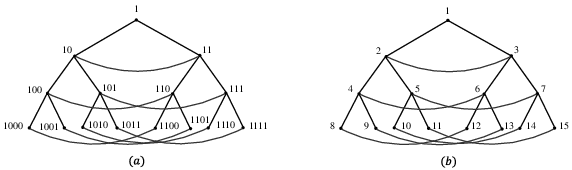 Figure 1
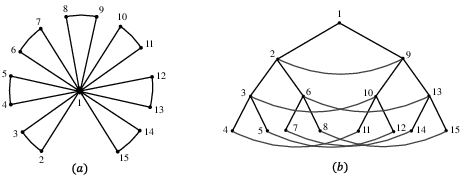 Figure 2
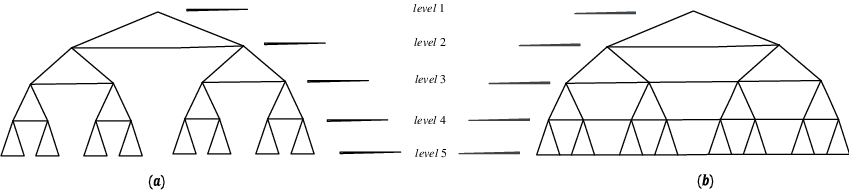 Figure 3
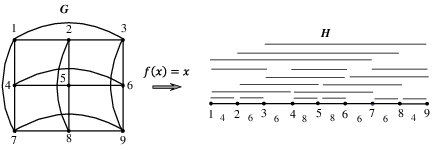 Figure 4
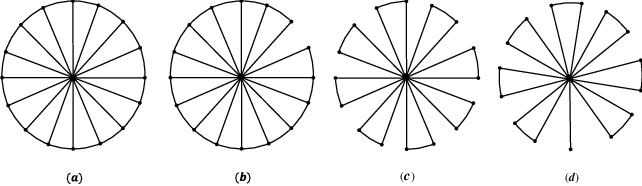 Figure 5
Peer Reviews
No public reviews on file for this paper yet. If you reviewed it on a platform where reviews are public (OpenReview, ICLR, NeurIPS, ICML), you can paste yours below so the community can read it here.
Videos
No videos yet. Explain this paper in a talk, walkthrough, or lecture? Add one.
Taxonomy
TopicsInterconnection Networks and Systems · Embedded Systems Design Techniques · VLSI and FPGA Design Techniques
Embedding onto Wheel-like Networks
R. Sundara Rajan a
T.M. Rajalaxmi b
Sudeep Stephen c
A. Arul Shantrinal a
K. Jagadeesh Kumar a
Abstract
One of the important features of an interconnection network is its ability to efficiently simulate programs or parallel algorithms written for other architectures. Such a simulation problem can be mathematically formulated as a graph embedding problem. In this paper we compute the lower bound for dilation and congestion of embedding onto wheel-like networks. Further, we compute the exact dilation of embedding wheel-like networks into hypertrees, proving that the lower bound obtained is sharp. Again, we compute the exact congestion of embedding windmill graphs into circulant graphs, proving that the lower bound obtained is sharp. Further, we compute the exact wirelength of embedding wheels and fans into 1,2-fault hamiltonian graphs. Using this we estimate the exact wirelength of embedding wheels and fans into circulant graphs, generalized Petersen graphs, augmented cubes, crossed cubes, Möbius cubes, twisted cubes, twisted -cubes, locally twisted cubes, generalized twisted cubes, odd-dimensional cube connected cycle, hierarchical cubic networks, alternating group graphs, arrangement graphs, 3-regular planer hamiltonian graphs, star graphs, generalised matching networks, fully connected cubic networks, tori and 1-fault traceable graphs.
a Department of Mathematics, Hindustan Institute of Technology and Science, Chennai,
India, 603 103
[email protected] [email protected] [email protected]
b Department of Mathematics, SSN College of Engineering, Chennai, India, 603 110
c Department of Computer Science, National University of Singapore, 13 Computing Drive, Singapore 117417
Keywords*:* Embedding, dilation, congestion, wirelength, wheel, fan, friendship graph, star, median, hamiltonian
1 Introduction
Graph embedding is a powerful method in parallel computing that maps a guest network into a host network (usually an interconnection network). A graph embedding has a lot of applications, such as processor allocation, architecture simulation, VLSI chip design, data structures and data representations, networks for parallel computer systems, biological models that deal with visual stimuli, cloning and so on [1, 2, 3, 4].
The performance of an embedding can be evaluated by certain cost criteria, namely the dilation, the edge congestion and the wirelength. The dilation of an embedding is defined as the maximum distance between pairs of vertices of host graph that are images of adjacent vertices of the guest graph. It is a measure for the communication time needed when simulating one network on another. The congestion of an embedding is the maximum number of edges of the guest graph that are embedded on any single edge of the host graph. An embedding with a large congestion faces many problems, such as long communication delay, circuit switching and the existence of different types of uncontrolled noise. The wirelength of an embedding is the sum of the dilations in host graph of edges in guest graph [3, 5].
Ring or path embedding in interconnection networks is closely related to the hamiltonian problem [6–9] which is one of the well known NP-complete problems in graph theory. If an interconnection network has a hamiltonian cycle or a hamiltonian path, ring or linear array can be embedded in this network. Embedding of linear arrays and rings into a faulty interconnection network is one of the central issues in parallel processing. The problem is modeled as finding fault-free paths and cycles of maximum length in the graph [10].
The wheel-like networks plays an important role in the circuit layout and interconnection network designs. Embedding of wheels and fans in interconnection networks is closely related to 1-fault hamiltonian problem. A graph is called -fault hamiltonian if there is a cycle which contains all the non-faulty vertices and contains only non-faulty edges when there are or less faulty vertices and/or edges. Similarly, a graph is called -fault traceable if for each pair of vertices and , there is a path from to which contains all the non-faulty vertices and contains only non-faulty edges when there are or less faulty vertices and/or edges. We note that if a graph is hypohamiltonian, hyperhamiltonian or almost pancyclic then it is 1-fault hamiltonian [11] and it has been well studied in [8, 11, 12].
The rest of the paper is organized as follows: Section 2 gives definitions and other preliminaries. In Section 3, we compute the dilation, congestion and wirelength of embedding onto wheel-like networks. Finally, concluding remarks and future works are given in Section 4.
2 Preliminaries
In this section we give basic definitions and preliminaries related to embedding problems.
Definition 2.1**.**
[13]* Let and be finite graphs. An embedding of into is a pair defined as follows:*
* is a one-to-one map: * 2. 2.
* is a one-to-one map from to is a path in between and for *
By abuse of language we will also refer to an embedding simply by . The expansion of an embedding is the ratio of the number of vertices of to the number of vertices of . In this paper, we consider embeddings with expansion one.
Definition 2.2**.**
[13]* Let be an embedding of into . If , then the length of in is called the dilation of the edge denoted by . Then*
[TABLE]
Definition 2.3**.**
[13]* Let be an embedding of into . For , let denotes the number of edges of such that is in the path between and in . In other words, Then*
[TABLE]
Further, if is any subset of , then we define .
Definition 2.4**.**
[14]* Let be an embedding of into . Then the wirelength of embedding into is given by*
[TABLE]
An illustration for dilation, congestion and wirelength of an embedding torus into a path is given in Fig. 1. The dilation, the congestion, and the wirelength problem are different in the sense that an embedding that gives the minimum dilation need not give the minimum congestion (wirelength) and vice-versa. But, it is interesting to note that, for any embedding , the dilation sum, the congestion sum and the wirelength are all equal.
Graph embeddings have been well studied for a number of networks [1,2, 4–7, 11, 13–34]. Even though there are numerous results and discussions on the wirelength problem, most of them deal with only approximate results and the estimation of lower bounds [13, 18]. But the Congestion Lemma and the Partition Lemma [14] have enabled the computation of exact wirelength for embeddings of various architectures [14, 21, 23, 24, 32, 33]. In fact, the techniques deal with the congestion sum [14] to compute the exact wirelength of graph embeddings. In this paper, we overcome this difficulty by taking non-regular graphs as guest graphs and use dilation-sum to find the exact wirelength.
Definition 2.5**.**
[19, 35]* A wheel graph of order is a graph that contains an outer cycle or rim of order , and for which every vertex in the cycle is connected to one other vertex (which is known as the hub or center). The edges of a wheel which include the hub are called spokes.*
Definition 2.6**.**
[11, 36]* A fan graph of order is a graph that contains a path of order , and for which every vertex in the path is connected to one other vertex (which is known as the core). In other words, a fan graph is obtained from by deleting any one of the outer cycle edges.*
Definition 2.7**.**
[36]* A friendship graph of order is a graph consists of triangles with exactly one common vertex called the hub or center. Alternatively, a friendship graph can be constructed from a wheel by removing every second outer cycle edge.*
Definition 2.8**.**
A windmill graph of order is obtained by deleting a vertex of degree 2 in .
Definition 2.9**.**
[3]* A star graph is the complete bipartite graph .*
Figures 2(a), 2(b), 2(c) and 2(d) illustrate the wheel graph , fan , friendship graph and windmill graph respectively.
Definition 2.10**.**
[37]* The basic skeleton of a hypertree is a complete binary tree , where is the level of a tree. Here the nodes of the tree are numbered as follows: The root node has label 1. The root is said to be at level 1. Labels of left and right children are formed by appending a 0 and 1, respectively, to the label of the parent node, see Fig. 3. The decimal labels of the hypertree in Fig. 3 are depicted in Fig. 3. Here the children of the node are labeled as and . Additional links in a hypertree are horizontal and two nodes in the same level of the tree are joined if their label difference is . We denote an level hypertree as . It has vertices and edges.*
Definition 2.11**.**
[34]* For any non-negative integer , the complete binary tree of height , denoted by , is the binary tree where each internal vertex has exactly two children and all the leaves are at the same level. Clearly, a complete binary tree has levels. Each level , , contains vertices. Thus, has exactly vertices. The sibling tree is obtained from the complete binary tree by adding edges (sibling edges) between left and right children of the same parent node.*
Definition 2.12**.**
The -tree is obtained from the complete binary tree by adding the consequent vertices in each level by an edge.
For illustration, the sibling tree and -tree are given in Figure 4.
Definition 2.13**.**
[22, 38]* The undirected circulant graph , , is a graph with the vertex set and the edge set .*
It is clear that is the undirected cycle and is the complete graph . The cycle contained in , is sometimes referred to as the outer cycle of .
Definition 2.14**.**
[19]* Let be a vertex in . The eccentricity of , denoted by , is . The maximum eccentricity is the graph diameter . That is, . The minimum eccentricity is the graph radius . That is, . For brevity, we denote and as and respectively.*
Notation:
For , let denotes the set of all vertices of at distance from , , where denotes the diameter of .
3 Main Results
In this section we compute the dilation, congestion and wirelength of embedding onto wheel-like networks.
3.1 Dilation
We begin with the following definition.
Definition 3.1**.**
A dominating set in a graph is a set of vertices such that each vertex is either in or is adjacent to a vertex in . The minimum cardinality of a dominating set of is the domination number.
Lemma 3.2**.**
Let be a graph with domination number 1 and be a graph with . Then , where is the radius of .
Proof.
Since the domination number of is 1, there exist a vertex such that . Let be an embedding from to and map . If eccentricity of is minimum, then . Otherwise, . Hence the proof. ∎
Corollary 3.3**.**
Let be a graph with domination number 1 and be a vertex-transitive graph with . Then , where is the diameter of .
We now compute the dilation of embedding wheel-like networks into hypertree and prove that the lower bound obtained in Lemma 3.2 is sharp.
Theorem 3.4**.**
Let be or or or and be a -level hypertree , where . Then , where is the radius of .
Proof.
Since the domination number of is 1 and by Lemma 3.2, we have . We now prove the equality.
Label the vertices of as follows:
- •
hub vertex as ;
- •
outer vertices as consecutively start with any vertex in the clockwise or anti-clockwise direction, see Fig. 5(a).
Removal of the horizontal edges in hypertree leaves a complete binary tree . Label the vertices of using pre-order labeling begin with level 1 vertex, see Fig. 5(b). Let for all and for . Let be a shortest path between and in .
Since the hub vertex with label 1 in is mapped into a vertex in is in level 1 gives the minimum eccentricity of and hence any edge with either or as a hub vertex is mapped into a path in with dilation at most , which is nothing but the radius of .
We now claim that the outer edges of are mapped into a path of length at most in . Since the graph is obtained from , the left and right children of any parent node in level is connected by a path of length 2. By the labeling of pre-order traversal in , for any parent node in level , , the right most vertex of a left node and the right node of a parent node are connected by a path length at most and hence the dilation of any outer edge in is at most in . Hence the proof. ∎
Using the same analog, we prove the following result.
Theorem 3.5**.**
Let be or or or and be a -level sibling tree or -level -tree , where . Then , where is the radius of .
3.2 Congestion
In this section, we first obtain the lower bound for congestion of embedding onto wheel-like networks. Then prove that the lower bound obtained is sharp for embedding windmill graphs into circulant graphs. To prove the main result, we need the following result.
Lemma 3.6**.**
Let be a graph with domination number 1 and be a graph with . Then , where is the maximum degree of .
Proof.
Since the domination number of is 1, there exist a vertex such that , where . Let be an embedding from to and map . Let , then for any ,
[TABLE]
where . Thus, there is at least one edge in with congestion . Further, for any embedding of into , . Therefore,
[TABLE]
Hence the proof. ∎
We now compute the edge congestion of embedding windmill graphs into circulant networks and prove that the lower bound obtained in Lemma 3.6 is sharp.
Theorem 3.7**.**
Let be a windmill graph and be a circulant network , where is large. Then .
Proof.
Since the domination number of is 1 and by Lemma 3.6, . We now prove the equality.
Label the vertices of as follows:
- •
hub vertex as ;
- •
pendent vertex as ;
- •
remaining vertices as consecutively start with any vertex such that are adjacent, where even and .
Label the consecutive vertices of in in the clockwise sense. Let for all and for , let be a shortest path between and in .
Since is vertex transitive, map the hub vertex , which is labeled as 1 in into any vertex in . Without loss of generality, the label of as 1 . Now, we map the edges in into a path in using the following algorithm.
- •
For , let must pass through the outer cycle of in the clockwise direction, where ;
- •
For , let must pass through the outer cycle of in the anti-clockwise direction, where ;
- •
For , let must pass through an edge, which is labelled as followed by the outer cycle of in the clockwise direction, where ;
- •
For , let must pass through an edge, which is labelled as followed by the outer cycle of in the anti-clockwise direction, where .
From the above algorithm, it is easy to see that the edge congestion of each edges in is at most . At this stage, the following edges in are having as the edge congestion and we denote the set by . Now, the remaining edges , and is even in is mapped into a path of length 1 in and it will not contribute the congestion in any of the edges in . Hence the proof. ∎
3.3 Wirelength
We need the following lemma to prove the main result.
Lemma 3.8**.**
Every 2-fault hamiltonian graph on vertices contains a hamiltonian path of length .
Proof.
Let be a 2-fault hamiltonian graph. Then for , contains a hamiltonian cycle of length . Since is connected at least one of or is adjacent to a vertex in . Without loss of generality let . Let in be adjacent to . Now is a hamiltonian path of length in . ∎
Theorem 3.9**.**
Let be a wheel and be a graph with as a median. Then . Equality holds if and only if is hamiltonian.
Proof.
Let be hub of . Map in to in . Since is a median of , , . Suppose is hamiltonian. Map the outer -cycle in to a hamiltonian cycle in . Thus
[TABLE]
Conversely, suppose . If is not hamiltonian, then the cycle in cannot be mapped onto a cycle in , a contradiction. ∎
Proceeding in the same way, we have the following result.
Theorem 3.10**.**
Let be a fan and be a graph with as a median. Then . Equality holds if and only if contains a hamiltonian path.
4 Concluding Remarks
The host graphs in Theorem 3.9 and Theorem 3.10 cover a wide range of graphs. This has motivate us to identify interconnection networks which fall into this category:
[TABLE]
Acknowledgment
The work of R. Sundara Rajan was partially supported by Project no. ECR/2016/1993, Science and Engineering Research Board (SERB), Department of Science and Technology (DST), Government of India. Further, we thank Prof. N. Parthiban, School of Computing Sciences and Engineering, SRM Institute of Science and Technology, Chennai, India for his fruitful suggestions.
The reference list from the paper itself. Each links out to its DOI / PubMed record.
- 1[1] J. Fan, X. Lin and X. Jia, Optimal path embedding in crossed cubes , IEEE Transactions on Parallel and Distributed Systems, Vol. 16, no. 12, 1190-1200, 2005.
- 2[2] C.-N. Kuo and Y.-H. Cheng, Cycles embedding in folded hypercubes with conditionally faulty vertices , Discrete Applied Mathematics, Vol. 220, 55–59, 2017.
- 3[3] J.M. Xu, Topological Structure and Analysis of Interconnection Networks , Network theory and applications, Vol. 7, Springer Science & Business Media, 2013.
- 4[4] R.S. Rajan, T.M. Rajalaxmi, J.B. Liu and G. Sethuraman, Wirelength of embedding complete multipartite graphs into certain graphs , Discrete Applied Mathematics, 2018. https://doi.org/10.1016/j.dam.2018.05.034
- 5[5] Y.L. Lai and K. Williams, A survey of solved problems and applications on bandwidth, edgesum, and profile of graphs , Journal of Graph Theory, Vol. 31, 75–94, 1999.
- 6[6] T.-J. Lin, S.-Y. Hsieh and J.S.-T. Juan, Embedding cycles and paths in product networks and their applications to multiprocessor systems , IEEE Transactions on Parallel and Distributed Systems, Vol. 23, no. 6, 1081–1089, 2012.
- 7[7] M. Liu and H. Liu, Paths and cycles embedding on faulty enhanced hypercube networks , Acta Mathematica Scientia, Vol. 33, no. 1, 227–246, 2013.
- 8[8] C. Chen, C.H. Tsai, L.H. Hsu and J.M. Tan, Pn some super fault-tolerant hamiltonian graphs , Applied Mathematics and Computation, Vol. 148, no. 3, 729–741, 2004.